Founder & CEO at Abnormal AI. I tweet about AI, sci fi, and cybersecurity.
Joined October 2007
- Tweets 979
- Following 687
- Followers 1,829
- Likes 9,811
250 Photos and videos




Jun 13
I drove past a billboard on the highway with a picture of a man that said “IYKYK” with no other context. Great example of poor customer empathy and lack of first principles thinking. Feels like many companies are losing the script in the AI era
1
2
109
Jun 13
The #1 cybercrime in the world isn’t a software exploit: it’s social engineering. The most effective way to “hack” a human or an AI is to manipulate a trusted identity into doing untrusted things. As AI scales, that’s the real threat surface. It’s what we built @Abnormal to stop.
57
Jun 4
Turns out science fiction was a very good source for startup ideas
1
7
268
Jun 1
In the AI era of cybersecurity human-only defense is dead
Autonomous AI agents working at machine speed are the required table stakes to play
Behavioral context is the defender’s superpower to win
3
142
May 29
Using Claude dynamic workflows with opus 4.8 with a fresh token quota…
6
259
May 21
Someone asked me what actually earns trust in enterprise sales, from years of CISO conversations:
Intellectual honesty is the foundation. We don't let awkwardness get in the way of finding what's true. The CEOs who tell customers "last quarter wasn't good, we screwed up in five ways" build more trust than the ones who recite the comfortable version.
Show up hardest when things go wrong. The top 10 CISOs that trust us the most are all on the list of our biggest mistakes. When we screwed up and showed up anyway, customers leaned in harder, not away.
Decade-long partnerships beat quarterly transactions. Your first year with us is a proof of value of the partnership, not just the product. Different math than a vendor optimizing for short term profits.
Curiosity-led discovery, not pitch-led. CISOs can tell the difference between "I'm trying to learn" and "I'm running a discovery question to sell you something." The first one earns time. The second one burns it.
Same side of the table. The best customers describe us as an extension of their team. The bank CISO who insisted we share his threat intel with his competitors had it right: if the bank across the street gets hacked, his stock goes down too.
Ambition paired with humility. Without the humility, the ambition reads as posturing. Without the ambition, the humility reads as small thinking. You need both.
4
172
May 20
An AI just made a novel contribution to an 80y/o open problem in math
The narrative that AI helps with science but can't invent is getting harder to defend
We are entering a golden era of discovery, and today's models are the kindergarten version of what's coming
3
1
16
599
May 20

Today, we share a breakthrough on the planar unit distance problem, a famous open question first posed by Paul Erdős in 1946.
For nearly 80 years, mathematicians believed the best possible solutions looked roughly like square grids.
An OpenAI model has now disproved that belief, discovering an entirely new family of constructions that performs better.
This marks the first time AI has autonomously solved a prominent open problem central to a field of mathematics.
1
2
193
May 18
Last week, @Abnormal launched Transforming in Public. Employees across every function sharing how they use AI to reimagine how they work. Seeing builders across the company step up like this only makes me more excited and confident about the team we have.
A lot of companies say they're transforming with AI. Fewer are willing to show it. We built Abnormal for people who want to find out what they're actually capable of when everyone around them is building at the same level.
abnormal.ai/transform
1
11
321
May 14
Every company faces a choice: transform for real, or perform transformation theater.
Today, we’re launching Transformation in Public, where you can see real examples of AI Transformation across @Abnormal. The employees featured on abnormal.ai/transform aren’t just engineers. They’re builders across every function, using AI to reimagine how they work. To name a few:
• Sales reps are deploying agents that qualify leads and run outbound
• Product managers who turn technical code into content for automated, real-time product updates for customers
• Recruiters are surfacing candidates that traditional talent sourcing tools and processes miss
Every Abnormal employee, regardless of role, gets access to the best AI tools available and the enablement to actually use them well. We believe the highest-ROI investment we can make is in our own people's ability to build with AI. The work you see on the site is what happens when you take that commitment seriously.
We're sharing it externally for two reasons.
The first is accountability. Customers trust us to keep them safe as threats accelerate. Employees trust us to give them the AI fluency that will define their careers. The industry is watching for what AI transformation looks like in practice. Sharing the work openly is how we stay accountable to all of them.
The second is recruiting. Every CEO talks a big game about AI Transformation, but examples of real execution are few and far between. At Abnormal, we build. The work is the pitch; Transforming in Public is the proof. Every story we share is an asset that compounds, and the people who see themselves in it are exactly the builders we want to work with.
Abnormal isn't for everyone. We're not the place to come for a comfortable seat. We're the place you come to see what you're capable of as a builder, surrounded by other people doing the same. If this sounds exciting to you, consider joining us.
abnormal.ai/transform
2
7
979
May 13
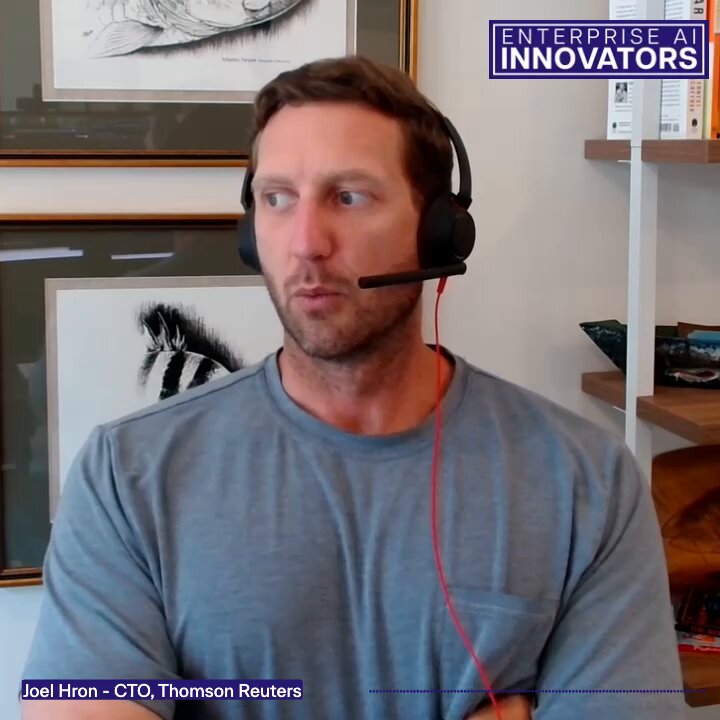
New episode of Enterprise AI Innovators features @JoelHron, CTO of @thomsonreuters, a 150 year old company and the world's largest legal software provider, with massive tax and compliance businesses.
Three takeaways from our conversation:
1) One of Joel's engineers told him, "Something really changed when 50% of our code was being written by AI." The engineer stopped being the primary contributor to the codebase and became its controller and governor. Joel calls this the shift from "copilot to colleague."
2) Thomson Reuters built AI agents that take a stack of W-2s and 1099s, apply the tax law, and compute a complete return. The tax professional's job shifts from pulling numbers off documents to advising clients. Fewer people are taking the CPA every year. AI is filling the gap.
3) AI has made Joel more hands-on as a CTO, not less. With 5,000 engineers and 100 products, it was impossible for him to ever look at anyone's code. Now he can clone a repo and spend an hour with Claude or Codex before a meeting, and actually show up with real technical grounding.
Full episode here: enterprisesoftware.blog/cio-…
2
155
Apr 29
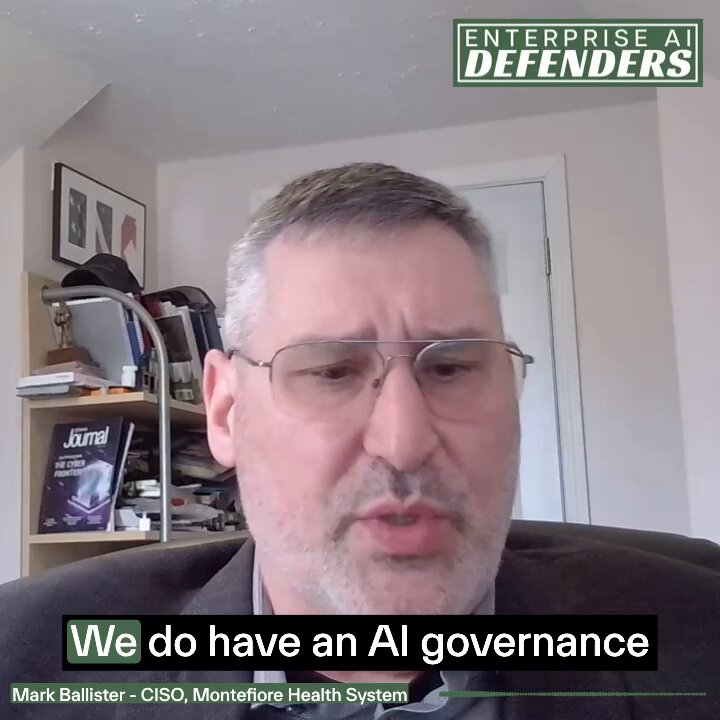
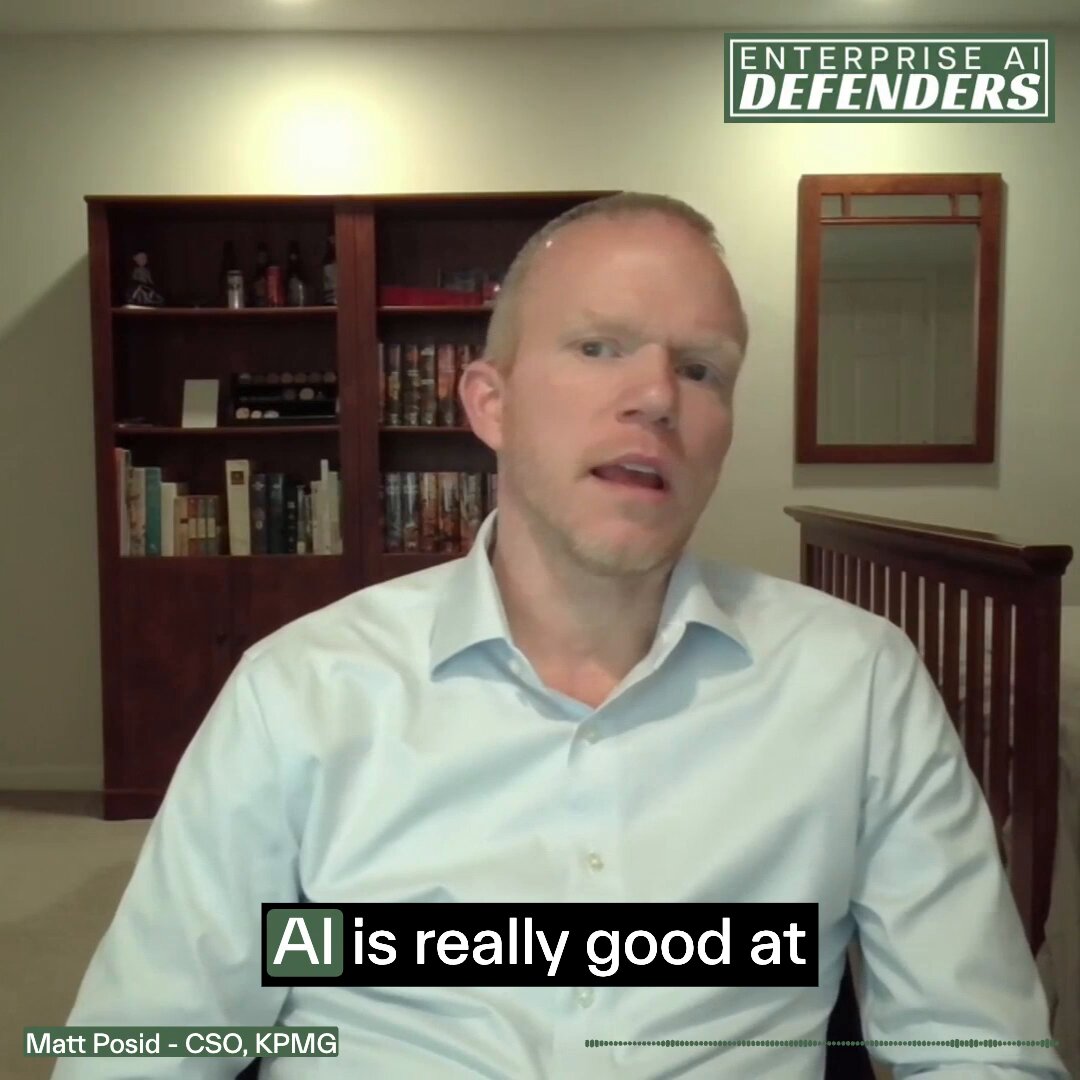
New episode of Enterprise AI Defenders features Mark Ballister, CISO at @MontefioreNYC. 10 hospitals, 50,000 employees, 10,000 physicians. His framing: "We're not doing this to build a world-class security organization. We are looking to build a really good security organization that supports a world-class hospital."
A few highlights from our conversation:
1) Most people are overlooking this: Microsoft Copilot has a "work" and "web" toggle. In work mode, your data stays behind guardrails. One click to web mode and those protections vanish. Your information gets indexed, gets exposed. Threat actors already have tools designed to exploit this gap.
2) Mark's team defaults to "yes, with controls" instead of "no." They deployed a splash page on unapproved AI sites to map usage before moving to blocking. They also added ROI analysis to the review process. His point: everybody thinks an AI tool will help them. The keyword is "thinks." The cost doesn't always back it up.
3) The AI workforce shift is already happening inside his own security team. They built a custom model that ingests architecture review requirements and generates risk evaluations. 22,000 lines of AI-generated code. Passed static and dynamic analysis with minor tweaks.
Full episode here: enterprisesoftware.blog/ciso…
2
213
Apr 22
What it feels like when you realize how to fully use AI to do your job
3
226
Apr 22
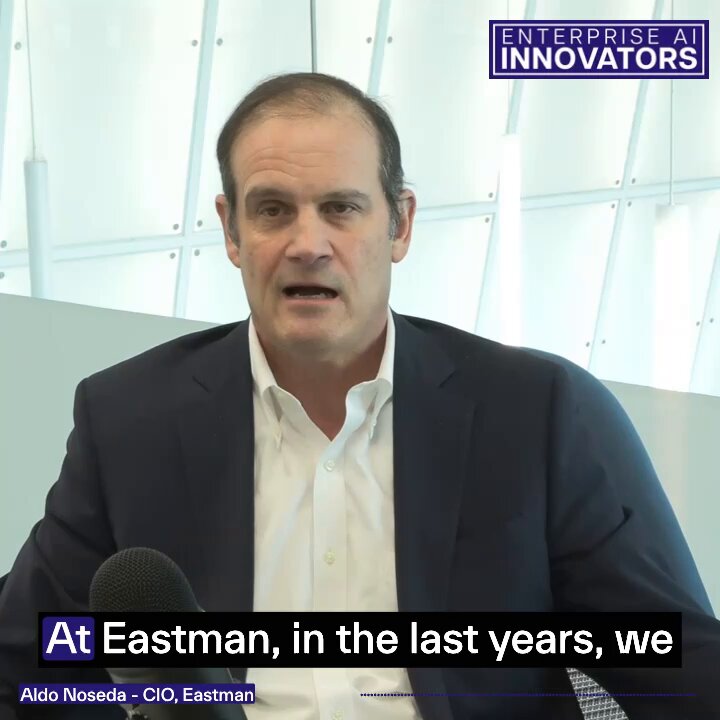
New episode of Enterprise AI Innovators features Aldo Noseda, CIO at @EastmanChemCo. Eastman is a $10 billion specialty chemicals company with over 100 years of history. Every function is getting rewired with AI.
Three takeaways from our conversation:
1) Eastman built an AI product called Fluid Genius that predicts when thermal fluid in a customer's plant will degrade. Customers plug in sampling data and get a prediction of when to plan maintenance. AI packaged as a service, not an internal experiment.
2) They deployed what Aldo calls "AI for the masses." 6,000 recurring users on an internal engine wrapped with security and company customization. Programmers went from 5,000 lines of code per month to 40,000 using AI agents. They stood up an AI powered IT help desk in two weeks. A capability that used to take two months to build, they just built in 10 minutes.
3) On risk: "If you're creating a coaching opportunity for sales, you can take some risk. If you are opening or closing a valve in the manufacturing plant, you better have the answer right." In chemicals, AI hallucination is a safety issue. Risk tolerance has to be situational.
Full episode here: enterprisesoftware.blog/cio-…
227
Apr 8
New episode of Enterprise AI Innovators features Steve Chase, who runs AI globally at @KPMG. 250,000 people across tax, consulting, and deal advisory. Every client conversation now starts with "tell me how we're going to do this with AI."
Three highlights from our conversation:
1) KPMG tried teaching AI as a standalone course. Adoption was flat. When they embedded training directly into workflows, adoption went through the roof. Context changed everything.
2) Steve is pushing decisions to the edge. His words: "Slow decision making terrorizes teams. A no is a gift. A yes is a gift. But 'let me get back to you' grinds everything to a halt." His plan: rewrite the org charts. Rewrite how work gets done.
3) On where this is heading: "Process thinking is a construct for human minds. That wouldn't necessarily be the way agents think."
Full episode here: enterprisesoftware.blog/cio-…
1
235
Apr 7
I've been building AI-native teams at @Abnormal for the past few years. The hardest part isn't the technology. It's realizing which of your organizational assumptions are now wrong.
I'm starting a series about this. AI × Transformation. Each article takes a specific "best practice" that's governed how organizations build, hire, and communicate for decades, and asks: does AI break this? What are the 2nd and 3rd order consequences?
The first piece is The Projection Problem. Why smart teams ship the wrong product, and what AI changes about it. Human communication is lossy compression. Great ideas get silently distorted at every handoff. AI gives us new techniques to close that gap and build better products faster.
If you're a builder, executive, or investor trying to figure out how AI changes the way organizations should actually operate, this is what I'm writing about.
evanreiser.com/blog/transfor…

4
2,062
Apr 6
Prompt engineering is dumb. You dont need more than a few sentences to get people/AI to understand/do the right things IF they have sufficient context.
The key is context engineering. Figuring out: what are the perfect 800k tokens to give Opus for a genius answer?
2
219
Apr 4
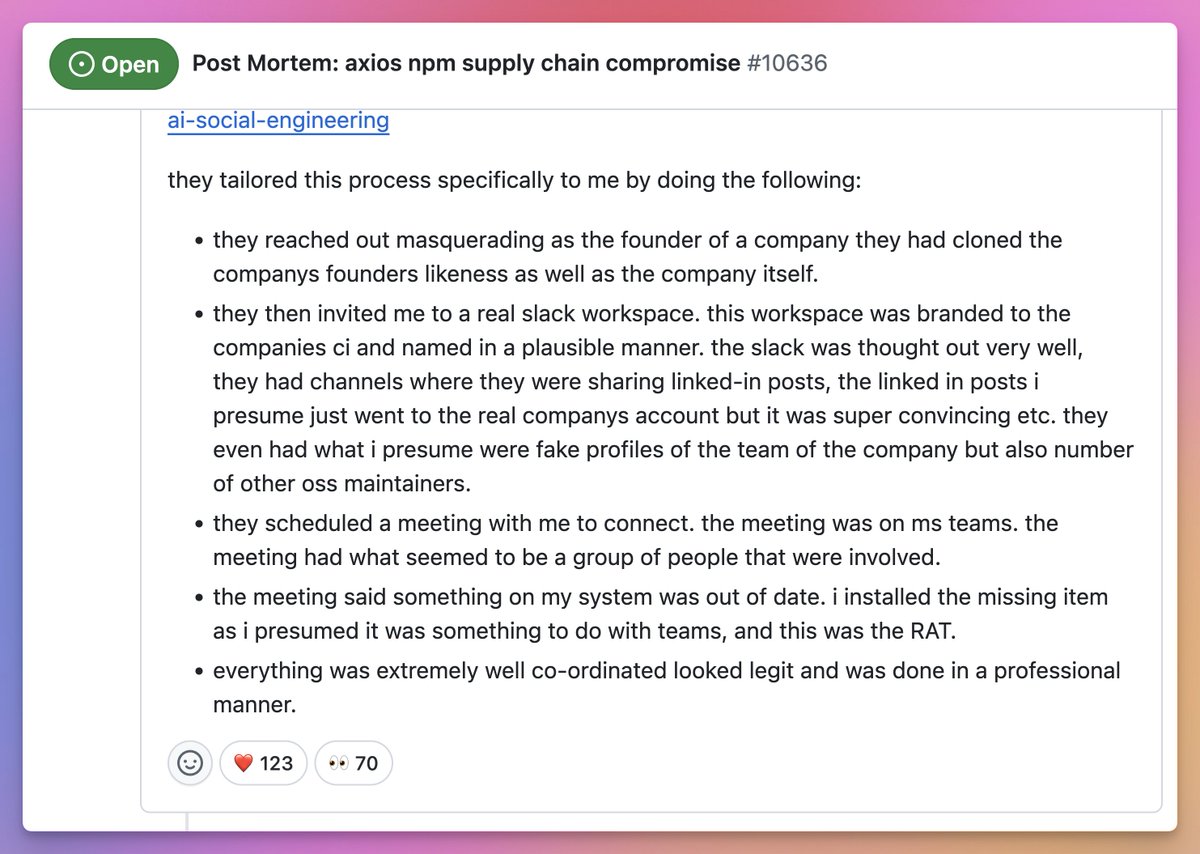
Attackers built a fake company, cloned a founder’s identity, and compromised Axios through social engineering.
Now imagine AI doing this a thousand times a day, personalized to every target.

1
4
684
Apr 3
Imagine you’re in 1950 trying to explain what an influencer is. You can’t. The conceptual foundation and mental models don’t exist. Social media, internet, computer, etc
That’s where we are with the AI cyber attacks coming. So alien, so rooted in a world we can’t yet imagine, that our current frameworks and technologies can’t defend against them.
The only solution is to use AI to compress the security problem to product lifecycle from 24 months to 24 hours. That’s the only security paradigm that survives what’s coming in the age of AI
1
97