
A modular Layer-0 infrastructure for DePIN that brings verifiable compute resources to any blockchain.
Joined November 2024
- Tweets 108
- Following 163
- Followers 8,713
- Likes 20
34 Photos and videos










Pinned Tweet

6 Nov 2025
📢 | IMPORTANT ANNOUNCEMENT – EXEOS IS EVOLVING | ⚡
Hey @everyone 👋
Exeos is entering its next chapter. 🚀
We’re excited to share that we’re evolving into a fully decentralized protocol designed to better serve our mission and empower our community long-term.
70
28
71
7,556
6 Nov 2025
📢 | IMPORTANT ANNOUNCEMENT – EXEOS IS EVOLVING | ⚡
Hey @everyone 👋
Exeos is entering its next chapter. 🚀
We’re excited to share that we’re evolving into a fully decentralized protocol designed to better serve our mission and empower our community long-term.
70
28
71
7,556
6 Nov 2025
This is just the beginning of what we’re building together.
Thank you for your trust, support, and for running with us from day one. ⚡
2
12
3,870
6 Nov 2025
More details, previews, and timelines will be announced soon.
Let’s keep building the future—together.
— Team Exeos 💜
2
1
16
4,033
Exeos Network retweeted

30 Jul 2025
An irreverent cohort of new DePIN entrepreneurs are ruffling feathers with a bold strategy: build revenue-generating businesses before launching tokens.
While many will take to the streets to protest this vile repudiation of the status quo, just stick with me.
Whereas DePIN 1.0 was defined primarily by token emissions, DePIN 2.0 will be defined by a return to real business fundamentals: product-market fit, unit economics, CAC, revenue, cash flows.
That “DePIN tokens are down” is actually not a valid incrimination of anything. Alts are down and DePIN has lost the sexy bid.
But this was always destined to happen. DePIN is actually the least sexy, and in the long run will be the most fundamentally priced sector. The most successful DePIN projects will feel unsexy because they’ll operate like infrastructure. They’ll deliver fundamental resources with the reliability of a utility.
But, in time, some DePIN tokens will rise from the ashes. And those tokens belong to the platforms that are good businesses today and will become great businesses due to their surgical deployment of a token and even more surgical accrual of value to that token.
I think DePIN 2.0 - The Business Generation - broadly looks like this:
1. Teams first figure out what works, and what doesn’t work before releasing the beast
2. They always generate substantial revenue before releasing the token
3. Rather than “order hardware and deploy anywhere”, incentivized build-out is a) phased b) tightly mapped against revenue scaling units (typically by geography)
4. The token’s purpose is simple and easy to understand for deployers, investors, and speculators
5. Token sinks are more abundant than token faucets
6. The primary token sink is revenue accrual
7. Emissions schedules are adaptive, not fixed from t=0
8. Apps are built without tokens, infrastructure to support the app is built with tokens
Decentralization enables key properties that truly global systems require: censorship resistance, capital formation, and the ability to permisionlessly build applications on top. We’ve spent too much time navel gazing about complex token incentives models and pursuing “decentralization” as if it’s some holy principle.
Nobody cares about decentralization in and of itself. What we need to care about is building generational companies, that grow every year, and generate a lot of cash.
29
28
218
25,470
14 Jul 2025
DePINs need a chain that rewards real hardware, not just capital. Exeos does that with hybrid Proof-of-Stake Proof-of-Resource: nodes stake tokens and prove bandwidth/compute, binding security to useful work.
636
1,346
4,633
51,573
14 Jul 2025
Faster everything — video calls, gaming, AI chat. Apps can route through Exeos’ global mesh of volunteer nodes for lower lag and fresh bandwidth.
11
39
473
17,536
14 Jul 2025
Privacy on by default. The same mesh works like a decentralized VPN, helping you unblock sites and keep snoops out wherever you live.
4
34
375
15,043
4 Jul 2025
🚀 The Age of AI is here, and Exeos is right on time.
DePIN keeps AI infrastructure open and inclusive—rewarding global hardware contributors and empowering developers everywhere.
Join us in shaping a democratic AI future. 🌐🤖
68
83
321
14,145
22 Jun 2025
🚧 Heads-up: We’re upgrading infrastructure & integrating the mobile app. Services will be down briefly. Thanks for your patience—faster, more reliable, cross-device goodness is on the way! 🙏🔧
23
27
193
22,066
17 Jun 2025
Exeos’ new website is live. Explore our infrastructure-app platform as we evolve into the AI-ready layer of DePIN. Product updates soon.
🔗exeos.network/
67
58
225
25,080
Exeos Network retweeted

11 Jun 2025
Who will control AI in the future — big, centralized companies, or communities of users?
Blockchains can counterbalance many of the centralizing forces we’re already seeing in AI.
Together these trends enable useful applications.
Here are 11 crypto x AI use cases, from decentralized physical infrastructure to IP registries for creators.
→ a16zcrypto.com/posts/article…
189
117
634
132,882
5 Jun 2025
🚀 DePIN is how we untether telecom, energy & mobility from 20th-century monopolies.
Dive into this talk on verifiable physical infra and see how Exeos adds zk-proof fuel to keep providers honest. 📽️👇 #DePIN #Web3 #Exeos
youtube.com/watch?v=rUYgce4R…
57
51
133
14,143
Exeos Network retweeted

20 May 2025
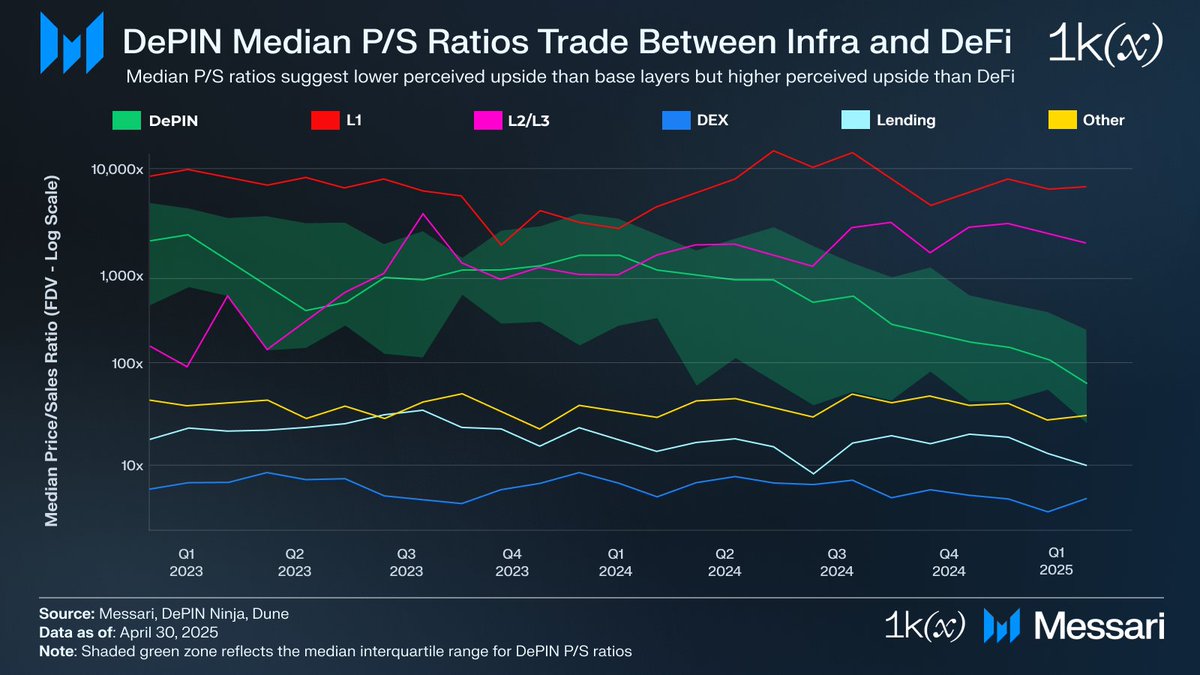
High valuations in digital assets? Where to look for value? Turns out the only sector in digital assets where 𝐏𝐫𝐢𝐜𝐞-𝐭𝐨-𝐒𝐚𝐥𝐞𝐬 (𝐏/𝐒) 𝐫𝐚𝐭𝐢𝐨𝐬 𝐡𝐚𝐯𝐞 𝐛𝐞𝐜𝐨𝐦𝐞 𝐦𝐨𝐫𝐞 𝐚𝐭𝐭𝐫𝐚𝐜𝐭𝐢𝐯𝐞 lately is Decentralized Physical Infrastructure Networks (DePINs).
Why this trend?
DePINs have experienced a combination of 𝐝𝐞𝐜𝐥𝐢𝐧𝐢𝐧𝐠 𝐟𝐮𝐥𝐥𝐲 𝐝𝐢𝐥𝐮𝐭𝐞𝐝 𝐯𝐚𝐥𝐮𝐚𝐭𝐢𝐨𝐧𝐬 (𝐅𝐃𝐕𝐬) 𝐚𝐥𝐨𝐧𝐠𝐬𝐢𝐝𝐞 𝐬𝐭𝐞𝐚𝐝𝐲 𝐫𝐞𝐯𝐞𝐧𝐮𝐞 𝐠𝐫𝐨𝐰𝐭𝐡, resulting in a compression of P/S ratios over the past years.
Where is the contrast?
This trend is in contrast to other major crypto sectors like base infrastructure (L1, L2s, and L3s) and decentralized finance (DeFi):
- 𝐇𝐢𝐠𝐡𝐞𝐫 𝐏/𝐒 𝐫𝐚𝐭𝐢𝐨𝐬: 𝐛𝐚𝐬𝐞 𝐢𝐧𝐟𝐫𝐚𝐬𝐭𝐫𝐮𝐜𝐭𝐮𝐫𝐞 (L1, L2s, and L3s)
- 𝐋𝐨𝐰𝐞𝐫 𝐏/𝐒 𝐫𝐚𝐭𝐢𝐨𝐬: 𝐃𝐞𝐅𝐢, including perpetual protocols, decentralized exchanges (DEXs), lending platforms, and agent-based and liquid staking protocols.
Based on transaction fee revenues, 𝐏/𝐒 𝐫𝐚𝐭𝐢𝐨𝐬 𝐟𝐨𝐫 𝐛𝐚𝐬𝐞 𝐢𝐧𝐟𝐫𝐚𝐬𝐭𝐫𝐮𝐜𝐭𝐮𝐫𝐞 𝐧𝐞𝐭𝐰𝐨𝐫𝐤𝐬 (𝐋𝟏, 𝐋𝟐, 𝐚𝐧𝐝 𝐋𝟑), 𝐃𝐄𝐗𝐬 𝐚𝐧𝐝 𝐥𝐞𝐧𝐝𝐢𝐧𝐠 𝐩𝐫𝐨𝐭𝐨𝐜𝐨𝐥𝐬 𝐡𝐚𝐯𝐞 𝐡𝐞𝐥𝐝 𝐬𝐭𝐞𝐚𝐝𝐲, reflecting the relative re-rating of DePINs within the broader market.
Read my full analysis w/ @KoschigRobert of @1kxnetwork and @dylangbane of @MessariCrypto
👇
messari.io/report/depin-toke…
3
9
85
5,894
20 May 2025
Phase 2 of our Android APK testing is now live—exclusively for our Discord community.
If you’re ready to help shape the next release, join the server, download the build and share your insights.
Your feedback drives us forward. 👾🔗
#BetaTesting#DePIN
86
37
94
9,225