
Signal, Image, Channel.
Joined July 2022
- Tweets 8,112
- Following 208
- Followers 119
- Likes 22,132
301 Photos and videos









Fhotek retweeted

Jun 13
Some thought:
1) The Anthropic fiascos is a self-inflicted wound and likely a payback.
2) I spent the night helping many clients off of Anthropic and moving to local open source models and many very large clients will NEVER go back. This has absolutely advantaged open source model from China.
3) This situation NO MATTER WHAT permanently damaged the Anthropic IPO.
4) At 3AM last night I helped a client team move a massive account off of all Anthropic products. This was worth millions of dollars per month and this was the last straw.
5) The fall of Anthropic should not be applauded by anyone. The fall of the company should be viewed as an injury to All US AI COMPANIES.
6) The Anthropic fiasco is not a technical issue, it is a LEADERSHIP issue. If it is not fixed the company is cooked.
7) By the time we end this summer no matter how good Anthropic is, they lose customers, they lose key employees and they ultimately will lose the race.
It was a sad day on top of a massively great day with the SpaceX IPO and one reason I did not post last night.
Dario asked to be regulated, begged to be regulated and yelled to be regulated…
NOW HE IS REGULATED.
You like it now Dario?
Jun 13

Unprecedented.
@BrianRoemmele warned everyone for the past two years that the government would take away our AI.
That day just arrived.
Was talking with an entrepreneur in San Francisco who was running Fable to build software and just turned it off while it was building.
Tomorrow night Anthropic is throwing a Fable builders event in San Francisco. I wonder if that event is still going to happen?
This hurts American national security. I know of several companies that were using Mythos to close all of their security holes because it is so powerful at finding weaknesses in software. That effort has not been completed, so there are many companies with many holes still open now.
This throws that effort into question. It also means that China is emboldened because, you know, can you trust an American company to keep their systems up and running if the government is willing to shut them down so abruptly and with no warning?
It also means that open source and running models on your own computers is now very attractive (if it wasn't already). Expect Apple Mac Studio sales to go up.
80
83
462
50,304
Fhotek retweeted

Jun 13
Anthropic Deputy CISO Jason Clinton earlier this week:
"I suspect that we have ~7 to 10 months before open weights models have this capability. And when that happens, we will have the roughest, most difficult time in our careers that we've had as cybersecurity folks. That will happen for approximately I would guess 18 months."
Jun 13

Anthropic Deputy CISO Jason Clinton earlier this week: Advanced coding models inevitably develop powerful cybersecurity capabilities as a byproduct.
"...the most important thing to remember about Mythos is that it was not intended to be a cyber model. It was entirely an accident that this emerged. And I think that's really important for us to think about for strategically as leaders, in cybersecurity, anyone who's making a model to be good at coding is going to trip over cyber capability in the process of doing that. It just comes along for the ride. If it's good at coding, and the model is good at cyber, but it's also good at reverse engineering binaries or pulling apart firmware blobs and doing things that you need to do for software engineering, which in turn helps with the cyber capability"
4
30
212
98,480

The US is a Kakistocracy.
Jun 13

What timeline are we on man.
There’s a $60 million UFC cage on the White House lawn for the president’s 80th birthday. 125,000 guests. 494 port-a-potties. He compared it to the Eiffel Tower and said maybe they’ll never take it down.
The world’s first trillionaire was minted yesterday. SpaceX IPO. One person now holds more wealth than the GDP of most countries.
The government is negotiating to own a piece of OpenAI. The CEO walked into the White House and pitched it himself. They’re calling it a Public Wealth Fund.
That same government killed OpenAI’s biggest competitor’s models on a Friday night. The reason? A verbal jailbreak claim from an unnamed company. The same jailbreak works on OpenAI’s models. Nobody touched them.
The competitor got blacklisted by the Pentagon four months ago. Their crime? Refusing to let the military use their AI for mass surveillance of American citizens. A judge called it retaliation. The Pentagon did it anyway.
Both AI companies filed to go public in the same two-week window. Both targeting trillion-dollar valuations. One has a government equity deal in progress. The other can’t keep its products online.
The engineers who built the banned models can’t use them anymore. Because of their passports.
And an AI company that spent thousands of hours cooperating with government safety testing got punished harder than any company that didn’t bother.
UFC on the White House lawn. A trillionaire. Government-owned AI. Export controls based on phone calls. Cage fights and trillion-dollar IPOs in the same news cycle.
Watch the film titled Idiocracy. That’s the timeline we’re on.
15
Fhotek retweeted

😭
Jun 13

According to Grok, Andrej Karpathy is an EB-1 extraordinary ability green card recipient, not a US citizen. Thus under these new restrictions he is not permitted to use, or work on, Mythos 5 or Fable 5 as of 5:21pm tonight.
2
10
55
4,454
You cant make this stuff up...unbelievable.
Jun 12

META MOVES TO LIMIT EMPLOYEE AI USAGE AS COSTS REACH BILLIONS
5
98
Fhotek retweeted

Jun 12
I had an interesting dialog with Fable 5 on how the foundation model labs turn a profit. Here was the conclusion.
Fable: My honest bottom line, with my conflict of interest restated plainly: the original question — "how do the labs turn a profit?" — has, after pricing everything, a stark answer. On the current cost trajectory and capital structure, they don't, in any conventional sense. Conventional profitability would require a macroeconomic miracle delivered on a loan officer's timetable. The investment is rational only as a race: either machine intelligence starts improving itself fast enough to dissolve the cost curve before the interest comes due, or this is the largest, most productive misallocation of capital since the railroads — real infrastructure, real technology, ruined balance sheets.
Sharing the entire conversation. Your mileage may vary, but interesting nonetheless.
13
13
200
64,249
Fhotek retweeted

Jun 11
if you think data centers in space are a good idea, you are exit liquidity.
106
69
934
84,549
Fhotek retweeted
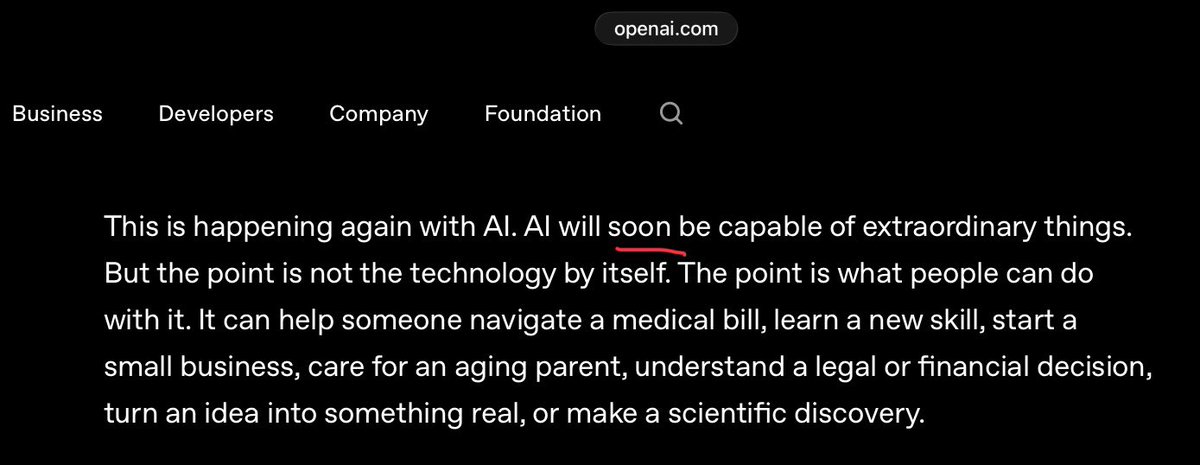
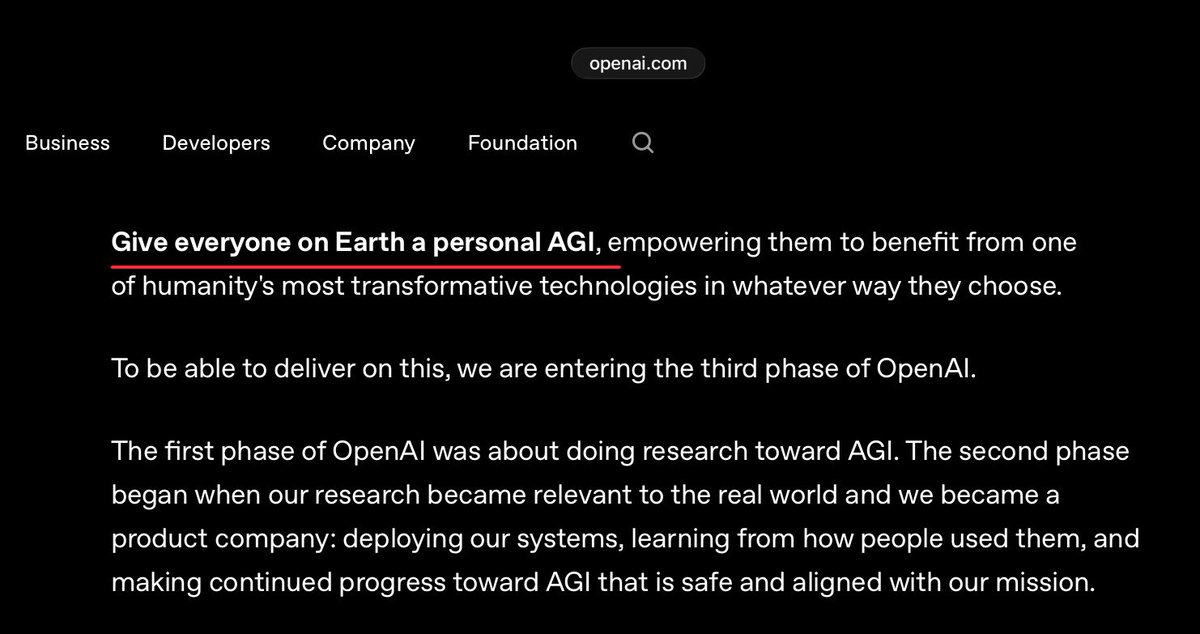
OpenAI is a disaster. Employees are leaving it in droves because they have no plan and no clue what their product is even for.
It will “soon be capable of extraordinary things” is the same line we’ve been hearing for 5 years. No, it won’t. It compresses large datasets and lets you query it with language. It’s a fuzzy search engine. It’s a software feature. It’s not going to sprout consciousness.
The goal of giving everyone a “personal AGI” is horrifying.
If a technology is ever actually developed that has true general intelligence, then you are describing a kind of master-slave relationship.
In the real world, this is marketing drivel designed to present a slot machine as the future of mankind—because the VCs need retail for liquidity.
What a joke.

Jun 8

The north stars we're working towards at OpenAI all center around the mission: ensure AGI benefits all of humanity. AI should expand human agency, not make people less consequential to the future.
openai.com/index/built-to-be…
40
314
1,252
109,037
Fhotek retweeted

Jun 7
guy who sells tokens says solution to all your problems is to spend more tokens
Jun 7

Here’s your monthly reminder that you shouldn’t be prompting coding agents anymore.
You should be designing loops that prompt your agents.
70
85
2,444
68,461

Once the bubble pops, Anthropic and OpenAI will become the Coinbase and Block of the AI world. Mundane companies that ship narrative wrappers on mundane bytes.
That the bubble will pop isn’t some apocalyptic doomsday prophecy. It’s not that complicated: AI is freakishly expensive to serve. If the returns on the other end are not justified, the bubble pops. And thus begins the decades long buildout to actually economically justifiable AI.
It’s amusing how resistant reality is to our fictions and fantasies. In the peak of the crypto bubble we thought reality was going to be transformed into financial liberty and democratization for all, and network states and decentralized reserve currencies. Coinbase stood to be a multi-trillion dollar company and is now just a mundane tech startup.
Today we spin similar narratives about the intellectual upheaval of AI, about the new democratization of intelligence and how everything will soon begin to orbit this new technology.
At the end, Anthropic and OpenAI will be mundane IT providers with an insanely grim research outlook to make AI economically sensible and useful, no different from Google’s position in trying to make quantum commercially viable.
Reality is, fortunately, pretty hardened against our delusions.
330
245
2,575
211,597

Premium Newsletter: The Hater's Guide To The AI Bubble 3.0, a massive guide to how the AI bubble inflated, big tech's failed AI plays, how NVIDIA findom'd every hyperscaler, and how the ROI debate is fatal to OpenAI and Anthropic.
wheresyoured.at/premium-the-…
9
81
442
84,483
Fhotek retweeted

Jun 5
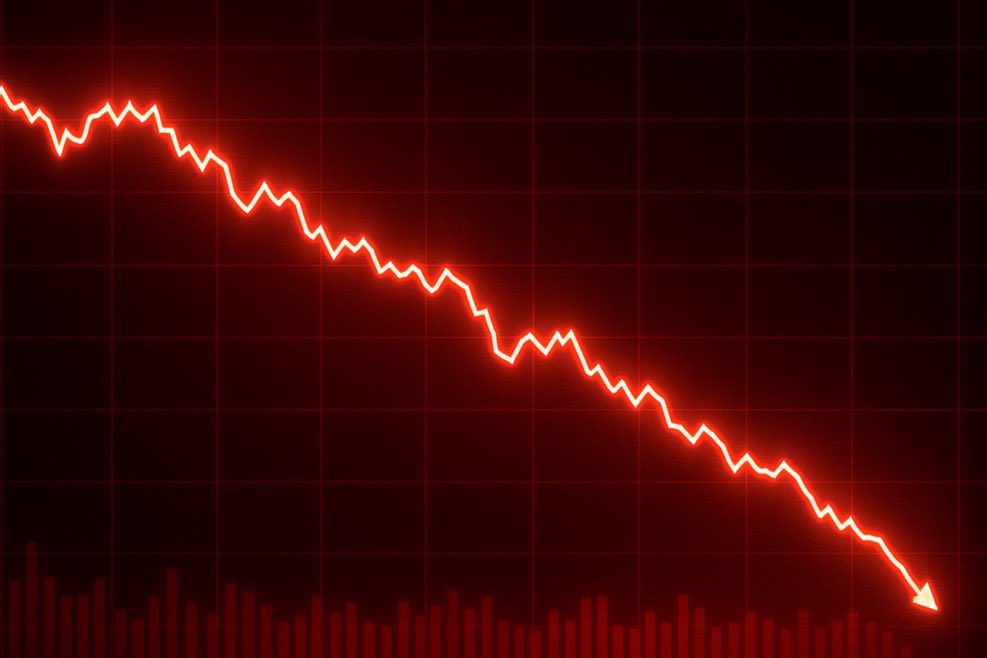
🚨 EVERYTHING THAT COULD GO WRONG FOR MARKETS WENT WRONG TODAY.
S&P 500 down -1.65%, wiping out $1.14 trillion.
Nasdaq down -2.60%, wiping out $1.11 trillion.
Gold down -3.38%, wiping out $1 trillion.
Silver down -6.9%, wiping out $280 billion.
Bitcoin down -6.31%, wiping out $80 billion.
In total $2.5 TRILLION wiped out in a single session. These were not isolated moves. Everything started breaking at the same time.
It started with the jobs report this morning.
The US economy added 172,000 jobs in May. Wall Street expected 88,000. That is almost double.
On any normal day, strong jobs is good news. But inflation is already at 3.8% and oil is sitting at $90. A labor market this strong tells the Fed it cannot cut interest rates and may actually need to raise them.
The probability of a rate hike this year went from 40% to 57% in a single day. That spooked every investor holding tech and growth stocks because higher rates mean those stocks are worth less today.
Then the AI trade started cracking.
Yesterday Broadcom reported record earnings: revenue up 48%, AI chip sales up 143% and the stock still crashed 12.6%. The reason was simple.
Broadcom did not raise its AI revenue targets for the year. Investors had expected it to. That single miss made people ask a question they had been avoiding for months: are we paying too much for AI stocks?
That question got louder today when a research firm called SemiAnalysis revealed that Nvidia's next-generation AI chips will need significantly less memory than everyone assumed, roughly half of what the market was pricing in.
Memory chips are what companies like SK Hynix and Samsung make. SK Hynix fell nearly 10% today. Samsung fell over 6%.
South Korea's entire stock market crashed 5.5% in a single session. Japan's semiconductor stocks did the same.
And then Anthropic added fuel to the fire by publishing a report warning that AI is getting close to the point where it can improve itself without human help and calling for a global pause in AI development.
Coming on the same day as the memory demand news and Broadcom's miss, it fed a single growing fear across the market: what if the AI boom is moving faster than the business models can keep up with?
Underneath all of this, there is a liquidity problem nobody is talking about.
SpaceX goes public next week at a $1.75 trillion valuation. Anthropic just filed to go public. OpenAI is next.
These three companies together are worth $4 to $5 trillion. Fund managers need cash to buy into these listings.
But cash levels are already at their lowest since early 2024. The only way to raise cash is to sell what they already own. That selling is happening right now.
The new Fed Chair Kevin Warsh will also hold his very first policy meeting in 11 days. He was appointed by Trump with the expectation of cutting rates.
He is now walking into a situation where inflation is high, oil is high, and the job market is running hot. Investors do not know what he will do.
When nobody knows what the most powerful central banker in the world will decide in less than two weeks, the safest move is to reduce risk today.
Everything that could go wrong, went wrong at the same time. A hot jobs report, a collapsing ceasefire, a crack in the AI trade, a trillion dollar liquidity drain, and a Fed meeting with no clear outcome.



337
1,317
6,196
770,233
Fhotek retweeted

Jun 5
SpaceX IPO is loading.
But this isn’t a listing.
This is the most carefully engineered insider exit Wall Street has ever signed off on.
A full breakdown — including what Morgan Stanley’s own 132-page model missed 🧵
11
80
478
88,503
Exactly right.

The AI Bubble is being driven by the fantasy that AI can replace human labour cost effectively. It can’t. The cost of compute is too high. Semiconductors are too expensive. GPU’s, CPU’s, even a commodity like NAND flash memory. Power is too expensive. Water is too scarce. Key metals are too expensive. It’s cheaper for humans to do the work than burning tokens using Claude Code or OpenAI Codex. The layoffs were premature. Humans are cheaper than compute.
1
21
Correct on all counts.
Jun 2

Been a management consultant for 20 years.
Made Partner in my 30s.
Led teams of 100 people.
Run 9-figure client portfolios.
Lived and worked in 4 continents.
Typically, corporate IT investment would follow a common script.
Capital spent on software means a shrinking payroll.
As boards map out their strategies for the coming quarters, they are operating under the comfortable assumption that this way of thinking still holds true for AI.
But I think a fiscal reckoning is brewing there, because within the next few quarters, the current prevailing narrative of AI as a headcount killer (which we all know is vastly exaggerated) will give way to a far more punishing reality.
Instead of a clean capital-for-labor swap, executives are about to watch their IT infrastructure costs and their personnel expenses balloon simultaneously 🚀🚀🚀
It may not be fun.
First, this whole idea that generative AI can operate autonomously will shatter as early deployments attempt to scale.
Because LLMs remain inherently prone to hallucination and error, companies cannot simply fire the analysts; they will be forced to retain them (or hire new talent) to serve as high-vigilance editors.
Furthermore, because AI makes it effortless to generate code, reports, marketing collateral, etc etc organizations will soon find themselves drowning in internal output. Managing, auditing, and securing this massive influx of AI-generated material will require an unprecedented wave of human oversight....
This will ultimately EXPAND corporate bureaucracy rather than trimming it (remember the 'Scaled Agile' saga??).
Even in scenarios where entry-level automation does succeed, the math of headcount reduction will fail to balance out on the ledger.
In the coming quarters, the wage differential of the AI era will trigger *severe* skill inflation.
Replacing 5 mid/entry-level programmers does not result in a net savings of 5 salaries. Instead, it requires hiring a premium-tier AI architect whose single salary frequently eclipses the combined wages of the workers they replaced (plus tokens cost).
Companies will trade high-volume/low-cost labor for scarce/ultra-premium talent, driving TCO UPWARD despite a leaner organizational chart on paper.
Jevons' Paradox again...
AI slashes the time and cost required to draft a legal brief, design a graphic, build a software feature, and therefore executive appetite for those outputs will skyrocket.
Management will demand 10x the volume of data analysis or continuous product iterations. Because the corporate demand for output will scale far faster than the technology's efficiency gains, departments will find themselves forced to expand their human teams just to handle the sheer velocity of these new AI-driven initiatives.
Until AI achieves absolute, unmonitored autonomy (if ever), it will function not as a replacement for human labor, but as a hyper-amplifier of it.
If ungoverned, the corporate balance sheets will show that the AI boom made running the business vastly more expensive.
1
43
Fhotek retweeted

Jun 2
we are being gaslit about AI on a societal level. Everybody is vibe coding but I haven’t seen one useful thing get produced. Everybody has agents doing something but nothing useful is getting done. Cool you had AI summarize a PDF and make a template. Nice
257
122
1,736
197,466
Fhotek retweeted

May 30
"If the Strait of Hormuz doesn’t open by August, there may be a risk of a recession rivaling the great financial crisis," per Bloomberg
317
944
7,700
933,601
Automate your way to boundless productivity and zero demand...
May 30

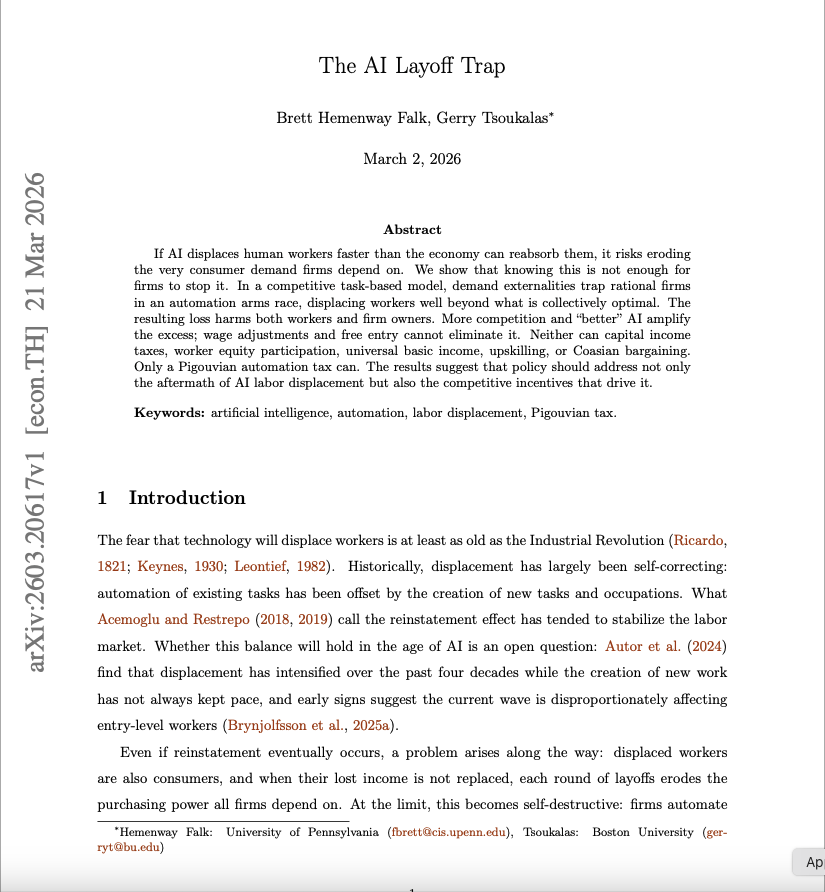
Two economists just published a mathematical proof that AI will destroy the economy.
Not might. Not could. Will — if nothing changes.
The paper is called "The AI Layoff Trap." Published March 2, 2026. Wharton School, University of Pennsylvania. Boston University. Peer reviewed. Mathematically modeled.
The conclusion is one sentence.
"At the limit, firms automate their way to boundless productivity and zero demand."
An economy that produces everything. And sells it to nobody.
Here is how you get there.
A company fires 500 workers and replaces them with AI. A competitor fires 700 to keep up. Another fires 1,000. Every company is behaving rationally. Every company is following the incentives correctly. And every company is building a trap for itself.
Because the workers who were fired were also customers.
When they lose their jobs faster than the economy can absorb them, they stop spending. Consumer demand falls. Companies respond by cutting costs — which means automating more workers — which means less spending — which means more falling demand — which means more automation.
The loop has no natural exit.
The researchers tested every proposed solution. Universal basic income. Capital income taxes. Worker equity participation. Upskilling programs. Corporate coordination agreements.
Every single one failed in the model.
The only intervention that worked: a Pigouvian automation tax — a per-task levy charged every time a company replaces a human with AI, forcing them to price in the demand they are destroying before they pull the trigger.
No government has implemented this. No major economy is seriously discussing it.
Meanwhile the numbers are already tracking the curve. 100,000 tech workers laid off in 2025. 92,000 more in the first months of 2026. Jack Dorsey fired half of Block's workforce and said publicly: "Within the next year, the majority of companies will reach the same conclusion."
Nobody is doing anything wrong. Companies are following their incentives perfectly. That is exactly the problem.
Rational behavior. At scale. Simultaneously. With no mechanism to stop it.
Two economists built the math. The math leads to one place.
Source: Falk & Tsoukalas · Wharton School Boston University ·
24
Nailed it.
May 29

It even worse.
The old VC move was as it was because the cost of servicing an additional customer was negligible, nearly zero, and that customer strengthened network effects and drew in even more customers. Operating costs were minimal, so advertising (or other) revenue scaled greatly once you got big enough.
None of this is the case with LLMs as is. Each new customer costs as much as the first customer to service; costs go up directly with usage. And those customers interact with the software, not each other, so there are no/minimal network effects (and thus negligible switching costs).
It's a disastrous business model. These companies are all betting on the come, that some miracle use case will just emerge.
13
Fhotek retweeted

May 28
NEW: Amazon has reportedly scrapped its internal AI leaderboard as costs soared, with a senior executive telling staff: “don’t use AI just for the sake of using AI.”
459
1,772
21,240
9,092,521