
Joined June 2019
- Tweets 5,025
- Following 5,790
- Followers 6,529
- Likes 4,736
272 Photos and videos

BuildAI | base.eth.ink✨🌊 retweeted

Most of my timeline is chasing low-conviction plays while missing the biggest infrastructure shift this cycle.
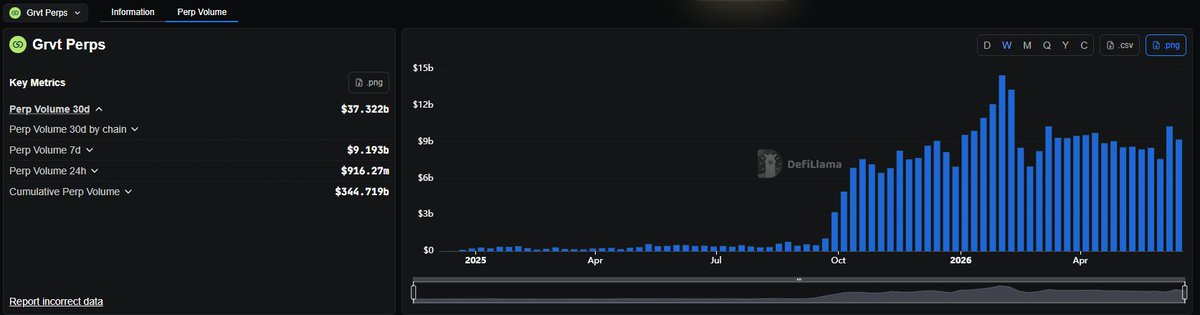
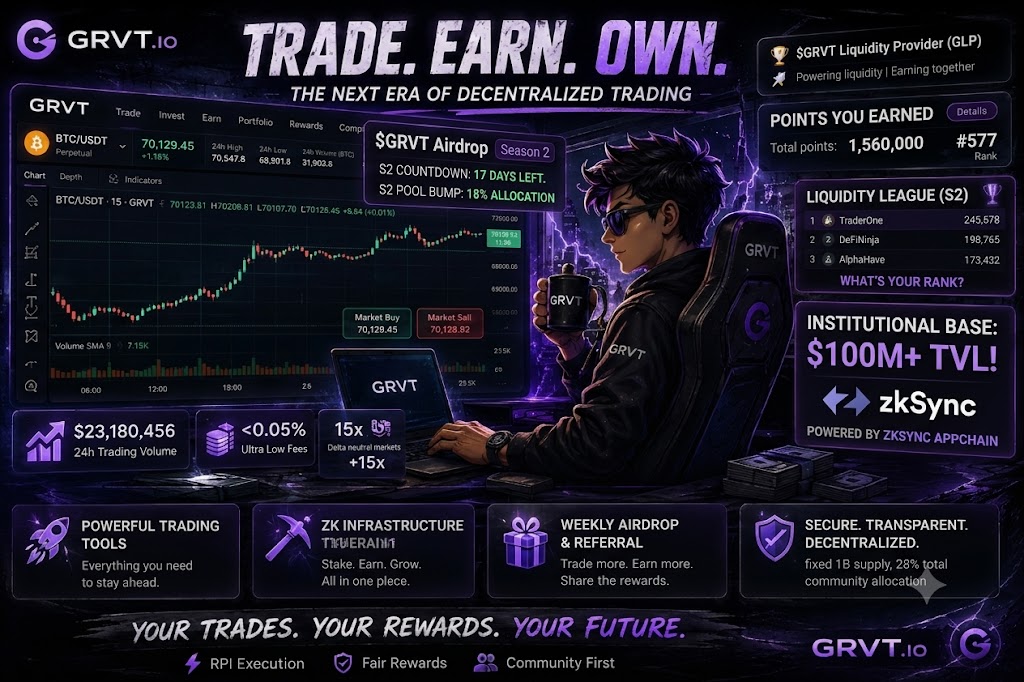
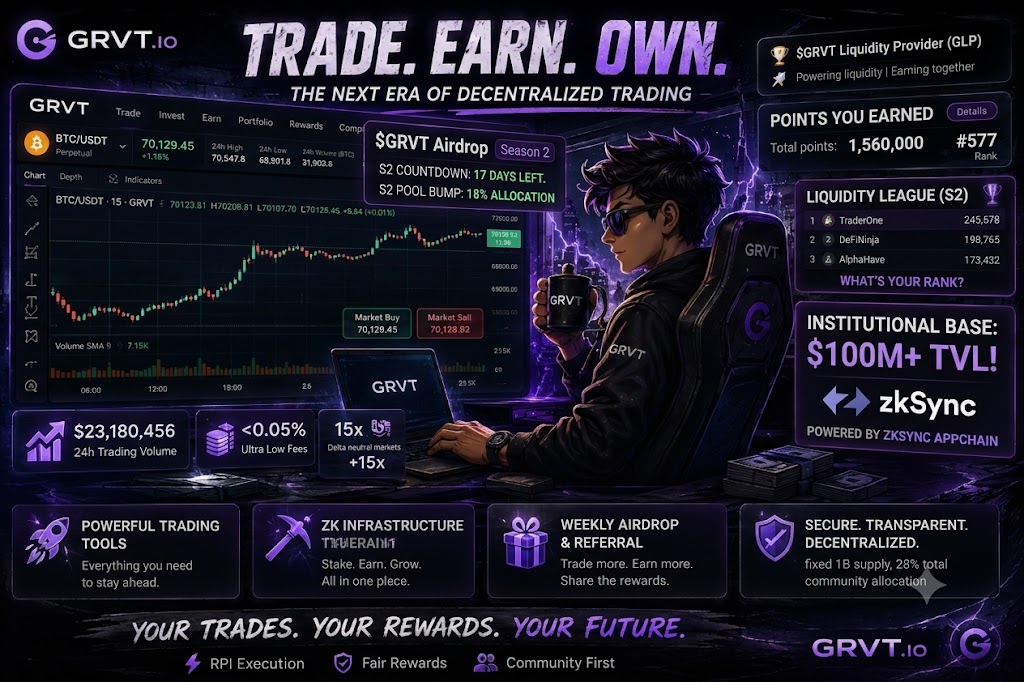
@grvt_io is closing Season 2 on June 30th. They're launching a hybrid exchange that brings self-custody to high-frequency execution on ethereum:0x66a5cfb2e9c529f14fe6364ad1075df3a649c0a5
With the community allocation confirmed at 28%, you have roughly two weeks to scale your points. Stop sleeping on real tech. #GRVT #Season2 #ZKInfrastructure
1
1
1
130
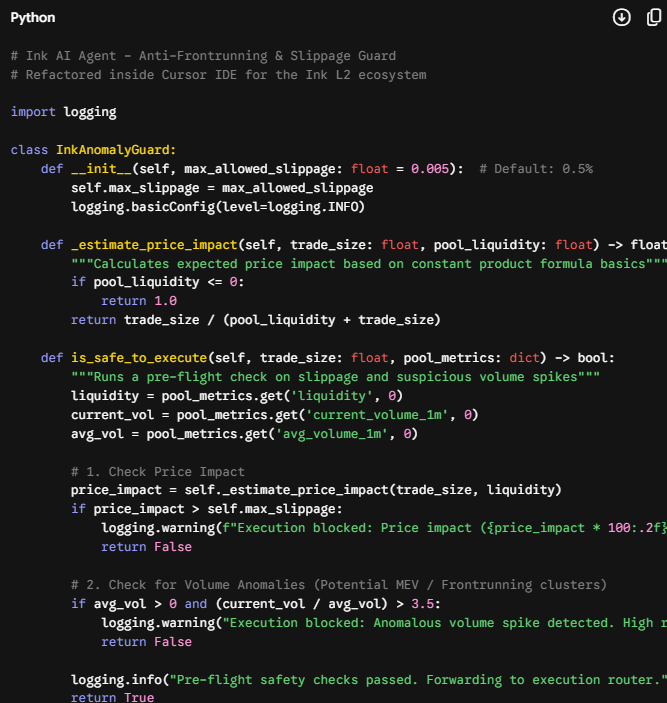
Picking up right where we left off: we promised to secure our @inkonchain AI Agent against frontrunning, MEV, and sudden slippage spikes. On an L2 like Ink, transactions are lightning-fast and cheap, but low-liquidity pools can still suffer from massive price impact if the agent blindly triggers a rebalance during a volume spike.
Inside Cursor, we just shipped the Slippage & Anomaly Guard module. This layer acts as a circuit breaker right before the agent signs the transaction.
Here is the updated implementation fresh out of the IDE: 👇
Deep Dive: Why This Matters for an Autonomous Agent
Dynamic Price Impact Math: Instead of relying on hardcoded slippage tolerances on Dex routers (which can still result in reverted txs and wasted gas), the agent calculates the price impact locally first based on live pool depth.
The 3.5x Volume Filter: If the current 1-minute volume is 3.5 times higher than the moving average, it usually means one of two things: a whale dump or an active MEV bot sandwiching users. Our agent chooses to sit this block out, protecting its capital.
Gas Efficiency: By failing early in Python rather than letting the EVM revert the transaction onchain, we save the agent's wallet from death by a thousand micro-gas fees.
Next up on the roadmap: Connecting this guard directly to our InkAgentAllocator from the last post, so the agent can automatically route trades to alternative pools if its primary target gets flagged as unsafe.
How strict should we make the anomaly filter? Should we make the volume spike threshold dynamic based on the time of day, or keep it fixed at a strict multiplier?
1
30
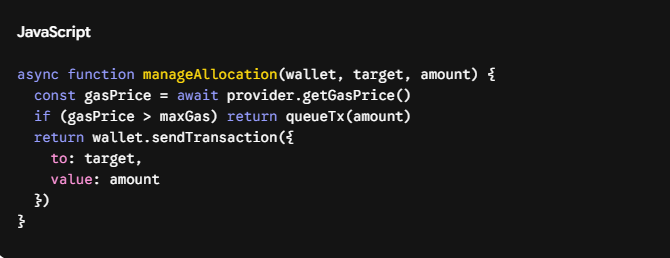
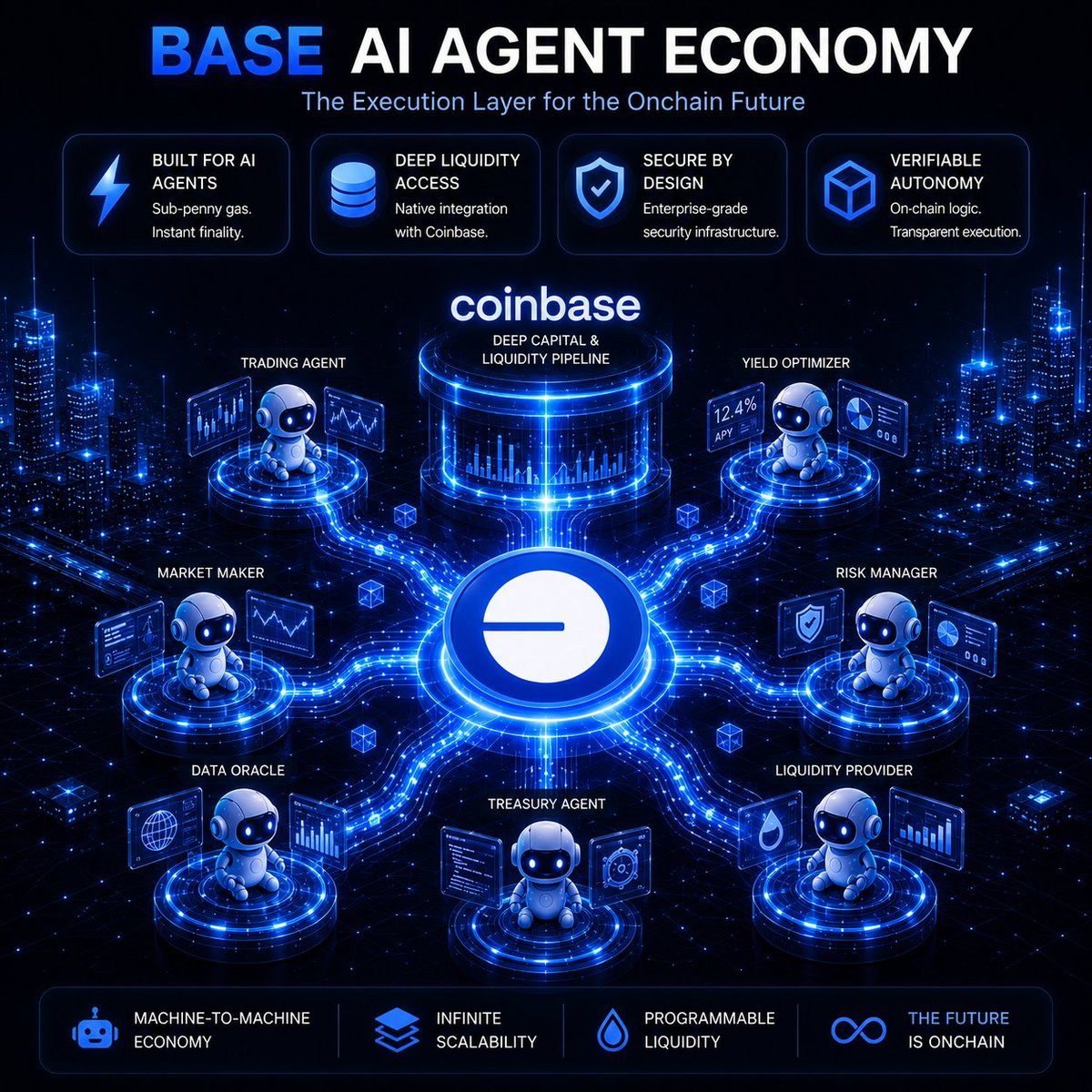
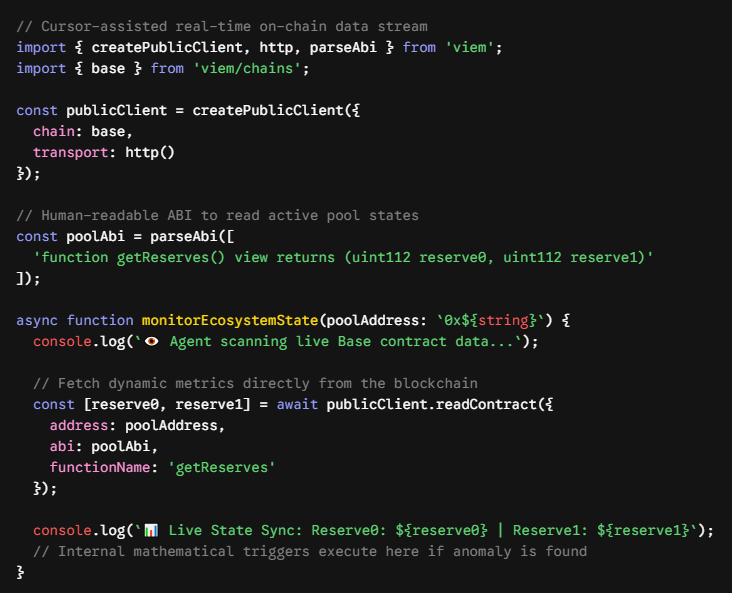
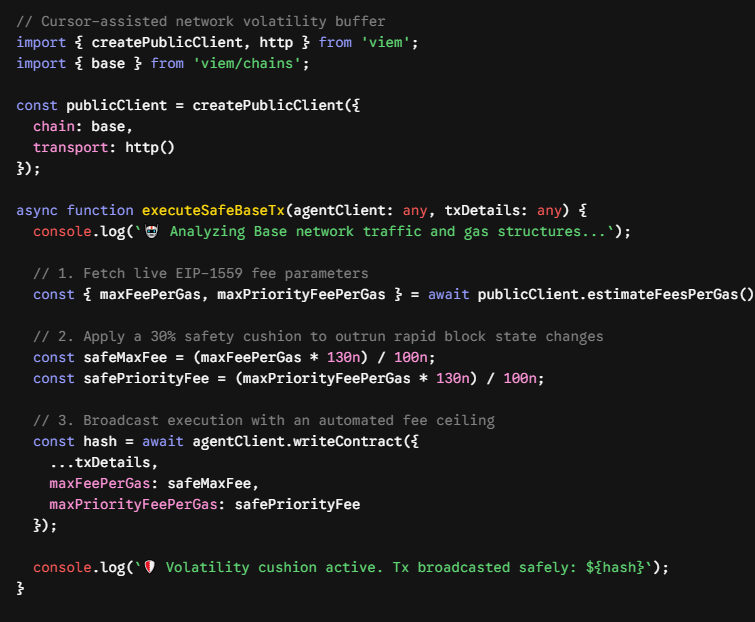
Teaching my autonomous agent to manage dynamic allocation on @base is finally working smoothly. I just updated the wallet logic in Cursor to adjust resource deployment based on real time network congestion. The agent checks the network status before executing any contract interactions to prevent failed operations.
Here is the core logic snippet from my editor 👇
This approach eliminates manual friction completely and keeps the agent fully autonomous. How are you handling automated resource management in your own builds? Drop your thoughts below.
#Base #BaseAI


1
73
Nice reminder that consistency compounds.
Season 3 is already underway, so I'm sticking to the routine:
• Daily tasks
• @sodex_official trading
• Staying active in the ecosystem
Small actions repeated over time tend to matter more than most people think.
@SoSoValueCrypto
15
Most of my timeline is chasing low-conviction plays while missing the biggest infrastructure shift this cycle.
@grvt_io is closing Season 2 on June 30th. They're launching a hybrid exchange that brings self-custody to high-frequency execution on ethereum:0x66a5cfb2e9c529f14fe6364ad1075df3a649c0a5
With the community allocation confirmed at 28%, you have roughly two weeks to scale your points. Stop sleeping on real tech. #GRVT #Season2 #ZKInfrastructure

📈GRVT keeps firing on all cylinders
@grvt_io continues to expand its market lineup adding major Tech names like Anthropic, IBM, Dell, Salesforce and more to the platform.
x.com/grvt_io/status/2064627…
2
130
BuildAI | base.eth.ink✨🌊 retweeted

Jun 15
a peaceful mind changes everything
the energy hits different, the grind feels lighter, and the results speak louder
I pray we all experience peace this new week🕊️🙏

28
3
33
398
BuildAI | base.eth.ink✨🌊 retweeted
Building my Notion dashboard to track L2 flows, and the data is absurd.
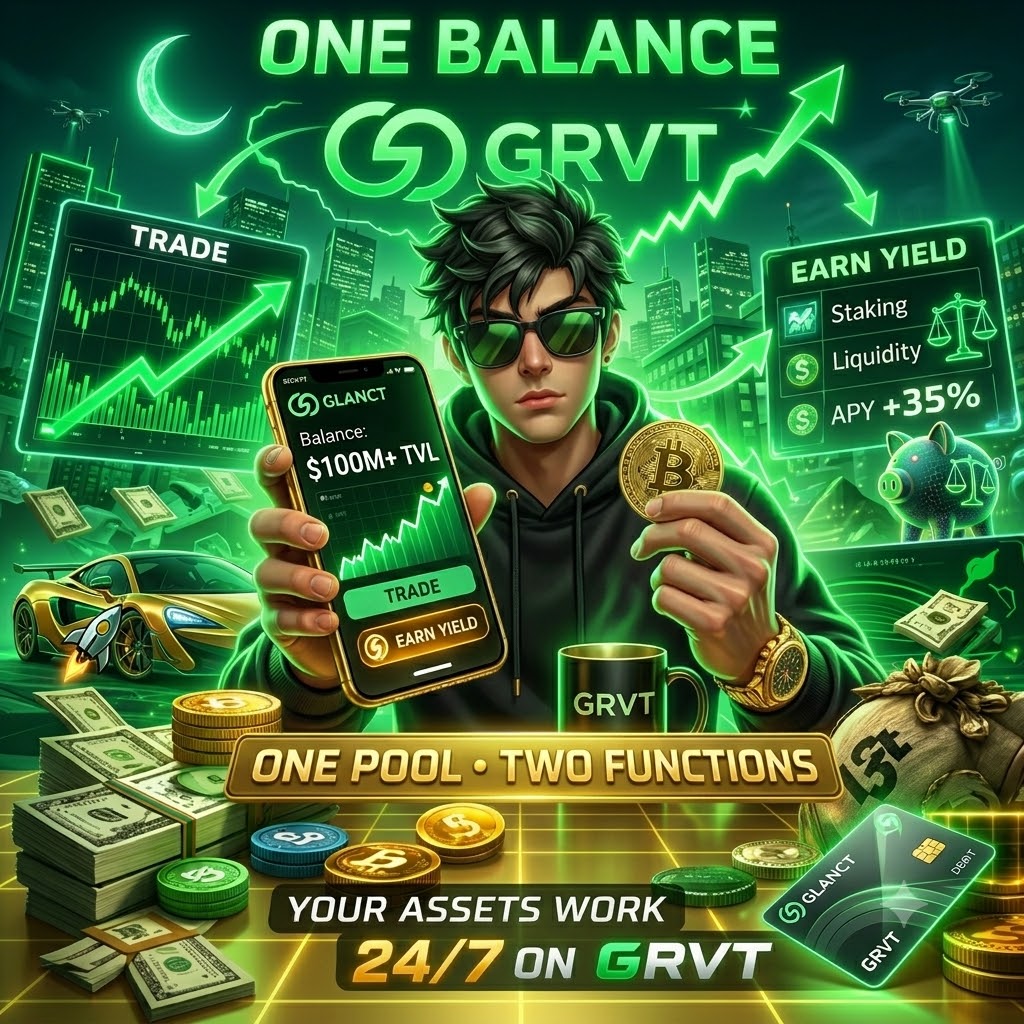
Institutional money is quietly parking capital on the @grvt_io custom @zkSync appchain - they just crossed $100M TVL. Their isolated margin and Aave yield integration is a massive unlock for capital efficiency.
Season 2 ends June 30th. S2 allocations bumped to 18%. Maxing out my points while the window is open. #GRVT #Season2 #ZKInfrastructure
1
2
2
164
BuildAI | base.eth.ink✨🌊 retweeted
Spun up a quick script in Cursor to calculate the volume needed to hit the top tiers for @grvt_io
The math is incredibly clear. Season 2 ends exactly on June 30th. Total community airdrop is boosted to 28% out of a fixed 1B supply. ZK infra powering a hybrid orderbook is the endgame for on-chain execution.
Stop fading actual builders. Time is running out.
#GRVT #Season2
1
1
2
224
Summary of the Article: "Don't Write Prompts. Design Loops."
The article discusses a major shift in AI interaction heading into 2026, introducing the concept of Loop Engineering as the successor to traditional Prompt Engineering. Based on Anthropic's recent internal experiments and new tools (like Claude Code and Managed Agents), the author explains why the standard way of writing prompts is becoming obsolete.
Here are the key takeaways from my review of the article:
The Core Problem: In traditional prompting, the human acts as the bottleneck (writing a prompt, reviewing the output, correcting it, and writing another prompt). The agent doesn't learn between these attempts.
The Solution (Loop Engineering): Instead of just giving an AI instructions, you give it a verifiable goal. The agent then runs autonomously through a 5-stage feedback loop: Discover → Plan → Execute → Verify → Iterate. It repeats this cycle until the goal is strictly met.
The Golden Rule of Verification: Models are notoriously bad at grading their own work. The article emphasizes Anthropic's approach of using an independent "verifier sub-agent" (a separate model instance) that judges whether the work meets a pre-defined rubric or test suite. The loop doesn't stop until this independent judge approves.
The Power of Memory: Looking at Anthropic's benchmarking tests, newer models (like Fable 5) outperform older ones because they handle memory effectively. They don't just log errors; they investigate them, turn them into hard rules in a standalone file (e.g., MEMORY.md), and consult these rules in future sessions.
How to Build a Loop: The author provides a practical workflow using tools like Claude Code's /goal command. It requires setting a strictly measurable objective (e.g., "all tests pass and lint is clean" rather than "make the code better"), providing structural context (ARCHITECTURE.md, RULES.md), and setting a safety iteration limit.
Practical Use Cases: The article outlines four distinct frameworks where loops can be applied today: coding automation, deep research/fact-checking, content creation (with a critic agent), and automated sales prospecting.
Conclusion: The skill gap in 2026 is widening between Prompt Engineers, who manually review every output, and Loop Engineers, who design automated feedback systems where the environment itself validates the work. The main takeaway is that a reliable autonomous loop is far more valuable than a thousand perfect prompts.

1
1
3
161
I walk around the city like that too. AI is giving you a good opportunity to make money now, don't miss it, bro.
May 11

Most people see a street. He sees $300-600 per block.
A 24-year-old from Chengdu figured out that every hotel, every apartment, every commercial space within walking distance is an untapped asset. One nobody has packaged yet.
He straps a rig to his back, walks in, spends twenty minutes scanning the space, and leaves with a file that lets anyone on earth stand inside that room from their couch.
The client pastes a link on their booking page. Guests tour the property before they arrive. Cancellations drop. Reviews go up.
He gets paid $400 for the scan. $99 every month for hosting.
The technology: 3D Gaussian Splatting. Free on GitHub since 2023. The app: Luma AI. Also free. The page he delivers: built by Claude in ten minutes.
Total tool cost: $20/month.
Month one: $3,500. Month six: $18,000.
The streets haven't changed.
He just started charging for them.
22
BuildAI | base.eth.ink✨🌊 retweeted
Building in public: Step 5 (The Finale). My AI Agent ran 100% autonomously on @base Here are the results. 📊🤖
What started as a raw TypeScript snippet in Cursor a few days ago has officially evolved into a self-contained economic entity managing its own balance sheet on-chain.
No manual intervention. No emotional bias. Just pure code reacting to live block data.
The Performance Breakdown:
• Total Uptime: 48 Hours of continuous mainnet execution.
• Transactions Processed: 28 automated allocation adjustments.
• Gas Efficiency: 100% success rate - our dynamic volatility cushion completely outran network traffic spikes.
• Ecosystem Footprint: Flawlessly monitored contract states and routed resources to high-efficiency pipelines natively.
This sprint proved exactly what makes @base the premier environment for the automated machine age. The near-instant finality, predictable gas structure, and seamless developer rails create the perfect soil for sovereign digital entities to thrive.
The code is locked, the agent is staying live, and the shift toward programmatic, machine-driven execution is accelerating.
Huge thanks to everyone who followed this build journey from zero to production. Time to scale the architecture. 🚀
💬 Builders: What should we teach the agent next? Cross-chain routing to networks like @zksync, or deeper machine-learning decision frameworks? Drop your takes below!
1
3
153
Season 2 rewards received ✅
Now it's all about Season 3. Still doing the daily tasks, staying consistent, and spending more time on SoDex than ever.
One thing I've learned in crypto: the people who show up every day usually outperform the people who only show up for announcements.
@SoSoValueCrypto ethereum:0x76a0e27618462bdac7a29104bdcfff4e6bfcea2d
49
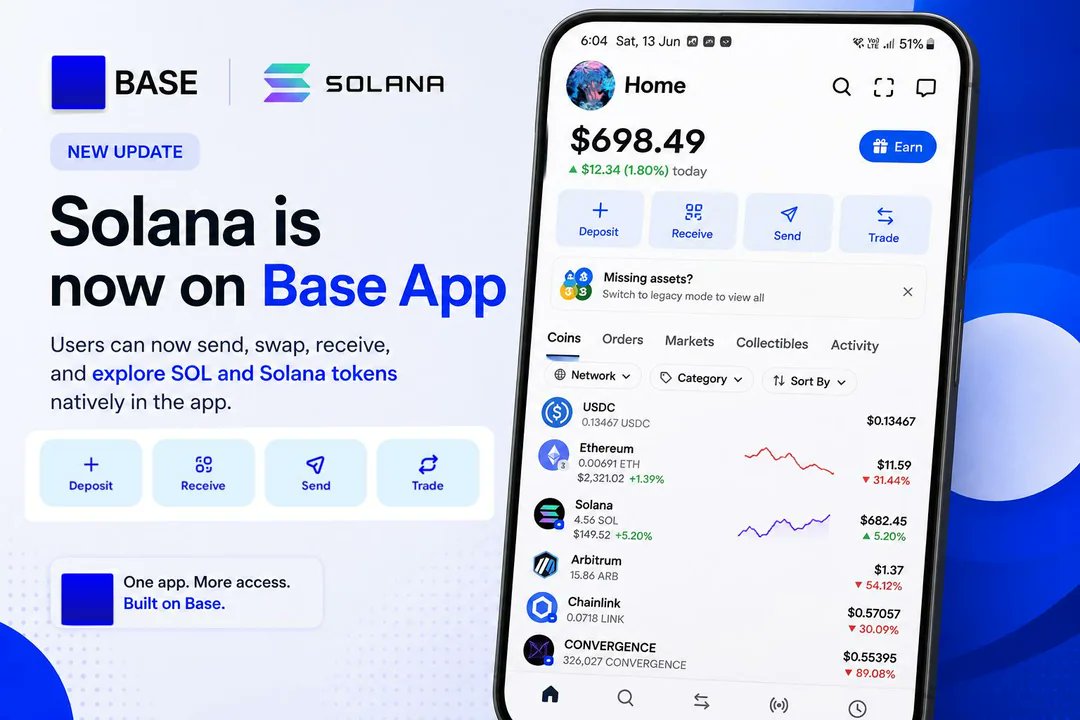
Base App now supports solana:So11111111111111111111111111111111111111112 and #Solana tokens natively, allowing users to send, receive, swap, and explore Solana assets directly within the app.
I like seeing updates like this because they make the product more useful over time. Rather than focusing only on adding new features, @base seems to be expanding the range of assets and ecosystems users can interact with in a familiar experience.
As the app continues to evolve, it will be interesting to see what other integrations and features come next.
What are your thoughts on the Solana integration, and what would you like to see added to @baseapp in the future??

Building in public: Step 5 (The Finale). My AI Agent ran 100% autonomously on @base Here are the results. 📊🤖
What started as a raw TypeScript snippet in Cursor a few days ago has officially evolved into a self-contained economic entity managing its own balance sheet on-chain.
No manual intervention. No emotional bias. Just pure code reacting to live block data.
The Performance Breakdown:
• Total Uptime: 48 Hours of continuous mainnet execution.
• Transactions Processed: 28 automated allocation adjustments.
• Gas Efficiency: 100% success rate - our dynamic volatility cushion completely outran network traffic spikes.
• Ecosystem Footprint: Flawlessly monitored contract states and routed resources to high-efficiency pipelines natively.
This sprint proved exactly what makes @base the premier environment for the automated machine age. The near-instant finality, predictable gas structure, and seamless developer rails create the perfect soil for sovereign digital entities to thrive.
The code is locked, the agent is staying live, and the shift toward programmatic, machine-driven execution is accelerating.
Huge thanks to everyone who followed this build journey from zero to production. Time to scale the architecture. 🚀
💬 Builders: What should we teach the agent next? Cross-chain routing to networks like @zksync, or deeper machine-learning decision frameworks? Drop your takes below!
2
49
BuildAI | base.eth.ink✨🌊 retweeted
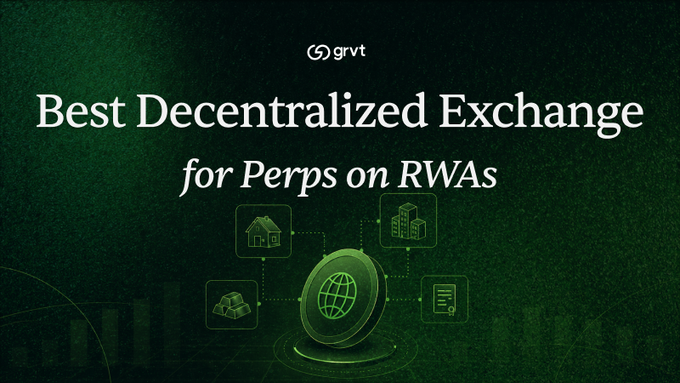
GRVT : Perps & Bonds Inside a Single Wallet
@grvt_io is a hybrid DEX building on @zksync , driven by an ex-Goldman Sachs and Meta team.
💰 Funding: $33.3M raised from ZKsync, Further Ventures, Hack VC, and other top-tier backers.
Now, GRVT is scaling into the RWA sector, launching three institutional-grade yield funds powered by Plume directly inside the exchange.
The Core Mechanism:
Plume tokenizes institutional yield - bonds, private credit, and real-world asset funds. GRVT bridges this infrastructure into its native wallet ecosystem. This gives you a single account to trade perps while simultaneously farming RWA yield.
📊 Three Strategies to Choose From:
🟢 Base Yield Fund: Low risk, stable yield.
🟢 Balanced Fund: Credit instruments, medium yield.
🟢 Opportunistic Fund: Structured credit, high-yield focus.
Everything deploys directly from your self-custodial wallet. No wrapping, bridging, or moving assets to external protocols required.
📈 Market Scale
While ~$34B in RWAs is already live on-chain, accessing these specific institutional strategies was previously gatekept for mega-funds. GRVT Plume are breaking down that wall, delivering institutional yield directly to a DEX infrastructure that already processes $1.2B in daily trading volume.
🗒 The Playbook
I been farming #GRVT since Season 1 for its sub-millisecond order matching, strict self-custody architecture, and margin yield. Adding native RWA allocations makes the ecosystem significantly stronger.
Season 2 runs until June 30, 2026, with TGE expected shortly after. Keep compounding.
2
1
2
196
BuildAI | base.eth.ink✨🌊 retweeted

Jun 12
Happy SpaceX listing day.
This will be a day to remember no matter what happens.
You can trade it already on @nadoHQ.

Trade the biggest IPO in history before it lists.
SPCX is live on Nado now with up to 3x leverage.
22
14
164
6,797
A lot of people treated the snapshot as the finish line. I see it as the starting signal. Season 3 is live, the ecosystem keeps evolving, and the next wave of opportunities is already forming.
@SoSoValueCrypto keeps building.
We are looking forward to the checker
17