
Scale your AI infrastructure with GPU financing. Tailored, affordable solutions. 🚀
Joined April 2025
- Tweets 682
- Following 4,424
- Followers 231
- Likes 268
243 Photos and videos









Jun 11
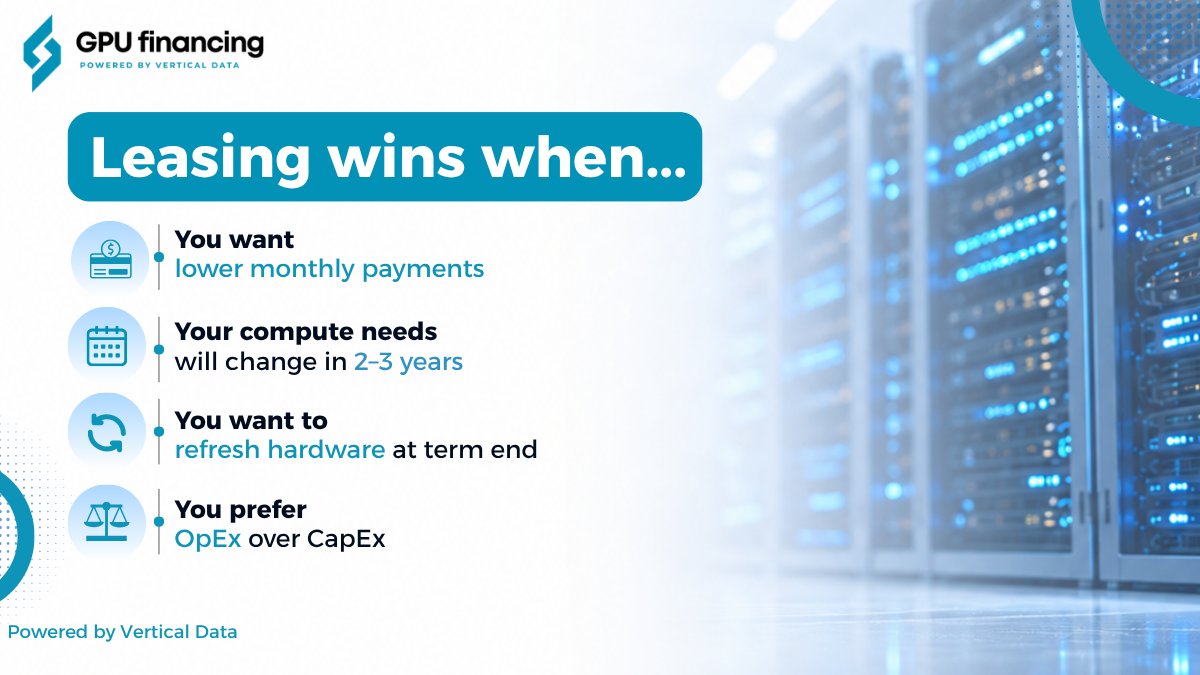
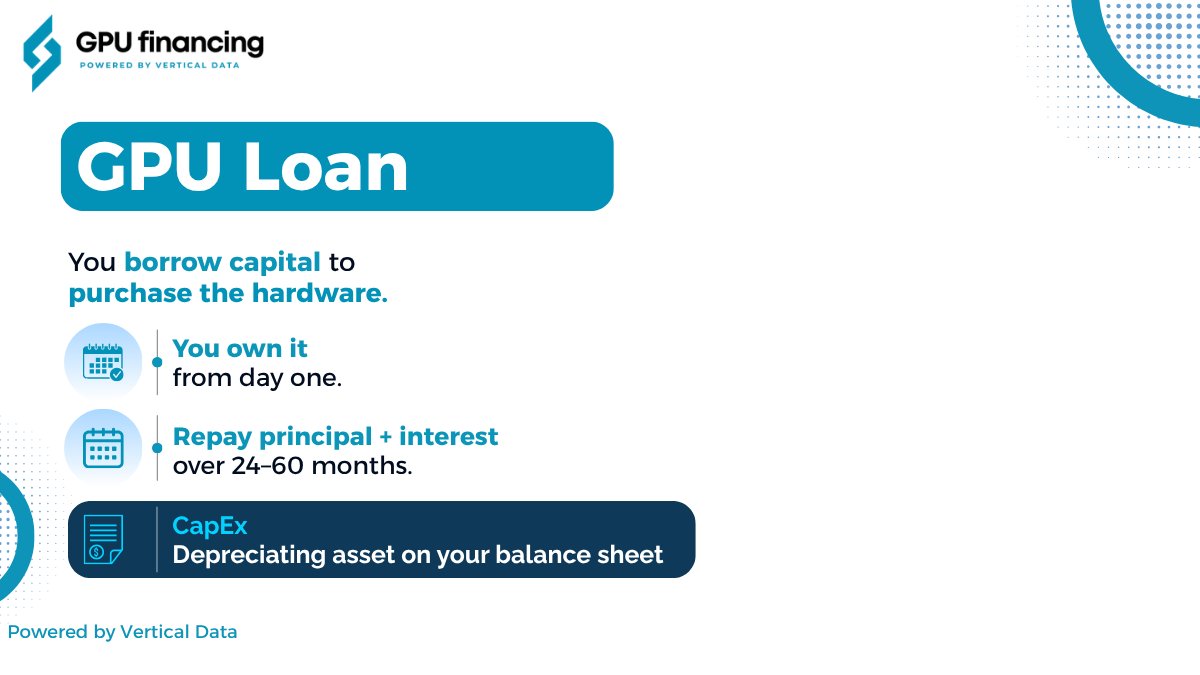
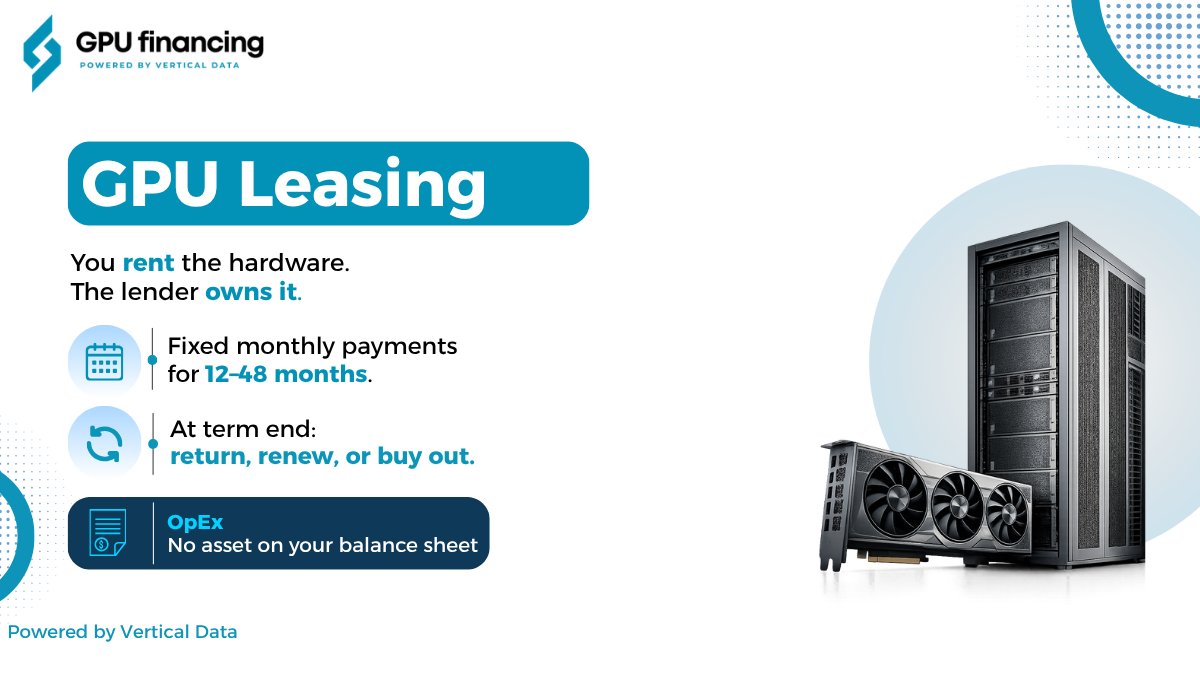
If your compute requirements will look meaningfully different in 24 months than they do today, what exactly are you optimizing for when you buy GPUs outright? Genuine question.
#AIInfrastructure #GPUFinancing
1
1
18
Jun 10
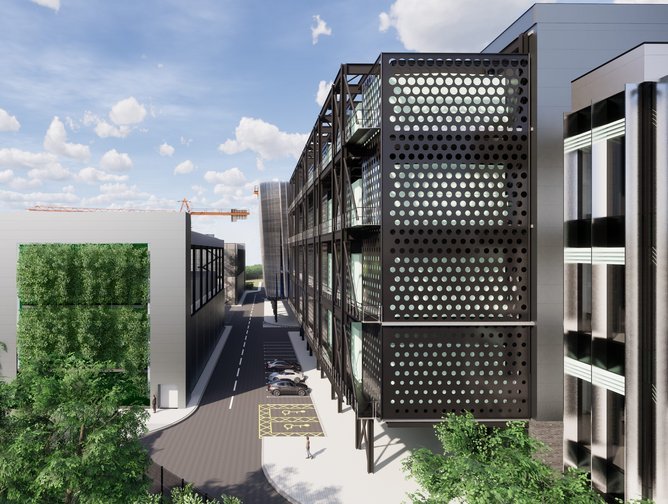
A new 36MW high-density AI data center building is advancing at Ark Data Centres’ Longcross Park in Surrey, UK, designed to support NVIDIA Blackwell Ultra GPU clusters.
Strategically located near London in a power-constrained market, this development reflects the continued momentum of the NVIDIA Blackwell era and the growing demand for advanced AI infrastructure.
Such high-density deployments underscore the importance of specialized GPU financing and leasing solutions to enable rapid scaling while maintaining capital efficiency and flexibility.
The Blackwell rollout across Europe continues to accelerate.

$NBIS
Ark Data Centres is expanding Longcross Park in Surrey with a new 36MW building (LP02) and infrastructure upgrades to support Nebius's UK AI growth. Nebius has launched a GPU cluster there using Nvidia Blackwell Ultra for high-density workloads. The site benefits from proximity to London in a power-constrained market.
Source: data-central.co.uk/ark-expan… #DataCentres #AI #UKTech
1
16
Jun 10
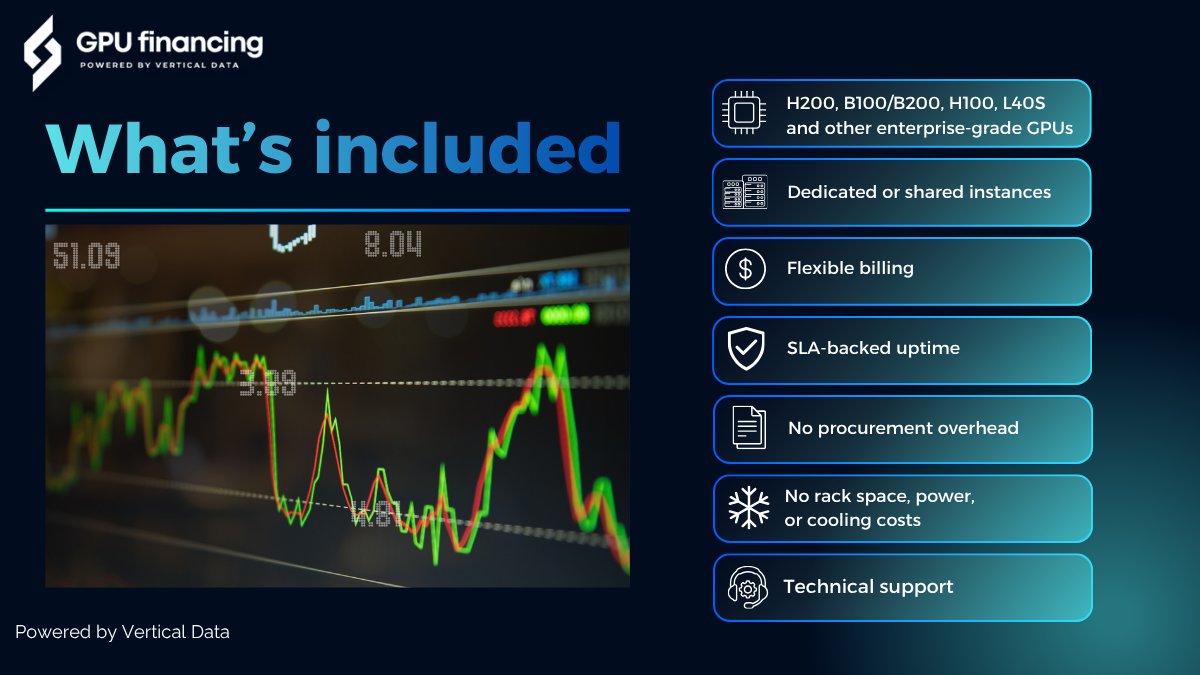
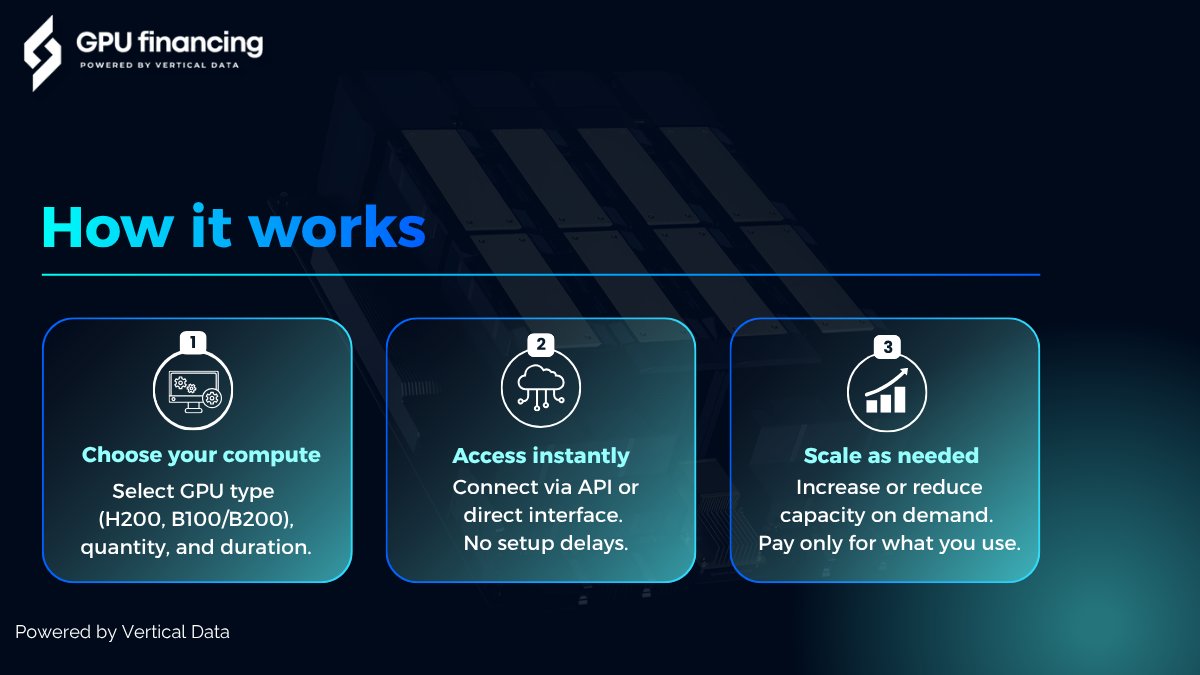
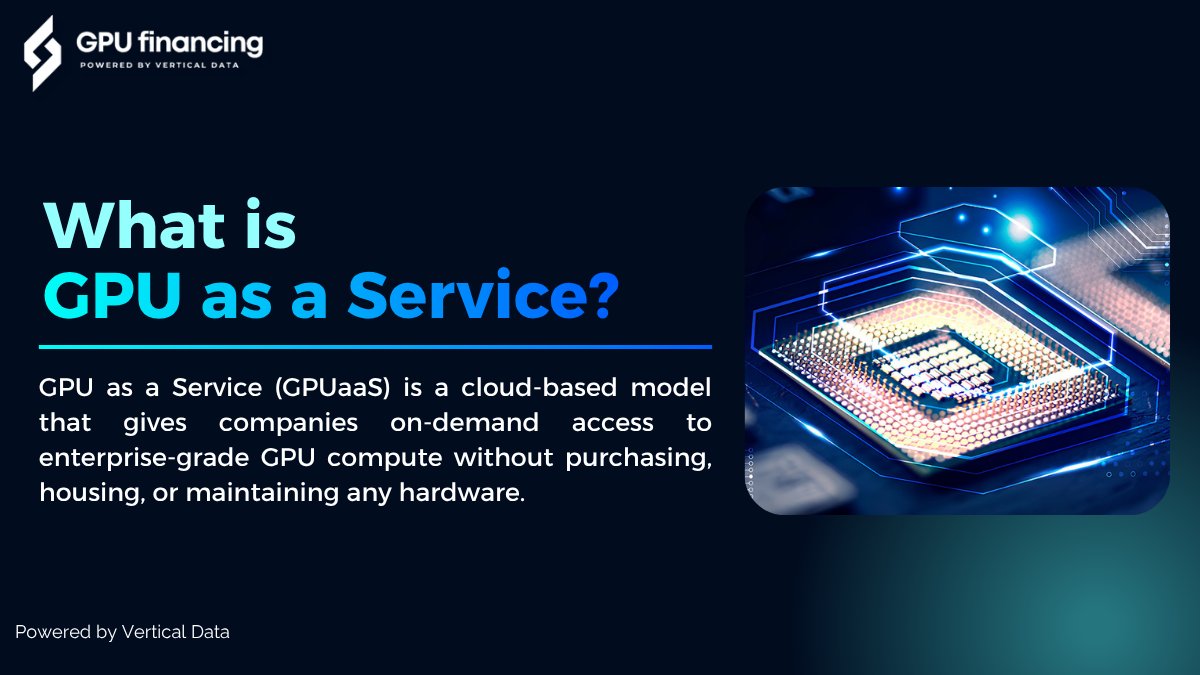
GPU as a Service is changing how companies think about compute infrastructure. Access, scalability, and flexibility are increasingly becoming more important than ownership.
Explore GPUaaS options at
🌐 gpufinancing.com/?utm_source…
📞 1 (702) 800-2466
#GPUaaS #AIInfrastructure #GPUFinancing
1
1
20
Jun 9
Two AI companies. Same Series A. Same compute requirements. One buys GPUs. One finances them. Here is what happens 18 months later.
#GPUFinancing #AICompute
1
1
1
12
Jun 9
18 months later: Company A is evaluating how to fund infrastructure refresh cycles. Company B is deploying more capital into product, hiring, and expansion. Same starting point. Very different capital positions.
1
3
Jun 9
The compute was never the differentiator. The capital structure was.
2
Jun 9
AI infrastructure expansion is accelerating globally.
But scaling infrastructure is not only a function of demand.
It is shaped by capital access, financing structures, deployment timelines, and operational flexibility.
In many cases, financing determines whether infrastructure is deployed efficiently, delayed, or never scaled at all.
As AI demand increases, capital strategy is becoming a core component of infrastructure strategy.
Discover financing solutions built for AI infrastructure
🌐 gpufinancing.com/?utm_source…
📞 1 (702) 800-2466
#AIInfrastructure #Finance #AICompute #GPUFinancing #ArtificialIntelligence #DataCenter
1
2
15
Jun 8
AI infrastructure scaling is often perceived as a compute problem.
In reality, it is frequently a capital allocation problem.
Large upfront GPU purchases concentrate liquidity in rapidly depreciating assets and reduce financial flexibility as infrastructure requirements evolve.
As AI deployment cycles accelerate, rigid capital structures can slow expansion and delay deployment timelines.
The question is not only how organizations access GPUs.
It is how they structure the capital behind them.
Discover financing solutions
🌐 gpufinancing.com/?utm_source…
📞 1 (702) 800-2466
#AIInfrastructure #GPUFinancing #ArtificialIntelligence #GPU #DataCenter #AICompute #Financing
1
1
19
Jun 6
GPU generations turn over roughly every 12 to 18 months. The hardware you buy today starts competing with its successor almost immediately. Every infrastructure team understands this technically. Very few structure capital around it financially.
#AIInfrastructure #GPUFinancing
1
1
20
Jun 4
The CFO who approves a $5M GPU purchase and the CFO who structures a 36-month lease are not solving the same problem. One is buying hardware. The other is preserving flexibility. Those are very different capital decisions.
#GPUFinancing #AIInfrastructure
1
2
21
Jun 3
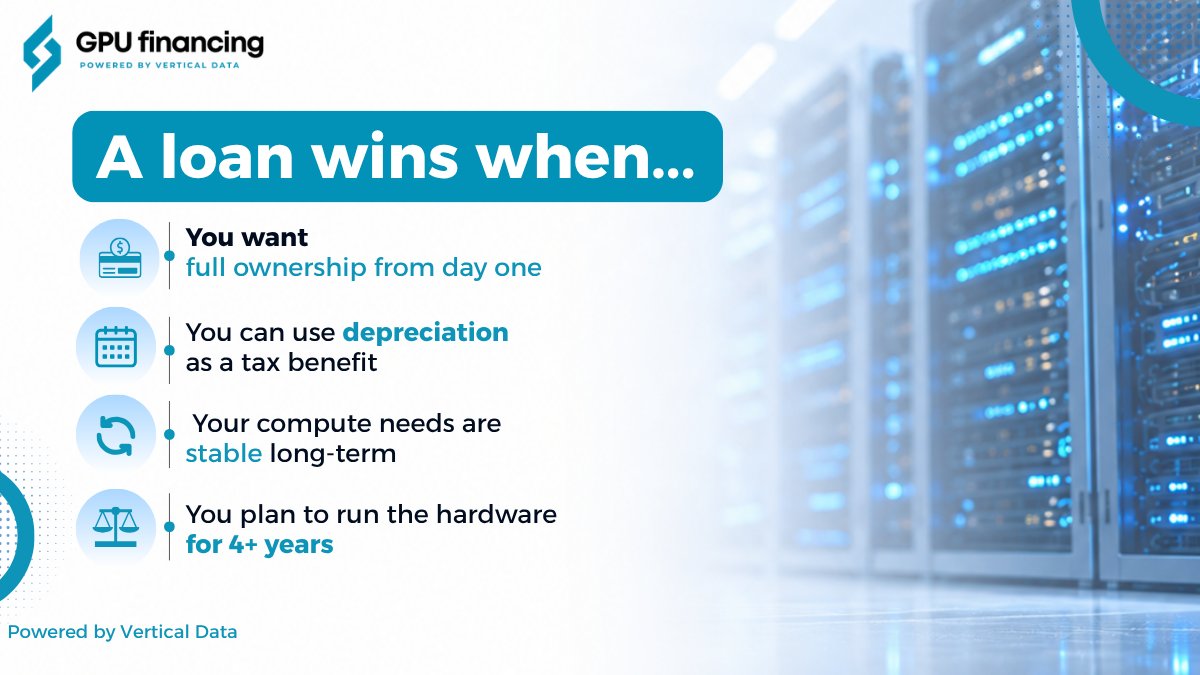
GPU leasing and GPU loans solve very different infrastructure problems. One prioritizes flexibility. The other prioritizes ownership. Understanding the difference matters more as AI infrastructure cycles accelerate.
Explore financing structures at
🌐 gpufinancing.com/?utm_source…
📞 1 (702) 800-2466
#GPUFinancing #AIInfrastructure #GPUleasing
1
1
27
Jun 2
Owning GPUs is not always an asset. In fast-moving infrastructure cycles, it can quickly become a liability. Hardware that loses value every time NVIDIA announces a new generation is not a store of value. It is a depreciating cost center on the balance sheet.
#AIInfrastructure #GPUFinancing
1
1
19
Jun 2
At GPU Financing, we fully understand this challenge.
The real bottleneck in AI extends beyond just acquiring chips, it lies in capital formation and securing efficient access to large-scale GPU infrastructure.
Specialized financing structures play an important role in broadening access to AI infrastructure.
May 28

Everyone is focused on AI models.
Almost nobody is paying attention to the financing layer underneath the compute infrastructure itself.
These days I've been a deep diving alot on this and the more I study GPU markets, the more it feels like the real bottleneck is not semiconductor physics anymore, it’s capital formation.
The economics of modern GPU clusters are actually brutal.
A serious AI data center today can easily require $300M -$500M upfront like H100/B200 procurement, networking fabric, liquid cooling, transformers, substations, rack density engineering, redundancy layers, power contracts, deployment logistics, etc.
And the scary part is that nearly all the capital expenditure arrives BEFORE revenue exists.
That creates a very weird asset class.
GPU infrastructure has the balance sheet profile of heavy infrastructure (like energy plants or telecom backbones), but the revenue profile of an extremely volatile startup market.
That mismatch is the core problem.
Traditional infrastructure finance only works when lenders can model future cash flows with reasonable confidence.
Banks don’t actually care whether your asset generates “huge upside.”
They care whether they can mathematically underwrite downside risk.
This is exactly why power plants, pipelines, toll roads, and airports became financeable like long-duration predictable contracts.
But GPU compute markets historically had almost none of that.
Spot GPU pricing was insanely volatile.
Clusters could swing massively in utilization depending on training cycles, inference demand, hyperscaler supply shocks, model launches, or chip shortages.
A lender underwriting debt against that environment basically sees the “unpredictable future cash flows attached to rapidly depreciating hardware.”
Which means financing becomes either extremely expensive, heavily equity dependent or impossible altogether
That’s why hyperscalers dominated the entire market for years.
Not necessarily because smaller operators lacked technical capability,
but because they lacked access to cheap infrastructure debt.
And this is where compute futures become incredibly important.
The parallel with electricity markets is actually deeper than most people realize.
Electricity grids had the exact same financing problem decades ago.
Electricity is non-storable at scale.
Unused power generation instantly evaporates economically.
GPU-hours behave almost identically.
An unused GPU-hour at 3 PM is gone forever.
You cannot inventory idle compute capacity.
That single property creates massive spot price volatility.
Power markets solved this using derivatives forward contracts.
Not because derivatives are “financial games,”
but because forward price discovery allows infrastructure financing to exist in the first place.
Once electricity producers could hedge future revenue streams, project finance unlocked.
Suddenly lenders could model debt repayment schedules.
That transition literally changed the scale of global energy infrastructure deployment.
Now we are watching the same thing emerge for AI compute.
GPU futures, swaps, and compute pricing indexes are effectively trying to transform compute into a financeable infrastructure commodity.
Because the moment a GPU operator can lock future revenue streams,
their cost of capital collapses.
An operator financing a $500M cluster at 7-8% behaves VERY differently from one financing at venture-style 18-20% expectations.
So this alone can tell whether independent compute providers can even exist.
Which means compute derivatives are not just trading instruments.
They are infrastructure expansion mechanisms.
That’s the part I think most people are missing.
The real downstream effect is not that Wall Street is entering in AI.
The real effect is more financeable GPU infrastructure, more independent supply, more competition, lower compute costs, broader access to AI research.
Ironically, GPU futures might end up helping small labs and university researchers more than hedge funds.
Because once infrastructure financing becomes efficient then compute supply can scale far beyond hyperscaler balance sheets.
People think the AI race is only about models.
But underneath the model layer,
there’s an entirely different war going on.
the transformation of compute itself into a globally traded infrastructure commodity.
And thats gonna matter even more in the future.
9
Jun 2
GPU as a Service (GPUaaS) gives companies access to enterprise-grade GPU compute without purchasing, housing, or maintaining physical hardware.
As AI infrastructure demand grows, many organizations are prioritizing flexibility, speed, and scalable access over ownership.
GPUaaS allows teams to deploy compute faster while avoiding procurement delays and infrastructure overhead.
Explore GPUaaS options
🌐 gpufinancing.com/?utm_source…
📞 1 (702) 800-2466
#GPUaaS #AIInfrastructure #GPUFinancing
1
1
1
24