
Joined October 2008
- Tweets 11,421
- Following 1,038
- Followers 26,181
- Likes 4,051
362 Photos and videos






Jerry Neumann retweeted

@ganeumann published his analysis of the reactions to "We Have Learned Nothing," his essay about the ineffectiveness of different startup methods taught in the last 20 years. The reactions themselves are the most interesting part.
buff.ly/AFmNV7N
The reactions were predictable: The data is wrong. The methods weren't applied correctly. You can't prove they don't work.
That last objection is the one Popper would have circled.
In The Open Society he identified the central problem with unfalsifiable systems: they are not wrong. They are immune to being wrong. Every failed application becomes evidence of incorrect usage. Every contradicting result gets absorbed as a special case. The theory survives every encounter with reality by explaining reality away.
Neumann's critics are not arguing that the methods work. They are arguing that no data could ever show they don't.
That is not a defence of a methodology. It is a description of an ideology.
Popper's point was that a theory which cannot be falsified is not a stronger theory. It is a weaker one. The strength of a claim is precisely its exposure to being wrong.
The different methodologies being defended as unfalsifiable, self-sealing, immune to aggregate evidence, is not science applied to entrepreneurship.
It is the Open Society problem wearing a business model canvas.
2
2
821

Apr 21
Idk, having watched a couple big SaaS businesses being built, coding was not the bottleneck
20
12
191
28,381
Apr 17
I no longer have access to a university library and, so, most academic papers
When I am president, any government funding of research (and there will be plenty) will be accompanied with the stipulation that the results must be published open access
2
16
1,362
Jerry Neumann retweeted

Apr 12
The complete segment is up on YouTube. Is your phone listening to you? No.
youtube.com/watch?v=mIOA3nQc…
3
4
24
4,255
Jerry Neumann retweeted

Apr 4
Founder vs. Investor by @ganeumann & Elizabeth Zalman.
It provides conflicting and complimentary perspectives on the whole venture game. Fundraising, term sheets, exits, sales incentives.
Awesome read for anyone in startups.
1
2
3
2,389
Mar 31
This is great reading
Mar 31

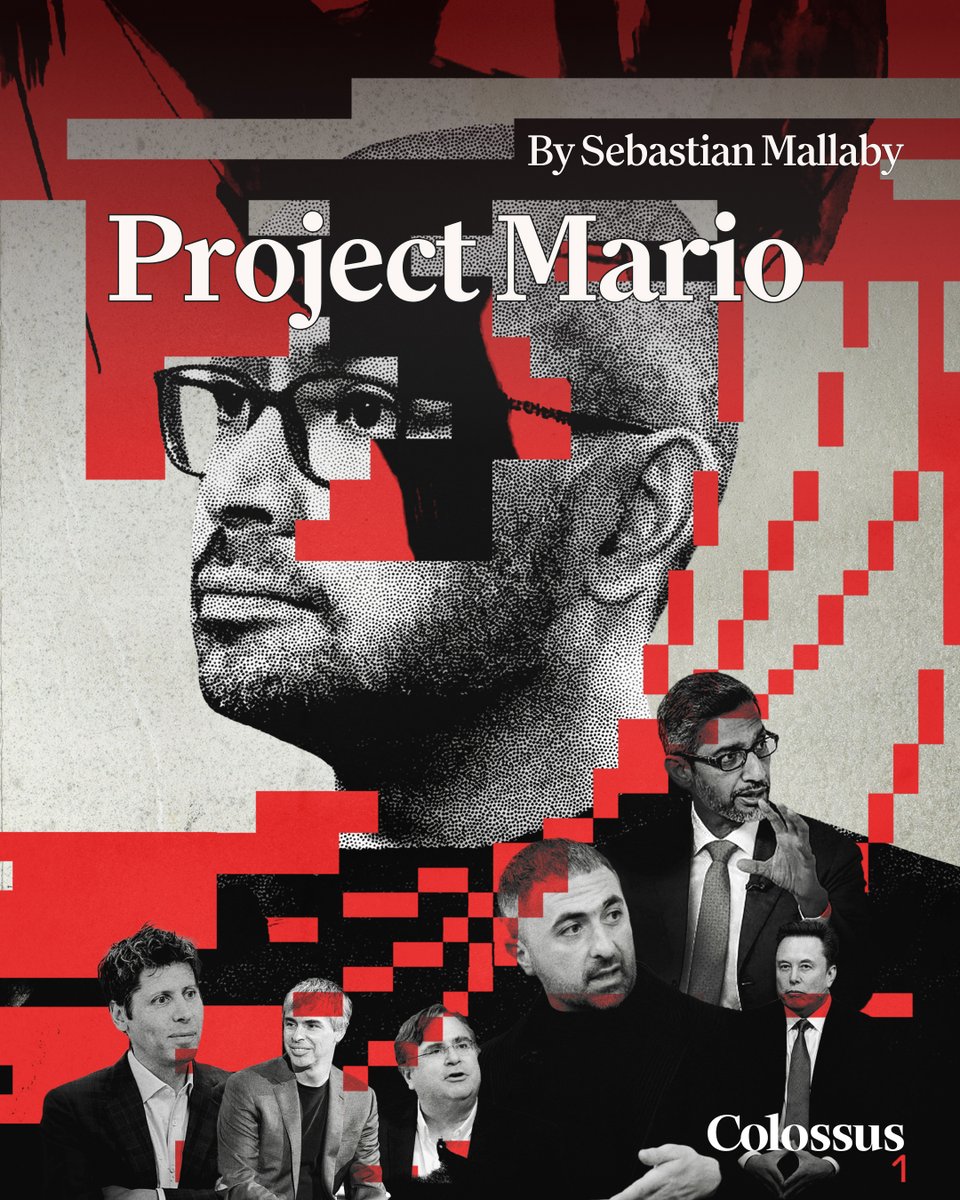
We're publishing an exclusive chapter from @scmallaby's brilliant new book about Demis Hassabis and DeepMind.
This is the inside story of Project Mario. How DeepMind's co-founders spent 4 years trying every mechanism they could think of to put guardrails around AGI, only to watch each one fail, and conclude that the only safeguard was themselves.
It reveals that Hassabis ran a secret hedge fund team inside DeepMind trying to beat Renaissance Technologies; Mustafa Suleyman assembled lawyers for a $5 billion walkaway plan; Reid Hoffman committed $1 billion of his personal fortune to back them; Google kept saying yes and no at the same time—and the endless negotiations left Hassabis so distracted that when the transformer paper dropped in 2017, he was less alert to its significance than he might have been.
Meanwhile, OpenAI was fighting the mirror-image battle with Musk, Altman, and Sutskever tearing each other apart over the same question: who gets to control AGI? Musk proposed folding OpenAI into Tesla. When that failed, he stormed out. When OpenAI's nonprofit board finally tried to assert authority in 2023, it was crushed in days.
Both camps arrived at the same unsettling conclusion, that governance structures don't hold. The best safeguard either side could come up with?
Trust us.
Read the chapter in the link below.
1
2
38
8,458
Jerry Neumann retweeted

Mar 27
"We Have Learned Nothing" by @ganeumann
colossus.com/article/we-have…
1
3
5
1,079
Jerry Neumann retweeted

Mar 23
Este ensayo crítico sobre la "ciencia del emprendimiento" es de lo mejor que he leído en estas últimas semanas. La Reina Roja nos enseña muchas cosas. Hilo va @Godivaciones @Recuenco colossus.com/article/we-have…
2
19
53
9,310
Jerry Neumann retweeted
Mar 18
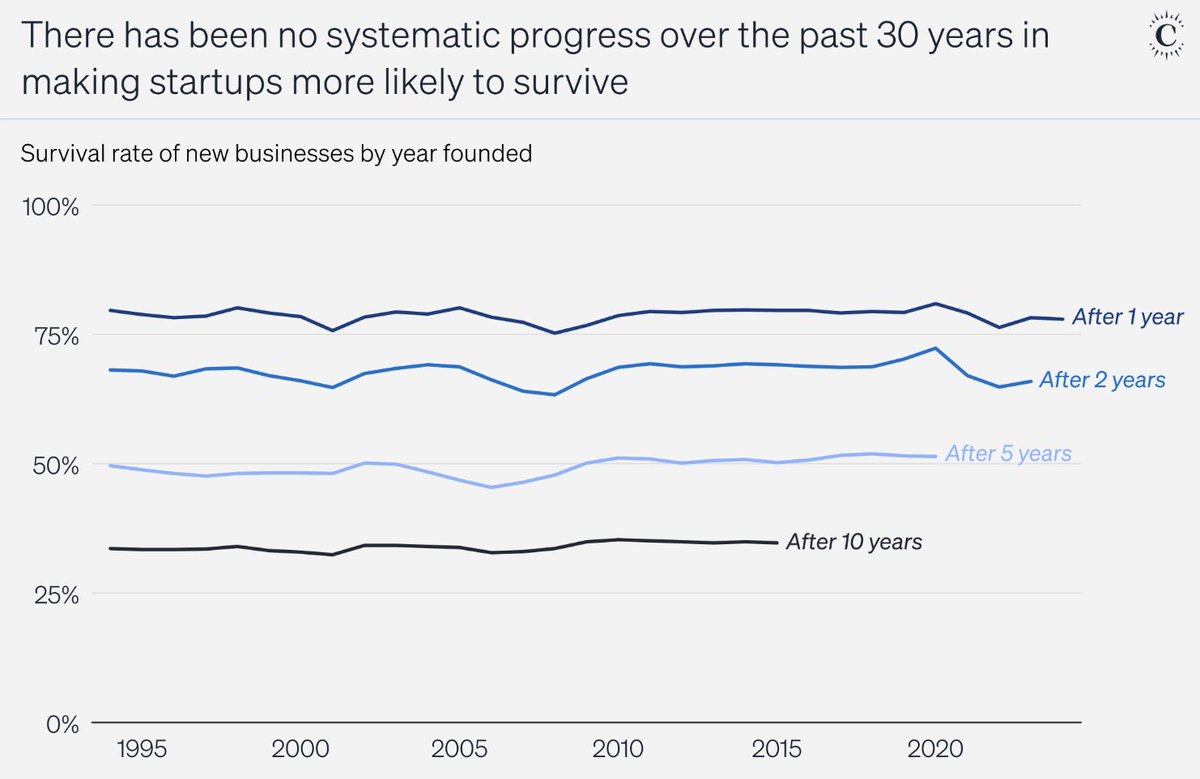
This chart has been bothering me for a while. Why, with all the new methods we have to build startups, have failure rates stayed the same? So I wrote about it
9
10
45
10,869
Jerry Neumann retweeted

Two founders enter the same market. Same timing, same customer interviews, same signals.
18 months later, a competitor launches a free version of Founder A's core product. He has to pivot. The pivot is expensive and slow.
Founder B barely notices.
Here's why 🧵
1
4
4
4,435
Jerry Neumann retweeted
There's a recent result that might be relevant here. @MiTiBennett 's doctoral thesis (ANU, accepted Nov 2025) proves that the optimal strategy in uncertainty is to maintain the weakest set of commitments consistent with your evidence.
He calls it w-maxing.
The interesting part for this conversation: it resolves the tension between "science of entrepreneurship" and "every startup is unique" because it's a science that operates at the meta-level. It doesn't tell you what to do, but it does tell you how much to commit to a given solution, and the answer is always specific to your situation.
Two founders w-maxing in the same market will arrive at different solutions, not because they're being contrarian, but because the weakest hypothesis consistent with each founder's position is genuinely different. No convergence problem.
I wrote a longer response to the essay exploring this if you're interested — it addresses the Red Queen trap too: pim-and-co.com/blog/we-have-…
5
1
2
1,149
Mar 20
Looking forward to reading this. Mallaby is excellent
Mar 18

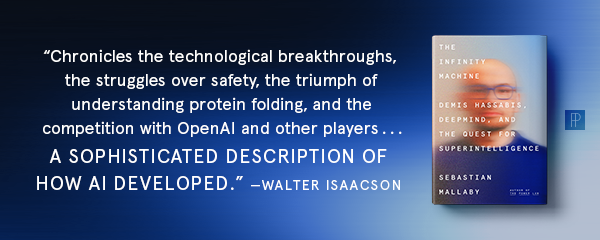
Proving it is better to be lucky than smart, I negotiated deep access to Demis Hassabis and DeepMind in November 2022. A week later, ChatGPT launched, and I began my deep-dive conversations with Demis and his team just as AI moved from the fringe to the mainstream. The result is The Infinity Machine. It's been a wild and fascinating ride.
1
10
3,308
Mar 20
Well, it seems the making friends and influencing the powerful phase of my life is over
5
26
3,752
Jerry Neumann retweeted

We Have Learned Nothing by @ganeumann colossus.com/article/we-have…
2
8
1,230
Jerry Neumann retweeted

Jerry’s @ganeumann latest in Colossus. Wish I could read an article by him everyday. He’s the person that first taught me about startups.
There’s plenty to learn and borrow from others, but there’s no playbook for making something great.
Mar 18
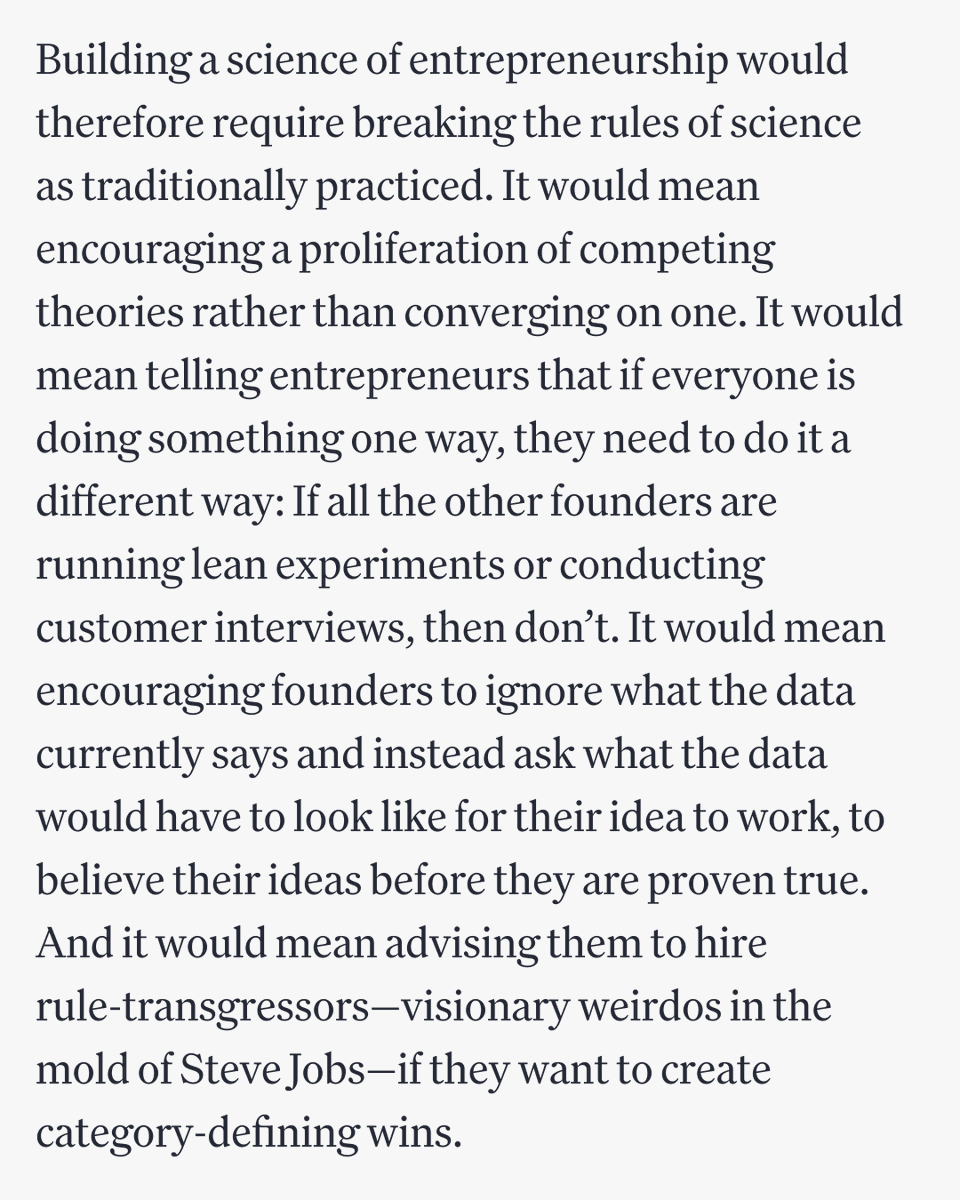
Despite the proliferation of startup pundits over the last 25 years, no one knows how to make startups more successful.
The New Pundits have sold millions of books, and their entrepreneurship “science” is taught in universities and accelerators all over the world. But none of it has made a difference.
Startups are no more likely to survive today than they were in 1995. By some measures, they are even less likely to work.
In his latest essay, legendary venture investor @ganeumann presents the data, diagnoses the problem, and proposes something that might actually work.
It involves Robert Boyle, Peter Thiel, Paul Feyerabend, and Lewis Carroll’s Through the Looking-Glass.
colossus.com/article/we-have…
5
8
48
27,338
Jerry Neumann retweeted

Superb from @ganeumann
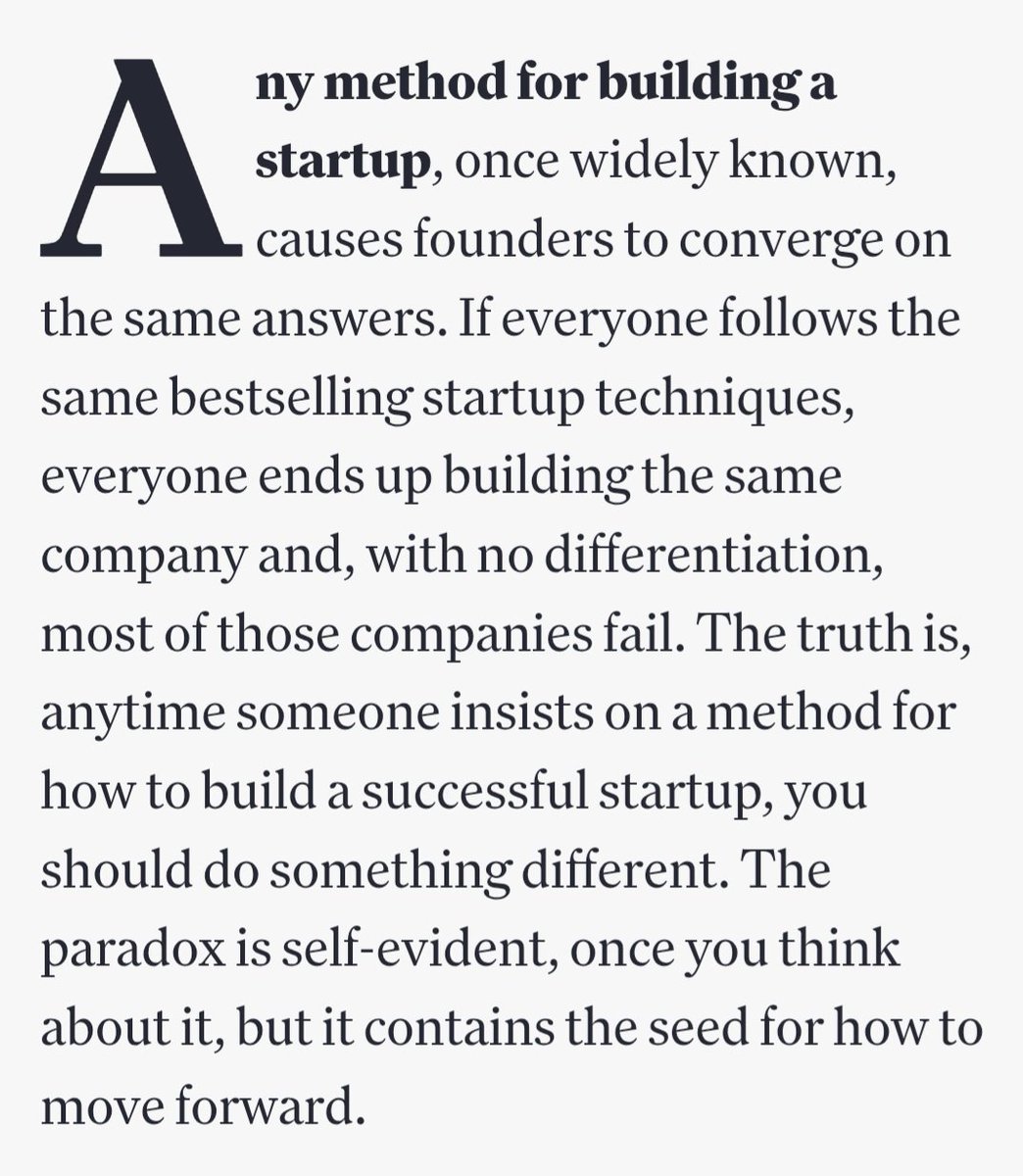
As an oft-times coach to founders, though, this reality hasn't always been helpful for business
The socialised mind craves the answer, playbook, 5 step process that will remove uncertainty. It takes an even braver entrepreneur to break free
colossus.com/article/we-have…
1
1
6
1,118
Jerry Neumann retweeted

Mar 18
The great @ganeumann and why startups are so hard and interesting to build and invest in colossus.com/article/we-have…
1
2
10
2,505
Jerry Neumann retweeted
Mar 18
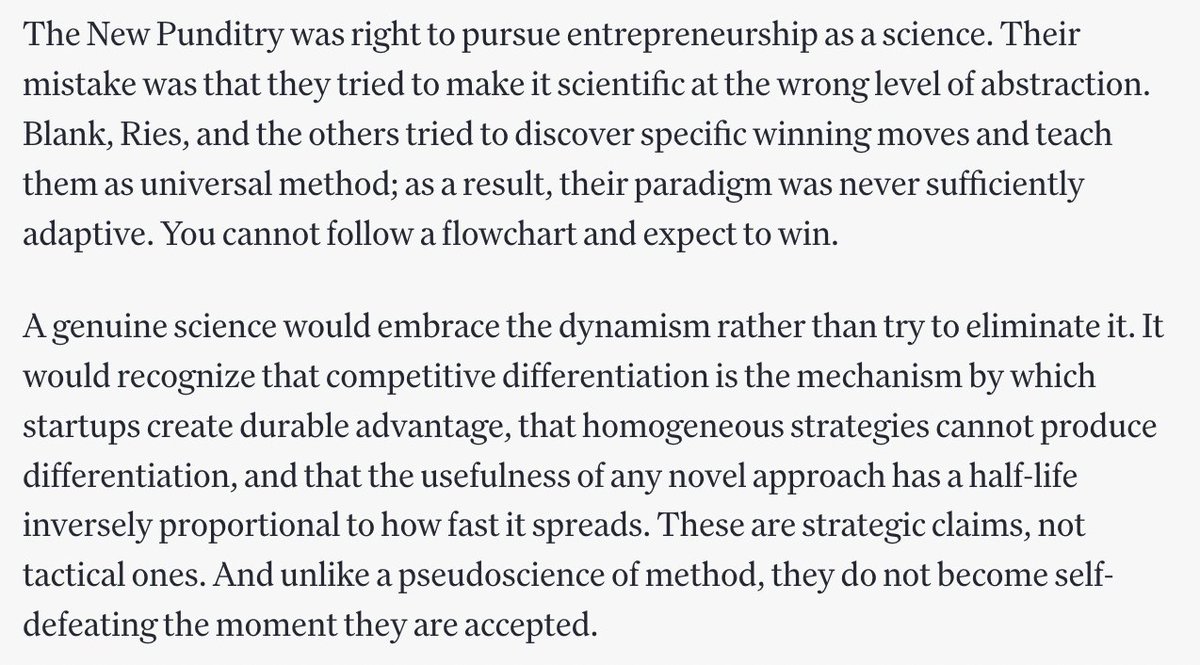
"If you do what everyone else does, you get what everyone else gets. The Red Queen hypothesis is the closest thing entrepreneurship has to a foundational law."
1
7
25
5,087
Mar 18
Part of my take on it
Mar 18

This chart has been bothering me for a while. Why, with all the new methods we have to build startups, have failure rates stayed the same? So I wrote about it
2
2
16
2,282

The great @ganeumann on the cargo cult science of entrepreneurship.
If The Lean Startup or The Four Steps to the Epiphany worked, it would show up in the statistics.
"Instead, there has been 0 systematic progress over the past 30 yrs in making startups more likely to survive."
Mar 18
Despite the proliferation of startup pundits over the last 25 years, no one knows how to make startups more successful.
The New Pundits have sold millions of books, and their entrepreneurship “science” is taught in universities and accelerators all over the world. But none of it has made a difference.
Startups are no more likely to survive today than they were in 1995. By some measures, they are even less likely to work.
In his latest essay, legendary venture investor @ganeumann presents the data, diagnoses the problem, and proposes something that might actually work.
It involves Robert Boyle, Peter Thiel, Paul Feyerabend, and Lewis Carroll’s Through the Looking-Glass.
colossus.com/article/we-have…
1
5
16
4,638