
President & CEO @ycombinator —Founder @garryslist—Creator of GStack & GBrain—designer/engineer who helps founders—SF Dem accelerating the boom loop
Joined January 2008
- Tweets 73,926
- Following 5,859
- Followers 890,565
- Likes 248,348
4,835 Photos and videos




Tech gave me everything I have
Its capacity to lift people into abundance is incredible and there is nothing like it
We must make that into prosperity for everyone
11 Aug 2023

"I realized tech is this thing that can bring people out of whatever situation they're in and often into prosperity. And that's what I want for everyone."
@ycombinator’s @garrytan tells @emilychangtv how tech changed his family's life.
Watch here: trib.al/sxg1VGR
942
776
6,446
4,375,454
Garry Tan retweeted

10h
Fortunately this is already happening. Between 1982 and 2020, the number of the richest 100 Americans who got their money by inheritance decreased from 60 to 27.
paulgraham.com/richnow.html
14
23
474
32,802


Open source is the escape hatch for businesses to be able to continue to control their own destiny long term

My interpretation of this:
Right now, Anthropic and OpenAI are making a killing by selling enterprise FDE services to F500s, building workflows for them on top of proprietary models, then using the traces and context from this to build RL envs to improve the models.
This is crazy amounts of leverage - instead of buying this data they're getting paid gigantic consulting fees to extract it.
This also goes way beyond typical consulting in scope - organizations are effectively outsourcing key learning curves and domain knowledge to the AI labs.
Despite that, it's so far been worth it for them because the value of skilled FDE is so high and the ROI so fast, and orgs are willing to pay a premium for competent AI implementation.
But in the long run, one of two things happens: either orgs are gonna get hooked on this and end up paying for the model training that replaces their business, or they find a way to build and own their own model ecosystem.
What that looks like is developing some combination of AI models, evals, RL envs, and workflows. Initially probably the model will still be an off-the-shelf frontier model from a top lab.
But as firms build out more sophisticated eval / RL env (increasingly the same thing) infra, it starts to become viable to post-train an custom model on top of an OSS base. Cursor have done this successfully with their Composer model RL'd on top of Kimi.
Sidenote, this is the same conversation that a lot of national governments in Europe are having in the past week. When we look at what the rhetoric about 'sovereign AI' in the UK actually boils down to, it's doing custom post-training on top of an OSS model, and then running it on local GPUs.
Ultimately, the current feeding frenzy for AI services in all of its guises - FDE, AI consulting, etc - should raise questions about long-term sustainability. If consulting services are truly a value add and competitive advantage, then in the long term you want to in-house.
22
11
108
14,943

Garry Tan retweeted

A founder pitched me this week with spectacular numbers. But they opened with a two-minute backstory... By the time the traction slide came up, the room had half-decided they were ordinary. They weren't.
15
10
225
36,599


The next generation of young people who change the world will almost certainly be the people who are most adept at making long-running multi-stage multi-team agent tasks work extremely well, and at high volume and across every part of their personal and work lives.

It’s not so simple, but this is somewhat correct. The real truth is that admissions is more qualitative and based on if your admissions officer likes you.
I will say, though, that agents made this process much easier for me. I was basically able to automate extracurriculars and outreach while I focused on building apps all day (and night).
33
21
247
27,450
The housing NIMBYs and the datacenter NIMBYs are all the same people
Hate tech, hate prosperity, subsidize demand, block all supply, be surprised when everyone ends up poor with no jobs

Seattle is banning new data centers despite the fact their entire economy and tax base these days is literally just the tech sector and nothing else after they killed every other industry
Legit impressed by their record-breaking “Become Detroit - Any% speed run”
20
17
161
23,226
Veto supply through process, socialize the costs, then act shocked when prices climb and jobs leave.
The fix is the same too: reform the review process, build the housing, build the grid and datacenters.
If we do the fix, we'll have prosperity. If we do what the NIMBYs want we just get cost disease and more market failure.
4
1
12
5,061

The permissioned path does not arrive as tyranny. It arrives as convenience.
A society can lose its freedom this way without a single dramatic moment, simply by routing more of its thinking through infrastructure that answers to someone else.
We must protect open source and open source models

46
45
344
47,598
Garry Tan retweeted

Nothing more energizing than a week of meeting with @ycombinator companies!
Congrats to @garrytan and the whole team for another fantastic cohort - and to the founders taking big swings.
YC is often a few months ahead of the market - trends I noticed from the batch 👇
1. "Real economy" AI is here. Manufacturing, supply chain, logistics, etc. We have agents that can reliably operate across platforms, plug into legacy equipment, and scrape data from systems of record. Businesses that haven't bought new software in decades are now customers of AI.
2. The broker and the agency are becoming software. Founders are taking businesses that have always run on human middlemen and rebuilding them as agent-run platforms. This both unlocks labor budgets allows you to own transactions and get outcome data that can be further used to improve the product / build a network.
3. Vertical AI is (often) routing around incumbents, not integrating with them. For many founders, the new playbook is to skip the official API entirely (computer-use, front-end reverse-engineering) so legacy software can't shut you off. Fragmented industries with no dominant platform are suddenly wide open.
4. Founders are going upmarket early, not eventually. ACVs for the first few customers are going up. Founders are starting on enterprise logos from day one and treating SMB as validation they've already outgrown. This might mean 1-2 $100k ACV customers in the first 6 months versus a long tail of $10 - $20k logos.
5. Everyone is moving to the US - fast. A striking number of teams are international and already have real traction in their home markets, but are relocating to the US within weeks (visas in progress) post-YC to chase the bigger market. Yes, there will be outliers who build massive cos locally - but SF is the center of gravity.
6. Self-improving products are here. Teams are spinning up companies operated by agent "org charts" - who can not only run the product but proactively and autonomously make it better over time. Customers can prompt their own workflows...or the product will start to do this intelligently over time (on a per-product basis).
10
11
164
20,217
The Gestalt Prayer by Fritz Perls
I do my thing and you do your thing. I am not in this world to live up to your expectations, and you are not in this world to live up to mine. You are you, and I am I, and if by chance we find each other, it’s beautiful; if not, it can’t be helped.
20
18
149
11,372
The mistake: Using AI for simple tasks
You should use it for complex, multi-stage tasks that involve lots of people and moving parts

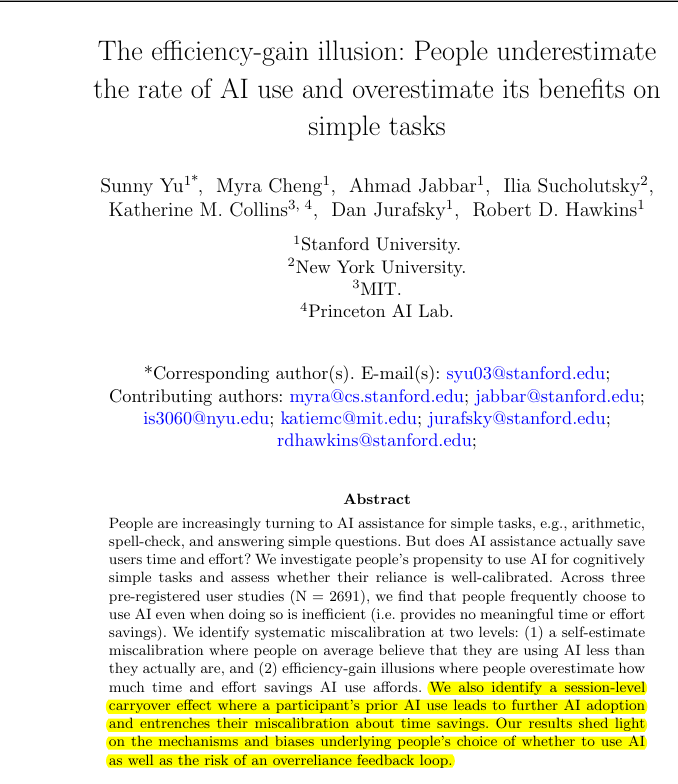
MIT, Stanford, New York Univ, Princeton paper says AI can make people feel more efficient even when they are not actually becoming much more efficient.
that people often use AI for simple tasks because it feels like it saves time and effort, but the measured benefit is often tiny, missing, or even negative.
The biggest point is the feedback loop: once people use AI, they become more likely to use it again, even for easy tasks where doing it themselves would often be just as fast or faster.
i.e. AI dependence can grow from a mistaken feeling of convenience, not just from real productivity gains.
Across three preregistered studies with 2,691 participants, people used AI for basic arithmetic, spelling, recall, and short rewriting at higher rates than they predicted, especially on easy tasks.
They also expected AI to save 55.7 seconds on average, when the measured saving was only 7.5 seconds.
For simple work, the hidden cost is not intelligence but interface friction: writing the prompt, waiting, reading, checking, and deciding whether the answer is acceptable.
Once that loop begins, it can feel like effort has been outsourced, even when effort has only been rearranged.
Here’s the key part: the study suggests that AI use can train its own justification.
After using AI on just two tasks, participants became more likely to use it again, even when independent completion was faster.
The danger is not dramatic dependence, but quiet recalibration.
A person who asks AI for a trivial answer today may not become less capable tomorrow, but they may become less accurate at judging when their own mind is already the faster tool.
----
Paper Link – arxiv. org/abs/2605.22687
Paper Title: "The efficiency-gain illusion: People underestimate the rate of AI use and overestimate its benefits on simple tasks"
48
20
292
36,247
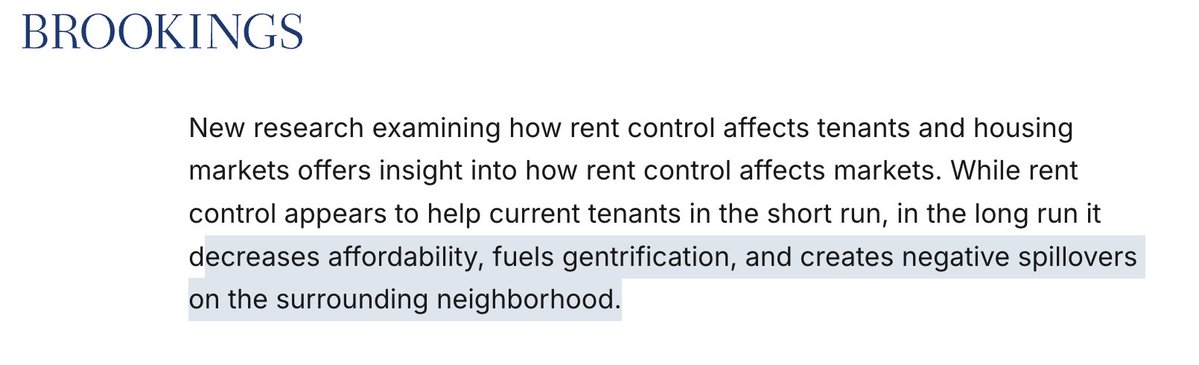
Rent control subsidizes demand
We need to dramatically increase supply
Anyone who tells you otherwise just wants your rent to go up
brookings.edu/articles/what-…
10h

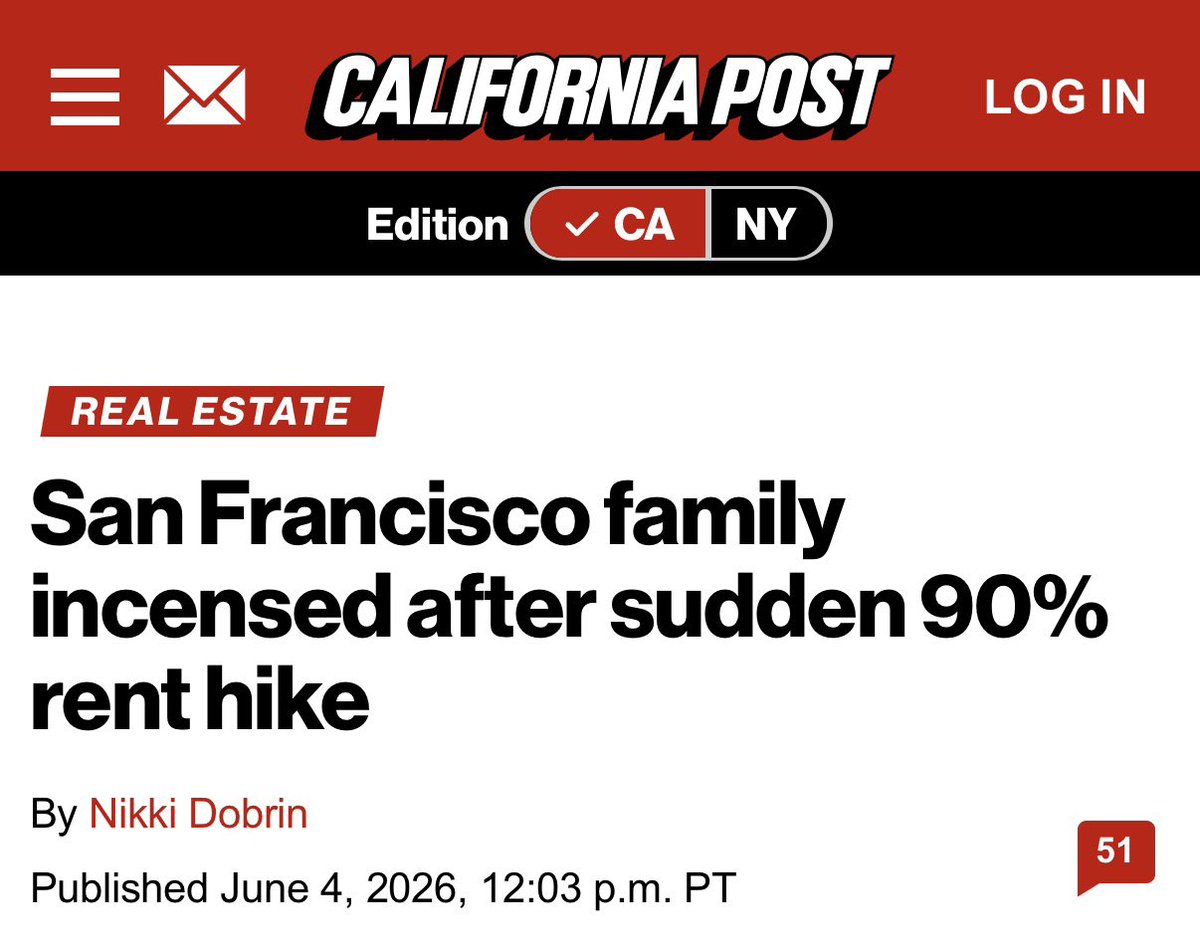
Rent control in San Francisco is not going anywhere. If anything, cases like this will eventually cause it to expand dramatically in San Francisco
20
16
192
19,150
Hey so could we start building housing again in SF, that'd be great thanks!

57
12
691
106,314
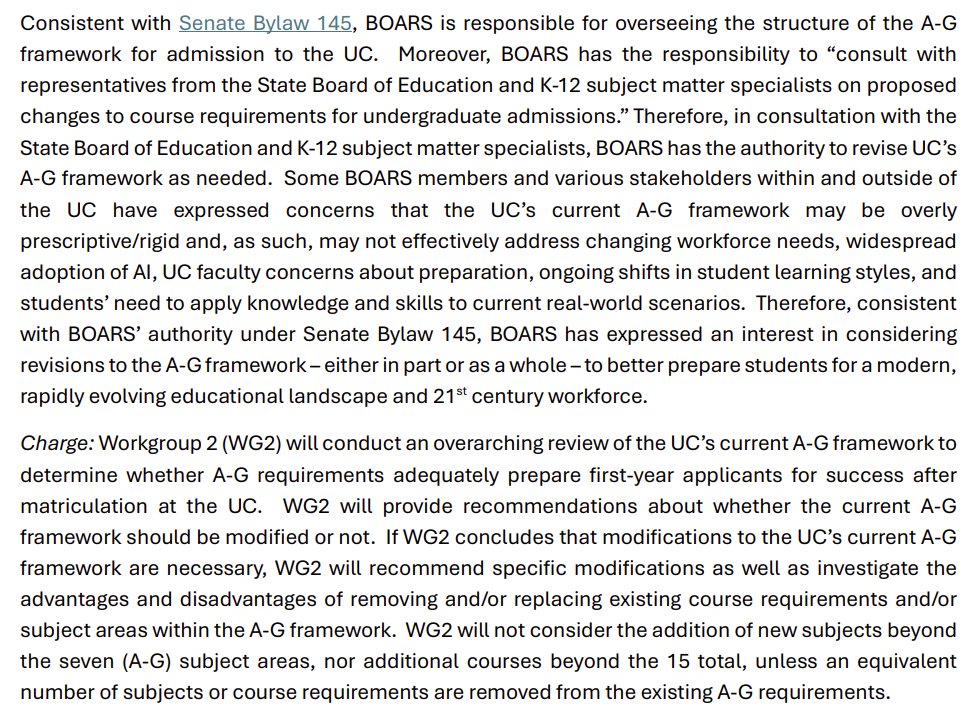
Looks like University of California leadership is going to water down the admissions requirements right at the moment when they should instead be bringing back the SATs just like all the Ivies did

While faculty complain of rising student underpreparedness, University of California leadership is concerned our minimum admission requirements are "overly rigid" and convened a workgroup to investigate reducing them.
Notably, the workgroup is not allowed to consider enhancing requirements, only reduce them.
I guess they thought everyone is so focused on the SAT that no one would notice this getting snuck in.
23
39
328
36,640
The same people behind the California Math Framework debacle are up to their old tricks: water down the admissions standards and the curriculum
The kids lose x.com/minilek/status/2066171…
Some of the talking points in the document for why we may need to remove/replace requirements include "changing workforce needs", "widespread adoption of AI", and "students’ need to apply knowledge and skills to current real-world scenarios".
These were basically all the talking points of the California Math Framework (CMF) for why we needed to dumb down high school math.
That's no accident. Guess who's partnering with the UC on this workgroup? The State Board of Education -- the state body that adopted the CMF.
3
1
28
7,898