
Early projects. A web3 girl. NFTs, DeFi. Six figures in 2026, insha'Allah.
Joined January 2023
- Tweets 1,387
- Following 630
- Followers 86
- Likes 2,224
89 Photos and videos









Pinned Tweet

25 Jul 2025
Whether you like it or not,
Data is an integral part of our lives.
You'll see that access to data helps many to make a living.
IRYS is taking data a step further by
Making it programmable and permanent.
Data powers our world and you should stay with @irys_xyz
2
1
5
529
NFT Nexus 🐬TermMax retweeted

𝐦𝐲 𝐟𝐚𝐭𝐡𝐞𝐫 𝐧𝐞𝐯𝐞𝐫 𝐟𝐢𝐧𝐢𝐬𝐡𝐞𝐝 𝐚𝐧𝐲𝐭𝐡𝐢𝐧𝐠.
not the old car he bought in 2011 with full intentions of fixing it, which sat under a tarp in the compound getting older while he got busier.
not the diary he started three separate times in three separate notebooks,
each one abandoned somewhere around the fourth or fifth entry when real life crowded the page out.
i grew up around that unfinished painting, and I think it made me look at art differently. not with wonder but suspicion. like I was always waiting for the moment the artist decided it was enough and walked away.
I have seen a lot of art since then. galleries, exhibitions, collections, drops. enough to develop taste and enough to develop the particular tiredness that comes with taste.
the feeling that you have seen the shape of most things before they finish showing themselves to you.
then that day, I watched Dima draw a bird live on here. I was fascinated and I really wanted to see it to the end, which I did.
---------
𝐰𝐡𝐚𝐭 𝐬𝐭𝐨𝐩𝐩𝐞𝐝 𝐦𝐞 𝐰𝐚𝐬 𝐧𝐨𝐭 𝐭𝐡𝐞 𝐢𝐦𝐚𝐠𝐞. 𝐈𝐭 𝐰𝐚𝐬 𝐭𝐡𝐞 𝐦𝐞𝐭𝐡𝐨𝐝.
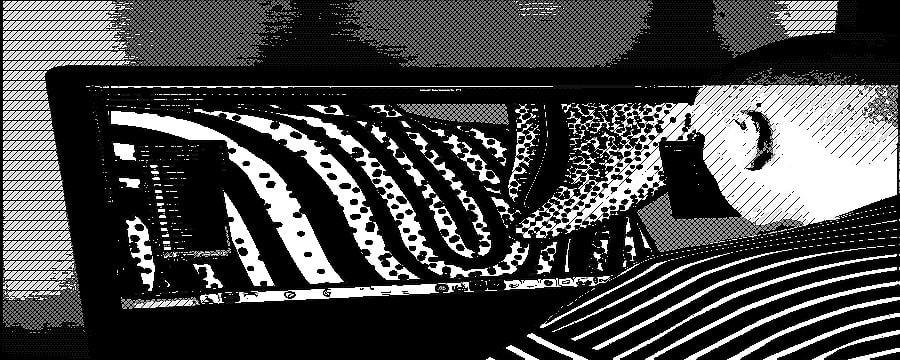
stippling builds a picture entirely from individual dots. there are no lines or blending or even brushstrokes that cover uncertainty with movement.
every mark is a decision, and every decision is permanent, and the image only becomes itself through the accumulation of thousands of those decisions made one at a time with complete commitment.
I have seen painterly work. I have seen precise work. I have seen work that rewards close inspection and work that only works from a distance.
I have not seen work that operates at both scales the way Kashtalyan's does, where the dot up close is its own universe and
the creature at a distance is something else entirely, and somewhere between those two views something happens that I cannot fully explain and do not want to.
most art asks you to look at it. his asks you to be inside it.
---------
𝐭𝐡𝐞 𝐲𝐞𝐚𝐫𝐬 𝐨𝐟 𝐰𝐨𝐫𝐤
Kashtalyan has been doing this for >20 years.
before the dots ,
there were walls in Minsk, spray cans, and graffiti that lived for hours before someone painted over it.
that early reality shaped everything after it.
when your work disappears that easily, you either stop or you learn to build differently, and he chose to build differently.
he moved into illustration, and the language deepened. dot by dot, he started earning the kind of attention that does not come from marketing.
The New York Times called him. Harper's Magazine called him. MIT Technology Review called him. Galleries in Rotterdam, Taipei, London, Seoul and Barcelona. A 25-metre mural stippled across seven days at a festival in Romania, built in full knowledge that weather would eventually come for it.
𝘏𝘦 𝘣𝘶𝘪𝘭𝘵 𝘪𝘵 𝘢𝘯𝘺𝘸𝘢𝘺.
I have seen artists with impressive lives' work.
what is different here is that every single credit on that list was earned through the same method, the same patience, the same refusal to simplify.
there is no early work you have to forgive and no late work you have to make excuses for.
the dots were always this deliberate. the commitment was always this complete.
---------
𝐭𝐡𝐞 𝐛𝐞𝐚𝐤𝐬
The Beaks is his first NFT collection. 1,111 pieces, each one built in the same stippled language that got him everything else.
the number is a quality threshold. It is how many he can make well. that is the only number that mattered to him, and it shows.
the central figures are beaked creatures, surreal and precise and completely inevitable once you see them.
Hybrid forms dressed with intention, built dot by dot until they stop looking constructed and start looking like they were always going to exist and someone finally had the patience to find them.
the beak is not a mascot choice. A beak is the most deliberate part of a bird. the instrument of voice, of survival, is the exact point where an interior life makes contact with the world outside it.
for an artist whose whole practice is built on honesty and the responsibility to say true things through the work, the beak is not a design decision.
It is a self-portrait.
---------
𝐭𝐡𝐞 𝐩𝐚𝐫𝐭 𝐭𝐡𝐚𝐭 𝐠𝐨𝐭 𝐦𝐞.
Kashtalyan spent twenty years making work on surfaces that could not hold it forever.
walls painted over.
murals that withered.
magazine pages that got recycled.
for someone whose entire philosophy is built around the importance of the mark, the belief that the fact of having been here and felt something deserves to be recorded, that impermanence was not just a logistical problem. it followed him.
going onchain solves that. what is onchain does not get painted over.
the record is permanent in a way no wall has ever been and no magazine page has ever been. for an artist who kept working in faith for two decades, faith that the right surface would eventually exist, this is not a trend he jumped on.
it is the answer the practice was always waiting for.
---------
𝐃𝐢𝐦𝐚 𝐟𝐢𝐧𝐢𝐬𝐡𝐞𝐬 𝐞𝐯𝐞𝐫𝐲𝐭𝐡𝐢𝐧𝐠
The Beaks is described as a genesis collection. the first chapter of a universe twenty years in the making.
here it means something because the body of work behind it is real and verifiable and built the hard way, dot by dot, on surfaces that kept disappearing, by a man who kept going anyway.
my father's old car is still under the tarp. The third diary is still somewhere in the house, abandoned around the fifth entry, exactly where life crowded it out.
I used to see an abandoned thing.
now I see a man who got close enough to completion to feel afraid of it and stopped just before the moment where it would have become real forever.
I watched Dima sit down that day, here, live and finish drawing the bird in real time.
same hand that painted walls in Minsk. same patience that built twenty years of work on surfaces that kept disappearing.
except this time the surface holds.
I have seen a lot of art. I was not prepared for this one.
@thebeaksart @DKashtalyan

who got SPARK token?
I’m trying to add the CA in my wallet, looks like Zerion don’t have that feature
happy for you, if you did
small stimmy like that comes in handy
keep winning and have a great day!
ps: when will Somnia release our tokens? @TermMaxFi too👀

15
3
41
1,775
hope you're not slacking off on @TermMaxFi , use the dapp for lending and borrowing seamlessly
5
5
164
Apr 29
hey guys, here's how to get easy 2k MP points on @TermMaxFi
simply tweet with #TermMaxPuzzleChallenge and submit the link for verification.
you get points to boost your position on the leaderboard,
2
1
140
Apr 14
have you noticed that defi protocols just give you a rate,
but @TermMaxFi is the opposite, it gives rate to plan around and to take orders
easy peasy.

there's an opportunity to earn up to 2k MP on @TermMaxFi by creating content, are you hopping on it?
4
5
148
NFT Nexus 🐬TermMax retweeted
looks like we'll see @TermMaxFi tge soon
introducing $TMX, are you positioned?
1
1
195
NFT Nexus 🐬TermMax retweeted
the next chapter of DeFi is structure
and it's already live on @TermMaxFi
i hope you're there already
looks like we'll see @TermMaxFi tge soon
introducing $TMX, are you positioned?
1
1
98
there's an opportunity to earn up to 2k MP on @TermMaxFi by creating content, are you hopping on it?
the next chapter of DeFi is structure
and it's already live on @TermMaxFi
i hope you're there already
1
179
NFT Nexus 🐬TermMax retweeted
Mar 30
so many things to do on @TermMaxFi
deposit, bridge and create content dailty to improve your ranks
don't forget today's check in
Mar 24
a friend recently connected my to @TermMaxFi and I'm thinking of trying it.
so, expect more of lending borrowing content from this page
ciao
1
1
22
Mar 28
more opportunities to explore on @TermMaxFi

Your borrow position, your rules.
One-click rollover from TermMax to @Morpho is now live!
• Roll fixed on TermMax to later maturity
• Roll variable on Morpho
• Exit before maturity
Fixed-rate borrowing just got way more flexible.
1
9
NFT Nexus 🐬TermMax retweeted
Mar 26
seen this?
you can now long or short these tokens without the fear of liquidation on @TermMaxFi
don't miss out on ths juicy update
You can LONG/SHORT the following tokens 𝘄𝗶𝘁𝗵𝗼𝘂𝘁 liquidation on @BNBCHAIN:
• @Stable's $STABLE
• @OndoFinance's QQQon, CRCLon
• @BitwayOfficial's $BTW
• @blockst_hq $BSB
Only on TermMax Alpha 👇
app.termmax.ts.finance/alpha…
1
1
24
Mar 27
if you participated in @TermMaxFi frontend guardian bug bounty,
the results are in!! you can check yours rn
The results for our Frontend Guardian Bug Bounty are in🛡️
We received 2,000 submissions
Thank you to everyone who took the time to help us improve TermMax.
Full results & reward details 👇
discord.ts.finance
1
12
NFT Nexus 🐬TermMax retweeted

You can LONG/SHORT the following tokens 𝘄𝗶𝘁𝗵𝗼𝘂𝘁 liquidation on @BNBCHAIN:
• @Stable's $STABLE
• @OndoFinance's QQQon, CRCLon
• @BitwayOfficial's $BTW
• @blockst_hq $BSB
Only on TermMax Alpha 👇
app.termmax.ts.finance/alpha…
12 Nov 2025
TermMax Alpha is live on @BNBCHAIN!
You can now leverage assets on BNB Chain 𝘄𝗶𝘁𝗵𝗼𝘂𝘁 𝗹𝗶𝗾𝘂𝗶𝗱𝗮𝘁𝗶𝗼𝗻𝘀
app.termmax.ts.finance/alpha…
1/7
28
8
45
10,087
NFT Nexus 🐬TermMax retweeted
Mar 24
a friend recently connected my to @TermMaxFi and I'm thinking of trying it.
so, expect more of lending borrowing content from this page
ciao
1
1
61
NFT Nexus 🐬TermMax retweeted
Mar 25
goodnews to all @TermMaxFi users
TermMax is now live on
@XLayerOfficial, yayy
from March 23 - April 6, 8:00 UTC,
deposit to USD₮0 Vault on X Layer to earn 𝟭𝟮𝟬𝘅 𝗫𝗣 X Layer Early Depositor Badge.
min. $10 equivalent to qualify, dont miss it
more badges to collect
Mar 24
a friend recently connected my to @TermMaxFi and I'm thinking of trying it.
so, expect more of lending borrowing content from this page
ciao
1
1
29