Human Intracranial Cognitive Neuroscience & Neurology Lab, PI Randolph Helfrich, @dfg_public Emmy Noether Group @uni_tue, @uktuebingen, @TueNeuroCampus
Joined January 2022
- Tweets 151
- Following 707
- Followers 1,103
- Likes 278
18 Photos and videos
HelfrichLab retweeted
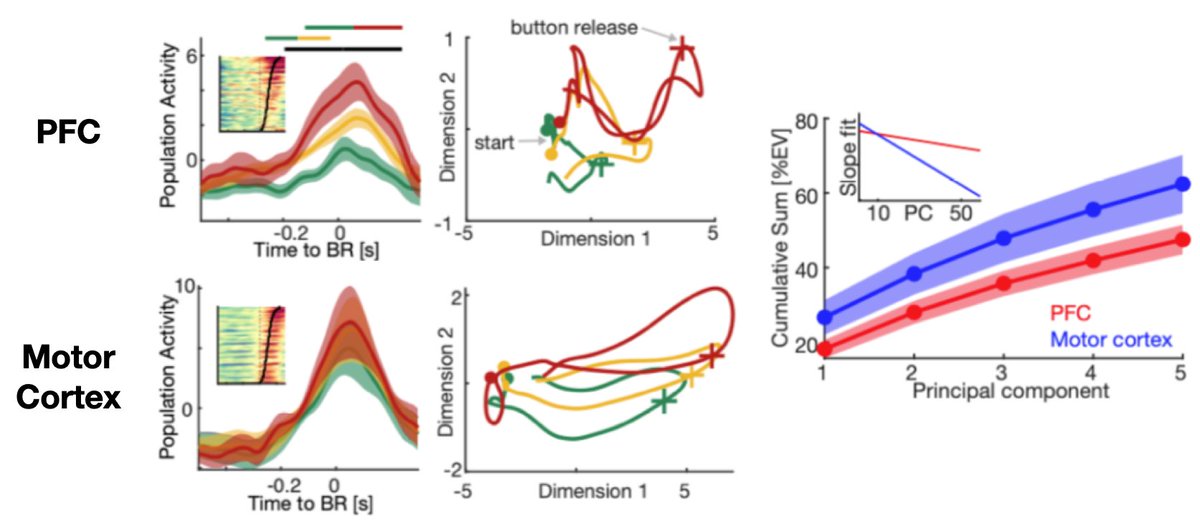
Anatomy sets things up, but it’s not the whole story. A low-D communication subspace from PFC to motor cortex reconfigures with context, routing signals so the same movements can be driven by different rules without rewiring the network.
nature.com/articles/s41593-0…
#neuroscience
2
28
113
5,250
HelfrichLab retweeted

Jan 21
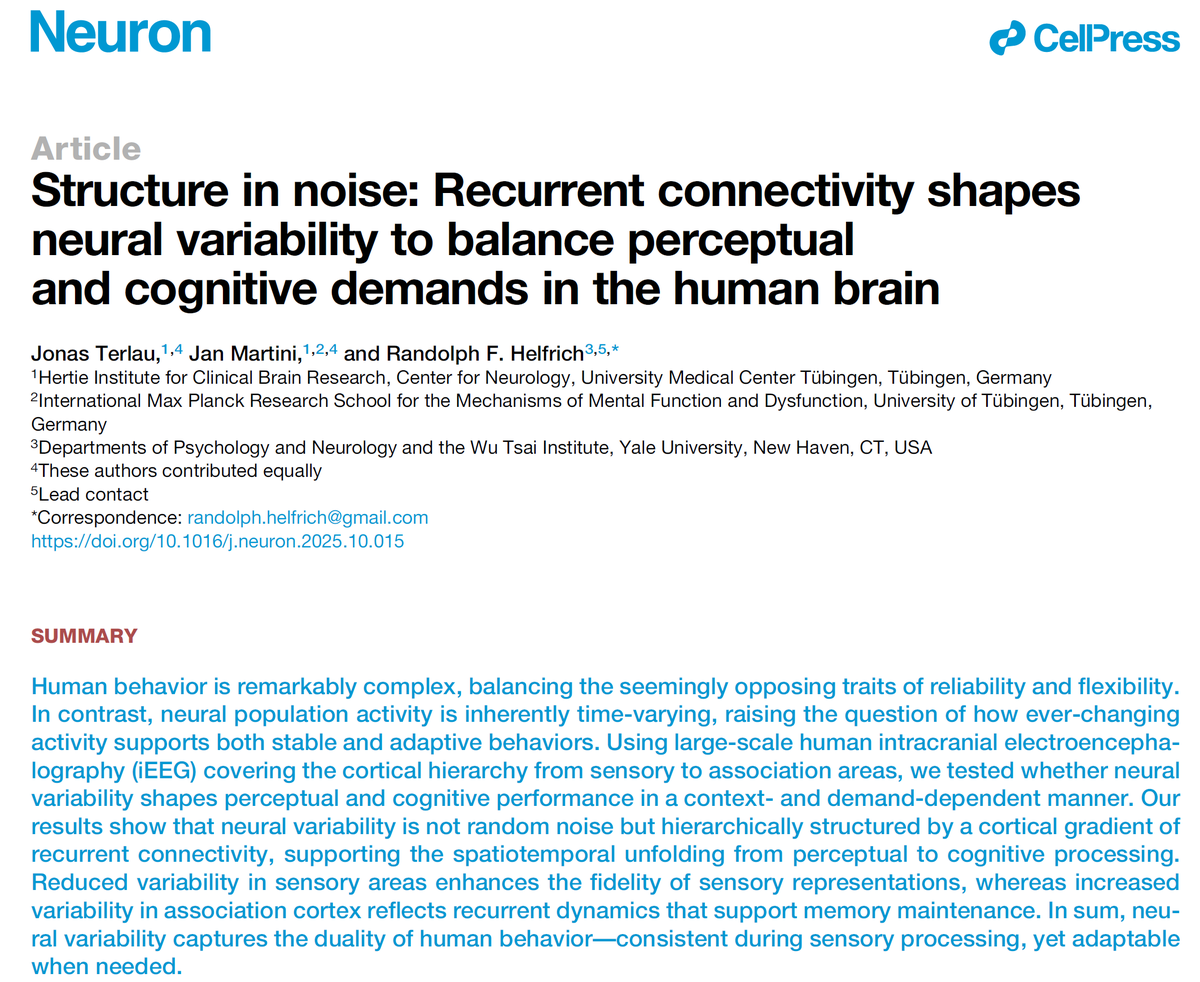
𝗪𝗵𝗮𝘁 𝗶𝘀 𝗻𝗼𝗶𝘀𝗲 𝗶𝗻 𝘁𝗵𝗲 𝗯𝗿𝗮𝗶𝗻?
Almost always we average responses thus equating response variability with noise.
Well, we shouldn't because variability is also signal, not noise to be entirely discarded.
doi.org/10.1016/j.neuron.202…
4
73
302
16,600
HelfrichLab retweeted

4 Dec 2025
Our new paper is out in @NatureNeuro
How do large-scale brain networks route information about where/what to attend at fast timescales?
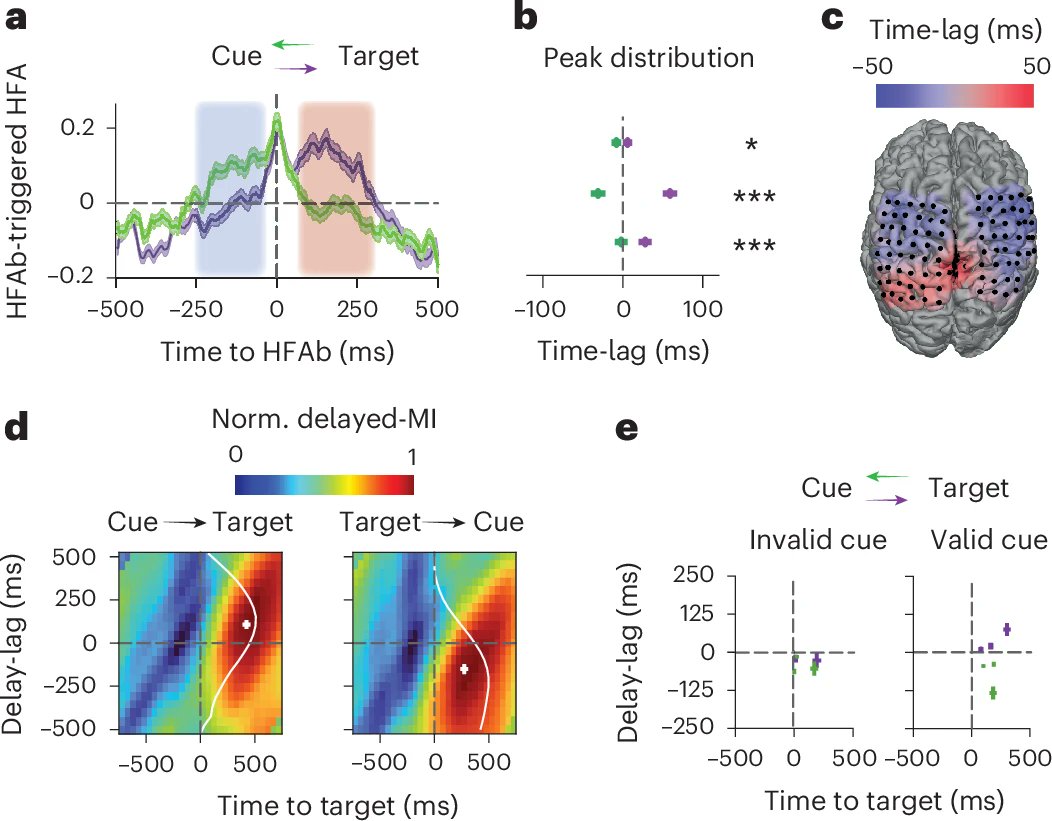
High-frequency bursts facilitate fast communication for human spatial attention
nature.com/articles/s41593-0…
Using intracranial EEG recordings and spiking neural network modeling we demonstrate that transient bursts of high-frequency activity (HFAbs) in the human brain facilitate attentional performance and support fast, large-scale information routing.
We show:
- HFAbs are synchronized brain-wide.
- HFAbs are strongly coupled to slower brain rhythms but transiently decouple during active processing, such as cue and target periods.
- Network-level synchronization patterns of HFAbs reveal functional subnetworks for cue and target processing.
- HFAbs in cue subnetworks predict behavioral accuracy following cue onset, and precede target subnetworks following target onset when cues are informative for target detection.
- Using spiking neural network models, we show that HFAbs reflect state transitions in population activity, and a four-network model demonstrates attention-mediated fast HFAb communications enhances probability of target detection.
We demonstrate that transient bursts of high-frequency activity (HFAbs) in the human brain facilitate attentional performance and support fast, large-scale information routing. Using intracranial EEG recordings and spiking neural network modeling we show:
We demonstrate that transient bursts of high-frequency activity (HFAbs) in the human brain facilitate attentional performance and support fast, large-scale information routing. Using intracranial EEG recordings and spiking neural network modeling we show:
1
11
42
2,548

10 Nov 2025
New work from the lab now published in @NeuroCellPress
8 Nov 2025

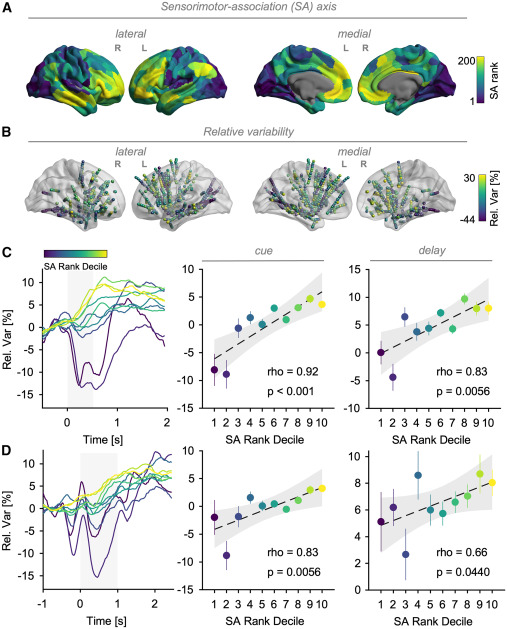
Online now: Structure in noise: Recurrent connectivity shapes neural variability to balance perceptual and cognitive demands in the human brain dlvr.it/TP83lF
3
8
3,230
HelfrichLab retweeted

15 Nov 2024
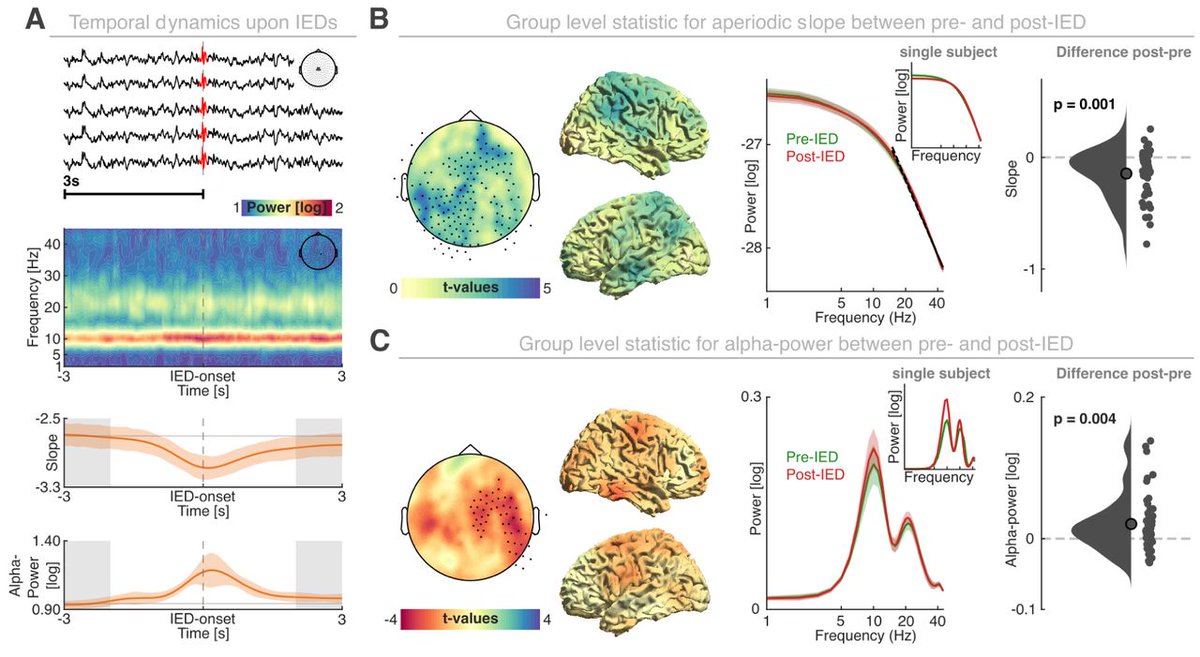
#eNeuro: Kopf and colleagues directly tested whether MEG background activity reflects hyperexcitability in a patient cohort suffering from generalized epilepsy. Their results demonstrate that background activity does not constitute random noise, but reflects excitability dynamics, which define the current brain state. @HelfrichLab @TueNeuroCampus @HIHTuebingen
eneuro.org/lookup/DOI/10.152…
8
12
2,242
17 Oct 2024
Lastly, several other groups recently investigated sleep timescales, including @mo_s_ameen and @Tomdonoghue or @AthinaTzovara who preprinted cool work on @biorxiv_neursci that jointly suggests that intrinsic timescales shape the brain state during sleep. (5/7)
1
3
668
17 Oct 2024
For more background on timescales, see @roxana_zeraati and @_rdgao excellent recent review on timescales. Also check out the summary in the ‘This Week in the Journal’ for a summary: jneurosci.org/content/44/42/… (6/7)
1
3
621
17 Oct 2024
Work conducted at @TueNeuroCampus @uktuebingen @HIHTuebingen @uni_tue and funded by @HertieNeuroSci, @JungStiftung, @dfg_public and @MedTuebingen. In collab. with Pål Larsson and @linjj4. Thanks everyone! (7/7)
1
494
17 Oct 2024
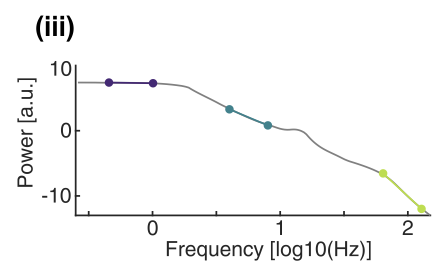
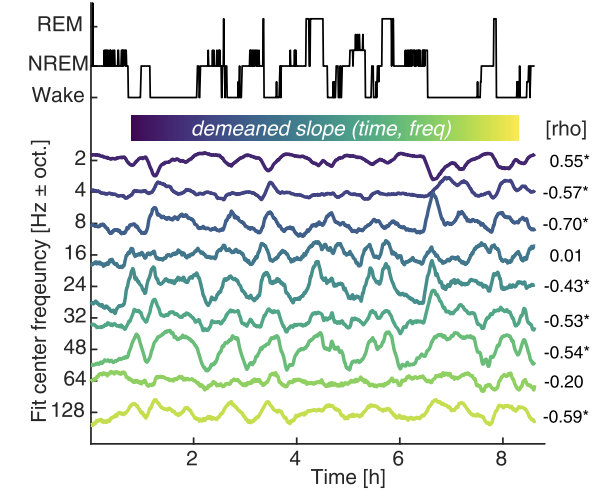
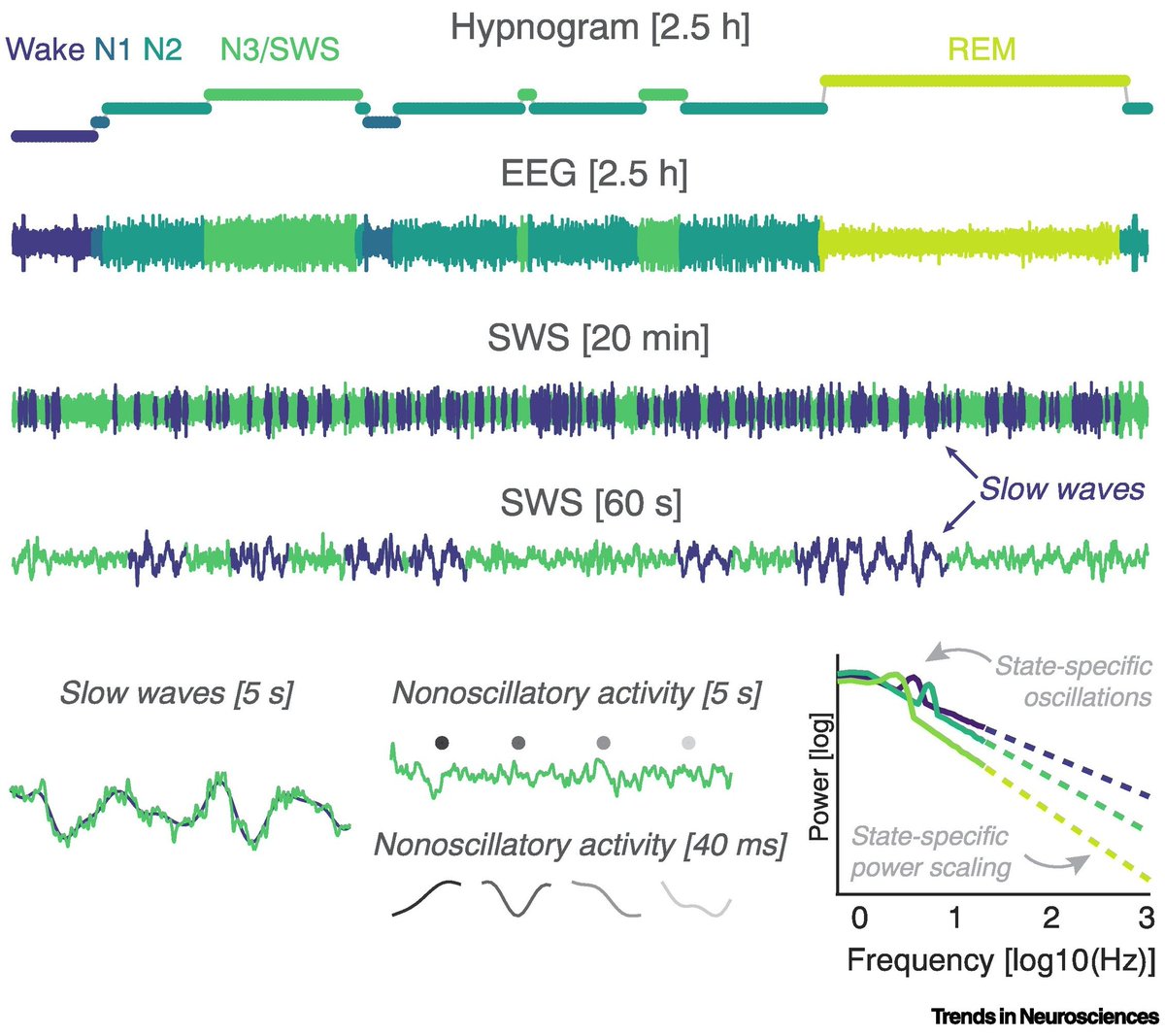
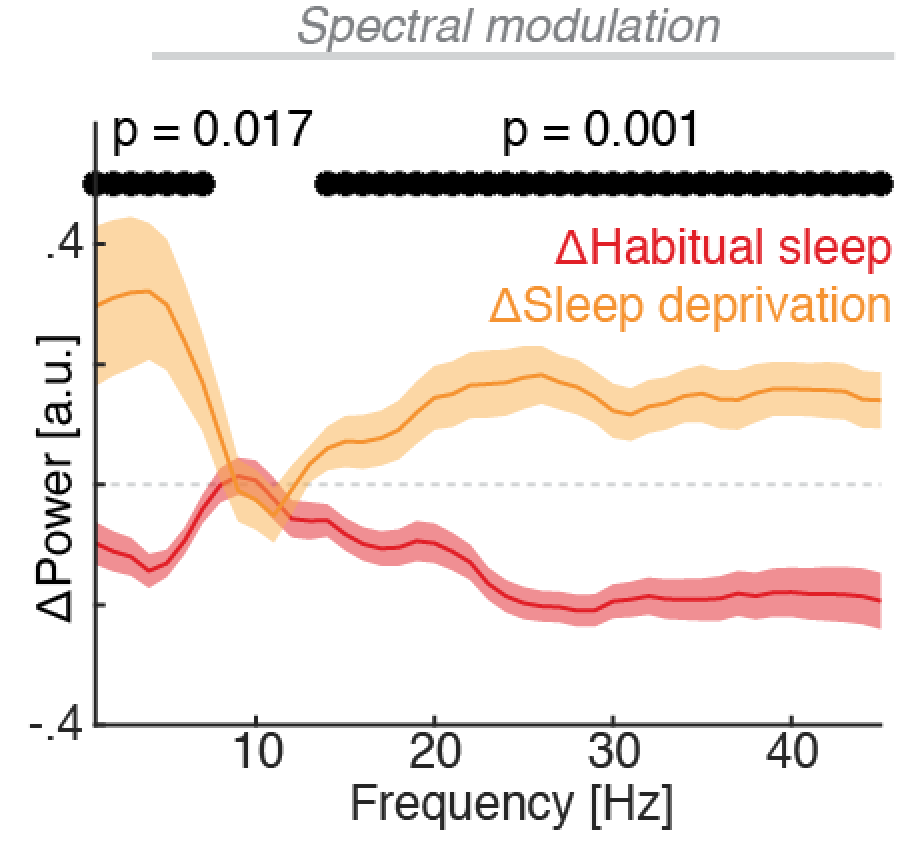
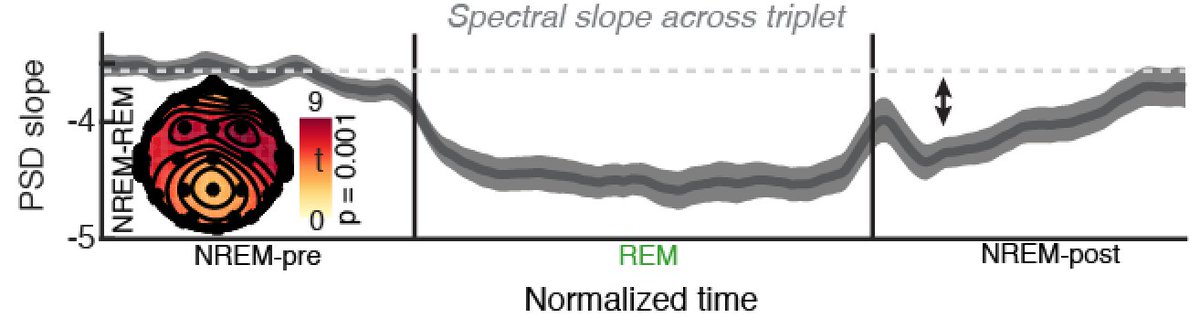
Are different sleep stages only defined by neural oscillations? Our new work led by @JannaLendner now out in JNeuro @SfNJournals demonstrates that several aperiodic (intrinsic) timescales shape the iEEG power spectrum during sleep: jneurosci.org/content/44/42/… (1/7)
2
13
47
5,414
17 Oct 2024
We devised an iterative fitting approach to estimate these spectral ‘knees’ in 3 independent iEEG datasets, including publicly shared data by @Kai_J_Miller published in @PLOSCompBiol and @NatureHumBehav, which enabled validating and replicating our approach. Thanks! (4/7)
1
1
376
17 Oct 2024
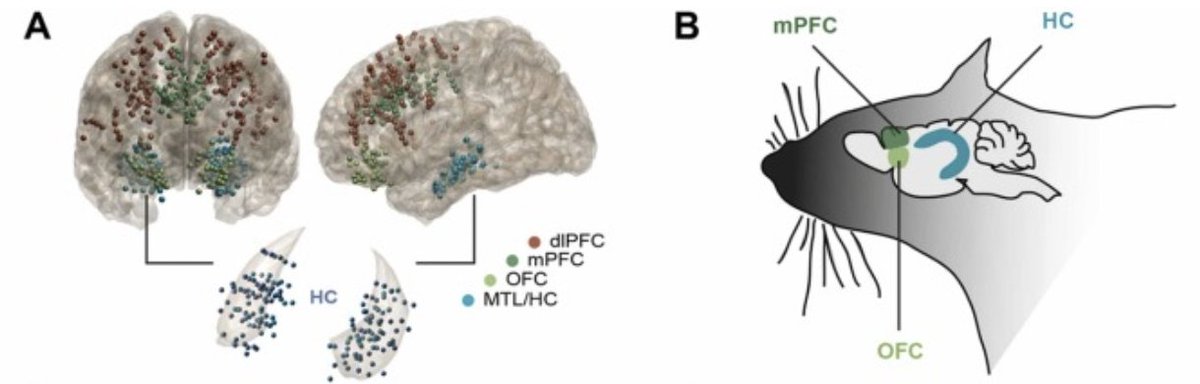
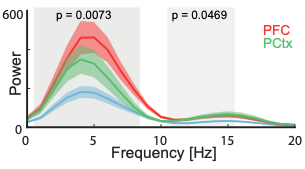
Turns out: It depends… The PSD exhibits multiple intrinsic timescales (‘knees’) that shape the 1/f decay function. Some of them are state-invariant, while others were state-specific. Moreover, 1/f behaviors differ between different brain regions, such as the MTL and PFC. (3/7)
2
457
17 Oct 2024
We and others (e.g., @smpzzz) had previously observed that the spectral slope tracks the hypnogram, but results across studies varied with different fitting ranges (1-20 vs 30-50 Hz). We wondered where should we fit the spectral slope to define distinct sleep stages? (2/7)
1
1
349
HelfrichLab retweeted

11 Oct 2024
A tradeoff between efficiency and robustness in the hippocampal-neocortical memory network during human and rodent sleep
doi.org/10.1016/j.pneurobio.…
#neuroscience
7
25
2,950
14 Oct 2024
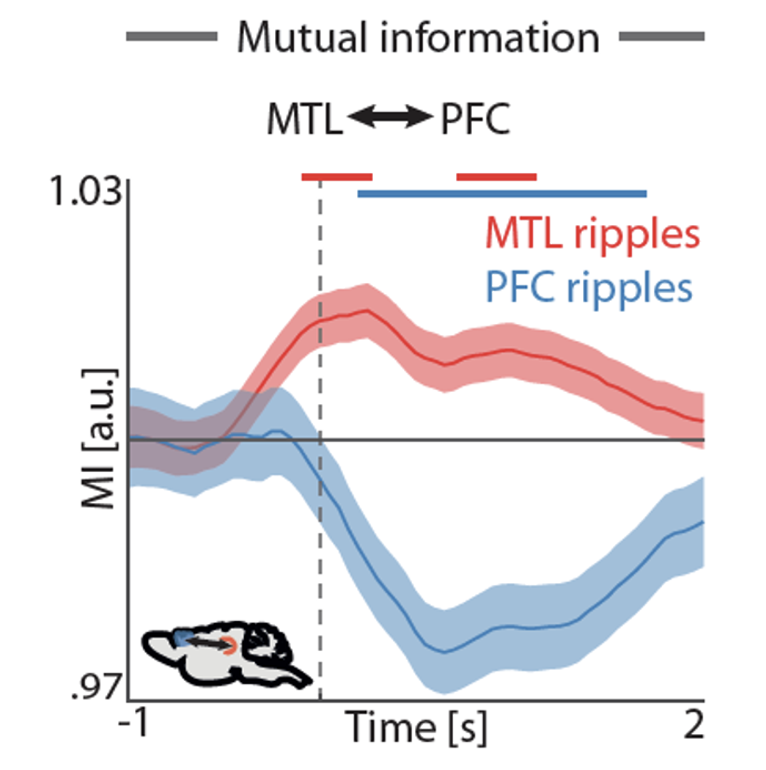
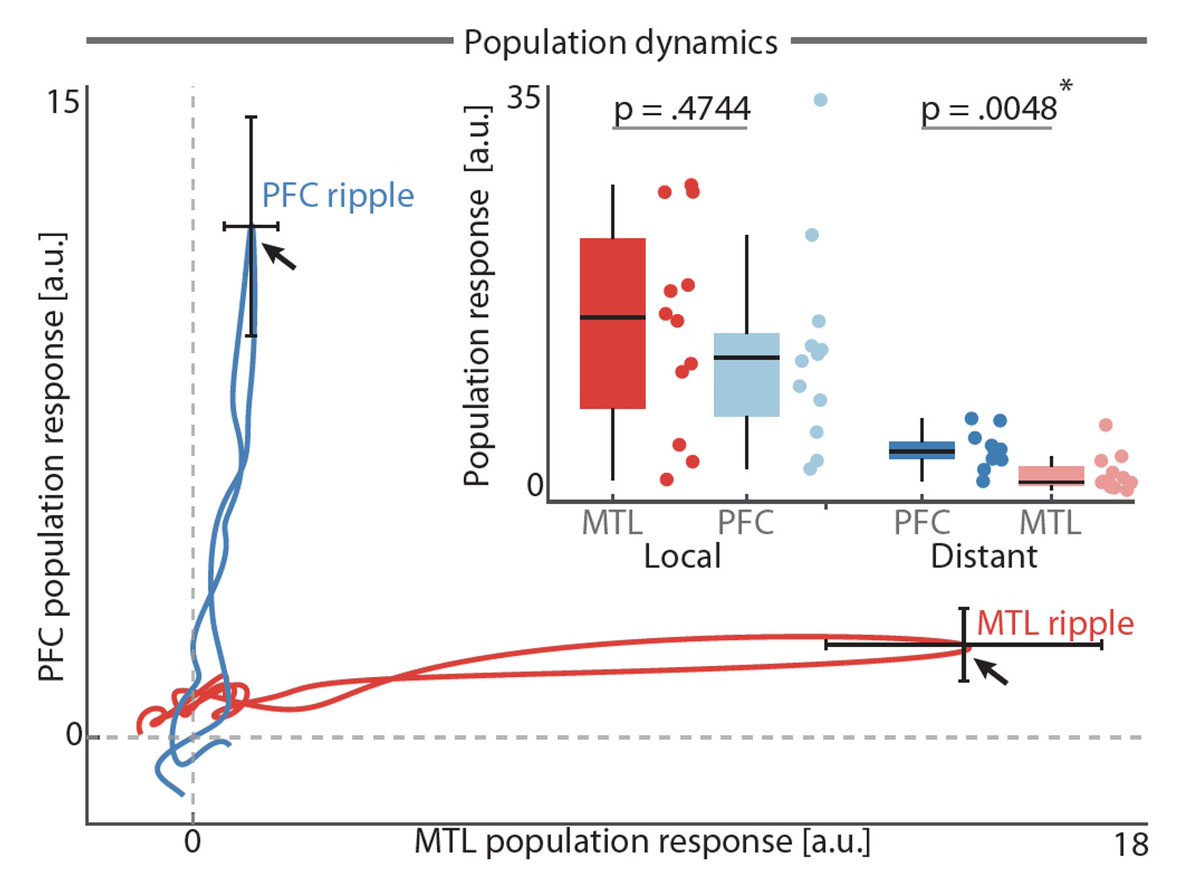
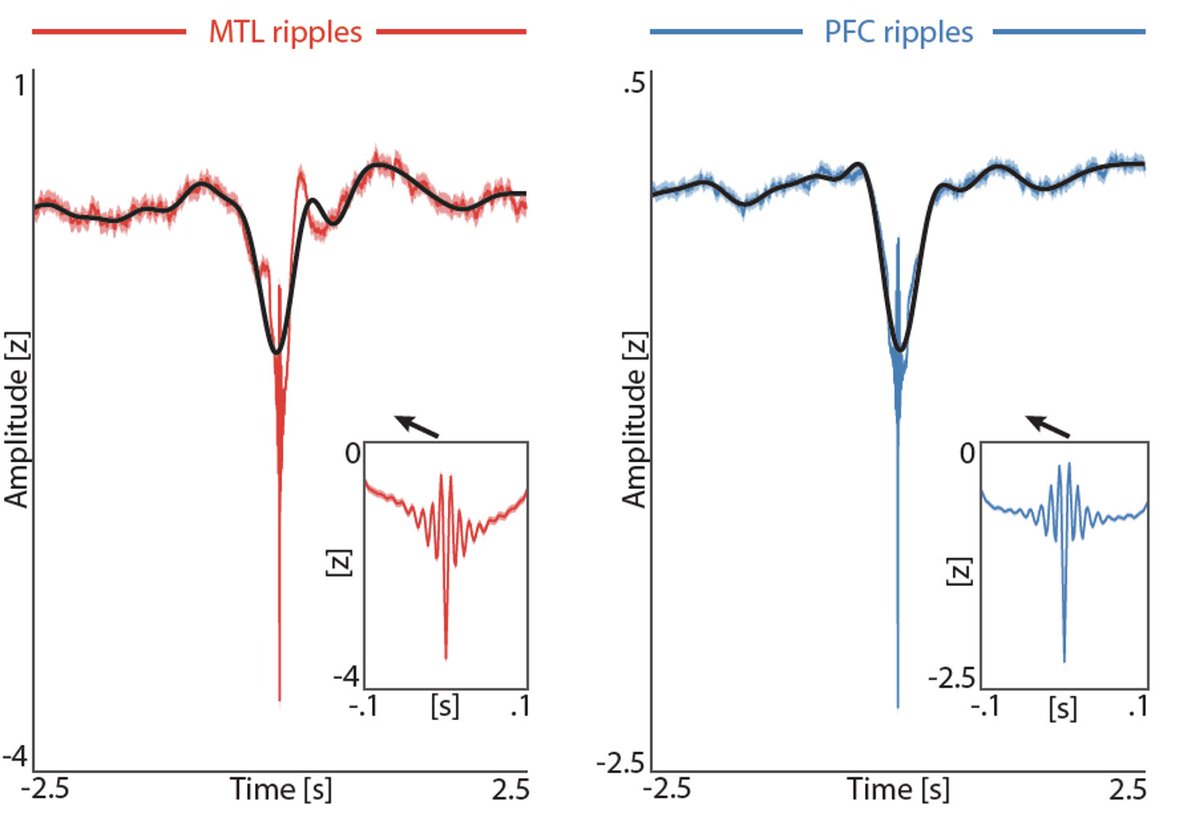
Does sleep free cognitive resources for efficient next-day processing? Are processing capacities similar in human and rodent sleep? How does the sleeping brain balance efficiency and robustness? New paper led by @HahnMic to answer these questions. sciencedirect.com/science/ar… (1/6)
1
8
38
4,003
14 Oct 2024
Critically, we observed that sleep rebalanced information processing capacities. Population activity was also more efficient during task engagement, while it was drastically reduced during propofol anesthesia (5/6).
1
2
383
14 Oct 2024
Work funded by @DAAD_Germany, @JungStiftung and @HertieNeuroSci at @uni_tue, @MedTuebingen, @HIHTuebingen, @TueNeuroCampus in collab. with @JannaLendner, @linjj4 and friends (6/6)
1
376
HelfrichLab retweeted

14 Oct 2024
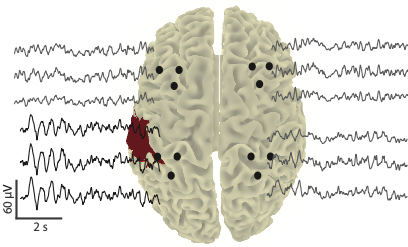
Check by a 5yr journey of the lab in mice & humans, just up on bioRxiv! Post-ictal symptoms can be life-threatening, & basic mechanisms are mostly unclear. 1/2 biorxiv.org/content/10.1101/…
1
9
19
2,592