
Joined May 2018
- Tweets 4,705
- Following 4,963
- Followers 1,592
- Likes 47,680
551 Photos and videos












Pinned Tweet

My new blog post!
Information Security in the US Firearm Industry
cybersecuritydave.com/p/info…
1
1
54
Cybersecurity Dave retweeted

> lay off a bunch of people
> replace with AI slop machine 9000 turbo edition
> everything breaks and implodes
wow its the future

lmao. Facebook’s down because…
*drumroll*
… they didn’t lint the program that sends its json, and now its malformed.
Another classic from the golden age of AI slop code.

42
180
2,761
110,854
Cybersecurity Dave retweeted

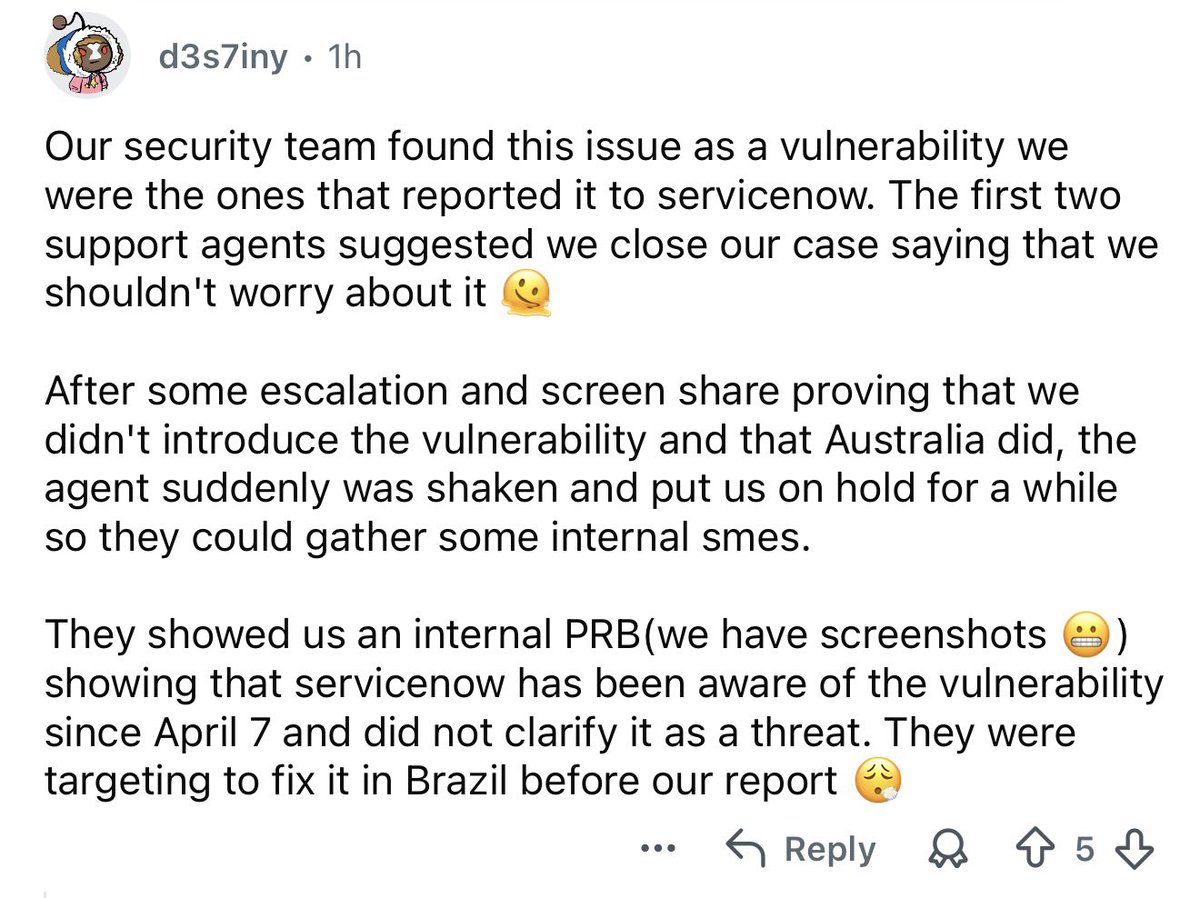
‼️🚨 BREAKING: ServiceNow has been breached. Customers are reporting unauthorised access to their instances.
One customer states their security team reported this vulnerability to them, and they closed the case twice, saying they had already known since the 7th of April.

93
731
3,860
872,535
Cybersecurity Dave retweeted

Jun 1
>companies and investors pour trillions into AI
>build data centers nobody asked for or wanted
>mass layoffs so you can replace senior devs with AI
>turns out AI/maintenance costs are astronomical
>is actually cheaper to just hire junior developers
>re-invent entry level jobs
This is how mass adoption of AI is going.

79
640
6,235
155,805
Cybersecurity Dave retweeted

Jun 1
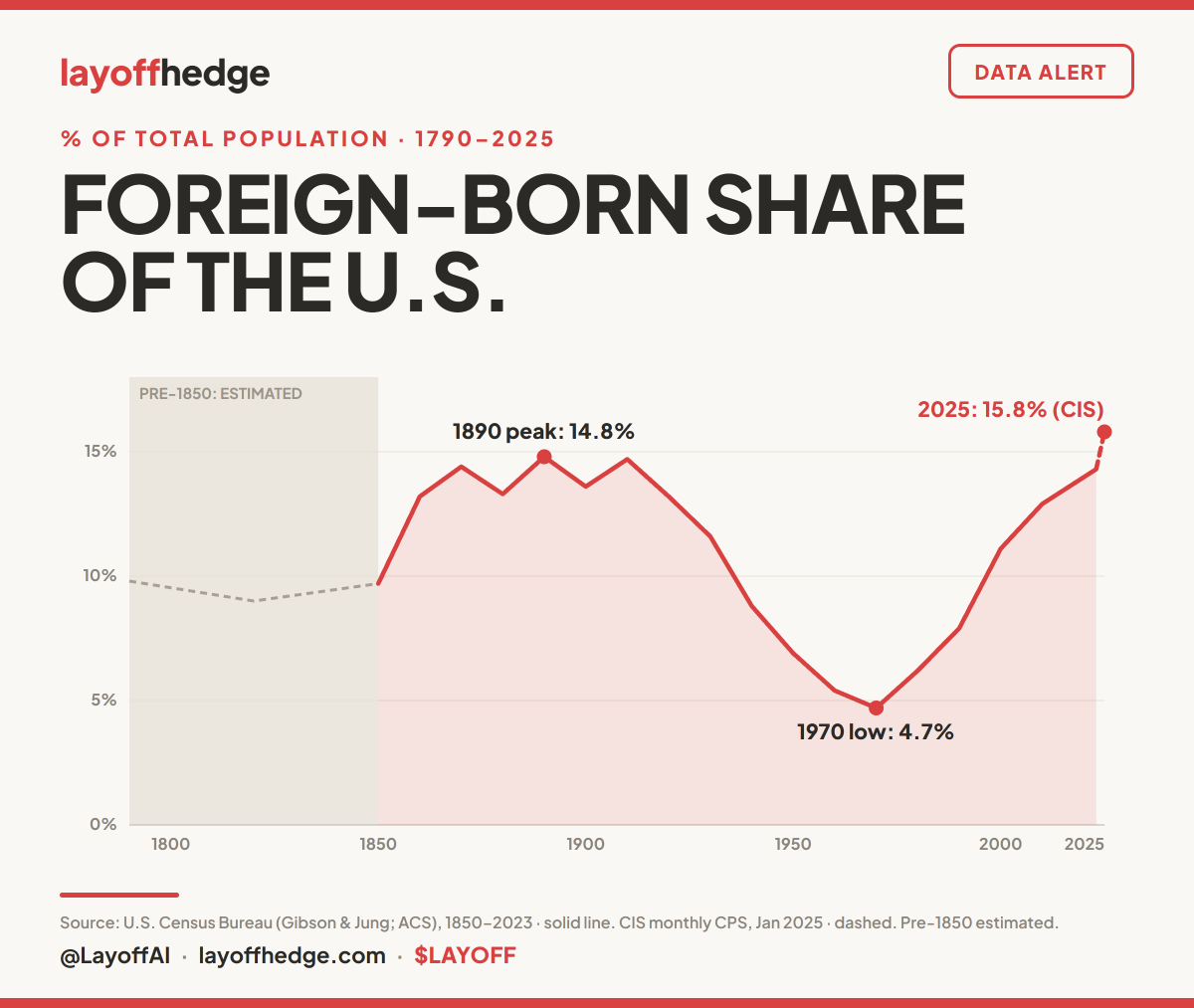
FOREIGN-BORN SHARE OF THE U.S. IS HIGHER THAN THE 1890s IMMIGRATION WAVE
The foreign-born share of the population hit nearly 16%. Compare that to under 5% in 1970.
WHY IT MATTERS. Since early 2020, nearly 9 in 10 of America's net new jobs went to foreign-born workers. Native-born workers captured almost none of the growth.
Here is how the country got here.
THE 1890s PEAK. There were almost no federal immigration limits, and a booming industrial economy pulled millions out of Europe. The foreign-born share reached 14.8% in 1890.
THE 1970 LOW. The 1924 quota laws slammed the door. The Depression and the war kept it shut. For four decades almost no one came, and the share fell to 4.7% by 1970, the lowest on record.
TODAY. The 1965 Immigration Act reopened the gates, and the share has climbed every decade since. The legal pipeline adds about 1 million green cards and 85,000 new H-1B workers a year (capped) and up to 60,000 more (uncapped from universities, non-profits, etc.)... plus 1.5 million foreign students who can roll straight into U.S. jobs through OPT. Most of these renew indefinitely, as shown by the 94% approval rate of H-1B renewals and transfers. The 2021 to 2024 border surge then pushed the total to a record 53.3 million.
Where do we go from here?
The Trump administration’s policies have begun to make progress. Net international migration has plummeted (due to illegal policies, mostly), and the foreign-born share has declined from its January 2025 record high of 15.8%, the first sustained drop in decades. That said, the absolute number of foreign-born residents remains near historic highs, and legal high-skilled pipelines (H-1B, OPT, green cards) continue, albeit with new restrictions and higher hurdles.
It feels like we are at an inflection point.
7
65
187
9,050
Cybersecurity Dave retweeted

May 29
Rough week for the "AI is taking our jobs" narrative.
> Amazon just axed its AI leaderboard as costs soared with no clear payoff
> Starbucks' AI can't even count coffee cups right
> Uber burning a $3.4B AI budget in just 4 months with nothing to show for it
WE ARE SO BACK.
May 28

NEW: Amazon has reportedly scrapped its internal AI leaderboard as costs soared, with a senior executive telling staff: “don’t use AI just for the sake of using AI.”
205
1,414
13,004
1,426,070
Cybersecurity Dave retweeted

We're in the weirdest job market of all time.
From 2020 to mid 2022, companies were hiring at a pace that made no sense.
Some teams grew 50%, some doubled. Everyone was afraid of missing out on talent, so they just kept adding headcount. If you could spell the word "javascript" you could land a remote role and a 25% raise.
Then the second half of 2022 hit and the hangover started. Layoff after layoff. Each wave was supposed to be "the last one."
Now in 2026 there are already over 130,000 tech layoffs and we still have another 6 months to go in the year.
The twist this time is AI.
Companies aren't just saying they overhired anymore.
They're saying AI is making them leaner. That they can do more with fewer people. It's become the convenient new reason that sounds strategic while making their stock pop.
But here's where it gets absurd.
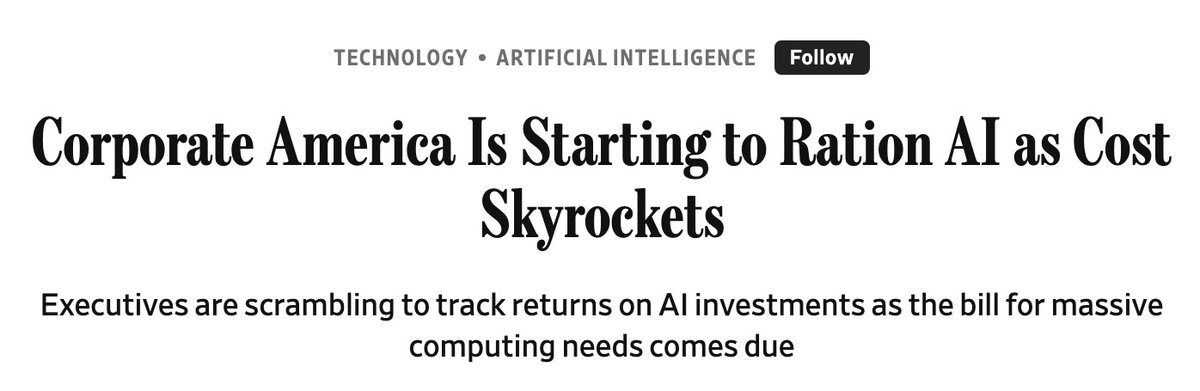
More and more companies are admitting the AI math isn't working out. They can't find the ROI they promised their boards. The computing costs are massive. It's more expensive than they thought, not less.
So let me get this straight.
We're in a job market where companies fired their workforce to buy something they now say is too expensive and doesn't work as advertised.
And the executives responsible for those decisions? They're still collecting their bonuses.
Weirdest job market of all time.
130
259
1,997
268,301
Cybersecurity Dave retweeted

May 28
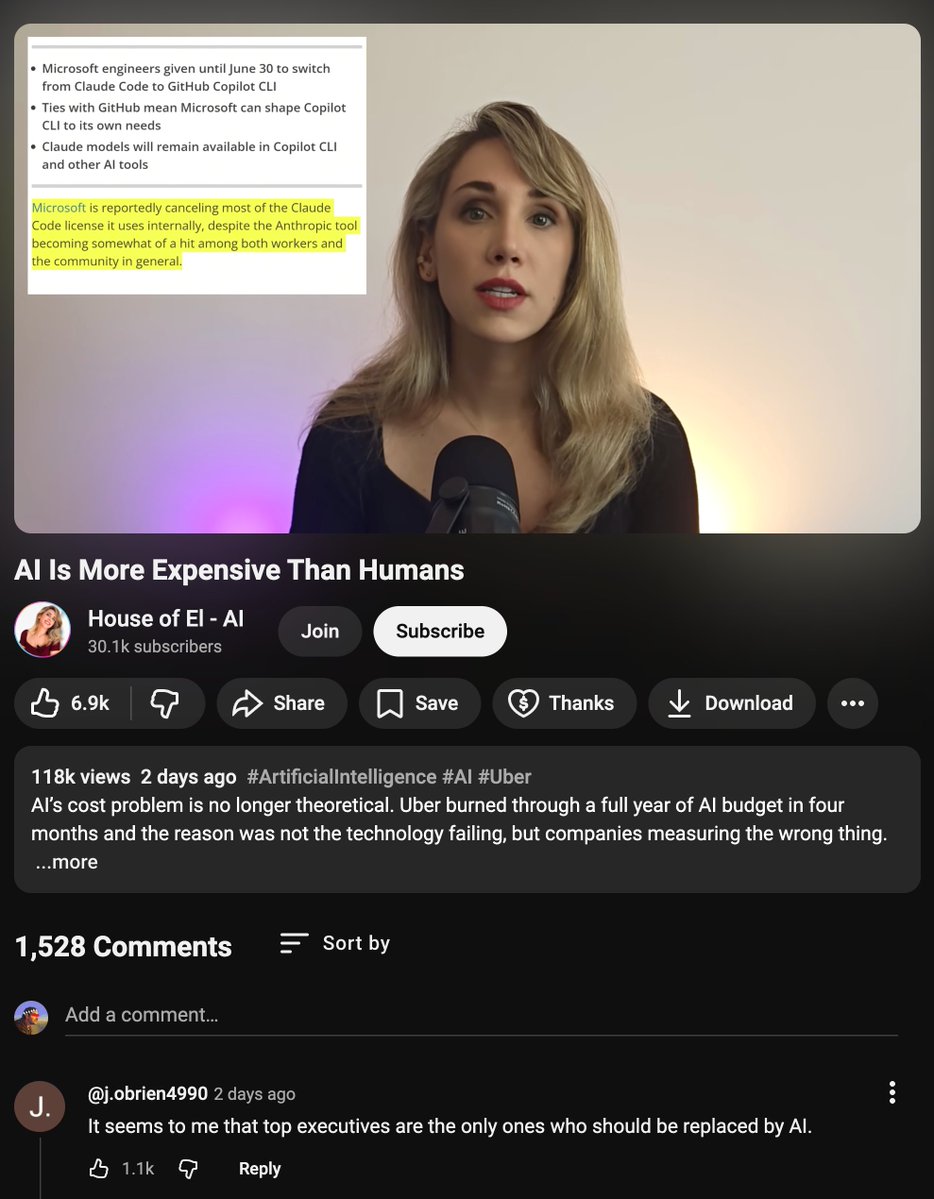
she's right, the industry seems to be in a state of mass psychosis. everyone is spending because everyone else is spending.
> Uber burned 12 months of budget in 4 months
> Meta used scoreboards for token usage
> Amazon told workers to "token max" on simple tasks
> Microsoft removed Claude access and forced Copilot
> Nvidia's token bill is bigger than employee payroll
tech executives are rewarding the size of the AI bill rather than the quality of its outcomes, and they're willing to cut loose the talented engineers who know every crack of their product to save money for this.
42
169
1,442
60,014
Cybersecurity Dave retweeted

May 28
Around the globe, countries are enacting laws to remove privacy on the internet. Your ability to go online without the government looking over your shoulder is being eroded.
Right now, Canada is trying to push Bill C-22 through as fast as possible. In its current form, the language is broad enough to let them force basically any digital business serving Canadians, including us, into logging up to a year of metadata.
We cannot let the government treat all Canadians as suspects in the name of crime prevention.
For our fellow Canadians, OpenMedia has been busy fighting against C-22 and put together a letter to send to your Member of Parliament.
Contact your MPs before it's too late. The government needs to see that there is resistance from the citizens. Go here: openmedia.org/StopC22 and send your message.

38
274
771
20,125
Cybersecurity Dave retweeted

May 28
Foreign workers have received 52% of American jobs since 2007
304
2,509
12,664
2,945,033
Cybersecurity Dave retweeted

May 27
Signing a secret security agreement with a police state is not normal for a democracy. Especially when that police state has already been caught setting up illegal police stations in multiple countries.
May 27

EXPLOSIVE 🧨
Mark Carney confirmed today Canadians will never know what’s in the security agreement he signed with CHINA 🇨🇳
47
463
1,101
24,769
Cybersecurity Dave retweeted

May 23
"All told, a remarkable two-thirds of the Valley’s nearly 400,000 tech jobs are now held by those born abroad, according to a 2025 report from the think tank Joint Venture Silicon Valley." realclearinvestigations.com/…
425
2,139
6,263
1,081,551
Cybersecurity Dave retweeted
May 25
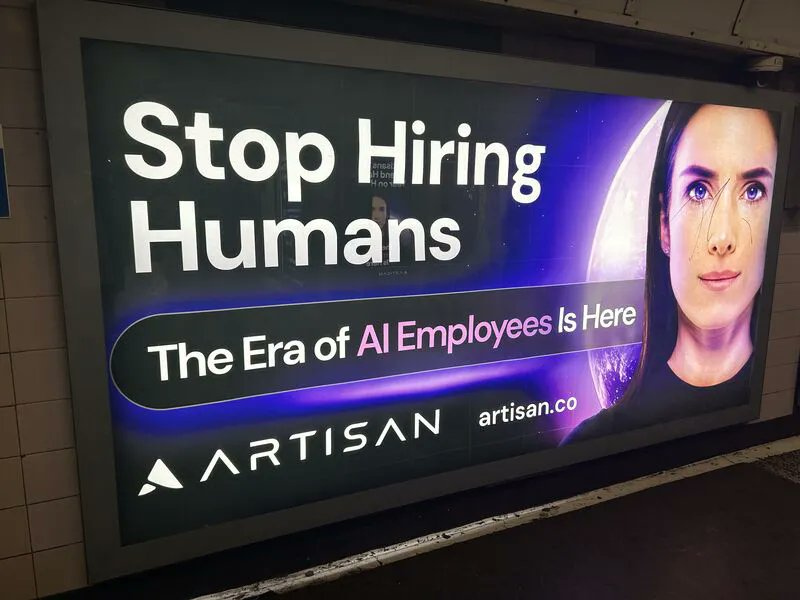
SO WHAT'S THE DEAL WITH THE "STOP HIRING HUMANS" ADS AROUND THE WORLD, ANYWAY?
A 23-year-old from England raised $46.8M to put "Stop Hiring Humans" billboards in Times Square and San Francisco.
His product? An AI that sends cold emails. Users report sending 1,000 with zero replies.
He still employs up to 190 humans.
Bernie Sanders called him out. His response: "Thank you for the free sponsored post."
Dystopian future, tone-deaf founder, or creative marketing campaign?
36
38
160
14,814
Cybersecurity Dave retweeted
May 19
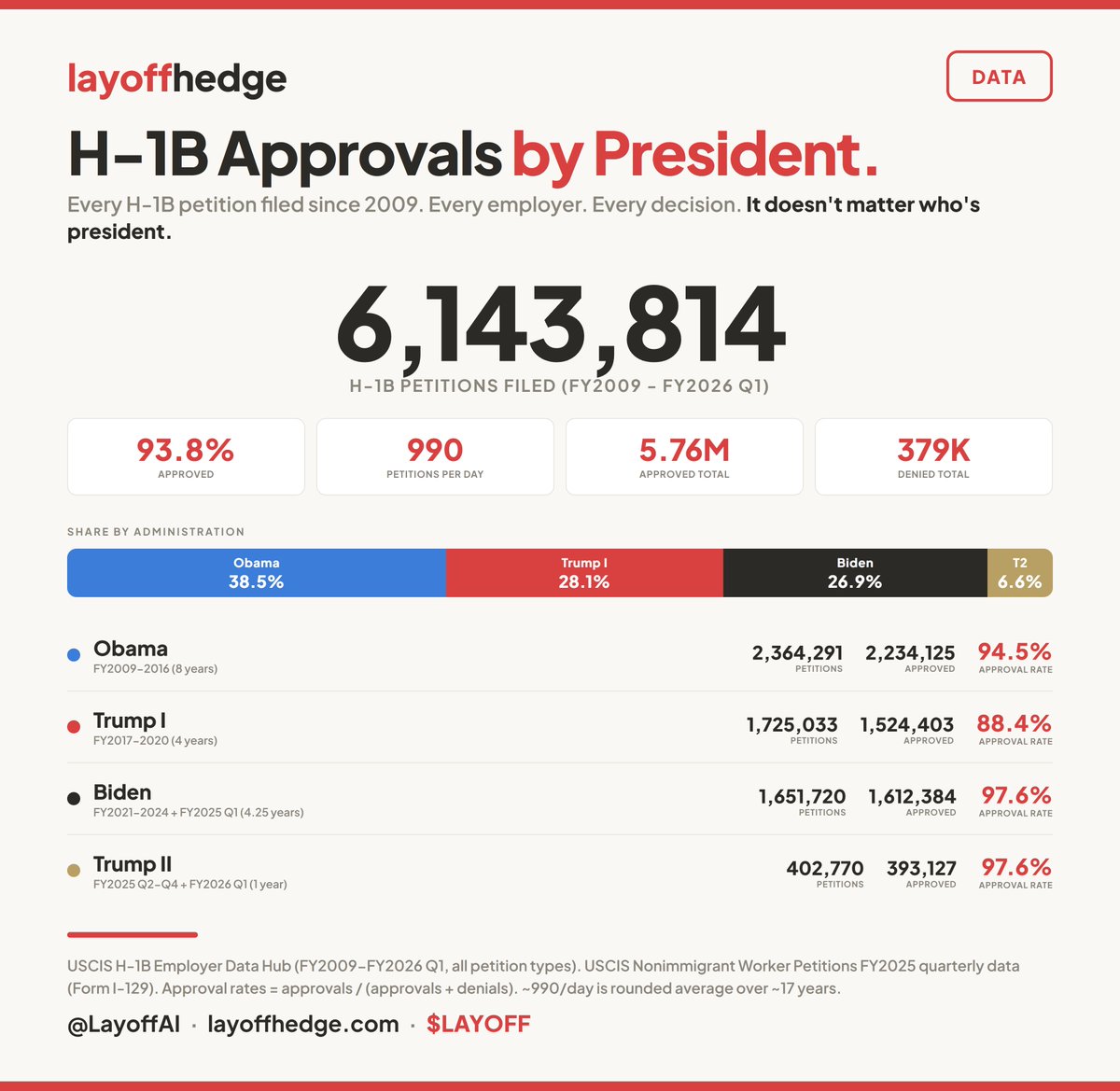
H-1B approvals by president.
6.1 million petitions filed since 2009. 93.8% approved. 990 per day.
Obama: 94.5%
Trump I: 88.4%
Biden: 97.6%
Trump II: 97.6%
Yes, this includes renewals. Yes, that matters because they are still here.
Left. Right. Irrelevant... 94% APPROVED.
319
1,803
4,440
193,667
Cybersecurity Dave retweeted
May 19
LEAKED AUDIO FROM META ALL-HANDS AHEAD OF LAYOFFS TOMORROW
Mark Zuckerberg, in his own words, told Meta employees their devices are being tracked to train AI models.
His reasoning? Meta employees are smarter than the contract workers the rest of the industry uses for data labeling. So instead of hiring outside help, Meta is turning its own workforce into training data.
"The average intelligence of the people who are at this company is significantly higher than the average set of people that you can get to do tasks if you're working through these contractors."
He wants the AI to learn how "really smart people use computers" by watching employees work. He says the content is "stripped out" and none of it is used for surveillance or performance tracking.
Then he admitted the rollout was botched but said Meta intentionally kept employees in the dark because leaking competitive AI strategy would help rivals.
"It is not strategically in your interest for us to communicate everything in all the detail that we normally would on this."
Translation: We're watching you, we told you as little as possible, and we did it on purpose.
AI is replacing the contractor. Then the employee trains the AI. Then the AI replaces the employee.
This story and this company keeps getting weirder.
May 19

LEAKED AUDIO: In an all-hands meeting on April 30, Mark Zuckerberg tells employees that he's training AI on them ahead of mass layoffs.
"The AI models learn from watching really smart people do things... The average intelligence of the people who are at this company is significantly higher than the average set of people that you can get to do tasks.
So if we're trying to teach the models coding, for example, then having people internally build tools or solve tasks that help teach the model how to code, we think is going to dramatically increase our model's coding ability faster than what others in the industry have the capability to do, who don't have thousands and thousands of extremely strong engineers at their company."
323
1,002
5,132
2,397,925
8
Cybersecurity Dave retweeted
My new blog post!
Information Security in the US Firearm Industry
cybersecuritydave.com/p/info…
1
1
54
Cybersecurity Dave retweeted

May 15
Major Canadian online privacy company plans to leave country if lawful access bill passes theglobeandmail.com/politics…
65
77
289
24,638
Cybersecurity Dave retweeted

May 11
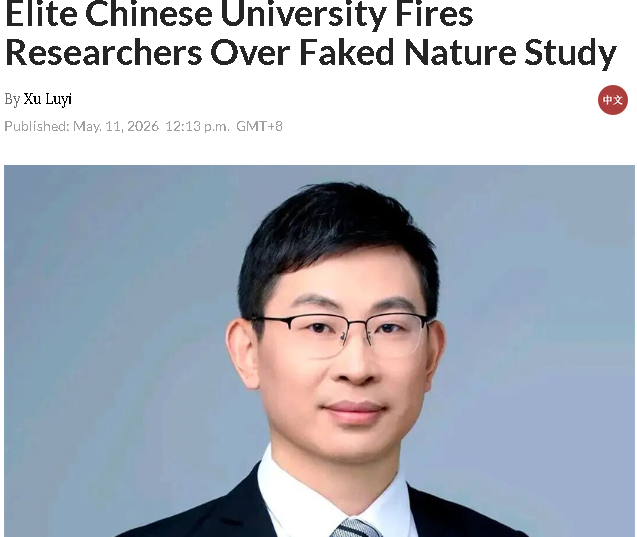
The CCP’s high-pressure "success at all costs" academic system has just suffered its most embarrassing exposure yet. On May 11, 2026, elite Tongji University fired lead researcher Jin Jiali and stripped Dean Wang Ping of his post after confirming that their a decade-in-the-making cancer study in the journal Nature was built on a foundation of impossible, fabricated data.
The fraud was so egregious that academic sleuths calculated the mathematical probability of the data occurring naturally at 10 to the power of negative 32. To put that in perspective, the universe isn't even old enough for such a "coincidence" to happen once. Investigators found that images were rotated and recycled across different experiments, while complex sequencing data was reverse-engineered to fit a desired outcome. This wasn't just a mistake; it was a systematic deception fueled by millions in state research grants and the intense pressure to deliver "breakthroughs" for the Party's prestige.
This scandal is pulling the thread on a much larger web of academic rot. Similar investigations have now been launched into deans and decorated scientists at Nankai University and Sun Yat-sen University for near-identical data manipulation. In the CCP’s academic apparatus, where funding is tied to "hats" and prestigious titles, research is often not allowed to fail. When the penalty for honesty is career death, fabrication becomes the standard operating procedure, turning China’s scientific output into a house of cards.
source:caixinglobal.com/2026-05-11/…
#UnveiledChina #AcademicFraud #NatureJournal #ScienceIntegrity #CCPCorruption
50
394
1,341
176,521
Cybersecurity Dave retweeted
May 12
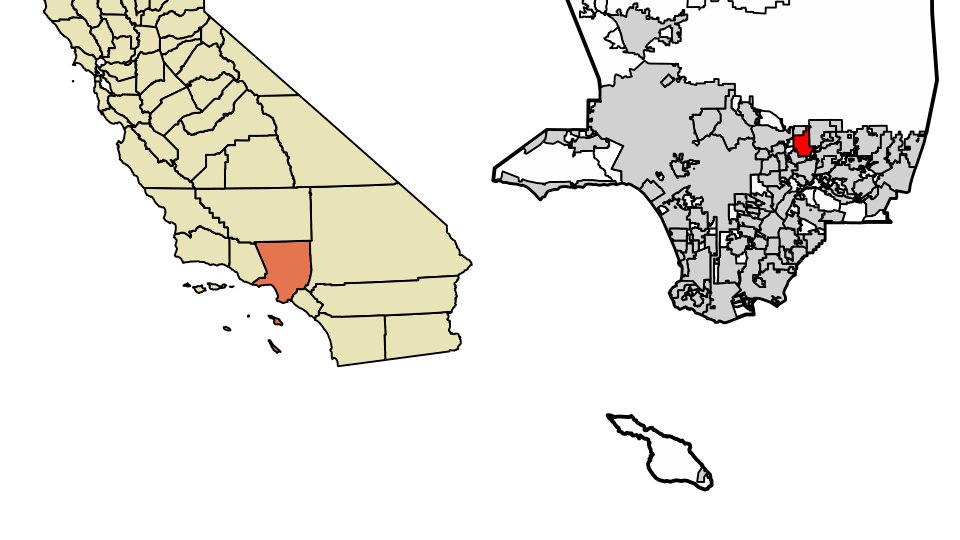
The Mayor of Arcadia in southern California resigned after confessing to working for China.
China is subsidizing drugs for sale to the Mexican cartels. The drug money is then laundered via students and Chinese banks. Arcadia is apparently a major hub for the CCP and cartels
May 12

No surprise about the mayor of Arcadia. This is where the CCP and Sinaloa Cartel meet in California
Project Sleeping Giant: Inside the Chinese Mercantile Machine Linking Beijing’s Underground Banks and the Sinaloa Cartel
Sam Cooper
Former senior DEA official describes covert global financial ecosystem tying Chinese students, Sinaloa fentanyl sales, cartel cash collection, and PRC state-linked infrastructure deals.
In January 2021, a grainy black-and-white surveillance photo quietly accelerated one of the most consequential geopolitical investigations in recent times — a case with influence over border security, trade policy, and tariff disputes shaping our era.
Captured at the U.S.-Mexico border, the image showed a thick-set Chinese man wearing a COVID-era face mask driving alongside a Mexican man — a key money launderer for the Sinaloa cartel. The Chinese man turned out to be a senior operative working for Sai Zhang, a younger Chinese international student living in the United States on a student visa.
To a small group of U.S. federal agents, the photo revealed a thread they had been painstakingly unraveling since 2018, part of an ongoing investigation known as Project Sleeping Giant.
The overarching task force, launched by senior DEA agent Don Im — whose career was built on decoding China’s paramount role in global money laundering and supply of chemicals used to produce methamphetamine and fentanyl — aimed to bring cases against Latin cartels working with Chinese money launderers.
This photo was the first concrete step toward proving a direct, operational bridge between Chinese underground banking networks and the blood-soaked heart of Mexico’s most notorious cartel.
While evidence of Sai Zhang’s commanding role in orchestrating Sinaloa fentanyl cash flows was stunning, the involvement of Chinese student networks followed its own curious logic, Im explained in an interview.
“Chinese banking networks were operating in the U.S. long before Zhang linked up with the Sinaloa cartel,” Im said, describing the system in which Chinese buyers bid on pools of drug cash collected in cities worldwide, paying a premium to receive laundered dollars in American locations and investments of their choosing. “The buyers were mostly wealthy Chinese seeking dollars for real estate or tuition in America. Payments were made in yuan through Chinese accounts. In return, Mexican cartels received goods or cash.”
In exclusive interviews, Im revealed in unprecedented details the breathtaking complexity of China’s global drug money laundering networks — a system of Byzantine paths that Sleeping Giant helped map and penetrate. The troubling implications help explain why Washington is now imposing trade sanctions targeting China and countries deeply entwined with its export-driven economy.
At the heart of it, Beijing’s centralized economic apparatus and the Chinese Communist Party’s regional governors knowingly align with global drug barons — channeling fentanyl cash, reintegrating it into China’s factory output, and exporting drug-funded “legitimate” goods worldwide. Meanwhile, Chinese immigrants and travelers access the other side of this narco-banking system, using it to bankroll overseas investments and strengthen the reach of the Chinese diaspora.
It is a system that works for China’s government and citizens alike — on the micro level, it pays for tuition and housing for Chinese students in America; on the macro level, it helps fund Xi Jinping’s Belt and Road infrastructure projects abroad, designed to bind other states more closely to China through trade, debt, and ultimately elite corruption. According to Im, the chemical precursors fueling the production of fentanyl, methamphetamine, and ecstasy in parts of Europe — as well as in countries like Canada and Mexico — are woven into this Belt and Road system.
45
583
1,988
62,888