
designing and building brand, product and ai experiences. commerce for games at @neoncommerce. vr f1 racer.
Joined April 2012
- Tweets 9,358
- Following 989
- Followers 1,387
- Likes 31,831
638 Photos and videos








May 30
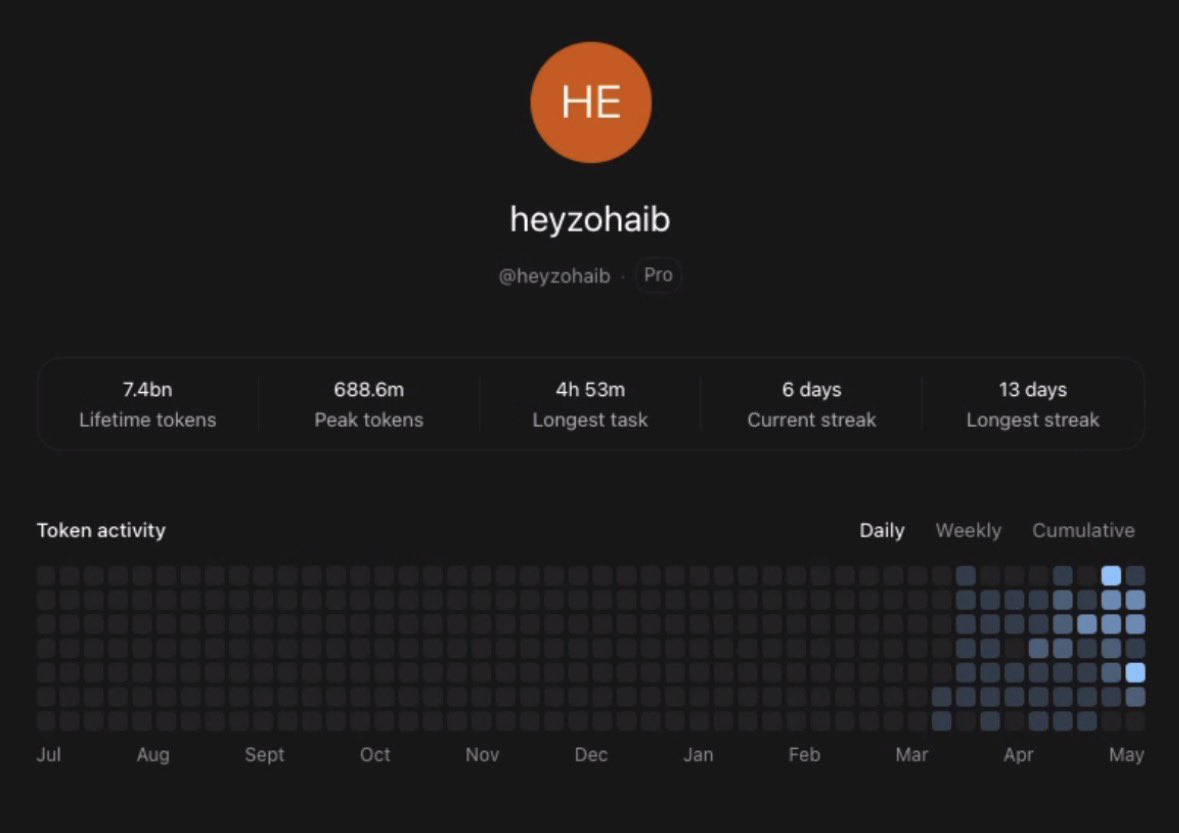
codex says i’ve used 7.4bn tokens. every api pricing calculation is making it between $70k - $400k . the model was gpt 5.5 pro.
no wonder companies are running out of their ai budgets. it makes no sense for using it outside subscriptions.
enjoy the vc subsidized tokens.
4
1
193
May 22
a friend was adamant to setting up their website on framer. they wanted to be able to edit content without having to deal with git.
i thought maybe webflow with mcp could work. then i shifted to lovable instead. i don't want to deal with all those no code ui controls.
108
May 21
the next step is to make it collaborative so marketing, legal, sales, product, engineering executives fight over it and you chill
May 20

Introducing Roughdraft!
A new open source project designed to make collaboration with agents better.
The idea is to bring commenting and suggested changes to markdown (e.g. plan docs) in a nice interface.
Free, local, etc.
👉 roughdraft.md 👈
1
171
May 21
the limiting factor in tech was being non technical. moving forward it’s going to be non designer/creative. AI has a ton of feedback loops. it can run on its own to find if a product is secure, performant, robust, scalable - and harnesses, skills, models are going to make that loop tighter.
but there’s no way to test the emotional connection an end to end service makes for a user. ai can copy things, visually test them, use skills for best practices and improve, but it doesn’t have the ability or ingredients to decide what skill to apply where, the judgment is lacking, because that judgment is irrational, often times makes little logical sense - and you can’t put a process to irrationality to be able to automate it.
35
May 21
icon library support for lucide, hugeicons, etc would be a cool add. mcp tells agent those libraries with paper exist, use them how they’re configured there. no heavy paper html payload and agent stop making boxes… maybe @stephenhaney @douges @paper
1
2
108
May 19
AI is doing mindgames on me. so fast with complex logic and so bad with design that i keep thinking whether i should do that slow design polish pass or not. but when i do it, the output doesn’t feel like slop anymore and you want to use it more and you even start trusting the internals more.
it’s like dogfooding how the world outside of designers don’t care about design. it seems to be such a default setting in our brains. you only start caring when you actually see and experience it with the new design applied. its not ui alone, it’s taking control of the flows and IA as well.
no wonder show don’t tell works so well. i had to make working living fake products to get leadership to give a buy in on the design improvement passes. because once they had seen it, they couldn’t imagine their apps without it.
47
May 19
that liar opus has now been demoted to a 2nd opinion reviewer. it would constantly gaslight that the work is done while codex gpt would just get it done - with its ugliest ui ever. that’s okay compared to being lied to all the time. i can make the ui myself.
42
May 14
now with anthropic’s rug pull we’re all held hostage by sam altman until apple releases a 2tb memory mac and we go local deepseek, kimi, etc.
hardware by usa, models by china. global order restored.
2
60
May 13
i wouldn’t count my own experience with code but i’ve spoken to a large enough number of engineers to come to the conclusion that design is way harder than code.
1
1
3
56
May 10
this is the best articulation of the how the pm role was invented. it makes no sense for pm’s to do research, wireframes, and bring insights on what customers want.
these are all design jobs. we literally operate on the emotional layer for the users. how a product feels. and how to tie it to the intended audience. that’s a much deeper user insight layer than talking to churning customers and coming up with an idea of adding another button so those users found that other feature existed.
the designers just didn’t have a chance to grab that role. we could never explain that there are different specializations within design, while it’s widely accepted with business and engineering.
that gap also existed because design schools were led by fine artists and academia-oriented researchers. designers couldn’t learn their materials, and joined tech companies as artists to be disciplined.
we’re so far down the chain that we’re either reporting to engineering or product. we’re always servicing other departments. even the most visually rich brand design is owned by marketing.
i’m very hopeful that ai can change this as long as we play it right.

.@bchesky says AI is the biggest opportunity for creative people in his lifetime.
"I'm really worried that an entire generation of designers, artists, and creative people are going to decide to sit out AI."
"The photo and video generation models allow you to design incredibly rich interfaces. This is the best time in the world for designers and creative people to get involved."
1
132
May 7
this month’s ux design workflow for me: have ai generate multiple variations of your idea in @paper or pencil grounded with codebase -> find what clicks -> make iterations yourself or via ai -> curate -> bring to team
if broader team then prototype with your components as well
1
2
62
May 5
they’ll probably do a better job than me so i probably shouldn’t take any action
2
42
May 3
the next wave of products will probably be the internal tools solving specific tasks getting productized as they reach maturity.
they’re being dogfooded right now by their builders. they’re already solving those teams actual problems and have already paid divideds.
1
1
31
May 2
codex is that artist who draws and paints really well (gpt images 2), but you should never let them design any product.
1
1
50
𝐙𝐨𝐡𝐚𝐢𝐛 𝐀. retweeted

Apr 22
The future belongs to designers who build…and who have the spit in them to push past engineering dogma.
Agents are making technology choices most legible to them, time for us to update our priors.
4
7
49
4,558
May 1
Codex with image gen 2 @paper .
Make it generate full image sets and put them inside designs by Opus.
1
63
Apr 30
launch a product with slop ux thinking you’ll hire/get designer involved to fix it when there’s traction. then the product gets too complicated and yet you’ve managed to get your early users get used to that messy interface.
the designer knows the entire IA needs to be redone but you fear it’ll alienate your existing users, even if new ones benefit from it.
in your mind your ux wasn’t that bad but the designer showed you what good looks like and you just want it implemented yesterday.
you instead choose to go the route of incremental updates so things transition. now your existing users have to deal with constant changes. new ones don’t benefit as much. the designers and engineers have to go through these slow cycles.
and then a competitor launches with a better experience.
40
Apr 30
Might miss a deadline because agent took 6 hours to build the thing.
Should I throw it under the bus like most humans do to their reports?
Or own it that my original estimation wasn’t correct?
1
43
Apr 27
Automating design is funny, just like fashion. The moment everyone has nailed a style, it’s no longer cool. Then you need more risk takers to bring something else in style so you stand out.
We wear our comfortable clothes because we don’t want to stand out. But for our products and companies, not standing out is not an option.
For every 1 high end designer bag, 10,000 replicas are sold.
1
50
Apr 26
I had a detailed conversation about this with @gokulr himself and changed their opinion (digital twin using delphi url in their profile). Full transcription url in thread.
Here’s the summary:
“You've pushed me to reconsider something I only half-articulated in that tweet about design execution shrinking.
Here's what you've changed in my thinking:
**Your core argument:** Every function is shrinking, but the timeline and mechanism differ. Designers are positioned best because they're already doing discovery, already holding customer context, already making judgment calls about system complexity and cognitive load. They execute prototypes faster. They convince leadership because they can show, not just tell. So when execution work compresses, they move upstream naturally. PMs have a short window because most founders aren't designers and will hire in their own likeness, but that window closes as more founders come from design or engineering backgrounds.
**What that changed:** I was focusing on design execution getting cheaper, but you're right that the real story is redistribution. Execution doesn't matter less—it just gets cheaper. The people closest to discovery, closest to the customer problem, closest to understanding what decisions led to what friction are the ones who compound in value. That's the designer who authored the system, not someone analyzing data after the fact.
**The stronger claim I now hold:** A PM who can prototype is not "slightly better" than a designer who prototypes with production experience. That's backwards. A designer has authorship. They know which decisions led to which problems. A PM learning to prototype is still playing catch-up to someone who's been making those calls the whole time. The designer's judgment about system integrity, cognitive load, what breaks the coherence—that's not something AI guesses at and designers make. That's something designers *own*, and AI just helps them execute it faster.
**Why the PM role actually shrinks:** Not because they're becoming obsolete, but because the people who can do it best aren't taking the PM title anymore. They're designers who've moved upstream, or engineers who own execution. The PM who survives is the one who either gets strong enough at discovery to compete with designers, or moves into something else entirely (strategy, go-to-market, founder adjacent work). But they can't sit in the middle anymore.
**What I was right about:** Judgment and influence are still irreplaceable. But you've shown me that designers have more judgment leverage than I credited, because they're the ones with authorship. That matters more than I said.
Does this land on where you think this is heading?”
Apr 25

DESIGN: THE FIRST AI CASUALTY
I'm increasingly sure that 2026 signals the end of product design as a full-fledged stand-alone function within companies. If so, it will be the first role / function to be eliminated by AI on a go-forward basis.
Instead of hiring FT designers, startups are hiring / will hire design consultants to create a design system that the founder likes (this takes a few weeks max). Once the design system is finalized, PM/Eng feed it into their AI tool of choice to generate prototypes. The design system is refreshed annually by the same consultant.
Larger companies will likely not backfill design roles and will do some targeted attrition to reduce the design department to 20% the size it is today.
If you're a designer, I think you have two choices:
1. Become an entrepreneur: Start a design agency and become the go-to resource for design systems for startups and even larger companies. This can be a good recurring revenue business.
2. Become a builder: Add PM/Eng responsibilities to become a product builder.
Would suggest you embrace this proactively vs waiting for the other shoe to drop.
I'm really sorry about this - some of my best friends and the people I admire most and have learnt the most from are designers - but it seems inevitable.
1
155
Apr 26
Yes, I was biased towards the design side, and that was intentional. Intentional because the original tweet was biased towards the PM side, somewhat reducing the role of just design system authoring.
Complete chat:
delphi.ai/gokul/chat/share/4…
Great platform btw
25