
Joined September 2024
- Tweets 71
- Following 7
- Followers 4,196
- Likes 681
3 Photos and videos



Pinned Tweet

31 Mar 2025
257
32
187
23,488

The internet was supposed to be an infinite green garden that anyone could access from anywhere, to explore its beauty and chaos.
just a bunny in the garden, hopping around without any restrictions, having fun.
but then came some powerful forces like governments, institutions and corporations who began restricting access:
blocking people from accessing content from other parts of the world
limiting specific social media access due to local regulations
a user in China wanting to watch a Hollywood movie, or someone in the US looking for anime from Japan or someone in Central Asia wanting to enjoy a Bollywood thumka and what if they all get blocked by virtual borders set by their local regulations..
traditional VPNs offer some benefits, but they come with their own set of limitations:
- Centralized Servers: most VPNs rely on a network of centralized servers owned and controlled by the provider.
- Performance Degradation: routing traffic through a single remote server, along with encryption, causes latency and slow speeds.
- Privacy Concerns: many VPNs log user data either for analytics or due to negligent security practices.
- Geo-Restriction Workarounds Are Inconsistent: streaming services and ISPs use advanced methods to block VPN servers.
- Security Vulnerabilities: VPNs using older protocols can be exploited or misconfigured, exposing user IPs.
- One size fits all Approach: they market privacy heavily but often ignore user experience.
this is where Hop is trying to create a difference. it’s not just a normal VPN it will be a decentralized VPN aiming to provide users a great experience to truly explore that greenfield of internet without any borders or restrictions..
yes, privacy would be one of the main features, but not the only focus. the main goal is the easy access for users.
at the end of the day, that’s what users want. many say they want privacy, but in reality, they prefer accessibility and good user experience.
it’s basically a portal where you hop around in real time, anonymously and without any geo-restrictions, and in a frictionless manner.
just like bamboo grows back stronger when cut, if one path is blocked for Hop, many others are still available.
How Hop Works Underneath
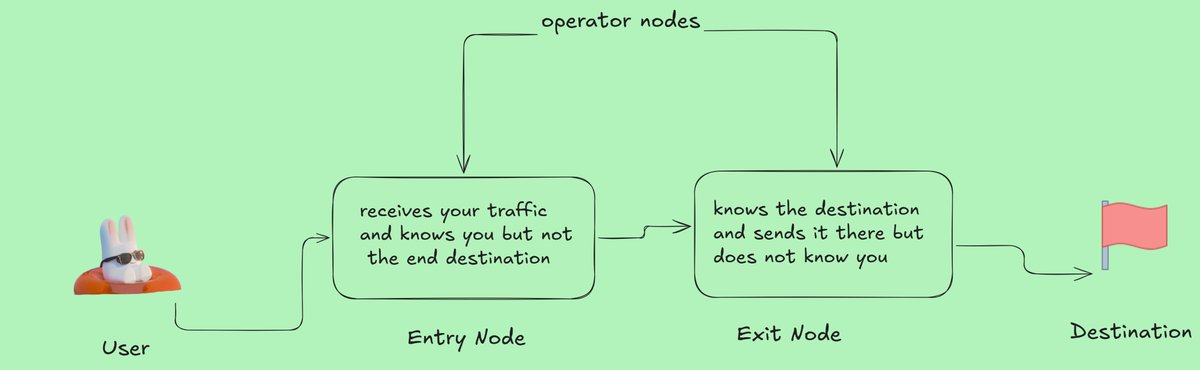
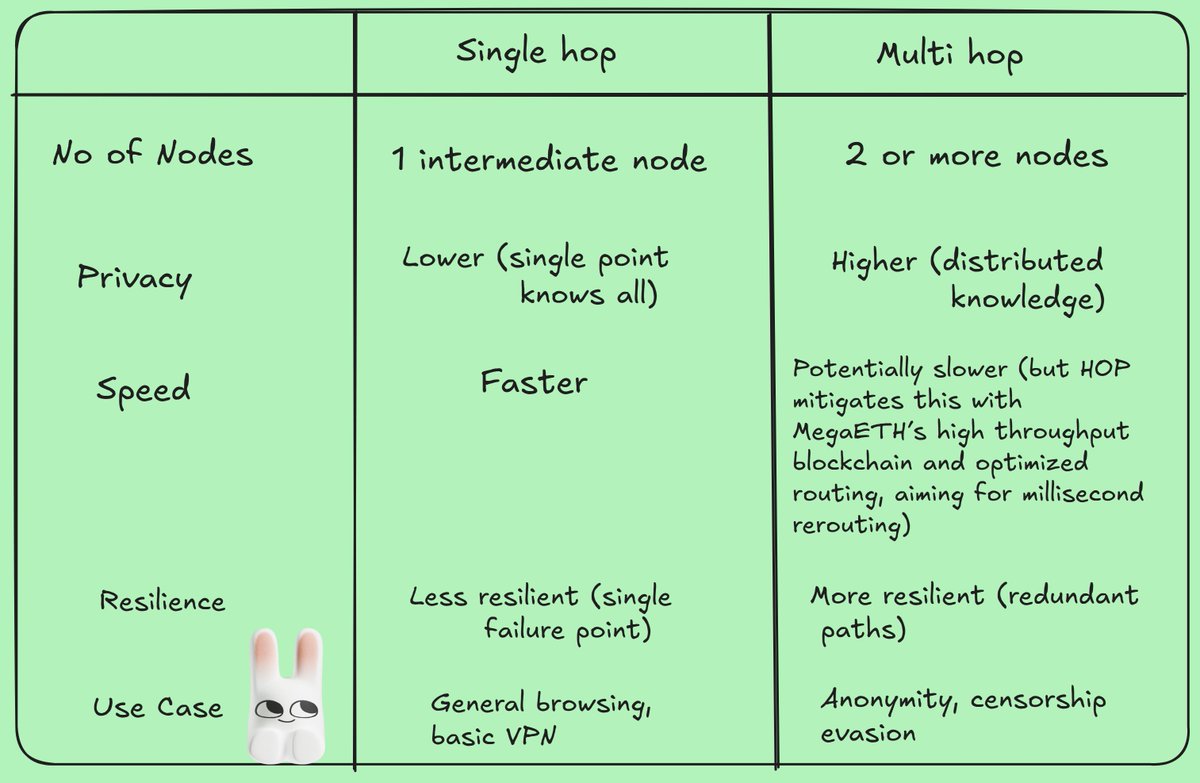
Hop uses a multi-hop architecture (unlike others using a single hop). It uses a two-hop relay:
- Entry Node: Receives your traffic and knows you, but not the destination.
- Exit Node: Knows the destination, but not you.
since they’re separate and not linked, your data and private info remain safe.
MegaETH & EigenLayer
Hop leverages @megaeth high throughput to enable near instantaneous rerouting of traffic across its multi-hop architecture and can handle the growing number of Hop users and nodes.
rerouting happens in milliseconds, a significant improvement over early decentralized VPNs that suffered 10 second delays.
one of the key things needed is reliability this is where @eigencloud comes in, solving the cold start problem in new networks by providing high quality node infrastructure from day one.
eigenLayer’s operators are incentivized by rewards and penalized for downtime or any negative behavior via slashing to maintain a stable network.
restaked ETH secures HOP’s infrastructure, adding a layer of trust and resilience. basically if a node misbehaves, slashing reduces the operator’s stake aligning their interests with network uptime.
mega's speed and scalability complements eigen’s reliability and security. while megaETH handles the rapid routing and high volume traffic, eigen ensures that the nodes executing those routes are trustworthy available and do their work honestly.
and the crypto natives can also join as network contributors by running the nodes earning enough to cover their subscription and still making some profit on the side..
Hop is literally trying to provide open access to the online garden of the internet where no one is stopped due to restrictions, geo blocks, or censorship.
it sets the bunnies free in the garden to hop anywhere using the portal to the open internet.
there are other dVPNs, but their focus has mainly been on privacy, not much on user experience or accessibility. Hop will excel there not only because of its UX focus, but also thanks to its real time layer, making it much faster.
also, I’ve seen how much effort the @0xFirewallFlirt has put in over the last few months getting on calls with users worldwide to understand the real issues. why users use VPNs at the first place, the main reasons and the problems they face with traditional or decentralized VPNs , what could be improved,etc.
it has been about users and what they need and how to deliver it not building a product for the sake of it, but one that actually meets user needs and provides real value.
so just hop and join the portal to the open internet at hop network ..

231
4
34
4,334
HopNetwork | 🐰 retweeted

5 Jun 2025
Mega Mafia will change the world because they solve real problems for real people.

10
7
77
6,775
4 Jun 2025
We’ve eagerly been listening to the real problems that real people (you) have.
Excited to continue building around it
1
3
31
2,525
HopNetwork | 🐰 retweeted

22 May 2025
“Stop VPNing, Start Hopping": Why @Hop_Network is the future of internet freedom
I like to think of all three trilemma of crypto (Decentralization, security and scalability) the easiest to tackle might decentralization because it's mostly human factor and less machine dependent like scalability. EOD, human laws will end up guiding what and what should not be permitted from region to region
A Central Authority (either The Government itself or a body empowered by The Government) always one way or the other determine what it thinks the citizens should be able and not able to access.
This is exactly I strongly believe in what @0xFirewallFlirt is building with @Hop_Network on Megaeth
Imagine a world where you can access any crypto native site regardless of where you live and also without the fear associated with native VPN's owned by big corps who obviously have access to your personal data or information you may or may not have intentionally divulged.
@Hop_Network isn't just another VPN that governments and Internet service providers can block. HOP runs on a decentralized, multi‑hop mesh of user‑operated nodes.
Traffic is relayed through two nodes—one sees you but not the site, the other sees the site but not you—giving VPN‑level privacy while focusing on what most people actually want: un‑restricted access to content anywhere in the world.
Geo‑blocks and censorship make today’s “borderless” internet feel fenced‑off. Standard VPNs help, but they’re slow, centralized, and easily black‑listed.
Hop is building a distributed infra on Megaeth that leverages a global network of node contributors in an expansive system that makes it almost impossible to be blocked entirely. Think of how a hydra regrows two heads if one is cut off.
Hop's traffic flows through multiple independent nodes, ensuring no single point can see both the user and their destination.'
Node operators also earn rewards for contributing bandwidth.
I could go on and on about why i think Hop is building something cool for the future but i don't entirely trust you plebs to read this far especially when the thread is filled with technical jargon so i will simply make a short one that even your grandma can read and understand
Hop is also selected amongst the projects participating in Megamafia 2.0
Actionable things you can do to participate in the future right now:
head to hopnetwork.xyz/
connect a EVM compatible wallet and join waitlist
Follow @Hop_Network and also join Hop herd telegram channel t.me/HOPHerd
Also fill this form to give the team a feedback
2g6w10ag996.typeform.com/to/…
5
5
24
2,356
21 May 2025
Learn more about the journey to HOP. Discover the problems we’ve discovered for real users, which will require a different lens!
4
3
25
1,748
HopNetwork | 🐰 retweeted

19 May 2025
5/ Hop is building the first decentralized “Portal Network”, a VPN alternative focused on free access, not anonymity.
Powered by MegaETH’s speed, it enables real-time microtransactions for bandwidth without the lag or stigma of traditional VPNs.

1
1
11
2,000
HopNetwork | 🐰 retweeted

10 May 2025
Come one, come all

GMega guys!
Episode 2 of the MegaEth Community Vibes and Chill Space would be kicking off tomorrow!
We’d be having some special guests:
• @0xBreadguy our absolute MegaEth chad and 🥁🥁🥁
• @0xFirewallFlirt co-founder of @Hop_Network
OMEGA!
twitter.com/i/spaces/1OwxWXP…
4
2
15
1,615


HOP is a decentralized VPN being built on MegaETH.
The node registry and open/teardown connection requests will exist onchain.
Real-time speed means HOP can rapidly re-establish user routes without UX degradation, making the onchain product materially better than its peers.

139
149
764
31,807
HopNetwork | 🐰 retweeted

7 May 2025
Guys, definitely read this carefully and don’t forget to fill out the form.
Also, make sure to share your feedback with the @Hop_Network team.
HOP is building the future with @megaeth Real-time Blockchain.
1
2
14
1,065
HopNetwork | 🐰 retweeted

7 May 2025
Ghop 🐰
1
2
753
HopNetwork | 🐰 retweeted

6 May 2025
i love testing @megamafia apps and new features.
today was @Hop_Network and let me tell you, i had no expectation going in ( first version of the product)
but, but the product was very stable ( made a tg call in a country where tg call is restricted) plus refreshingly and deceptively simple user experiences.
@0xFirewallFlirt is cooking hard

27
5
98
5,810
6 May 2025
study user research
6 May 2025
1/
Great Monday - got to spend 5 hours talking to prospective users about how they use the internet, and what problems they face
Why? The only way we can build something that matters is by speaking with people and understand how they think and what they care about
3
8
1,114
HopNetwork | 🐰 retweeted
1 May 2025
How do you know we're building for real people? We talk to them.
Shoot your shot, but only after you know where the goalpost is.
30 Apr 2025

Did you know there's a waitlist on @Hop_Network’s website? 👀
Just got off a call with their team. First time I’ve seen someone this early genuinely listen to what users actually want. You can tell they’re not just building a product—they’re building something people will want to use. Really excited about these guys.
Accelerated by @megamafia

3
2
11
1,299
HopNetwork | 🐰 retweeted
29 Apr 2025
Always a blast to talk to real people, discussing real problems, in order to build real solutions
Don't be afraid, be unstoppable

just finished call with @0xFirewallFlirt from @Hop_Network
never been so bullish on the future of VPNs
study founders that want to build useful products around real user needs
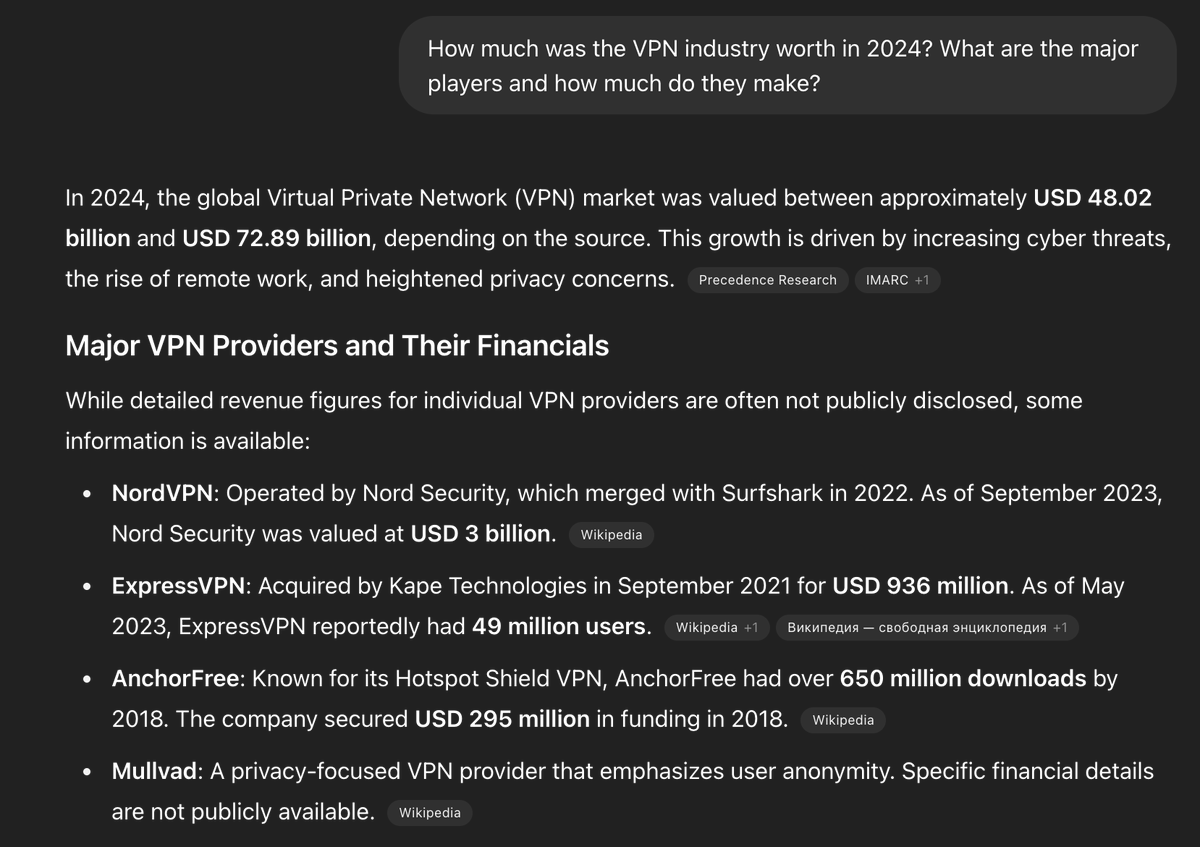
the VPN industry currently preys on fear and misinformation - its time to change that
2
1
20
1,314
HopNetwork | 🐰 retweeted

21 Apr 2025
131 projects across 14 categories on @eigencloud mapped
h/t: @0xcoordinated
3
5
37
2,668
20 Apr 2025
See how deep the rabbit hole goes.
20 Apr 2025
Neo escaped the Matrix just so he could watch the latest season of Game of Thrones early on HBO Max.
What will you do?
Take the blue pill, the story ends.
Take the red pill - you stay with @Hop_Network, and I show you how deep the rabbit hole goes.

3
17
1,454
HopNetwork | 🐰 retweeted
12 Apr 2025
Corporate says you can't access Twitter, Reddit, or YouTube.
Corporate also says you should stop making "that's what she said" jokes.
Corporate can suck it (that's what she said).
Live a little. Use @Hop_Network .

7
1
25
1,480