
The best research, data, and governance insights all in one place.
Joined May 2022
- Tweets 6,552
- Following 40
- Followers 40,165
- Likes 2,229
2,427 Photos and videos


Pinned Tweet

4 Feb 2024
This is the official list of Blockworks Research analyst accounts.
Anyone DMing you claiming they are from @blockworksres that is not on this list is a scammer.
x.com/i/lists/17542454878744…
12
35
195
89,529
Blockworks Research retweeted

Jun 12
9
12
74
14,977
Blockworks Research retweeted

Jun 12
Pre-IPO perps are incredibly accurate near listing as traders price off Nasdaq IPO auction indications.
Rather than speculation, prices reflect private auction data, including live orders, imbalances, and indicative clearing prices, diffusing into public markets.
Hyperliquid
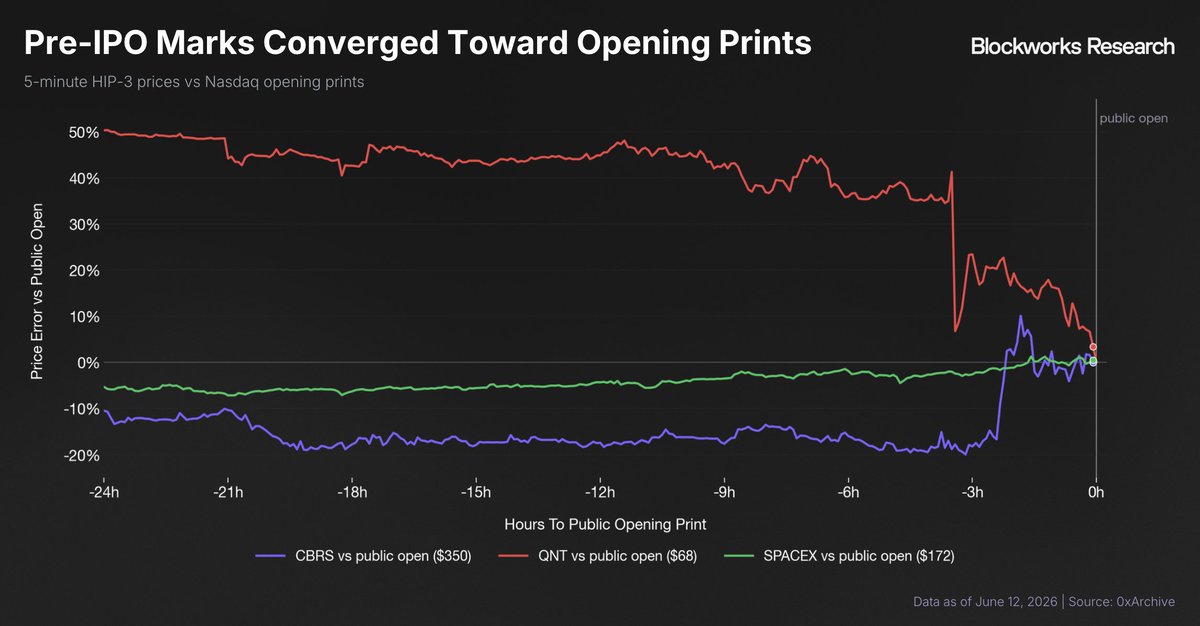

Hyperliquid (Tradexyz) traders predicted the exact opening price of SpaceX.
The Hyperliquid SpaceX perp was trading at 171 just 1 minute before they announced the starting price of $171 per share.
app.hyperliquid.xyz/trade/xy…

6
13
111
8,693
Blockworks Research retweeted
Jun 11
17
26
237
47,501
Blockworks Research retweeted

Jun 11
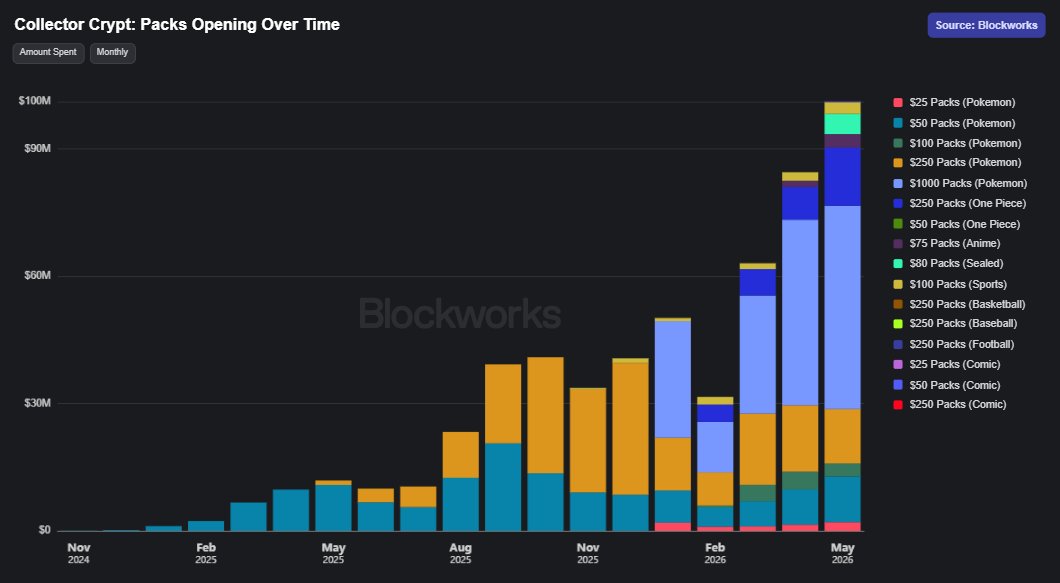
This is huge! Demand for higher tier gacha packs has been clear for a while, and the $1,000 packs proved it almost immediately after launch.
I expect the new $2,500 tier to follow a similar trend, attracting both larger collectors and degens looking for bigger swings.
Jun 10

Every great collection deserves a centerpiece.
The card everyone notices first.
The card with a story behind it.
We built a machine around cards like that.
The $2,500 Pokémon Gacha is now live.

6
6
49
9,619
Blockworks Research retweeted
Jun 10
Another big week for Hyperliquid.
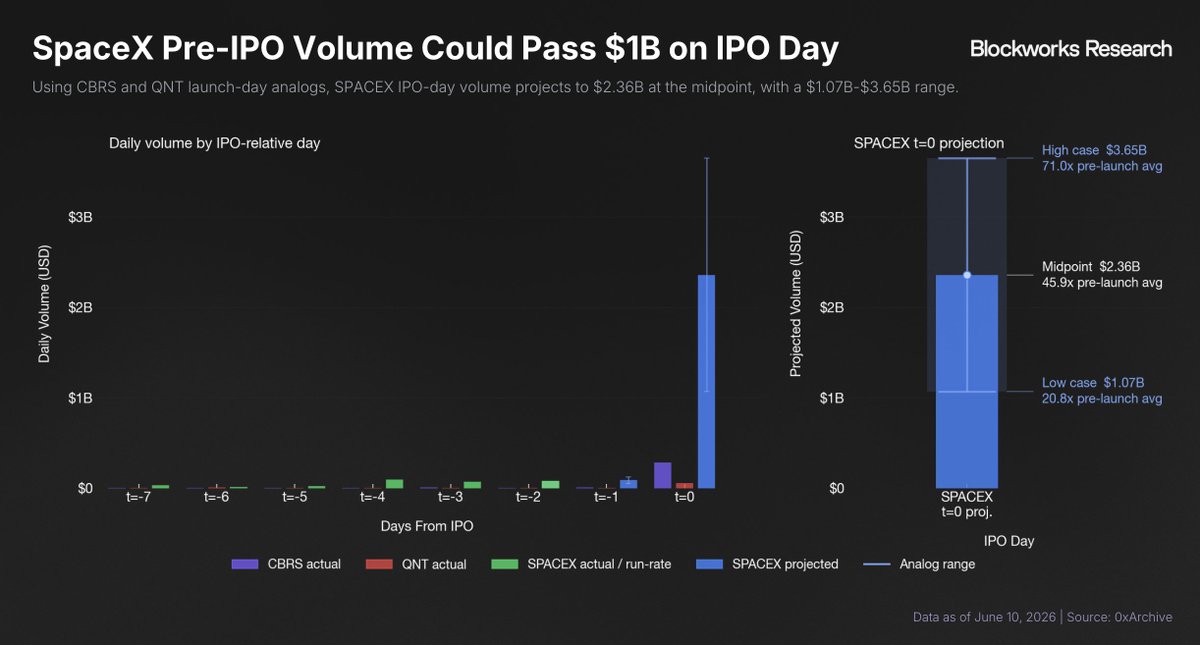
SpaceX is by far the largest pre-IPO market, averaging $51M/day vs CBRS at $4M/day and QNT at $3M/day during their pre-IPO phases.
If launch day mirrors prior TradeXYZ IPOs, volume could clear $1B, with estimates ranging from $1.1B to $3.6B .
14
19
130
18,793
Blockworks Research retweeted
Jun 10
14
14
147
29,991
Blockworks Research retweeted
Jun 8
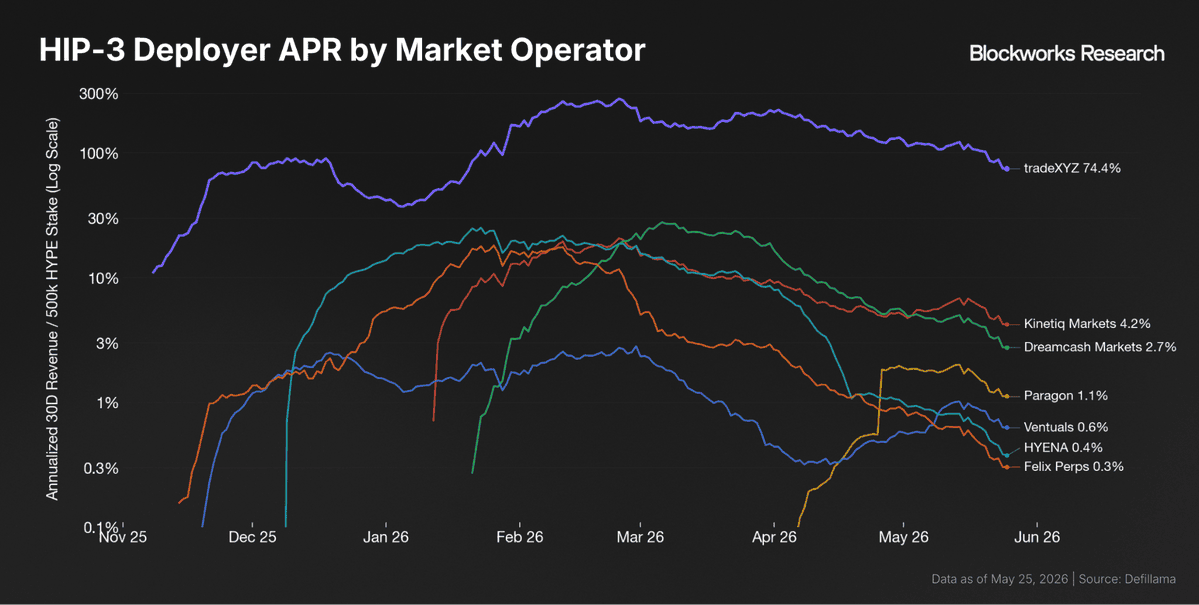
As Felix becomes the first HIP-3 deployer to officially wind down, I fear it may be the first of many. For deployers outside of TradeXYZ, returns on HYPE stake and auctions remain unattractive.
Will share a report this week on these HIP-3 dynamics and potential solutions.
Jun 8

In light of the USDH sunset, the Felix HIP-3 DEX and all live markets will begin sunsetting on June 19 and conclude on June 20. All traders are encouraged to close active positions before this time. Another reminder of this sunset will be sent in the Felix Discord and Telegram announcements channels on June 15.
Markets will be settled sequentially, with each market settling one hour after the previous market. For full settlement mechanics, please review the FLX HIP-3 Sunset section of the Felix docs here: usefelix.gitbook.io/docs/fel…
Telegram announcements: felixannouncements
Discord link in bio
11
11
201
31,781
BNB is already one of the largest digital assets in the world. The more interesting question is what is being built around that scale.
This quarterly report gives the market a clearer view into BNB Chain’s growing real-world asset ecosystem.

18
3
14
1,293
Blockworks Research retweeted
Jun 4
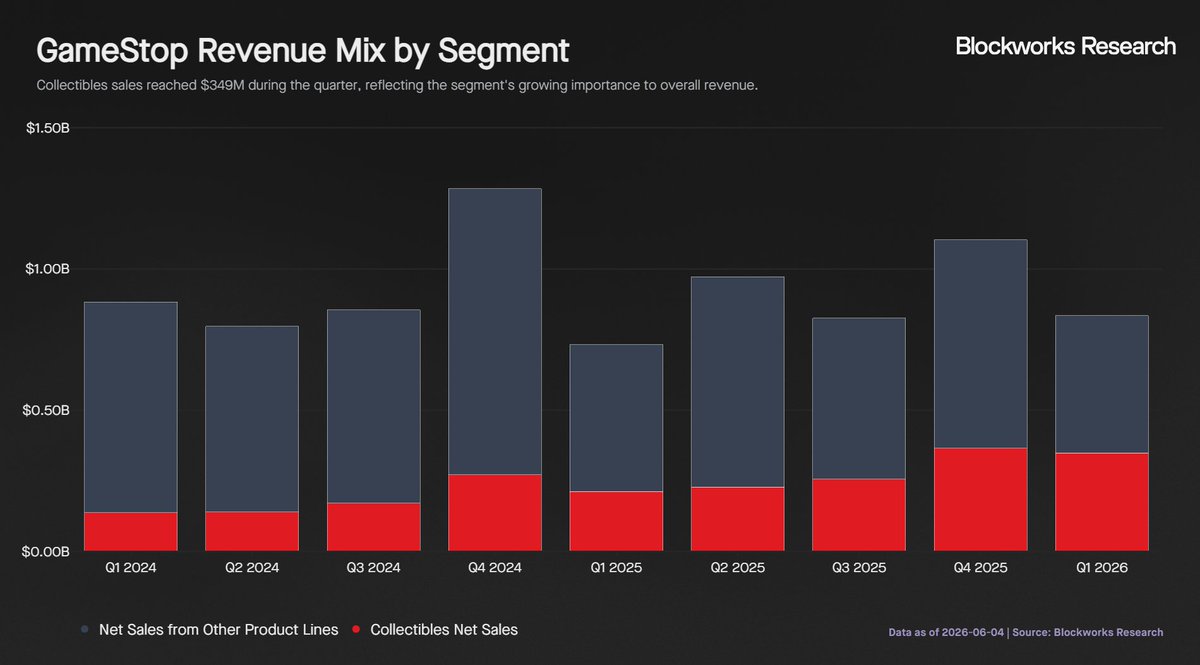
The latest earnings of @gamestop may have been one of the most bullish developments for the onchain TCG sector this year.
The company reported the highest quarterly profit in its history, driven largely by strength in collectibles. The segment generated $349M in revenue during the quarter, accounting for 42% of total sales. This includes TCG products, grading services, Power Packs, toys and other collectibles related merchandise.
The results reinforce a trend that many investors continue to underestimate: collectibles are no longer a niche category. They are increasingly becoming one of the most important growth drivers across the broader retail market.
A key advantage for GameStop has been its partnership with PSA, which effectively serves as the inventory backbone for its Power Packs product.
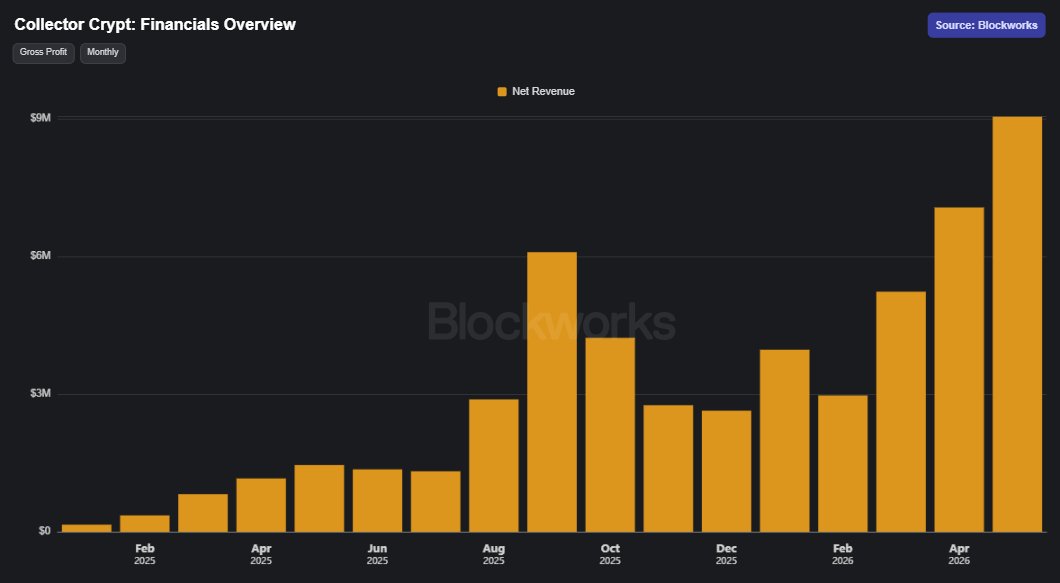
For onchain collectibles platforms, the numbers help frame the size of the opportunity. @Collector_Crypt generated $21.3M in net revenue over the last three months. By comparison, GameStop's collectibles segment alone generated roughly 16x that amount in a single quarter.
The more interesting takeaway is that Collector Crypt is not competing for a crypto native market. It is competing for a share of a much larger collectibles economy that is already proving capable of generating hundreds of millions in quarterly revenue.
In many ways, Collector Crypt already has the better product. Users benefit from more transparent odds and stronger buyback rates versus GameStop's Power Packs offering.
Despite operating in a much earlier stage of growth, Collector Crypt trades at only a modest premium to GameStop on a sales basis, roughly 4x-5x annualized revenue versus around 3x sales for GameStop.
The key question is no longer whether demand for collectibles exists. GameStop's earnings answered that.
The question is whether Collector Crypt can successfully expand beyond crypto natives and build an onboarding experience that captures the much larger retail audience already participating in the collectibles boom.
Bullish on solana:CARDSccUMFKoPRZxt5vt3ksUbxEFEcnZ3H2pd3dKxYjp
4
9
42
3,701
Blockworks Research retweeted

Jun 3
12
13
101
20,143
BNB is a top-four digital asset by market cap, yet its onchain economy is still under-discussed relative to its scale.
This dashboard helps close that gap by making BNB Chain’s real-world asset growth easier to track.
Jun 2
NEW: Now tracking @BNBCHAIN, one of the largest blockchain ecosystems in crypto with over $18.5 billion in stablecoins and other RWAs.
With 14 pages and over 100 charts, track the most in-depth BNB Chain dashboard in the industry.
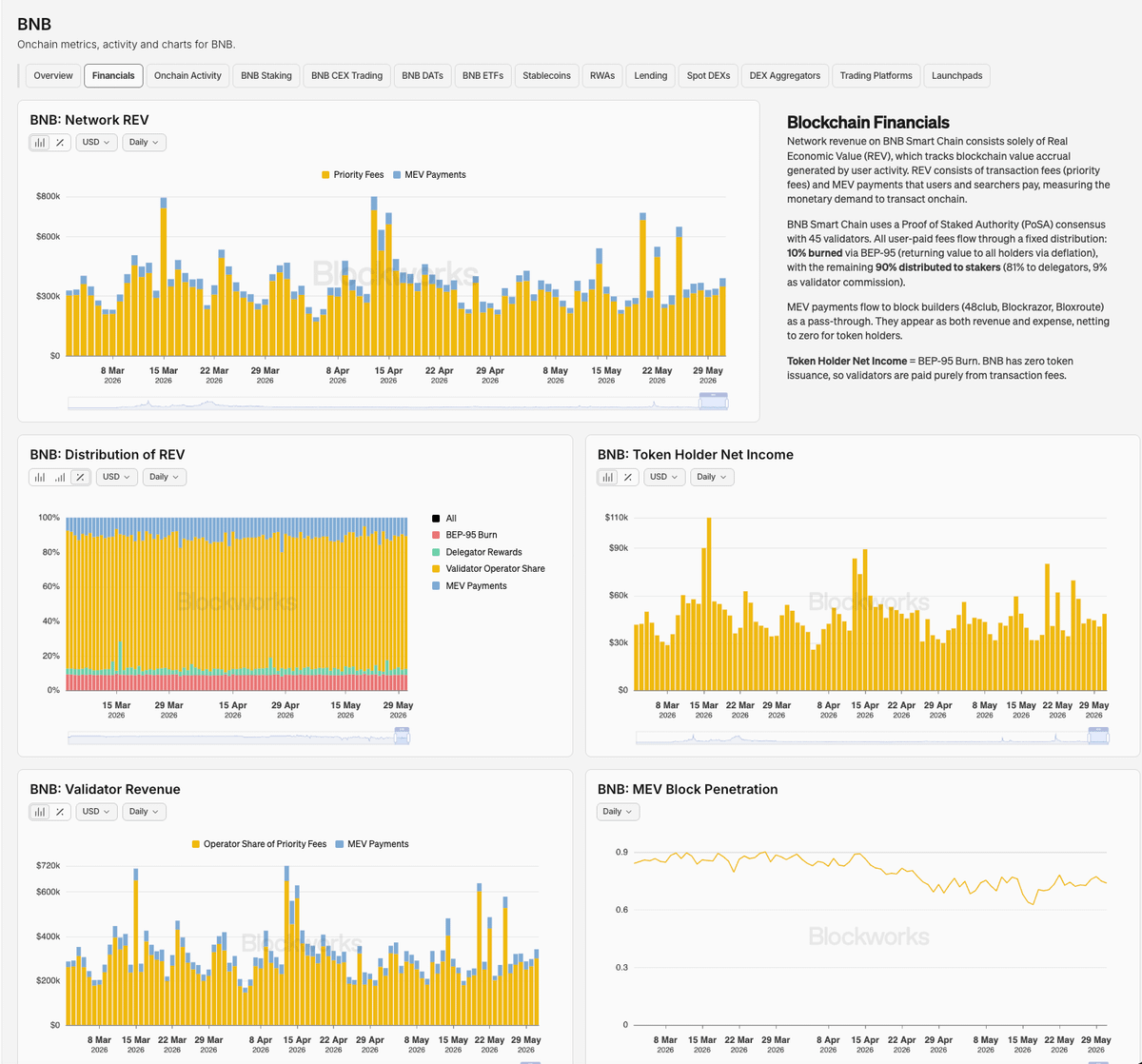
ALT Various charts display BNB Chain's financial metrics, including network revenue, distribution, token holder income, and validator revenue.
1
1
18
1,132
Blockworks Research retweeted
Jun 1
One of our theses this year was that as prediction markets mature and competition intensifies at the base layer, the most attractive opportunities will shift toward the applications and intelligence built on top. One project I have been watching closely is @SynthdataCo
Synth displays expected outcomes for hourly and daily event contracts alongside the implied market probability, allowing users to compare market pricing against real time forecasts. Those forecasts are generated by the top 10 models from a pool of more than 200 competing on Bittensor.
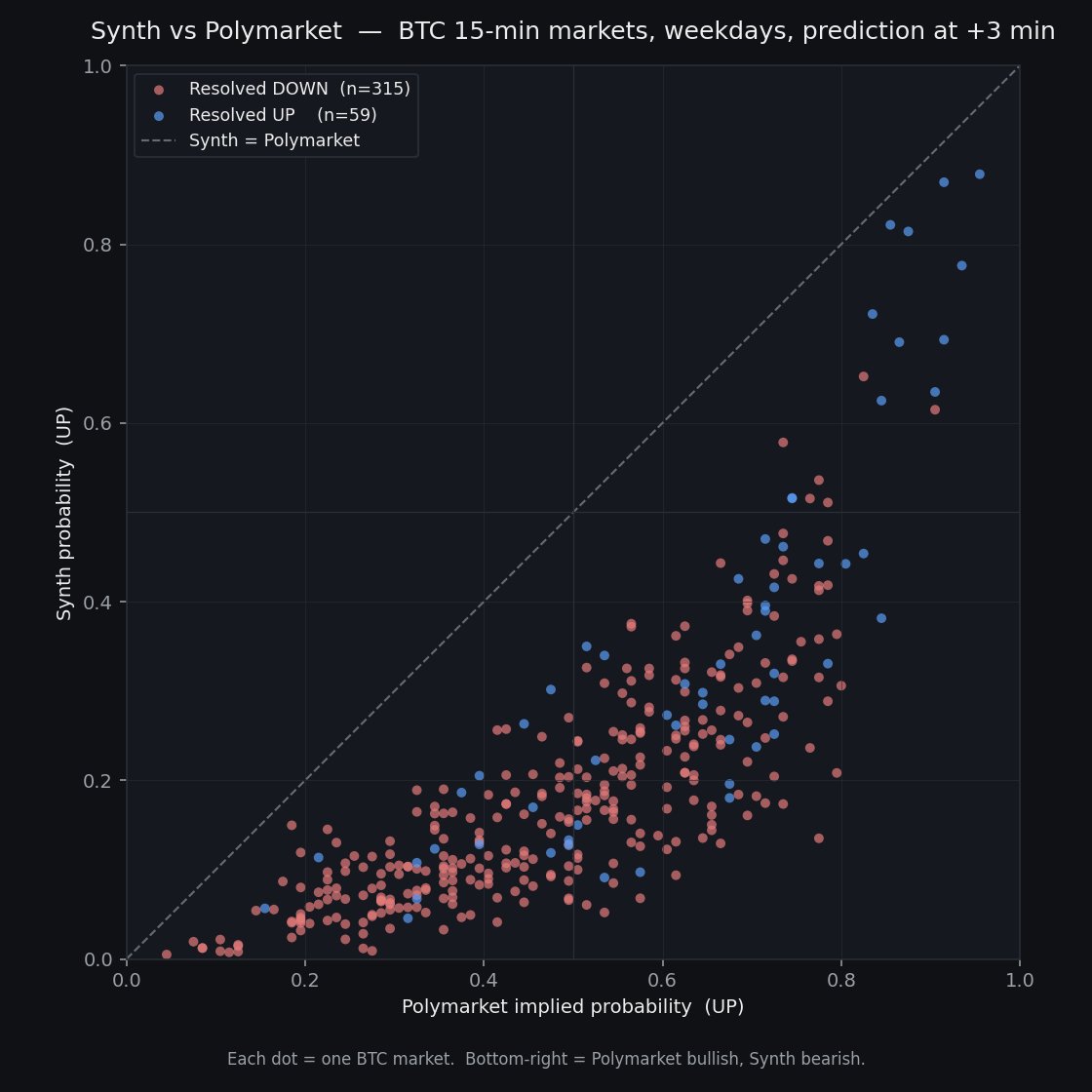
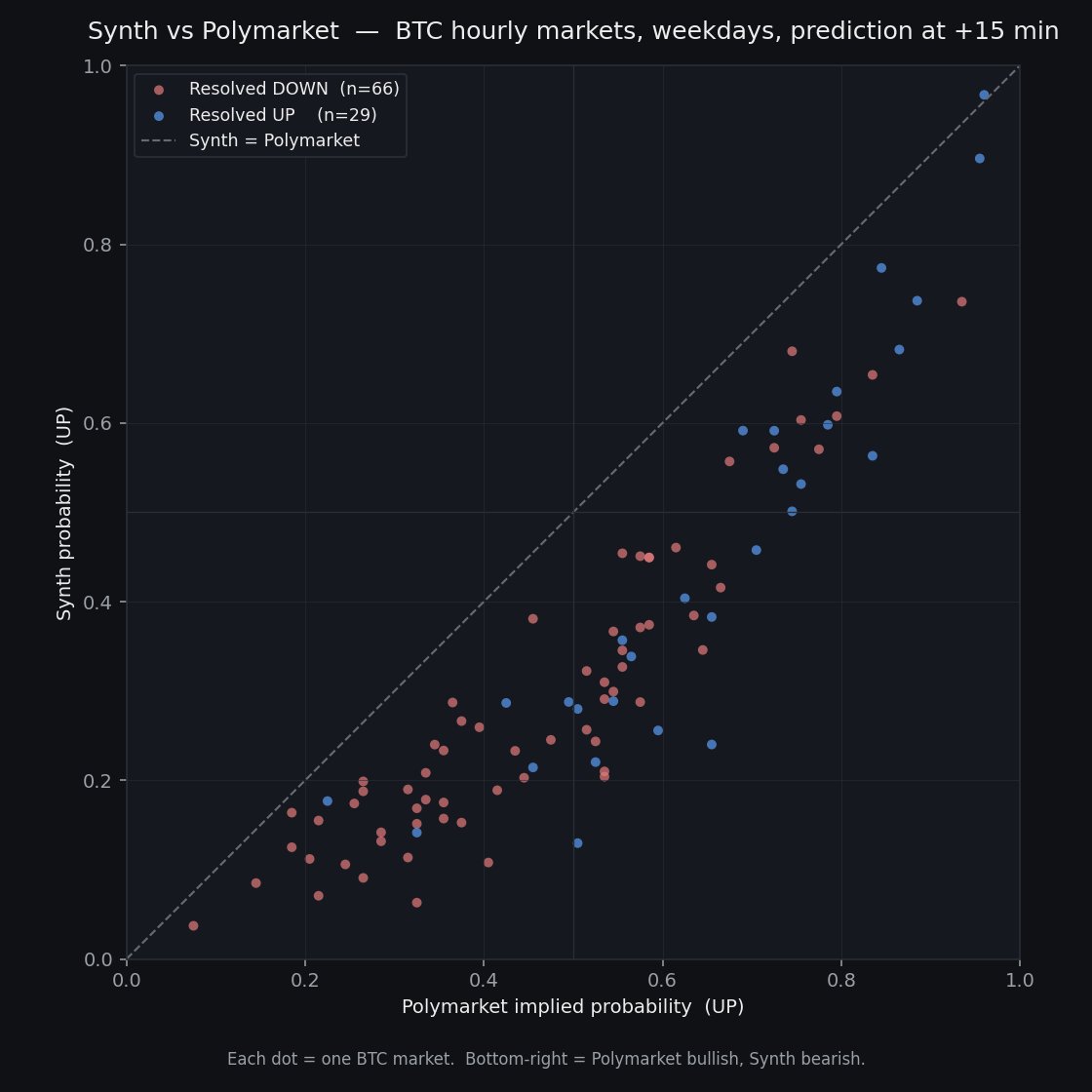
To test the product, I tracked every BTC up/down market on @Polymarket over nine weekdays. Both Synth and Polymarket probabilities were recorded at the same moment: three minutes into each 15 minute market and 15 minutes into each hourly market. The forecasts were then compared against the final outcome.
Across 374 weekday 15 minute markets, Synth correctly called direction 86% of the time versus 57% for Polymarket. Across 95 hourly markets, Synth achieved 75% accuracy compared to 62% for Polymarket.
Notably, Synth's edge widened significantly at shorter time horizons, posting a 29 percentage point advantage in 15 minute markets versus a 13 percentage point advantage in hourly markets.
The disagreement data was even more interesting than the headline numbers. In 46% of 15 minute markets, Synth and Polymarket pointed in opposite directions. In every single case, Synth forecast DOWN while Polymarket implied UP. Synth was correct 82% of the time in these disagreements, suggesting the market was consistently underpricing short term downside during the sample period.
The bigger opportunity here may not just be for directional trading but especially for market making. A market maker armed with a calibrated probability edge can quote tighter two way prices, hold less inventory and capture more volume without taking on the same adverse selection risk.
As the base layer becomes commoditized, the intelligence layer becomes the moat. Synth may be an early example of what that future looks like.
11
10
77
22,099
Blockworks Research retweeted
May 27
45
75
472
301,515
Blockworks Research retweeted
May 27
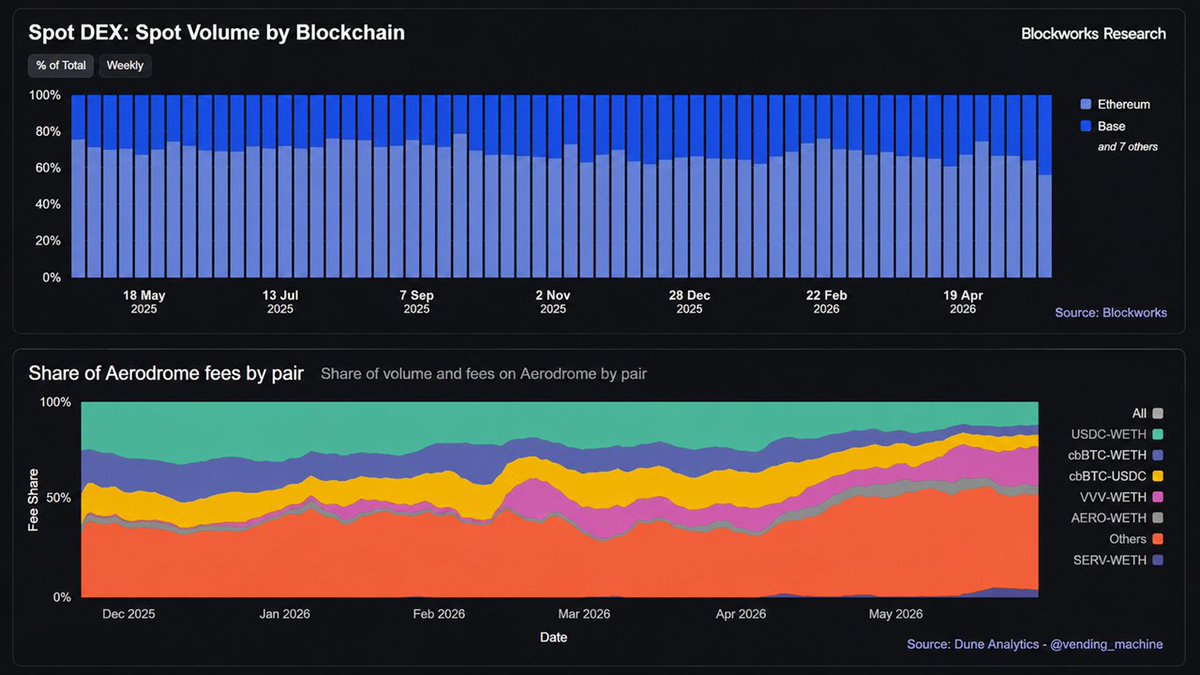
Spot DEX volumes on @base briefly flipped Ethereum on May 24th, capturing 53% market share as weekly volumes continue trending upward. A major driver of that growth has been @AerodromeFi which consistently accounts for roughly 50%-60% of all Base DEX volume.
What the market still underappreciates is how much of the recent privacy and AI trading activity is flowing through Aerodrome.
Lower cap names such as VVV, DIEM, SERV and POD rely on Aerodrome for onchain liquidity and price discovery, with VVV and SERV alone contributing nearly 25% of the protocol’s fees in recent weeks.
In many ways, Aerodrome is increasingly becoming the liquidity layer behind the emerging AI and privacy trade on Base.
2
3
26
1,235
Blockworks Research retweeted
May 25
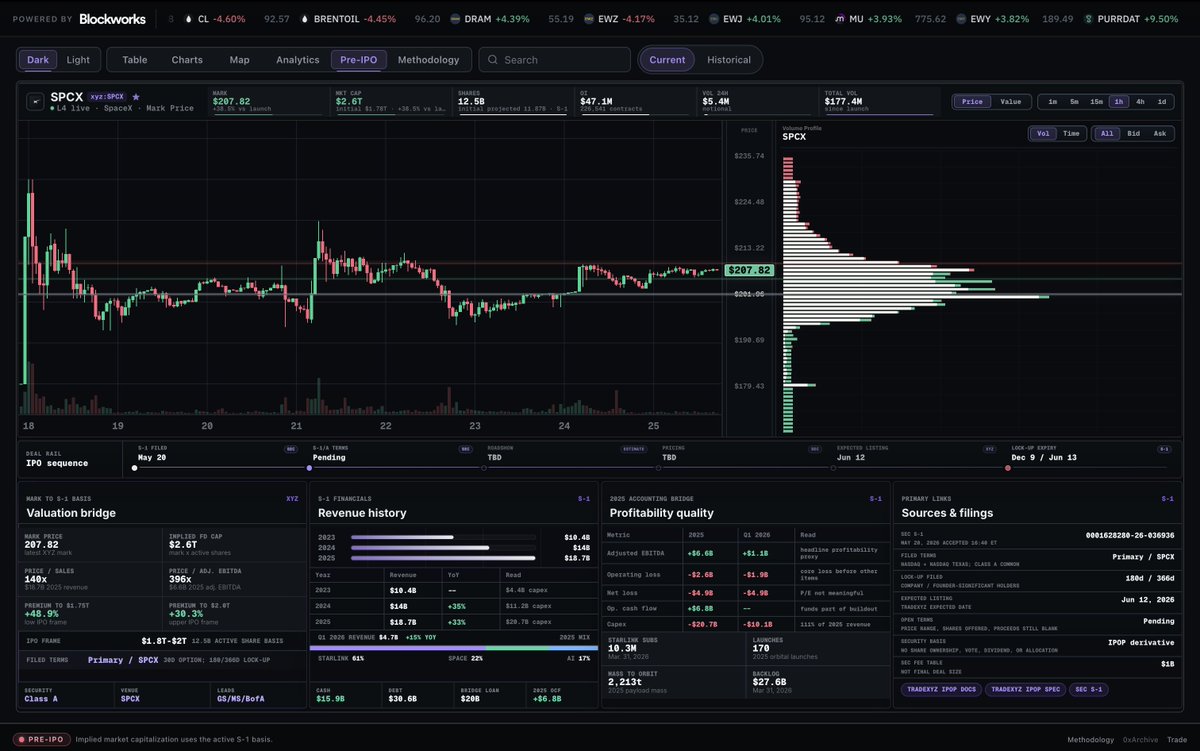
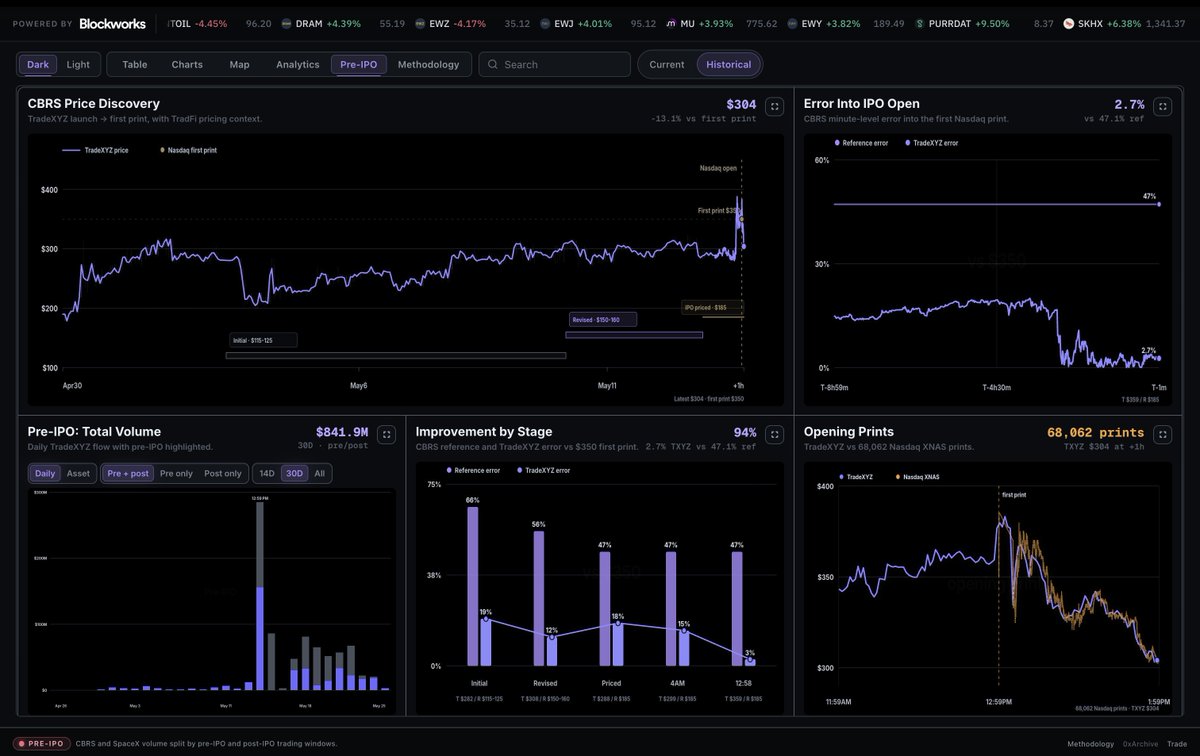
On Hyperliquid, the world’s most important private companies are tradable before they go public.
On WeekendMarkets, you can now track them in one place: live implied valuations, filings, market updates, and analytics on how prior IPOs traded against stale TradFi anchors.
21
29
247
16,022
Blockworks Research retweeted
May 21
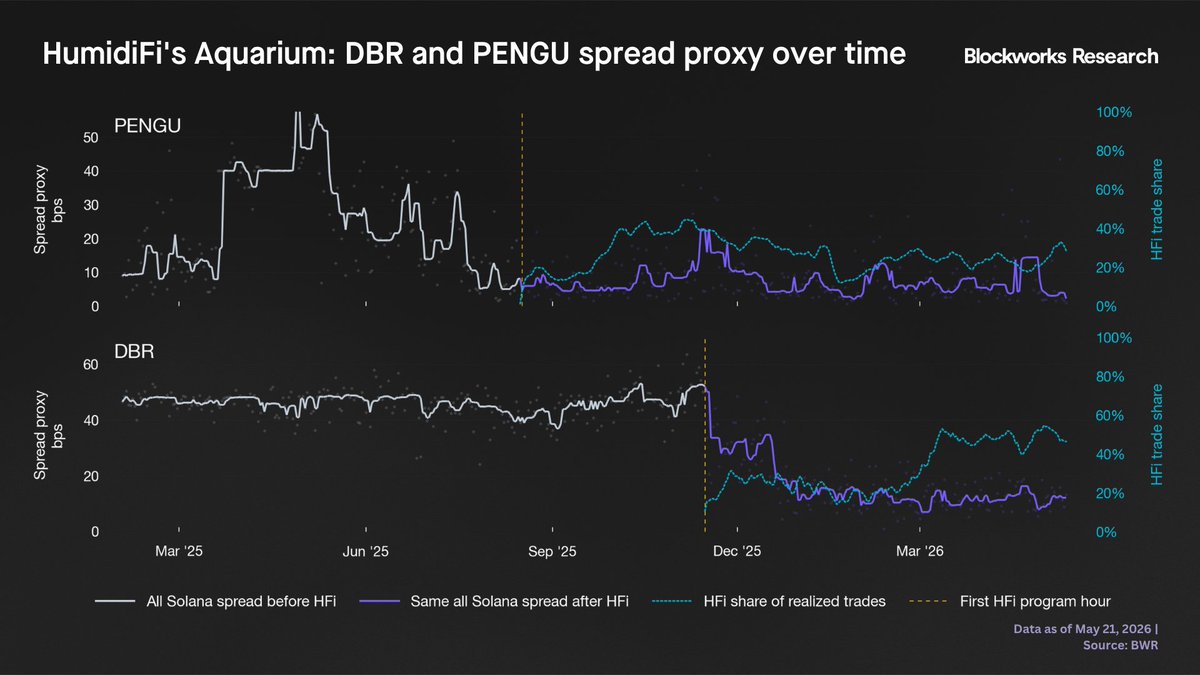
@humidifi’s Aquarium is starting to show what its market-maker coverage can do for longer-tail tokens.
Prop AMMs already dominate SOL-USDC execution, but extending that model across more pairs is the next step for @solana market structure.
After HFi program activity began, realized spread proxies tightened for both solana:DBRiDgJAMsM95moTzJs7M9LnkGErpbv9v6CUR1DXnUu5 and solana:2zMMhcVQEXDtdE6vsFS7S7D5oUodfJHE8vd1gnBouauv.
Better for issuers, better for users.
4
5
40
4,557
Blockworks Research retweeted
May 21
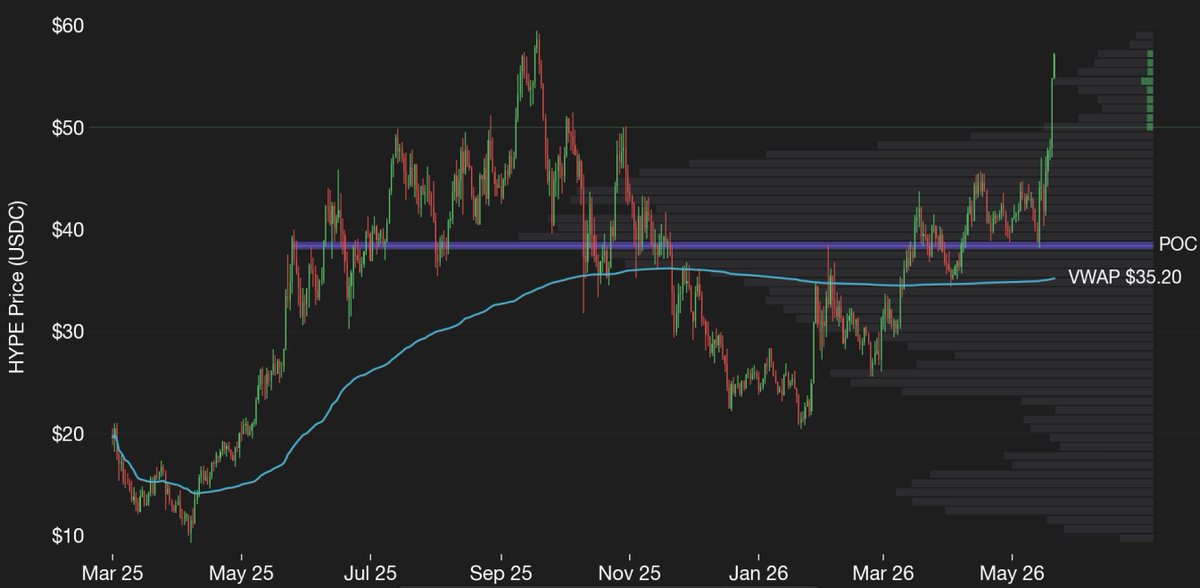
12 hours later, HYPE is up 15% from $50.
The volume profile highlights my previous argument almost perfectly: green shows volume traded during the recent move, compared to total auctioned volume at each price level.
Relatively little HYPE is actually changing hands at these new levels. The violence of the move is coming from the imbalance between aggressive buyers (DATs, ETFs, chasers) and a seller base that already had months to distribute in the prior range.
However, until sellers find a material reason to step in, the path of least resistance remains higher. Higher prices can become reflexive: they validate existing holders, reduce the urgency to sell, and force sidelined buyers to chase.
For example: if you are an existing holder, has this recent move made you more or less likely to sell versus when HYPE was at range lows? If you are sidelined, has this move made you more or less likely to enter?
Counterintuitively, despite higher prices meaning higher multiples, the answer is likely that it increased your desire to hold and participate. That is ultimately why we buy assets: for them to go up.
So where is the level where long-term holders finally sell? My bias is much higher.
May 20

HYPE >$50. Some thoughts:
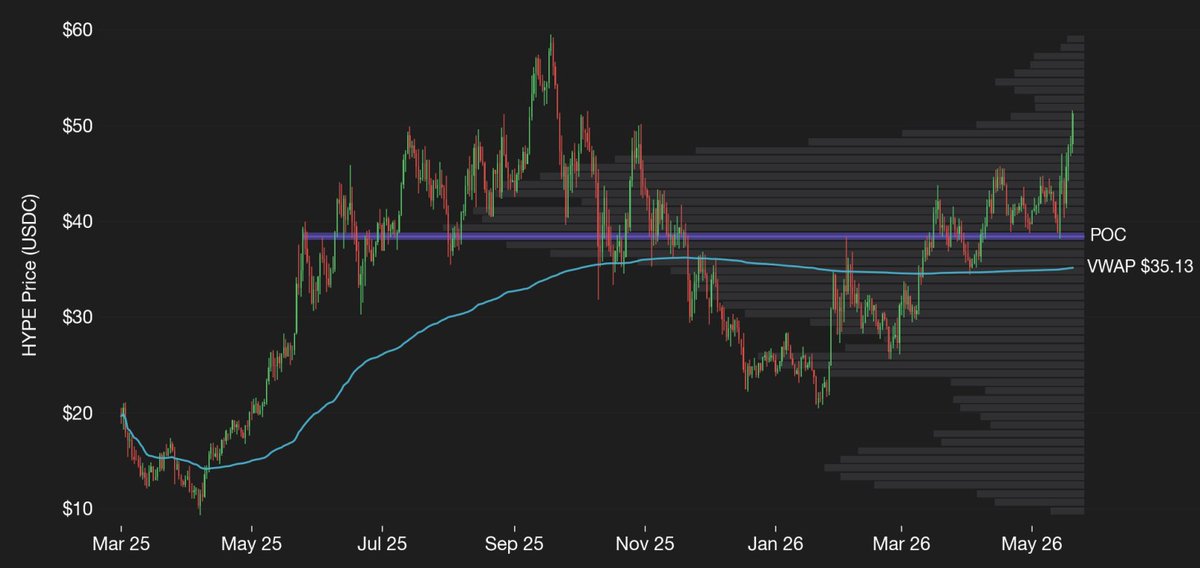
Asset prices reflect the last trade in a market’s continuous auction. While this is often treated as “fair value,” only a small share of supply actually changes hands. As a result, price usually reflects the most aggressive buyers and sellers, and the premium or discount they are willing to accept relative to the recent price range. Still, over time, slower-moving supply and demand respond, and the market starts to re-equilibrate.
Therefore, while there are many ways to value an asset, the best way to contextualize its current value is:
1) What do short-term flows and asymmetries look like?
2) Where are longer-term buyers and sellers likely to step in?
For HYPE, short-term aggressive flows are clearly asymmetric to the upside. ETF access has started ($14.1M volume on May 19th), DATs are buying (Hyperliquid Strategies has $100M left), and the Assistance Fund continues to purchase $10M–$15M a week. On the market side, we are seeing tons of positive catalysts: Circle / Coinbase likely bringing in >$100M of stablecoin-related revenue for Hyperliquid, pre-IPO markets like SpaceX and potentially OpenAI from TradeXYZ bringing outsized TradFi attention, RWA open interest at $2.6B (up 2x from two months ago), and most recently regulatory momentum around tokenized stocks.
This leads to the second question: where do longer-term holders sell into this demand? HYPE spent nearly a year auctioning between $20 and $40, rotating supply into a new holder base. My bias is that much of this supply now sits with less price-sensitive holders: Deployers, the Assistance Fund, DATs, and stakers. If motivated sellers already had repeated exits around $38–$40, how much is left to sell above $50? Instead, we may see a reflexive dynamic where investors waiting for lower (e.g HYPE’s $8 Solana moment) are forced to rotate in.
My view is that flows and demand have already pushed many TradFi equities into extremely stretched valuations, while HYPE, despite being crypto’s clear winner, has remained relatively anchored to fundamentals. This break above the prior range, along with clear improvements in fundamentals (regulation, diversified revenue, 0-1 pre-IPO / 24/7 markets) and access (ETFs and DATs), could create an environment where price discovery turns reflexive and HYPE grinds much higher, detaching from traditional valuation anchors in the same way many high-growth L1s have in past cycles.
Hyperliquid
18
22
235
25,430
Blockworks Research retweeted
May 20
HYPE >$50. Some thoughts:
Asset prices reflect the last trade in a market’s continuous auction. While this is often treated as “fair value,” only a small share of supply actually changes hands. As a result, price usually reflects the most aggressive buyers and sellers, and the premium or discount they are willing to accept relative to the recent price range. Still, over time, slower-moving supply and demand respond, and the market starts to re-equilibrate.
Therefore, while there are many ways to value an asset, the best way to contextualize its current value is:
1) What do short-term flows and asymmetries look like?
2) Where are longer-term buyers and sellers likely to step in?
For HYPE, short-term aggressive flows are clearly asymmetric to the upside. ETF access has started ($14.1M volume on May 19th), DATs are buying (Hyperliquid Strategies has $100M left), and the Assistance Fund continues to purchase $10M–$15M a week. On the market side, we are seeing tons of positive catalysts: Circle / Coinbase likely bringing in >$100M of stablecoin-related revenue for Hyperliquid, pre-IPO markets like SpaceX and potentially OpenAI from TradeXYZ bringing outsized TradFi attention, RWA open interest at $2.6B (up 2x from two months ago), and most recently regulatory momentum around tokenized stocks.
This leads to the second question: where do longer-term holders sell into this demand? HYPE spent nearly a year auctioning between $20 and $40, rotating supply into a new holder base. My bias is that much of this supply now sits with less price-sensitive holders: Deployers, the Assistance Fund, DATs, and stakers. If motivated sellers already had repeated exits around $38–$40, how much is left to sell above $50? Instead, we may see a reflexive dynamic where investors waiting for lower (e.g HYPE’s $8 Solana moment) are forced to rotate in.
My view is that flows and demand have already pushed many TradFi equities into extremely stretched valuations, while HYPE, despite being crypto’s clear winner, has remained relatively anchored to fundamentals. This break above the prior range, along with clear improvements in fundamentals (regulation, diversified revenue, 0-1 pre-IPO / 24/7 markets) and access (ETFs and DATs), could create an environment where price discovery turns reflexive and HYPE grinds much higher, detaching from traditional valuation anchors in the same way many high-growth L1s have in past cycles.
Hyperliquid
38
96
680
138,065