
Joined May 2025
- Tweets 471
- Following 261
- Followers 268
- Likes 838
101 Photos and videos
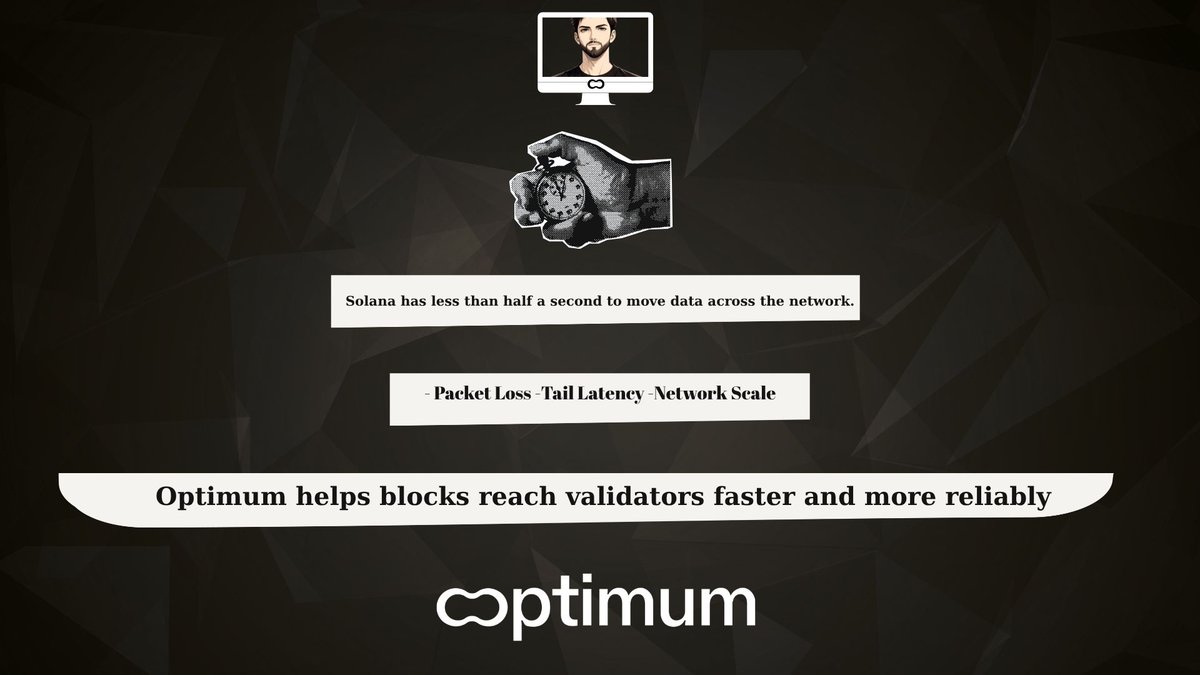



Yesterday I talked about how Ethereum validators earn revenue. Today, let’s look at Solana, one of the ecosystems where speed and low latency matter the most.
When people think about Solana, they usually think about high throughput and fast block times. But behind the scenes, things are a lot more delicate than they seem. A Solana slot lasts around 400ms, less than half a second.
With such a small time window, data needs to reach validators across the network as quickly as possible. Every millisecond matters. In fact, on high-performance networks like Solana, even 100ms of additional latency can put noticeable pressure on performance and reliability.
Today, Solana relies on powerful data propagation mechanisms like Turbine and JetStreamer. But as the network grows and validators become more geographically distributed, data transmission starts running into real-world physical limits.
This is where @get_optimum comes in.
Using RLNC (Random Linear Network Coding), Optimum aims to reduce packet loss and minimize the “tail latency” issues that can slow down network-wide data propagation.
Why does that matter?
Because it’s not enough for a leader validator to produce a block quickly. That block also needs to reach validators on the other side of the world just as fast and without missing data.
By addressing these data transmission bottlenecks, Optimum is helping create a stronger foundation for real-time networks like Solana, making them more efficient, reliable, and scalable as they continue to grow.
Over the last few posts, I’ve tried to explain some of the core problems Optimum is tackling and why they matter. Hope it was useful 🙏
gmum🤍
2
1
20
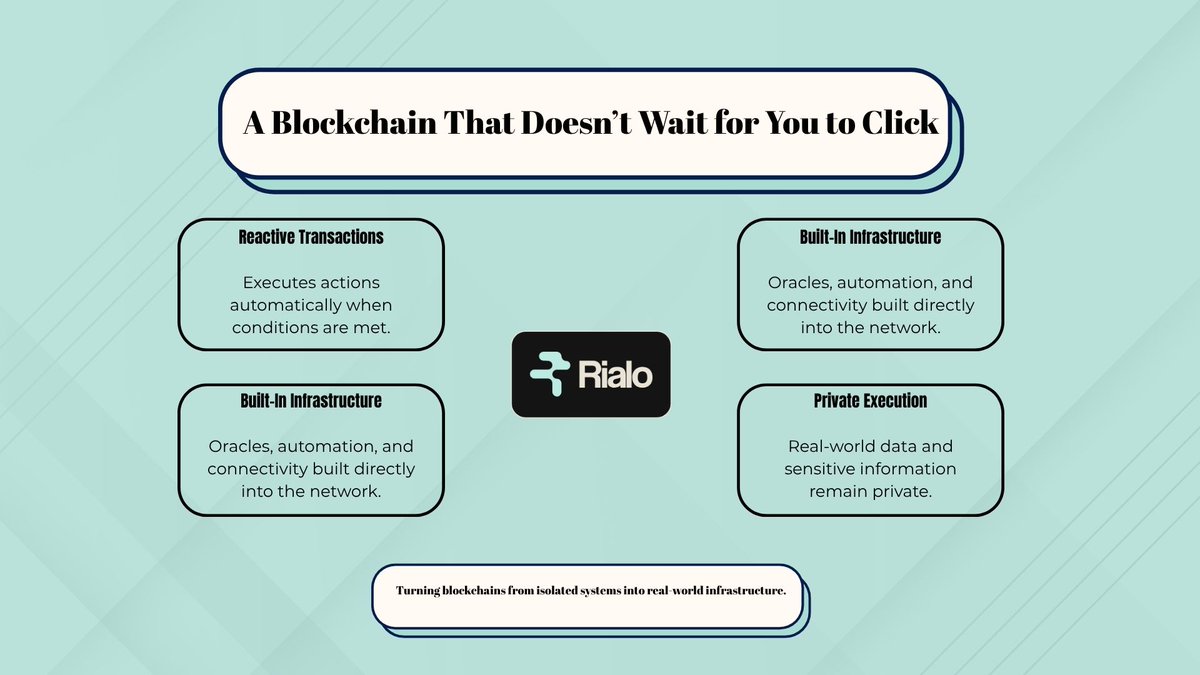
What interests me most about @RialoHQ is its vision of turning blockchains from isolated systems into something that can actually interact with the real world.
Today, most blockchains only “wake up” when someone submits a transaction. Rialo is building an infrastructure that can react to events on its own.
• By integrating services like oracles, automation, and connectivity directly into the network, it reduces both complexity and security risks for developers.
• Reactive Transactions allow actions to be executed automatically when predefined conditions are met, without relying on external bots.
• With the Stake-for-Service model, staking rewards can help cover transaction costs, reducing the need to constantly manage gas balances.
• The REX layer enables applications to use real-world data while keeping sensitive information private.
To me, Rialo isn’t just another blockchain. It’s an attempt to build infrastructure that can bridge Web2 and Web3, creating systems that are more connected, responsive, and useful in the real world.
3
5
30

Jun 12
If you saw my post yesterday, I talked about Optimum’s 6x speed improvement on Ethereum using mump2p, bringing propagation times down to around 150ms.
Today, I want to talk about why that matters beyond just being an impressive technical achievement.
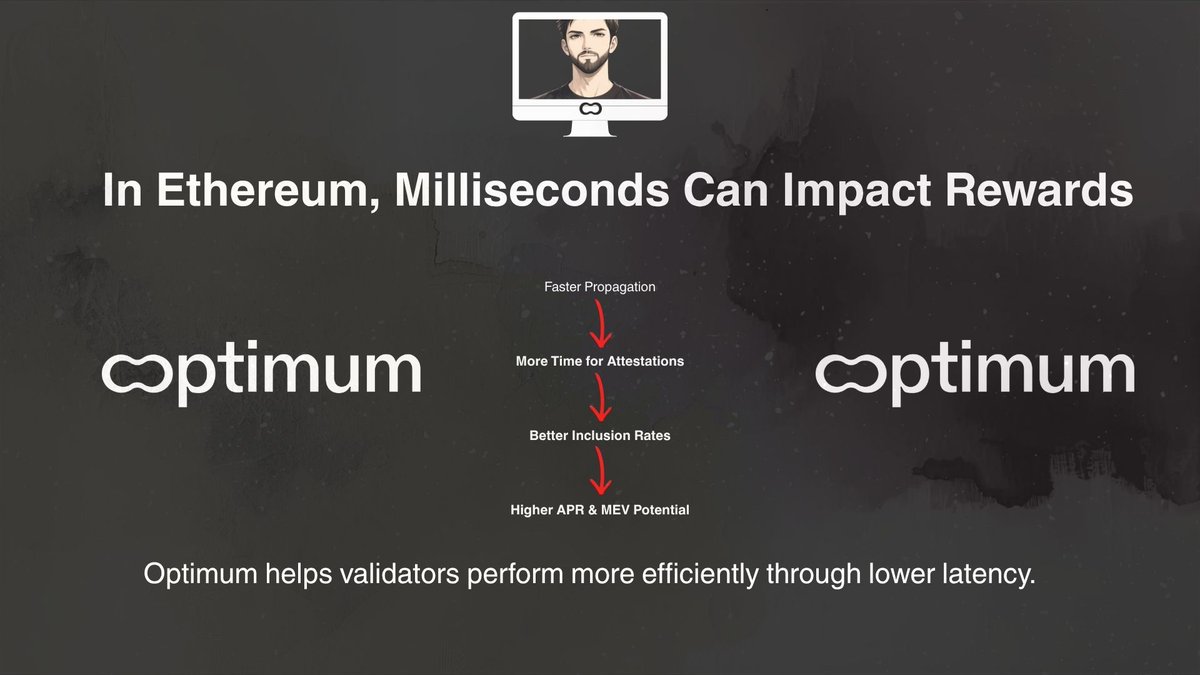
In Ethereum, timing is everything. The longer it takes for a block to propagate across the network, the less time validators have to see it and submit their attestations.
That can lead to missed opportunities, missed slots, and ultimately lower staking rewards.
With faster data propagation, validators can:
✅ Receive critical network data sooner and improve their chances of submitting timely attestations.
✅ Maintain stronger performance and inclusion rates, even during periods of network congestion.
✅ Potentially benefit from higher APR and MEV (Maximal Extractable Value) revenue thanks to having more time to react and participate.
That’s why I don’t see @get_optimum as just another infrastructure upgrade. Faster propagation isn’t only about network performance, it can also have a real impact on validator economics.
By reducing one of Ethereum’s key bottlenecks, Optimum is working toward a network that’s not only faster, but potentially more rewarding for validators as well.
Tomorrow I’ll be looking at the Solana side of things, where milliseconds matter even more. In that environment, latency isn’t just an inconvenience, it’s often the difference between winning and losing.
Stay tuned.
4
4
29
Jun 12
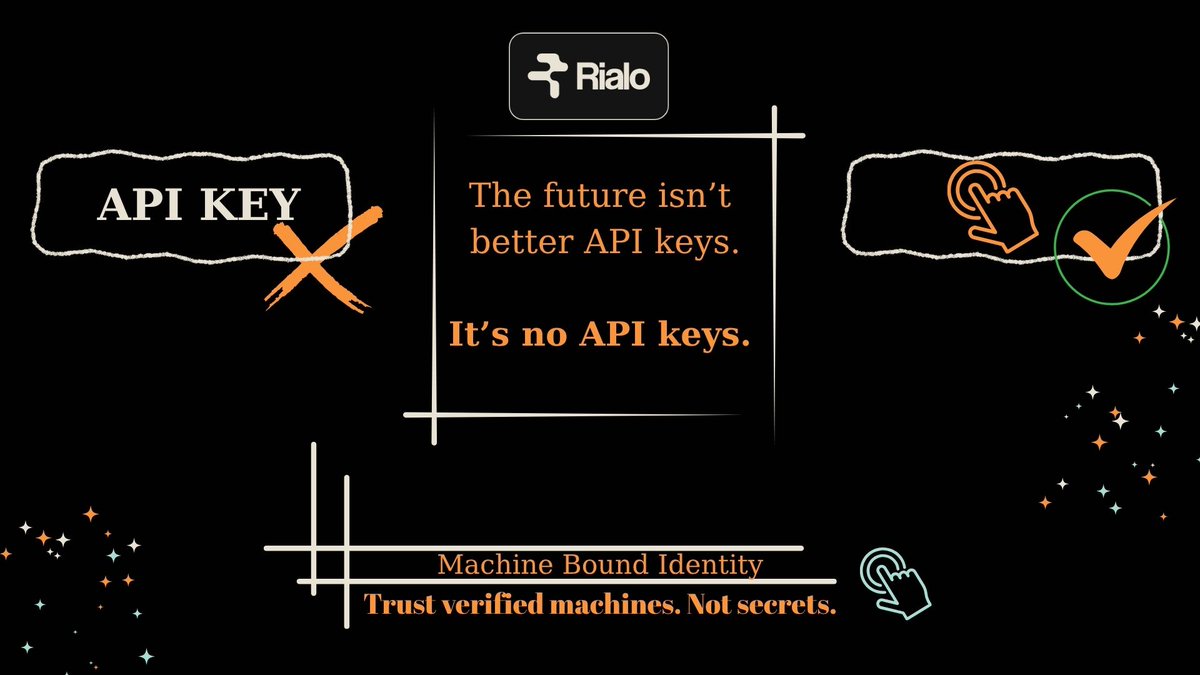
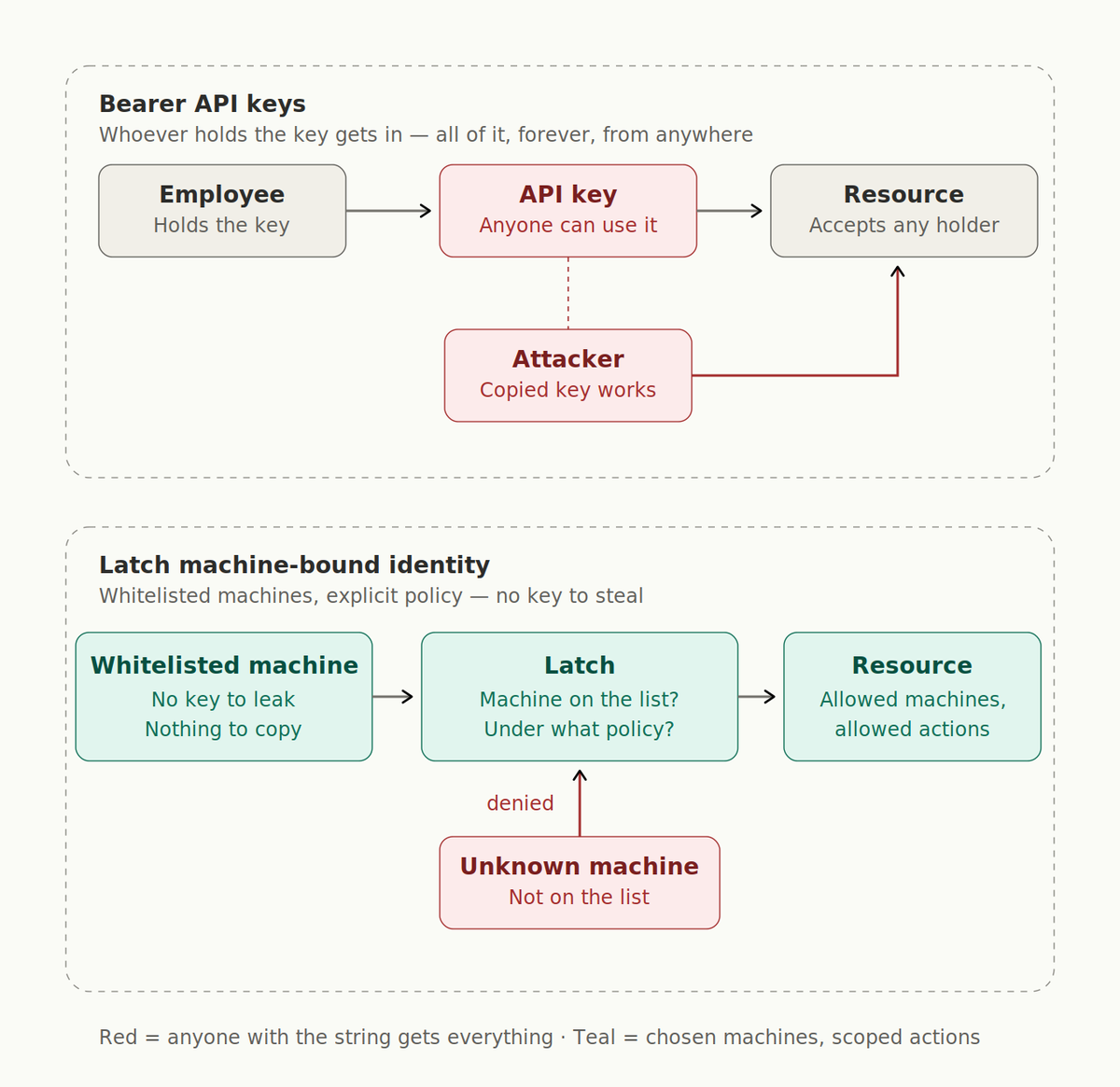
API keys have powered the internet for years, but they’ve always had the same weakness:
If a key leaks, anyone holding it can often act as the legitimate user.
That’s why ADE’s post on Machine Bound Identity caught my attention.
As AI agents become more autonomous and machine-to-machine interactions become the norm, identity may become just as important as intelligence itself.
This is especially relevant for the future Rialo is building toward, where agents, applications, and machines will need to interact and transact securely at scale.
Instead of relying on a secret string, the idea is to tie trust to verified machines and clear policies.
Not saying API keys disappear tomorrow, but it’s an interesting direction for a future agent economy that needs trust built into the infrastructure layer.
Definitely a space worth watching. 👀
@RialoHQ @itachee_x
Jun 11

Say goodbye to API key theft.
Can't steal credentials if there are no credentials to steal.
A major goal of ours is to get rid of API keys altogether.
Machine Bound Identity is our first major step in this direction. Your machine is the key.
Try it 👉 onlatch.com
4
5
52
Jun 11
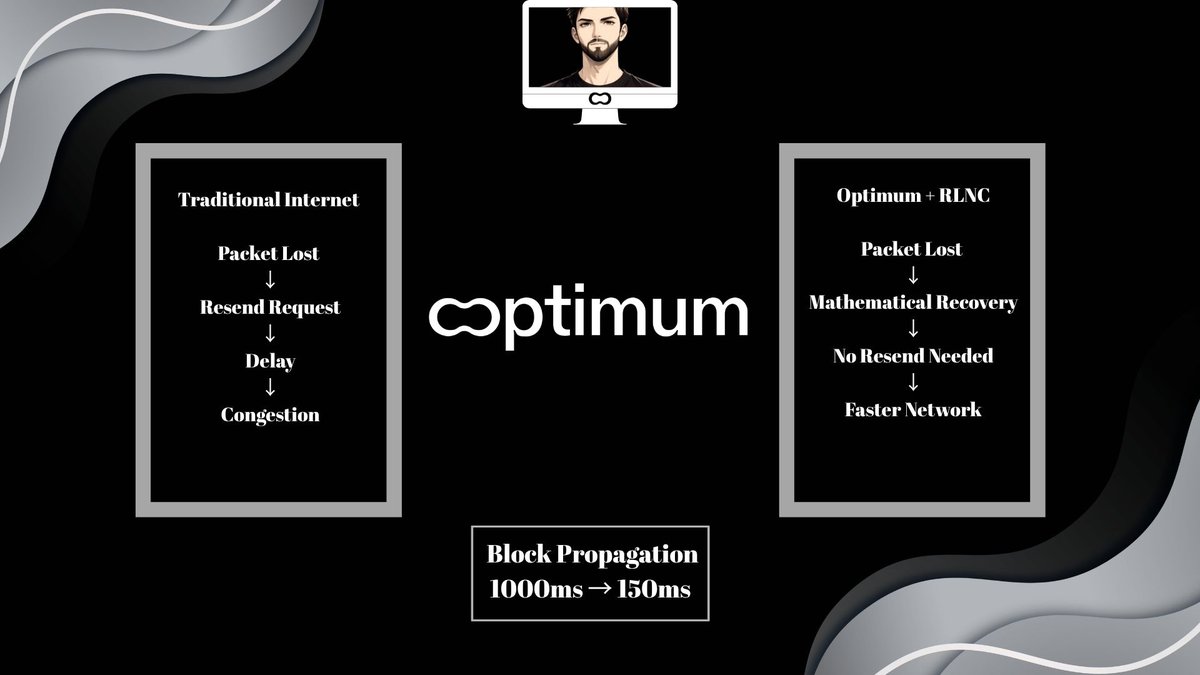
Let’s take a closer look at one of @get_optimum most interesting technologies: RLNC (Random Linear Network Coding).
In traditional internet networks, if a data packet gets lost along the way, the network has to stop and wait for that missing piece to be sent again. When traffic is heavy, this creates delays and adds even more congestion.
Optimum approaches this problem differently. RLNC, developed by MIT professor and IEEE Hamming Medal recipient Muriel Médard, doesn’t treat data as individual packets. Instead, data is transmitted as mathematically encoded pieces.
The result is pretty impressive: even if a node doesn’t receive every packet, it can still reconstruct the original data using the information it already has. In other words, the network becomes far more resilient to packet loss.
So what does this mean in practice?
In tests on the Ethereum Hoodi testnet, block propagation that normally took around 1 second was reduced to just 150 milliseconds using Optimum’s mump2p protocol. That’s roughly a 6x improvement in propagation speed.
And it’s not just about speed. RLNC is widely recognized in academia as one of the most effective approaches for handling network congestion. Rather than throwing more hardware at the problem, Optimum is using mathematics to tackle one of Web3’s biggest scalability challenges.
We’ll look at why this 150ms propagation time matters for validators tomorrow and how faster propagation can potentially translate into higher earnings.
2
6
55
Jun 10
Crypto research keeps getting harder.
On-chain data, social sentiment, dashboards, reports, and a news cycle that never slows down. Most of us end up jumping between dozens of tabs just to understand what’s happening.
That’s what caught my attention about @SurfAI
Instead of treating crypto as a general AI use case, Surf was built specifically for crypto markets. It brings together data from sources like Token Terminal, Dune, and X into a single interface, making research much more efficient.
What I find most useful is that it links insights back to their original sources. Rather than blindly trusting an AI-generated answer, you can verify the information yourself.
It also recently raised $15M and has been performing strongly on the CAIA benchmark, outperforming existing models across multiple categories.
If you spend a lot of time researching crypto, Surf might be worth checking out.
4
8
84
Jun 10
I talked about why I became interested in @get_optimum yesterday. I want to dig a little deeper into a simple question today:
Why did this idea of a “memory layer” suddenly appear, and why does it matter so much?
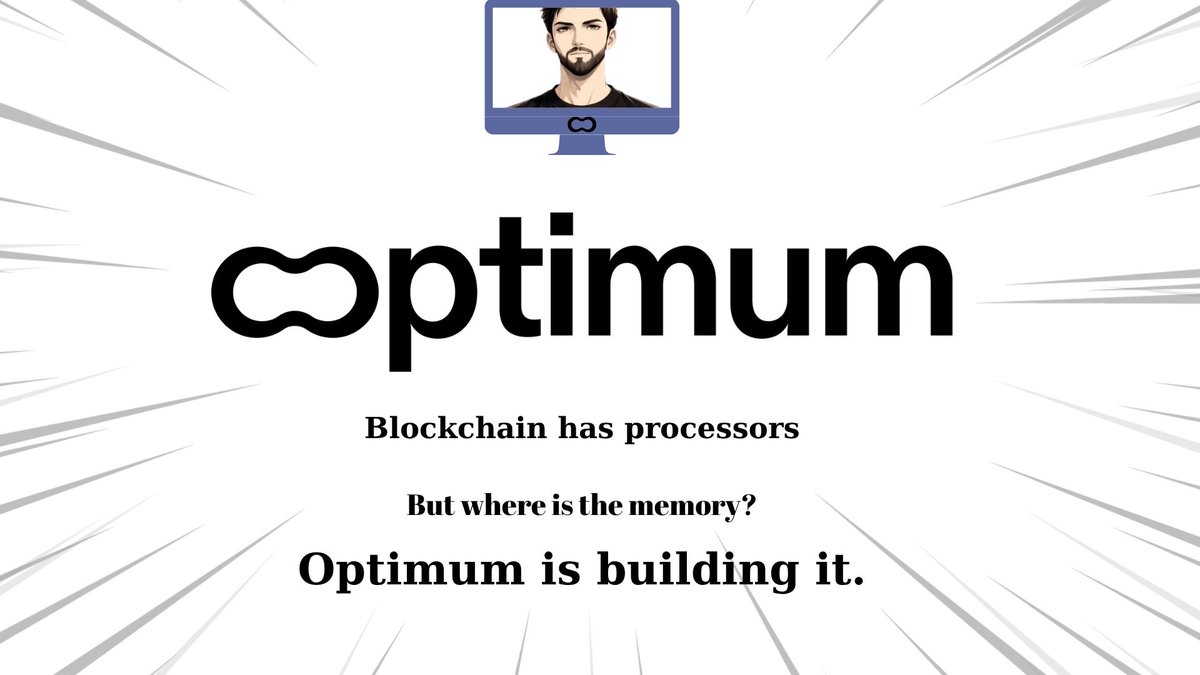
Think of blockchain as a giant world computer. For years, most of the industry has focused on increasing compute power. New L1s, L2s, faster execution, better consensus…
But a computer is more than just its processor.
One comparison from Optimum CEO Muriel Médard really stuck with me. No matter how powerful a processor is, it still needs an efficient data bus and fast memory to perform at its full potential.
I think blockchain is starting to face the same reality.
Today, data is mostly propagated through networks using a gossip-based approach. It works, but as networks scale, the same information gets repeatedly copied and transmitted across nodes, creating unnecessary traffic and unpredictable delays.
Your transaction might be confirmed quickly, but if the underlying data takes longer to reach the rest of the network, the overall system still feels slower than it should.
This is where Optimum caught my attention.
The challenge isn’t just storing data. It’s moving data across the network as efficiently and as quickly as possible.
That’s why Optimum doesn’t position itself as another blockchain or execution layer. Instead, it’s building the infrastructure layer that helps data move and stay accessible across the broader Web3 ecosystem.
Tomorrow I’ll dive into the RLNC technology behind it and some of the performance results they’ve demonstrated on Ethereum.
The more I learn, the more the bigger picture starts to make sense. 👀
6
10
105
Jun 9
Hello @get_optimum community! 👋
As of today I’ve joined the Optimum journey, and I’m genuinely excited to be here.
I’ve been researching the project for a while now. What first caught my attention was Optimum’s focus on solving Web3’s “missing memory layer” problem, along with its use of RLNC technology developed by MIT Professor Muriel Médard to improve data propagation efficiency. The technical approach feels truly unique.
The $11M seed round led by 1kx also says a lot about the project’s potential. Seeing names like Robot Ventures, Finality Capital, and Spartan backing the vision definitely made me pay closer attention.
Lately, I’ve been seeing Optimum everywhere on my timeline as well. The growing interest from both the technical and crypto communities pushed me to dig deeper, and eventually convinced me to join the community.
Looking forward to learning more, meeting everyone here and contributing however I can along the way.
Gmum🖤
3
12
119
Jun 8
One thing I’ve noticed is how much infrastructure teams need to piece together before they can even start building a blockchain application.
Oracles, APIs, bots, bridges… before you know it, you’re spending more time connecting components than building the actual product.
That’s one of the reasons @RialoHQ caught my attention.
Their idea is to move more of the interaction with real-world data to the protocol layer itself, reducing the need for so many external dependencies.
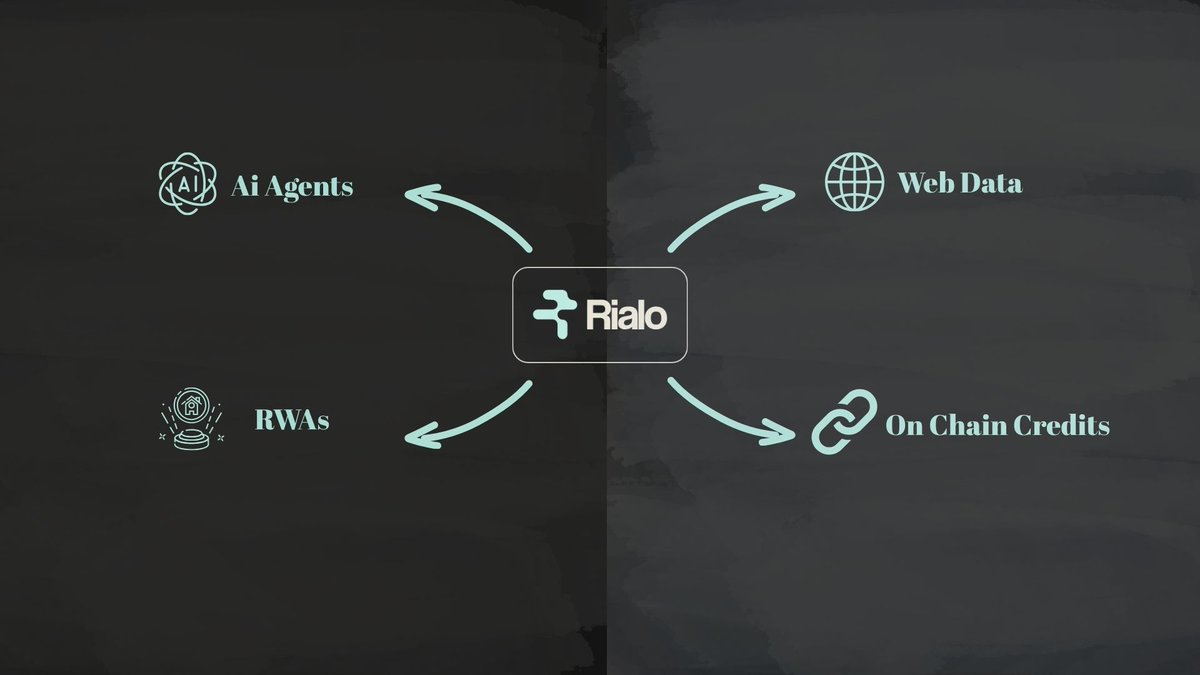
That could open up some interesting possibilities, especially for:
-RWAs (Real World Assets)
-AI Agents
-Prediction markets
-On-chain credit systems
On the technical side, they’re building around RISC-V while aiming for Solana VM compatibility, which could make adoption easier for existing developers.
The team includes people with backgrounds at Meta, Google, Netflix, Solana, Mysten Labs, and Diem. Backers include names like Pantera Capital and Coinbase Ventures.
It’s still early, but I think Rialo is trying to tackle an important question:
How can blockchains interact with the real world in a more native way?
Personally, I’m most interested in the AI Agent and RWA angle.
4
9
67
Jun 4
Everyone is talking about how intelligent AI agents will become.
But very few are talking about security.
The future of AI agents depends not only on intelligence, but also on trust, permissions, and security.
That’s why what @RialoHQ is building matters.
If you’d like to sign up and learn more, check out the post below. 👇
Jun 3

Bad access control has already cost companies billions. Now everyone's deploying agents as their newest employees and handing them all-access master keys on day one.
We're building a better more secure way, powered by @RialoHQ 🧵
👉 onlatch.com
4
48
Jun 3
Some projects chase attention.
@RialoHQ focuses on execution.
In the long run that’s what matters.
2
3
26
Jun 1
Watching @RialoHQ feels like watching something take shape in real time.
No noise.
Just progress.
2
10
69
May 25
The biggest breakthroughs in technology don't usually come from making something faster.
They come from looking at the problem from a different perspective.
That's what stands out about @RialoHQ
Instead of simply pushing existing limits, it's rethinking what blockchain infrastructure should look like.
Get Real. Get Rialo.
3
7
47
May 23
Some projects focus on today’s limitations.
Others focus on what tomorrow can make possible.
@RialoHQ belongs to the second group.
5
14
88
May 21
Why should thousands of validators repeat the same computation?
Execute once.
Prove it.
Verify it.
That’s the direction blockchain infrastructure is heading, and @RialoHQ is building for that future.

2
5
40
May 14
Most people are racing to automate.
Very few are building accountability layers for autonomous systems.
On-chain permissions verifiable execution logs will become mandatory faster than people expect.
Everyone is rushing to deploy agents right now, but they’re missing the full picture.
AI agents are the what. They decide, act, hit APIs, move money, coordinate with other agents, ship code, and complete tasks without a human in the loop. That capability is real and it's here.
But capability without governance is just chaos that’s good for demos and not much else.
Orchestration and governance is the how. It answers the questions the agent never asks itself. Who authorized this? What are the limits? Is there a record of any of this?
Right now most deployed agents have no answers to any of those questions.
That is the problem that Rialo can solve.
Permissions enforced on-chain. Agent coordination systems baked into the protocol. Every decision logged before execution, not after.
Make sure you understand the how before you scale the what.
This isn’t just the cautious path. This is the only path that doesn't blow up in production.
1
2
42
May 12
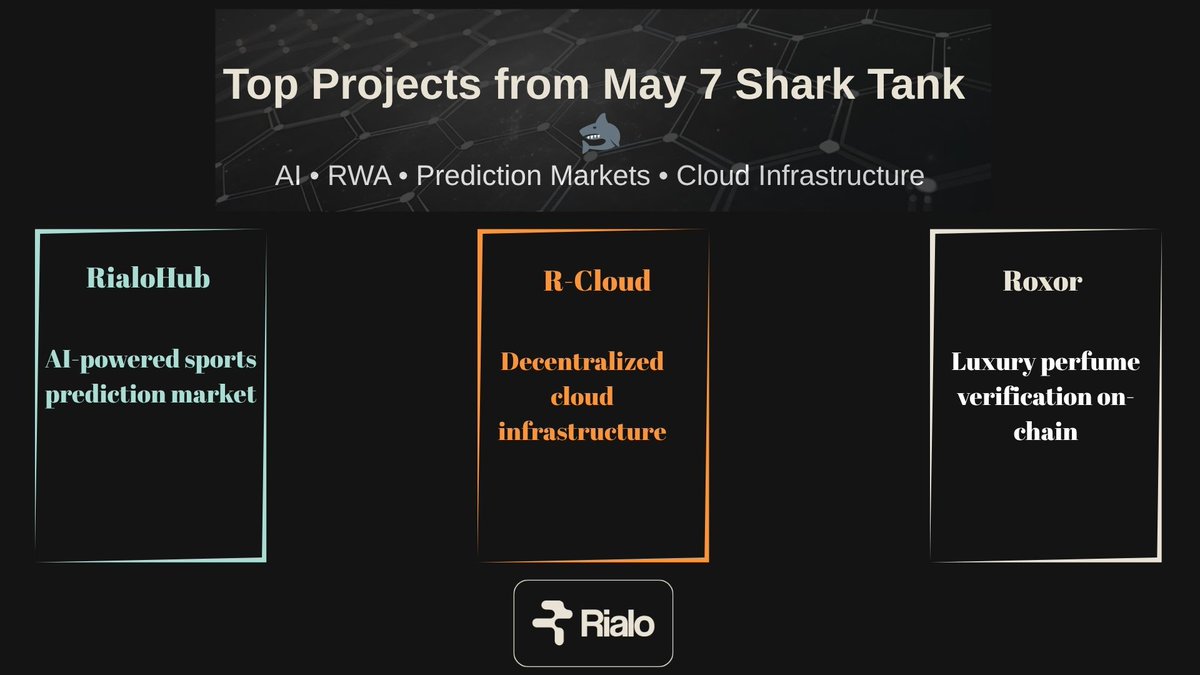
3 standout projects caught attention during the May 7 @RialoHQ Shark Tank event 🦈
From prediction markets to decentralized cloud infrastructure, and from RWA perfume verification to AI Agent systems, we saw projects tackling very different sectors.
Here are the highlights 👇
1. RialoHub
A sports-focused prediction market platform.
It offers:
• Football match prediction markets
• Global event markets
• Short-term BTC/ETH/SOL trading opportunities
But what really differentiates the project is its AI Agent system.
This agent can:
• Analyze matches
• Calculate probabilities
• Provide suggestions to users
• Eventually evolve into an automated execution system
The team is also heavily focused on Web2 user onboarding.
Reducing wallet complexity is one of the key details that stood out.
2. R-Cloud
A blockchain-based decentralized cloud infrastructure project.
Main focus areas:
• Data security
• Reducing centralized points of failure
• Preventing data loss
The team is specifically trying to solve problems commonly seen in traditional cloud systems, such as:
• Hacking risks
• Server failures
• Data loss
Its backup server architecture and encrypted data infrastructure were among the most notable aspects.
3. Roxor
An interesting RWA project combining the perfume industry with blockchain technology.
Each perfume bottle comes with:
• A unique QR code
• An NFT-based digital certificate
• An on-chain verification system
The goal is to reduce counterfeit premium perfume issues and make product authenticity verifiable.
The physical product blockchain integration aspect was especially interesting.
Overall, one common theme stood out across the event:
AI Real World Utility Web2 onboarding.
It feels likely that we’ll continue seeing more niche projects focused on solving real-world problems in the coming period.
4
9
53
May 8
Rialo community keeps growing day by day.
Yesterday’s weekly Shark Tank event reached a new record with 650 participants joining the session. And honestly, this is about much more than just numbers. It’s a strong sign of how organically the community is growing and how builder-focused the ecosystem is becoming.
Every week, we continue to see new ideas, new projects, and more developers willing to contribute to the ecosystem. Especially recently, the technical discussions and community-driven initiatives have started building a genuinely strong builder culture around Rialo.
What makes a community truly valuable is not just hype, but people consistently building and contributing over time. And that’s exactly what we’re starting to see with @RialoHQ
Those who have been here since the early days know exactly what I mean. 🧡
3
6
66
May 6
Direct integration of institutional-grade market data into onchain applications is actually huge.
I really love @RialoHQ ’s vision and the way they’re building.
We are proud to share that Subzero Labs (Rialo) has been featured in the @CBOE Innovation Spotlight.
CBOE (Chicago Board Options Exchange) is one of the world's largest derivatives and securities exchanges, handling 3.8 billion options contracts a year and powering $45B in daily FX volume. We are integrating CBOE's high-fidelity market data directly into Rialo, giving developers building on Rialo access to institutional-grade financial data as a native part of their onchain applications.
This is what it means to build neofinance infrastructure seriously: the data that institutional markets run on, available to developers building financial applications onchain. With market data from the likes of @CBOE provided natively, developers on Rialo can build sophisticated, data-rich applications without relying on third-party infrastructure or building custom data pipelines.
Rialo takes care of the data so developers can focus on building world-class apps.
Read the full spotlight: cboe.com/market_data_service…
4
7
75