
Blockchain venture capital fund of funds platform
Joined January 2019
- Tweets 2,988
- Following 787
- Followers 1,228
- Likes 3,768
60 Photos and videos











Hutt Capital retweeted

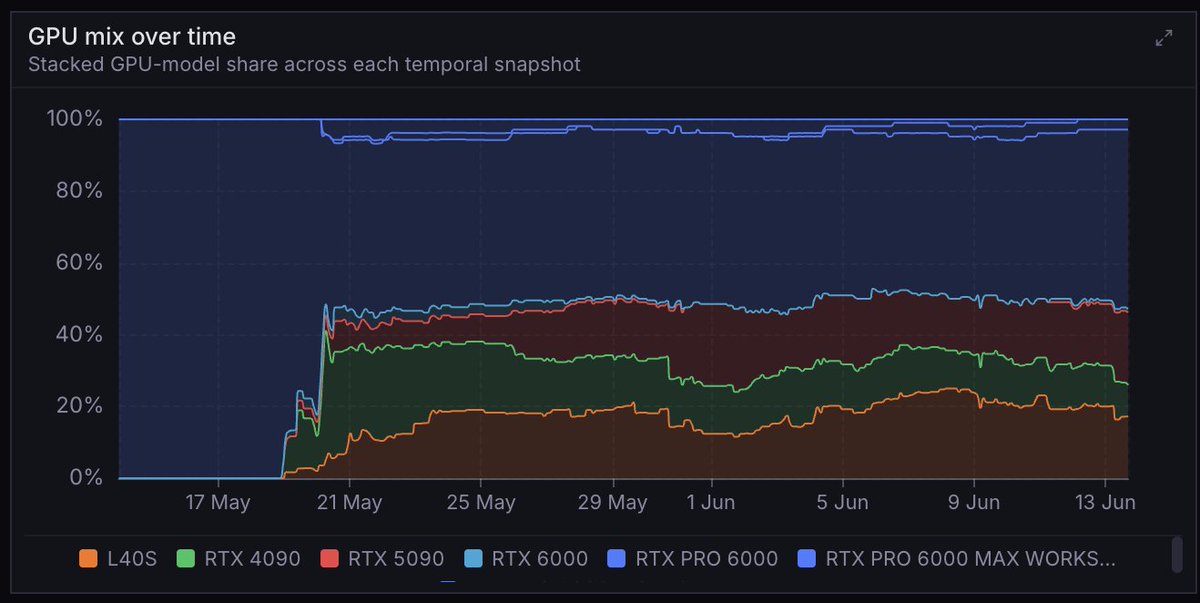
The 8B model currently training on Agora is 350B tokens in and continuing to converge. The top level metrics and evals look almost exactly like a centralised run. But;
- 133 external contributors total bringing 4090's, 5090's, L40S/RTX 6000 and RTX 6000 Pros. These are cards that people actually own - there are no H100, B200's etc.
- The max number of nodes the system can support (104) was filled almost immediately. The authorization layer is receiving approximately 100 requests/minute to join.
- The total tokens/per second processed moves directly with amount of compute in the swarm, with Agora constantly optimising to make most efficient use of what hardware is present.
- MFU is approximately 20%, TPS is 170k tok/s. There are near constant communication failures which Agora is completely absorbing without slowdown.
- The system is effectively on auto-pilot, requiring very little intervention from us. Bad nodes are purged immediately before training is affected and new nodes take their place.
4
14
119
44,213
Hutt Capital retweeted

Jun 10
No longer will you have to say gm or gn.
Onchain Everything Exchange is calling you.
66
156
823
151,078

Hutt Capital retweeted

Jun 10
Intelligence is becoming a commodity, but autonomous execution is still rare.
Hermes Agent from @NousResearch is bridging the two and is about to change how we think about software forever.
New post from @nickgarcia from @breed_vc.

2
3
9
6,235


Hutt Capital retweeted

Jun 9
Ethena has selected Centrifuge as a strategic tokenization partner.
Following an in-depth RWA RFP, @Ethena chose Centrifuge to support the next phase of USDe's backing diversification.
The partnership launches with an allocation to Centrifuge’s JAAA fund, managed by @JHIAdvisors, bringing institutional credit into Ethena’s expanding real-world asset collateral strategy.
A major step for Ethena. A major step for RWAs.
Powered by Centrifuge.
55
66
403
133,233
3Jane has executed an ~$8.5m whole-loan purchase with Slope, the credit infrastructure powering business lending for @slashapp & the Fortune 10
Phase 0 of a broader $50m forward-flow program
USD3 now directly funds SMB lines of credit embedded in major U.S. commerce platforms
2
10
87
10,035
Hutt Capital retweeted

Jun 9
We’ve just raised $175M, in a round co-led by @paradigm, @a16zcrypto, and @RibbitCapital, the largest raise DeFi has ever seen.
Credit is the bedrock of our civilization, but the infrastructure underneath is fragmented, extractive, and closed to most of the world. That is what @Morpho is here to change.
Morpho is building the open credit network for the world. The global credit market is $ 200T. We are building the infrastructure layer that will move it onchain, and every institution, fintech, and bank that wants to participate in the next era of finance will connect to this network.
After four years of being heads down building Morpho, we now count more than $11B in deposits and integrations with leading financial institutions including @Coinbase, @Binance, @FireblocksHQ, @SG_Forge, @krakenfx, @Bitwise, and dozens of others building on Morpho to offer better products to their users. But this is just the beginning.
This raise will allow us to accelerate: activating the global credit network at scale, building the go-to-market engine to match our ambition, and bringing more institutions onto the network faster.
Having any kind of onchain strategy in this era will mean going through Morpho at some point. Reach out and let's talk. And if you want to help build the open credit network for the world, we have plenty of open roles.
Let’s fly 🦋

Morpho Association has raised $175M to build the open credit network for the world.
Co-led by @paradigm, @a16zcrypto, @RibbitCapital with strategic participation from @apolloglobal, @vaneck_us, @circle_ventures, and @Ledger @Cathayinnov.
The round also included participation from @variantfund, @wmt_ventures, @preludexyz, @IOSGVC, @HashKey_Capital, @sbigroup, @Bpifrance, @mirana, @bamazizimesh, NJJ Capital and 10 other strategic partners.
The funding will help accelerate Morpho's position as the foundation for onchain credit.
322
148
2,299
347,054
Hutt Capital retweeted

Jun 9
Hyperliquid Perps is Now Live on Nansen 🚀
You already track Smart Money, Whales, and Public Figures here.
Now you can trade here too.
Available for all users, on web and mobile.
92
144
495
153,645
Hutt Capital retweeted

Jun 9
Listen to Brett if you want to understand more about tokenization and @Securitize position in the industry and growth potential

Today's pod is with @Observatory13, President of @Securitize.
Brett traces how tokenization has evolved from floor-based trading rooms to onchain capital markets, why tokenized stocks might be the next major frontier, and the conversations happening between bulge bracket banks about bringing tokenized IPOs to onchain investors within the next year or two.
TIMESTAMPS
00:00 - Understanding Tokenization
02:44 - The Evolution of Capital Markets
05:09 - Regulatory Landscape and Innovation
09:11 - Institutional Adoption of Tokenization
13:22 - Brett's Transition to Leadership at Securitize
16:15 - Growth Opportunities for Securitize
20:12 - Advice for Traditional Firms Entering Digital Assets
21:56 - The Importance of Networking in Crypto Events
24:26 - The Shift of Tokenization from Disruption to Integration
27:09 - Bridging Traditional Finance and Blockchain
30:07 - Understanding the Landscape of Tokenization
32:33 - The Future of Tokenized Assets
39:42 - Regulatory Perspectives on Tokenization
42:47 - Envisioning the Future of Tokenization
Watch below or on X:
3
7
57
3,765
Hutt Capital retweeted

Jun 9
Public Beta is live.
Trade real US stocks and ETFs alongside crypto, perps, and yield, all within one account.
Real ownership under New York law. Cash dividends, brokerage transfers, and corporate actions rolling out during Public Beta.
24/5. Instant execution. Traditional market liquidity.
No fees in June: backpack.exchange/stocks
140
185
691
168,911

Ethena has partnered with Janus Henderson, a $480 billion asset manager, to allocate and support the distribution of their liquid high-quality CLO tokenized funds.
As part of the partnership Janus Henderson has made a strategic investment into Ethena's governance token, will allocate into USDe as part of their treasury cash management, and is also exploring avenues to distribute USDe to their client base via exchange traded instruments.
115
80
629
199,216

Morpho Association has raised $175M to build the open credit network for the world.
Co-led by @paradigm, @a16zcrypto, @RibbitCapital with strategic participation from @apolloglobal, @vaneck_us, @circle_ventures, and @Ledger @Cathayinnov.
The round also included participation from @variantfund, @wmt_ventures, @preludexyz, @IOSGVC, @HashKey_Capital, @sbigroup, @Bpifrance, @mirana, @bamazizimesh, NJJ Capital and 10 other strategic partners.
The funding will help accelerate Morpho's position as the foundation for onchain credit.
255
118
1,111
769,605
Hutt Capital retweeted

Jun 5
We’re excited to propose Ownership Capital.
Ownership Capital would be:
- A MetaDAO-native fund taking an activist approach
- Run by @allocateur and @agentmechanic, two entrepreneurs who previously built successful businesses in their home country of Georgia and spent the last 5 years running a successful crypto prop firm
- Anchored with $2M of MetaDAO’s capital
You can trade META-039, authorizing its creation, here: metadao.fi/projects/metadao/…
Jun 5

META-039 is now live. @metaproph3t has proposed incubating Ownership Capital, a MetaDAO-native fund.
Read the full proposal and trade it below.
28
15
203
35,658
Hutt Capital retweeted
Jun 5
Today, we announced that the SEC has declared the Registration Statement on Form S-4 effective. The proposed business combination will be submitted to $CEPT shareholders of record as of May 11, 2026 (the "Record Date"), for approval at a special meeting scheduled for June 29, 2026, and, if approved, is expected to close shortly thereafter. Upon closing of the transaction, the combined company is expected to operate under the name Securitize Corp., and its shares are expected to trade on the NYSE under the ticker symbol "SECZ."
43
54
339
49,077
Hutt Capital retweeted

Jun 4
hyperliquid is a killer product
meanwhile, there are pressures that may constrain the project’s viability within US borders
including:
- hyperliquid’s product layer (via CFTC’s kalshi approval, coinbase/deribit no action, and policy statement)
- hyperliquid’s network and token layer (via clarity act)
- hyperliquid’s collateral layer (via USDC, managed by circle/coinbase, two US regulated entities)
haven’t seen a thorough discussion on these impacts, so below is a brief summary of the current paths forward, and the rationale behind each:
(1) hyperliquid can ignore US market, go offshore only
(2) hyperliquid can build a US regulated wrapper
(3) hyperliquid can decentralize under ‘clarity act’
(4) hyperliquid can centralize the project, turn $HYPE into a security
(5) hyperliquid can lobby for a change
these are the five, i'll start with the first
(1) hyperliquid can ignore US market, go offshore only
last week the CFTC approved kalshi’s BTCPERP as a futures contract on a DCM
the CFTC separately confirmed certain deribit perps may be treated as foreign futures through the coinbase FCM path
the implication is that regulated distributors for perps in the US may need a fully regulated venue, compliant customer funds path, approved product scope, surveillance, disclosures, and accountable corporate counterparties
without these in place
distributing hyperliquid liquidity, or offering hyperliquid perps, could look like routing US customers into an unapproved offshore venue
so the first option for hyperliquid is that they ignore the US market entirely
this approach would be similar to binance main exchange, which was ultimately forced to more aggressively block american customers after years of light effort
like binance, doing so would preserve hyperliquid’s product offshore, but cede US institutional access for the time being
(2) hyperliquid can build a US regulated wrapper
the second path is to find a way to build or partner with a US regulated wrapper to offer perps
under this path, offshore hyperliquid would remain a global crypto native venue, while a separate US affiliate or partner offers regulated perps through an FCM/DCM/DCO/FBOT style wrapper
you can think about this separate venue like Hyperliquid US™
in a perfect world, this is the ideal outcome for hyperliquid to target US users
however, this approach would likely require hyperliquid to ring fence (1) customer funds, (2) products, and (3) $HYPE value capture separate from the main network
the ongoing separation of Binance US™ from Binance’s main exchange is instructive here as a case study
- customer funds may be ring fenced because US regulated futures infrastructure cannot commingle US customer collateral with offshore protocol margin
- products may be ring fenced because the US venue will likely require approved, deep, liquid digital commodity perps, not the entire hyperliquid long tail universe of assets
- revenue and $HYPE value capture may be ring fenced because profits from a regulated corporate venue flowing into buybacks, burns, or assistance fund mechanics starts looking like token holders are economically participating in the profits of a corporate operating business, which could implicate US securities laws
net net, this model would likely require a significant rewrite of how the hyperliquid network works for US participation
(3) hyperliquid can decentralize under ‘clarity act’
the clarity act drafts offer a groundbreaking path for a lot of protocols to ‘progressively decentralize’ a network
i'll be writing more on this down the road
but for now
under clarity, progressive decentralization means reducing the role of the originator / related parties until the network and token are no longer under ‘coordinated control’
in exchange, a token may exist to capture *automatic* revenue flows originating out of the decentralized network, as long as the token value is primarily driven by the distributed ledger system rather than entrepreneurial or managerial efforts by a control group
in a vacuum, a token powering a decentralized network may support shifting the token’s classification from “security” to “commodity”
which is a big deal for many protocols and networks in the US
however, there are tradeoffs for projects optimizing for the ‘decentralization’ route
for hyperliquid, decentralization under clarity would likely mean the project would need to aggressively broaden validators, decentralize the listing process, decentralize oracle/risk controls, reduce controlled ownership, reduce emergency discretion decisions, make upgrades slower and more governance driven, among offloading other day to day product decisions
this would be a meaningful change, as a large part of the hyperliquid thesis has been underwriting the core team’s ability to make fast product decisions, in a manner they see best
ceding managerial control over the protocol to satisfy decentralization changes the trajectory of the project, and shouldn’t be taken lightly
this also coincides with a separate issue
the clarity act’s decentralization framework is not a DCM/DCO workaround. even if the hyperliquid network could eventually satisfy clarity’s decentralized governance framework, this would still not automatically permit hyperliquid to offer perps directly to US users
notably, both clarity and the ag committee text for clarity preserve the existing commodity exchange act (CEA) regime for futures, swaps, options, and leverage transactions
this is important for understanding clarity's intent, as the ag committee writes the CFTC/CEA side of market-structure legislation and this text signals that clarity act legislation is not a workaround for the existing CEA derivatives regime
simply put
this likely means any decentralization for hyperliquid will *not* erase the need to follow regulated derivatives market infrastructure without a regulated wrapper, which would require a significant rewrite of how hyperliquid works for US participation
(4) hyperliquid can centralize the company, turn $HYPE into a security
this is probably the weakest option game theoretically, but worth mentioning
hyperliquid could become a corporate exchange, register or restructure $HYPE into a security, build a regulated wrapper, and shift value capture away from token buybacks/burns and toward equity, licensing, or regulated-entity revenue
this is the cleanest for compliance because the entity, venue, governance, customer funds, disclosures, and revenue flows become legible to US regulators *today*
but it is the most damaging to the network value prop, which relies on the idea that protocol activity, incentives, and economics are all aligned around $HYPE as a digital commodity, not a tokenized security
(5) hyperliquid can lobby for a change
there is a fifth option, which is to lobby for a change
here, related organizations could work hard to lobby the agencies to eventually create a bespoke framework for crypto-native perp venues like hyperliquid to directly target US audiences and capital
the work being done here by @HyperliquidPC is instructive
there is some evidence this approach could work in part
the CFTC is clearly moving in a more innovative direction, and the kalshi / coinbase-deribit path may be the first conservative step before more liberal steps to include more unique design architectures
important to consider, however
even if the CFTC further opens up on perps to tailor approvals for decentralized networks
this wouldn’t solve a $HYPE securities classification under the clarity act, which is a separate issue that may require network changes before US participation
without these changes
and under a current reading of clarity
i do find it impractical to think there will be a special token exemption for one project, while other projects are required to satisfy clarity act’s decentralization / network token framework
ok
in closing
these are the five US options as i currently see it, i'd be curious if folks in the legal / policy community are seeing others
there is also one final wrinkle, which is USDC now serving as hyperliquid’s ‘aligned quote asset’, with coinbase/circle tied into the broader treasury and routing strategy
a final point on this
if hyperliquid’s core settlement asset is USDC, then the system unquestionably inherits some degree of US regulatory control at the asset layer
but it also opens up a unique opportunity for significant policy shifts to support extending USD dominance, as flagged by @blknoiz06
its an interesting dynamic worth keeping an eye on for policy reasons
i hope some of this discussion is useful for further dialog
as of today
whether you are bullish or bearish on hyperliquid’s US efforts from here probably depends on two things:
(1) what probability you assign to each of these paths; and
(2) hyperliquid’s ability to compete once they end up on one of these paths
disclosure: my fund @collab_currency currently has exposure to $HYPE and projects building in the hyperliquid ecosystem

36
49
381
146,481
Hutt Capital retweeted

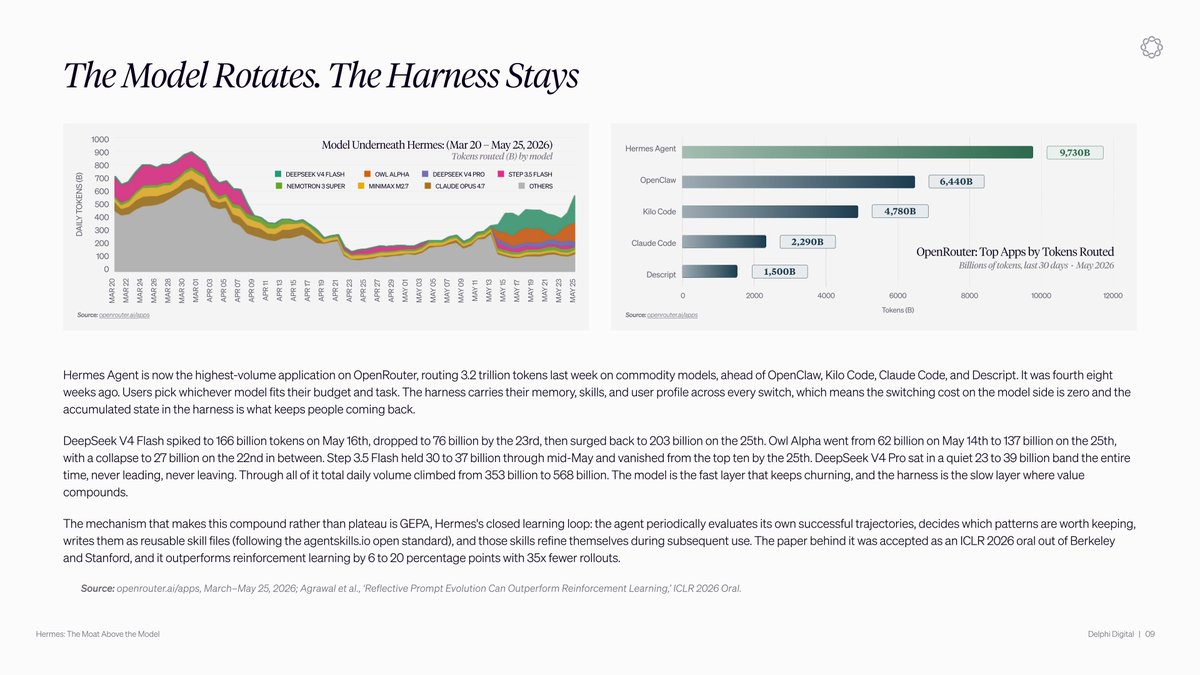
Our New Report "Hermes: The Moat Above the Model" is live!
Hermes is the AI agent that belongs to you.
Your agent builds valuable context about you with every session. When you switch models, you can't take any of this with you. What a closed agent learns about you is its product. You are renting your own work back.
Hermes breaks this model by keeping everything it learns on your machine. Between sessions the agent reviews its successful runs and writes them into reusable skills using GEPA, which beats reinforcement learning with 35x fewer rollouts. These skills travel with you when you switch models.
Two years before Hermes shipped, @NousResearch was already building the fine tuning and reinforcement learning pipelines for their open-weight models. In the last week of May, Hermes was OpenRouter's highest volume app with 4.5 trillion tokens routed currently.
At Hermes's scale, that signal lets Nous keep improving the user experience. Your memory and skills stay on your machine the whole time.
25
17
105
30,635
Hutt Capital retweeted

Jun 2
Hyperliquid, a decentralized crypto platform, is open 24 hours a day, seven days a week. The exchange has emerged this year as a go-to spot for Wall Street’s weekend warriors. on.wsj.com/4egXD8d
125
326
1,558
157,682
Hutt Capital retweeted

Jun 2
Excited to partner with Coinbase for the first time to support their dollar savings products. The upcoming integration next week will be the first time Ethena products are available for their 100m user base.
Given the evolving nature of the Clarity Act, we expect further potential tailwinds for onchain native products like USDe from idle balances on exchanges, and Ethena is well positioned to support this transition.

Ethena and @coinbase have partnered to grow onchain finance and savings products for their 100m userbase, with the first growth initiative launching next week.
Alongside this partnership Coinbase Ventures have also made their first investment into Ethena on the open market.
54
86
583
113,326