ICARS Team - UK Lead (International Coalition Against Restraint and Seclusion) @ICARSBanRandS

Joined November 2021
1 Photos and videos
Pinned Tweet
Huge thanks to @KeithCooper1973 and @theipaper for exposing the lack of meaningful, timely action by the @educationgovuk to protect disabled children in our schools from unnecessary harm. @bphillipsonMP
inews.co.uk/news/education/p… Part two of the I Paper Series on restraint in England's schools " Pupils traumatised by restraint in schools failed by ‘wishy-washy’ guidance." ICARS warn of lack of clear rules on physical interventions puts children at risk. #AgainstRestraint @KeithCooper1973 @theipaper
8
9
2,413
Have you or your child attended Baston House School? Emma Dalmayne is currently researching and documenting the history of Baston House and is seeking contributions from former pupils, young people, parents, carers and families who have experience of the school. If you would like your experiences, observations or memories to be considered as part of this work, you can contact: autisticinclusivemeets@gmail.com Contributions from different time periods and perspectives are welcome. Please share with anyone who may have attended Baston House or whose child attended the school. #Againstrestraint
7
7
291
Disturbing investigation: The i Paper reviewed 100 accounts alleging seclusion rooms are used to punish, not protect, often harming children with special educational needs. msn.com/en-gb/news/insight/i…

5
5
155
Video released by @theipaper regarding children across England, based on findings from the ICARS Isolation, Seclusion and Removal Room Survey. It is also worth noting that, federally and in the states Mr Bennett and Nick Gibb have visited in the USA this week, many of the approaches adopted under their leadership within the Department for Education’s behaviour department would be subject to legal restrictions, disability rights safeguards and greater oversight than exists in England. Americans watching this debate may be surprised by how different the legal protections are. In England, families continue to report physical restraint, seclusion, isolation and removal rooms being used as behaviour management practices, rather than genuine measures of last resort to prevent imminent serious physical harm. That should concern all parents, educators and lawmakers across the United States.
3
11
13
527
Becky Gillespie retweeted
I struggled as a social worker going into schools to see children where they were at risk of harm within their homes or social contexts, only to often walk past these isolation rooms and see institutional harm first hand in the settings that should be part of their safety.
Horrifying report revealing that children with SEND are left sobbing in isolation rooms for hours. It’s a harrowing one but well worth a read
1
13
51
2,992
Becky Gillespie retweeted
This began with my son. Six months on from the Mossbourne safeguarding review, I’m left asking: what does it take to create change? open.substack.com/pub/andyle…
1
7
8
908
ICARS United Nations Evidence Survey is now live. This survey is for families in England whose child experienced restraint, seclusion, isolation, removal, use of force, recording failures, detriment or discrimination in school. This final evidence will support a United Nations evidence submission concerning children’s rights, disability rights, safeguarding, discrimination, restrictive practices, recording and reporting failures, and access to remedy in England. You do not need photographs or documents to complete the survey. Most questions can be answered by ticking boxes, with space to give more detail if you wish. Evidence submission closing date: August 2nd 2026 Please complete and share with families in England whose experiences need to be heard. If you experience any issues accessing the survey through Safari on a Mac, please try Google Chrome or another browser. URL is also available in the comments
2
18
15
1,035
Becky Gillespie retweeted
Horrifying report revealing that children with SEND are left sobbing in isolation rooms for hours. It’s a harrowing one but well worth a read
Exclusive investigation finds isolation rooms now used in 90% of secondary schools, with disabled children worst affected and some developing suicidal thoughts 🔴 Keith Cooper reports Read more: trib.al/ltPTXA9
3
21
20
7,045
Exclusive investigation finds isolation rooms now used in 90% of secondary schools, with disabled children worst affected and some developing suicidal thoughts 🔴 Keith Cooper reports Read more: trib.al/ltPTXA9
1
1
84
Britain’s largest teachers’ union, the National Education Union, said the Government should be finding out why so many pupils are removed from mainstream classrooms when they become dysregulated. The NEU’s general secretary Daniel Kebede said there was “clear concern” from members about the “inappropriate use” of isolation rooms. Seclusion would only be reduced by investment in staff and access to specialist support, he added.
2
10
9
313
“These accounts are a damning indictment of Westminster’s failure to act on seclusion as a disciplinary practice in England’s schools,” says Becky Gillespie who heads ICARS’ UK division. “The harm to children and families is horrifying.” 'I found my SEND son sobbing': Inside the damaging school isolation rooms inews.co.uk/news/i-found-my-…
1
7
7
885
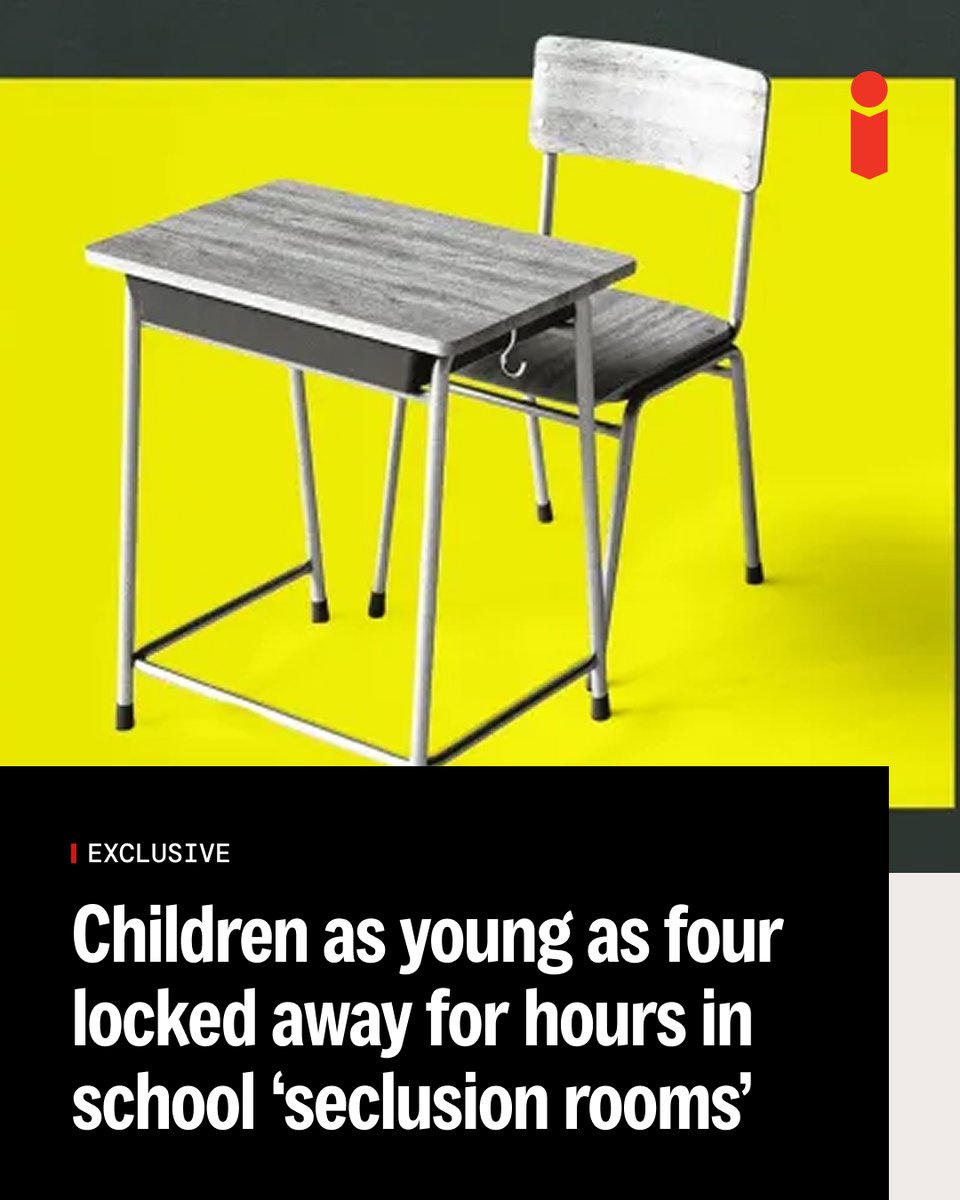
GIFT ARTICLE Children as young as four locked away for hours in school 'seclusion rooms' The 100 accounts were collected by the International Coalition Against Restraint and Seclusion, which plans to submit them to the United Nations in the autumn as evidence that the UK Government has failed to comply with a 2023 UN recommendation that seclusion be banned as a disciplinary measure in schools. inews.co.uk/news/children-ag…
11
13
2,538
Becky Gillespie retweeted
Exclusive investigation finds isolation rooms now used in 90% of secondary schools, with disabled children worst affected and some developing suicidal thoughts 🔴 Keith Cooper reports Read more: trib.al/ltPTXA9
2
13
13
7,165
LIVE NOW youtube.com/live/2EcqVktFkNg… The U.S. House Committee on Education and Workforce is holding its hearing: “Breaking Trust: Attacks on Parental Rights, Inappropriate Content, and Legal Abuses in America’s Schools.” Among those appearing today is LCPS Superintendent Aaron Spence alongside school leaders from San Francisco and Chicago. The hearing is examining parental rights, school transparency, curriculum concerns, and legal issues within public education. (Education and Workforce Committee) Whatever your perspective, congressional hearings provide an opportunity for the public to hear directly from school leaders and lawmakers, and to evaluate the testimony for themselves.
2
3
304
TES reports that school staff are leaving because of parent complaints. If that is happening, it is a serious issue. Nobody should face abuse, harassment or unreasonable conduct simply for doing their job. But there is another question that deserves attention: why are parents complaining in the first place? The discussion appears to focus heavily on the volume of complaints, how quickly they are escalated, and whether some are being drafted using AI. What appears largely absent is any discussion about the substance of those complaints. Are parents raising concerns about safeguarding, SEND provision, discrimination, exclusions, restraint and seclusion, use of force, bullying, or failures to provide the support their children are legally entitled to receive? A rise in complaints can mean many things. It may reflect worsening relationships between schools and families. It may reflect increasing pressure on school staff. It may reflect growing frustration among parents who feel their concerns are not being addressed. Or it may reflect all three. The answer cannot simply be to make complaints harder to raise. Schools need protection from abusive and vexatious complaints. Families need meaningful routes to challenge decisions and raise concerns when things go wrong. Those two things should not be in conflict. The evidence matters. Not just how many complaints are being made, but why parents feel the need to make them. tes.com/magazine/news/genera…
1
5
4
351
Becky Gillespie retweeted
This is a difficult read - former Mossbourne students share their accounts. They feel this is part of a wider problem and are calling for a national inquiry into school culture and child mental health. Please support their petition. change.org/schoolsinquiry
6
9
908
thetimes.com/article/7757ef6… I have read both the Sunday Times article and the underlying Centre for Social Justice report. The report raises important questions. But I do not think it proves what many people will claim it proves. The headline narrative is that autism and ADHD are being overdiagnosed. Yet much of the evidence presented is GP opinion polling, SEND growth data, disability benefit data, waiting list data, interviews and system-level analysis. The report cites concerns from over 1,000 GPs, a Cambridge study on SEND referrals, the 2022 SEND Review and a range of statistics showing rapid growth in diagnoses, EHCPs and disability benefits. Those are all legitimate things to discuss. But they are not the same thing as demonstrating widespread autism or ADHD misdiagnosis. The report relies heavily on the views of GPs. Their experience matters, but GPs are usually referrers into autism and ADHD assessment pathways, not the clinicians carrying out most specialist assessments. One obvious question is whether the report asked the clinicians actually conducting autism and ADHD assessments whether they agree with these claims. The report repeatedly combines ADHD and autism into a single discussion, despite them being different neurodevelopmental conditions with different diagnostic pathways, evidence bases and research literatures. It also moves between SEND, EHCPs, disability benefits, behavioural difficulties, ADHD and autism, often treating them as part of the same broader trend. What I did not find was a diagnostic audit showing how many children diagnosed with autism or ADHD were later found not to meet diagnostic criteria, or evidence establishing the false-positive rate and scale of misdiagnosis needed to support some of the stronger public claims now being made. England's SEND system is in serious trouble. Incentives are distorted. Assessment pathways are weak. Some children need earlier practical support long before families are pushed into diagnosis, EHCPs, tribunals or welfare claims. But none of that proves that large numbers of autistic or ADHD children have been wrongly diagnosed. That is a much bigger claim, and if people are going to make it, we should expect equally big evidence.
8
11
8
663