
The Internet Ethics program at the Markkula Center for Applied Ethics, Santa Clara University / Irina Raicu behind the keyboard
Joined January 2013
- Tweets 105,547
- Following 7,809
- Followers 9,507
- Likes 7,373
186 Photos and videos

Pinned Tweet

May 14
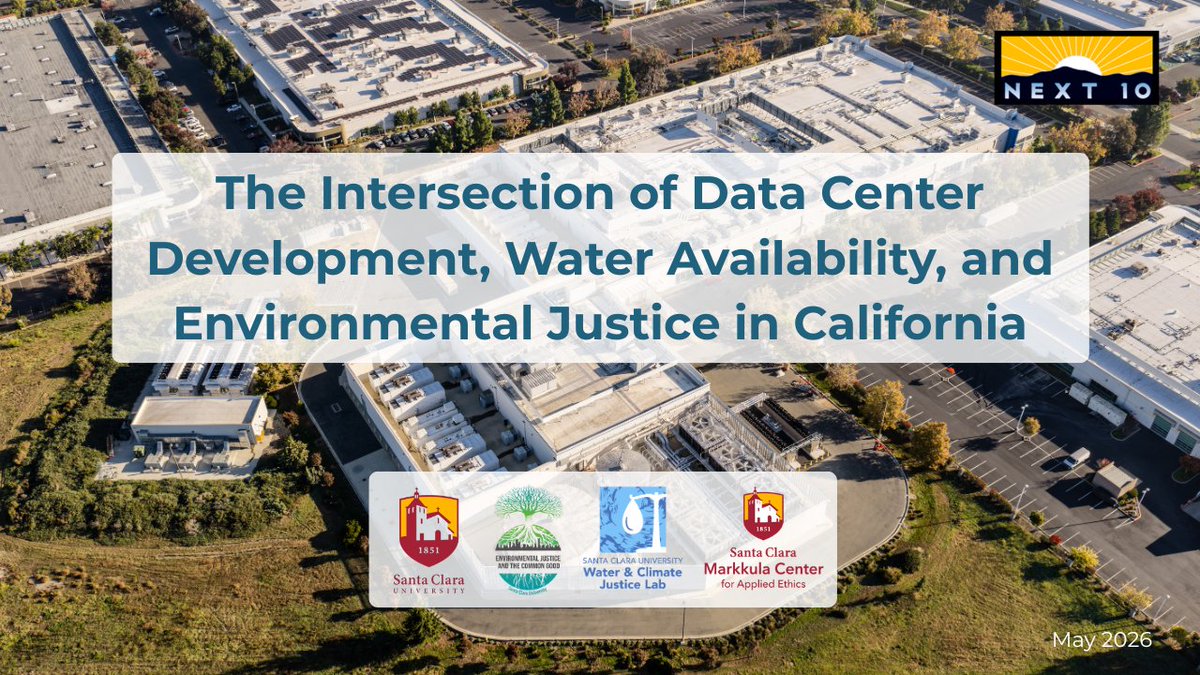
Working on this report with prof. Stewart-Frey, who leads the #Water and Climate Justice Lab at @SantaClaraUniv, as well as with SCU students and the @Next10 team, has been an amazing learning experience.
#ethics #policy #research #gov #tech #business #highered #sustainability

New Next 10 report by Iris Stewart-Frey and Irina Raicu at @SantaClaraUniv maps every known operating and planned data center in California through a water access and environmental justice lens.
next10.org/publications/data…
1
2
737
"[T]he environmental toll remains a concern long after facilities are built due to the unprecedented 24/7 energy demands of #AI data centers which, according to one recent study, could emit the equivalent of tens of millions of tonnes of CO2 annually in the [U.S.] alone." #ethics

Related: "Prior to the #AI boom, most data centers relied on tried-and-true designs that prioritized inexpensive and efficient construction. Big #tech’s willingness to spend has shifted the focus to speed and scale": spectrum.ieee.org/5gw-data-c… #ethics #sustainability #gov #business
1
55
Related: "Prior to the #AI boom, most data centers relied on tried-and-true designs that prioritized inexpensive and efficient construction. Big #tech’s willingness to spend has shifted the focus to speed and scale": spectrum.ieee.org/5gw-data-c… #ethics #sustainability #gov #business
"[T]hough hyperscalers make up a relatively small portion of the facilities now operating, the number in development would increase their count by 74 percent": politico.com/news/2026/06/13… #ethics #AI #tech #gov #sustainability #business #environment
1
122
"[T]hough hyperscalers make up a relatively small portion of the facilities now operating, the number in development would increase their count by 74 percent": politico.com/news/2026/06/13… #ethics #AI #tech #gov #sustainability #business #environment
109
"The industry’s exponential growth means that lawmakers from all parts of the country are now exposed to it, from the dense data center developments in the Virginia suburbs to the heart of the industrial Midwest": politico.com/news/2026/06/13… #ethics #tech #gov #sustainability #AI
1
1
176
"The #government and #Anthropic already had worked on pre-release testing of #Fable, and the company had received explicit approval to deploy." #ethics #AI #tech
"The Trump administration gave #Anthropic 90 minutes on Friday to pull down its most powerful models before imposing a licensing regime on the company": axios.com/2026/06/13/anthrop… #ethics #AI #law #tech #gov #business #security #cybersec
119
"The Trump administration gave #Anthropic 90 minutes on Friday to pull down its most powerful models before imposing a licensing regime on the company": axios.com/2026/06/13/anthrop… #ethics #AI #law #tech #gov #business #security #cybersec
173
Internet Ethics retweeted
Jun 12
"GPTZero alleges that roughly half of the report's factual claims were false, unsupported, or attributed to the wrong source. Several case studies highlighting supposedly cutting-edge deployments of agentic #AI appear to have been particularly creative": theregister.com/ai-and-ml/20…
1
1
82
Internet Ethics retweeted
Jun 12
And about #AI--"'It is neither god, nor is it the devil,' he said. 'And it’s nowhere near as good as you think it is, and it is nowhere near as bad as you think it is. And it changes every week … and it doesn’t know what day of the week it is.'" #ethics #tech

During a meeting this week, Meta chief product officer Chris Cox addressed the “difficult” and “brutal” environment created by the “insanity of this company” in the past few months, according to a recording heard by WIRED.
Read the full story: wired.com/story/mark-zuckerb…
1
120
Internet Ethics retweeted
Jun 12
"[O]ngoing research indicates that domestic US actors are leading the online anti-data-center conversation"; as with many other controversies, "foreign actors" then amplify the polarization. #ethics #internet #socialmedia #AI #tech
GOP lawmakers, tech investors, and even OpenAI have tied the anti-data center movement in the US to Chinese interference. Experts say it’s much more complicated than that. wired.com/story/china-us-dat…
1
85
Internet Ethics retweeted
Jun 12
"As of Wednesday, the group had targeted roughly 300 endpoints belonging to 100 user organizations. About 68 [%] of the organizations operated within the higher #education sector": arstechnica.com/security/202… #ethics #internet #cybersec #highered #business
1
58
Internet Ethics retweeted
Jun 12
The fact that "of the 56% of Americans who expressed some worry over dependence, only roughly 1/5 would feel significant disruption if #AI became unavailable" does *not* mean that "cognitive dependency appears to be a mostly anticipatory fear"... anthropic.com/news/anthropic… #ethics
1
1
62
Internet Ethics retweeted
Jun 12
"As of late 2025, about 6% of Americans used #AI every day for both work and personal life. ... Integrated users skew young, male, urban, employed, and college-educated": anthropic.com/news/anthropic… #ethics #tech
1
63
Internet Ethics retweeted
May 14
Working on this report with prof. Stewart-Frey, who leads the #Water and Climate Justice Lab at @SantaClaraUniv, as well as with SCU students and the @Next10 team, has been an amazing learning experience.
#ethics #policy #research #gov #tech #business #highered #sustainability
New Next 10 report by Iris Stewart-Frey and Irina Raicu at @SantaClaraUniv maps every known operating and planned data center in California through a water access and environmental justice lens.
next10.org/publications/data…
1
2
737
Internet Ethics retweeted
Jun 12
"#Surveillance meant the powerful watching the people... Accountability meant the people watching the powerful... That distinction no longer holds. The same footage can serve both roles." #ethics #tech #privacy #security
Jun 12
On a "recursive pattern of observations intended to hold power accountable becoming new input for the same #surveillance infrastructure": spectrum.ieee.org/unintended… #ethics #tech #privacy #AI
1
1
86
Jun 12
"[E]ducators were 2.5 to 3 times more likely than average to report having witnessed cognitive atrophy firsthand, presumably in their students.... [E]ducators are likewise among the occupations most worried about dependency": anthropic.com/news/anthropic… #ethics #AI #education #tech
48