
Joined March 2015
- Tweets 11,791
- Following 364
- Followers 483
- Likes 152
Photos and videos
Pinned Tweet

7 Dec 2025
1/ I become more and more dismayed by the huge number of supposed education experts who regularly use data from the NAEP improperly. In this thread I plan to outline some of the issues so the rest of us will have a better understanding of how people mislead with NAEP.
1
3
9
1,417
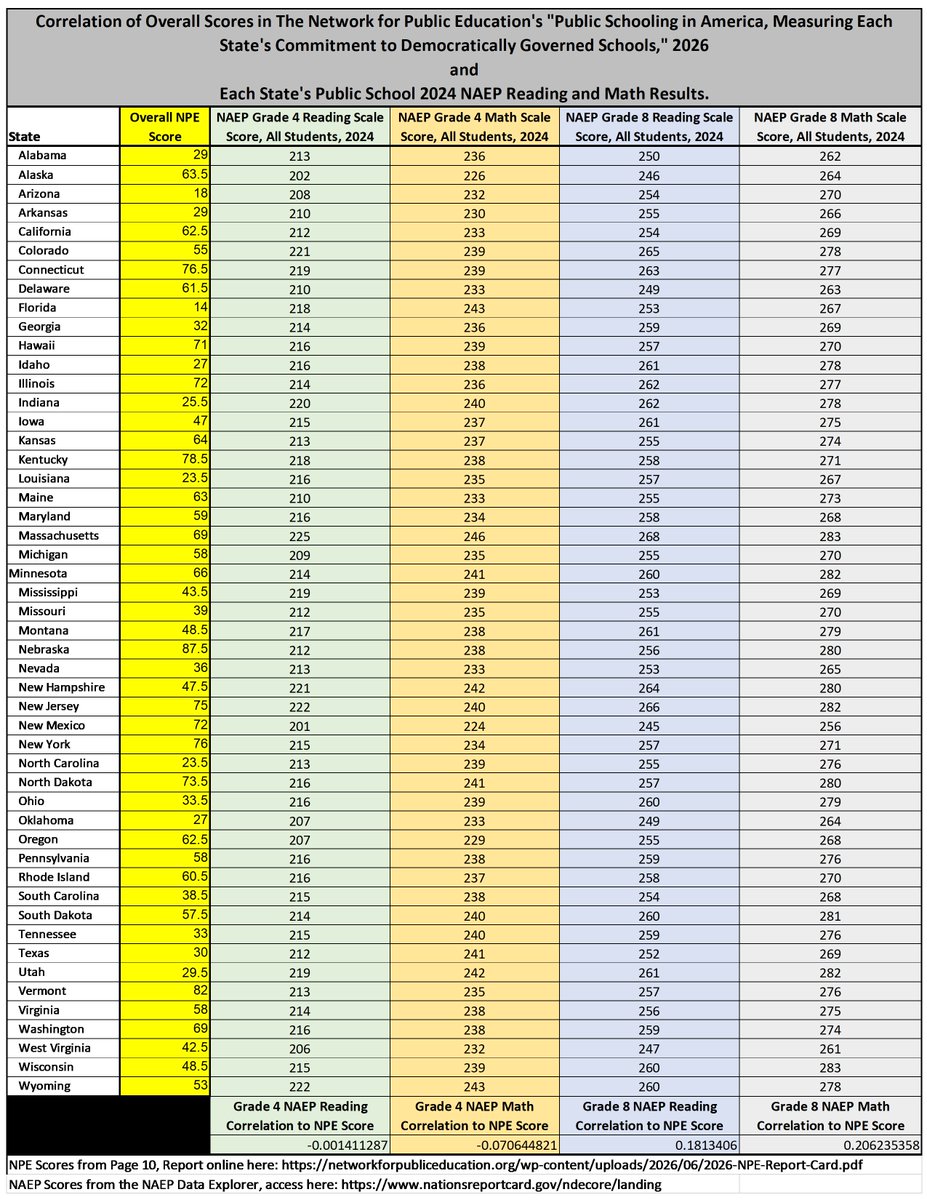
The school-choice-hostile Network for Public Education (NPE) just posted its 2026 grades for each state's supposed commitment to public education. I correlated the NPE's Overall Scores to each state's performances in the 2024 NAEP reading and math assessments. The table below shows what I found. Essentially, there is no correlation between what the NPE focuses on and what actually works for kids (find correlations at the bottom of each NAEP column).
1
3
63
Jun 15
This needs restating.
Apr 29

Expecting impacts of Mississippi’s reform to already show in ACT scores is inappropriate. There hasn’t been enough time for a K to 3 set of reforms to work up into high school.
Mississippi didn’t start getting national notice for NAEP Grade 4 Reading improvement until 2019, and that’s not surprising. While the frequently cited legislation passed in 2013 (though there were earlier efforts — more on that later), it took 2 years just for Carey Wright to set up the major programs at the MS DOE. It took more time to get a notable number of teachers retrained and proficient in the new approaches. So, 2019 seems reasonable as the point where things started to really produce.
The 4th graders of 2019 didn’t reach 8th grade until 2023, but the NAEP got cancelled that year due to COVID. So, the first time improvements seen in Grade 4 were likely to show in Grade 8 NAEP Reading was 2024. And, guess what — if you break NAEP results down and compare separately for white students and Black students in each state, Mississippi’s 8th graders moved up very notably in 2024.
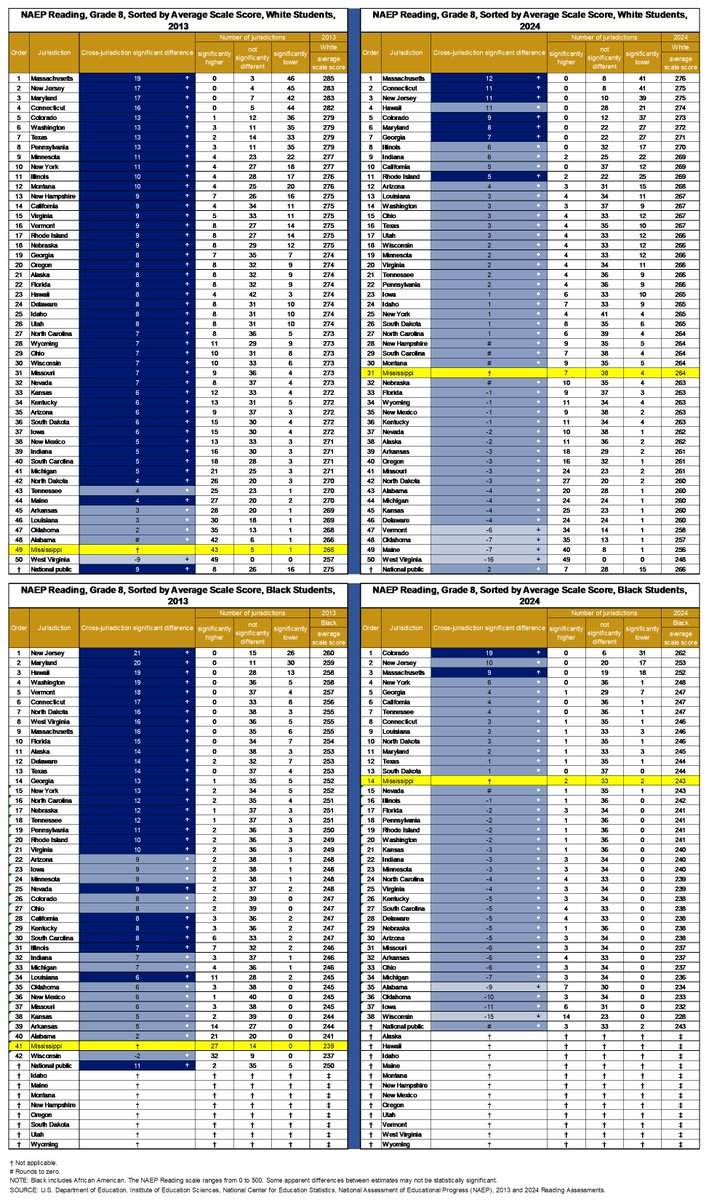
Because NAEP is a sampled assessment, a good way to consider performances is looking at statistically significant results. Back in 2013, when the reform act passed, Mississippi’s white 8th graders were statistically significantly outscored by whites in 43 other states on NAEP Reading. Flash forward to 2024 and only white students in just 7 states could make the same claim.
For Black students, the changes in NAEP Grade 8 Reading were equally notable. In 2013, Black students in 27 of the 42 states that got NAEP Grade 8 Reading scores outscored those in Mississippi by a statistically significant amount. By 2024, only those Black students in Colorado and Massachusetts could make the same claim.
One other point, between 2013 and 2024 the white minus Black achievement gap on Grade 8 NAEP was decreased by 6 NAEP Scale Score points, and the NAEP Data Explorer indicates that change was statistically significant, too.
So, impacts are just now showing for Mississippi in Grade 8 NAEP Reading. We shouldn’t expect to see impacts on 11th grade ACT testing for another year, at best.
One more point: Mississippi’s reforms didn’t start in 2013. The state was doing things to improve way back around the time the Year 2000 report from the national reading panel came out. You and your readers would really benefit from Rachel Canter’s new report, “Inside the Mississippi Marathon,” online here: progressivepolicy.org/wp-con…. It turns out things like a $100 million project from the Barksdale Reading Institute started bringing outcomes from the national reading panel to Mississippi’s classrooms well before 2013. This helps explain some of the state’s improvement in Grade 4 NAEP Reading prior to that year.
The Barksdale effort was a start, but it wasn’t enough, so after 2013 the state’s rate of improvement on Grade 4 NAEP Reading, which had started to stagnate, started to rise again, and at an increased rate from that in the earlier years.
Was this a miracle? No. Is it quite impressive — absolutely. As far as the ACT goes, just be a little more patient.
2
3
61
May 19
A new Education Scorecard ranks states and some school districts for academic progress from 2022 to 2025 educationscorecard.org/?utm_…. It's an interesting report and adds to the discussion, but I have questions.
The Scorecard adjusts test results from different state assessments -- which are not directly comparable -- onto a common scale using results from the 2019 NAEP. I am wondering why a more current NAEP, either 2022 or 2024, wasn't used and if there are potential problems with this approach.
The rankings are for overall state scores only. I suspect that things could look very different if the results were broken out and compared in a more apples to apples manner, such as looking at white student and Black student scores separately. Page 32 in the NAEP 2009 Science Report Card talks about why such breakouts are important. A similar logic should apply here.
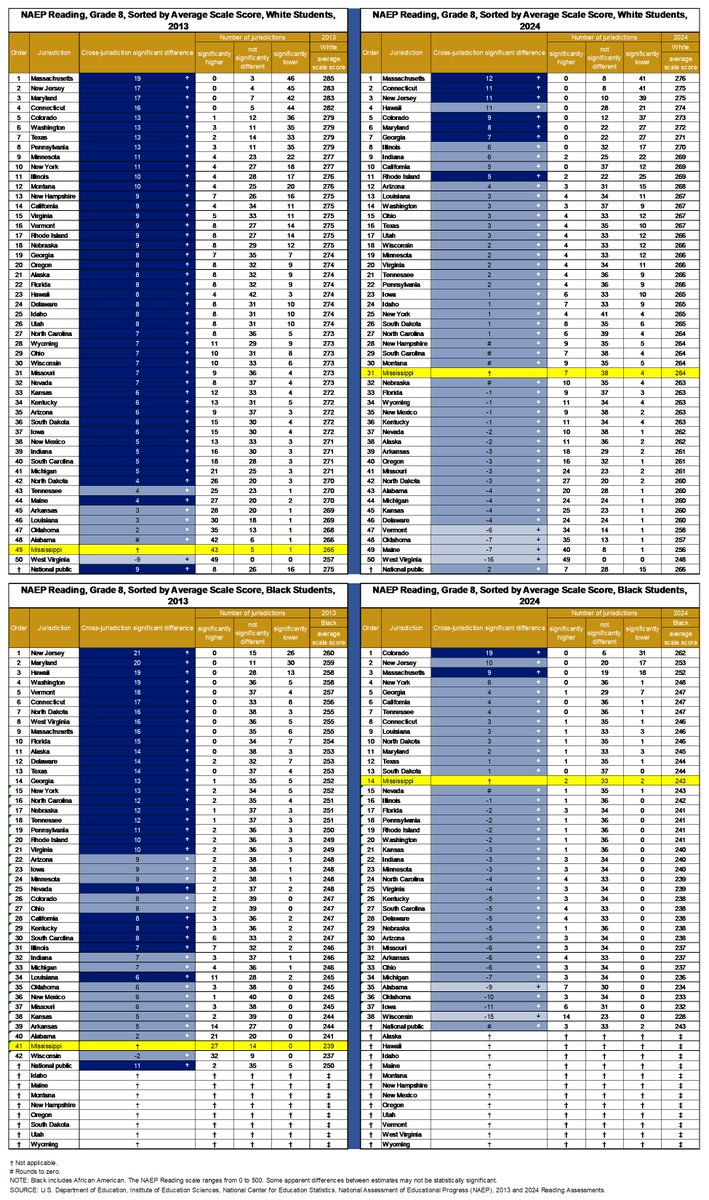
There can be a notable difference between making progress and current standing. Consider information in Figure 11 in the national Education Scorecard educationscorecard.org/wp-co…. It shows Tennessee ranked 4th best for reading growth, well ahead of Massachusetts. But check below to see how Tennessee ranked for NAEP Grade 8 Reading in 2024 (most recent available) compared to Massachusetts. Tennessee ranks statistically significantly behind Massachusetts for white student scores. Why didn't the scorecard include current standings along with the improvement information?
1
2
68
May 18
I continue to see educators misusing the NAEP, often by ignoring the sampling errors in the scores. This thread will help you to avoid being misled.
7 Dec 2025
1/ I become more and more dismayed by the huge number of supposed education experts who regularly use data from the NAEP improperly. In this thread I plan to outline some of the issues so the rest of us will have a better understanding of how people mislead with NAEP.
2
2
6
837
May 18
I am still seeing some making claims about MS' reading reform not showing any improvement on the ACT. Well, it's simply too soon to see that. The post below has more details.
May 5
I am surprised. Too many educators seem to expect Mississippi’s (MS) reading reforms to somehow already be impacting the state's Grade 11 ACT scores. They just don't recognize that a reform aimed at lower grades K to 3 needs extra time to show improvement in higher grades. There simply hasn't been enough time for that to happen.
Though MS' reading improvement act was passed in 2013, it took the MS DOE several more years just to set up programs to impact things like Professional Development. And, you cannot retrain an entire corps of a state's teachers in new methods and get them proficient with those methods in just a year or two, either.
So, it's no surprise that impacts of MS' reform really wern't recognized until after the 2019 Grade 4 NAEP Reading scores released. This was just starting to impact Grade 4 at that time.
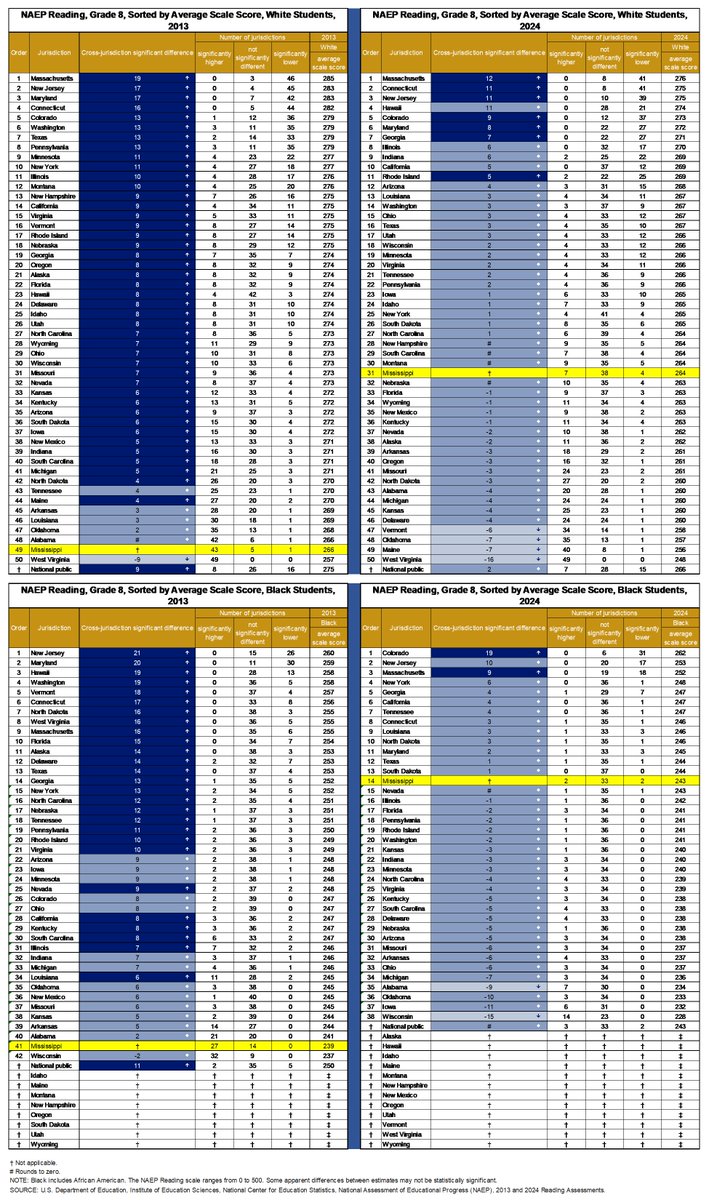
Those impacts might have shown in a 2023 Grade 8 NAEP, but the federal test was not given that year due lingering COVID impacts. The next NAEP in reading was given in 2024, and despite claims from some, compared to other states MS started to show notable improvements in Grade 8 NAEP Reading in 2024, as the tables below, generated with the NAEP Data Explorer, show.
For white students, the tables show that in 2013, MS' 8th graders were statistically significantly outperformed by white students in 43 other states. In 2024, only white students in 7 states could make the same claim. For Black students, MS' were statistically significantly outscored by those in 27 other states in 2013. By 2024, only Black students in Colorado and Massachusetts could make the same claim.
Now we get to the ACT. MS does statewide ACT testing in Grade 11. Even the 8th graders from 2023 didn’t enter that ACT test pool until 2026. We haven't even seen those ACT results and won’t for many months. Eighth graders who started to move up in NAEP in 2024 won't see the ACT until 2027.
Also keep in mind, MS continued to improve in Grade 4 NAEP Reading after 2019. It will be even longer before those students hit Grade 11.
So, let’s see what happens in a couple of more years with the ACT and stop trying to kill something before it even has a reasonable chance to prove itself, @DianeRavitch @plthomasEdD
1
3
9
842
Richard Innes retweeted

May 13
The bill for Fayette County school mismanagement was always going to come due bluegrassinstitute.org/the-b…
2
2
187
Richard Innes retweeted
May 5
I am surprised. Too many educators seem to expect Mississippi’s (MS) reading reforms to somehow already be impacting the state's Grade 11 ACT scores. They just don't recognize that a reform aimed at lower grades K to 3 needs extra time to show improvement in higher grades. There simply hasn't been enough time for that to happen.
Though MS' reading improvement act was passed in 2013, it took the MS DOE several more years just to set up programs to impact things like Professional Development. And, you cannot retrain an entire corps of a state's teachers in new methods and get them proficient with those methods in just a year or two, either.
So, it's no surprise that impacts of MS' reform really wern't recognized until after the 2019 Grade 4 NAEP Reading scores released. This was just starting to impact Grade 4 at that time.
Those impacts might have shown in a 2023 Grade 8 NAEP, but the federal test was not given that year due lingering COVID impacts. The next NAEP in reading was given in 2024, and despite claims from some, compared to other states MS started to show notable improvements in Grade 8 NAEP Reading in 2024, as the tables below, generated with the NAEP Data Explorer, show.
For white students, the tables show that in 2013, MS' 8th graders were statistically significantly outperformed by white students in 43 other states. In 2024, only white students in 7 states could make the same claim. For Black students, MS' were statistically significantly outscored by those in 27 other states in 2013. By 2024, only Black students in Colorado and Massachusetts could make the same claim.
Now we get to the ACT. MS does statewide ACT testing in Grade 11. Even the 8th graders from 2023 didn’t enter that ACT test pool until 2026. We haven't even seen those ACT results and won’t for many months. Eighth graders who started to move up in NAEP in 2024 won't see the ACT until 2027.
Also keep in mind, MS continued to improve in Grade 4 NAEP Reading after 2019. It will be even longer before those students hit Grade 11.
So, let’s see what happens in a couple of more years with the ACT and stop trying to kill something before it even has a reasonable chance to prove itself, @DianeRavitch @plthomasEdD
1
2
9
1,493
Richard Innes retweeted
Bottom line: Kentucky is losing its clearest window into student performance at the worst possible moment — and the decision to do so appears to have bypassed the safeguards built into state law. Full report: bluegrassinstitute.org/asses… @Innes434
2
1
90
Richard Innes retweeted
May 6
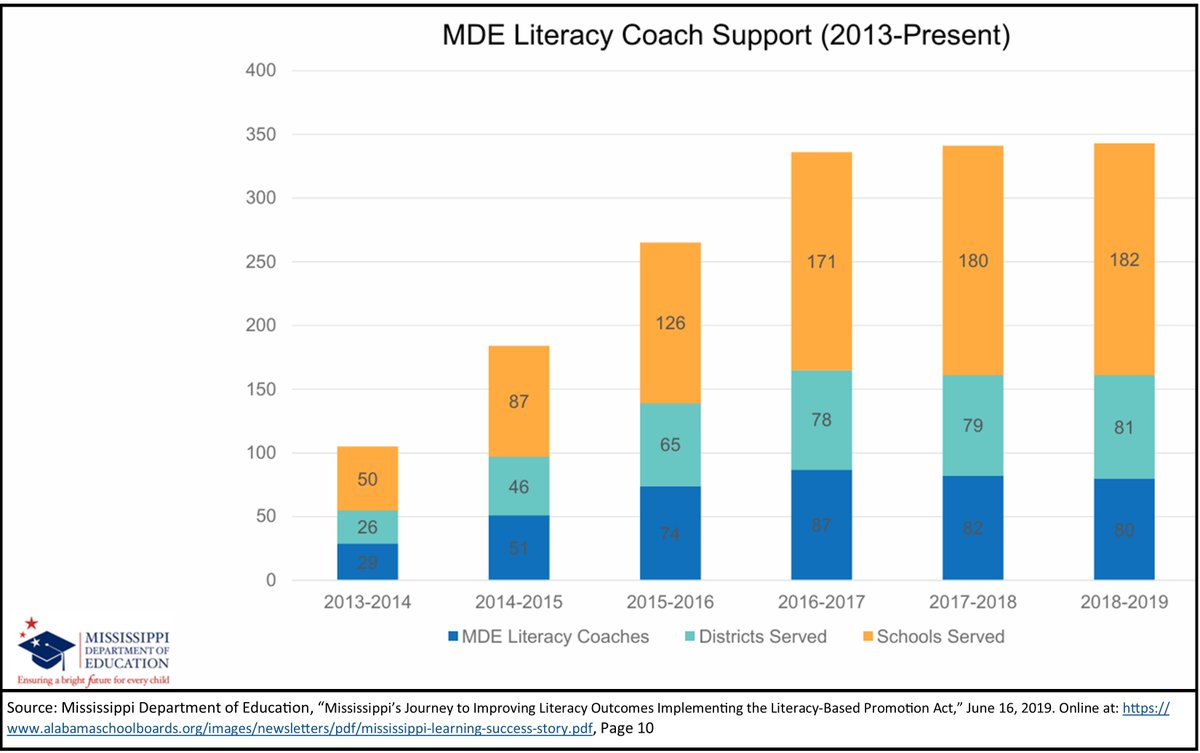
I found some more interesting information that bears on the discussion of whether or not it's simply too soon to expect results of Mississippi's reading reforms to show in ACT results.
This slide from a MS DOE presentation shows how use of literacy coaches expanded over time. Note that even in 2014-15 only about half of the districts and fewer than half of the schools had been served. It wasn't until 2016-17 that essentially all schools and districts had been served.
MS' NAEP Grade 4 Reading didn't start to get national attention until 2019, two years later. The 4th graders in 2019 didn't reach 11th grade until 2026, and the ACT results for them won't be released until sometime in the fall.
The point here is that MS didn't magically pass a reform and instantly get help out to teachers to improve practice. Teachers probably didn't instantly get proficient in the new methods, either. It was a multi-year process that's probably still not complete.
So, let's have a little patience before expecting to see impacts on ACT. There simply hasn't been enough time for that to happen.
May 5
I am surprised. Too many educators seem to expect Mississippi’s (MS) reading reforms to somehow already be impacting the state's Grade 11 ACT scores. They just don't recognize that a reform aimed at lower grades K to 3 needs extra time to show improvement in higher grades. There simply hasn't been enough time for that to happen.
Though MS' reading improvement act was passed in 2013, it took the MS DOE several more years just to set up programs to impact things like Professional Development. And, you cannot retrain an entire corps of a state's teachers in new methods and get them proficient with those methods in just a year or two, either.
So, it's no surprise that impacts of MS' reform really wern't recognized until after the 2019 Grade 4 NAEP Reading scores released. This was just starting to impact Grade 4 at that time.
Those impacts might have shown in a 2023 Grade 8 NAEP, but the federal test was not given that year due lingering COVID impacts. The next NAEP in reading was given in 2024, and despite claims from some, compared to other states MS started to show notable improvements in Grade 8 NAEP Reading in 2024, as the tables below, generated with the NAEP Data Explorer, show.
For white students, the tables show that in 2013, MS' 8th graders were statistically significantly outperformed by white students in 43 other states. In 2024, only white students in 7 states could make the same claim. For Black students, MS' were statistically significantly outscored by those in 27 other states in 2013. By 2024, only Black students in Colorado and Massachusetts could make the same claim.
Now we get to the ACT. MS does statewide ACT testing in Grade 11. Even the 8th graders from 2023 didn’t enter that ACT test pool until 2026. We haven't even seen those ACT results and won’t for many months. Eighth graders who started to move up in NAEP in 2024 won't see the ACT until 2027.
Also keep in mind, MS continued to improve in Grade 4 NAEP Reading after 2019. It will be even longer before those students hit Grade 11.
So, let’s see what happens in a couple of more years with the ACT and stop trying to kill something before it even has a reasonable chance to prove itself, @DianeRavitch @plthomasEdD
1
2
123
May 4
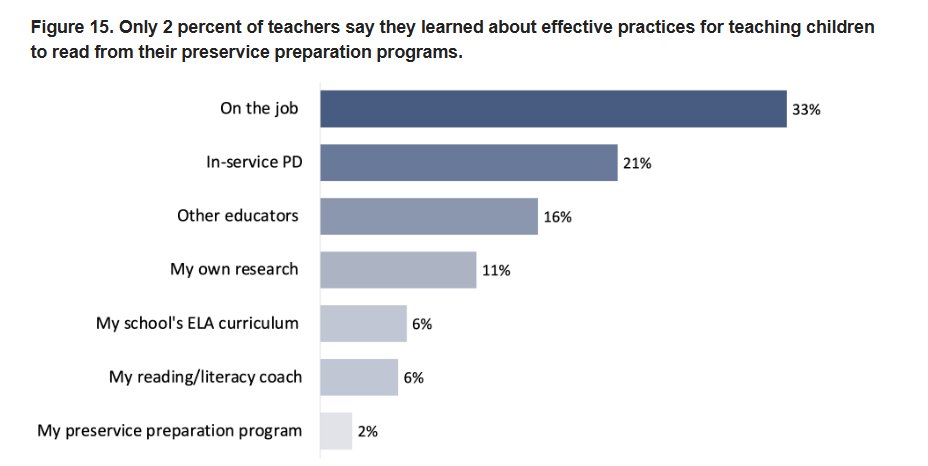
This comes from a new Fordham report, "From the Teacher’s Desk: A Science of Reading Progress Report," available from here: fordhaminstitute.org/nationa…
Clearly, preservice programs need serious reevaluation and revision.

What an embarrassment
Only two percent, TWO PERCENT of teachers say they learned about effective literacy instruction (i.e. phonics) in their teacher prep program
1
4
11
1,311
May 1
Course Reading Grades Versus State Test Results in Kentucky —Who Ya Gonna Trust?
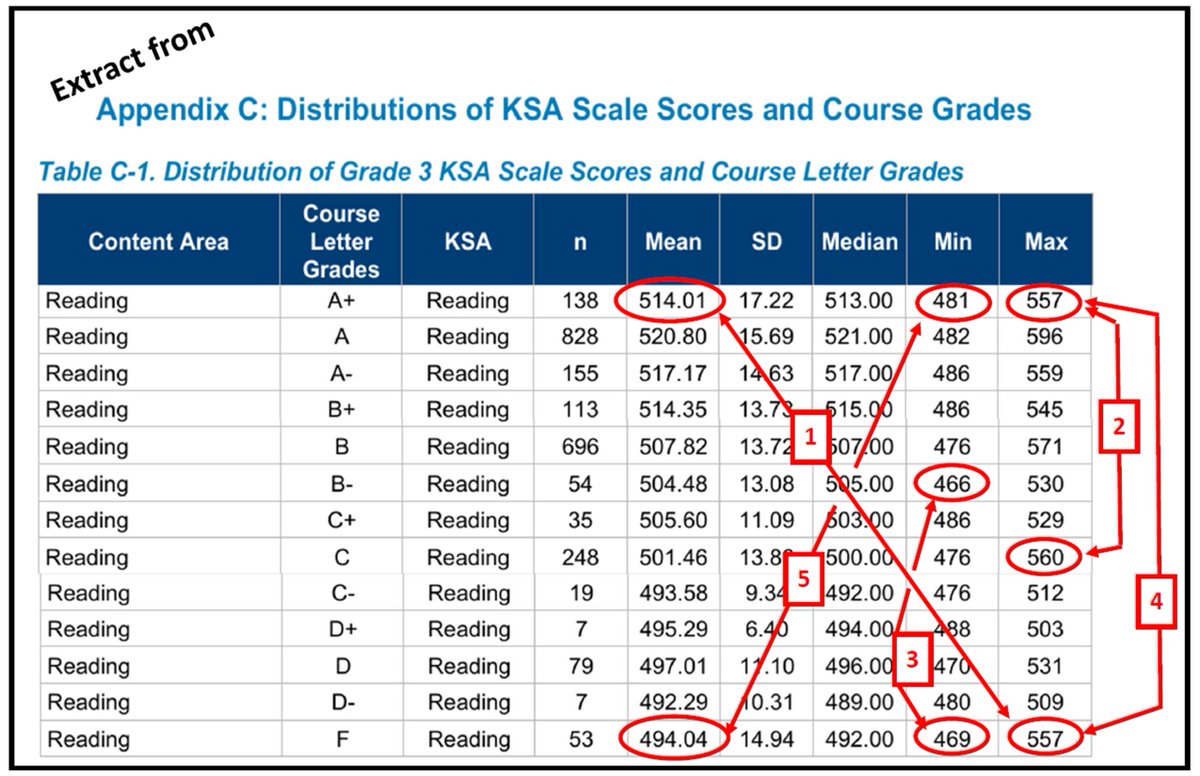
A recent report, “Correlations Between Kentucky Summative Assessment (KSA) Scores and Student Grades” education.ky.gov/AA/Reports/… has some disturbing examples of the disconnects between course letter grades received and state test score results for the same subject.
The table below covers 3rd grade reading.
Just a few anomalies:
[1] The top KSA Scale Score for a student getting an “F” in reading class was 557. This is HIGHER than the mean (average) KSA score of 514.01 for all students who got an “A ” in their reading classes!
Did the “F” student cheat on the KSA? Did his/her teacher shortchange them in class? Any investigation underway?
[2] The top KSA score awarded to a “C” student was 560. This is higher than the top score awarded to any of the A students. Did this “C” student cheat on KSA? Is the teacher's grading out of line?
[3] The minimum score awarded an “F” student, 469, was higher than the minimum score student who got a “B-” classroom grade, 466. Cheating is unlikely here. Did someone get an "F" when a much higher grade was deserved? Did someone get an undeserved "B-"?
[4] The top KSA score earned by an “F” student was 557, exactly the same as the top score awarded the very best “A ” student! Did the “F” student (or school) cheat on the KSA? How did this happen? Is anyone investigating?
[5] The lowest KSA score for a student graded “A ” in class was just 481. This is lower than the mean (average) score for all the students graded with an “F.” Cheating unlikely here, unless it was with grading.
3
3
4
603
May 1
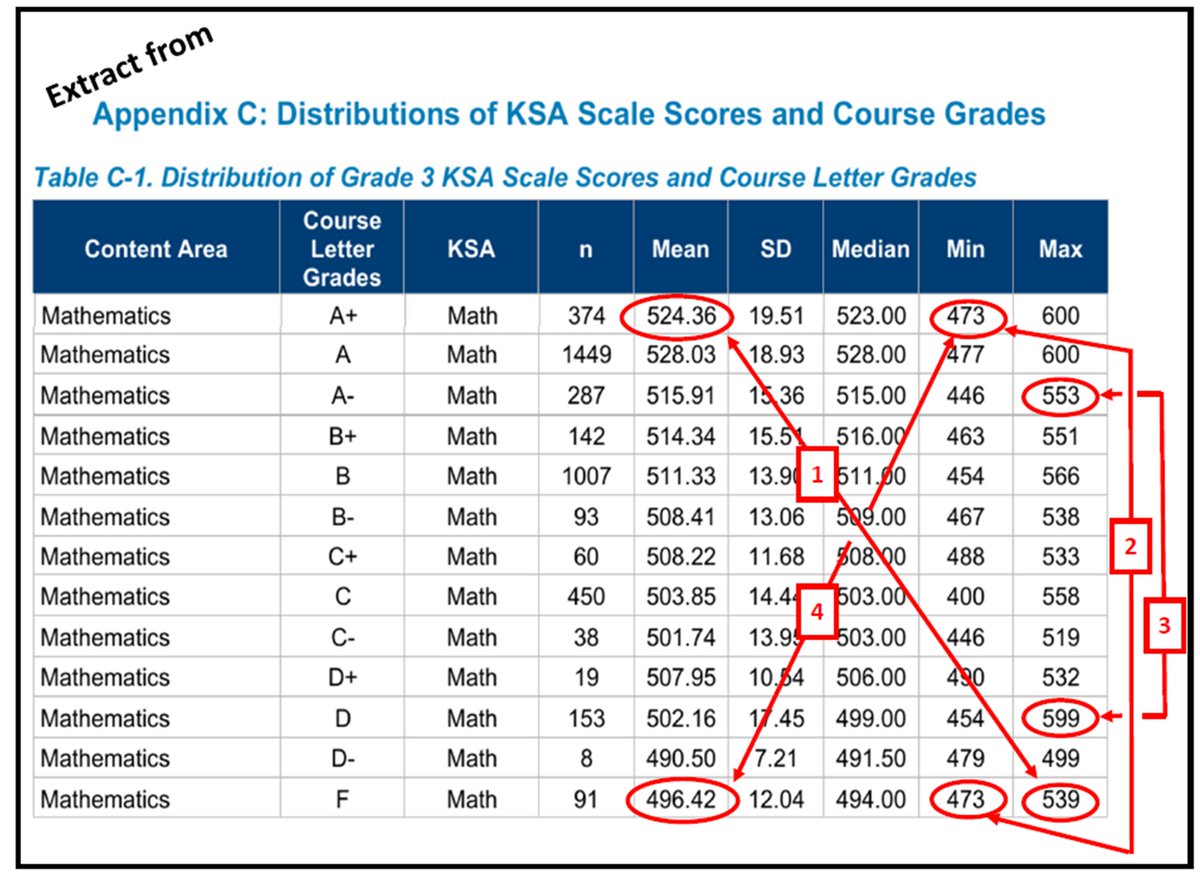
Now, let's look at the 3rd grade math situation. This is pretty much a repeat of the issues found with reading.
Just a few anomalies.
[1] The top KSA Scale Score for a student getting an “F” in math class was 539. This is HIGHER than the mean KSA score of 524.36 for all students who got an “A ” in their math classes! Did this “F” student cheat on the KSA? Did the teacher cheat on grading? How can there be such a huge disconnect?
[2] The minimum KSA Scale Score (473) for a student graded “A ” in class is equal to the minimum score awarded to a student who got an “F” in math! Cheating unlikely here, unless it's with teacher grading.
[3] The top score awarded to a “D” student was 599. This is higher than the top scores awarded higher graded students up to and including those getting an “A-” and just 1 point lower than the top score achieved by the A students. Did the “D” student cheat?
[4] The lowest score achieved by a student graded “A ” in class was 473. This is lower than
the average score of 496.42 achieved by all the “F” students. Cheating unlikely here, unless someone paid a teacher for a high grade or had a really terrible day during KSA testing.
The report has more information on grades versus KSA scores for higher grade levels, as well. The anomalies don't stop after Grade 3.
This report has been out since August, 2025. So far, I don't think there has been anything said by the KY Dept. of Ed. or the KY Board of Ed. regarding the obvious credibility issues raised by the data. Clearly, that needs to change.
27
Apr 29
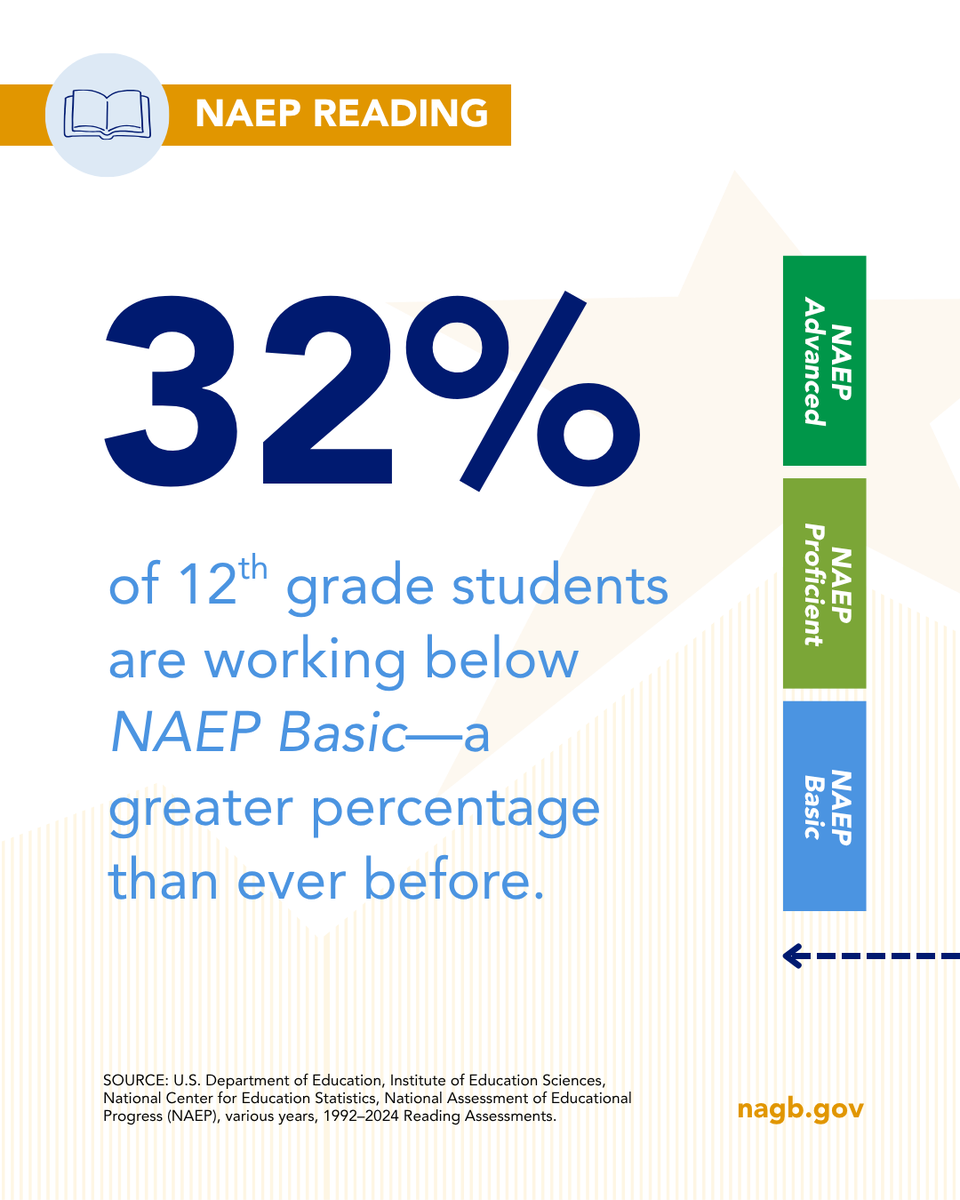
Yet some in education continue to claim there is no crisis here, writing off 1 out of 3 students in the process.
Apr 28

Too many students graduate from high school without the reading skills they need.
Here's what we know from the NAEP data:
ALT 32% of 12th grade students are working below NAEP Basic on reading—a greater percentage than ever before
3
4
24
2,529
Apr 27
#aeimississippimarathon Who says no improvement in MS Grade 8 Reading. You are behind the times. Check this:
4
5
291
Apr 27
#aeimississippimarathon Part of the original 2013 effort involved use of LETRS. I believe MS is now using something else. How is that working?
53
Apr 16
Kentucky's Department of Education, on its own, just changed from using the ACT for 11th grade testing to using the SAT. Maybe now we know why.

1
2
16
1,326
Apr 13
I continue to see people trying to discredit the NAEP's Proficient grade as simply set too high and unrealistic. The truth, as you can learn here (bluegrassinstitute.org/conte…) is that NAEP Proficient is set where it needs to be if students are going to be ready for either college or living wage careers. The naysayers confuse what is with what needs to be.
3
3
25
1,472
Apr 12
"The data isn’t the problem. The belief system is."
Exactly!
Schools in Kentucky's poor Appalachian region produced notable results, as well, and no one, not media, not KY Dept. of Ed., not legislators, has paid any attention. See this: web.archive.org/web/20240529…

Why would a teacher rather believe a child can’t read than believe a school proved every child can?
I posted Steubenville’s results — lowest 5th grade reader reading at 5th grade level.
9 of 10 said I was lying.
1 of 10 asked how to do it.
The data isn’t the problem. The belief system is.
@ehanford
@reading_league
2
5
16
2,182