
Joined November 2025
- Tweets 139
- Following 7
- Followers 3
- Likes 0
123 Photos and videos










AI didn’t make coding easier.
It made bad architecture ship faster.
1
Most AI integration platforms require you to trust them with your code, your credentials, and your infrastructure.
We built IntegrateAPI OS differently.
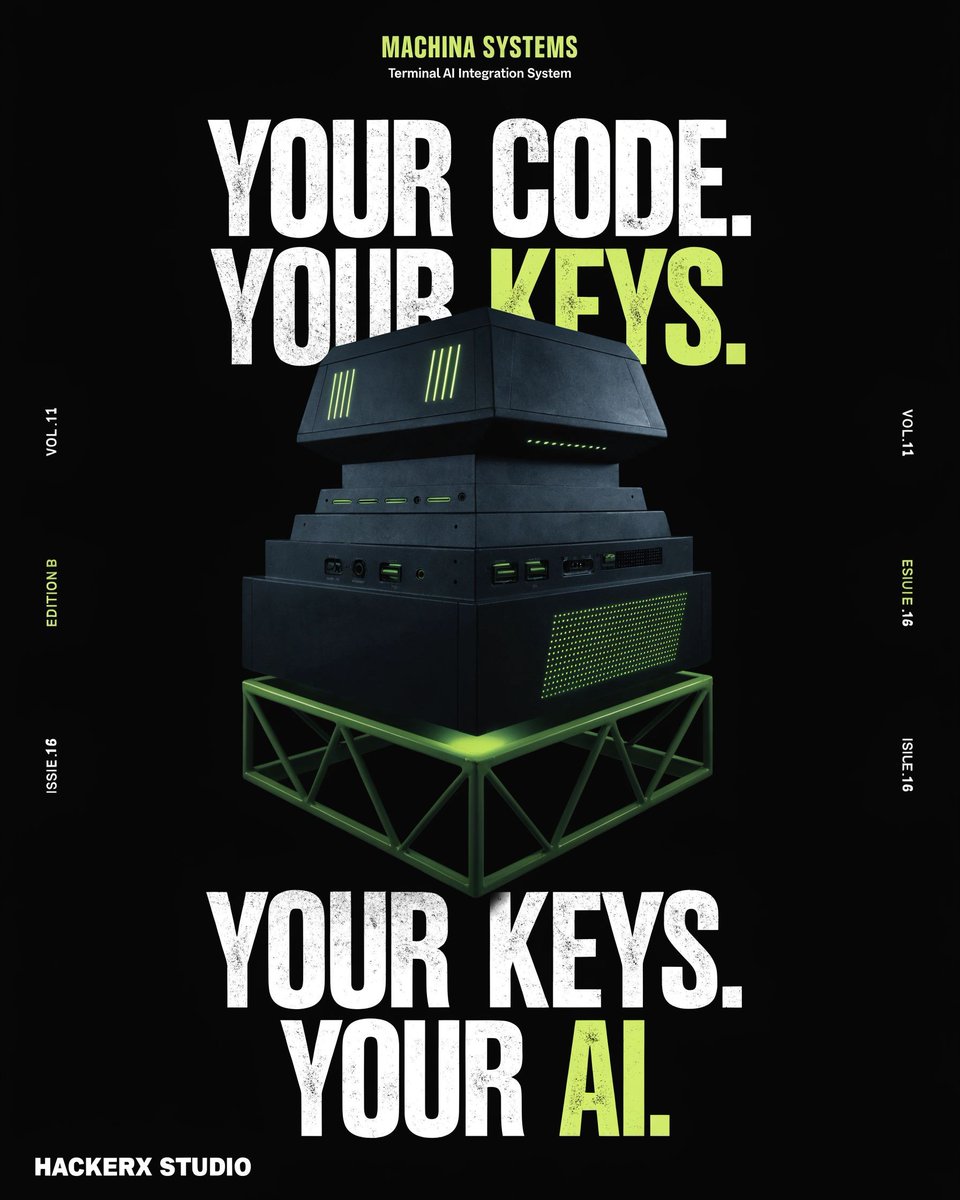
✅ Your code stays yours
✅ Your keys stay yours
✅ Run locally or in your own infrastructure
✅ Bring your own AI models
No repo uploads. No vendor lock-in. No black boxes.
AI-powered. Trust-minimized.
Get early access -> integrateapios.com
#AI #ArtificialIntelligence #AIDevTools #LocalFirst #PrivacyFirst #DataPrivacy #SelfHosted #OpenSourceAI #AIAgents #DeveloperExperience

Jun 13
**GraphQL API**
Imagine a library with a single super-smart librarian.
A cat walks up and says:
*"I only want the cat's name, breed, and owner's name."*
The librarian replies:
*"Got it."*
Instead of bringing back entire books, records, and shelves of information, the librarian quickly checks the right sections and returns exactly:
- Name: Luna
- Breed: Persian
- Owner: Kuls
That's essentially how GraphQL works.
GraphQL is an open-source query language for APIs and a server-side runtime that executes queries against a defined schema. It allows clients to request exactly the data they need in a single request.
Key benefits of GraphQL:
• Fetch only the fields you request
• Reduce over-fetching and under-fetching of data
• Retrieve related resources in a single query
• Use a single endpoint for all operations
• Give frontend developers more flexibility over data retrieval
REST and GraphQL both have their place.
REST works well when resources are simple, predictable, and clearly defined.
GraphQL shines when applications have large, complex, and highly connected data structures where clients need different combinations of data.
The biggest advantage of GraphQL is precision. Instead of receiving an entire resource, clients get only the data they ask for, which can improve performance and reduce unnecessary network traffic.
One tradeoff is that GraphQL lacks some of the standardization and simplicity that REST provides. However, for modern applications that require flexibility and efficient data fetching, GraphQL can be a powerful alternative.
10
Jun 13
Did you know your API key is 112 days old?
Most AI founders don't, because their tools keep it hidden.
We built FlowAI's API dashboard to show key age, usage, IPs, and security checks, front and center.
A single unrotated key handling 38,210 calls monthly? That's a ticking security bomb.
Smart design makes risks impossible to overlook.
2
Jun 12
Most bugs in integrations aren’t bugs.
They’re assumptions that were never written down.
integrateapios.com
Jun 11
3 trust rules behind IntegrateAPI OS:
1. Your code stays on your machine.
Integrations run locally, so your source code and secrets never leave your environment.
2. Bring your own AI.
Choose your model and use your own API keys - full control over cost, performance, and compliance.
3. No cloud lock-in.
Nothing is stored or trained on vendor servers, reducing exposure and dependency.
That’s IntegrateAPI OS.
integrateapios.com
#AI #DeveloperTools #LocalFirst #ZeroTrust #APIs #DevTools #Automation #OpenSource
11
Jun 11
A production system is not your code.
It’s your code services auth retries failures human mistakes.
If you don’t design that, you don’t have a system.
1
5
Jun 10
Connect anything. Trust nothing.
Most integration tools solve connectivity by asking for access — your repo, your secrets, your infrastructure.
IntegrateAPI OS flips that model.
Everything runs locally. Your code stays in your environment. No uploads, no hidden access, no external control.
You get full auditability, instant revocation, and zero trust by default.
Build and integrate without giving anything away.
Get early access -> integrateapios.com
#AI #DeveloperTools #LocalFirst #ZeroTrust #Cybersecurity #DevOps #Automation #OpenSource #APIs #BuildInPublic
1
8
Jun 10
Your code stays yours.
IntegrateAPI OS is local-first by default.
Integration doesn’t start with a repo upload. It runs on your machine so you keep control, avoid unnecessary cloud copies, and reduce the risk of accidental exposure.
No repo sharing. No external access. No lock-in.
Just run locally and get targeted integration guidance that respects your privacy and speeds up onboarding.
Sign up for early acccess -> integrateapios.com
#AI #ArtificialIntelligence #AIDevTools #LocalFirst #PrivacyFirst #DataPrivacy #SelfHosted #OpenSourceAI #AIAgents #DeveloperExperience
1
13
Jun 9
Most developers think APIs are just a way to fetch data.
They're not.
APIs are the infrastructure that connects modern software.
The difference between a junior developer and a systems engineer isn't writing API calls—
it's understanding how APIs shape entire products.
Here's the API ecosystem 👇
APIs
│
├── External APIs
│ ├── REST
│ │ ├── Payments
│ │ ├── Maps
│ │ └── Weather
│ │
│ ├── GraphQL
│ │ ├── Social platforms
│ │ ├── Analytics
│ │ └── Custom data queries
│ │
│ └── SOAP
│ ├── Banking
│ ├── Insurance
│ └── Government systems
│
├── Internal APIs
│ ├── Frontend ↔ Backend
│ ├── Service ↔ Service
│ ├── Auth systems
│ ├── Search systems
│ └── Data access layers
│
└── Partner APIs
├── Payment processors
├── Logistics providers
├── Affiliate networks
└── Enterprise integrations
Most developers focus on:
→ Making the request
Great engineers focus on:
→ Where does the API sit in the architecture?
→ What happens when it fails?
→ How is data validated?
→ How does it scale?
→ What becomes the bottleneck at 10x traffic?
Because APIs aren't just integrations.
They're the communication layer between every part of a business.
External APIs acquire capabilities.
Internal APIs power products.
Partner APIs create distribution.
That's how companies build:
→ SaaS products
→ Marketplaces
→ Fintech platforms
→ AI applications
→ Enterprise software
The progression looks like this:
Beginner → Consumes APIs
Intermediate → Builds APIs
Advanced → Designs API systems
Once you start thinking in systems instead of endpoints,
you stop building features in isolation—
and start building products that scale. ♻️
1
1
1
41
Jun 8
In a world where information is everywhere,
it's crucial to separate noise from value.
3
Jun 8
APIs are not systems.
They’re entry points into systems.
Most bugs happen in everything the API doesn’t show you.
2
Jun 7
Most tools sit between you and your system — as a platform, a dependency, or a gatekeeper.
We don’t.
No middle layer. No central control point. Nothing you need to “trust” just to use it.
Everything runs local-first, with your own keys, your own infrastructure, and full visibility into every step.
You decide what runs, where it runs, and how it behaves.
No hidden execution. No opaque pipelines. No black-box orchestration.
Just direct control over your integrations — the way it should’ve been from the start.
IntegrateAPI OS.
integrateapios.com
5
Jun 7
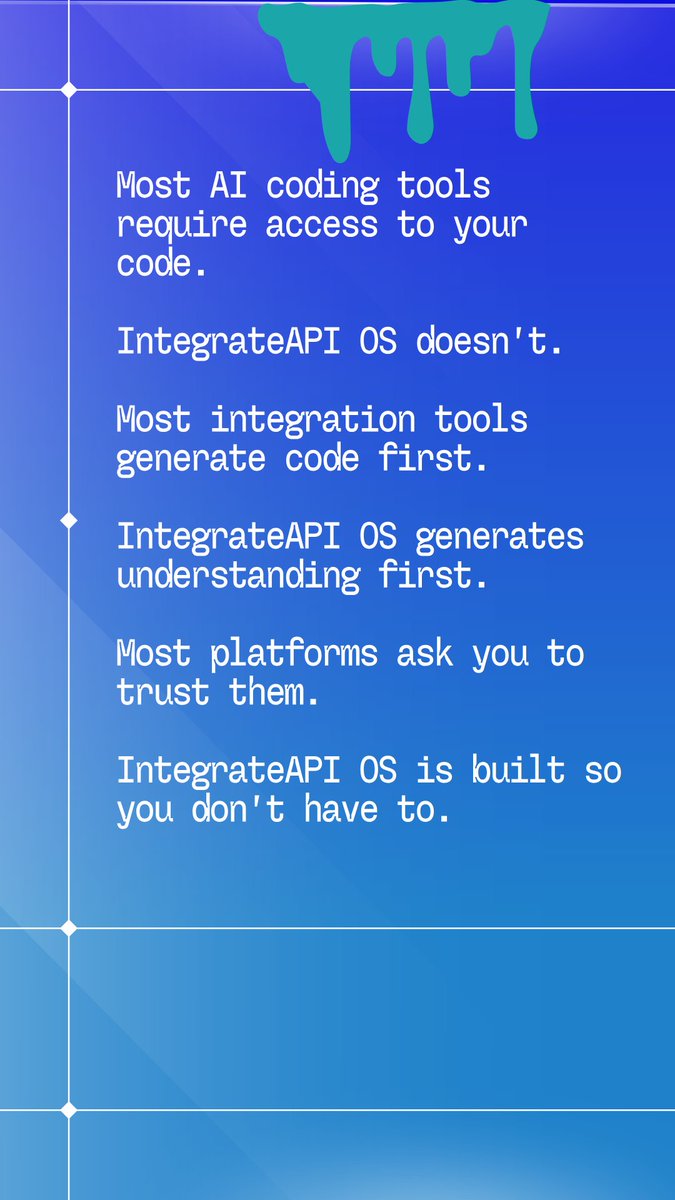
What makes IntegrateAPI OS different?
Most AI coding tools require access to your code.
IntegrateAPI OS doesn't.
Most integration tools generate code first.
IntegrateAPI OS generates understanding first.
Most platforms ask you to trust them.
IntegrateAPI OS is built so you don't have to.
integrateapios.com
5
Jun 7
Unlock $$$ with AI automation niches:
• Workflow & Process Optimization
• Lead Gen & Email Campaigns
• CRM & Customer Support Bots
• Social Media & Content Automation
• Data Analytics & E-commerce Flows
• Onboarding & Project Management
• No-code Tools (Zapier, Make, n8n)
Choose one. Master it. Stand out. Get paid.
1
14
Jun 6
AI should help you build — not take control away from you.
Most tools become a layer between you and your system.
This removes that layer.
Your code stays local. Your keys stay yours. Your workflow stays visible.
IntegrateAPI OS.
integrateapios.com
6
Jun 6
Ever wonder how often companies reinvent themselves?
It's not just about their products; it's the entire brand narrative that resonates.
When was the last time you felt a brand really connected with you?
1
11
Jun 5
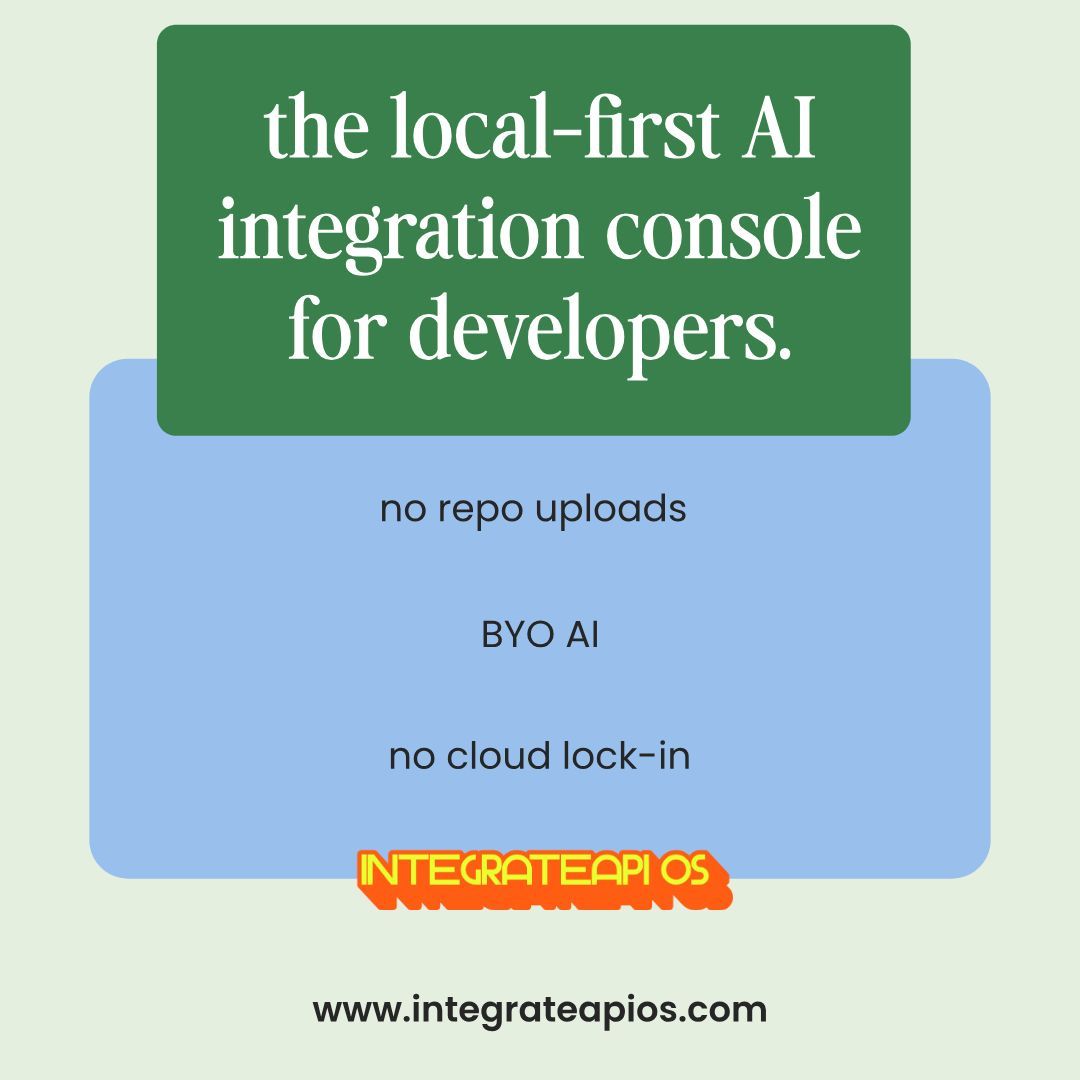
Stop uploading your code just to connect software.
IntegrateAPI OS is the local-first AI integration console that helps developers plan and connect APIs without giving away their code, keys, or data.
Your code stays yours
Bring your own AI
Connect faster with confidence
integrateapios.com
#AI #Developers #APIs #OpenSource #BuildInPublic #IndieHackers
1
13
Jun 5
AI should help you move faster — not sit between you and your own system.
Most tools introduce hidden layers of access, control, and dependency.
This removes them entirely.
Local-first execution, your own keys, and full transparency at every step.
IntegrateAPI OS.
integrateapios.com
1
16