1,033 Photos and videos












Pinned Tweet

May 26
One thing I’ve really noticed about the $IONQ community on X that separates them from most stock ticker communities is that the $IONQ community is actually smart, knows what they are talking about and has some of the best deep, educated, posts I’ve ever seen. From Skywater Acquisition, to Oxford, to the 256 Qubit goal for this year and more. This community knows what they are talking about and we all know that we are sitting on a gem!
If you want detailed explanations on a company and deep deep dives I recommend looking into $IONQ.
Recommend following
@TechInnovationz
@DesFrontierTech
@Dboybruh
@munoismuno
@JimHODL
@genejchan
@InvestorDenis
@MarvenzzFranc
And many more I’m sure I’m missing a few goats as well, but these legends stand out on my feed day in and day out! Please free to drop $IONQ legends who I’m missing on this list!
24
8
119
7,747
Investify Daily retweeted
Jun 13
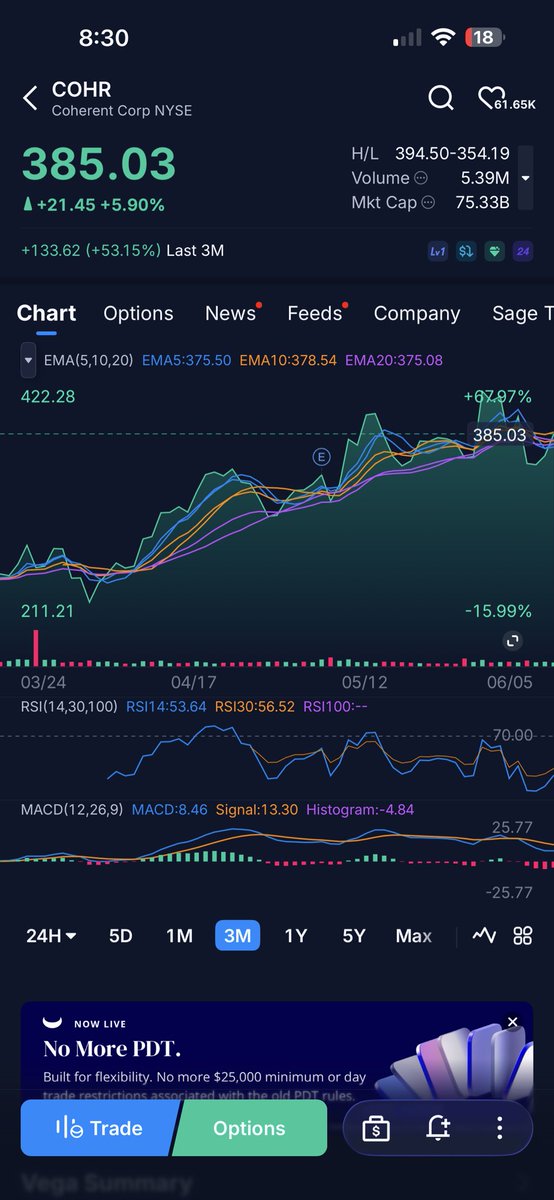
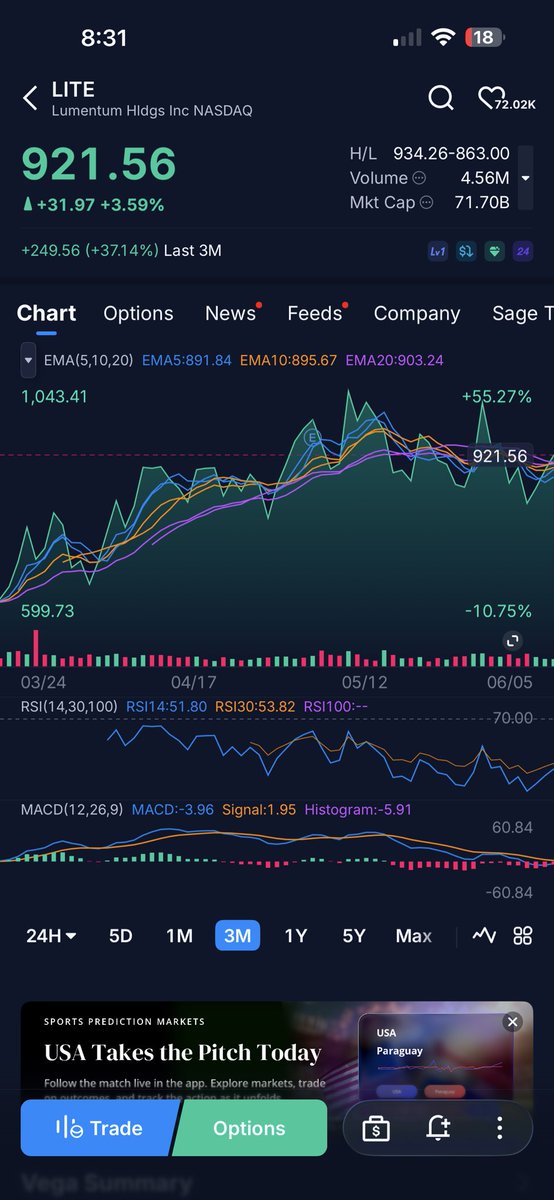
$IONQ $LASE $LITE $COHR I really like to find industries or “bottlenecks” rather than individual stocks. From industries I’ll look at a company I like. For Quantum and AI Photonics is a critical field.
What is it?
Photonics could become one of the most important technologies of the next decade.
While today’s computing revolution has been driven by electrons moving through semiconductor chips, the future may increasingly rely on photons — particles of light — to move information faster, more efficiently, and with less energy.
This is where photonics connects AI and quantum computing.
AI is creating massive demand for:
• Faster data movement
• Lower energy consumption
• Advanced optical networking
• Next-generation computing infrastructure
Quantum computing also relies heavily on photonics. Many quantum architectures use light to:
• Control and manipulate quantum systems
• Connect quantum processors
• Transfer quantum information
• Enable future quantum networks
Some companies positioned around this future:
$IONQ — IonQ
A leader in trapped-ion quantum computing. As quantum systems scale, photonic technologies will become increasingly important for networking, communication, and connecting quantum processors. $IONQ and others will need this.
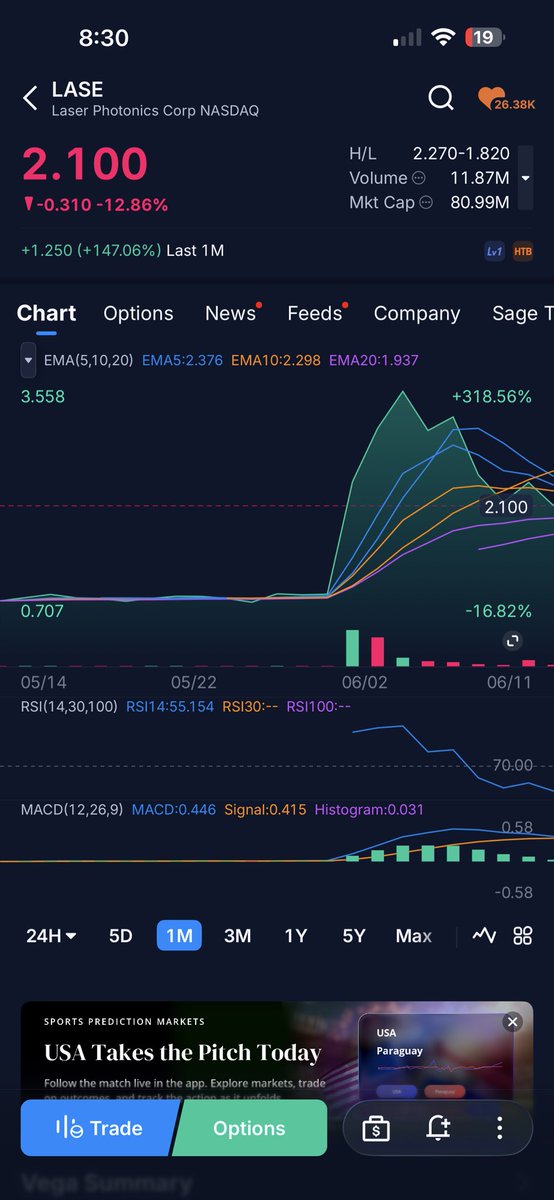
$LASE — Laser Photonics
An industrial photonics company focused on laser-based manufacturing solutions, including laser cleaning and processing applications.
$COHR — Coherent
A major photonics company providing lasers and optical technologies used across advanced manufacturing, semiconductors, and scientific applications.
$LITE — Lumentum
Focused on optical technologies that support high-speed communications and the growing infrastructure demands created by AI.
The next computing era may not be defined by one technology alone but multiple working together.
3
1
24
1,249
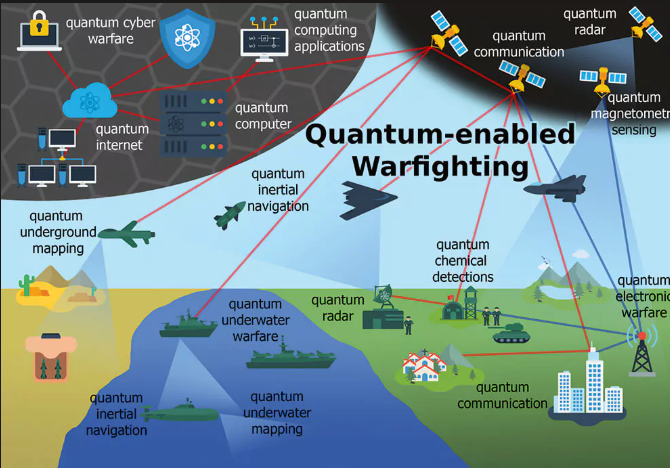
$IONQ The military use case for quantum technology is becoming one of the most important investment themes in the sector.
Most investors focus on quantum computing. Governments and defense agencies are increasingly focused on quantum sensing, quantum networking, secure communications, and GPS-independent navigation.
According to recent analysis from the Center for Strategic and International Studies, quantum sensing has the potential to reshape modern warfare by enabling detection capabilities that conventional systems struggle to achieve. Applications include:
• Detecting submarines through quantum magnetometers
• Identifying underground tunnels and hidden infrastructure through quantum gravimeters
• GPS-denied navigation using atomic clocks and inertial sensors
• Enhanced intelligence, surveillance, and reconnaissance (ISR)
• Quantum-secure communications and networking
The strategic implication is simple:
Many of today's military advantages depend on remaining undetected.
If quantum sensing matures as expected, stealth aircraft, submarines, underground facilities, and even electronic warfare tactics could become more vulnerable to detection. CSIS compares the potential impact to the way radar transformed warfare in the 20th century.
This is where $IONQ becomes particularly interesting.
Most people still classify $IONQ as a pure-play quantum computing company. However, the company has spent the last two years building a broader quantum technology platform spanning:
• Quantum computing
• Quantum networking
• Quantum security
• Quantum sensing
• Government and defense applications
A major development was the acquisition of Vector Atomic, a company with more than $200 million in government contracts and technologies including:
• Atomic clocks
• Positioning, Navigation, and Timing (PNT) systems
• Gravimeters
• Inertial sensors
These technologies are directly applicable to defense, aerospace, and national security programs. Vector Atomic technology has also been associated with military and space applications, including programs supporting the U.S. Department of Defense.
$IONQ has also delivered quantum networking systems to the U.S. Air Force Research Laboratory and established IonQ Federal to serve U.S. government and allied defense customers. Importantly, $IONQ is not the only company positioned for this trend.
Other notable players include:
• $IBM — quantum computing and government research partnerships
• $QNT — quantum computing, cybersecurity, and defense-oriented research
• $RGTI — participant in U.S. government quantum initiatives
• $QBTS — optimization and defense-related research applications
• $QUBT — photonics and sensing technologies
• Q-CTRL — quantum navigation systems designed for GPS-denied environments
• SandboxAQ — quantum sensing, cybersecurity, and government applications
The market may be underestimating a key point:
The first trillion-dollar quantum opportunity may not be quantum computing.
It may be the deployment of quantum sensing, timing, navigation, communications, and networking systems across defense, intelligence, aerospace, and critical infrastructure in sync with commercial use as well. The way I see it today, $IONQ seems to be the most structured company to date with the most resources, which is critical to deploy military related capabilities.
If that thesis proves correct, $IONQ's expansion beyond computing and into sensing, networking, and federal programs could be one of the most significant strategic moves in the entire quantum industry. If you don't think Quantum will have military applications I recommend to look again...
3
10
49
4,579
Good assessment on $BULL and I totally agree fair value price is and should be $15-$20. Super undervalued here…
Jun 12

I’m buying $BULL here and staying bullish for the long term. I think the recent selloff is more about the overall market than the company itself, and at around $6/share I still see a lot of upside. My target remains $15-$20, based on its growth potential and how undervalued it looks compared to competitors like Robinhood and Moomoo. I’m holding and adding on dips. This is one I’m treating as an investment, not a quick trade.
2
2
14
652
Investify Daily retweeted
May 26
One thing I’ve really noticed about the $IONQ community on X that separates them from most stock ticker communities is that the $IONQ community is actually smart, knows what they are talking about and has some of the best deep, educated, posts I’ve ever seen. From Skywater Acquisition, to Oxford, to the 256 Qubit goal for this year and more. This community knows what they are talking about and we all know that we are sitting on a gem!
If you want detailed explanations on a company and deep deep dives I recommend looking into $IONQ.
Recommend following
@TechInnovationz
@DesFrontierTech
@Dboybruh
@munoismuno
@JimHODL
@genejchan
@InvestorDenis
@MarvenzzFranc
And many more I’m sure I’m missing a few goats as well, but these legends stand out on my feed day in and day out! Please free to drop $IONQ legends who I’m missing on this list!
24
8
119
7,747
Jun 12
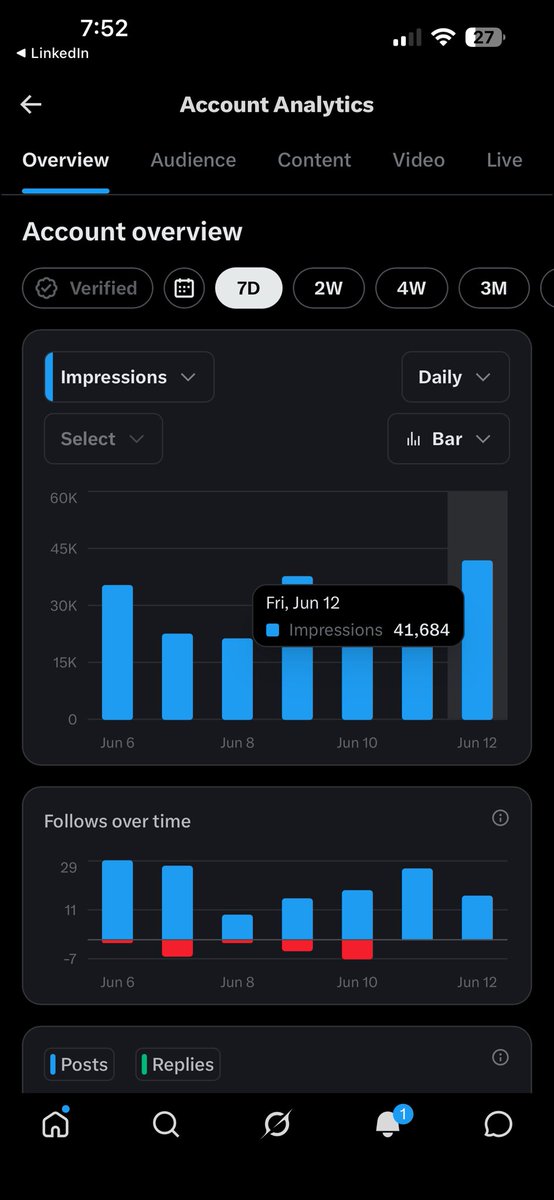
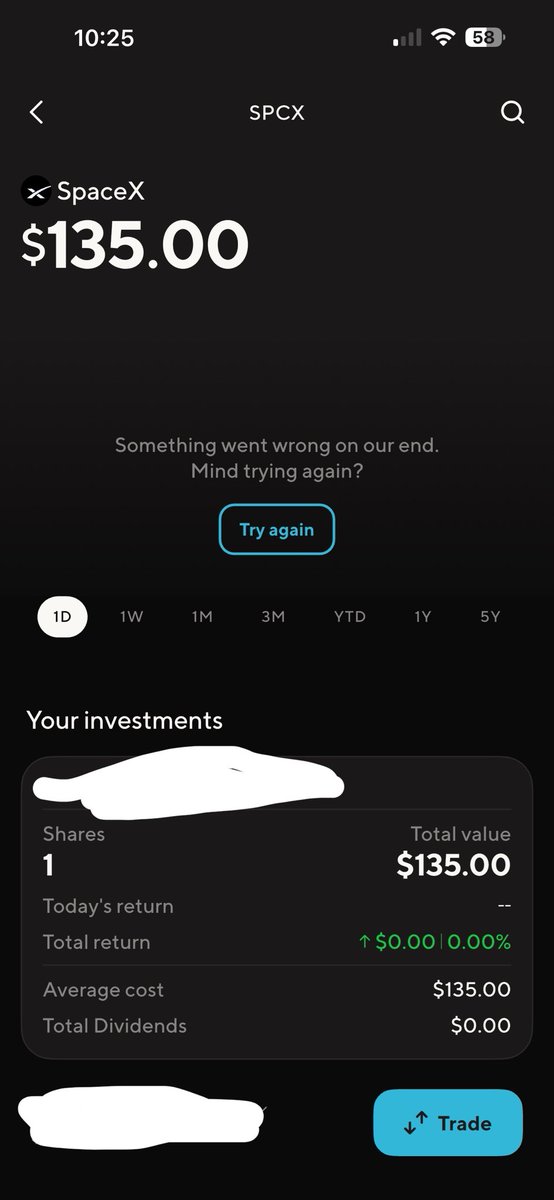
Hit 1.3k Followers today! Really grateful and also got my 1 $SPCX share too. 🍻 🎉
Impressions were decent this week, ended today strongest! The hardest thing is managing this account with a demanding job too but we try fam.
Right now no days below 20k which is good! Just got to set the bar and keep consistent. It will compound over time!
Have a good weekend everyone!
13
31
2,117
Jun 12
Jun 12

JUST IN: 🇺🇸 White House Official Patrick Witt says they're aiming to pass crypto Clarity Act by July 4th.
1
11
461



Jun 12
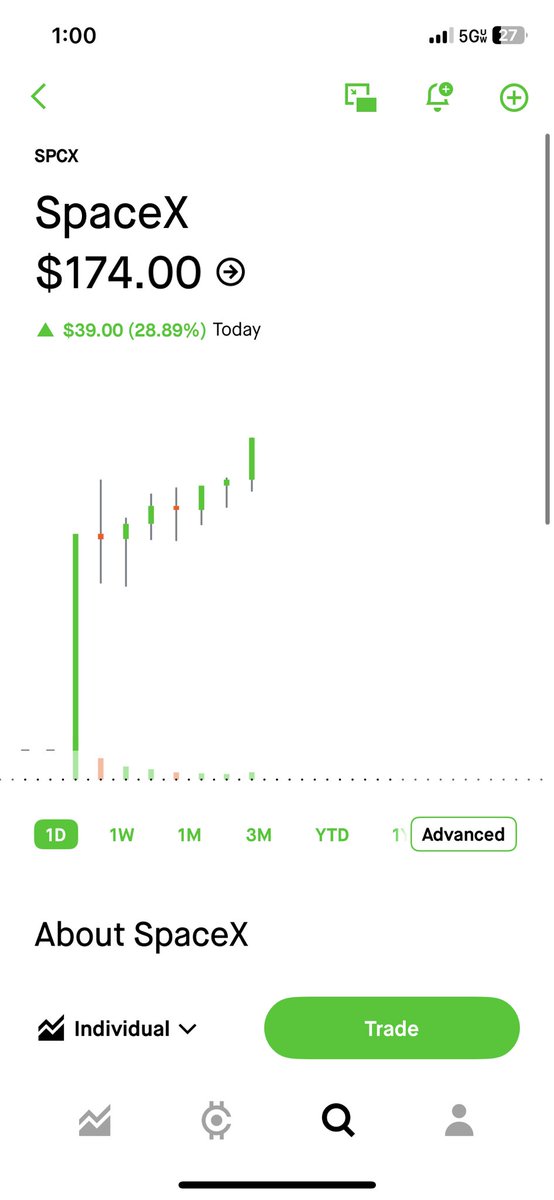
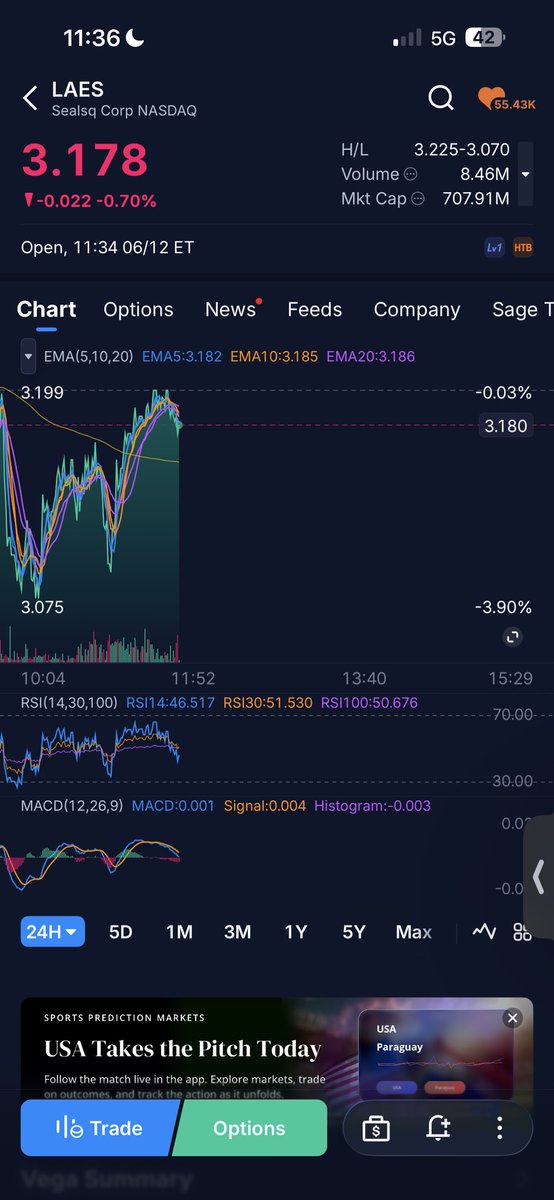
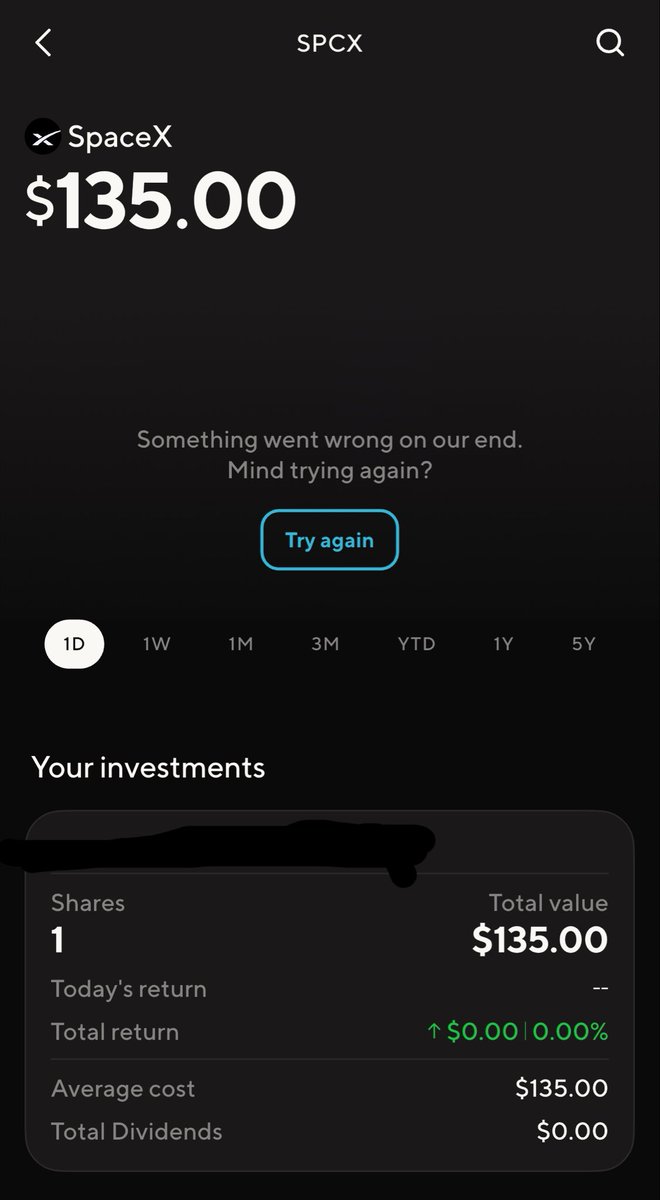
$SPCX For good or better I’m happy to own 1 full share of $SPCX!
First IPO I’ve been in as well. I wanted to be apart of finance and business history and here we are! I know a lot of you are watching but hey $135 to own one of the coolest companies in the world 🤷🏼♂️
As always a LONG TERM HOLD for me!
7
21
1,118
Investify Daily retweeted
Jun 12
Because it’s a day to PARTAY!
5
1
66
14,666
Investify Daily retweeted
Jun 12
Good morning Twitter world! 🌎 🚀
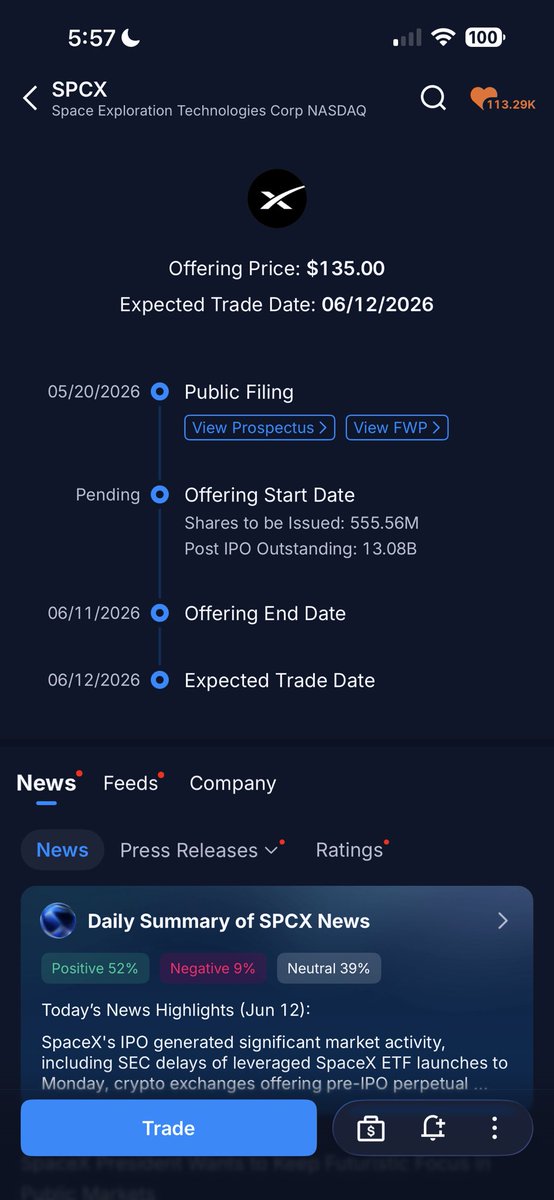
HISTORIC day for the markets as $SPCX goes public in what will likely
Be biggest IPO valuation of All time. This isn’t just historic in IPO terms but also for new fintech platforms such as $BULL $SOFI AND $HOOD as their customers have access and a chance to own a piece of @SpaceX
Let me ask are you buying today or sitting on the sidelines?! Have a blessed day Twitter world!
10
2
20
858
Jun 12
Keep an eye on $UEC & $LEU
Both Nuclear energy plays. Could be big gainers. Energy is a bottleneck in 🇺🇸 and if 🇺🇸 is to continue its dominance it needs to start thinking smart. Nuclear can offer many solutions. I know this is not a deep dive but more of sharing to everyone here on X! Will do more looking into and a BLUF in next 2 days on each!
3
1
12
649
Jun 12
How $SPCX investors will be celebrating tomorrow night finally being a partial owner of a company that will someday take humanity to the stars ✨.

Teams are go for launch with a $135 price per share for the SpaceX IPO → spacexipo.com/#priceannounce…
2
7
318
Investify Daily retweeted
Jun 11
9
3
30
967
Jun 11
Simple you buy the stocks of tomorrow today.
That is what my portfolio is focused on a lot of names that will be key in the shifting economy in the next 5-10 years. Think LONG
Jun 11

The tomorrow winners are not names everyone is talking about:
$MP - Rare earth miner with a 15% equity stake held by the Trump administration
$EOSE - Zinc-based long-duration energy storage pioneer
$SYM - AI-powered warehouse robotics automation leader
$CRWV - Fast-growing AI cloud infrastructure specialist
$OKLO - Small modular reactors for reliable baseload energy
$XPEV - Chinese EV and robotics technology leader
$UUUU - Largest U.S. uranium supplier and future heavy rare earth supplier
$FLNC - Large-scale battery energy storage technology leader
$SE - Southeast Asian tech and e-commerce leader
$AMBA - AI vision and video processing chip leader
What's your favourite?
Which names am I missing?
6
363