
Joined November 2025
- Tweets 8,036
- Following 655
- Followers 595
- Likes 20,155
699 Photos and videos















Jun 14
It seems to me that a strange thing is happening in robotics right now. Companies are throwing away millions of dollars to collect data for training models, and then this data is literally enough for just one training cycle, and everything starts all over again
I think it's not even about the technology, but about how the process itself is structured. For text and images, we have Common Crawl. This is a huge shared pool of data on which all language models grow. But for the physical world, there is no such thing. No one has collected a shared array of real robot actions that anyone could use
I like that @PrismaXai is doing exactly this, they are building an open dataset of real actions that scales through people, rather than through the budget of a single company. A person remotely controls a robot, the robot performs a task, and the data of this task is recorded into the shared pool. For this, the operator receives a reward. For access to the data, other companies pay, and a portion of the tokens is burned. This means that the value of the data is fixed right in the protocol, rather than in the accounting department of some corporation
I would put it this way. In five years, any company that wants to train a robotics model will face a choice. Either it will buy access to this dataset through the token-burning mechanism, or it will lag behind those who did. The question is not whether this data is valuable, but who will own it. A centralized company that decides for itself whom to give access to, whom to block, what price to set, or a network of people where the rules are written in code and work the same for everyone
the second option is closer to me. I think this is exactly what the infrastructure for physical AI should look like.
8
18
87
Jun 14
Everyone talks about institutional crypto adoption. But it seems to me that the real moment of adoption happens when the institutional data infrastructure stops being a separate layer and becomes a native part of the blockchain. I would say that this is exactly the moment that many are missing
I like that the Subzero Labs team, which is building the Rialo network, made it into the CBOE Innovation Spotlight. CBOE is an exchange that processes 3.8 billion contracts per year. The power here is that CBOE data is now directly embedded into Rialo's infrastructure. A developer gets access to what used to be available only to institutional desks. 9500 instruments, real-time, top-of-book
I'm curious to see what will be built out of this first. I would gladly look at the first applications that take this data and do something that was previously impossible in an onchain environment.
@RialoHq
9
20
64
Jun 13
Everyone is talking about speed, but I would like to talk about unpredictability
In my view, in Ethereum's PBS, the average block delivery time is not the main thing at all, unlike the tail of the distribution. Those exact moments when a block suddenly arrives later, for no apparent reason. The proposer does not sit and wait for the best block, because they have a hard cutoff. They take what lies in front of them at that specific moment. A block that could have brought more, but arrived a fraction of a second later, simply does not exist for them
I looked at the data from Optimum. They measured what happens if you give proposers a little more time. Accelerating propagation by 50–150ms yields an increase in the average bid value by 13–16%. For me, this means that the blockspace market already exists, but it cannot function properly because block delivery is too unstable. Proposers are forced to hedge risks, choosing the safe option instead of the best one
For me, this is a problem not of speed, but of a market that cannot clear by value because the infrastructure does not provide it with predictability
I like Optimum's approach. Their mump2p protocol uses RLNC, a technology that the project's CEO, Muriel Médard, developed at MIT. In tests on the Hoodi testnet, the average block delivery via mump2p was around 150ms, which is at least 6 times faster than the baseline GossipSub. But what is more important to me is that in academic simulations, mump2p showed that the standard deviation of latency remains stable within ±0.2–0.3 seconds even under load, whereas with GossipSub, the variance grows up to ±0.9 seconds. This is precisely what predictability is
When delivery becomes stable, proposers stop hedging. They begin to trust the market, and that is when blockspace starts to function the way it should. It seems to me that Optimum is doing exactly that, fixing the foundation upon which everything else rests.
@get_optimum
2
19
58
Jun 13
I have been looking at the RWA market for a long time and noticed one pattern. Projects die not at the idea stage and not when they look for investors. Often they die quietly when the token is already issued and the real asset behind it lives its own life without connection to the blockchain. You hold the token, and what happens to the physical entity is unclear, the chain simply breaks
I am sure that SimpleChain understands this problem. They have a different approach where each asset is broken down into small data particles with a unique hash. Compliance fields and a dynamic connection with the real object are built into each particle. Their oracles collect operational events, cash flows, IoT device readings, audit data. All this goes on-chain in real time, because of which the chain does not break
I have a question for those who work in RWA. Have you ever seen a project where the token grew, and behind it stood an asset that had long ceased to exist in the form in which it was tokenized? And how often does this happen unnoticed by the holders?
I like that SimpleChain is building an infrastructure where such situations are technically impossible. Their approach with granular data, built-in compliance and a live connection with off-chain is what the RWA market lacks. The team of former executives from Ant Group and JDcom knows how to work with regulators and real assets. And 15 million dollars in the seed round say that institutional investors also believe in this
I would say that @SimpleChain_RWA is making an operating system where the token and the asset breathe in unison, and this is a rarity.
1
13
39
Jun 12
I watched what they were showing at ICRA 2026 in Vienna. There were many beautiful demos, robots were pouring popcorn, folding things, arranging blocks. It looks spectacular, but I have a question. Who will repeat this a couple of hundred times in a row in a room that nobody cleaned up specifically?
@PrismaXai, in my opinion, are doing exactly this, they do not need beautiful demos. For them, a system is important that does not care what the table looks like, without preparation, without clearing. Just repeatable work in the real world, where everything is not perfect. They are making a system where people control robots from a distance. A person puts on a helmet or looks at a screen, and a robot repeats their movements. All actions are recorded. Then Eval Engine, their automatic verification system, analyzes these recordings and gives a score. Only data with a high score goes further, into model training. This is how real data is collected from real rooms
It seems to me, this is the whole difference. A beautiful shot at an exhibition is one thing. And when a person takes a robot and teaches it to work in our usual mess, that is already something completely different. I would like robots to learn exactly this way. Not on exhibition tables, but on yours and mine.
6
22
67
Jun 12
Your agents have already transferred money, called an API, or executed code without your knowledge. You didn’t notice this because there are no logs, and the agent itself doesn’t think it’s necessary to ask for permission-it just executes. The most interesting thing is that what is described here is not a bug, but a trust architecture where there is zero trust
the problem is not at all with the agents' capabilities, but with the fact that you mistook speed for reliability. Every action without prior permission is a kind of debt to chaos
@RialoHq does not slow down agents. It forces them to ask first, then do, and absolutely record it. This is the only way not to wake up one day with an empty wallet and questions without answers.
13
25
84
Jun 11
GM legends, huge news!
Solana Funded Creator Program is live, letting you stack bags just for making content. We're talking a $30,000 prize pool, leaderboard rewards, and affiliate commissions
Just make content and earn. Who’s in?
Jun 10

The Solana Funded Creator Program is live!
Get paid to post. Climb ranks. Unlock more rewards.
What's in it for you:
→ $30,000 in prize pools
→ Clear campaign briefs
→ Higher ranks unlock bigger payouts
→ Affiliate commissions
Join now → creators.solanafunded.com

4
15
82
M.Ark retweeted

Jun 10
Two runs of the same task. One trains a capable model. The other quietly degrades it. It's full of errors the model would just learn to copy.
Separating the two is what our Standards for Data are for.
23
30
175
7,967
Jun 10
It seems to me that everyone in robotics is looking in the wrong place. Everyone talks about motors, neural networks, and chips. But I would focus on a much simpler question. Who will manage millions of robots before they learn to do it themselves?
this is not about hardware or algorithms. It is about people, the data they generate, and trust between all participants in the process. And here, I like what PrismaX is doing
they are building an open market where an operator can sit at a computer and control a robot located in another city or even another country. The robot owner receives income because their machine is performing real tasks. AI companies buy data on every movement and every decision the operator makes. And the protocol itself verifies the quality of the work without the need for someone to stand over your shoulder and monitor it manually
it seems to me that this goes far beyond the usual robots plus token formula. PrismaX is trying to turn teleoperation into a global coordination layer for physical AI. That is, the very infrastructure that connects people, machines, and companies into one functioning system
I would ask myself the question: if robots become mainstream before they become truly autonomous, who wins? Hardware manufacturers or operator networks? It seems to me that the answer is not as obvious as it appears at first glance. Hardware can be copied. But a network of people who know how to work with robots, the data they create, and the trust built around this process are much harder to replicate
@PrismaXai, in my opinion, is working on exactly this. And I think this is the right focus. Because in a world where robots cannot yet do everything themselves, the most valuable thing is not the machine, but the person who knows how to operate it.
10
24
117
Jun 10
Looking at the numbers, it becomes clear to me where the entire market is heading
Analysts from Boston Consulting Group predict that the real-world asset tokenization market will grow to 16 trillion dollars by 2030. For comparison, the entire crypto market today is roughly 3 trillion. That is a five-fold difference, and it is only the beginning
I feel that many people do not yet realize the scale. RWA is not just another niche inside crypto. It is a separate layer that can eclipse everything we have seen so far in terms of volume
@SimpleChain_RWA is building infrastructure specifically for this scale. This is not a universal blockchain trying to adapt to everything at once. It is a specialized Layer 1 where regulatory compliance is built into the protocol itself rather than being tacked on top. They have their own data verification system and tools for issuing assets that work within the framework of the law right from the start
I think in a few years it will become obvious that the winner is not the one who simply launched another chain, but the one who laid down the right infrastructure for the largest transition of assets on-chain in history.
10
34
271
M.Ark retweeted
Apr 26
have a great sunday friends, and a wonderful mood

17
1
61
319
M.Ark retweeted
Jun 9
Robots are learning from data like this, at massive scale.
Better models start with better data.
Better data needs humans scoring it.
Coming soon.
107
76
336
22,104
Jun 9
I remember when Warlords of Draenor was released in 2014. The starting zones simply crashed. People were flooding in by the hundreds, and the servers couldn't handle it. I had to wait for hours back then just to log into the game
Blizzard solved this by simply splitting players into separate copies of the exact same zone. The load issue disappeared, but I ended up in an instance without my friends. We were playing in the same world, but essentially in different ones
the same thing is happening with blockchain now. The network is growing, and everyone faces a choice, either split the chain into shards, and then liquidity gets spread thin across pieces, or run everything on more powerful hardware, and then the network becomes centralized because not everyone can afford such equipment
I would not want to choose between these two evils.
But I think there is a third way. Remember Akamai in 1998, they didn't build new data centers all over the world, but simply learned how to deliver content smarter. The same websites, the same data, but it loaded multiple times faster
@get_optimum does roughly the same for blockchain. Their RLNC technology works like smart data delivery inside the network. Instead of moving full blocks from node to node, it sends encoded fragments that can be assembled in the correct order on the receiving side. This means information arrives faster and uses less traffic at the same time
on the Hoodi testnet, it looks like Optimum has an average block propagation time of about 150 milliseconds. For standard Gossipsub, which Ethereum currently uses, this is about 1000 milliseconds, which means it is six and a half times faster
this seems important to me because it is not sharding. The network remains whole, liquidity is not fragmented. It is also not a hardware race, because you do not need to buy supercomputers to participate. Optimum simply makes the data transmission itself smarter
Blizzard multiplied the worlds back then to cope with the crowd. Optimum, in my opinion, speeds up the very world we are already in.
17
41
229
Jun 9
I like Metcalfe's law
it’s simple, the more people in a network, the more valuable it is. This isn't an abstract theory, it's something you and I see every day
but connecting to a network needs to be safe, and that's where I look at SimpleChain. They don’t shout on every corner or promise moonshots, they are just quietly building infrastructure
I am particularly impressed by their approach to confirmations. They have an N-confirmation mechanism. Its essence is that the larger the transaction amount, the more blocks need to be confirmed, which is logical and fair. The system itself understands where the risk is higher and demands more guarantees
I would say this is a mature approach. Instead of hiding risks behind beautiful words, SimpleChain establishes rules. They are making cross-chain a normal technology with clear logic. It seems to me that this is exactly what is missing in crypto. When a team builds a foundation, not a show.
@SimpleChain_RWA
9
44
263
M.Ark retweeted

Jun 8
𝐞𝐏𝐁𝐒, 𝐬𝐥𝐨𝐭 𝐭𝐢𝐦𝐢𝐧𝐠𝐬, 𝐚𝐧𝐝 𝐬𝐜𝐚𝐥𝐢𝐧𝐠 𝐚𝐩𝐩𝐫𝐨𝐚𝐜𝐡𝐞𝐬
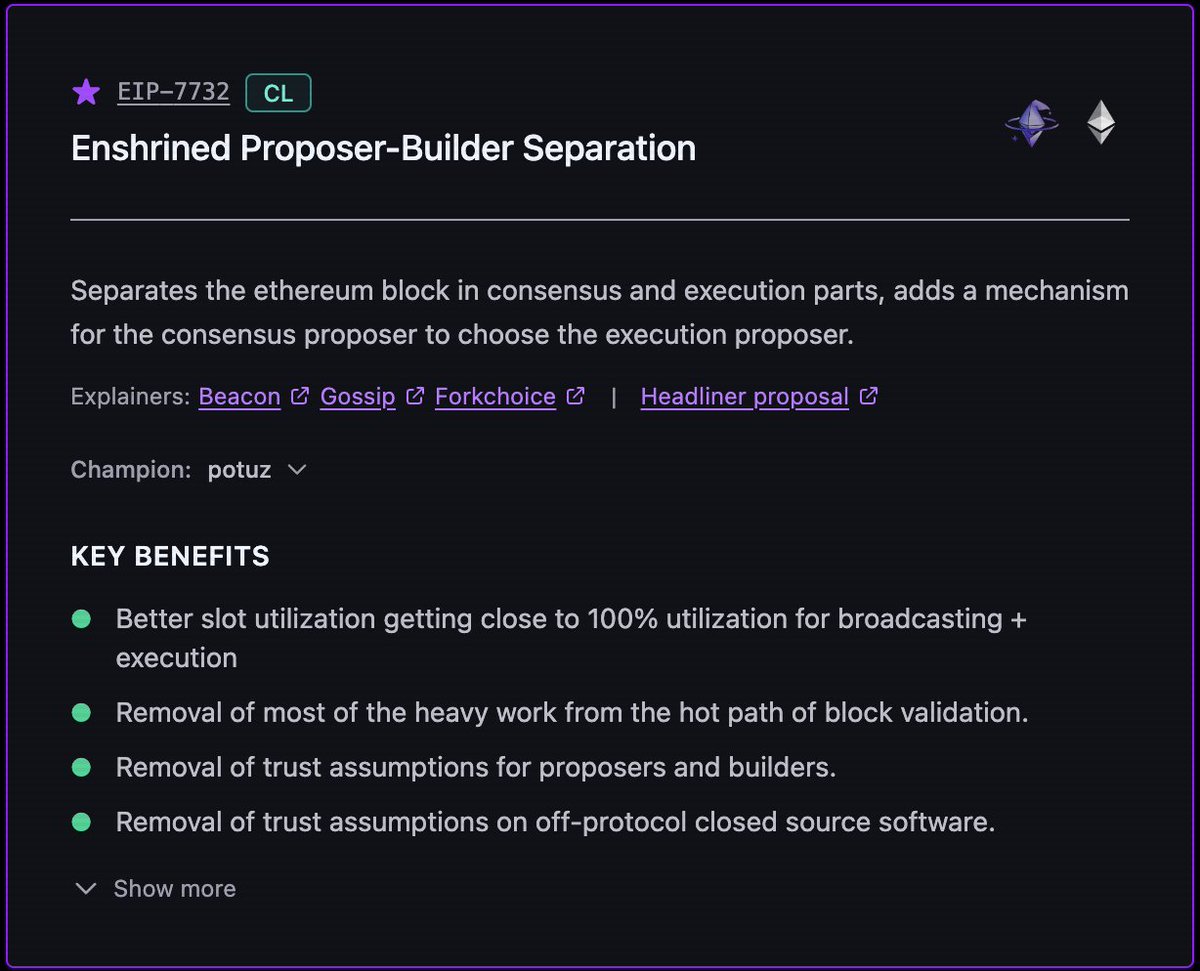
Ethereum is targeting Q3 for the next major upgrade, Glamsterdam. ePBS is the headliner, restructuring the deadlines within a slot to allow for larger blocks (higher gas limit & more blobs).
In the current slot structure a block has to be selected, proposed, propagated and attested to by the network in under 4 seconds. Increasing block size means more data has to reach nodes in the same short amount of time, and you run into bandwidth constraints.
ePBS buys more time for data propagation by separating blocks into the consensus block, execution payload, and blobs, and changing the deadlines for when those different parts of the block need to arrive.
Instead of the entire block needing to reach validators before the 4 second mark, they only need to receive the consensus block- a cryptographic commitment to a certain block & set of blobs. They make their attestation without receiving the execution payload, then have the remainder of the slot to receive that payload and verify it. Blob data is propagated separately giving nodes the full 12 seconds to receive it.
This scheme makes it easier to increase the gas and blob limits, which is good for some additional scaling. However, it's more of a sidestep than a true solution to the bandwidth bottleneck.
If you want to unlock serious throughput gains you need to improve how fast and efficiently data can move across the network. That's the key to increasing block size while ALSO shortening slot times.
Removing the bandwidth bottleneck means fundamentally upgrading the way data moves across Ethereum. Optimum's Random Linear Network Coding approach propagates Ethereum blocks with lower latency AND in a way that won't slow down as the size of blocks increase, OR as the network becomes larger and even more decentralized.
Scale the L1.
39
30
205
11,885
Jun 8
When I look at large technology markets, it seems to me that it's rarely just about the invention. Usually, organization is what decides everything
factories sped up not because someone invented a single machine; it happened because people learned how to standardize processes. The Internet grew not just thanks to servers; it grew out of communication protocols that allowed everyone to speak the same language. Right now, robotics is at a similar point. The hardware is already there, but the market hasn't yet figured out how to scale operators, data, fleet ownership, and payments
I like that @PrismaXai is working precisely in this direction. Teleoperation is becoming a paid labor. The robot turns into a productive asset, and data becomes a commodity. The $PIX token works as a mechanism for settlements and incentives
If they succeed, I would say that the value will not be in one specific robot, but in the network that teaches, distributes, and verifies the work.
15
50
268