
Researcher studying clouds, weather, and wildfires with machine learning and physics
Joined March 2013
- Tweets 3,448
- Following 1,112
- Followers 556
- Likes 16,469
249 Photos and videos




Jatan Buch retweeted

Apr 30
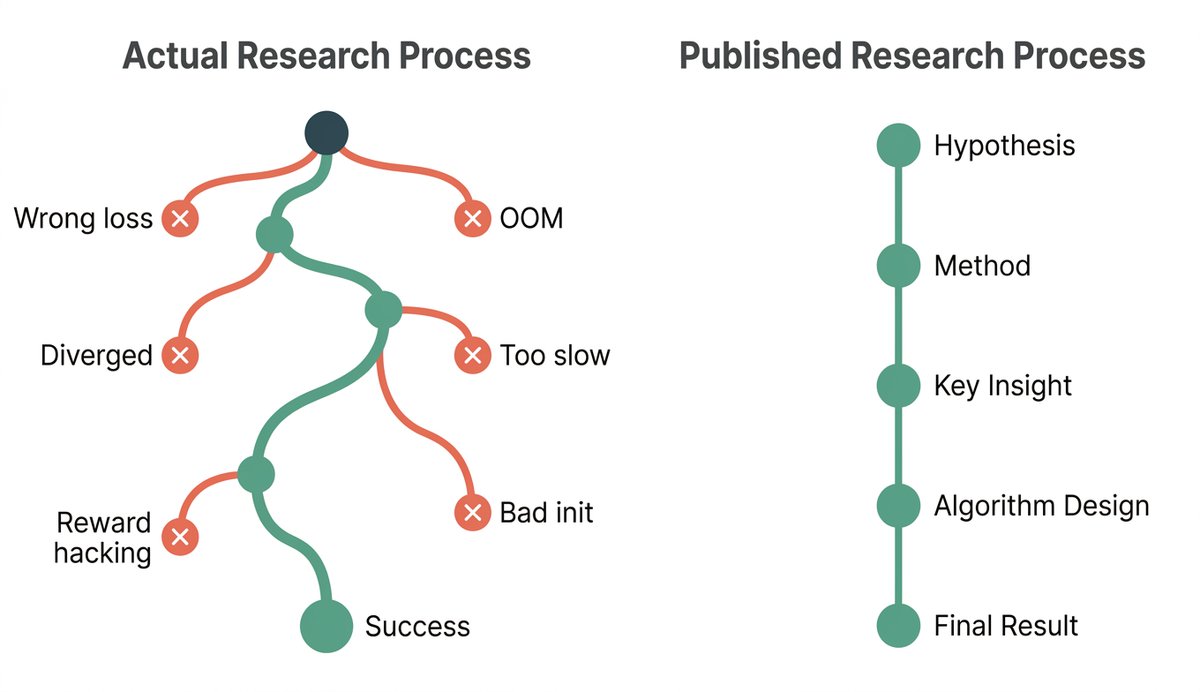
1/ For nearly 350 years, science has communicated itself through one object: the paper. A linear narrative, frozen as a PDF, written for a human reader. We've come to treat that format as the medium of science itself.
It doesn't have to be. It's a historical artifact. 🧵
28
136
1,067
141,360

The potential for catastrophic effects from the AI boom demands robust deliberation and real democratic governance.
Localized initiatives like data center moratoria won't get us there. jacobin.com/2026/04/ai-data-…
46
95
622
528,097
Jatan Buch retweeted

Mar 31
Toozology is a difficult and esoteric science, and so it must be approached with the greatest care. But the Toozologists have not reached their goal, a true and correct interpretation of Tooze. They have not appreciated his recent contribution at the right hermeneutical level. Questions have been registered pragmatically—is this ‘blueprint’ feasible? if feasible, would it actually be ‘leadership’ (ie hegemony)? The extent to which this represents another major revision to his thinking has not been seen. In particular, it must be placed within the context of two other Toozological observations: first, his soft spot for Kindleberger’s hegemonic transition theory of the 1930s; second, his hatred for Arrighi and disdain for the neo-Gramscian idea that the history of capitalism can be narrated as a sequence of hegemonies, such that we could characterize the contemporary period as an “interregnum.” Hitherto these positions have been reconciled by observing the “radical novelty” of the early twentieth century—both imperialism and the problem of attempting to construct a global order “after imperialism” were radically novel problems; ditto America, a self-contained continental superpower protected by two oceanic moats. There was a transitional crisis caused by the failure of liberal hegemony in the early twentieth century, but this was because of that conjuncture’s radical novelty. The uniqueness of that conjuncture means the ‘interregnum’ concept developed to explain it is not appropriate for our time. There will be no hegemonic transition from America to anyone else, Tooze had maintained; instead we have polycrisis. Now, he has a blueprint for How China Could Still Win hegemony. Apparently, then, whether or not we are living in an interregnum has not yet been determined. It is an open question. It may be the case, according to Tooze’s recent column, that we do in fact have a hegemonic transition on our hands, if only the CCP wills it. Thus we draw the conclusion that there are other uniquenesses that can lead to a conjuncture correctly being characterized as a hegemonic transition. The early twentieth century uniqueness was not itself unique. Whether there were also nonuniquely unique circumstances characterizing the conjuncture during which the Italian city states and the Dutch Republic came into capitalist leadership roles appears to be equally open to further research and investigation within the bounds of correct Tooziological doctrine as a result of this innovation.
16
29
323
73,523

2 Dec 2025
We are actively reviewing applications for a Performance Engineer role at Aeolus expensive-legume-bf0.notion.…
I'll be at NeurIPS later in the week, so DM me if you're interested in chatting more about the role or our approach to modern differentiable modeling more broadly!
166
Jatan Buch retweeted

28 Jun 2025
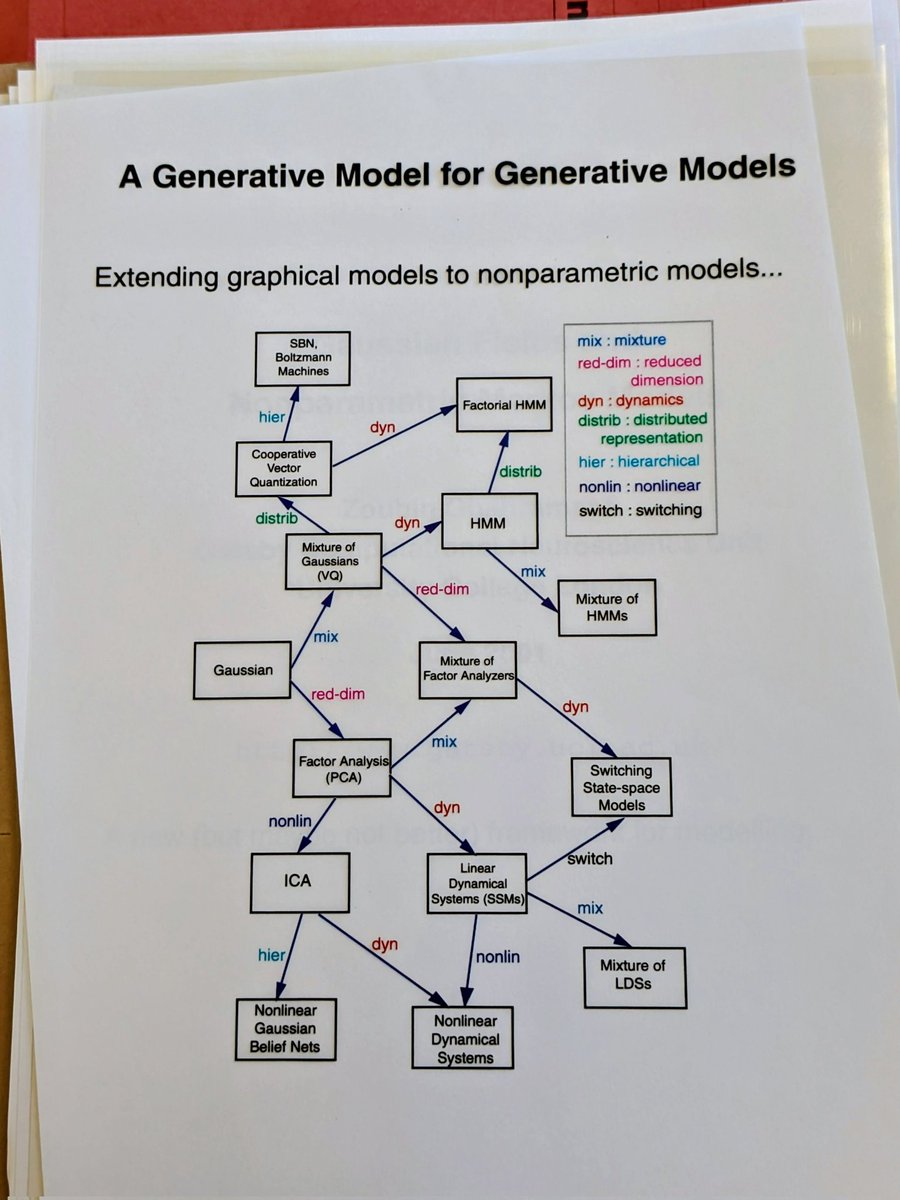
Clearing out my old office and finding transparencies from my talks from 25 years ago...
14
29
419
35,517
Jatan Buch retweeted

27 Feb 2025
🚀 I am hiring a Founding Engineer for Inkboard Inc. 🚀👀
I’m confident there is no other role on the market like this - and for the right person, I believe this could be a career defining opportunity.
General Requirements:
- Good vibes. 😁
- You're a prolific generalist engineer who hates being confined to just code.
- You’re rarely blocked: you learn new skills on the fly to get the job done.
- Have worked/Are looking to work on atoms and bits rather than just the latter.
- Our customers (and we) love nerdy/quirky/joyful things - if you do as well please mention it when you reach out.
- (Bonus) You’ve built products people love.
More info in the linked tweet below!
5
8
37
39,601
Jatan Buch retweeted

17 Feb 2025
Recently published!
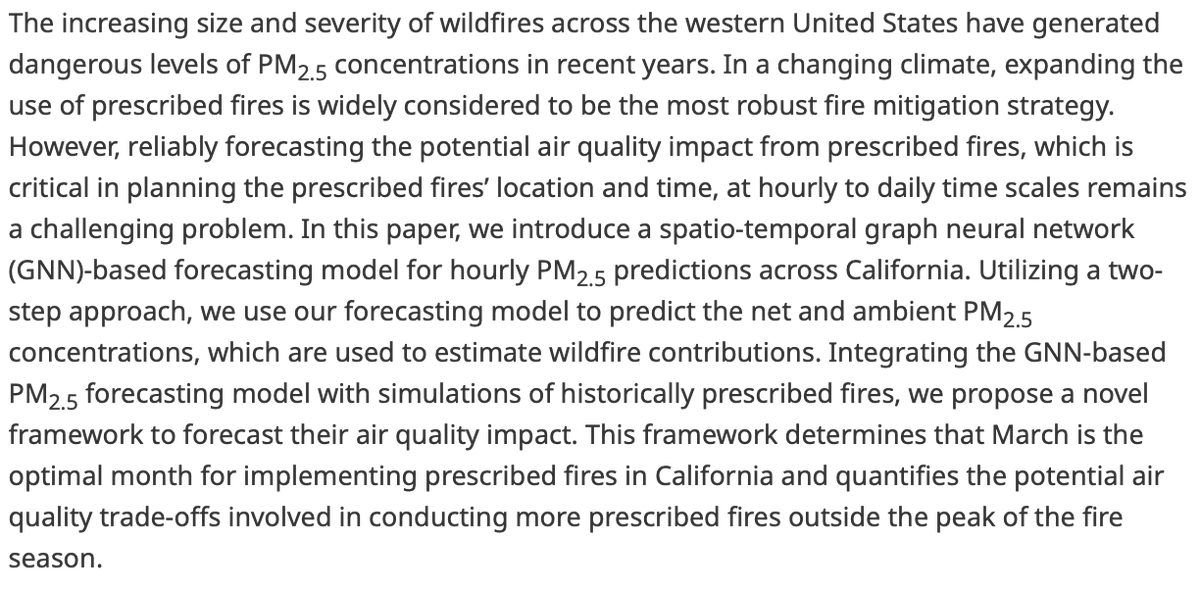
Simulating the air quality impact of prescribed fires using graph neural network-based PM2.5 forecasts
👉 bit.ly/3CFlejg
By Kyleen Liao, @JBuch7, @karadlamb and @PierreGentine
#airquality #wildfires #forecasting
2
2
626
23 Oct 2024
Usually a good read, Ben Recht absolutely wrote a sophomore-level philosophy analysis of the Higgs discovery, and I’m glad Kyle (who was on the CMS team) corrected the record here!
23 Oct 2024

My first draft of a reaction to @beenwrekt's blog post on the Higgs discovery. TL;DR, yes it did.
theoryandpractice.org/2024/1…
1
5
424
23 Oct 2024
recht’s post might qualify for the “not even wrong” distinction, the more I think about it
1
128
11 Oct 2024
I've thought of this as one of the stronger consistency tests for AI NWP models -- glad there's a detailed study out now!
11 Oct 2024

Can #AI-based weather forecasting models (trained on present-day data) provide skillful forecasts also in different colder and warmer states of the climate system?
Our new preprint @arxiv explores this question:
doi.org/10.48550/arXiv.2409.…
Here is what we found so far (🧵1/6)
2
7
745
16 Sep 2024
Are there any examples of differentiable modeling being applied to ecological systems, or discrete-state systems, more broadly?
1
217
23 Aug 2024
Horrifying but not that surprising if you have spent any time in New Delhi.
23 Aug 2024

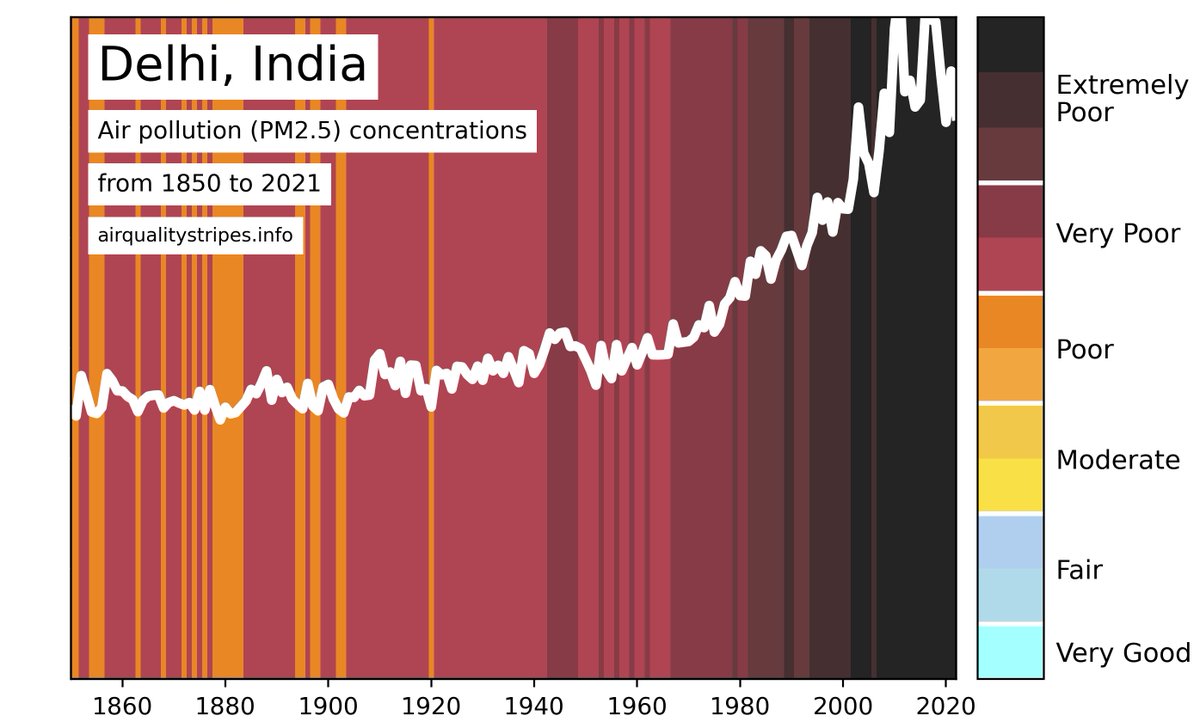
Inspired by @ed_hawkins, @AtmosScience have developed a tool to generate air quality stripes. Here is the plot for Delhi, India. It shows clearly how we have made bad policy decisions when it comes to air quality in India airqualitystripes.info/strip…
1
5
410
2 Aug 2024
Update your Zoteros/bibliography managers ppl: there’s a new ERA5 reference in town!
8
292
30 Jul 2024
I've tried my best to tune this out, but the response of sea ice to anomalous sea surface and atmospheric temperature perturbations over the past two years is a scary phenomenon.

Due to anomalous conditions ongoing in the #Arctic and #Antarctic, the total extent of sea ice globally is a record low for the date and nearly *4 million square kilometers* below the 1981-2010 average...
More graphics: zacklabe.com/global-sea-ice-…
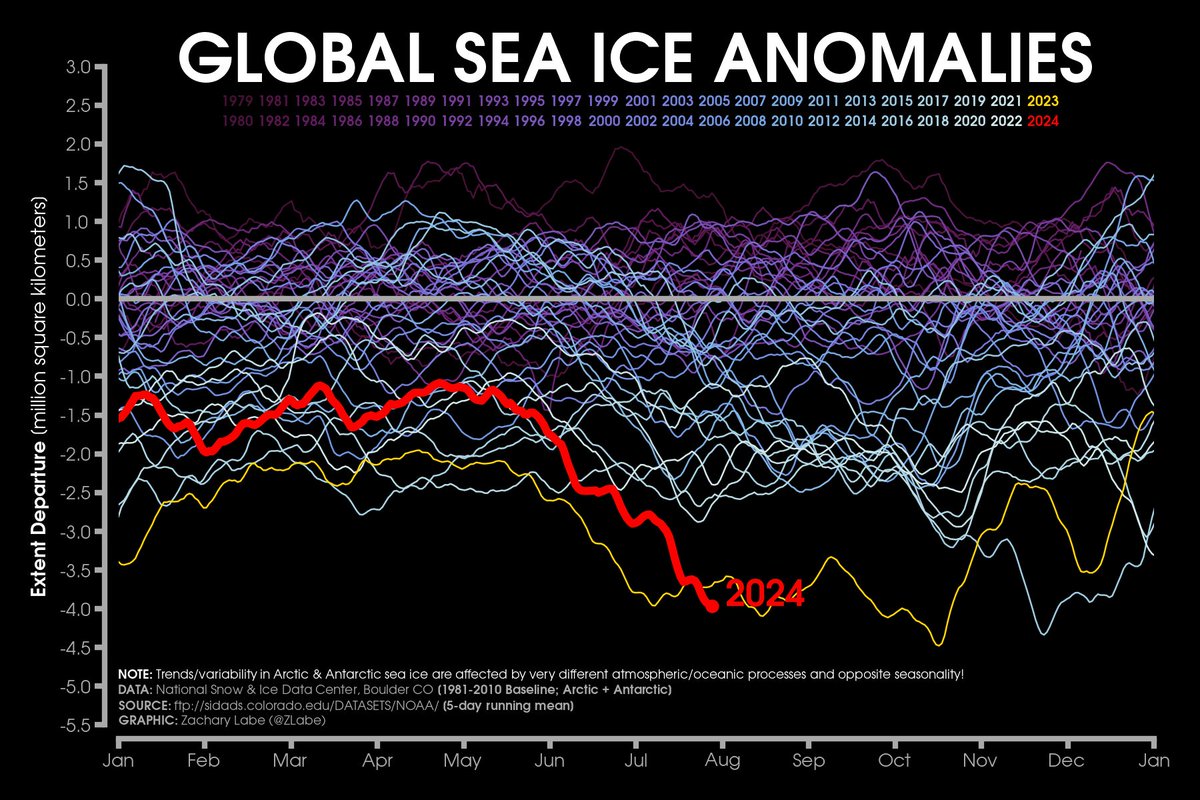
ALT Line graph time series of 2024's daily global sea ice extent anomalies in red shading compared to each year from 1979 to 2022 using shades of purple to white for each line. The year 2023 is also highlighted in yellow, which is the current absolute magnitude record low. Anomalies are computed relative to a 1981-2010 baseline. There is substantial interannual and daily variability. Data from the NSIDC.
3
9
696
28 Jul 2024
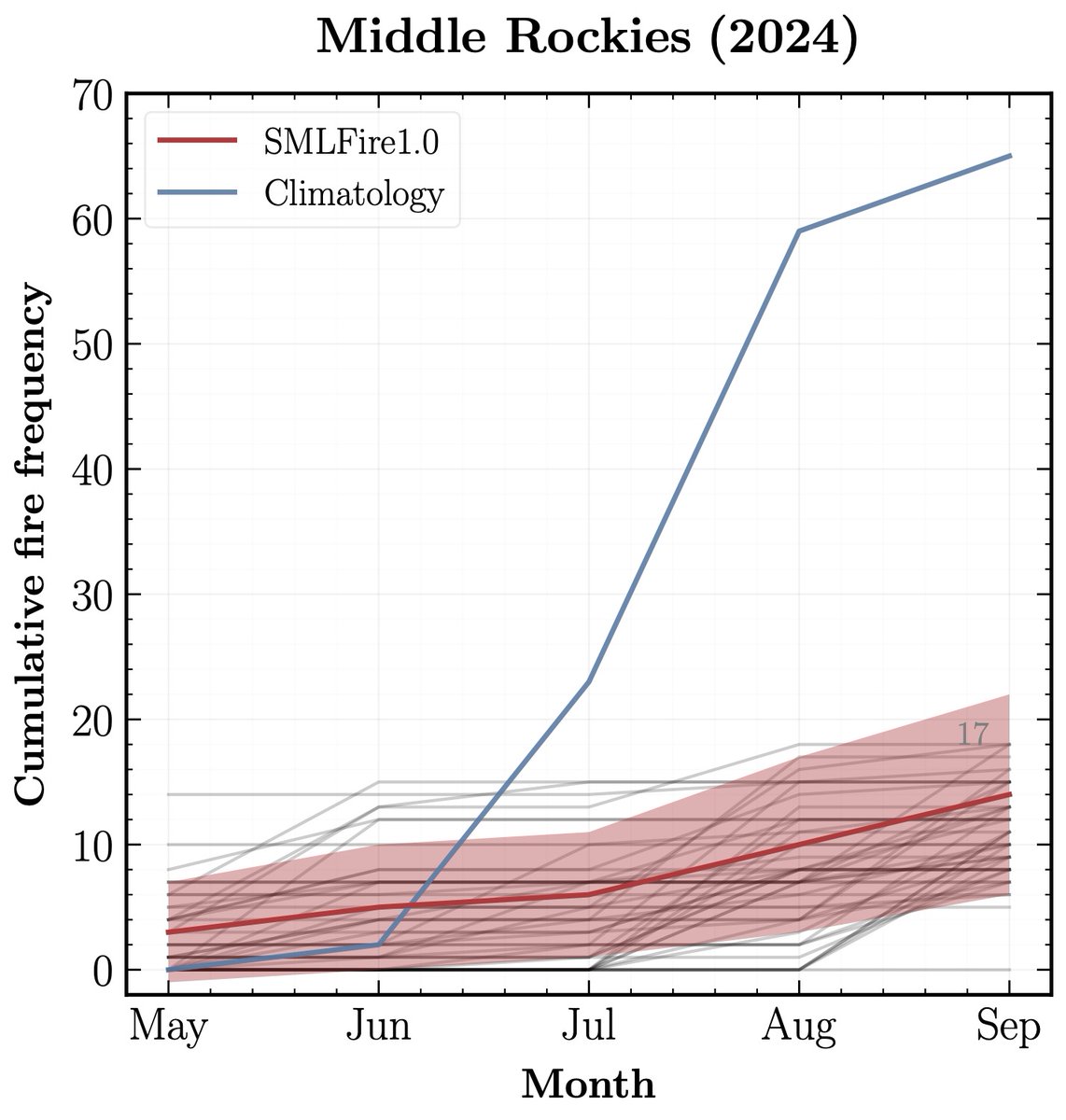
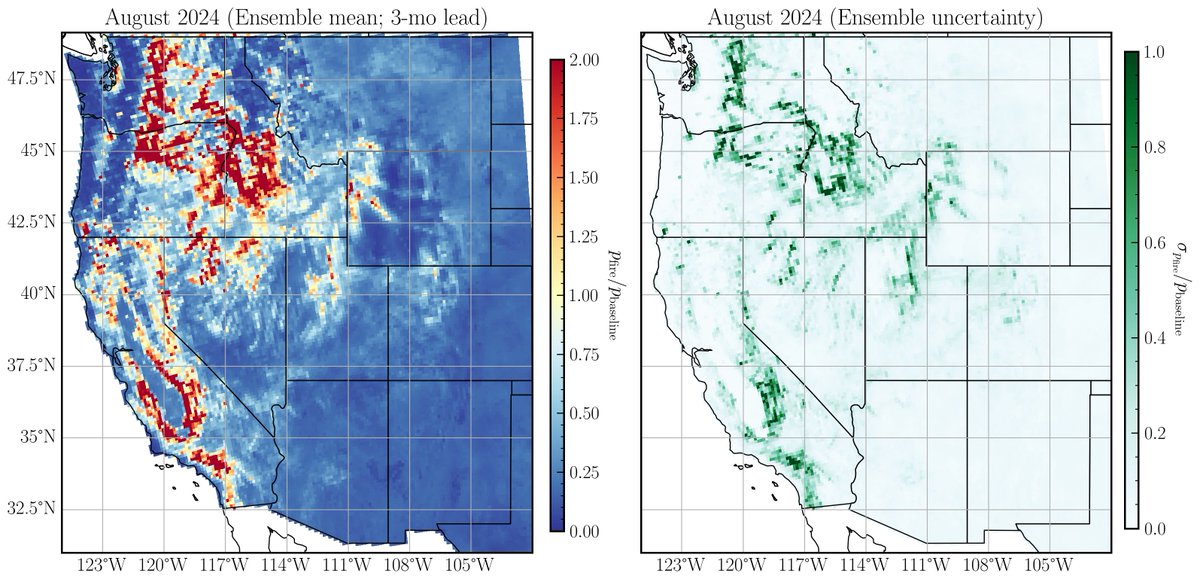
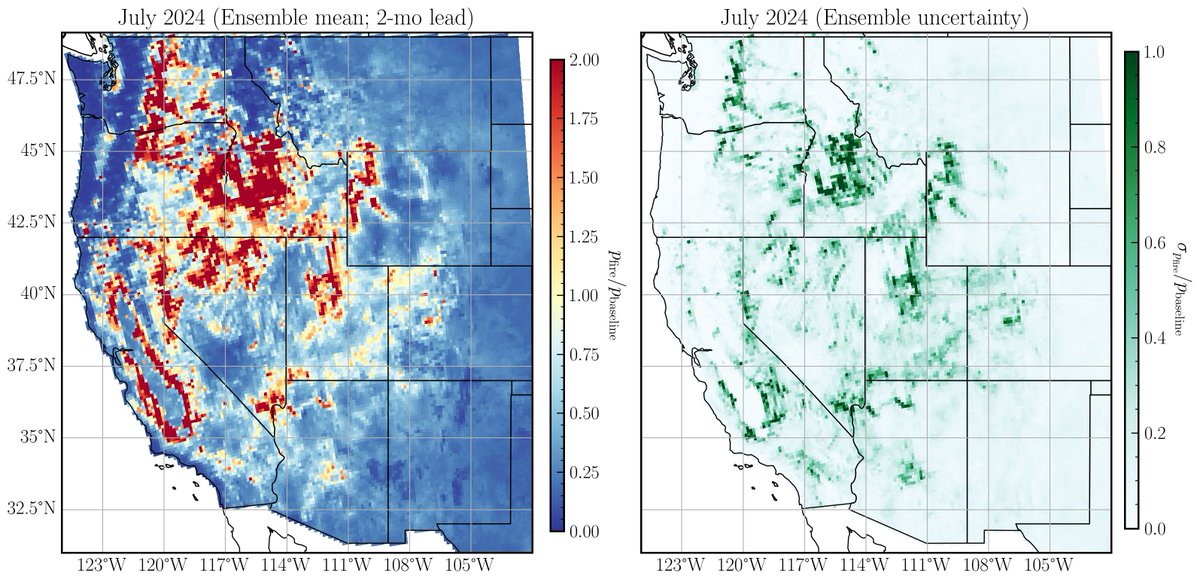
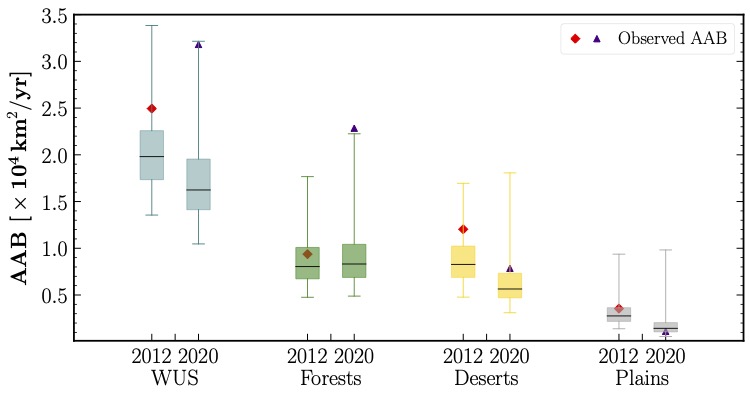
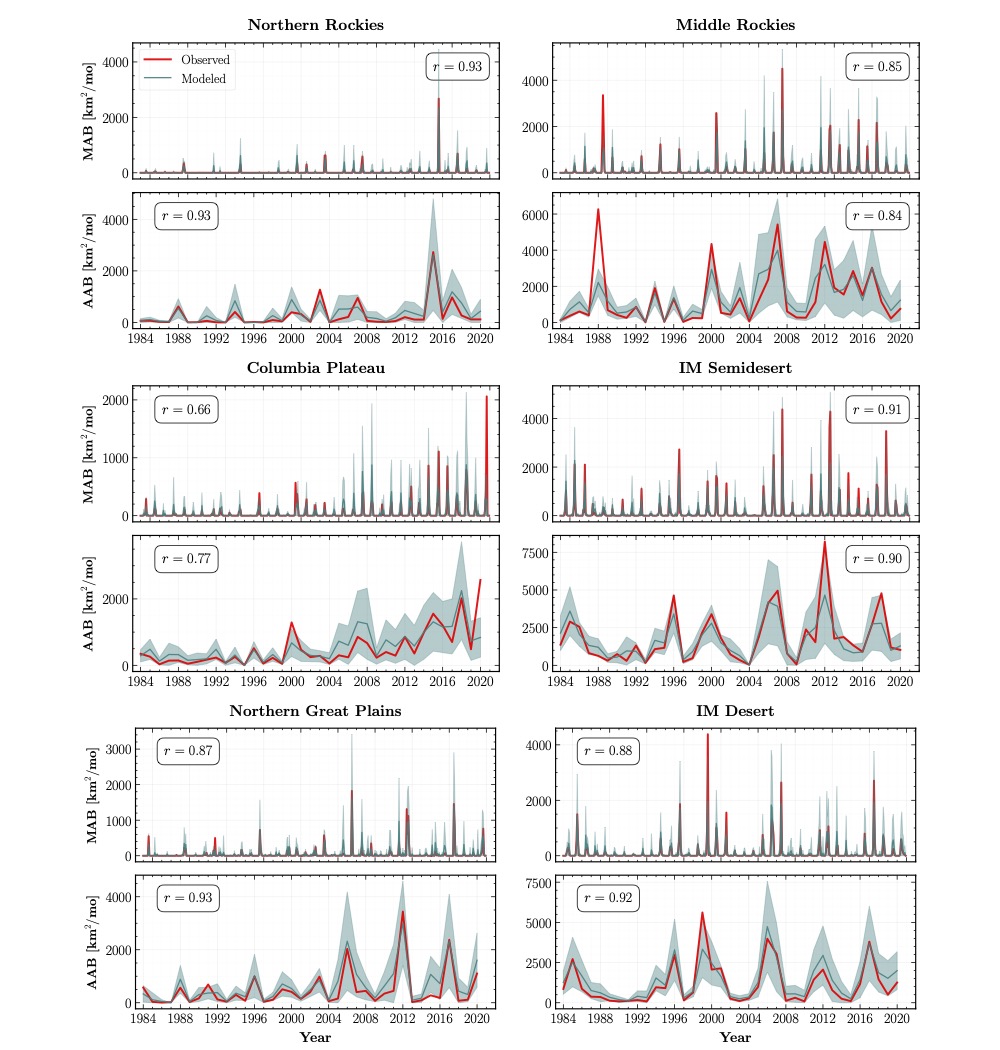
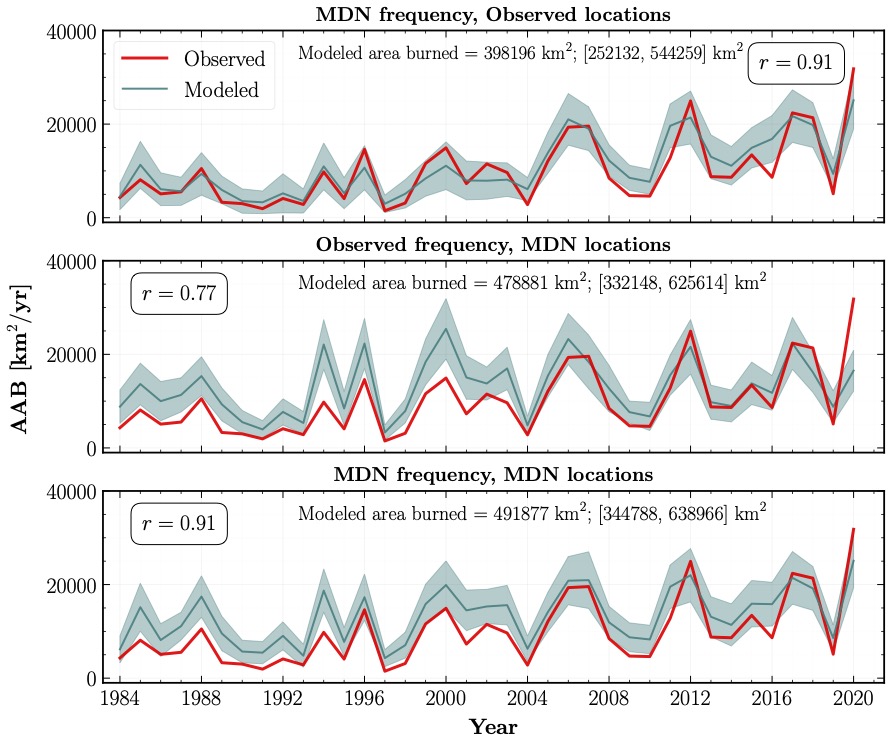
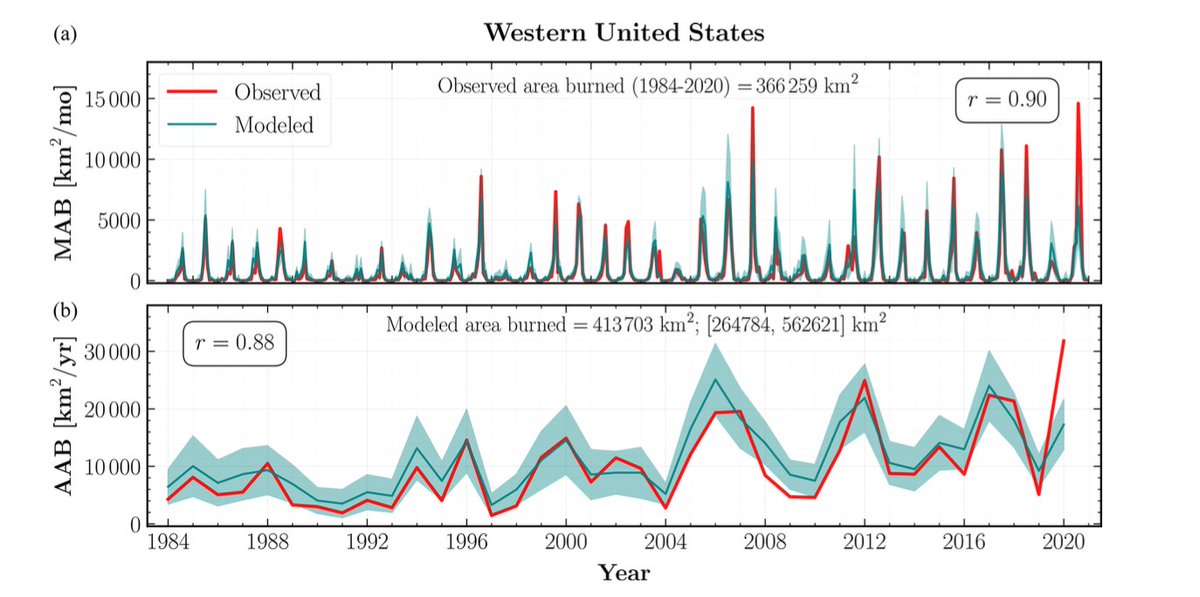
As the fire season intensifies over parts of the western United States, I wanted to share some results from ongoing work to improve seasonal and subseasonal-to-seasonal scale forecasts of wildfire frequency and burned area with machine learning. The model forecast for July 2024:
1
5
360
28 Jul 2024
4. Last, these forecasts are experimental in nature and should not be used in any decision-making.
1
150
28 Jul 2024
I should add that the spatial and temporal scales for these forecasts unfortunately do not quite capture the dynamics of rapidly growing wildfires such as the #ParkFire :
x.com/US_Stormwatch/status/1…
27 Jul 2024

The #ParkFire has grown to a mind-boggling 348,370 acres in less than 72 hours, becoming one of the fastest-growing wildfires in California history.
The fire has been spreading at an average pace of over 60 football fields per minute since it began.
807