
Cuenta oficial. Hagamos todo porque Colombia funcione lo mejor posible.
Joined April 2021
- Tweets 3,381
- Following 318
- Followers 87,077
- Likes 943
904 Photos and videos














Nos reunimos con María Claudia Lacouture de AMCHAM, para revalidar la alianza estratégica con el Banco de Bogotá para promover a la Pequeñas y Medianas Empresas, y llevar a cientos y ojalá miles de ellas a exportar, desde todos los departamentos de Colombia.
4
41
2,082
Los invito a oír esta conversación con Gustavo Gómez sobre cómo estamos y para dónde vamos
youtube.com/watch?v=gbX8nXW8…
14
48
3,403
Tuve la oportunidad de conocer de cerca el proyecto que desarrolla Sencia Bogotá, cuya visión es transformar el corazón de la ciudad en el gran hub de entretenimiento de la región.
Estamos ante uno de los proyectos de entretenimiento y experiencias más ambiciosos de América Latina, y probablemente uno de los mayores motores de desarrollo y renovación urbana que haya visto Colombia en su historia reciente.
No se trata solo de construir un estadio de clase mundial, sino de impulsar una transformación integral que redefinirá este sector de Bogotá y generará un impacto económico, social y cultural para toda la ciudad.
Y, además, Millos podrá estrenar nueva casa!! 💙⚽️
9
14
97
7,363
La economía es mucho más frágil de lo que la gente cree.
La riqueza no aparece sola, se construye todos los días.
Quizás por eso los economistas deberíamos parecernos menos a los ingenieros y más a los jardineros.
4
43
161
4,501
Juan Carlos Echeverry retweeted

#Elecciones | Un llamado al nuevo gobierno que sea elegido el próximo 21 de junio en la segunda vuelta presidencial, para que su prioridad sea arreglar las finanzas del Estado, hizo en #Cali el presidente del @BancodeBogota, @JCecheverryCol.
13
45
147
22,759
Vivir en México me ayudó a entender mejor a Colombia.
Los países no se desarrollan porque tengan recursos. Sino por gestionar una estrategia coherente de largo plazo.
Eso lo entendió México. En Colombia tenemos una oportunidad de oro para ver esa luz y seguirla.
2
18
78
3,022
La confianza toma tiempo. Se construye lentamente y puede perderse muy rápido.
Comparto algunas reflexiones sobre este desafío para el sistema financiero en una conversación reciente con El Tiempo. eltiempo.com/economia/sector…
2
2
12
1,450
Las organizaciones empiezan a deteriorarse cuando dejan de sentir el dolor de las personas a las que sirven.
1
4
13
1,515
La sostenibilidad dejó hace tiempo de ser únicamente una conversación ambiental.
5
1,186
Y para que eso ocurra, se necesita financiamiento.
1
1
15
2,098
Juan Carlos Echeverry retweeted

May 31
“El procedimiento del conteo en Colombia es manual, transparente, trazable y no hay ningún documento que no se publique. Por lo tanto, es perfectamente garantista”, aseguró desde Corferias Esteban González Pons, jefe de la MOE UE en Colombia. #LaElecciónEsColombia
79
2,905
8,788
252,339
Juan Carlos Echeverry retweeted

Alerta democrática Máxima ❗️El ataque sistemático del Presidente de la República del sistema electoral colombiano, y el proceso democrático amerita la intervención de garantes internacionales que le permitan a los ciudadanos llevar a cabo una elección en paz. En Colombia daremos nuestra lucha institucional para evitar tantos abusos e irregularidades, pero hace rato llegó el momento en el cual tenemos que pedirle a organismos internacionales que nos acompañen en esta defensa, para la cual podemos contar con inmensas limitaciones, en términos de su efectividad local.
56
1,813
4,136
51,672
Juan Carlos Echeverry retweeted

May 31
What a day in Colombia!
Congratulations to @ABDELAESPRIELLA for receiving the most votes.
The beauty of democracy was on full display as the people of Colombia exercised their power to chart their future, in their own hands, with their own voices.
As an observer, I’m truly humbled and filled with pride to have been invited and to have witnessed this historic election.
The strong partnership between the United States and Colombia remains vital, especially with the continued need for robust security cooperation in the face shared challenges.
Democracy won today, but the work isn’t done yet. There’s a runoff in three weeks, and, at the request of the CNE, I’ll be back to observe the final round.
446
2,575
8,880
204,350
Hay una diferencia importante entre hablar de inteligencia artificial y realmente transformar una organización con inteligencia artificial.
Porque al final, la tecnología por sí sola no transforma organizaciones.
Las transforman las personas que aprenden a usarla con criterio.
2
7
37
1,891
La incertidumbre nunca desaparece. Se debe aprender a metabolizarla. Cuando una familia decide comprar una casa, cuando un emprendedor evalúa abrir un negocio o cuando una empresa decide invertir, siempre hay incertidumbre.
Hay momentos históricos en los que esa sensación se multiplica. Este es uno de esos. Guerras comerciales, elecciones, tensiones geopolíticas, cambios tecnológicos acelerados están obligando a personas, empresas y países a replantear decisiones que antes parecían obvias.
La historia económica muestra que los períodos de mayor transformación suelen ser también de enorme incertidumbre.
El problema no es convivir con la incertidumbre. Sino evitar que nos paralice.
La incertidumbre hay que convertirla en un insumo para decidir. Las personas, las empresas y los países que avanzan son los que logran actuar aun cuando el panorama no está completamente resuelto.
Al final, crecer siempre implica apostar por el futuro. Una de las tareas más importantes es ayudar a que aprendamos a metabolizar la incertidumbre.
17
66
3,448
Juan Carlos Echeverry retweeted

#Atento I Banco de Bogotá anunció que la Corporación Financiera Internacional, entidad del Banco Mundial, otorgó un paquete de financiamiento en transición energética por US$150 millones. Juan Carlos Echeverry, presidente del Banco de Bogotá, aseguró que se busca integrar la sostenibilidad y el financiamiento
1
10
42
11,896
Juan Carlos Echeverry retweeted

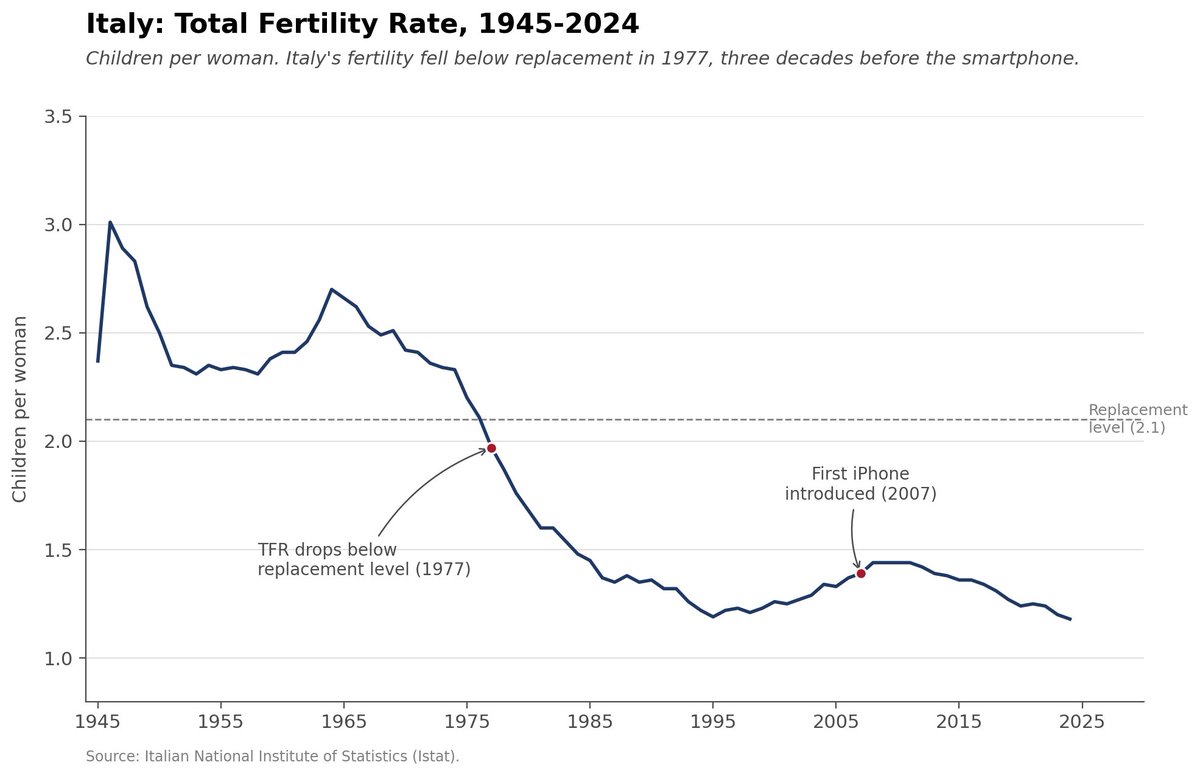
Smartphones are not the explanation for the recent decline in fertility. Instead, they are an accelerator of deeper forces already at work.
Let’s start with the facts. Fertility is falling almost everywhere: in rich, middle-income, and poor countries; in secular and religious countries; and in countries with high and low levels of gender equality.
The decline accelerated around 2014. So, no country-specific explanation will work unless you are willing to believe that 200 distinct country-specific explanations arrived at roughly the same time.
Smartphones look like the obvious candidate: the first iPhone was released in 2007, and global adoption has been astonishingly fast.
Economists understand the first major decline in fertility in advanced economies, from 6 or 7 children per woman throughout most of human history to about 1.8, that occurred between the early 1800s and roughly 1970, well before smartphones. The main drivers were a sharp fall in child mortality (effective fertility was rarely above 3 and often close to 2) and the shift from a low-skill, rural agrarian economy to a high-skill, urban industrial one. We have quantitative models that fit these facts well.
Country-specific factors mattered too, of course. Proximity to low-fertility neighbors accelerated Hungary’s decline, while fragmented landowning structures accelerated France’s. But these were second-order mechanisms.
This is also why most economists long considered Paul Ehrlich’s doom scenarios implausible. We forecast that fertility in middle- and low-income economies would follow the same path as in the rich, probably faster, because reductions in child mortality reached India or Africa at lower income levels (medical technology is nearly universal, and most gains come from handwashing and cheap antibiotics, not Mayo Clinic-level care). Much of what we see in Africa or parts of Latin America today is still that old story.
But in the 1980s, a new pattern appeared. Japan and Italy fell below 1.8, the level we had thought was the new floor. By 1990, Japan was at 1.54 and Italy at 1.36.
This second fertility decline began in Japan and Italy earlier than elsewhere, driven by country-specific factors, but the underlying dynamics were widespread: secularization, an education arms race, expensive housing, the dissolution of old social networks, and the shift to a service economy in which women’s bargaining power within the household is higher. The U.S. lagged because secularization came later, suburban housing remained relatively cheap, and African American fertility was still high. U.S. demographic patterns are exceptional and skew how academics (most of whom are in the U.S.) and the New York Times see the world.
My best guess is that, without smartphones, Italy’s 2025 fertility rate would be about 1.24 rather than 1.14. I doubt anyone will document an effect larger than 0.1-0.2. Italy was at 1.19 in 1995, not far from today’s 1.14. The TFR is cyclical due to tempo effects, so I do not read too much into the rise between 1995 and 2007 or the decline from 1.27 in 2019 to 1.14 today. The direct effect of smartphones is not zero, but it is not, by itself, that large.
Where social media, in general, and smartphones, in particular, matter is in the diffusion of social norms. What would have taken 25 years now happens in 10. Social media are not the cause of fertility decline; modernity is. But they are a very fast accelerator.
That is why social media are a major part of the story behind Guatemala (yes, Guatemala) going from 3.8 children per woman in 2005 to 1.9 in 2025. Without them, Guatemala would also have reached 1.9, just 20 years later.
Modernity, in its current form, is incompatible with replacement-level fertility. By modernity, I do not mean capitalism: fertility fell earlier and faster in socialist economies than in market economies. Socialist Hungary fell below replacement in 1960, and socialist Czechoslovakia in 1966 (both experienced small, short-lived baby booms in the mid-1970s). By modernity, I mean a society organized around rational, large-scale systems and formalized knowledge.
Countries will not converge to the same fertility rate. East Asia is likely stuck near 1, possibly below, given its unbalanced gender norms and toxic education systems. Latin America faces the same gender problem plus weak growth prospects, so I expect something around 1.2. Northern Europe has more egalitarian family structures and might hold near 1.5. The very religious societies are probably the only ones that will sustain 1.8.
All of this could change with AI or changes in population composition. We will see. But on the current evidence, deep sub-replacement fertility is the “new new normal.” Unless we reorganize our societies, better learn to handle it as best we can.
224
918
3,711
901,291