landholder. decentralized crypto c 2013. barbell investment strategy. me manage billions in CRE IRL. learn and share.
Joined February 2020
- Tweets 19,895
- Following 632
- Followers 426
- Likes 38,966
3,136 Photos and videos















Jun 4
Monero doing best among my crypto holdings. Overall brutal times. Clear to me that AI stole the show from crypto.
2
2
55
unbound 🐂 💩 retweeted

Jun 2
So-called age verification for social media is spreading across the world, framed as an effort to create a safer internet for children. In reality, age verification lays the foundation for a fully controlled internet.
The age verification rush must be slowed down, and politicians need to recognize the consequences of different types of legislation and systems.
Age verification is the wrong approach to fix “the social media problem”
The big tech social media companies are bad. Their business model is bad; it is based on mass surveillance and manipulation, and they cooperate with governments in mapping entire populations. But age verification is fundamentally the wrong approach to preventing children from using big tech social media platforms. Introducing age verification is based on coercion; the state forces social media companies to verify their users’ identities. But the big tech social media platforms already know which of their users are children. Their business model depends on knowing this. They know how old users are, and they know exactly what type of person they are. As age verification is based on coercion, politicians could instead force platforms to stop doing the things politicians consider harmful to children, or force them to block children (again, they know who they are) from using their services. But instead, politicians seek to massively invade everyone’s privacy and undermine democratic rights on a global scale. In other words, the latter is the real objective – they do not want to protect children; they want to impose control.
Slippery slope of age verification
It is undeniable that age verification threatens freedom of expression, risks increasing mass surveillance, and is likely to lead to censorship. It will not only shrink the online world and reduce young people’s right to privacy (for example, if VPN services were to be restricted); but also risks becoming a significant step toward a controlled internet for everyone.
Most age verification is identity verification
Most countries are now considering introducing age verification systems, meaning that everyone would have to identify themselves either to the service/website they want to use or to a third party capable of linking them to their activity on that service or website. This is not age verification but identity verification, and the consequence is therefore that freedom of information is restricted (you can no longer visit regulated websites anonymously) and that you can no longer post anonymously on social media. This is a major problem in countries like the UK and Germany where the police conduct raids on people’s homes for posting content on social media that the authorities dislike. Or in the United States, where authorities are trying to pressure tech companies into revealing the identities behind accounts protesting ICE. Social media identity verification removes important tools for activists in countries where criticizing those in power is dangerous.
Restrictions on app store or operating system level
Some countries are looking to impose identity verification at the app store level or even within the operating system itself. This is an exciting experiment, since this is possible to circumvent using open-source operating systems. Some countries are already looking to include open-source systems. Since open-source systems cannot be controlled, politicians would ultimately need to ban devices that are not controlled by the state. The end point: telescreens like those in Orwell’s 1984, devices that both monitor you and broadcast only the information approved by the state.
The Zero-Knowledge Proof (ZKP) alternative and the EU
The EU has presented its own age verification app as “completely anonymous”. The idea is to use Zero-Knowledge Proof (ZKP) cryptography to break the link between the age credential issuer (EU governments) and the regulated services/sites. Currently, the EU app does not have ZKP functionality, contrasting Ursula von der Leyen’s claim that the app ”is technically ready to be used”. But more importantly, the app is currently designed to always function without ZKP technology; if ZKP is unavailable, the app falls back to a non-ZKP model. Even if fully developed ZKP technology could be implemented in the future, it would remain an optional extra feature that countries may choose to disable and that the EU could remove at any time.
Read more on our site.
mullvad.net/blog/age-verific…
74
887
3,071
70,117
May 29
Mtg today w/ my AI team. Our CTO has a day job running AI for a multinational. Say job company can't even use the AI tools without getting approval from an EU based workers counsel proving that the tool won't replace jobs... EU companies are cooked.
2
33
unbound 🐂 💩 retweeted

May 27
This can never happen in Monero

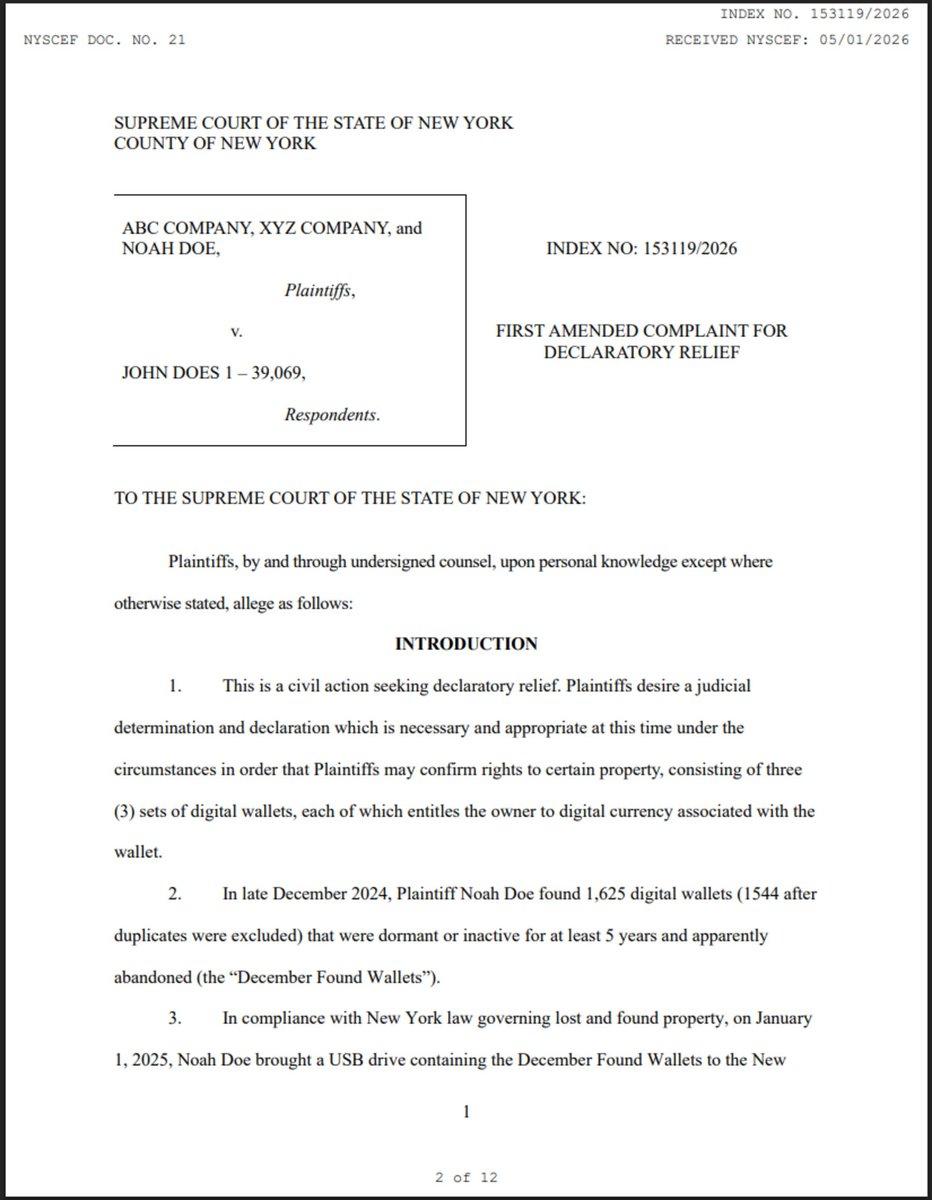
A Wyoming LLC filed a lawsuit in New York Supreme Court seeking ownership of 39,069 Bitcoin wallets it claims are abandoned property.
The plaintiff, operating under the pseudonym "Noah Doe," says he built an algorithm to identify dormant Bitcoin wallets that have been inactive for at least five to six years. He brought USB drives containing the wallet addresses to the NYPD's 17th Precinct, reporting them as found property under New York's lost-and-found law.
The complaint claims notices were sent to wallet owners via OP_RETURN blockchain messages, a public webpage, and a global press release. Owners were given 90 days to respond. Of the original 42,001 wallets flagged, 2,932 were removed after some showed on-chain activity. The remaining 39,069 wallets did not respond.
The plaintiff is now asking the court to declare him the legal owner of all 39,069 wallets and the Bitcoin inside them under New York Personal Property Law Article 7-B, which governs found and abandoned property.
The wallets reportedly hold approximately 3.8 million BTC. The complaint argues that losing a private key does not destroy the property interest in a wallet, likening dormant wallets to abandoned bank accounts.
The case names all 39,069 wallet holders as "John Doe" defendants. The plaintiff is not claiming to have the private keys to any of the wallets. He is seeking a court order declaring ownership.
The complaint was filed May 1, 2026 under Index No. 153119/2026.
h/t @DailyStackHQ
4
1
32
1,667
unbound 🐂 💩 retweeted

This.. this is my point
The governance process is wrong
Instead of arbitrary proposals being submitted. An RFP, RFI and RFQ process should be followed. With the scope of the feature to be announced and then responses voted on, with subsequent standard practices followed
May 21

Do you realize how impossible it is to provide feedback on 60 proposals ?
This system has to change
4
3
30
1,648
May 8
Selling to open on longer dated $USO puts. 15% below current price as an easy way to make some money when you think oil prices go up longer term.
1
1
289

SUI just had its 3rd DeFi hack in 30 days 🤯
Aftermath Finance just got drained for $1.14M
The bug? The SC let users set negative fees on perps so you could pay yourself to trade
This was handling 1 in 8 transactions on Sui
Protocol's now paused. Exploit season is here. 😕

Attention Aftermath community - We’ve identified an exploit affecting the protocol.
Our team is actively investigating alongside leading security partners. As a precaution, the protocol has been paused and measures are being taken to minimize potential impact to user funds.
We’ll continue to share updates as we learn more. Thank you for your patience.
30
25
144
18,773
unbound 🐂 💩 retweeted

Apr 27
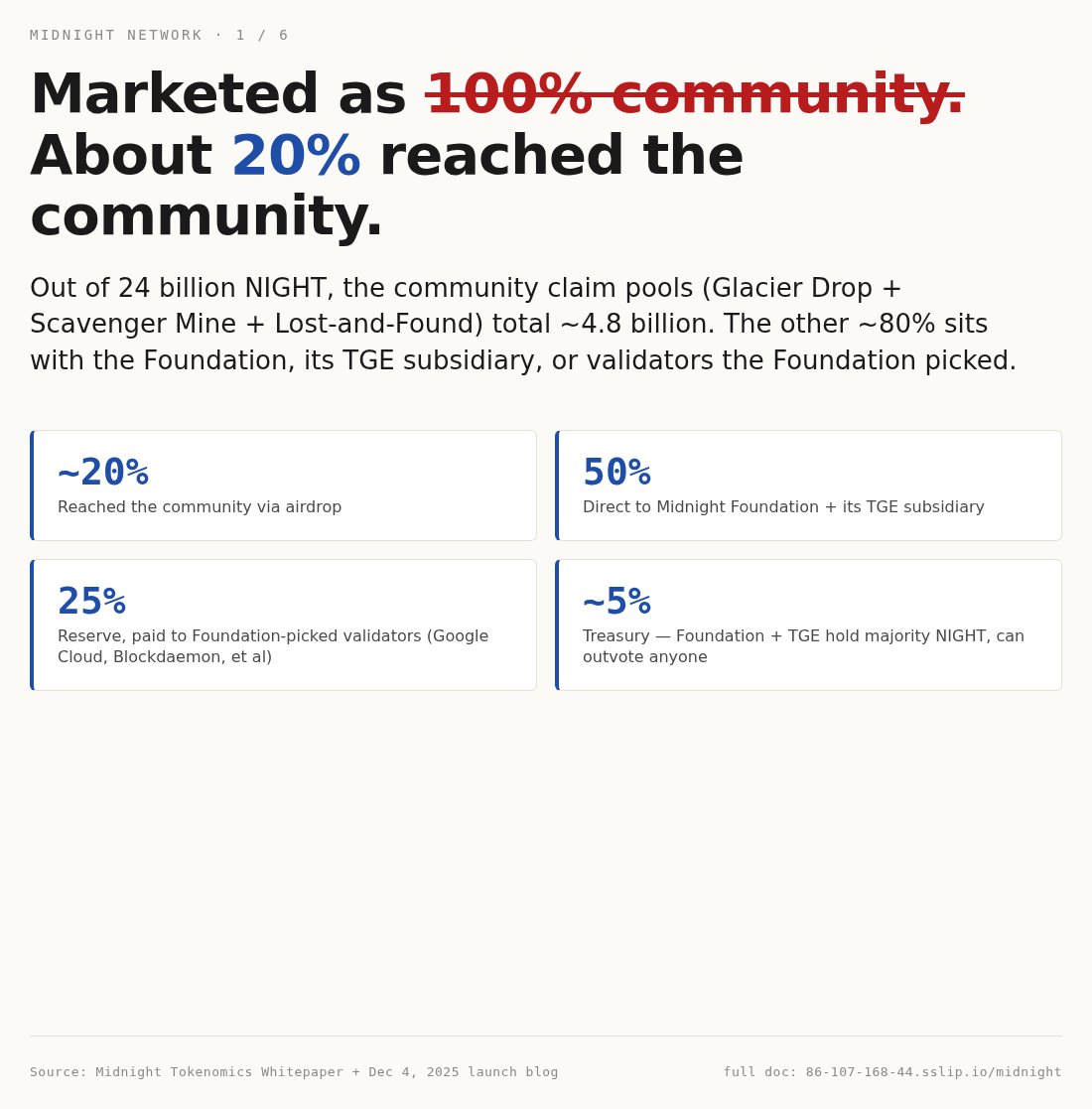
IOG mandate: "...mandate for Cardano focused on research, engineering, and the development of core infrastructure, aimed at advancing the network's scalability, security, and decentralized governance"
So why is IOG building against the ecosystem builders?
Fluid tokens and Sundial are under funded ecosystem builders, yet have produced more with limited funding - story for almost all ecosystem builders
@pogun_io is a commercial product. This is NOT IOG's mandate, so why is IOG involved in this proposal?
Let's have this discussion.
Apr 24
This a dig at IOG not Robert.
IOG's mandate is NOT products, spreading themselves thin is an IOG problem not a Cardano problem.
Stop building against your own ecosystem and start focusing on your mandate.

22
23
210
11,693

unbound 🐂 💩 retweeted

Apr 24
Hey Pete,
I'm sorry to hear about the personal attacks man, I really am. This has nothing to do with money for me though.
The reason I posted this is because It's really frustrating to see people ask legitimate questions and because they don't align with Chuck, he simply extinguishes their flame in the ecosystem.
To me, governance is not decentralized when the dreps voting on giving money away are also ambassadors for the company or companies under their umbrella, which are asking for the money.
The incentive lies in voting in favor of said company. I don't understand how that is so hard to see.
Last time, Chuck threatened to leave and gave an ultimatum. This time he simply unleashed his dogs on Iagon for a few months and then trashed them publicly.
You put out a lot of content on all things Cardano and I don't think you should stop, you are an under appreciated asset.
Everyone's moral compass is theirs to use as they wish. You have the right to participate. If I was in this position as an ambassador, incentivized by the people asking for money. I would simply abstain.
7
4
61
3,796
Apr 25
Anarchic systems evolve and there is no Treasury to loot.
Apr 24

The Monero Research Lab has provided an update on post-quantum encryption for Monero!
1
68
unbound 🐂 💩 retweeted
Apr 24
I expect nothing less from you.
Whale was right
42
31
469
32,592
unbound 🐂 💩 retweeted

IOG got 2.46 BILLION ADA at genesis
9 years later, still asking treasury for ~$47M in 2026
That war chest should’ve delivered a finished product by now - especially with AI supercharging efficiency
Where is the incentive to finish when jobs depend on never finishing?
15
17
117
6,469
Apr 23
I've been building agents all year. Just sold an ai based service to a massive public company. Everything may end in a few years, but right now it's fucking amazing.
98
unbound 🐂 💩 retweeted

Apr 19
"Why should I care about privacy? I have nothing to hide".
We hear it every week.
Today, the company that builds software for law enforcement by mining your medical records just published a 22-point manifesto about "freedom" and "democracy".
This is why you should care.
Apr 18

Because we get asked a lot.
The Technological Republic, in brief.
1. Silicon Valley owes a moral debt to the country that made its rise possible. The engineering elite of Silicon Valley has an affirmative obligation to participate in the defense of the nation.
2. We must rebel against the tyranny of the apps. Is the iPhone our greatest creative if not crowning achievement as a civilization? The object has changed our lives, but it may also now be limiting and constraining our sense of the possible.
3. Free email is not enough. The decadence of a culture or civilization, and indeed its ruling class, will be forgiven only if that culture is capable of delivering economic growth and security for the public.
4. The limits of soft power, of soaring rhetoric alone, have been exposed. The ability of free and democratic societies to prevail requires something more than moral appeal. It requires hard power, and hard power in this century will be built on software.
5. The question is not whether A.I. weapons will be built; it is who will build them and for what purpose. Our adversaries will not pause to indulge in theatrical debates about the merits of developing technologies with critical military and national security applications. They will proceed.
6. National service should be a universal duty. We should, as a society, seriously consider moving away from an all-volunteer force and only fight the next war if everyone shares in the risk and the cost.
7. If a U.S. Marine asks for a better rifle, we should build it; and the same goes for software. We should as a country be capable of continuing a debate about the appropriateness of military action abroad while remaining unflinching in our commitment to those we have asked to step into harm’s way.
8. Public servants need not be our priests. Any business that compensated its employees in the way that the federal government compensates public servants would struggle to survive.
9. We should show far more grace towards those who have subjected themselves to public life. The eradication of any space for forgiveness—a jettisoning of any tolerance for the complexities and contradictions of the human psyche—may leave us with a cast of characters at the helm we will grow to regret.
10. The psychologization of modern politics is leading us astray. Those who look to the political arena to nourish their soul and sense of self, who rely too heavily on their internal life finding expression in people they may never meet, will be left disappointed.
11. Our society has grown too eager to hasten, and is often gleeful at, the demise of its enemies. The vanquishing of an opponent is a moment to pause, not rejoice.
12. The atomic age is ending. One age of deterrence, the atomic age, is ending, and a new era of deterrence built on A.I. is set to begin.
13. No other country in the history of the world has advanced progressive values more than this one. The United States is far from perfect. But it is easy to forget how much more opportunity exists in this country for those who are not hereditary elites than in any other nation on the planet.
14. American power has made possible an extraordinarily long peace. Too many have forgotten or perhaps take for granted that nearly a century of some version of peace has prevailed in the world without a great power military conflict. At least three generations — billions of people and their children and now grandchildren — have never known a world war.
15. The postwar neutering of Germany and Japan must be undone. The defanging of Germany was an overcorrection for which Europe is now paying a heavy price. A similar and highly theatrical commitment to Japanese pacifism will, if maintained, also threaten to shift the balance of power in Asia.
16. We should applaud those who attempt to build where the market has failed to act. The culture almost snickers at Musk’s interest in grand narrative, as if billionaires ought to simply stay in their lane of enriching themselves . . . . Any curiosity or genuine interest in the value of what he has created is essentially dismissed, or perhaps lurks from beneath a thinly veiled scorn.
17. Silicon Valley must play a role in addressing violent crime. Many politicians across the United States have essentially shrugged when it comes to violent crime, abandoning any serious efforts to address the problem or take on any risk with their constituencies or donors in coming up with solutions and experiments in what should be a desperate bid to save lives.
18. The ruthless exposure of the private lives of public figures drives far too much talent away from government service. The public arena—and the shallow and petty assaults against those who dare to do something other than enrich themselves—has become so unforgiving that the republic is left with a significant roster of ineffectual, empty vessels whose ambition one would forgive if there were any genuine belief structure lurking within.
19. The caution in public life that we unwittingly encourage is corrosive. Those who say nothing wrong often say nothing much at all.
20. The pervasive intolerance of religious belief in certain circles must be resisted. The elite’s intolerance of religious belief is perhaps one of the most telling signs that its political project constitutes a less open intellectual movement than many within it would claim.
21. Some cultures have produced vital advances; others remain dysfunctional and regressive. All cultures are now equal. Criticism and value judgments are forbidden. Yet this new dogma glosses over the fact that certain cultures and indeed subcultures . . . have produced wonders. Others have proven middling, and worse, regressive and harmful.
22. We must resist the shallow temptation of a vacant and hollow pluralism. We, in America and more broadly the West, have for the past half century resisted defining national cultures in the name of inclusivity. But inclusion into what?
Excerpts from the #1 New York Times Bestseller The Technological Republic: Hard Power, Soft Belief, and the Future of the West, by Alexander C. Karp & Nicholas W. Zamiska
techrepublicbook.com
95
2,609
15,297
338,691
