
Joined April 2011
- Tweets 23,309
- Following 1,929
- Followers 8,022
- Likes 48,728
2,551 Photos and videos









Jacob Brown retweeted

Jun 11
"When it comes to finding out what the market wants we kind of set our own tone." @Bitcoin_phan
1
2
147

Jun 11
One of my top performing interviews on YouTube.
People are curious about securing their Bitcoin & keeping their AI agent in check.
youtu.be/Cf05gZmAE5U
1
1
199
Jun 11
10 days into having my little girl. 👼
Best thing ever.
19
57
1,829
Jacob Brown retweeted

Jun 10
we live in age of great moral panics about things that don’t matter and zero moral outrage over some of the most egregious societal sins we’ve ever seen
176
10,994
59,690
851,481
Jun 9
Sad to hear. Botanix was a really unique take on a Bitcoin sidechain.
Props to @WillemSchroe and the team for the A attempt.
Jun 9

It is with a heavy heart that we announce we are winding down the Botanix network.
This decision is the hardest one we have made in four years, and we want to share the reasoning openly because the people who backed us, built with us, and used what we shipped deserve more than a quiet shutdown notice.
First off, an immediate practical consideration for the Botanix community: please withdraw your Bitcoin and other assets before July 9th, 2026.
When we started in 2022, the pitch was simple enough to say in a sentence: bring real utility to Bitcoin. What that actually meant in practice, and what we have spent nearly four years building toward, was more ambitious than that sentence made it sound. We were trying to build a Bitcoin-based blockchain that could find genuine product-market fit as a platform for Bitcoin applications, without using token incentives to drive growth, manufacture users, or simulate utility. Almost every chain that has launched in the last cycle has reached for the same playbook (issue a token without PMF, engineer the incentive surface, point at the resulting metrics), and we did not believe this route is a viable strategy in the long term. We wanted to know whether a Bitcoin chain could earn its users on the strength of what was built on top of it, the value it brings in the market with Bitcoin itself as the only meaningful economic primitive in the system.
And we built it. The Spiderchain went live and stayed live, a year of mainnet operation with one hundred percent uptime and zero security incidents on a genuinely novel cryptographic architecture. We built Dynafed, a dynamic federation that turned the Spiderchain from a static multisig set into a rotating, decentralized one, the technical milestone that most people in this space said could not be built on Bitcoin without compromising trust assumptions. Twenty-five million transactions, two hundred thousand wallets, and tens of millions of dollars in assets moved across the chain, every single number of that earned organically without a token, without airdrops, without points programs, or any of the manufactured-demand machinery. Chainlink, Morpho, GMX, Dolomite, Fireblocks, Alchemy, Galaxy, OKX Wallet, all integrated. We shipped a Bitcoin neobank with BINK on iOS and Android, with self-custodial email login for Bitcoin (something that had never existed before), native Bitcoin yield, and the lowest borrowing rates against Bitcoin anywhere in the world, all of it downstream of owning the infrastructure. The point of saying this is not to argue with our own conclusion. The protocol works, the product works, and our team and ecosystem worked in concert to do exceptional work.
We have run this experiment in earnest, with a working protocol, real applications, and a serious team, for over a year on mainnet and nearly four years in total. The honest answer we have arrived at, after living inside it every day, is that it did not work, at least not in this market and not on this timeline.
We want to share what we think we learned, with the caveat that some of this is conviction and some of this is still suspicion, and we would rather be transparent about the difference than pretend to have clarity we do not have.
The first thing I've had to sit with is timing. Bitcoin utility, making Bitcoin programmable, productive, and integrated into real financial activity, isn't where the real world users sit right now. The conversation is still on Bitcoin as a reserve asset, on its monetary and political positioning, on base-layer conservatism. Those questions are upstream of the ones a Bitcoin L2 needs people to be asking. I still believe Bitcoin gets there, but belief in the destination is not the same as being able to predict when, and nobody can. It's also possible the destination never materialises at all, and that Bitcoin's role as a reserve asset is simply where it settles. If that's true, there will never be a market for what we were building, and no amount of time or capital would change that.
The second is the token question. We intended to eventually launch a token. We saw it, and still see it, as a genuinely new form of equity, something closer to an IPO than an airdrop, to be done when you reach product market fit and the moment is right. That moment never came. What became clear over the last year is that the market largely stopped rewarding even the more considered versions of that playbook. Token launches across the board have broadly underperformed, and those that did go to market with tokens haven't seen the outcomes or PMF that the model is supposed to produce.
The third lesson is about where DeFi demand on Bitcoin actually lives. For most use cases that exist today, lending, yield, leveraged exposure, WBTC on a mature general-purpose L2 is genuinely sufficient. Users have voted with their behaviour, and the verdict is that the trust assumptions of a wrapped representation on Ethereum are acceptable to almost everyone who wants Bitcoin-denominated DeFi. Decentralisation matters to people in principle and in conversation; in practice, when something cheaper and easier is in front of them, they use it. The security case for a dedicated Bitcoin L2 is real, but it only matters for a narrower band of applications than our thesis required, one of the clearer lessons this market has taught us.
The fourth lesson is structural. The on-chain economy is consolidating around venues that own the user relationship: Hyperliquid, Robinhood, the major CEXes, and now TradFi participants absorbing an ever-larger share of attention, flow, and revenue. Convenience and institutional credibility win, every time, as soon as they're available. As retail participation thins, that concentration only deepens. We were, and still are, believers in decentralisation, but the current direction of on-chain growth is running through distribution, and any team building base-layer infrastructure today is rowing upstream against that current. We were no exception.
The fifth lesson is the most concrete. Both of the above played out directly in our economics. The users we attracted were primarily using Bitcoin as a store of value for yield, a legitimate use case, but not the high-frequency transaction volume that drives fee revenue on a network like ours. BINK was our answer to that: a Bitcoin neobank designed to bring daily usage of BTC and stablecoins on-chain, driving the transaction volume the network needed. It was the right strategic instinct, and one we never got the chance to fully test. BINK only landed on both app stores in the last few weeks, a product that by its nature could only be built once the underlying infrastructure was proven and live. When users choose the convenient option and economic gravity pulls toward distribution, what's left on a decentralised infrastructure layer is a user base that costs more to serve than it generates. Infrastructure costs are what they are, and the fee income never came close to covering them.
If you would like to see how we were imagining a Bitcoin future and what we have been working on since September, feel free to download BINK and give it a spin: it’s a full-fledged self-custodial Bitcoin Neobank with email login, one click borrowing, a Lightning integration and more.
App store: apps.apple.com/us/app/bink-b…
Play store: play.google.com/store/apps/d…
This UX is where we think Bitcoin is ultimately heading towards although it feels too early. You can use invite code 1SD31R, but remember to remove your funds by July 9th.
We could keep going. We have chosen not to, however, because continuing past the point where additional time stops producing additional learning is not conviction, it is something that looks like conviction from the outside while corroding into something else on the inside. We would rather stop now, with integrity intact and resources available to take care of the people who took a chance on us, than push the experiment past the point where it still has something to teach us.
Reminder: Please withdraw all your assets by July 9th. After this, the federation will sweep the remaining Bitcoin. Any other assets or tokens on the network from then onwards will unfortunately be unrecoverable.
After this, the federation will sweep the remaining Bitcoin. Any other assets or tokens on the network from then onwards will unfortunately be unrecoverable.
To our investors, who backed a thesis that was harder to defend than it should have been, to our partners who built alongside us and bet pieces of their own roadmaps on ours, to the developers who deployed on Spiderchain, to our users and the BINK community who showed up for something experimental and stayed, and most of all to the Botanix team who shipped a genuinely novel system with rigour and care and who made every hard day worth the difficulty: Thank you, more than the words available here can carry.
2
14
2,116
Jun 9
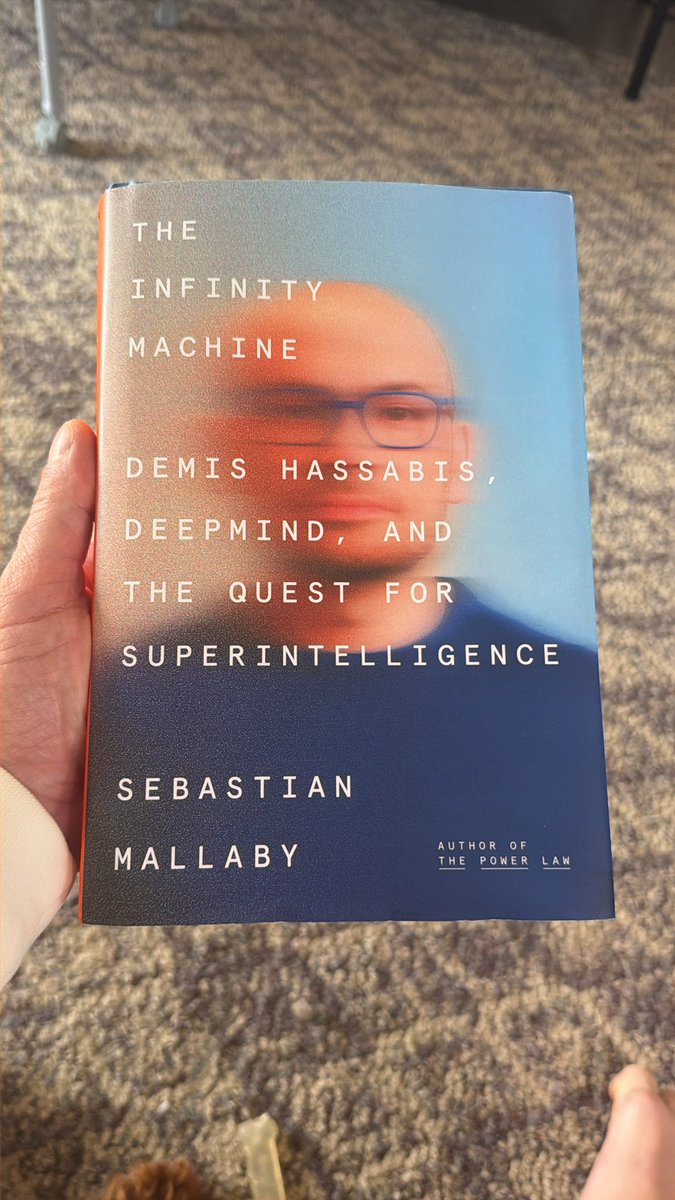
Fantastic read. Great ending comparing classical computers and quantum.
Another book on the shelf.
@scmallaby @demishassabis
2
178
Jun 9
Not tempted by Claude Fable 5 at all.
- How many prompts you get before you hit your limit on $20 plan?
- included in your subscription until June 22nd, then API pricing. lol. 🤦♂️
- $10 input/ $50 output pricing
Claude serves great extremely fat models that they suck at scaling.
I’ll stick with my $20 chatGPT and Gemini plans. Thanks.
8
8
1,686
Jacob Brown retweeted
Jun 1
🚨LATEST POD: A Hardware Device to Secure your Bitcoin & your AI Agent
I sat down with @zherbert - CEO of @FOUNDATIONdvcs who just released the Passport Prime.
We discuss why sovereign security is essential in the AI age, why “human in the loop” is mostly theater, and how to create your own security apps.
Watch now: 👇
youtu.be/Cf05gZmAE5U
1
6
14
2,994
Jacob Brown retweeted
What criteria does @BitcoinMagazine use when selecting projects to speak?
🎙️ @Bitcoin_phan
1
1
96
Jun 4
Reacting to the Stacks money printer / yield proposal.
Jun 4

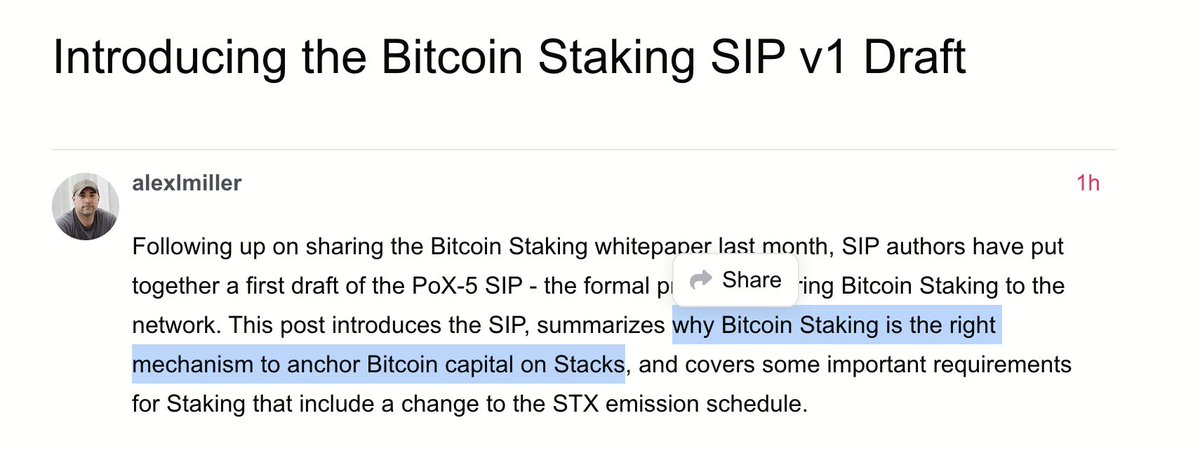
The PoX-5 SIP is here. The first draft that brings Bitcoin Staking to Stacks is on the forum👇
8
7
37
3,754

I was talking with an old friend at dinner last night, he described gpt fatigue
I'd examined the whole psychosis thing, but fatigue is different, and this one rings with me. I've been through cycles of this; I'm probably just emerging from my third epoch of gpt fatigue right now
it's very bittersweet. the cognitive overhead of context switching across the slop troughs is not as fun as the in-the-zone coding rhythm I enjoyed for the first twelve years of my career
I drew the connection to the Reactor Harness I'd been working on and he lit up (yes, this is a launch post, read on). I told him the basic idea:
In the same way that React (js) keeps the DOM up to date by rendering declared components efficiently based on upstream events...
the Reactor Harness keeps an ideal world-model up to date by rendering declared facets of the world-model efficiently based on upstream events.
This world-model can be anything--formally it's a faceted content addressable blob. In practice, it can be a file, a directory, a sqlite table, etc.
If you've followed OpenProse since the beginning, you'll guess that the render function is not deterministic byte code, but instead is declarative markdown instructions fulfilled by an agent session.
I'm releasing the harness here in beta today. It ships as an SDK so you can plug it into your own projects. We've built an experimental CLI w/ a lightweight server and a devtools package alongside it. Please give it a boost with a Github Star here, then return to read more:
github.com/openprose/prose
The Reactor Harness is built to run OpenProse, and its design was uniquely informed by the tenets behind OpenProse, such that you can declare your ideal world-model using familiar structured markdown, and you can optionally write imperative fulfillment plans in our original ProseScript.
One way of thinking about the Reactor is as a DAG of agent sessions. Every node in the DAG is an agent session tasked with keeping facets of the world model up to date. These are memoized, such that downstream dependent sessions only get re-run when their upstream counterparts change.
Over the coming days, I'll be writing more about the harness, how we've been using it, and where I hope we can take this. We are in the process of running benchmarks on it. The goal is that the SDK API itself remains relatively stable while we improve the agent session fulfillment cost, speed, and intelligence under the hood.
How did we get here?
Today I keep a large share of our company's operations in a directory: tenets, specs, code, analytics, our burn model, our sales lead enrichment CRM.
And I find myself having to manually "fast-forward" these models, dropping into context to proactively tell Claude Code to update a spec, add someone to the CRM, or update the financial model based on real-world events that have changed our plans.
I'd written many OpenProse scripts to accomplish these things, but I found I wanted this all to run reactively, as an ongoing time-invariant responsibility, rather than proactively as a tool that I continuously return to. Our first attempt at solving this was putting our OpenProse programs on a cron. The problem with that was that it became very expensive very fast.
As I started trying to design the OpenProse to work under these constraints, I found myself introducing concepts like memoization to different facets of the maintained state. From there, I decided not reinvent the wheel and to graft the patterns from React more explicitly. It's an analogy, and the analogy breaks down in some places. But it's a reasonable starting point that a lot of people are familiar with.
We built the first version in April internally on our hosted service for one of our customers' needs, but I decided that the core of this is interesting enough that it deserves to be in the public sphere, so we spent the intervening six weeks ripping it out and redesigning it as an SDK so people could plug it into their own stacks.
I can't emphasize enough how there's nothing new here, we're just applying classical engineering paradigms to our brave new world. We're finding that despite our topsy-turvy reality, the wisdom of the ancients holds fast.
The Reactor harness is young, should be used with caution, and has some way to go before it reaches it's ideal form. My ask is that you try it, wire it up to something useful, love it or hate it, and send me honest feedback about your experience. We're always listening and improving.
I have a particularly exciting end goal in mind: because the Reactor DAG is itself a world-model, downstream from events in the real world (say, learned event source/frequency/distribution), you could use Reactor itself to implement dynamic Reactor DAGs. This sets us on the path to a true RLM paradigm. I'm most excited about this because I hypothesize that it will yield a simple, elegant property of the Reactor:
Inference cost for maintaining a world-model scales with surprise, rather than wall-clock time.
It's not there yet, but my expectation is that this is achievable and that it's just a matter of walking up the ladder to get there. In my experience when you make something self-referential too early it can collapse back in on itself, so we're going to step our way there incrementally.
When we do get there, my hope is that the meta Reactor DAG can continuously self-calibrate on event source/frequency/distribution to optimize for efficient fulfillment Reactor DAGs, and where the cost of keeping the world-model up to date approaches only the surprise of upstream events in the real world.
At dinner last night, a recurring topic was this love-hate relationship we'd developed with the models. I've been building harnesses for these burgeoning minds since my GPT-2 finetune in 2020. In many ways I'm having as much fun as I've ever had with technology. And yet I've come to loathe their impacts in many other regards.
In the end, I guess the real goal is that the Reactor Harness lets me unburden the cognitive load at the root of my gpt fatigue, and frees me up for the more interesting forms of gpt psychosis :D
thanks for reading and following along, star the repo here and give it a try:
github.com/openprose/prose
15
10
128
9,284
Jacob Brown retweeted

Jun 2
Bitcoin yield is splitting into a few distinct markets:
1. BTC-paid income (trading activity)
2. token-paid incentives (emissions)
3. volatility-driven vault returns (market making)
4. treasury-company BTC-per-share accretion (securities)
5. managed fund / structured product exposure
Which one do you find most interesting?
1
4
329
Jun 2
In science, if you know what you are doing, you should not be doing it.
In engineering, if you do not know what you are doing, you should not be doing it.
1
1
230
Jacob Brown retweeted

Sovereign security in the age of AI
Jun 1

🚨LATEST POD: A Hardware Device to Secure your Bitcoin & your AI Agent
I sat down with @zherbert - CEO of @FOUNDATIONdvcs who just released the Passport Prime.
We discuss why sovereign security is essential in the AI age, why “human in the loop” is mostly theater, and how to create your own security apps.
Watch now: 👇
youtu.be/Cf05gZmAE5U
11
1
23
671
May 30
"Yield is a lie" and "deploy your whole stack into a 20% vault" are both lazy.
The work lives in between, reading bitcoinyield.com
Happy Saturday
May 30

A simple way to hold two competing Bitcoin yield ideas at once:
If you're content with Bitcoin's CAGR, sit in cold storage and sleep well. That's a legitimate, high-performing strategy.
If you want yield, carve out frontier capital — a slice you can afford to have at risk — and go learn the protocols with it. Start small. Understand the slash conditions, the redemption paths, the actual source of the return.
"Yield is a lie" and "deploy your whole stack into a 20% vault" are both lazy. The work lives in between, reading bitcoinyield.com bitcoinyield.com.
7
333
May 30
Start listening at 26:50.
@bgurley gives a fascinating take on why Anthropic is so doomerist around the AI and humans.
Hint: They believe they are birthing a new species.
youtu.be/4oq91rzQcO8?si=EJ-7…
1
1
853
May 30
Honestly. Makes some sense, and makes me way more skeptical of some tech founders if true.
351