
Joined May 2009
- Tweets 682
- Following 966
- Followers 399
- Likes 1,751
119 Photos and videos






Pinned Tweet

Apr 3
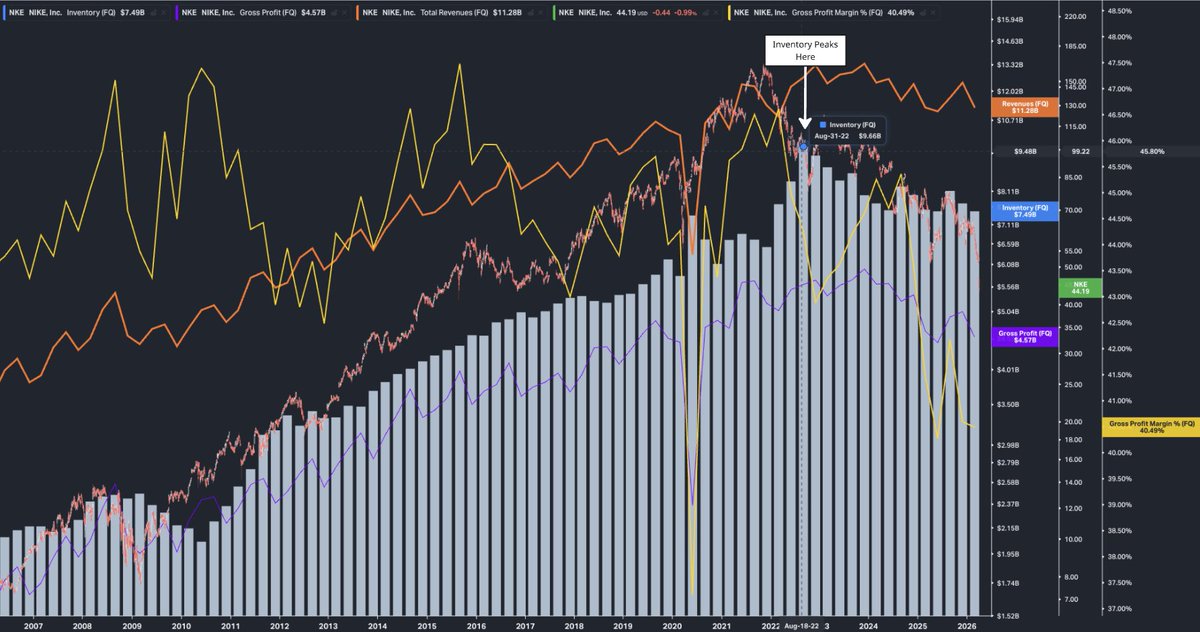
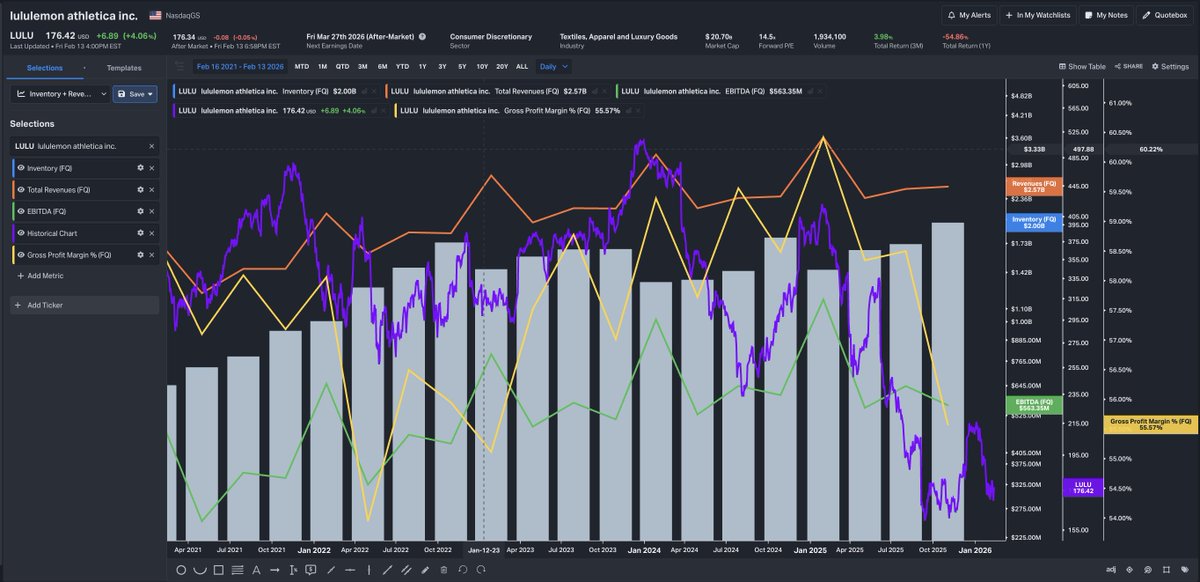
The only thing that seems obvious to me is this: if you want to grow an inventory-driven business, you have to grow inventory. And if you want to grow inventory, you have to keep shipping more products that people actually want.
What I see in this chart is the opposite. Nike has less and less inventory on hand, while at the same time charging less for that smaller inventory position. That is a brutal combination. You are offering less breadth, at lower prices, with less reason for the customer to keep coming back.
And when I say grow inventory, I do not mean just go deeper on the same products. I mean broaden the inventory position. More products, more winners, more reasons for demand to show up. Breadth matters. If you do not keep expanding the set of things customers want to buy, the whole machine starts slowing down.
At the same time, their retail footprint is clearly being reduced. Fewer storefronts, less shelf space, less physical presence. The only real way to offset that is to sell more online. And they are clearly not doing that either.
To me, all these retail businesses that are slowly dying seem to get distracted by everything except the actual equation. The equation is still price, inventory, and the advertising required to create throughput through the machine. That is true whether you are doing $1,000 a day or $100 million a day. It is the same math.
You can literally see in this graph where inventory peaks and then starts rolling over. If you do not grow inventory, you die. It really is that simple.
Apr 3

Nike wiped out $200B in market cap since November 2021. And the chart actually understates how bad it is.
This company made one bet that destroyed everything: the direct-to-consumer pivot. During COVID, Nike's online sales surged, and management convinced themselves the stay-at-home economy was permanent. They pulled product from Foot Locker, Dick's, and thousands of wholesale partners to push buyers through Nike.com and Nike stores.
That ceded physical shelf space to On Running, Hoka, New Balance, and every competitor happy to fill the void. By the time Nike brought Elliott Hill in as CEO, customers had already moved on.
The China numbers are staggering. Seven straight quarters of declining revenue. Greater China sales dropped 17% last quarter. Next quarter Nike expects a 20% plunge. Meanwhile Lululemon is posting double-digit growth in the same market. Anta and Li-Ning are eating Nike's share from below. Nike's China revenue contribution fell from 18.6% in 2021 to 14.2% in 2025.
Yesterday Goldman Sachs, JPMorgan, and Bank of America all downgraded the stock on the same day. Net income fell 35% year over year. Gross margin has declined for seven consecutive quarters. And the stock still trades at 38x forward earnings, a premium over the S&P 500 average of 22x.
This is what a slow-motion brand collapse looks like with a luxury multiple attached to it. The turnaround keeps getting pushed further out. Management promised growth by early 2027. Wall Street priced that in. Now it's late 2027 at best.
The scariest part: Nike is still the #1 sportswear company by market cap. If this is what #1 looks like, the rest of the industry is running a different race entirely.
2
2
15
6,095
James Tyler retweeted
Apr 4
I get what you’re saying, but I think seasonality is more of a product engineering and pricing problem than a law of nature.
To me, a business fights seasonality in two ways.
One, it grows fast enough that even its off-season periods keep compounding in absolute terms. Two, it engineers enough product breadth that there is always something relevant to sell during the so-called off-season.
Take a winter-heavy brand as an example. If the business is growing fast enough (in product breadth and velocity of advertising), its summer volume can still exceed what prior periods looked like simply because the company itself is compounding quickly. And if summer is still weak, that usually points to a product breadth problem. In other words, the brand has not engineered enough throughput-driving product for the off-season.
That is why I see seasonality as a product engineering problem more than anything else. If you sell disproportionately more in winter than summer, then you need to figure out what product(s) can carry demand during summer rather than treating the calendar as an excuse.
Then layer on pricing. If you are a winter-heavy brand, your winter goods should still be dynamically priced in summer at the willingness-to-pay level that lets them move at the pace you want, instead of just accepting lower demand as fate.
And if you layer in pre-order, that becomes another lever. You can let customers buy the in-season good at a discount during the off-season for future delivery, which helps pull demand forward, drive ancillary revenue, smooth throughput, and keep the business in more of a steady state rather than letting the calendar fully dictate the shape of demand.
So to me this comes down to price, product, and inventory management. If you are growing fast enough and you engineer product breadth well enough, there is no reason you cannot grow at the pace of market growth (or faster) every single month. I have a hard time imagining a situation where you cannot engineer your way out of this through dynamic pricing, better product breadth, and near-perfect inventory management.
This playbook has worked 100% of the time we've instituted it at the biggest scales in DTC.
1
1
4
116
Apr 3
The only thing that seems obvious to me is this: if you want to grow an inventory-driven business, you have to grow inventory. And if you want to grow inventory, you have to keep shipping more products that people actually want.
What I see in this chart is the opposite. Nike has less and less inventory on hand, while at the same time charging less for that smaller inventory position. That is a brutal combination. You are offering less breadth, at lower prices, with less reason for the customer to keep coming back.
And when I say grow inventory, I do not mean just go deeper on the same products. I mean broaden the inventory position. More products, more winners, more reasons for demand to show up. Breadth matters. If you do not keep expanding the set of things customers want to buy, the whole machine starts slowing down.
At the same time, their retail footprint is clearly being reduced. Fewer storefronts, less shelf space, less physical presence. The only real way to offset that is to sell more online. And they are clearly not doing that either.
To me, all these retail businesses that are slowly dying seem to get distracted by everything except the actual equation. The equation is still price, inventory, and the advertising required to create throughput through the machine. That is true whether you are doing $1,000 a day or $100 million a day. It is the same math.
You can literally see in this graph where inventory peaks and then starts rolling over. If you do not grow inventory, you die. It really is that simple.
Apr 3
Nike wiped out $200B in market cap since November 2021. And the chart actually understates how bad it is.
This company made one bet that destroyed everything: the direct-to-consumer pivot. During COVID, Nike's online sales surged, and management convinced themselves the stay-at-home economy was permanent. They pulled product from Foot Locker, Dick's, and thousands of wholesale partners to push buyers through Nike.com and Nike stores.
That ceded physical shelf space to On Running, Hoka, New Balance, and every competitor happy to fill the void. By the time Nike brought Elliott Hill in as CEO, customers had already moved on.
The China numbers are staggering. Seven straight quarters of declining revenue. Greater China sales dropped 17% last quarter. Next quarter Nike expects a 20% plunge. Meanwhile Lululemon is posting double-digit growth in the same market. Anta and Li-Ning are eating Nike's share from below. Nike's China revenue contribution fell from 18.6% in 2021 to 14.2% in 2025.
Yesterday Goldman Sachs, JPMorgan, and Bank of America all downgraded the stock on the same day. Net income fell 35% year over year. Gross margin has declined for seven consecutive quarters. And the stock still trades at 38x forward earnings, a premium over the S&P 500 average of 22x.
This is what a slow-motion brand collapse looks like with a luxury multiple attached to it. The turnaround keeps getting pushed further out. Management promised growth by early 2027. Wall Street priced that in. Now it's late 2027 at best.
The scariest part: Nike is still the #1 sportswear company by market cap. If this is what #1 looks like, the rest of the industry is running a different race entirely.
2
2
15
6,095
Apr 3
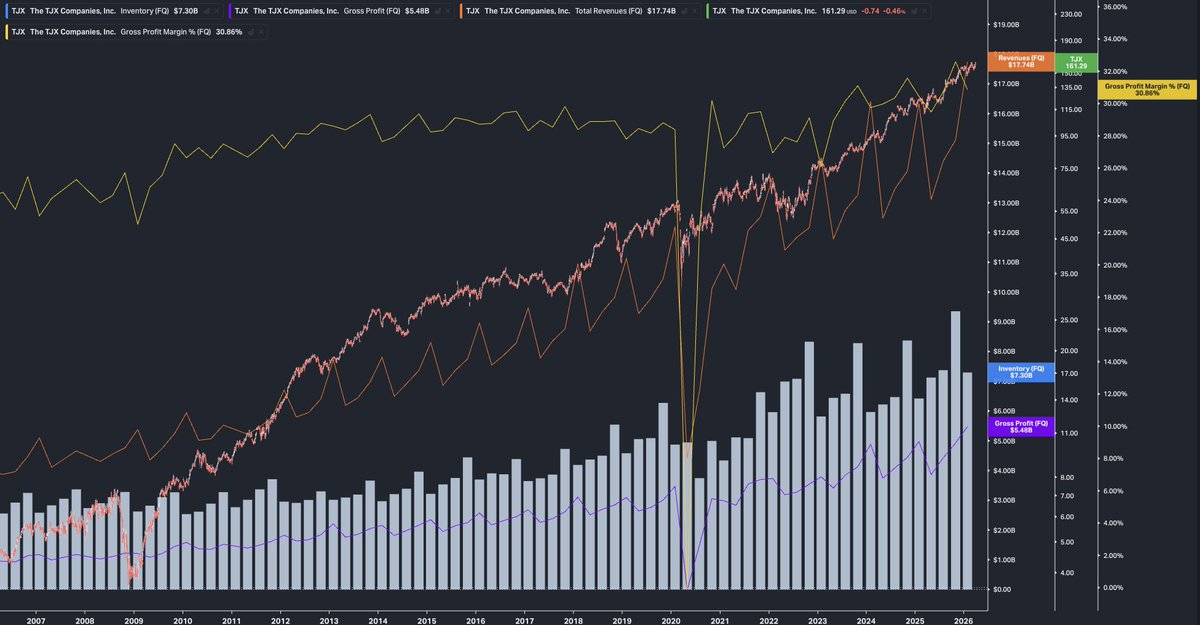
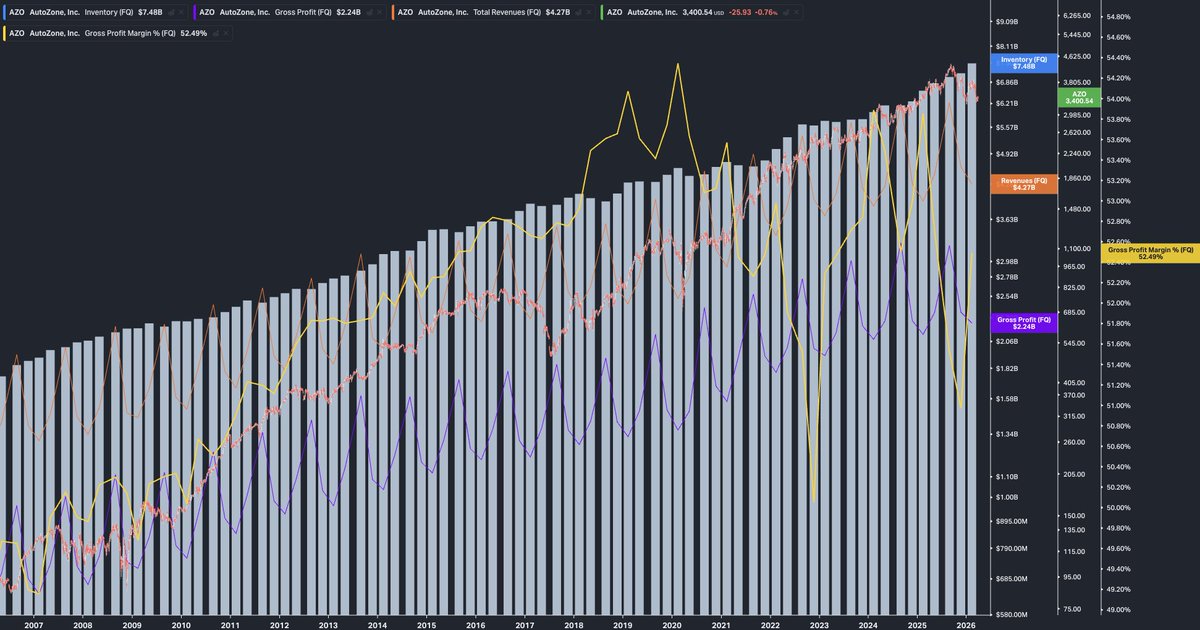
Be TJ Maxx or Autozone. Look at that inventory growth management. 🤌
1
4
323
Mar 23
Some of you have never read “Dynamic Learning for Joint Pricing, Advertising, and Inventory Management” by Huseyin Gurkan, N. Bora Keskin, and Rodney P. Parker, and it shows.
Mar 22

Paid marketing is the crudest game you can play. It’s admitting you have no creativity. And actually restricts your creativity. Fire those that want to spend more. abovethecrowd.com/2012/09/04…
6
137
James Tyler retweeted
Mar 22
There’s actually a bigger question to answer first.
Before you hire someone to “do marketing,” the first thing to understand is your TAM, meaning total addressable market. In plain English: how many people would find your product useful if it were free? You probably already have an intuition for this. You likely have some sense of what percentage of the U.S. population, or even the world, would genuinely want the product if price were not part of the equation.
Then I’d think about three price points: high, medium, and low. Of all the people who would have happily taken the product for free and loved it, what percentage of them would still be willing to pay at each of those prices? Once you have that in your head, you can start to estimate the total revenue ceiling of the product.
For example, let’s say you made a widget and you believed that 1 in every 1,000 Americans would buy it at a $30 price point. Using a U.S. population of roughly 340 million, that implies about 340,000 buyers. At $30 each, that is about $10.2 million in potential revenue. That does not mean you get all of that tomorrow. It means you now have a rough sense of the size of the hill you are trying to climb.
Your job is basically to ride the S-curve up that hill. And depending on your own reach, you may already have enough distribution to fund the first tranche of that climb yourself. In your case, X alone might be enough to validate demand and finance the early stages.
This matters even more if the product is physical and not digital, because physical products require inventory. If you sell something for $30 but it costs $12 to produce, then a meaningful chunk of that revenue is already spoken for. You can use that math to understand how much capital it would take to manufacture the total opportunity, and then how much gross profit might be left over to fund advertising over time. What remains after production cost and ad spend is what eventually makes its way into your pocket.
So the real question is not just “where do I find marketers?” The real question is: what does it cost to generate enough exposures to make the relevant portion of my TAM aware of the product, at a price where enough of them are willing to pay, and does that math actually work?
That is the core meta.
A good example is Tesla. Tesla historically spent basically nothing on traditional marketing. Why? Because if the product is meaningfully better than the competition and you are already constrained by manufacturing capacity, spending on awareness does not create incremental profit. If they are already selling as many Model Ys as they can make, more marketing is just wasted motion.
My recommendation would be to pre-sell the product first. In other words, design the product, understand how to bring it to market from a physical-goods standpoint, and then offer it for sale before fully scaling production. Kickstarter is the obvious example. My guess is that an Aella Kickstarter would probably do pretty well. And that would tell you something extremely valuable: whether there is enough real demand to justify bringing on an agency to run ads.
Once you have that signal, yes, there are plenty of direct-to-consumer e-commerce agencies that do exactly what you’re describing, from paid ads to influencer management to creative strategy. I’m sure some will even reply to your post. But I think there are a few steps before that, and those steps matter a lot more than people realize.
5
5
46
3,033
James Tyler retweeted

Mar 21
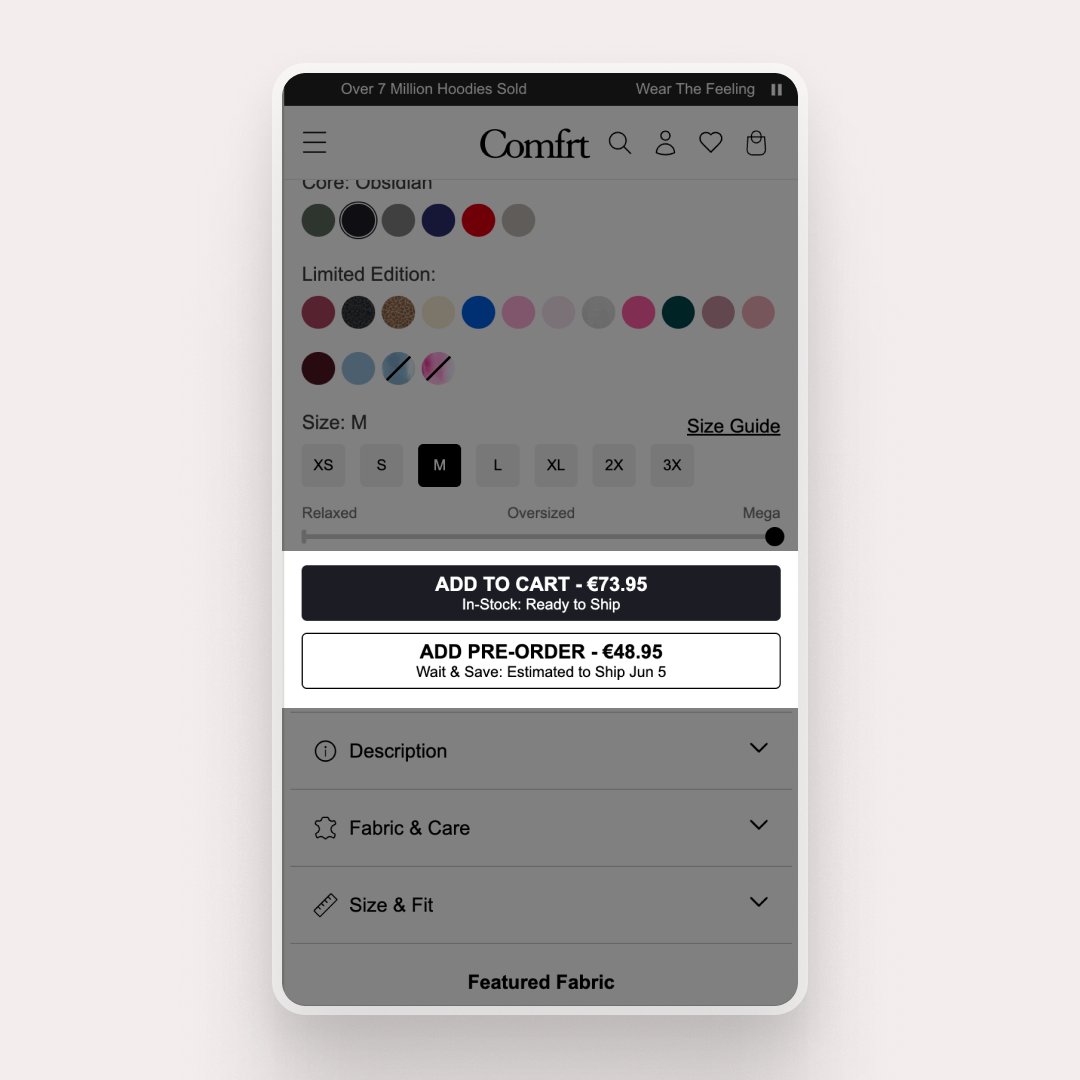
Comfrt is doing something smart on their PDP that most stores haven't figured out.
Two add-to-cart buttons. Same product. Different prices.
One for in-stock: €73.95 - ships now.
One for pre-order: €48.95 - ships June 5.
That's a €25 discount for waiting 10 weeks.
Most brands treat pre-orders as a last resort. A sign the product isn't ready. Something to hide.
Comfrt turned it into a choice.
And that choice does 3 things at once:
1. It captures buyers who were about to bounce on price. It builds revenue before the stock even arrives. And it tells you exactly how price-sensitive your audience is, in real time.
2. The pre-order button isn't a backup. It's a conversion lever for people who needed one more reason to say yes.
3. You're not discounting. You're selling patience.
If you've got products on backorder right now, this is worth testing before your next restock.
18
10
207
21,069
Mar 21
This mechanic does even more than this post lays out.
“Wait & save” is not just a conversion trick or even an inventory financing device (but it does do both of those too).
It is an inventory control mechanism.
When paired with dynamic pricing, you are no longer just measuring price elasticity or defending inventory through price. You are also measuring fulfillment-date elasticity and off loading some inventory burden so you can stay in stock longer.
A customer may accept a lower price for waiting 45 days, but not 90. Once you can test both price and fulfillment time together, you gain much tighter control over sell-through, scarcity, and inventory pressure.
For example, if in-stock units are getting tight, you can raise the in-stock price while shortening the promised pre-order date as inbound inventory gets closer. That preserves scarce on-hand inventory while shifting some demand into future receipts.
Now orchestrate that across every SKU in the store.
Yes, pre-order captures otherwise lost demand if you do go out of stock and allows you to pull demand and cash forward. But the deeper value is that it gives you another lever to shape demand before you ever go out of stock.
It is also a cleaner form of price discrimination: discount in exchange for time, capture more customers, and smooths average selling price over the horizon while preserving margin.
Being out of stock in even a single variant on a PDP harms conversion and advertising efficiency significantly. This mechanic is the relief.
That is when this gets really powerful.
This kind of program requires more than a front-end mechanic. It requires inventory-aware testing infrastructure tied to pricing, purchase orders, inbound timing, and cash flow planning at the the site and dashboard layer so decisions can be made against the actual state of the business.
It helps you see into and shape the future.
Once merchants experience that level of control, they don't return to the old way of managing inventory.
If you are an 8 or 9 figure merchant who wants to unlock this level of inventory control please reach out.
Mar 21

Comfrt is doing something smart on their PDP that most stores haven't figured out.
Two add-to-cart buttons. Same product. Different prices.
One for in-stock: €73.95 - ships now.
One for pre-order: €48.95 - ships June 5.
That's a €25 discount for waiting 10 weeks.
Most brands treat pre-orders as a last resort. A sign the product isn't ready. Something to hide.
Comfrt turned it into a choice.
And that choice does 3 things at once:
1. It captures buyers who were about to bounce on price. It builds revenue before the stock even arrives. And it tells you exactly how price-sensitive your audience is, in real time.
2. The pre-order button isn't a backup. It's a conversion lever for people who needed one more reason to say yes.
3. You're not discounting. You're selling patience.
If you've got products on backorder right now, this is worth testing before your next restock.
6
417
James Tyler retweeted
28 Jun 2024
Dynamically pricing based on available inventory is the only way to scale and manage inventory in any manner that actually maximizes total contribution.
Additionally, defending against sold out variants by yielding price up is just as important as reducing prices on overstock.
The last hotel room in Vegas on NYE is going to be priced a lot higher than the average daily rate. That's revenue management 101.
But for some reason, this hasn't translated to retail yet.
Perhaps it's because we can understand that if a room goes unsold, the hotel has lost that money but in retail a unit going unsold is still sitting in a warehouse.
But actually, those two things are identical.
28 Jun 2024

Product market fit.
An idea that gets applied to broadly inside a business.
Variant market fit, is a better path to cash optimization.
1
7
745
James Tyler retweeted
21 Aug 2024
The best product manager at a startup is often the founder because they are the source of the vision and strategy that determine the company’s future. The same logic applies to CRO. When thinking about hiring for a conversion rate optimization (CRO) role within a smaller e-commerce business, it’s essential to understand that this function is far more than just a set of tactical tasks—it’s the very engine (or should be) that drives the business forward. The individual or team handling this function should not just be executing simple tasks like tweaking landing pages or adding trust badges on checkout pages; they should be integral to the strategic direction and growth of the company.
The role of CRO within a business, especially a growing e-commerce operation, should be centered around experimentation that answers critical questions about the business’s future. It’s not just about increasing conversion rates in a vacuum; it’s about using experimentation to test hypotheses that can fundamentally alter the trajectory of the business. The best CRO programs are those that help the company understand and execute on ideas that could potentially double the business, rather than simply optimizing minor aspects like button colors or page layouts. The role, therefore, demands someone who can think strategically about the entire business, not just the website.
One pitfall to avoid in hiring for this role is the temptation to offload it entirely to someone who approaches CRO from a purely tactical perspective. This is where businesses can get into trouble. Hiring someone who is focused on superficial metrics—like artificially boosting conversion rates by making some onsite funnel change that doesn’t make it back to any real profit—can distract from the more important, revenue-driving experiments that need to happen. The person you hire should have the ability to look at the big picture and prioritize experiments that have the potential to significantly impact revenue and contribution. This means they need to understand the infrastructure, people, and processes required to answer the biggest questions about the business.
For these reasons, the ideal candidate for a CRO role should be someone with a deep understanding of business strategy, revenue growth, and the ability to operationalize insights across the company. They should not only be capable of running experiments but should also be able to translate the outcomes of those experiments into actionable strategies that can be scaled. This could mean finding someone with entrepreneurial experience, or at the very least, someone who has a proven track record of scaling businesses, in addition to running a sophisticated experimentation program. This person should own the revenue outcomes of their experiments, ensuring that their efforts are always aligned with the broader goals of the business.
For sure it may be tempting to hire someone to simply “handle” CRO, but it’s crucial to recognize that this function is core to the business’s growth and should be treated as such. The right hire for this role will be more than just a CRO expert—they will be a strategic leader capable of driving the business forward through smart experimentation and a deep understanding of what makes the company tick. Trust badges on a checkout page might slightly increase conversion rates, but what you really need is someone who can help you double your business and operationalize the outcomes of 2x to 10x experiments. The kind of experiment that means you are SPRINTING to order more inventory. That’s the kind of CRO role you should be hiring for.
21 Aug 2024

We’ve started to build out a solid, lean team for the brand now (over £1m per year per head)- but an area I still spend SO much time on myself is general website/ecom/CRO and that whole piece -
I struggle to define what a new hire could look like for this, or if actually a few is needed (probably)? Current setup is an agency to do the design and dev work, but still me to plan, manage & lead on roadmap/direction for website optimisation and design -
If I want to remove myself entirely from this and have one direct report here instead, who/which role should I hire, and ideally where from? 🖥️🤔
4
2
16
4,337
1 Oct 2024
For your ecommerce business:
Best Day Ever
Best Week Ever
Best Month Ever
Every month.
Why target anything else?
Achievable at every scale.
3
382
24 Sep 2024
Thoughts on this potentially "inventory aware" promotion 👇
1
3
306
24 Sep 2024
1
157
10 Sep 2024
What merchants will have a bigger December than November?
Which of those merchants will have a bigger January 2025 than November 2024?
The ones who decide.
Why wouldn't you want to grow month over month, every month?
3
204
9 Sep 2024
It's a good thing hotels don't change prices every day or it might erode their "brand"
1
3
190
2 Sep 2024
How it feels explaining dynamic pricing and revenue management to the ecommerce market.
2 Sep 2024

This is probably how the first fast food restaurant was received by the public
5
709
1 Sep 2024
I get the sentiment but what evidence do we have that Brian is actually moving $ABNB in the right direction?
$BKNG is up 100% in the past five years while Airbnb is down 20%.
Hardcore inventory expansion and guest cost reduction are the levers that need to be pulled. Bookingcom will win this war that AirBnB doesn't seem to even know is being fought.
Product and Price.
Focus on revenue expanding activity.
Not building the house from "UP" or life-sized Polly Pocket.
Not "Founder mode" or "brand."
Product and Price.
But what do I know.
1 Sep 2024

Founder Mode: paulgraham.com/foundermode.h…
2
6
1,767
James Tyler retweeted
15 Aug 2024
Percentages don't matter. Dollars do.
1
1
233
10 Aug 2024
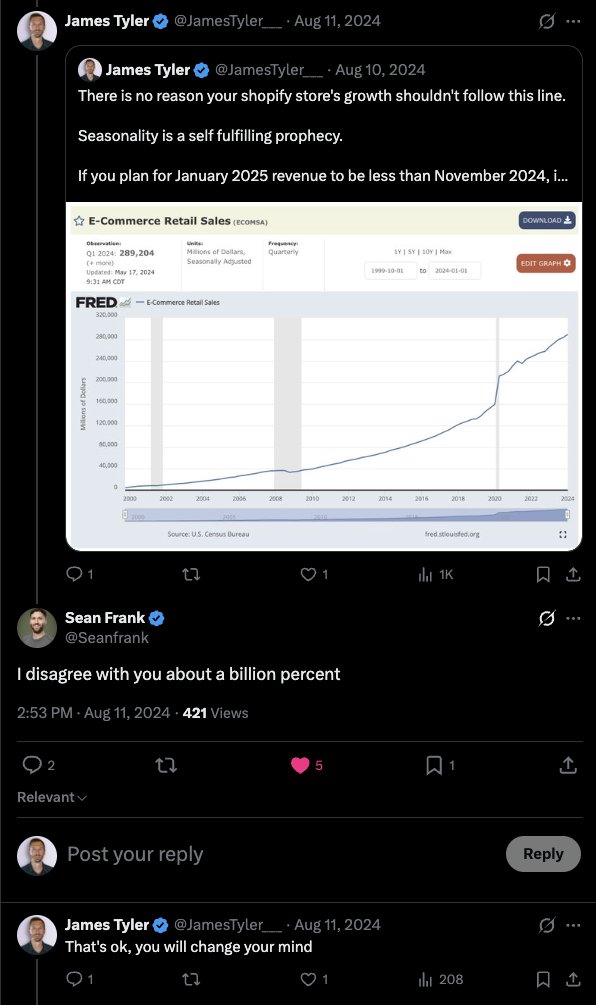
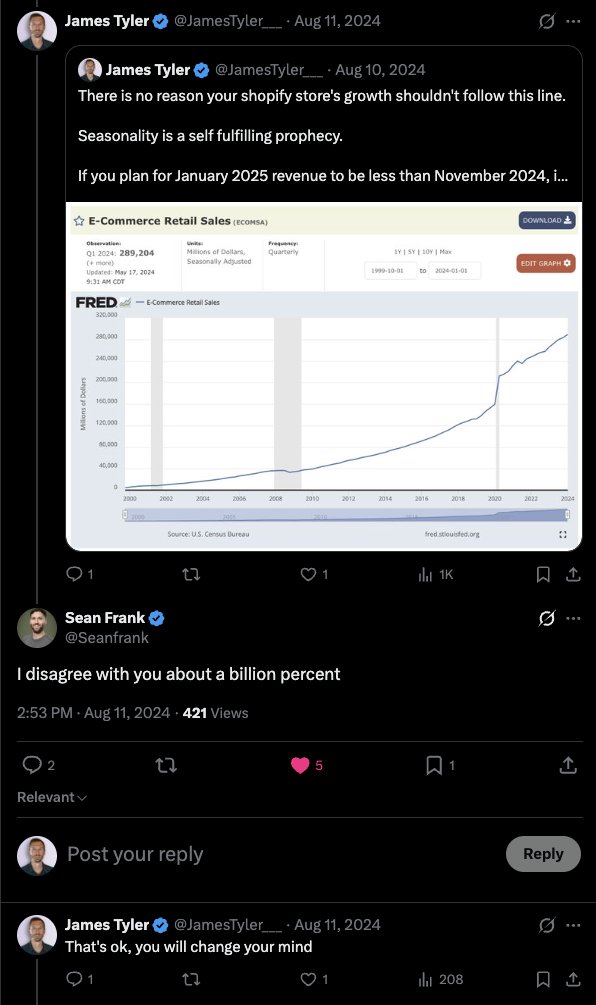
There is no reason your shopify store's growth shouldn't follow this line.
Seasonality is a self fulfilling prophecy.
If you plan for January 2025 revenue to be less than November 2024, it will be.
3
1,390