
Telling stories, trying new things. Love Florida, hate hurricanes. Family is my rock.
Joined May 2009
- Tweets 8,621
- Following 1,628
- Followers 2,756
- Likes 5,864
119 Photos and videos







X periodically switches my status from Following to For You, and I realize it when I read some truly awful, toxic post and think "where did that come from?" In a rare and welcome change, the For You feed served me this lovely story of the best of America from @AdamKinzinger
Jun 15

Posted by former US Congressman @AdamKinzinger on Facebook. Beautifully written, in both form and substance:
Hey everyone, happy Sunday. Are you ready for some good news? I know I am.
We are told, over and over, that America has gone cold on the rest of the world. That we have decided the people on the other side of the ocean are a threat to be kept out. That the welcome mat got rolled up and put away for good.
Then a soccer team from the North African nation of Algeria showed up in Lawrence, Kansas, and within a week the whole town was wearing green.
For today's Good News Sunday, I want to tell you about one of the best things happening in this country right now. It is happening at a soccer tournament, and it has almost nothing to do with soccer.
The World Cup is here, 48 teams playing across the United States, Canada, and Mexico. Each team in the tournament picks a base camp, one town to live and train in between matches. Germany set up shop in Winston-Salem, North Carolina. Spain is training in Chattanooga, Tennessee. And Algeria, playing two of its games up the road at Arrowhead, picked Lawrence and made it home for the summer.
What the people of Lawrence did with that is the part I can't stop thinking about.
It started small, with a whole town of people who had never given Algeria much thought deciding, more or less overnight, that this was their team now. Flags went up in shop windows. Folks pulled on the green jerseys. People drove over just to catch a glimpse of the players. And then a local news crew stopped an older gentleman on a Lawrence sidewalk, standing in front of a storefront draped in a whole row of Algerian flags he had clearly just gone out of his way to find.
They asked him what he actually knew about the country whose colors he was flying. He grinned, paused for a beat, and said something along the lines of: not much yet — but we want to welcome you here. There is no agenda in that man. Nothing performative. Just a neighbor, thrilled to his bones that these strangers chose his town, and perfectly at ease with the fact that he has a lot left to learn about them.
The welcome only got bigger from there.
The University of Kansas, the state's flagship school that calls Lawrence home, sent its marching band out to the training ground. They had spent the previous days learning Algeria's national anthem, note for note, and they played it as the players walked out for practice. Think about what that means for a moment.
These men are thousands of miles from their families, living out of a hotel in the American Midwest, preparing for the biggest sporting event of their professional lives. And the first thing they hear when they step onto the grass is the sound of their own country's song, played by a hundred American college kids in red and blue who learned it just for them. Several of the players stopped walking. A few of them looked like they weren't sure what to do with themselves.
Algeria did its part, too. The team opened a training session to the public and spent the afternoon out on the grass with neighborhood kids, walking them through drills, signing autographs, posing for pictures. There are children from small-town America who are going to be telling the story of the day they trained with a World Cup team for the rest of their lives. And the Algerians have spent the last week calling themselves honorary Kansans, falling hard for a corner of a state most of them could not have found on a map two months ago.
But it's not just Lawrence.
This is happening all over the country, in towns you would never expect.
The city of Alexandria, Virginia threw a street festival with an evening of Croatian food and music, and wrapped a city bus in the team's red and white. After crowds in Spokane, Washington flocked to watch Egyptian superstar Mohamed Salah, a brand-new Egyptian restaurant in town suddenly had locals lining up for food most of them had never tasted. All told, 19 American communities that are not hosting a single match still raised their hand to take in a national team and call them neighbors for a month.
There is a story we get told constantly about who we have become. That Americans have soured on outsiders. That we have decided the rest of the world is a threat. That we look at people who do not talk like us or pray like us or come from where we come from and see a problem instead of a person.
And then a college town in Kansas goes and learns every note of a North African country's national anthem, just so a group of strangers feel at home for a few weeks. An old local stands in front of a row of its flags and tells them, in so many words: we don't know much about you yet, but we are awfully glad you came.
That is who we actually are when nobody is telling us to be afraid. The band on the field, playing somebody else's song as if it were their own. The neighbor who knows next to nothing about you and waves you in anyway. We forget it sometimes. The good news is that it takes about one afternoon to remember.
That, my friends, is good news for your Sunday.
— Adam
1
62
Jennifer Orsi retweeted

Jun 13
Politicians, especially elected ones who aren’t often accessible, can expect to be asked about variety of topics at press conferences, even if they prefer otherwise. That’s how democracy works. Journalists are not stenographers. Outrage here is performative.
Jun 13

Florida’s Sheriffs are the best. Billy Woods doesn’t take crap from anybody.
2
1
324
Jennifer Orsi retweeted

Jun 5
JUDGE MILLETT: If the govt decides very quickly to bulldoze the Statue of Liberty, the people whose ancestors — that was the first thing they saw coming to this country, but the govt moved too fast — nothing can be done?
DOJ: I think that’s right, yes.
69
550
2,292
220,297

May 18
This has been my experience my entire life. When I take notes by hand, I remember things better. If I attended class in college and took notes, I rarely had to pull an all-nighter or cram. Alas, my handwriting is getting worse as I age, making this tougher!
May 18

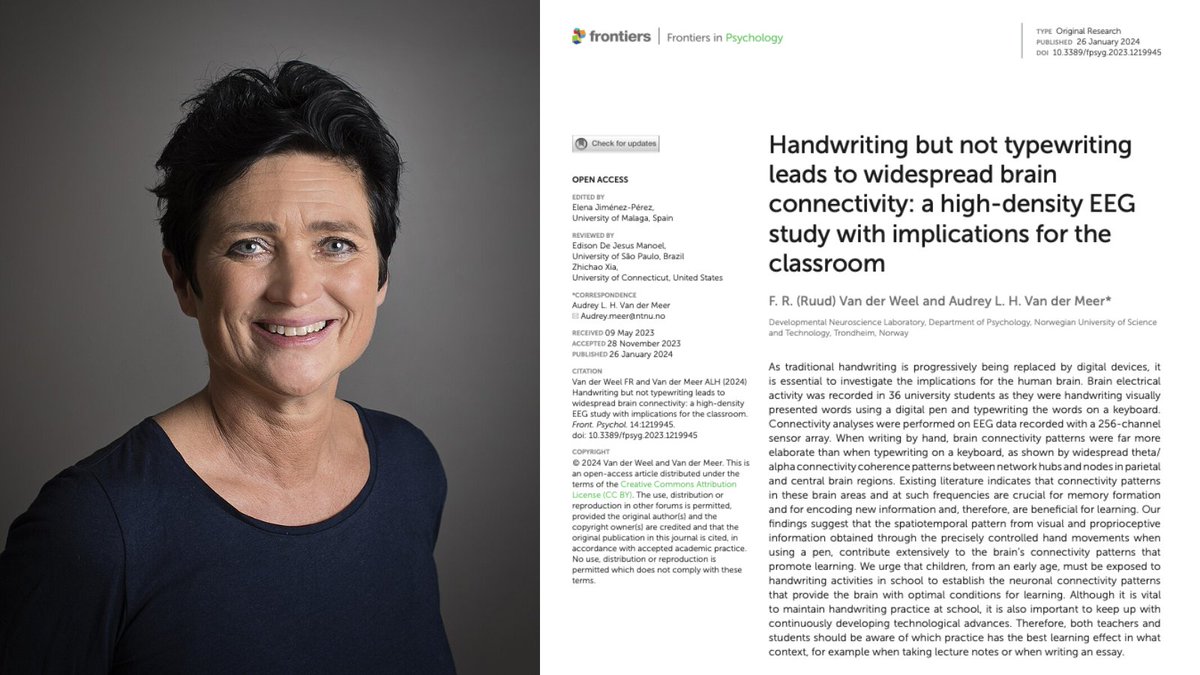
A Norwegian neuroscientist spent 20 years proving that the act of writing by hand changes the human brain in ways typing physically cannot, and almost nobody outside her field has read the paper.
Her name is Audrey van der Meer.
She runs a brain research lab in Trondheim, and the paper that closed the argument was published in 2024 in a journal called Frontiers in Psychology. The finding is brutal enough that it should have changed every classroom on Earth.
The experiment was simple. She recruited 36 university students and put each one in a cap with 256 sensors pressed against their scalp to record brain activity. Words flashed on a screen one at a time.
Sometimes the students wrote the word by hand on a touchscreen using a digital pen, and sometimes they typed the same word on a keyboard. Every neural response was recorded for the full five seconds the word stayed on screen.
Then her team looked at the part of the data most researchers had ignored for years, which is how different parts of the brain were communicating with each other during the task.
When the students wrote by hand, the brain lit up everywhere at once.
The regions responsible for memory, sensory integration, and the encoding of new information were all firing together in a coordinated pattern that spread across the entire cortex. The whole network was awake and connected.
When the same students typed the same word, that pattern collapsed almost completely.
Most of the brain went quiet, and the connections between regions that had been alive seconds earlier were nowhere to be found on the EEG.
Same word, same brain, same person, and two completely different neurological events.
The reason turned out to be something nobody had really paid attention to before her work. Writing by hand is not one motion but a sequence of thousands of tiny micro-movements coordinated with your eyes in real time, where each letter is a different shape that requires the brain to solve a slightly different spatial problem.
Your fingers, wrist, vision, and the parts of your brain that track position in space are all working together to produce one letter, then the next, then the next.
Typing throws all of that away. Every key on a keyboard requires the exact same finger motion regardless of which letter you are pressing, which means the brain has almost nothing to integrate and almost no problem to solve.
Van der Meer said it plainly in her interviews.
Pressing the same key with the same finger over and over does not stimulate the brain in any meaningful way, and she pointed out something that should scare every parent who handed their kid an iPad.
Children who learn to read and write on tablets often cannot tell letters like b and d apart, because they have never physically felt with their bodies what it takes to actually produce those letters on a page.
A decade before her, two researchers at Princeton ran the same fight using a completely different method and ended up at the same answer. Pam Mueller and Daniel Oppenheimer tested 327 students across three experiments, where half took notes on laptops with the internet disabled and half took notes by hand, before testing everyone on what they actually understood from the lectures they had watched.
The handwriting group won by a wide margin on every question that required real understanding rather than surface recall.
The reason was hiding in the transcripts of what the two groups had actually written down.
The laptop students typed almost word for word, capturing more total content but processing almost none of it as they went, while the handwriting students physically could not write fast enough to transcribe a lecture in real time, which forced them to listen carefully, decide what actually mattered, and put it in their own words on the page.
That single act of choosing what to keep was the learning itself, and the keyboard had quietly skipped the choosing and skipped the learning along with it.
Two studies. Two countries. Same answer.
Handwriting makes the brain work. Typing lets it coast.
Every note you have ever typed instead of written went into your brain through a thinner pipe. Every meeting, every book highlight, every idea you captured on your phone instead of on paper was processed at half depth.
You did not forget those things because your memory is bad. You forgot them because typing never woke the part of the brain that would have made them stick.
The fix is the thing your grandmother already knew.
Pick up a pen. Write the thing down. The slower road is the faster one.
90
May 15
Classic.

This is GLORIOUS
David Letterman & Stephen Colbert on the roof of the Ed Sullivan Theatre bringing back the classic @Letterman routine one last time
This is how you go out, @StephenAtHome! 😂
And may @CBS implode literally the same way without you
93
Jennifer Orsi retweeted

May 12
Trump April 23: I contacted people "that have worked for me in the past, doing swimming pools," and one gave me a great price on the Reflecting Pool project
Trump May 4: "I have some very good contractors," asked three of them to "do me a favor fellas" and go look at the Reflecting Pool, and the best one gave me a great price
Trump today: The Reflecting Pool contract "went to a contractor I did not know, and have never used before"
245
4,027
12,854
440,025
Jennifer Orsi retweeted

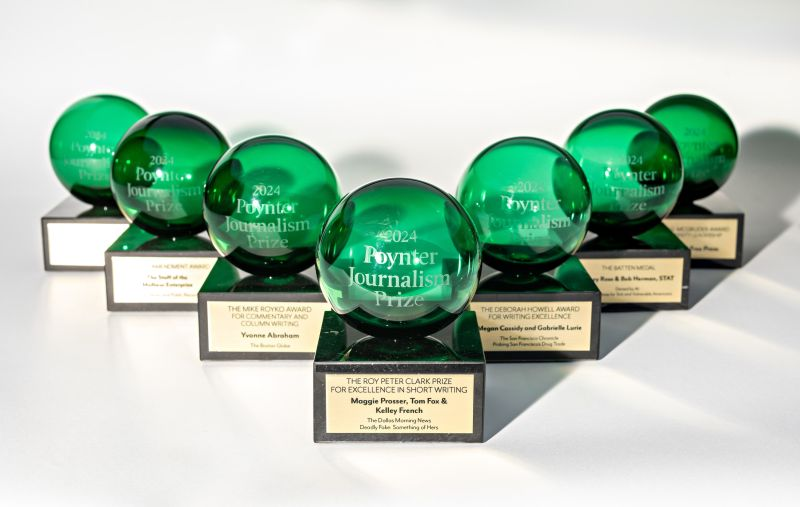
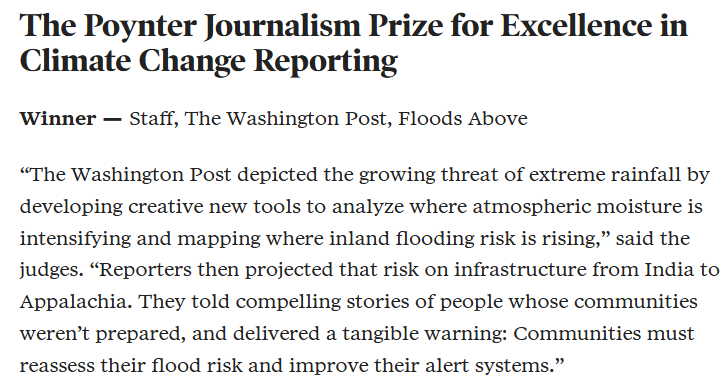
🏆Congratulations to our team for winning The @Poynter Journalism Prize for Excellence in Climate Change Reporting!
Start here to begin reading their "Floods Above" series on how rising atmospheric moisture is driving torrential rains all over the globe: washingtonpost.com/weather/i…
poynter.org/reporting-editin…
6
11
735
Jennifer Orsi retweeted

Apr 27
Grateful to part of a stellar @washingtonpost team awarded the first-ever Poynter Journalism Prize for Excellence in Climate Change Reporting for "Floods Above," our series on rising atmospheric moisture is driving torrential rains all over the globe:
poynter.org/reporting-editin…
1
8
42
3,129
Apr 27
It's always a great day when we get to announce the winners of the Poynter Journalism Prizes! The judges were so impressed by the high-quality, high-impact journalism we saw in the contest, across platforms and newsroom sizes. Please congratulate all the winners and finalists!

🏆Today, we’re honoring and recognizing excellent journalism: The 2026 winners and finalists of the Poynter Journalism Prizes!
1
2
252
Apr 26
It’s funny that no one reads print newspapers anymore, which has forced them to adopt crazy early deadlines to survive economically but when big news happens everyone expects to see it in print (which they don’t subscribe to) like it was 1990 again and there was no internet.
Apr 26

outrageous. media companies need to find a way to get info out faster than in print. perhaps a way to publish instantaneously, and in a manner that could be updated as news develops. and what if, someday, you could somehow get the articles without having to go to a newsstand?
2
33
301
35,244
Apr 2
An AI company set out to fix news deserts. Instead, it copied local journalists’ work poynter.org/ethics-trust/202…
1
1
128
Jennifer Orsi retweeted

Fact-checkers worldwide are under more pressure than ever. Their reach has also never been greater. Tomorrow, on April 2, the IFCN is showing the data – and exploring what comes next.

1
3
5
524
Jennifer Orsi retweeted

Mar 31
Come work with us at @PolitiFact! We're hiring a staff writer to cover national government and politics. More info here: linkedin.com/jobs/view/43935…

2
338
Mar 28
Umm… uh… this is … excuse me but … could someone take a look at this?

How is it not a bigger story that our nuclear bombers, LOCATED IN AMERICA, were targeted by drones…. IN AMERICA????
@MeidasTouch
1
130
Jennifer Orsi retweeted

Mar 19
There's a lot more to the Paramount-Warner Bros Discovery deal than what happens to CNN. Check out the latest @Poynter Report Podcast with my guest, @sarafischer of @axios as we talk about the big deal, Substack and the future of newsletters.
youtube.com/watch?v=mEzdk7Wx…
2
2
581

Jennifer Orsi retweeted

Mar 2
Thanks to USA Today for giving me the opportunity to write about the worrisome implications for free speech raised by the attempt to censor Stephen Colbert's interview of U.S. Senate candidate James Talarico.
usatoday.com/story/opinion/2…
1
2
176
Jennifer Orsi retweeted

Feb 25
This should be a bigger story.
ICE detained a father when he stepped outside his apartment to pick up dinner. His 6-year-old daughter was left alone. Neighbors later found her outside, crying in the street, asking for her father.
If any local law enforcement agency conducted an operation and left a child without supervision, there would be investigations, accountability, and consequences. That is what the public would rightly demand.
So where is the accountability here?
No matter your views on immigration policy, a 6-year-old child should never be left alone and vulnerable because of a federal enforcement action.
Basic standards of care and common sense still matter.
nj.com/morris/2026/01/6-year…
426
3,594
9,817
310,318
Feb 23
Really brave officers here. Grateful for their efforts.
Body cam footage shows Sarasota officers pull people from burning home heraldtribune.com/story/news… via @heraldtribune
29
Feb 21
A lovely remembrance of a lovely man, Joey Knight, by @romano_tbtimes.
For 30 years, he told the hidden stories of Tampa Bay. Now, here’s his tampabay.com/viewpoints/2026…
2
5
188