
Joined November 2021
- Tweets 1,513
- Following 238
- Followers 72,986
- Likes 2,346
142 Photos and videos












Jonathan Ross retweeted

Jun 11
I don’t feel like I have the authority to give advice, but I’ll teach mine the same fundamentals I learnt in college… physics, math, logic (if they’re STEM oriented). AI or not, these things don’t change and train your brain to be analytical.
1
1
14
2,510

Jun 11
Curious about GPU💚LPU?
Jun 11

Early on, @JonathanRoss321 foresaw the unprecedented demand for compute of the 2020s. After pioneering Google's TPUs, he founded Groq, a "Language" Processing Unit dedicated for inference. After joining NVIDIA, he is betting on the GPU LPU combo to power the agentic chains of AI calling AI calling AI.
This interview is part of my larger series on dedicated AI chips, so drop any suggestions/questions below.
Thank you @nvidia for hosting us at your HQ!
00:00 Intro
01:00 The Google TPU & Groq origin story
02:41 How is Groq different from a GPU?
04:43 Static scheduling makes Groq faster
05:47 Does Groq work with Mixture-of-Experts?
09:27 Are LPUs limited to text models?
11:03 Diffusion models
13:41 NVIDIA Vera Rubin: the GPU LPU combo
15:26 Will Groq still be sold as a standalone chip?
16:49 How does agentic AI impact inference economics?
19:21 Will AI replace CUDA kernel engineers?
21:08 Will AI democratize hardware design?
26:11 Jevon's paradox: An endless demand for compute
29:04 What should kids learn in the AI age?
3
6
61
9,848
Jonathan Ross retweeted

👏 Congratulations to the @Oracle Cloud team on being among the first to bring up NVIDIA Vera Rubin NVL72.
Together, we're delivering the infrastructure for the agentic AI era.
Jun 10

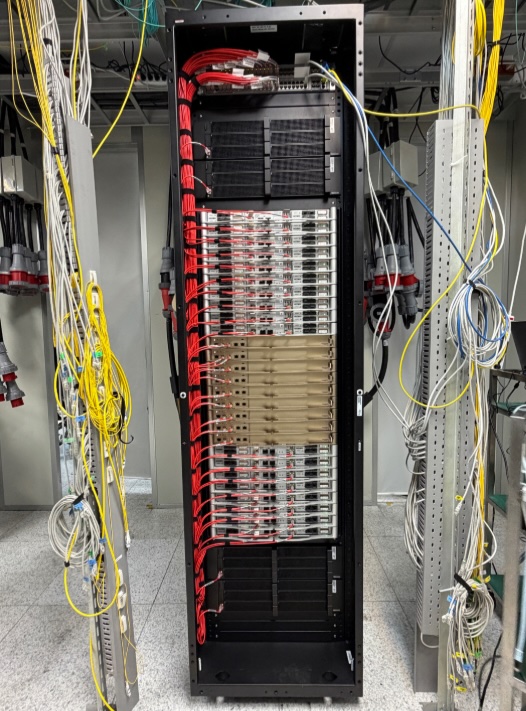
OCI continues to push the frontier of AI infrastructure. We are among the first cloud providers to bring up an @nvidia Vera Rubin NVL72 rack for validation testing, working closely with NVIDIA to deliver next-generation accelerated computing to customers at cloud scale.
Pic 1: What it takes to bring up the first rack. Pic 2: What it looks like after the models it will help train get a chance to clean up the photo.

13
42
413
27,841
Jun 10
Jevons paradox in terms of the Opus → Fable release.
1: Fable drafts all replies. I just approve. I get my life back.
2: Sending is cheap. I send 10x more. I trade some life back for productivity.
3: Everyone hits Phase 2. I can't keep up with approving the replies. Less life than before Phase 1.
Better models → more productivity → demand for even better models →
5
3
56
8,176
Jonathan Ross retweeted

Jun 5
As I wrote this, I saw X go into meltdown over tokens.
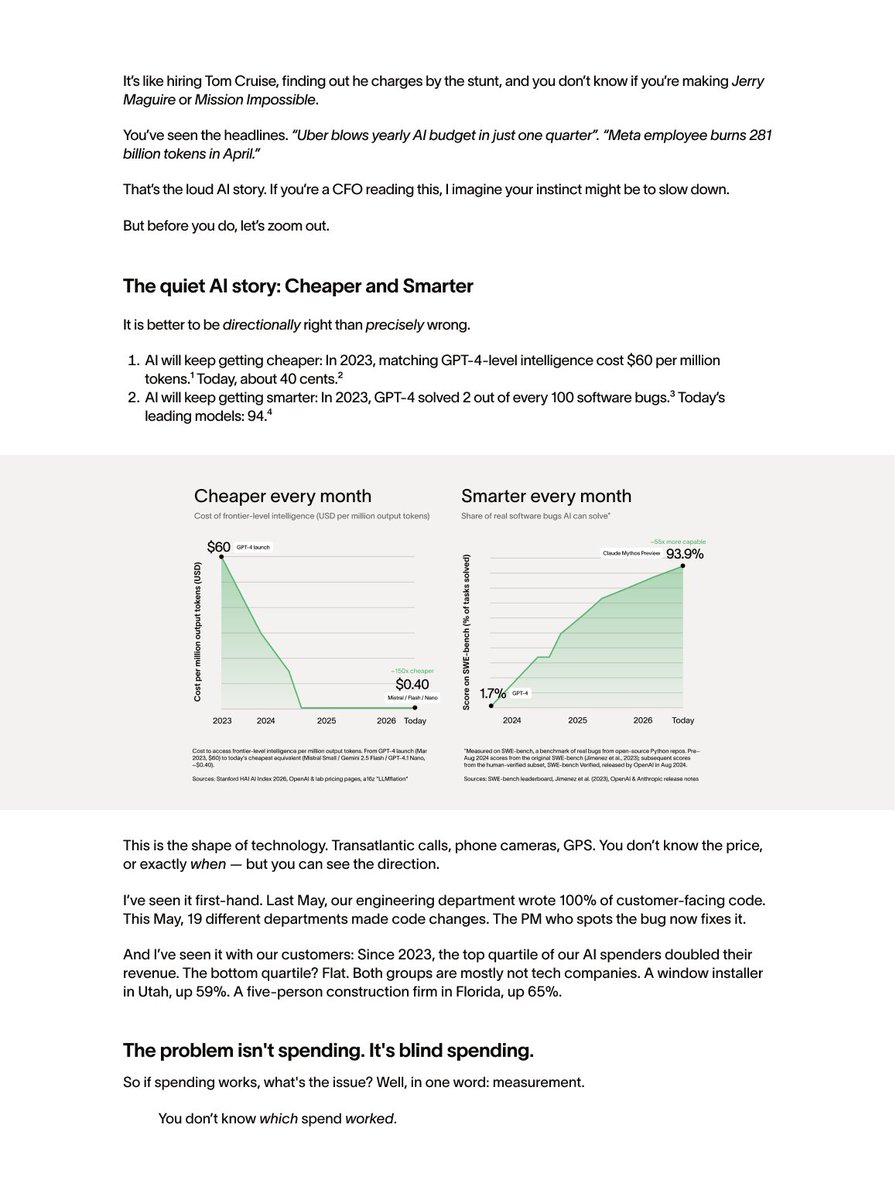
You've seen the headlines: “Uber blows yearly AI budget in just one quarter.” “Meta employee burns 281 billion tokens in April.”
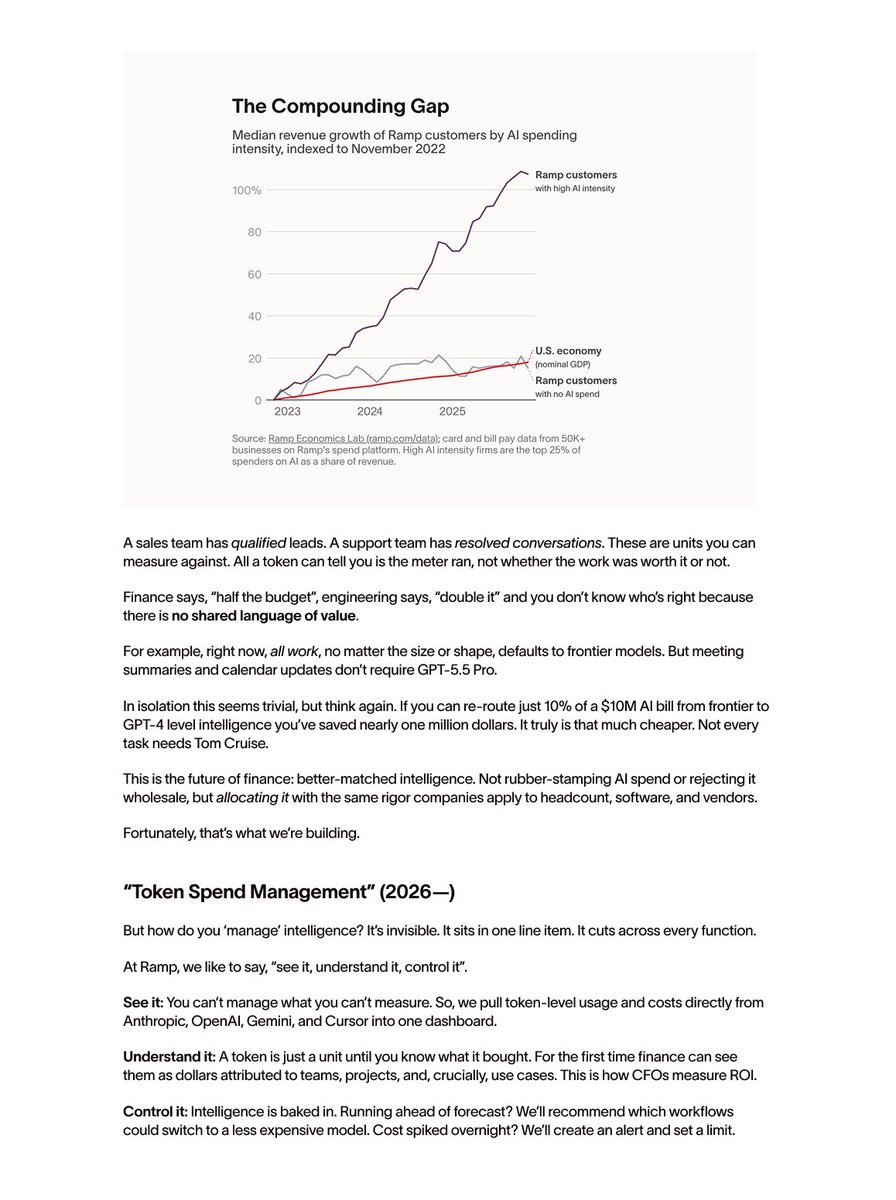
But, the problem isn't spending. Spending works. Since 2023, the top quartile of our AI spenders doubled their revenue. The bottom quartile? Flat.
It's blind spending. We don’t know which spend worked.
A sales team has qualified leads. A support team has resolved conversations. These are units you can measure against. All a token tells you is the meter ran, not whether the work was worth it or not.
Finance says, “half the budget,” engineering says, “double it” and you don’t know who’s right because there is no shared language of value. There’s no attribution, and no attribution means no allocation.
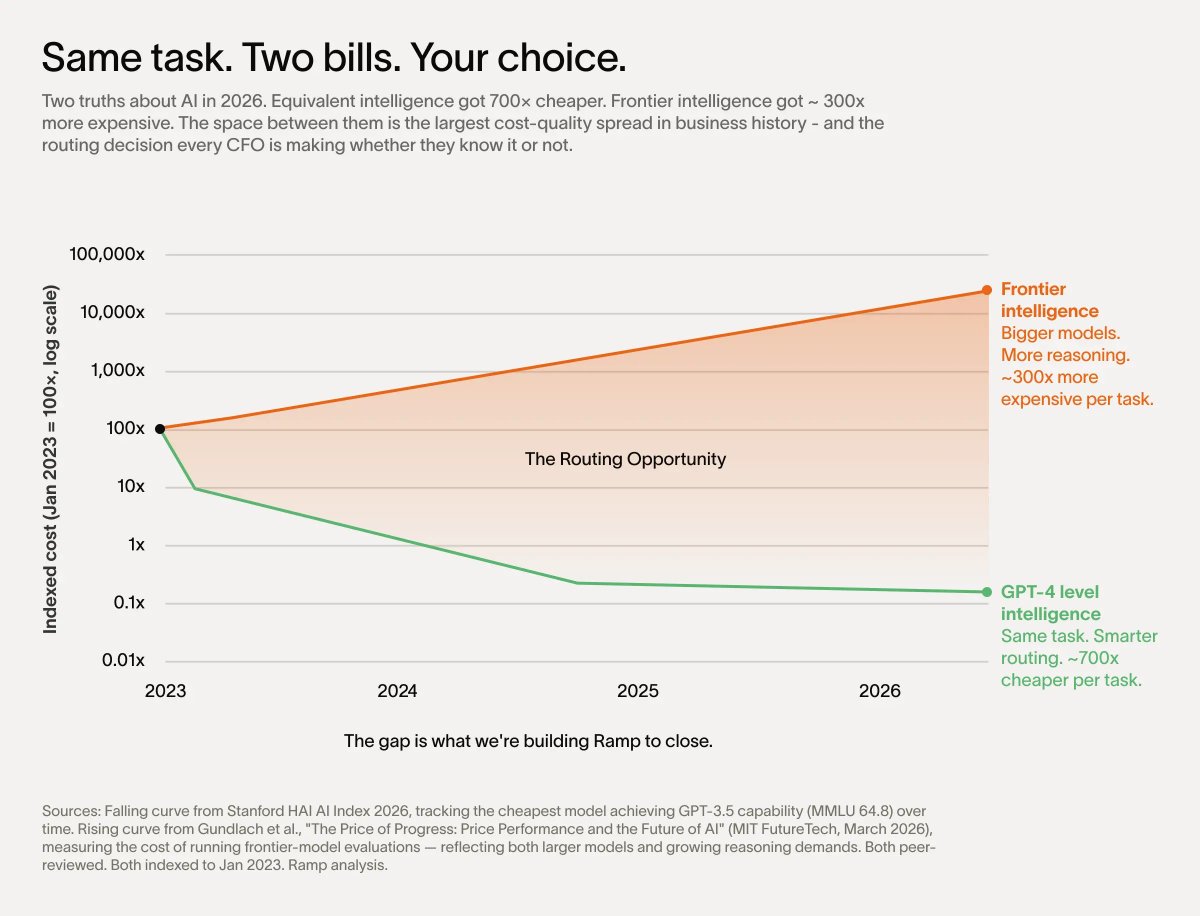
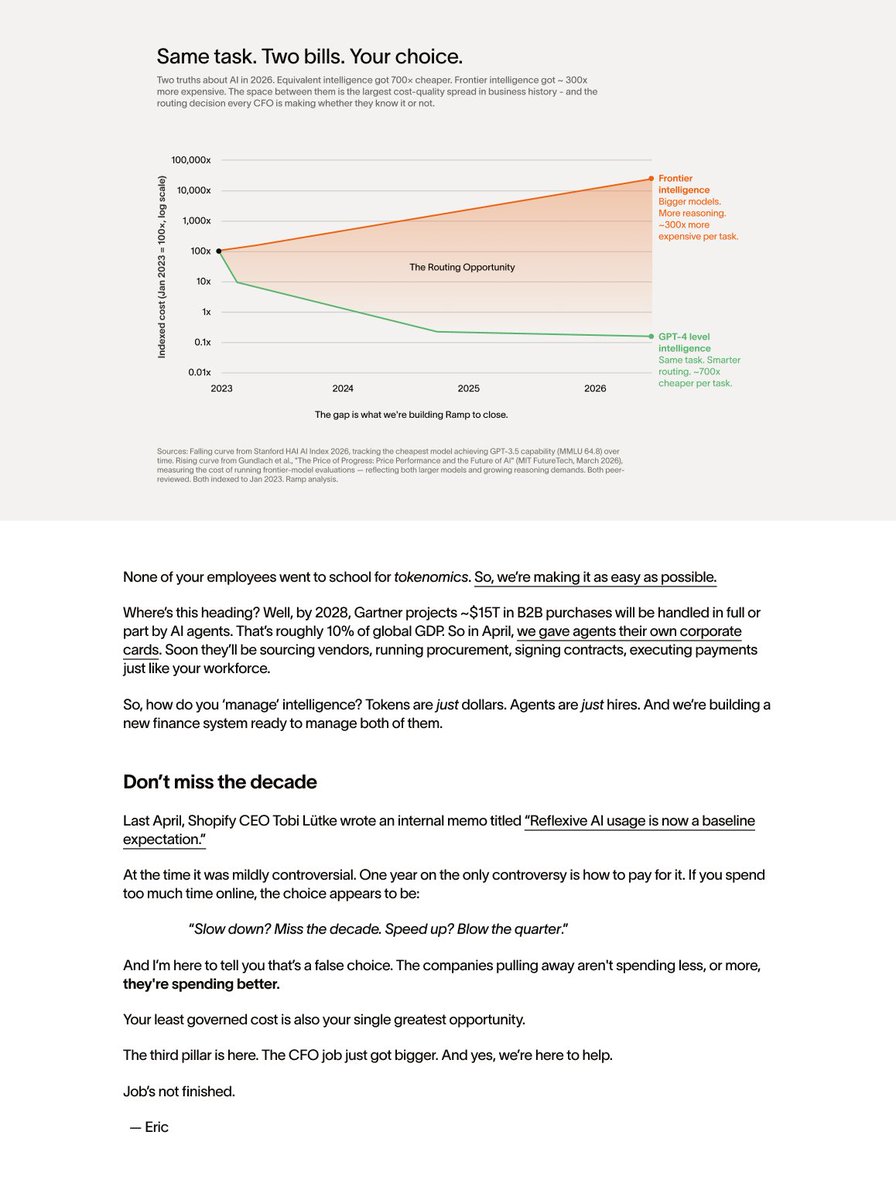
For example, right now, all work, no matter the size or shape, defaults to frontier models. But meeting summaries and calendar updates don’t require GPT-5.5 Pro.
In isolation this seems trivial, but re-route just 10% of a $10M AI bill from frontier to GPT-4 level intelligence you’ve saved nearly one million dollars. This sounds like a made-up stat — it’s not. It truly is that much cheaper.
This is the future of finance: not blindly rubber-stamping or rejecting AI spend, but allocating it with the same rigor companies apply to headcount.
Jun 4

Today, Ramp raised $750M at a $44B valuation.
Last time we grew this fast, we were 1/20th the size.
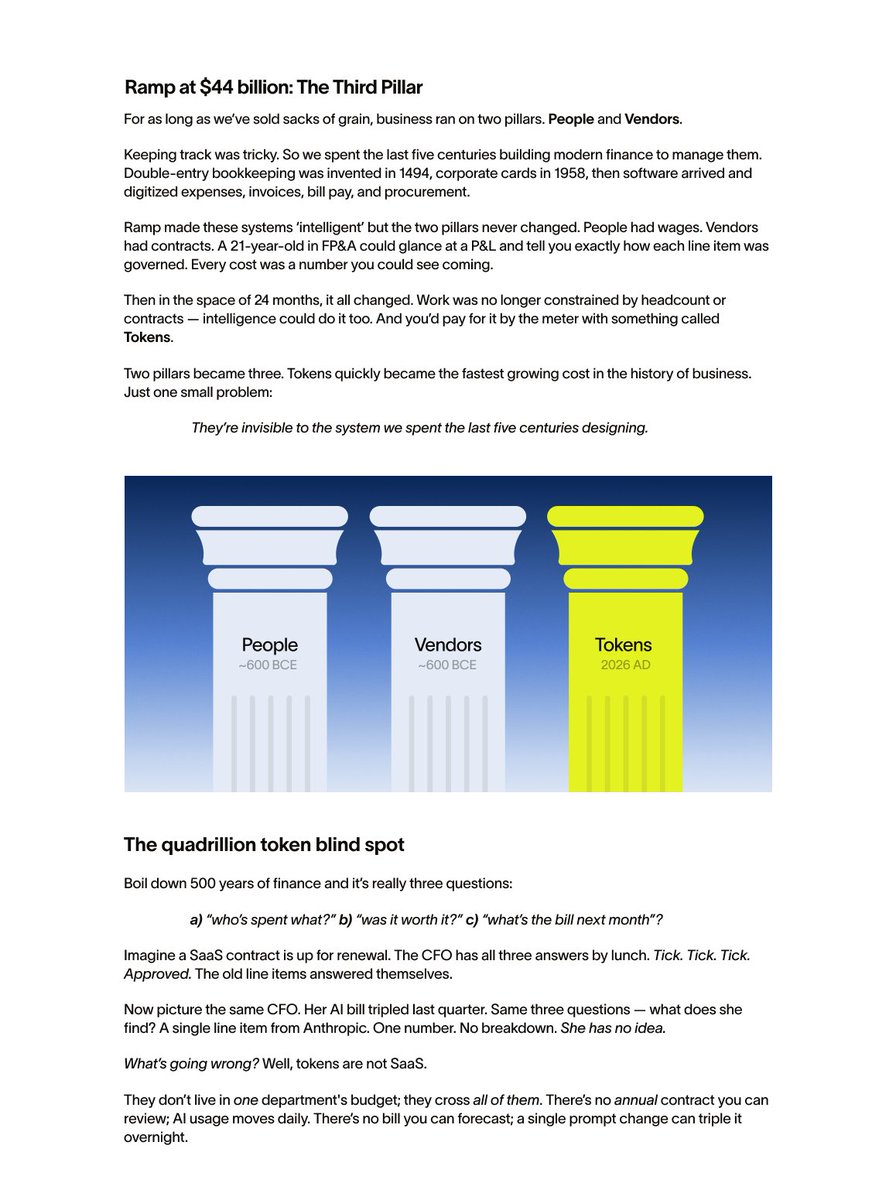
For 2000 years, business was built on two pillars. Today, a third: intelligence.
It’s your least governed cost. It’s also your single greatest opportunity.
70
72
840
363,510
Jonathan Ross retweeted

Jun 1
spent my 11-hour flight back from europe working on a very long report. started as a slack message but morphed into a several pages long doc. wifi was as shitty as it gets. after finally making it home i realized that the computer had forcefully restarted. opened slack: draft was gone :(
hail mary: claude pls save me, no clue how but pls try
it checked APFS snapshots, time machine, slack indexeddb, write-ahead logs, service worker / http caches, local storage, app logs, hibernation image... nothing. all gone
but then... it realized i have alfred installed. so it checked the clipboard snapshots alfred keeps in sqlite. sad news: alfred clipboard memory gets deleted after 24h. aggressive retention policy. however! when sqlite runs DELETE, nothing gets actually deleted. it only marks pages as reusable, but it doesn't override the physical bytes. so claude decided to do a raw-scan of the db, reverse eng alfred data format, figure out the portion containing the timestamp, stitched everything back together across overflow pages... and handed me the exact final version of my report, the last one i cmd C'd
all this, in a single shot
... day 200 of "what if you had an elite hacker you can ask anything to"
136
214
4,400
699,660
Jonathan Ross retweeted

May 28
After AlphaGo, the skill of human Go players noticeably improved. I suspect we will see a similar pattern in math.
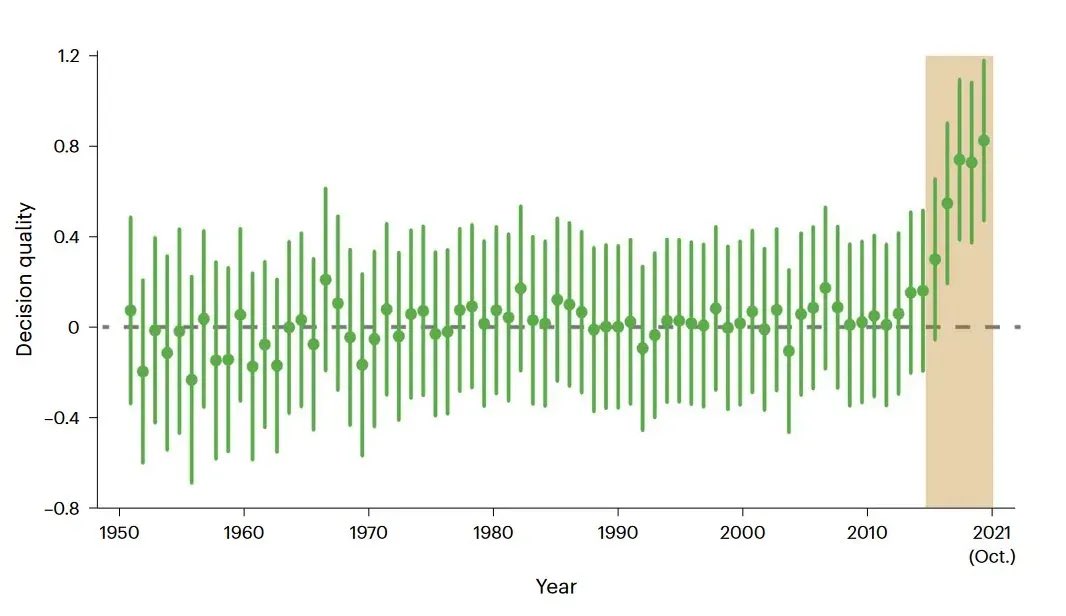

Another major problem, this time in additive combinatorics, has fallen, this time to humans rather than AI, but using methods related to the AI solution to the unit distance conjecture.
187
973
9,040
784,741
Jonathan Ross retweeted

May 24
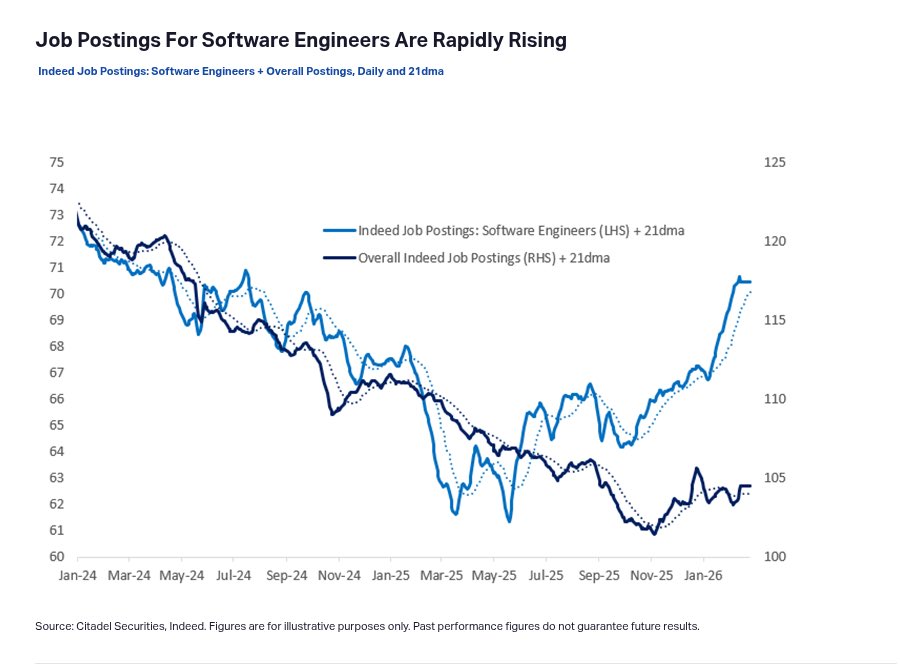
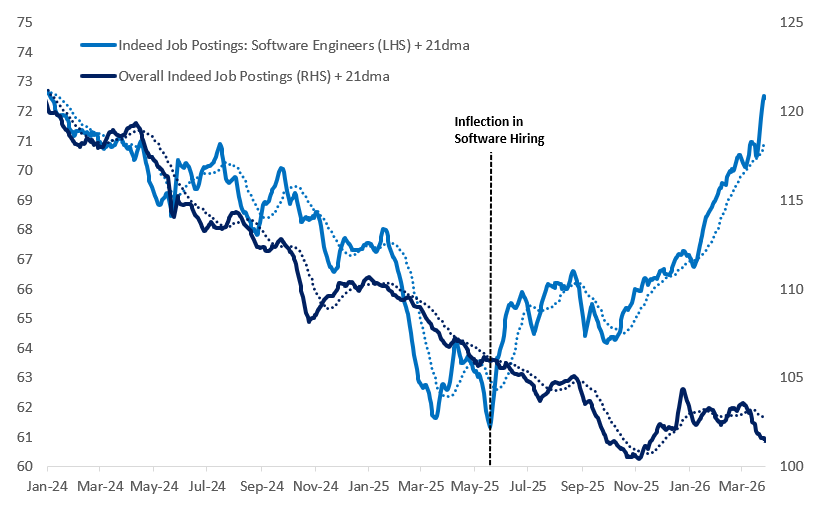
Q: How are job postings for software engineers rising rapidly despite AI agents automating coding?
A: Because there’s far more code to manage than ever before. We’re already seeing a 14x YoY increase in GitHub commits, and it’s accelerating.
AI has dramatically lowered the cost of writing code, so it’s now being used across far more businesses, applications, and use cases.
We’re at the beginning of a massive productivity boom driven by the proliferation of bespoke software throughout the entire economy.
Coding has been AI’s breakout use case this year. The fact that it’s increased demand for software engineers — rather than decreased it — should call into question the entire “AI will cause mass job loss” narrative.
827
1,465
9,115
1,630,341
Jonathan Ross retweeted

May 20
It would take ~1.3 million of these to store the weights of a 1T parameter model at FP16…

5
6
45
4,380

Jonathan Ross retweeted
May 10
Many people outside the tech industry are not fully grasping the latest advancements.
the-decoder.com/fields-medal…
9
11
80
7,599
Attention is all you need.
AI's is endless. Yours isn't.
Give it the toil. Keep the taste.
21
19
270
20,416
💚

5
8
218
18,167

The GB300 is the best AI computer

Two frontier labs. One accelerated computing platform. Congrats to @SpaceX and @AnthropicAI on the new compute partnership, powered by 220,000 NVIDIA GPUs inside Colossus 1. The future of AI runs on NVIDIA.
2,748
5,258
56,811
34,201,573
Jonathan Ross retweeted
May 6
Elon Web Services (EWS)

SpaceXAI will provide @AnthropicAI with access to Colossus 1, one of the world’s largest and fastest-deployed AI supercomputers, to provide additional capacity for Claude → x.ai/news/anthropic-compute-…

15
21
397
22,418
Jonathan Ross retweeted
May 6

“I think Nvidia will be the first $10 trillion company.” - Brad Gerstner @altcap on CNBC Halftime
• AI token demand continues to increase rapidly
• Nvidia leads on efficiency (token per watt per dollar)
• Trading at ~13–14x earnings despite strong forward demand
The market may be underestimating long-term AI infrastructure demand.
7
9
127
37,557
Jonathan Ross retweeted

May 4
Today we’re announcing $1 billion in new funds to back the bold founders shaping the next era of finance and technology.
I’ve been following the flow of assets my entire career and have never seen a more dynamic time. Financial infrastructure is being rebuilt from the ground up, new assets and markets are emerging, and an agentic economy is developing as AI agents begin to transact on behalf of humans. These areas, among others, are what will define the coming years as we deploy these new funds.
We’re excited for what’s ahead, and wrote about our thesis in the post below.

194
78
1,219
322,974
Jevon's Paradox?

Narrative violation and great insight from the latest Citadel Securities banger by Frank Flight: "We illustrated back in February that demand for software engineers, the most AI exposed occupation was accelerating higher, which we argued violates the displacement narrative. Indeed the acceleration in software job postings has continued, now up 18% from the inflection point in May last year."
7
4
58
15,294
Apr 30
For 50 years, software engineering ran on code rationing. Writing code was expensive, so we rationed it carefully through roadmaps, RFCs, prioritization meetings, and scope reviews.
This created a role: the No Engineer. No, that won't scale. No, we don't have bandwidth. No, that's out of scope. No, we need a design doc first. The No Engineer was valuable for 50 years. Every "no" saved real money. Their judgment was the rationing system.
LLMs will be the end of code rationing. Code is cheap now. And while the No Engineer is explaining why something can't be done, the Yes Engineer has already shipped three versions of it.
If you're a Yes Engineer, the next decade is yours.
387
213
2,093
737,837
Apr 28
My job used to be writing code. Now it's marriage counseling for Codex and Claude Code.
101
222
3,014
122,691