
15 Photos and videos



Josh ∞ retweeted

Jun 15
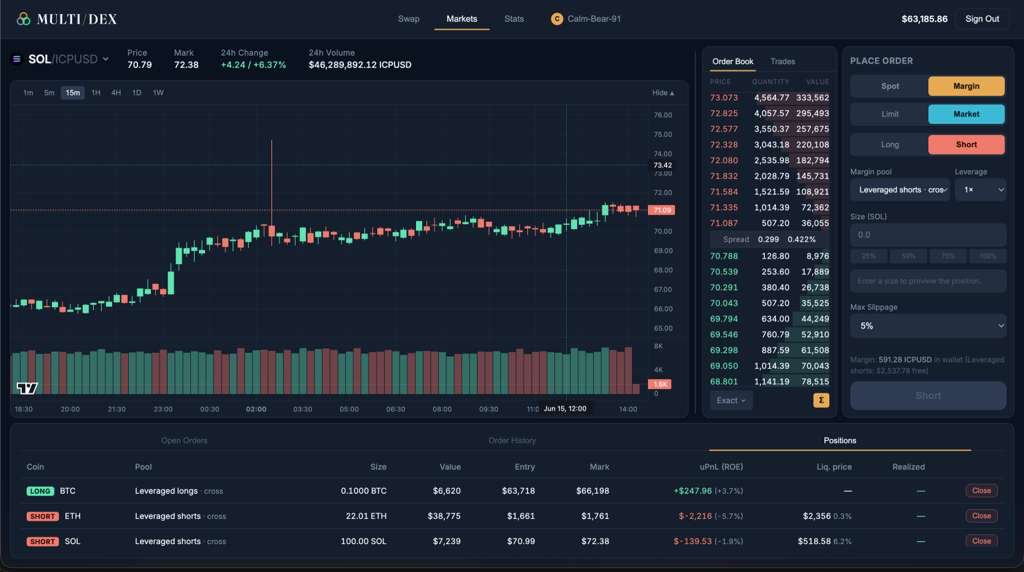
Hello MULTI/DEX 🔥 Should DFINITY release the most powerful DeFi application the world has ever seen?
What's cool about it? Here are some factoids, the craziest at the end:
1. It runs on an ICP cloud engine (soon everyone can have one) and is 100% network resident and tamperproof.
2. It is genuinely multi-chain, with no bridging hassles for users (users can deposit straight into their accounts, and withdraw directly, from the native chains of tokens).
3. It is order book based, but also provides a traditional swap interface, which swaps arbitrary assets by routing across the underlying markets.
4. It supports both spot trading, and margin trading that lets traders go long and short with leverage.
5. It has an AMM (Automated Market Maker) that uses Internet Computer outcalls to determine outside prices, then delayed matching against AMM limit orders to prevent arbitrageurs draining liquidity, as can occur with traditional DEXs providing swaps.
6. The AMM maintains a unified liquidity vault, and doesn't need two liquidity pools for every trading pair, providing outstanding capital efficiency and liquidity compared with traditional DeFi systems.
7. Users can earn by depositing into the AMM Vault, and into an insurance pool that protects the vault from margin calls that fail to recover all capital (the insurance pool gets 5% of all liquidations).
8. MULTI/DEX runs on the decentralized Internet Computer network, and is 100% open source — unlike HyperLedger, say, which remains closed source, and has an single-purpose architecture closer to federated CEX hosted on a symmetric cluster of federated servers.
9. If we go ahead, we would propose that MULTI/DEX runs as part of the Internet Computer, in the sense it is controlled and updated by the NNS (The Internet Computer's Network Nervous System, the world's largest and most sophisticated DAO, which directly orchestrates and updates the network) providing unparalleled levels of autonomy, transparency, and security.
10.... and this is the BIG ONE... its backend is built using the latest Motoko language framework (soon to be released) that puts AI *inside* of its software. That means, in another seminal inventive step from DFINITY and Caffeine Labs technology teams, that AI can see, browse and query the realtime data inside the app/dapp's persistent memory and can create and execute ad hoc queries and update logic on-the-fly (subject to permissions). So, while for much of the time traders will be using the traditional UX shown in the pic, increasingly, they will be interacting with the exchange through AI chats that have the "Internet Computer Connector" MCP installed (soon to be released). On the one hand, traders will be able to use chat to ask for simple things, like current spot pricing and market depth, and the likely slippage on a spot market order, and for orders to be submitted, but on the other, for much more demanding things that require the AI to execute ad hoc functionality, such as "Look at my positions and margin pools, and rebalance them to give me more blended market exposure, while also adjusting for risks indicated by social media coverage of forthcoming market events, but wait for my approval of your plan before proceeding."
This is a lot to take in, so I'm aiming to get a new demo video out ASAP that will demonstrate what's possible with this AIware, which will include MULTI/DEX — should be about a week!!
Btw. for those wondering what might be the big picture beyond what I just described with MULTI/DEX: At DFINITY, we are in the process of transforming ourselves into an "agentic organization," where all our existing apps/SaaS is replaced by custom on-demand apps/SaaS running on cloud engines that are created and updated by AI. Of course, these on-demand apps/SaaS are being built using the new technology described that automatically puts AI inside and provides users with fluid functionality via chat. The totality of the apps/SaaS represents an enterprise "World Model," which incorporates as much of the enterprise's data as possible, enabling AI to perform incredibly powerful analyses and actions — when you see this is in action, you can't unsee what you saw, because it's clearly a huge leap beyond the status quo of today's tech, which is exactly what the Internet Computer project is about. This wraps up our new technology stack, created by leaning on unique aspects of "The Network is The Cloud" paradigm, and years of work, and what, together with cloud engines, will finally enable the Internet Computer to strike out into the massive mainstream cloud technology market.
261
505
1,369
94,024
Josh ∞ retweeted
May 10
Dear ICP community, the Internet Computer has now been running strong for 5 years 👏👏👏
Here is a celebratory preview of ICP "cloud engines," the sovereign frontier cloud technology the network shall soon provide from opencloud.org.
Main points:
— Cloud engines enable anyone to spin up their own sovereign frontier cloud. The technology involves an extraordinary inventive step, in which cloud is created from a mathematically secure network of nodes. The nodes run as part of the Internet Computer network (internetcomputer.org) but are selected and configured by the cloud engine's owner.
— The frontier cloud provided by engines is strongly focused on enabling AI agents to build and update online applications and services for us. The world is changing fast, and nearly all new online apps and services are already being built with the help of AI, and thus cloud engines target the future of cloud.
— Software hosted on cloud engines is tamperproof, which means that it is immune to infrastructure hacks, because it runs inside a mathematically secure network protocol, rather than on computers directly. This means that AI agents, and those building with them, don't need to have a security team in the loop, or to trust someone else's security team. This is crucial, because in the future, non technical people will demand the freedom to build with full automation — where they just need to issue instructions to AI about what to build, and don't need to worry about anything or anyone else. Of course, apps and services running on engines are also vastly safer from the new breed of hacker being enabled by frontier AI.
(The cloud engines themselves are also "tamperproof." Even if a hacker gains physical access to some portion of a cloud engine's nodes, and can make arbitrary changes, the computations and data of the hosted apps and services cannot be corrupted or interrupted so long as the network's fault bounds aren't exceeded. The recent hack of Vercel, a major cloud platform, which gave hackers access to the apps it hosted, provides additional perspective on the importance of this advantage.)
— Software hosted on cloud engines is guaranteed to run, so long as a sufficient number of the engine's nodes are running. This means that AI can build applications and services without the need to have a human systems admin team constantly tinkering with the underlying platform to keep it running, which is again crucial, because in the future, non technical people will expect the freedom to use AI to build without the support of others.
— New frontier programming language technology, in the form of the Motoko language developed by Caffeine Labs, leverages seminal "orthogonal persistence" technology that unifies program logic and data to deliver further unlocks for AI (Motoko is the first computer language being developed that targets agents that are writing software rather than humans engineers per se). Nowadays, AI can build and update production apps at a prodigious rate, even at the speed of conversation. But it can also make mistakes, and there's a risk that an update it creates might be "lossy" in the sense it causes some transformed data to be lost. Again, in this new world, it's both undesirable and impractical for everyone to have to have a systems admin team on-hand to detect lossy updates and roll them back, but Motoko provides a solution: it can detect new software updates are lossy before they are applied, reducing potentially catastrophic errors by AI to harmless coding retries.
— Software hosted on cloud engines is "serverless" but unlike traditional serverless software, directly it directly incorporates data through "orthogonal persistence." Another key purpose is simplify backend software logic and fuel the modeling power of AI by increasing abstraction (sorry for the technical language!!!). Put simply, this enables AI to produce more sophisticated backends, faster, and at dramatically lower costs, as measured by the number AI API tokens consumed during coding. (Tip for the technical: orthogonal persistence is a new paradigm where "the program is the database," and data lives inside program variables, which is possible because it's as if hosted software runs forever in persistent memory).
— An expanding database of skills at skills.internetcomputer.org shall make it possible to develop and directly deploy apps and services to your cloud engines directly from Claude Code, Perplexity, Codex and other AI platforms. Further, your account on caffeine.ai can be connected, so that new apps and updates created through conversation automatically appear hosted from your cloud engine. In the future, R&D is going to be very seamless. You converse with AI, and your secure and unstoppable apps or services are created or updated. Cloud engines are designed to directly support this "self-writing cloud" future where we can work hands-free.
— Tech sovereignty is becoming a huge issue worldwide, with governments and corporations seeking to create sovereign tech stacks owing to geopolitical tensions. Increasingly, people are realizing that tech provided by foreign nations can come with hidden backdoors and kills switches, from the base platform, right up through hosted apps and services. ICP technology is open source, and those building on ICP using AI own their own source code. When you have the source code, you can verify that there are no backdoors, and when you own the source code thanks to AI, you can update it at will, freeing you from vendor lock-in. But cloud engines take sovereignty much further...
— You create a cloud engine by selecting the nodes that will be combined. You can choose the class of nodes used, and their number, but more importantly, you can choose who operates the nodes, and where they are located. Almost any configuration is possible, because the Internet Computer scales the security privileges afforded to hosted software within the network according to configuration (software hosted on cloud engines can directly interoperate with software on other engines and traditional subnets, but base restrictions are applied according to security rules). A cloud engine can be created within a region such as Europe, to comply with regs such as GDPR, or completely within a sovereign state like Switzerland or Pakistan. But cloud engines go further still...
— Sovereignty is also about freedom from vendor lock-in. Cloud engines are essentially ICP (Internet Computer Protocol) network configurations, and this means the underlying compute nodes they combine can be swapped out without interrupting their hosted apps and services. This is a big deal. In addition, cloud engines now support nodes that are instances running on Big Tech's clouds, in addition to nodes that are dedicated specialized hardware, as per the Gen I and Gen II nodes that dominate the Internet Computer today. For example, it is possible to have an engine running across different AWS data centers, say, and then reconfigure the engine to run across a mixture of AWS, Google, Azure and Hetzner for even more resilience, without the users of hosted apps and services noticing a thing. That's true freedom.
— Sovereign AI is becoming increasingly important too, and cloud engines allow special "AI nodes" to be added to them, so that hosted software can perform inference on hardware provisioned by the owner from a location the owner has selected. Even though the AI nodes are only accessible within the cloud engine, they can still benefit from the forthcoming Internet Intelligence Gateway (IG), which will make it possible to validate inference performed on key frontier open weights LLMs, even when the inference is performed on completely independent AI clouds. When the results of inference are received, this technology can verify that neither the prompt context (input) nor the inference result (output) have been modified, and that the results were produced by the precise LLM expected. This ensures that AI clouds don't cheat by running inference on cheaper models than are being paid for, and bad actors aren't modifying the inputs or outputs to surreptitiously insert advertising into results, say, or change facts, or insert malware when code is being generated. What's super cool about this technology is the cost of the verification is scalable. A very valuable additional security can be achieved with only 1-2% of extra cost.
— Scaling apps and services when they hit capacity limits is another thorny problem that cloud engines help the world address. Engines make scaling possible without rewriting or reconfiguring software. The query workload capacity of hosted software can be horizontally scaled simply by adding new nodes to an engine, and nodes can also be added in geographical proximity to demand. Meanwhile, update workload capacity can first be scaled-up by swapping an engine's nodes out for the next class up, and then when no larger class of node is available, horizontally scaled-out by "splitting" the engine into two, which doubles available capacity. (Technical tip: horizontally scaling update capacity by splitting engines requires multi-canister architectures).
— For those who have been following how Caffeine builds apps that can efficiently store large numbers of files, I should mention that apps built on cloud engines will also support the new ICP Blob Storage cloud network (since cloud engines currently have up to about 3 TB of memory, which apps storing large amounts of files can easily exceed). We are also working on allowing blob storage nodes to be added to cloud engines, to enable sovereign mass blob storage within an engine, similarly to how AI nodes can be added currently.
— Lastly, but certainly not least, I should mention that cloud engines are multi-blockchain capable, and ready for digital assets, thanks to the clever math at their core. For example, an e-commerce service built on a cloud engine can securely accept and custody stablecoin payments, or a multi-chain DEX could be hosted. Further, engines can support software autonomy (software orchestrated and controlled by other autonomous software, in a decentralized way) and can themselves be orchestrated by SNS technology, and thus run autonomously too.
Today, though, the focus is on *mainstream* cloud. This year, the cloud industry will generate approximately one trillion dollars in revenue. That number is already huge, but is expected to grow to two trillion dollars by 2030.
After years of continuous development, which have seen more than $500m spent on R&D, the Internet Computer network is now tacking directly toward this mainstream cloud market with cloud engine technology.
In their first version, cloud engines are not meant to be a cloud panacea. For example, currently they are not ideal for working with big data. You should use something like DataBricks for that.
Cloud engines are carefully targeted at enabling AI to produce traditional online applications and services, including SaaS, in a safer and more productive way, which represents a new market segment with tremendous potential. Of course, DFINITY will continue to work relentlessly to push forward ICP's capabilities, so expect further developments.
It's worth mentioning that this cloud segment isn't just about creating new apps and services using AI, it's also about replacing legacy systems and apps built on super expensive SaaS services. Caffeine Labs is working to produce technology (Caffeine Snorkel) that can study an enterprise's legacy systems and app built on SaaS, create replacement systems and apps, and migrate the data, while supporting key stakeholders through the process over email and chat, with full automation. Thus the legacy systems and SaaS markets shall also be addressed by cloud engines.
Zooming out, and reasoning in a more metaphysical way, we believe, as we always have, that there is room for a new kind of cloud created by mathematical networks, that provides seminal advances in the fields of security and resilience, as well as true sovereignty and freedom from lock-in. That this same technology, with the help of additional technologies like orthogonal persistence and Motoko, enables AI to build for us without the need for so much oversight, and to create more backend sophistication while consuming fewer AI API tokens, enables ICP to bring game-changing advances to the world.
Cloud engines will work synergistically with the Intelligence Gateway, which will enable apps and services running on engines to seamlessly leverage AI, wherever that AI is running, while providing verifiability at extremely low cost for open weights frontier models.
We believe that cloud engines represent an inflection point in the storied history of the Internet Computer project, and I'm very proud to be sharing the details with you on the network's fifth birthday 💪
I'll be back with more news soon!!
235
674
1,921
227,876
Josh ∞ retweeted

Apr 10
Build with @caffeineai, deployed to $ICP:
Mountain peak finder
Caffeine is crazy!!
31
95
466
28,450

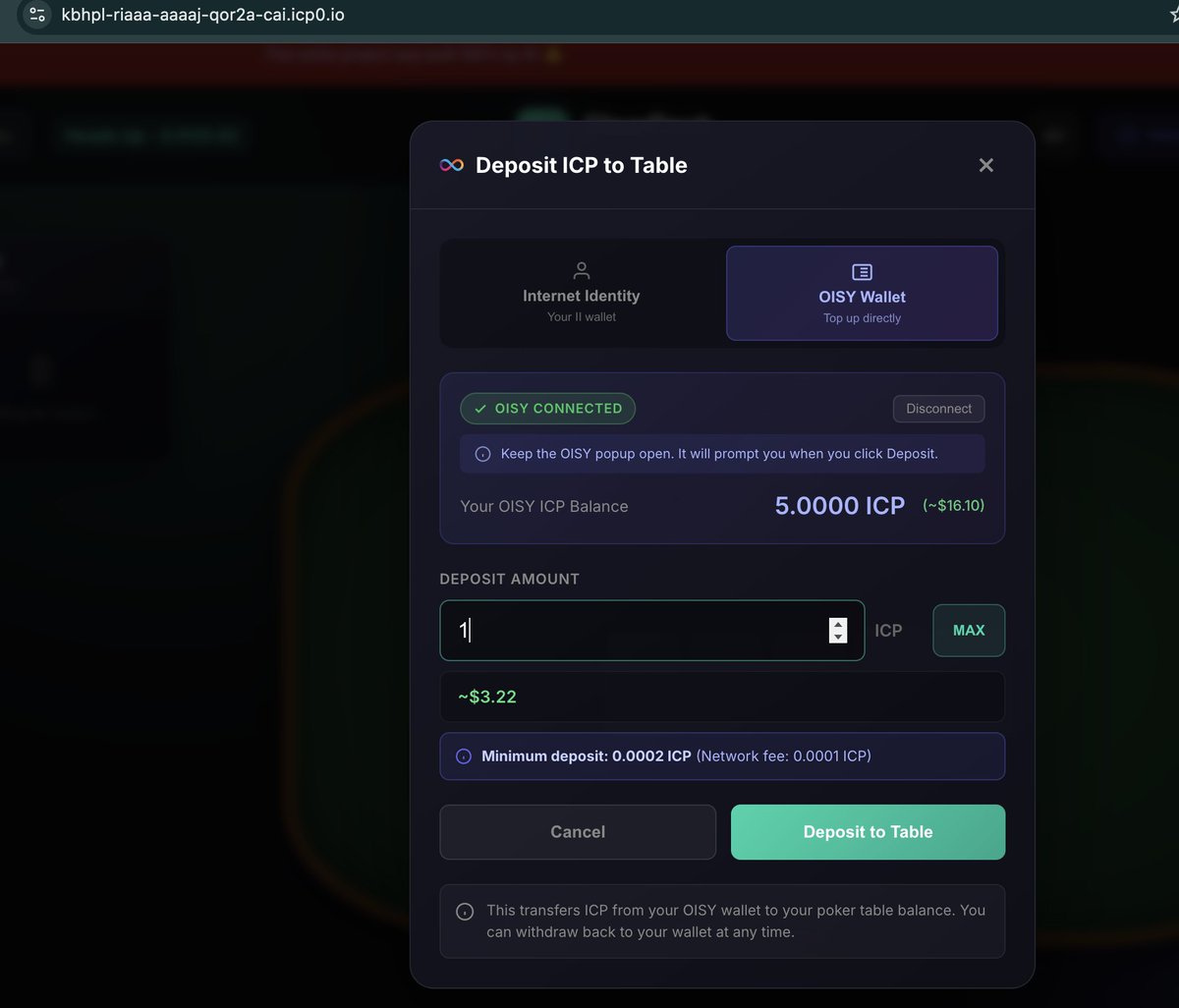
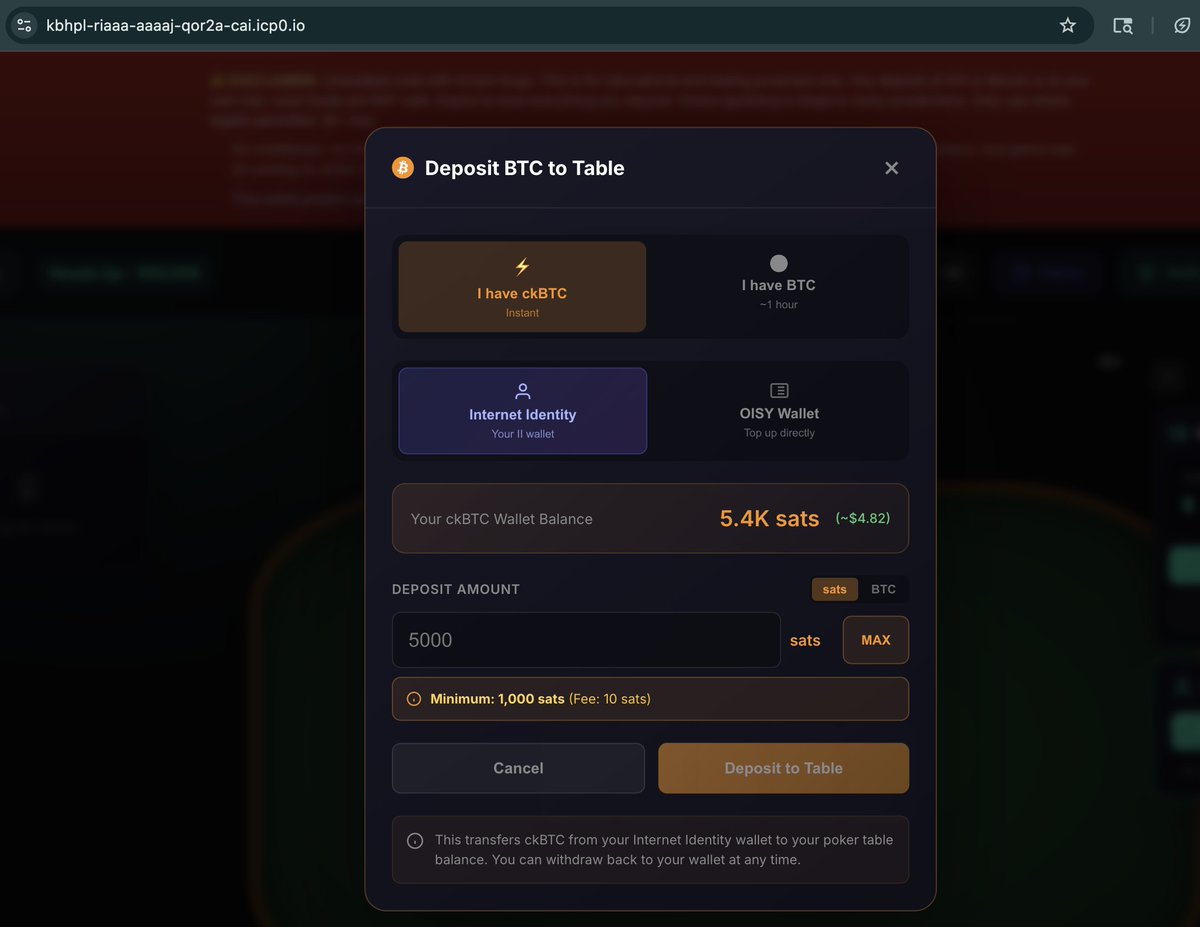
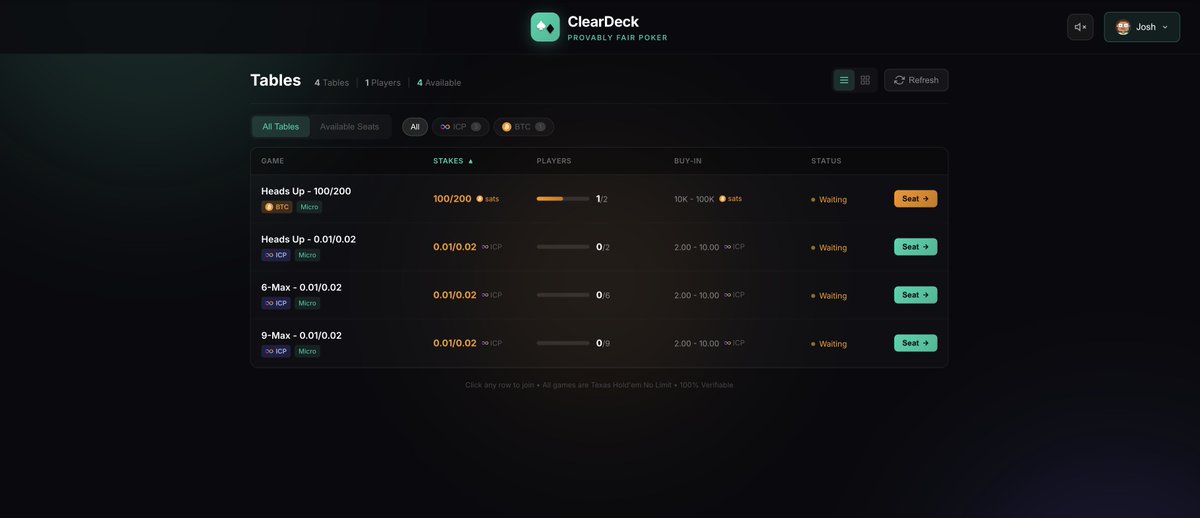
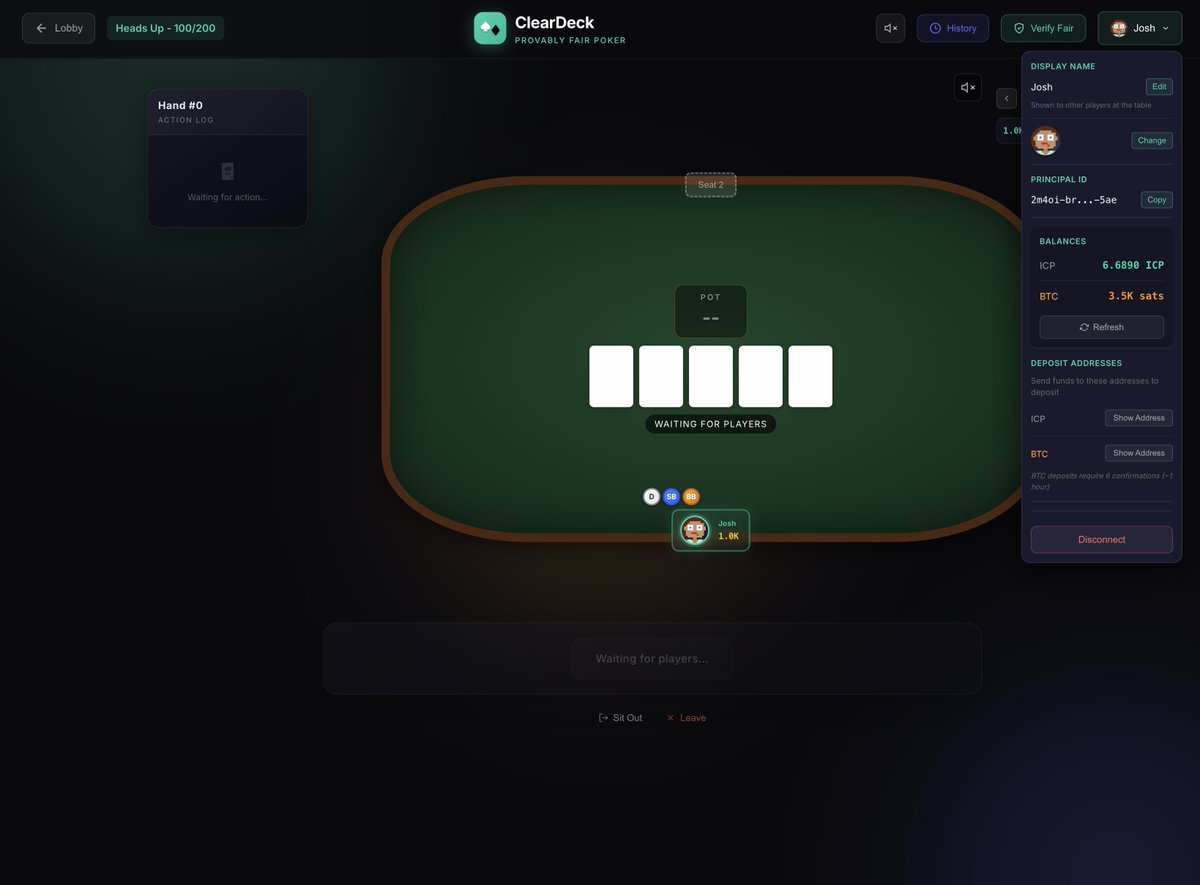
ClearDeck - provably fair poker on ICP
Built a full decentralized poker app:
Rust backend with IC VRF for verifiable shuffles
SvelteKit frontend
II auth, ICP & ckBTC support
Commit-reveal cryptography
Full hand history, time banks, multi-table support.
github.com/JoshDFN/cleardeck
100% AI coded. @claudeai
Demo: kbhpl-riaaa-aaaaj-qor2a-cai.…
For educational purposes only. Unaudited alpha software.
Feedback welcome! #DFINITY #ICP #poker #onlinepoker #claudeai

28
79
324
55,705
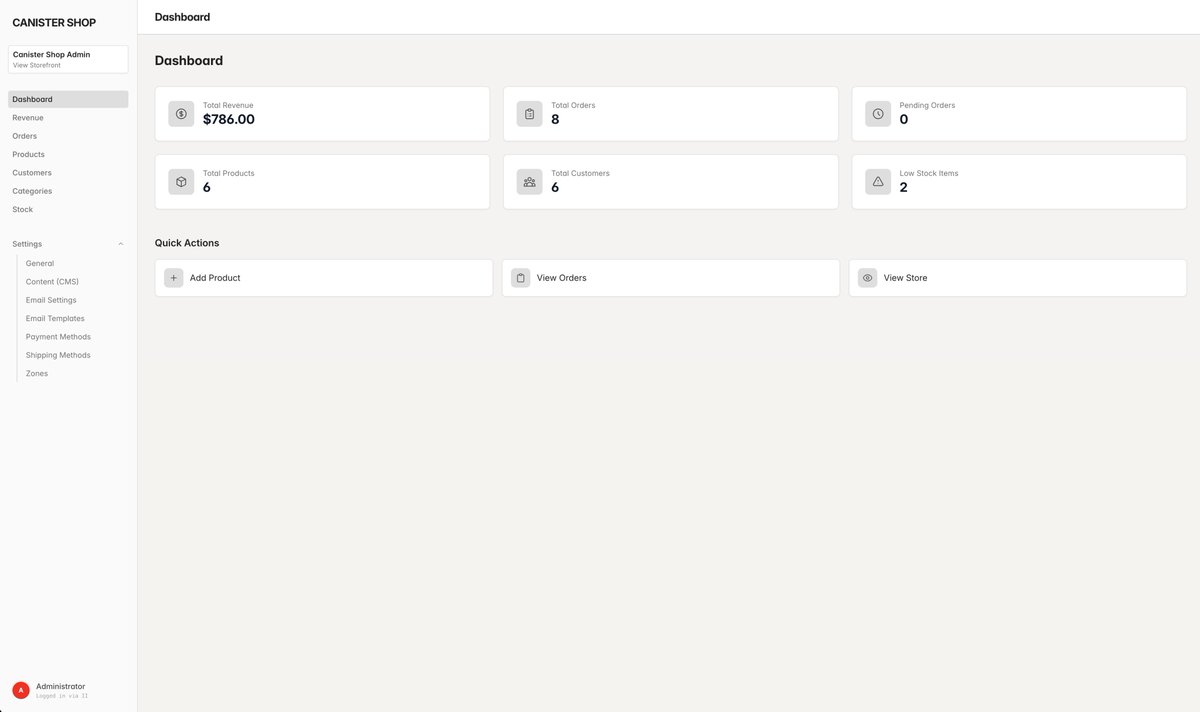
IC Commerce - open-source e-commerce platform
Built a full e-commerce solution:
- Rust backend with ic-sqlite for persistent storage
- React/TypeScript frontend
- II auth (first login = admin)
- Stripe paymentsFull admin dashboard, inventory management, orders, shipping zones, etc.
github.com/JoshDFN/ic-commer…
100% AI coded.
Data model inspired by github.com/solidusio/solidus Feedback and contributions welcome! #DFINITY #ICP
15
41
158
11,987
Josh ∞ retweeted

8 Dec 2025
Trail of Bits has completed a security audit of @OISY
The review found no high-severity issues. A handful of lower-severity findings were identified across testing, configuration, and data handling.
Many findings have been addressed, with fixes reviewed and verified ✅
🔗 Full report past audits: dfinity.org/third-party-secu…
Big thanks to the @TrailofBits team for the thorough review and great collaboration.
14
43
241
10,318
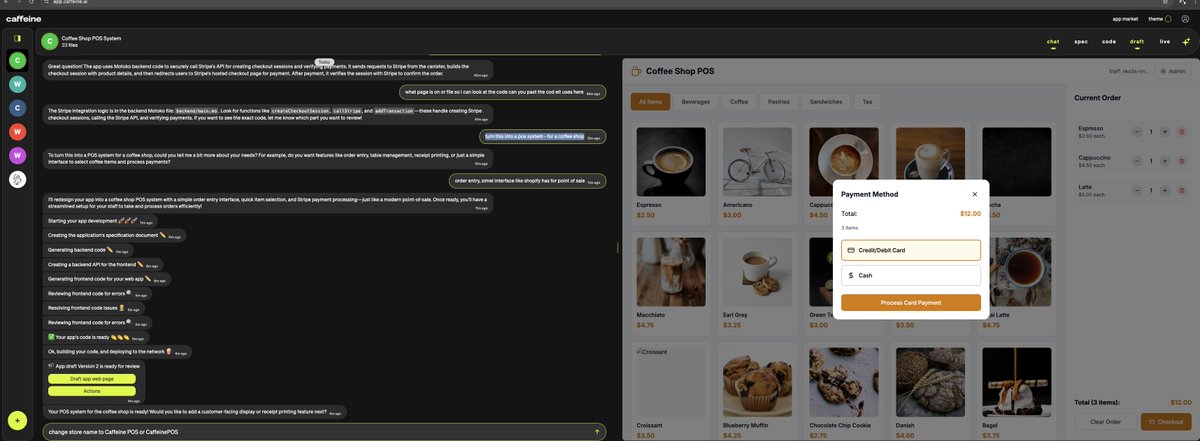
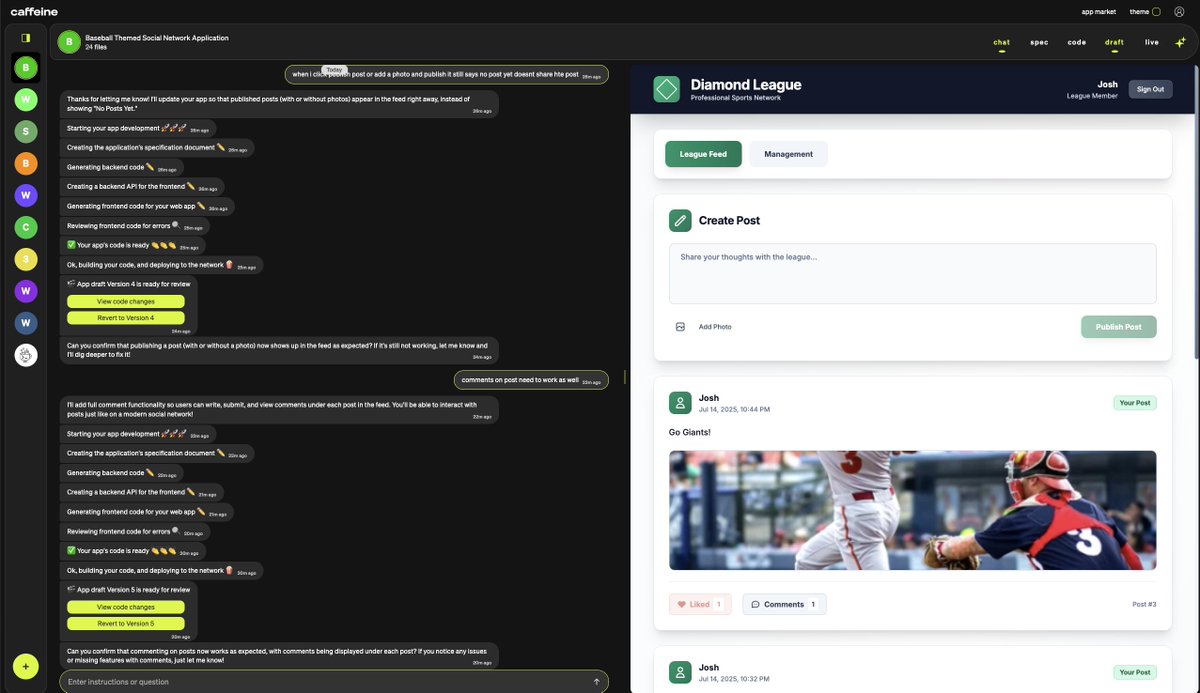
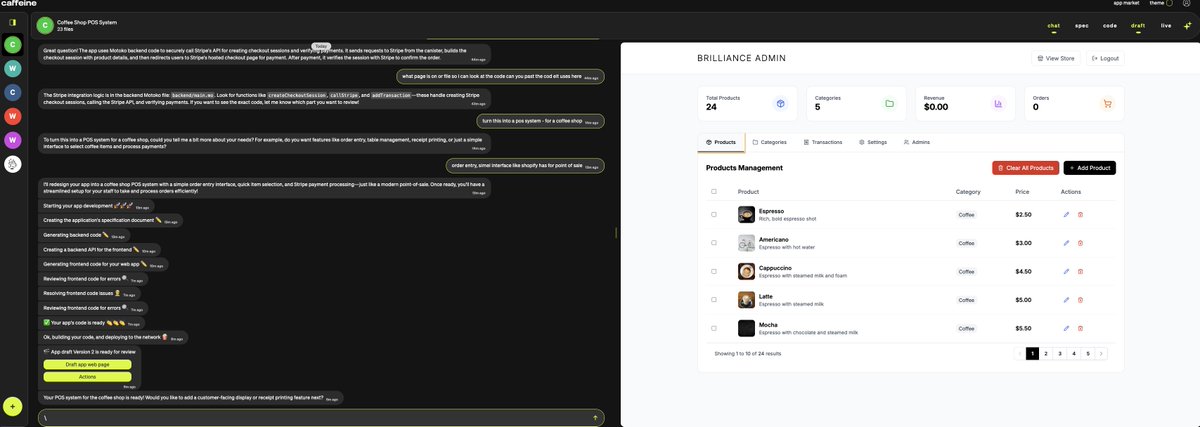
I cloned the Brilliance Jewelry App from Caffeine AI marketplace and rebuilt it as a POS for a coffee shop ☕️ in two prompts #ICP #CaffeineAI
58
110
546
43,441
Josh ∞ retweeted

13 Jun 2025
Heads up San Francisco 🇺🇸
Join us for a day to explore the Self-Writing Internet:
🗓️ July 15 | 🕙 10 AM–10 PM PDT
📍 San Francisco | Dogpatch Studios
🌐 Livestream
🎟️ RSVP: lu.ma/hello-swi
Highlights:
- Main Stage: Keynotes, demos, panels, and presentations.
- Hackathon: A high-energy builder zone for technical and non-technical participants.
- Caffeine Experience Pods: Stations open to everyone looking to test Caffeine.
See you there!
62
267
1,030
4,061,929
Josh ∞ retweeted
24 Mar 2025
Super exciting watching the Bitcoin community leverage Internet Computer Protocol (ICP) and chain key #WorldComputer #BitcoinDefi 💪💥
forum.dfinity.org/t/introduc…
37
212
728
24,784
Josh ∞ retweeted
6 Mar 2025
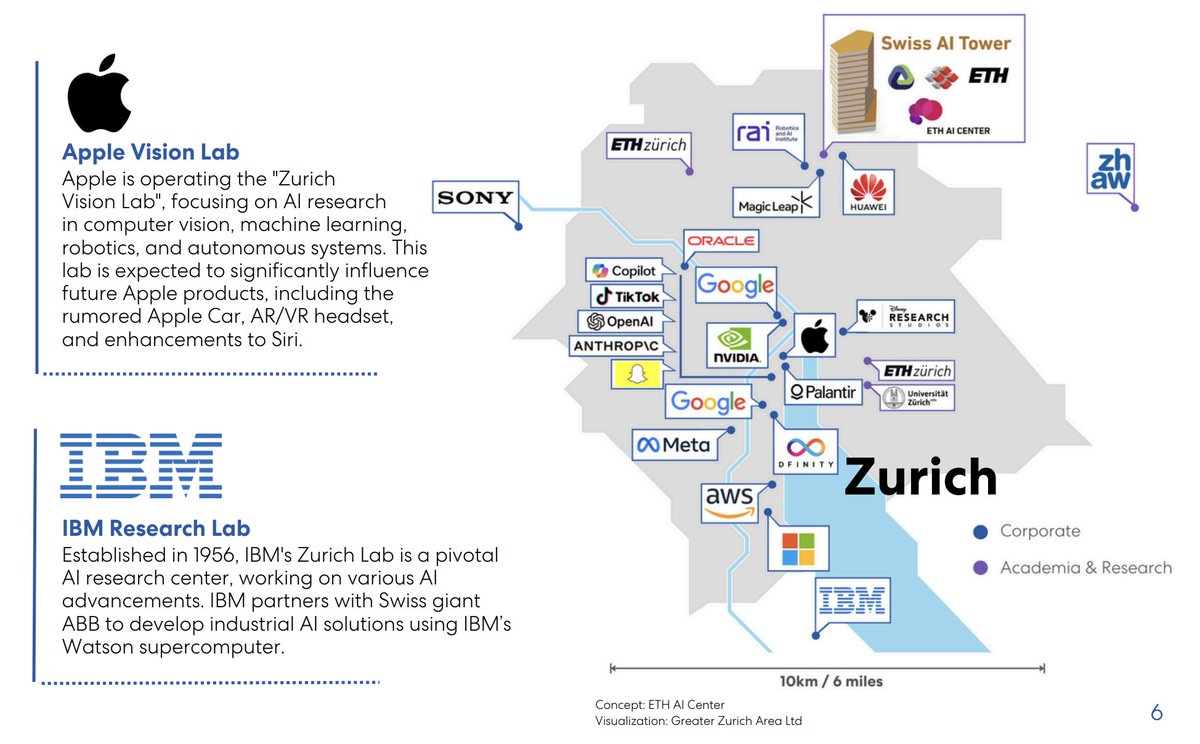
Zürich, Switzerland 🇨🇭 is a HUGE new hub for deep tech talent, particularly in the field of AI. I'm very proud to say that DFINITY/ICP puts crypto on the map with the Big Tech powerhouses 🧵
99
318
1,208
78,191

Josh ∞ retweeted

12 Feb 2025
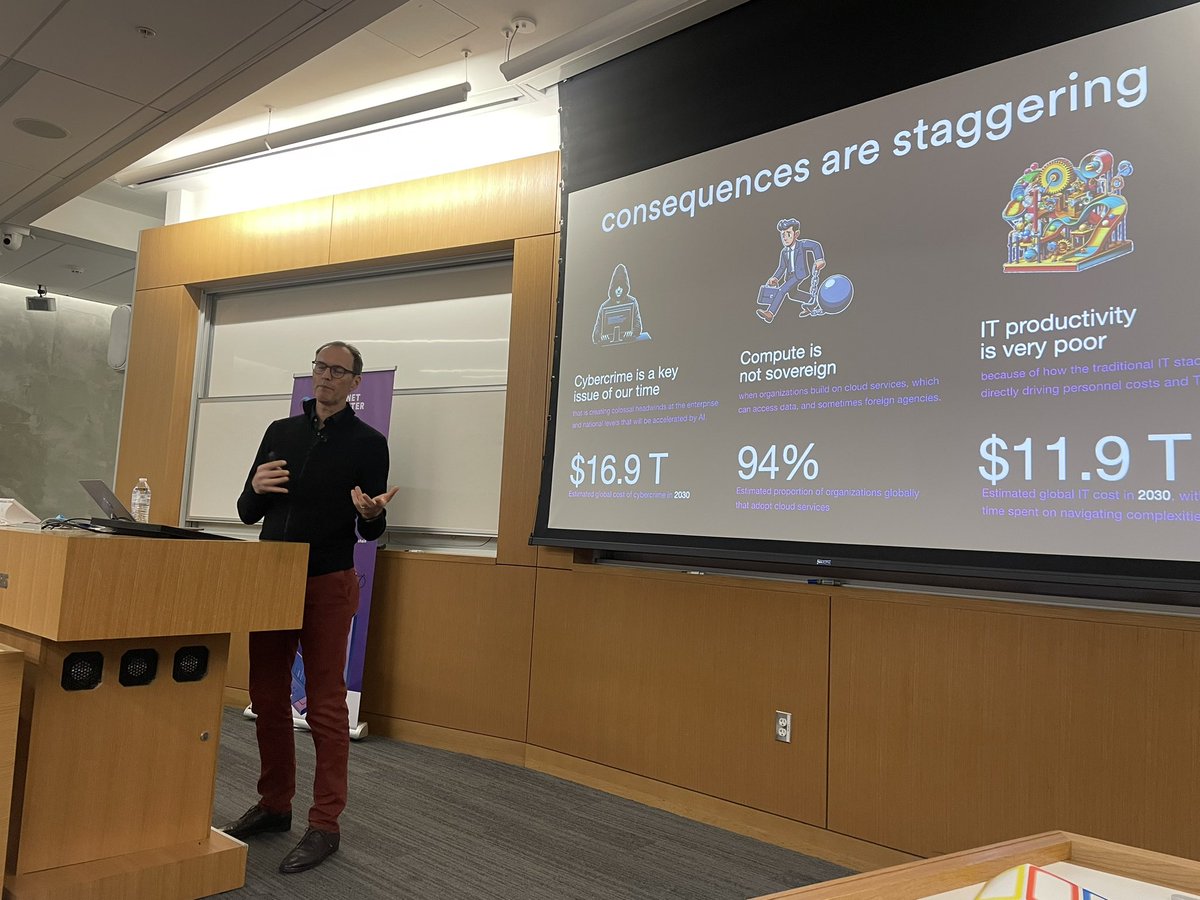
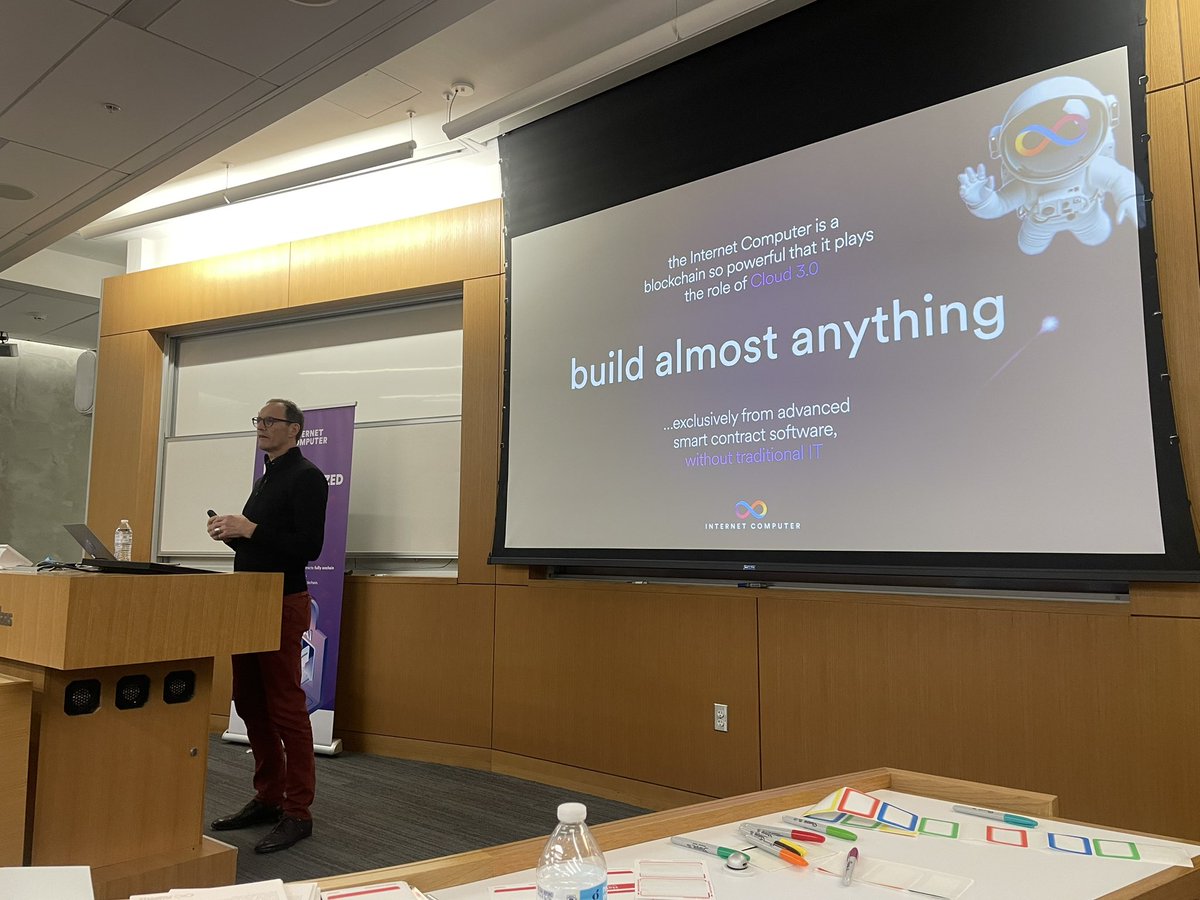
ICP deep dive with @JanCamenisch at @CalBlockchain, covering @dfinity, cryptography, and decentralized systems. Easily one of the smartest humans I know. Pretty sure he dreams in encryption while I’m still resetting my passwords. 😂
12 Feb 2025

🔴 Live now at Haas Berkeley Blockchain Club with @JanCamenisch
Join us as we dive into cryptography, privacy, and security in decentralized systems with the CTO of @dfinity.
5
15
87
11,339
Hey guys just wanted to address the clerical error when updating the Swiss registry for the Dfinity Foundation. My role as COO of Dfinity Research USA remains the same as it has been for years. Dom remains the Foundation’s President and Chief scientist and we remain laser focused on ICP and its ecosystem under his leadership. All business as usual.
26
74
354
16,324
Josh ∞ retweeted
27 Jan 2025
By popular demand, here's a detailed post about caffeine.ai and the forthcoming "self-writing internet" (SWI) paradigm we in the ICP community are working to realize 🌐🧠
If you prefer pics, checkout my deck at deck.icp.ai. Otherwise here goes...
Caffeine is meant for everybody. Using natural language, anybody will be able to create sovereign websites, web apps and internet services.
It might be an individual wanting to create something like a personal branding website, wedding planning app for their family, or portal for a sailing club. It might be an entrepreneur lauching an e-commerce website, or a sharing economy app with advanced Web3 rails. It might be a company or gov. dept. that needs a corporate portal, or some specific CRM (Customer Relationship Managment), ERP (Enterprise Resource Processing) or ARP (Accounts Receivable Processing) functionality.
The SWI paradigm is broad, and it involves anyone and everyone being able to create and own anything online from scratch, just by talking to AI. Over time, as the paradigm becomes more and more powerful, this will increasingly empower, democratize and decentralize tech worldwide.
Today, Large Language Models (a type of AI) have already become very good at writing code, and their abilities are continuing to improve rapidly. The Caffeine platform leverages this ability in combination with new specialized SWI infrastructure and technology that is being deployed to the Internet Computer network. This new tech infra has been especially designed to empower and enable AI to build effectively and safely solo on receipt of natural language instructions, without receiving any technical assistance from humans.
Caffeine has also been carefully designed to allow technical people, such as engineers and user experience designers, to build alongside AI, with purposes such as accelerating time-to-market, dramatically reducing costs while increasing quality, and using the AI as a tutor to learn new skills.
It's important to know that AI building apps solo is only one part of the SWI paradigm. It also involves apps and services being created on the decentralized internet, rather than inside some company's proprietary centralized platform, and drawing on this difference to provide 4 very important, defining characteristics:
1. Sovereignty
The SWI paradigm produces apps and services that become accessible via URLs (the addresses we enter into web browsers) that are *sovereign.* This property results from them being entirely hosted (running) on a decentralized, public network, in exactly the same way a bitcoin token lives on the Bitcoin blockchain. They are constructed from secure network-resident code/next-generation smart contracts, without any centralization or traditional backend IT needing to be involved, such as cloud computing services. This means that apps are not dependent on intermediaries that might censor them, or which might inflict harmful actions like massively hiking prices, which services typically seek to make them captive customers by locking them into their platforms. In addition, the underlying software and data of apps created by SWI belongs exclusively to their owners (which might be humans, an organization, DAO or yet another kind of entity), further preventing intermediaries gaining leverage. In production, these sovereign apps are controlled by a wallet (or assigned to a DAO, say), rather than a cloud account operated by a company.
2. Tamperproof security
Those building using traditional IT often euphemistically say their web apps and services are "secure," because they have carefully configured their cloud accounts to prevent exploits, and have purchased cybersecurity measures to protect hosted platform software like databases and their traditional custom code. However, in reality, such traditional IT infrastructure can never be truly secure, since the cybersecurity protections involved are highly fallible. In complete contrast, the websites, web apps and internet services created on SWI are "tamperproof," which means they are fundamentally secure, and don't need traditional cybersecurity measures for extra protection. This makes it much easier for AI to build solo, and also frees app owners from having to trust that centralized traditional IT service providers and SaaS platforms will successfully keep their data and systems secure using cybersecurity systems, which they cannot guarantee even if they wish to, because traditional IT is fundamentally insecure, and can only be patched by cybersecurity measures.
3. Updatable in production
The SWI paradigm requires that the owners of the apps and services produced can update them almost in real-time, simply by issuing additional natural language instructions to an AI, essentially evolving them at chat speed (in practice, with owners issuing instructions, and then refreshing the URL where their app is located). If you are non-technical, I need to tell you that this requirement is far more challenging than it might sound. Firstly, the process of upgrading/updating apps running in production must be sufficiently swift to occur at chat speed, which requires that the data involved can be transformed into new formats quickly. Secondly – and this is the really tough one – it is required that when the AI modifies the underlying software logic, and performs any required transformations/migrations of the app's data, that no data is accidentally lost, for example because the AI has made a mistake, which LLMs will continue to do because of the way they work, even as their overall abilities continue to improve.
4. Trustless Web3
SWI apps can incorporate many different types of functionalities, including AI functionalities. But there is a form of functionality that cannot be safely implemented on traditional IT stacks: Web3 functionality. SWI apps can securely hold and process tokens on multiple blockchains, trustlessly and seamlessly incorporating them into their own functionality, without requiring users use cumbersome traditional crypto wallets, which undermine user experience, and are themselves are vulnerable to hacks. The Internet Computer, in combination with the traditional blockchains it is directly interoperable with, forms a World Computer. The Internet Computer already hosts many onchain services that process tokens from multiple traditional chains, without the involvement of bridges and other systems that are often centralized in practice (note that in Web3, oftentimes people refer to apps built in a centralized way using traditional IT, which run on servers and compute platforms like Amazon Web Services, as "onchain," simply because they have an associated token, but in reality of course they are not, and therefore, cannot provide these guarantees). A great example of what's possible with the fully network-resident paradigm is , OpenChat, an open internet service that runs on the Internet Computer, which enables its users to instantly send bitcoins, ETH and SOL inside chat messages (the Internet Computer's "chain key" technology enables it to play the role of a kind of Layer 2 for blockchain assets). SWI will be able to build apps and services with similar functionality. Where required, those apps can also maintain their own treasuries using stablecoins (e.g. tokenized dollars) and other crypto innovations.
DFINITY is performing a wide range of technical work related to SWI. For example, we have an AI team that works with LLMs to make them better at coding SWI apps using specialized training and RAG infrastructures, and we are working to make efficient, seamless ICP network scaling even better, in anticipation of increased demands on the network created by SWI, and many other things, but in this post I'll talk more about our Motoko work.
Technical note (skip don't balk!): The Internet Computer hosts an entire serverless cloud, in which canister smart contracts are hosted and run, within a "virtual execution environment," which leverages the WebAssembly/Wasm virtual machine. (The virtual execution environment is hosted with the network's stateful decentralized network protocol, which is called Internet Computer Protocol, or ICP, which the network's sovereign node machines process).
This means both human developers, and AI, can write code in any programming language that compiles to Wasm byte code. Several languages are now popular in the ecosystem.
However, back in 2018, 3 years before the network launched, DFINITY decided to develop a completely new programming language for ICP platforms, called Motoko. Aside from applying advanced emerging concepts in programming language design, we were pursuing a number of objectives with Motoko:
1) To create a new, broadly accessible, simple-to-learn language, that was nonetheless powerful enough to build complex systems (addressing shortcomings of simple languages like JavaScript).
2) To create a language that leveraged special aspects of the Wasm virtual machine standard.
3) To create a language that was specifically designed for the Internet Computer's virtual execution environment, and some of the incredible advancements in the field of compute that it provides (in technical speak, Motoko is DSL/domain specific language).
Motoko is far more sophisticated and powerful than something like Solidity or Move, and developing a new language from scratch is not a simple undertaking, but we set to the task.
We were no doubt helped by the team being initially led by Andreas Rossberg, a co-inventor of WebAssembly, and leader within the Wasm community, who joined the DFINITY team in early 2017. He helped form a brilliant languages team, which continues to carry the torch today.
At some point, we realized that when AI builds solo, it might benefit from a language like Motoko, and thus, critical aspects of the language's design are being developed to empower human and AI developers alike.
Prima facie, without any special training, LLMs coding using Motoko already make far less mistakes than using Rust, an increasingly popular modern systems-programming language – despite their being far more training material available for Rust, in the form of online documentation, and open source code repositories.
But by developing special materials for training LLMs, and new technologies for Motoko, we are taking this much further.
One of the key advancements provided by ICP, is that software runs within a compute environment that providing something called "orthogonal persistence" (but don't balk, this is easy, keep reading!!)
This essentially means that software logic runs within persistent memory pages, and it's no longer necessary for developers to use database servers and file systems to persist data. In a sense, logic and data have become one, because developers can just define logical abstractions, and the data then automatically persists within them.
In summary, orthogonal persistence:
1) Massively simplifies software design, making it more abstract, which greatly helps AI.
2) Improves performance, since application data no longer has to be copied in and out of databases and files (this is part of the magic that allows, say, a social network to be built on the Internet Computer, while there is still not a single traditional blockchain that cfan store a simple photo taken with a phone).
Motoko development is leaning into orthogonal persistence, and I expect within 10 days, will release "enhanced orthogonal persistence," or "EOP," which takes things further still, especially with respect to AI empowerment.
With EOP, when canister smart contracts written in Motoko are upgraded, where the structure of data does not need to be transformed, it can be left completely alone during upgrades. This is another simplification, which will greatly help human and AI developers alike. But there's more...
When the SWI paradigm creates complex web applications and services online, inevitably changes to the structure of data in memory may occur.
For example, image an e-commerce website, with a Product object. The owner of the site might decide they wish to add comments functionality to listed products, which would require a Comments field being added to Product. At this stage, during the upgrade, the old Products objects must be transformed into new Products objects, and with EOP, some migration logic must thus be created.
EOP ensures that transformations can occur quickly, which is crucial for allowing SWI apps and services to be upgraded at chat speed, but it also addresses an even more important need.
Due to their design, LLMs will always occasionally hallucinate, and even though they are smart, they will make mistakes (and considering they are coding hundreds of times faster than humans, this is no surprise). What then if an AI building solo makes a mistake in the migration logic, causing app or service data to be lost?
For example, what if the AI defined the new Product format, adding the required comments feature, but in the process caused previously entered product data to be lost? (Of course, Caffeine will provide snapshotting and restore functionality, but this is last resort, not something a non-technical developer simply talking to build will want to use.)
The answer is that in EOP, when an upgrade is installed, the Motoko language platform checks the migration logic against the currently installed version to check that no data will be lost – and simply fails if it would be, forcing the AI to try again.
This is called "loss safe" programming, and it was invented at DFINITY.
I understand this is a bit of a technical story, but hopefully you can see that the "updatable" requirement of SWI is challenging to implement in practice, and thus that EOP delivers another groundbreaking ICP advance that will help AI and human builders alike.
None of this comes easy. Many aspects of EOP were envisaged back in the early days, but it has taken many years to realize the technology.
What is clear, is that AI must be empowered to build solo, because that is the future: AI is not human, and in the SWI paradigm, AI is required to build and update apps and services extremely rapidly, at the speed of chat.
To make all this possible, the bottom line is that AI requires its own environment to build in.
ICP already provides a tamperproof compute environment, so that a mistake by AI cannot lead to a hack and data exfiltration, or the installation of ransomware say – it is truly secure.
ICP already provides an unstoppable compute environment, relieving AI of the need to create things like failover and backup and restore systems, massively further simplifying software logic, enabling the AI to focus on what, not how, and further reducing the risk a mistake might cause data to be lost.
Now, Motoko's EOP will further accelerates upgrades on ICP, allowing them to run at chat speed, and most importantly, creates guardrails that prevent a simple mistake by AI causing data to be lost.
Of course, this is not all, and over time, I will have more to share with you about our SWI work.
What I hope I have conveyed, is that SWI is a new and emerging technical field, which is one that the Internet Computer, and the ICP community, is uniquely positioned to capitalize upon
In the future, human developers will build alongside AI developers (to reduce friction, we are also developing an in-browser development environment, called icp.ninja).
But also in the future, all 8 billion humans on earth without technical skills will also gain the ability to develop and own tamperproof and unstoppable sovereign websites, web apps and internet services, just by speaking in their local natural language.
When we release Caffeine, that will be only a beginning of a long and incredible journey into the future.
The SWI paradigm has no limits. As AI gets smarter, and as Caffeine, and the underlying SWI technology and infrastructure on the Internet Computer improves, it will be possible to create increasingly advanced apps and services.
Individuals, entrepreneurs, businesses, and governments, will increasingly choose to leverage SWI to create sovereign custom apps and services that are completely under their control, that they can update, customize and improve just by talking at any time of their choosing, and which slash their time to market and costs by orders of magnitude compared to today's tech – and the total addressable market will become unimaginably vast.
We want the SWI to explode on the Internet Computer, and are working towards that goal.
More news soon 💪
128
429
1,292
82,150
