Mar 15

Markets are notoriously slow to price architectural differences.
Especially when systems appear superficially equivalent:
blocks, transactions, tokens, validators, narratives.
But structural distinctions do not disappear because attention ignores them.
They wait — quietly — until reality forces the market to see.
The first phase of AI rewarded visible intelligence:
models, interfaces, benchmark superiority.
The second phase rewarded hardware concentration.
NVIDIA became the clearest symbol of that stage as compute turned into strategic gravity.
But infrastructure history rarely ends where visibility begins.
As systems mature, value tends to migrate downward — toward layers that remain indispensable even when narratives change.
That is where AI starts leaving the category of product
and entering the category of territory.
Not physical territory.
Operational territory.
A place where intelligence can persist, execute, interact, and remain governed under explicit rules.
The current AI crypto landscape already reveals different strategic layers.
Bittensor prices coordination through incentive alignment.
Render prices distributed GPU access.
Internet Computer remains structurally unusual:
not one layer,
but the full stack territory requires —
compute, storage, serving, identity, governance, and execution integrated directly at protocol level, without external cloud dependence.
So the real question is not which project carries the strongest narrative today.
It is which architecture remains indispensable once narratives compress and only functional dependency survives.
Because when intelligence touches finance, identity, and critical systems,
architecture matters more than spectacle.
Some assets price one strategic layer.
One attempts territorial integration.
That does not guarantee outcomes.
But it changes the nature of what is being accumulated.
When systems begin behaving like territory,
percentages stop feeling abstract.
If one had to rank structural AI weight honestly, the order would likely be:
1 #InternetComputer
Because it integrates the most complete operational territory:
• compute
• storage
• serving
• identity
• governance
• direct execution
• persistent agents
• on-chain inference
• no external cloud dependence
It is the only system in this list attempting to become habitat, not merely layer.
2 #Bittensor
Because it solved a highly powerful layer: economic coordination of intelligence.
• model production incentives
• subnet organization
• internal intelligence marketplace
A remarkably strong coordination layer.
But not full territory.
3 #Render
Because GPU access will remain critical for years.
• rendering
• inference support
• distributed compute markets
Highly valuable while compute bottlenecks remain central.
But still dependent on higher operational layers where systems ultimately live.
4 #NEAR Protocol
Because it is moving toward agent-native architecture:
• account abstraction
• AI-oriented user design
• machine-friendly UX
Important direction, though still lighter structurally.
5 #Virtuals Protocol
Because it captures emerging agent narratives:
• agents
• creator economy AI
• social AI dynamics
Interesting, but structurally lighter.
If AI eventually becomes civilizational infrastructure, compression may become sharper:
Internet Computer
Bittensor
Render
Because in the end, intelligence still depends on only three conditions:
coordination
compute
territory
Bittensor organizes intelligence.
Render powers intelligence.
Internet Computer attempts to become where intelligence
#WorldComputer #AIInfrastructure #ICP

1
228
Artificial Intelligence is becoming abundant.
Computation is becoming scarce.
Infrastructure is becoming strategic.
The future of civilization may depend on who provides computation.
THE COMPUTATION AGE #ICP
A Special Chapter from The World Computer Files ∞ Series.
#WorldComputerFiles #Documentary #InternetComputer #WorldComputer
Jun 12
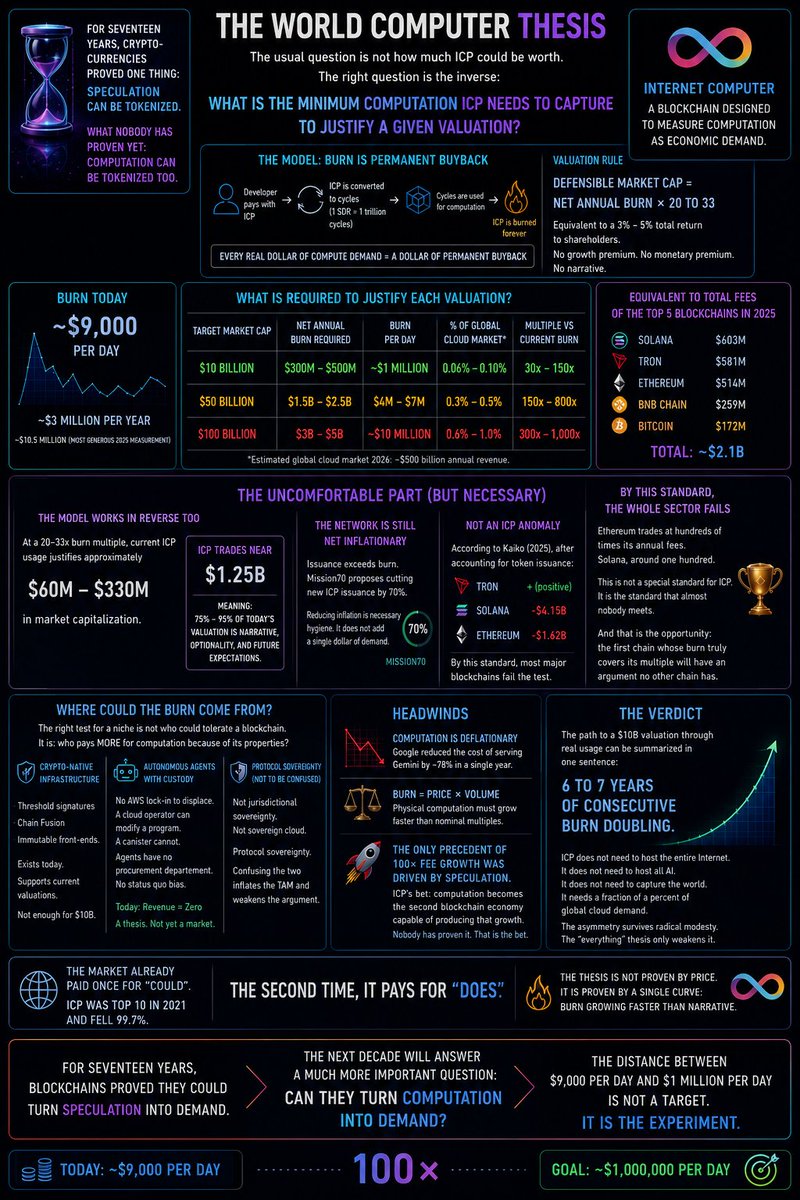
THE WORLD COMPUTER THESIS ∞
For seventeen years, cryptocurrencies have demonstrated one thing:
They can tokenize speculation.
What they have not yet demonstrated is whether they can tokenize computation.
That is the World Computer thesis.
And the usual question — How much could ICP be worth? — is the wrong question, because any number can answer it, and none can test it.
The correct question is the inverse:
What is the minimum amount of computation #ICP must capture to justify a given valuation?
That formulation forces us to answer with economics rather than narrative.
THE MODEL
In ICP, computation burns the token.
Developers convert ICP into cycles at a fixed rate — 1 SDR per trillion cycles — and the ICP used in that conversion is permanently destroyed.
Every real dollar of computation demand becomes a dollar of permanent buyback.
A perpetual buyback can be valued with a simple framework:
Defensible Market Capitalization = Net Annual Burn × 20–33
Equivalent to a 3–5% shareholder yield.
No growth premium.
No monetary premium.
No narrative premium.
That is the entire model.
Nothing more than a multiplication.
THE UNCOMFORTABLE PART
The model works in reverse too.
At a 20–33x multiple of annual burn, ICP’s current network usage justifies approximately $60 million to $330 million in market capitalization.
ICP trades at roughly $1.25 billion.
In other words, between 75% and 95% of today’s valuation is narrative, optionality, and future expectations.
There is more.
The network remains net inflationary.
Token issuance still exceeds burn.
That is precisely why Mission70 exists: to reduce new ICP issuance by 70%.
Reducing inflation is necessary hygiene.
It does not add a single dollar of demand.
Nor is this unique to ICP.
According to Kaiko, after accounting for token issuance, only Tron was net positive in 2025.
Solana diluted holders by approximately $4.15 billion.
Ethereum diluted holders by approximately $1.62 billion.
By the same standard, most major blockchains fail the test.
Ethereum trades at hundreds of times its annual fees.
Solana trades around one hundred times.
This is not a special standard for ICP.
It is the standard that almost nobody in the sector meets.
And that is exactly why it matters.
The first blockchain whose real economic activity genuinely supports its valuation will possess an argument no other blockchain can make.
THE NUMBERS
Current ICP burn is approximately $9,000 per day.
Roughly $3 million per year.
About $10.5 million using the most generous 2025 measurement.
To justify a $10 billion valuation:
Approximately $1 million of burn per day.
Roughly 0.06%–0.10% of the global cloud market.
To justify a $50 billion valuation:
Approximately $4–7 million of burn per day.
Equivalent to the combined annual fees of Solana, Tron, Ethereum, BNB Chain, and Bitcoin in 2025.
To justify a $100 billion valuation:
Approximately $10 million of burn per day.
Roughly 1% of the global cloud market.
The percentages sound small.
The multiples do not.
Two orders of magnitude for the first threshold.
Three for the last.
WHERE COULD THE BURN COME FROM?
The correct test for a niche is not:
Who could tolerate a blockchain?
The correct question is:
Who pays more for computation because of its properties?
Crypto-native infrastructure — threshold signatures, chain fusion, immutable front-ends — already exists and pays today.
Its ceiling can justify current valuations.
It does not justify $10 billion.
Autonomous agents with custody are the more interesting bet.
The demand is new.
There is no AWS lock-in to displace.
The property is binary:
A cloud operator can always modify a program.
A canister cannot.
And autonomous agents have neither procurement departments nor institutional inertia.
Today, however, revenue is effectively zero.
It is a thesis.
Not yet a market.
A note on terminology:
Hyperscalers already sell jurisdictional sovereignty.
ICP sells something different:
Protocol sovereignty.
Confusing the two inflates the TAM and weakens the argument.
THE HEADWINDS
Computation is deflationary.
Google reportedly reduced the cost of serving Gemini by roughly 78% in a single year.
And burn is simply:
Burn = Price × Volume
Physical work must therefore grow faster than nominal multiples.
The only major precedent for two orders of magnitude growth in blockchain fees was driven by speculation.
Exactly the demand ICP is not designed to optimize for.
ICP’s wager is that computation can become the second major economic category capable of producing that kind of growth.
Nobody has demonstrated that yet.
That is the wager.
THE VERDICT
The path to a $10 billion valuation through real usage can be summarized in a single sentence:
Six to seven consecutive years of burn doubling.
ICP does not need to host the entire Internet.
It does not need to host all AI.
It does not need to capture the world.
It needs to capture a fraction of a percent of global cloud demand.
The asymmetry survives radical modesty.
The “everything” thesis only weakens it.
The market already paid once for “could.”
ICP was a Top 10 crypto asset in 2021 and later fell 99.7%.
The second time, the market will pay for “does.”
For seventeen years, blockchains have proven they can turn speculation into demand.
The next decade will answer a much more important question:
Can they turn computation into demand?
The distance between $9,000 per day and $1 million per day is not a target.
It is the experiment.
∞
#WorldComputer #InternetComputer
2
4
24
996
Brenton G Hill retweeted

Jun 11

1
11
64
1,203
ChainCartel retweeted
Jun 10



3
3
41
1,272
Jun 12
Since 2021, I’ve been calling @dfinity the SpaceX of crypto.
Not because of price.
Not because of hype.
Because great infrastructure attracts great minds.
Today, SpaceX created thousands of millionaires and the world’s first trillionaire.
What many people miss is that the real story is not Elon Musk.
The real story is that extraordinary engineers built extraordinary infrastructure.
And in doing so, they created life-changing wealth for thousands of ordinary people who believed in them early.
Engineers.
Technicians.
Welders.
Cafeteria workers.
Investors.
Infrastructure came first.
Wealth followed.
That is why I continue to watch DFINITY.
Not because I know what the future holds.
But because I recognize the same pattern:
Bold vision.
World-class talent.
Years of relentless execution.
Infrastructure before applications.
If infrastructure can create trillionaires…
what could happen when the infrastructure being built is a World Computer?
I have faith that, just as the brilliant minds of SpaceX enriched ordinary people who believed in them, history may one day rhyme again.
DFINITY ∞ The SpaceX of Crypto.
#WorldComputer #InternetComputer #ICP
31 Dec 2021
They will be known as the SpaceX of cryptology.
8
32
185
5,354

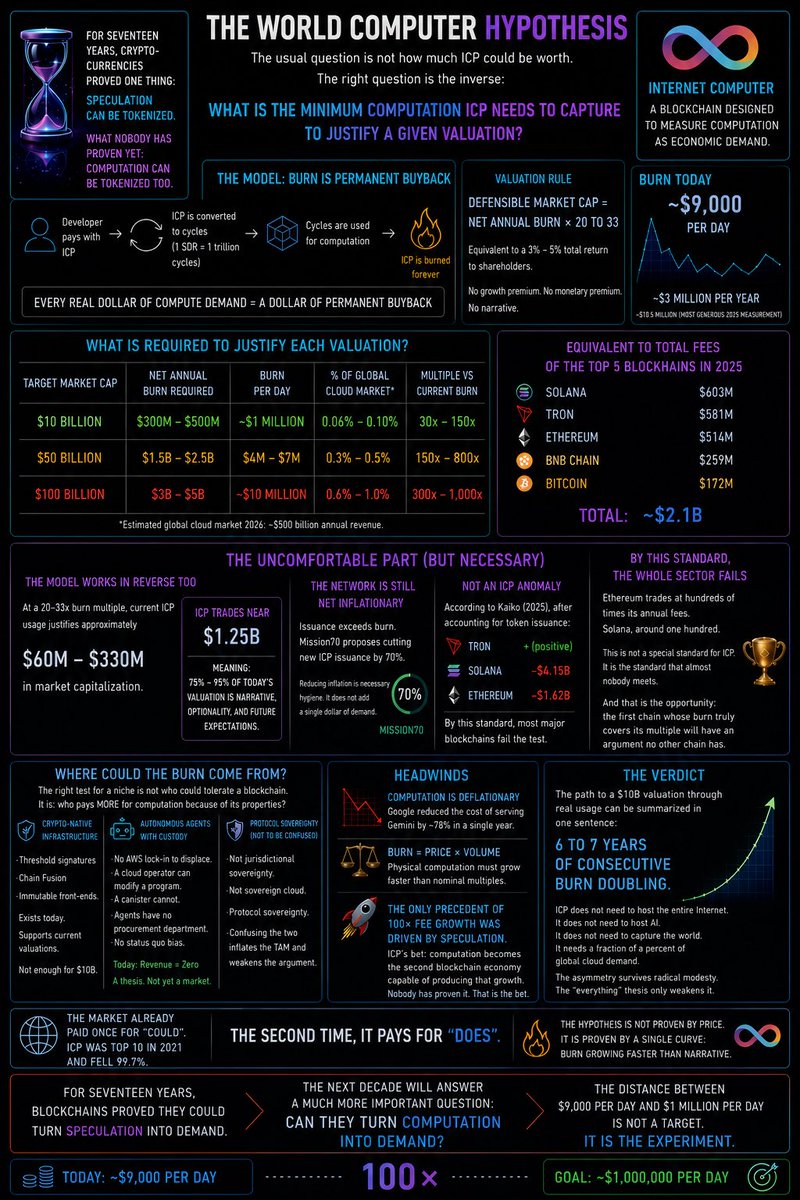
THE WORLD COMPUTER HYPOTHESIS ♾️ $ICP by @dfinity
For 17 years, crypto proved speculation can be tokenized.
$ICP is testing the harder question:
Can computation be turned into real economic demand?
The model is simple:
Developer pays in $ICP
$ICP converts to cycles
Cycles power computation
$ICP is burned permanently
That means every real dollar of compute demand becomes a dollar of permanent buy pressure.
Current burn is still small: about $9,000/day.
The target is not hype.
The experiment is whether $ICP can move from:
$9,000/day burn → $1,000,000/day burn
That is roughly a 100x usage gap.
If it happens, the argument changes completely.
Not speculation.
Not narrative.
Not another L1 fee story.
Actual computation.
Actual usage.
Actual burn.
$ICP is not trying to tokenize attention.
It is trying to tokenize compute.
♾️
#$ICP #InternetComputer #DFINITY #WorldComputer #Crypto #Blockchain #Web3 #AI
Donations:
1e672d038cebc619d93186418fa98f6499dbdb9cfdfac54f366c61a4a4ee4362
4
19
90
1,369
Jun 12
THE WORLD COMPUTER THESIS ∞
For seventeen years, cryptocurrencies have demonstrated one thing:
They can tokenize speculation.
What they have not yet demonstrated is whether they can tokenize computation.
That is the World Computer thesis.
And the usual question — How much could ICP be worth? — is the wrong question, because any number can answer it, and none can test it.
The correct question is the inverse:
What is the minimum amount of computation #ICP must capture to justify a given valuation?
That formulation forces us to answer with economics rather than narrative.
THE MODEL
In ICP, computation burns the token.
Developers convert ICP into cycles at a fixed rate — 1 SDR per trillion cycles — and the ICP used in that conversion is permanently destroyed.
Every real dollar of computation demand becomes a dollar of permanent buyback.
A perpetual buyback can be valued with a simple framework:
Defensible Market Capitalization = Net Annual Burn × 20–33
Equivalent to a 3–5% shareholder yield.
No growth premium.
No monetary premium.
No narrative premium.
That is the entire model.
Nothing more than a multiplication.
THE UNCOMFORTABLE PART
The model works in reverse too.
At a 20–33x multiple of annual burn, ICP’s current network usage justifies approximately $60 million to $330 million in market capitalization.
ICP trades at roughly $1.25 billion.
In other words, between 75% and 95% of today’s valuation is narrative, optionality, and future expectations.
There is more.
The network remains net inflationary.
Token issuance still exceeds burn.
That is precisely why Mission70 exists: to reduce new ICP issuance by 70%.
Reducing inflation is necessary hygiene.
It does not add a single dollar of demand.
Nor is this unique to ICP.
According to Kaiko, after accounting for token issuance, only Tron was net positive in 2025.
Solana diluted holders by approximately $4.15 billion.
Ethereum diluted holders by approximately $1.62 billion.
By the same standard, most major blockchains fail the test.
Ethereum trades at hundreds of times its annual fees.
Solana trades around one hundred times.
This is not a special standard for ICP.
It is the standard that almost nobody in the sector meets.
And that is exactly why it matters.
The first blockchain whose real economic activity genuinely supports its valuation will possess an argument no other blockchain can make.
THE NUMBERS
Current ICP burn is approximately $9,000 per day.
Roughly $3 million per year.
About $10.5 million using the most generous 2025 measurement.
To justify a $10 billion valuation:
Approximately $1 million of burn per day.
Roughly 0.06%–0.10% of the global cloud market.
To justify a $50 billion valuation:
Approximately $4–7 million of burn per day.
Equivalent to the combined annual fees of Solana, Tron, Ethereum, BNB Chain, and Bitcoin in 2025.
To justify a $100 billion valuation:
Approximately $10 million of burn per day.
Roughly 1% of the global cloud market.
The percentages sound small.
The multiples do not.
Two orders of magnitude for the first threshold.
Three for the last.
WHERE COULD THE BURN COME FROM?
The correct test for a niche is not:
Who could tolerate a blockchain?
The correct question is:
Who pays more for computation because of its properties?
Crypto-native infrastructure — threshold signatures, chain fusion, immutable front-ends — already exists and pays today.
Its ceiling can justify current valuations.
It does not justify $10 billion.
Autonomous agents with custody are the more interesting bet.
The demand is new.
There is no AWS lock-in to displace.
The property is binary:
A cloud operator can always modify a program.
A canister cannot.
And autonomous agents have neither procurement departments nor institutional inertia.
Today, however, revenue is effectively zero.
It is a thesis.
Not yet a market.
A note on terminology:
Hyperscalers already sell jurisdictional sovereignty.
ICP sells something different:
Protocol sovereignty.
Confusing the two inflates the TAM and weakens the argument.
THE HEADWINDS
Computation is deflationary.
Google reportedly reduced the cost of serving Gemini by roughly 78% in a single year.
And burn is simply:
Burn = Price × Volume
Physical work must therefore grow faster than nominal multiples.
The only major precedent for two orders of magnitude growth in blockchain fees was driven by speculation.
Exactly the demand ICP is not designed to optimize for.
ICP’s wager is that computation can become the second major economic category capable of producing that kind of growth.
Nobody has demonstrated that yet.
That is the wager.
THE VERDICT
The path to a $10 billion valuation through real usage can be summarized in a single sentence:
Six to seven consecutive years of burn doubling.
ICP does not need to host the entire Internet.
It does not need to host all AI.
It does not need to capture the world.
It needs to capture a fraction of a percent of global cloud demand.
The asymmetry survives radical modesty.
The “everything” thesis only weakens it.
The market already paid once for “could.”
ICP was a Top 10 crypto asset in 2021 and later fell 99.7%.
The second time, the market will pay for “does.”
For seventeen years, blockchains have proven they can turn speculation into demand.
The next decade will answer a much more important question:
Can they turn computation into demand?
The distance between $9,000 per day and $1 million per day is not a target.
It is the experiment.
∞
#WorldComputer #InternetComputer
1
11
1,429

39
Samkur Sam retweeted
Jun 11

4
25
888