Senior Research Fellow at the Cicely Saunders Institute of Palliative Care, King’s College London | Paediatric & end-of-life care; grief and bereavement
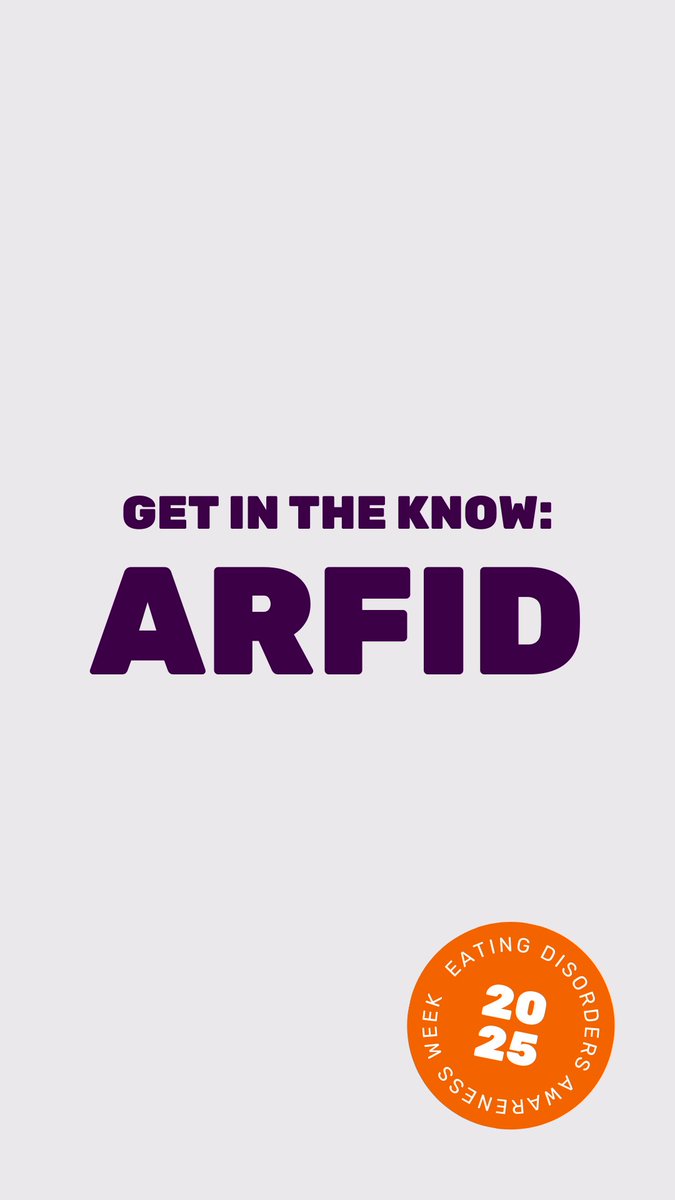
Each day this week, we'll be highlighting a type of eating disorder - today we're talking about ARFID. If you recognise these signs in yourself, or someone you love, contact our Helpline today 💜 #EatingDisordersAwarenessWeek#ARFID#EDAW2025#AnyoneAnytime
ALT Light grey background with dark purple capitalised text reading 'Get in the know: ARFID'. In the bottom right corner is an orange roundel with white text inside it reading 'Eating Disorders Awareness Week 2025'.
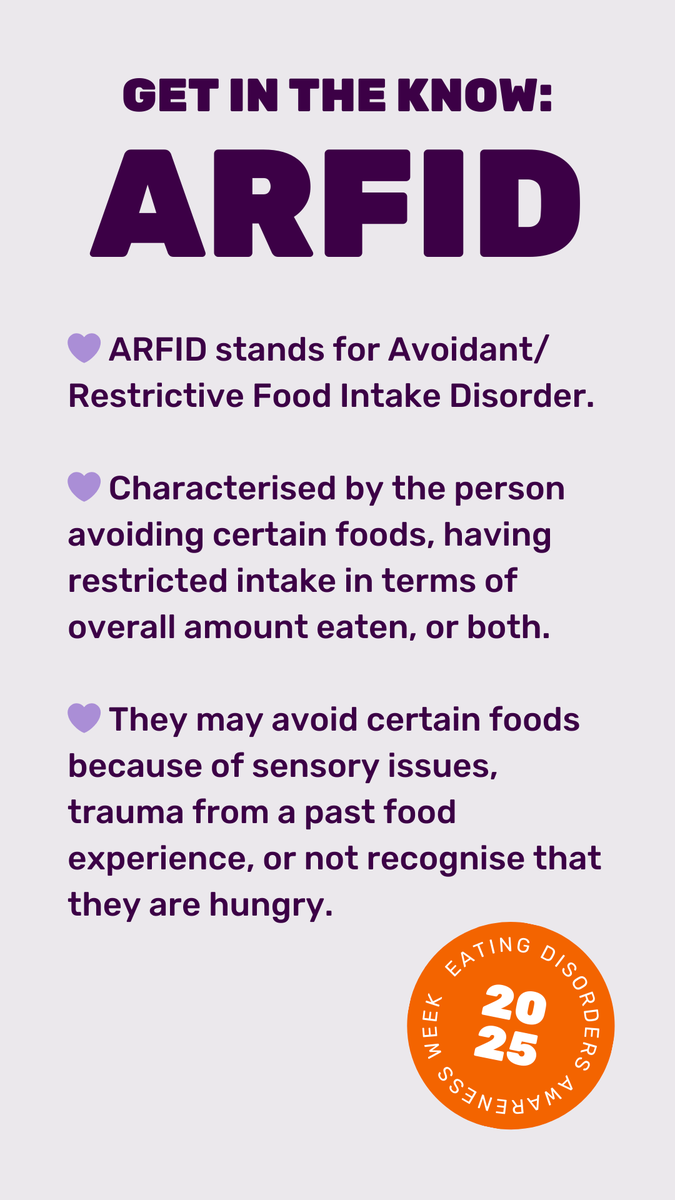
ALT Light grey background with dark purple text. Capitalised title reads 'Get in the know: ARFID'. In bullet points below, text reads 'ARFID stands for Avoidant / Restrictive Food Intake Disorder. Characterised by the person avoiding certain foods, having restricted intake in terms of overall amount of food eaten, or both. They may avoid certain foods, because of sensory issues, trauma from a past food experience, or not recognising that they are hungry.' The orange roundel is in the bottom right corner.
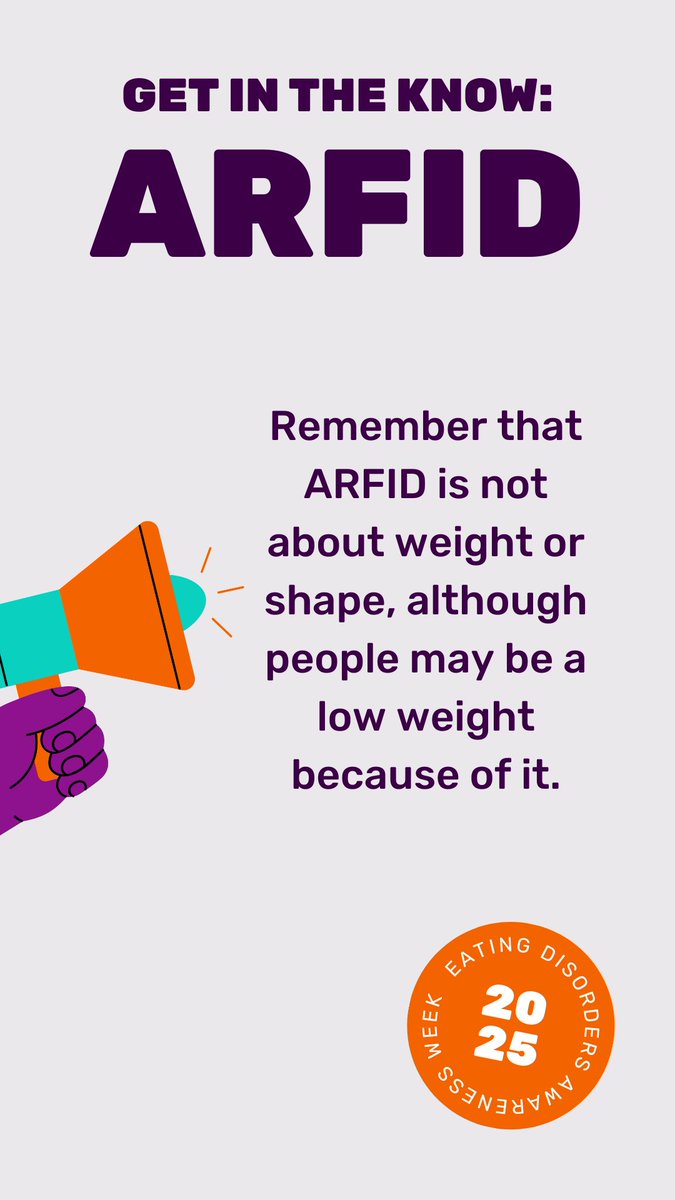
ALT Light grey background and dark purple text. Text reads 'Get in the know: ARFID'. Text below on the right reads 'Remember that ARFID is not about weight or shape, although people may be a lower weight because of it.' On the left of this is an illustration of a purple hand holding a teal and orange megaphone up to the text. In the bottom right corner is the orange roundel.
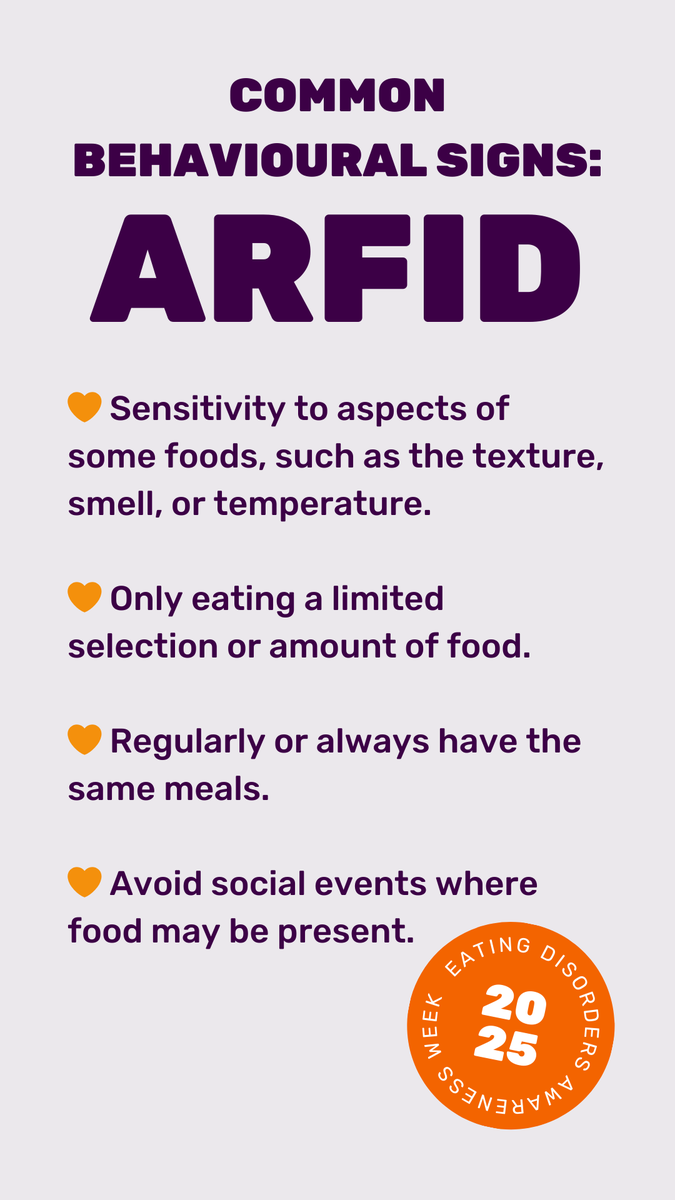
ALT Light grey background with dark purple text. Title reads 'Common behavioural signs: ARFID'. Bullet points underneath reads 'Sensitivity to aspects of some foods, such as the texture, smell, or temperature. Only eating limited selection or amount of food. Regularly or always having the same meal. Avoid social events where food may be present'. In the bottom right corner is the orange roundel.
We're hoping families who've experienced haematopoetic stem cell (bone marrow) transplant, or had follow-up scans after treatment, or worried about infection or mucositis can come to @CandlelightersT Sat 30th Nov - we're hosting researchers who need your input! (Travel covered)
We're looking for someone to help us improve the development of interventions to support families with a child with cancer - could this be the PhD you're looking for? @nicolaod_ @HullYorkMedfindaphd.com/phds/project/im…
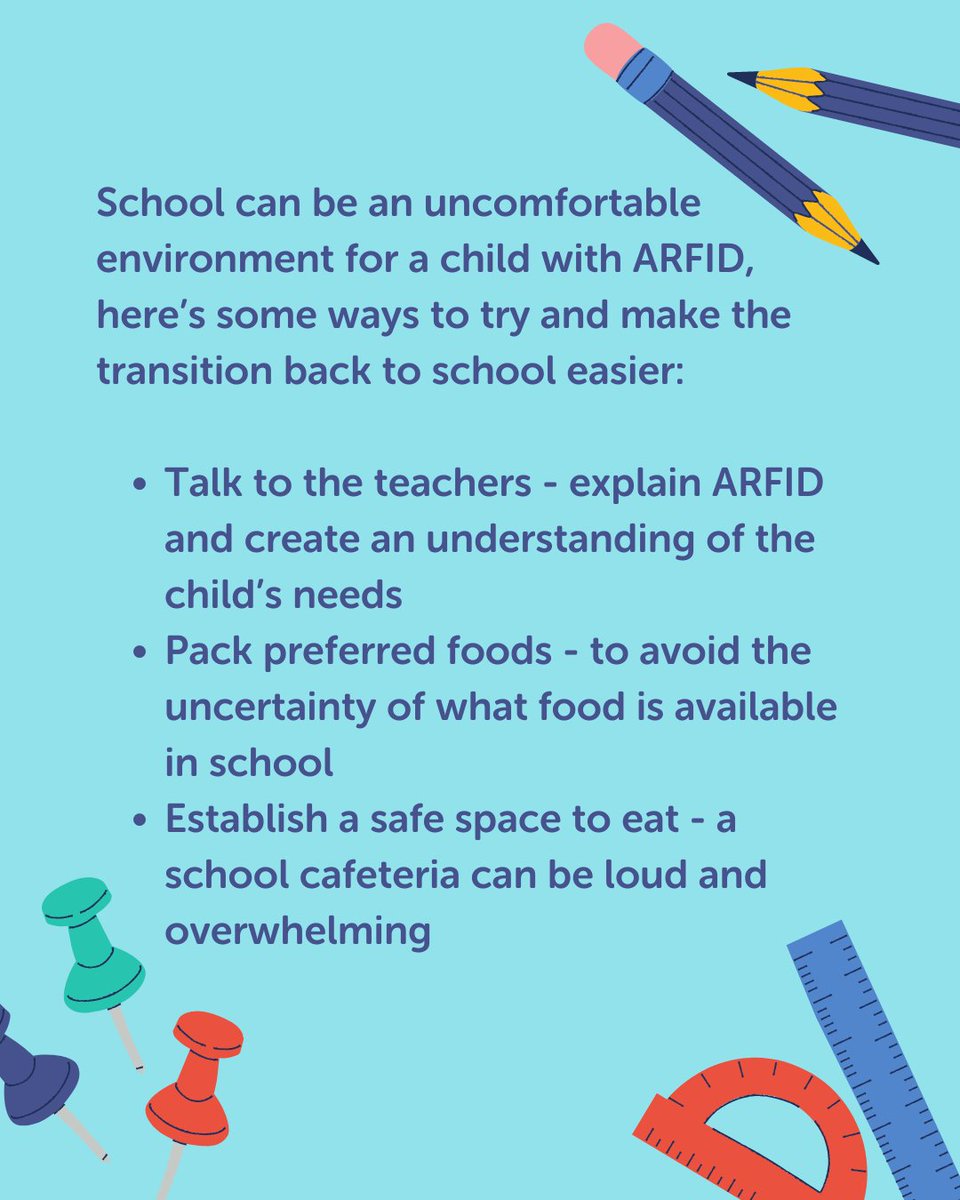
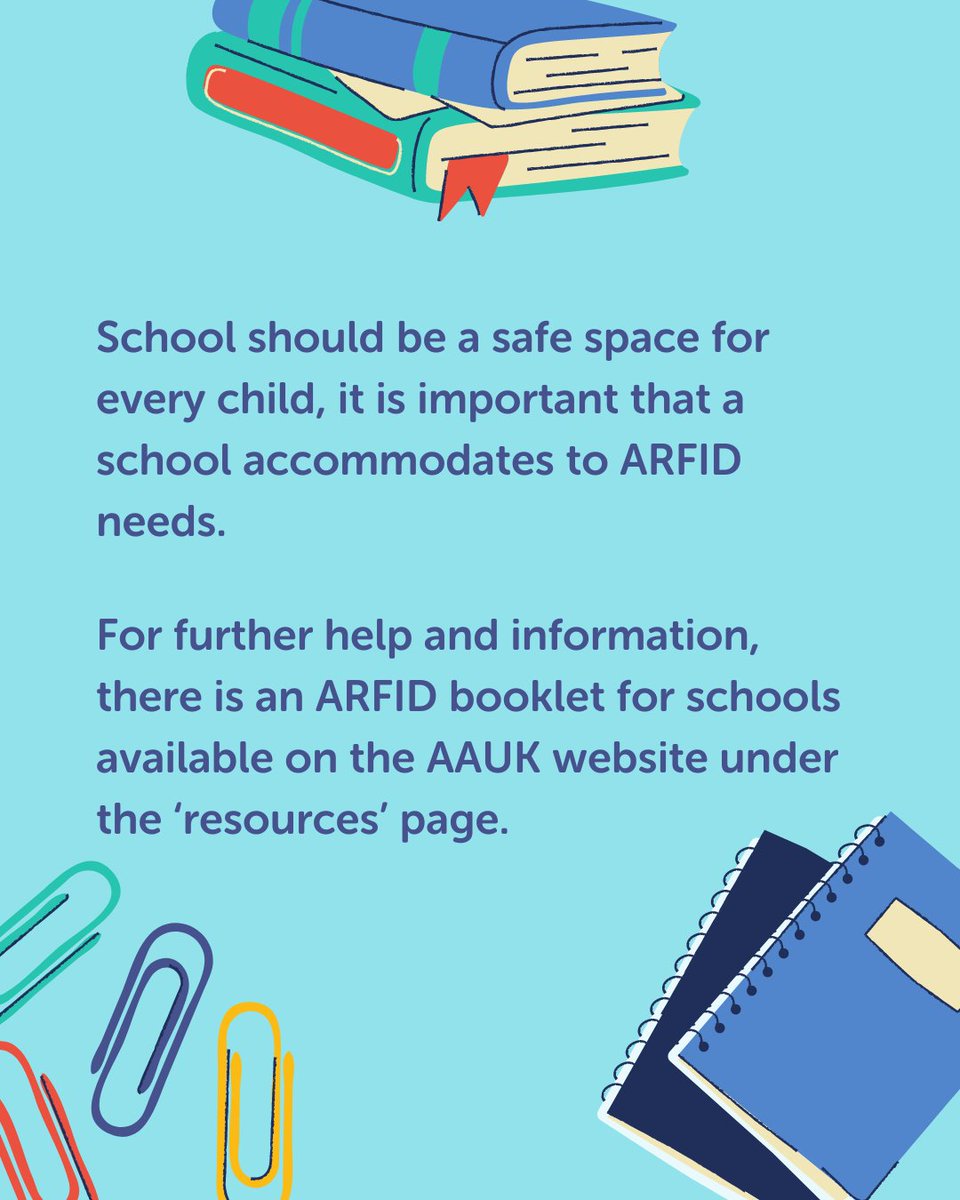
Going back to school can be a daunting time when it comes to ARFID. Here's some ways that school could be a little easier for a child struggling with ARFID.
Parents, if you have any advice on back to school with ARFID, comment below!
#ARFID#ARFIDAwareness#ARFIDAwarenessUK
This is so beautifully written and a must read for all. Not just all who work in #ppc but all of us. Thank you for sharing Neve and your story @EmilyTammam
Oddly, for me, I have very few words! Gratitude to @lisamarkwell and @Telegraph to be given a platform to share Neve and our story. Sadness not to be able to tell Neve. A mix of bittersweet emotions. telegraph.co.uk/family/paren… My hope is that reading my words can help
1/2
Following being awarded a temporary responsibility allowance, I’m delighted I have now been officially promoted to Associate Professor. Thank you to all who have supported me along the way, especially the families I work with who continue to make this more meaningful #ppc
🧵 1/3 Palliative care professionals have an important role to play when working with parents of seriously ill children to change support and services for the better.
If you or someone you know fancies working with us at the @CandlelightersT Supportive Care Research Centre at @UniOfYork@HullYorkMed a PhD looking at wellbeing interventions for families of children with cancer - chat with me! (Please share widely)
findaphd.com/phds/project/im…
We are recruiting! Interested in #paediatricpalliativecare? Come and work with us @UoYppcrg as a Research Associate. Full time £36,024-£44,263, Fixed Term for 12 months. For more info contact me: julia.hackett@york.ac.uk. Apply by 27th June 2024
jobs.york.ac.uk/vacancy/rese…
The first mention of #PalliativeCare can sound scary as people can think that it means treatment has not worked. However, palliative care is far more than just end-of-life care 💛 So, what exactly is it? Find out at: bit.ly/3UKhVNC#DyingMattersWeek#ResearchRoundup
We are supporting research to improve end-of-life care for babies and their families.
Researchers would like to hear from parents about the care their babies received on NICUs before they died.
Take part ⬇️
📧 dohs-enhance@york.ac.uk
☎️ 07384 239136
#BabyLoss
Are you a parent of a baby or child who has died in the last five years after receiving care in #NICU and #PICU?
@UoYppcrg would like to hear about your experiences.
📧 dohs-enhance@york.ac.uk
📞 07384239136
Are you a parent of a baby or child who has died in the last five years after receiving care in #NICU and #PICU?
@UoYppcrg would like to hear about your experiences.
📧 dohs-enhance@york.ac.uk
📞 07384239136
Are you a parent of a baby or child who has died in the last five years after receiving care in #NICU and #PICU?
@UoYppcrg would like to hear about your experiences. Contact details below 👇
Delighted to share our study on “Experiences of music therapy in paediatric palliative care from multiple stakeholder perspectives: A systematic review and qualitative evidence synthesis” has been published in @PalliativeMedJ and available at doi.org/10.1177/026921632412…