
Joined July 2021
- Tweets 2,452
- Following 773
- Followers 992
- Likes 4,629
466 Photos and videos
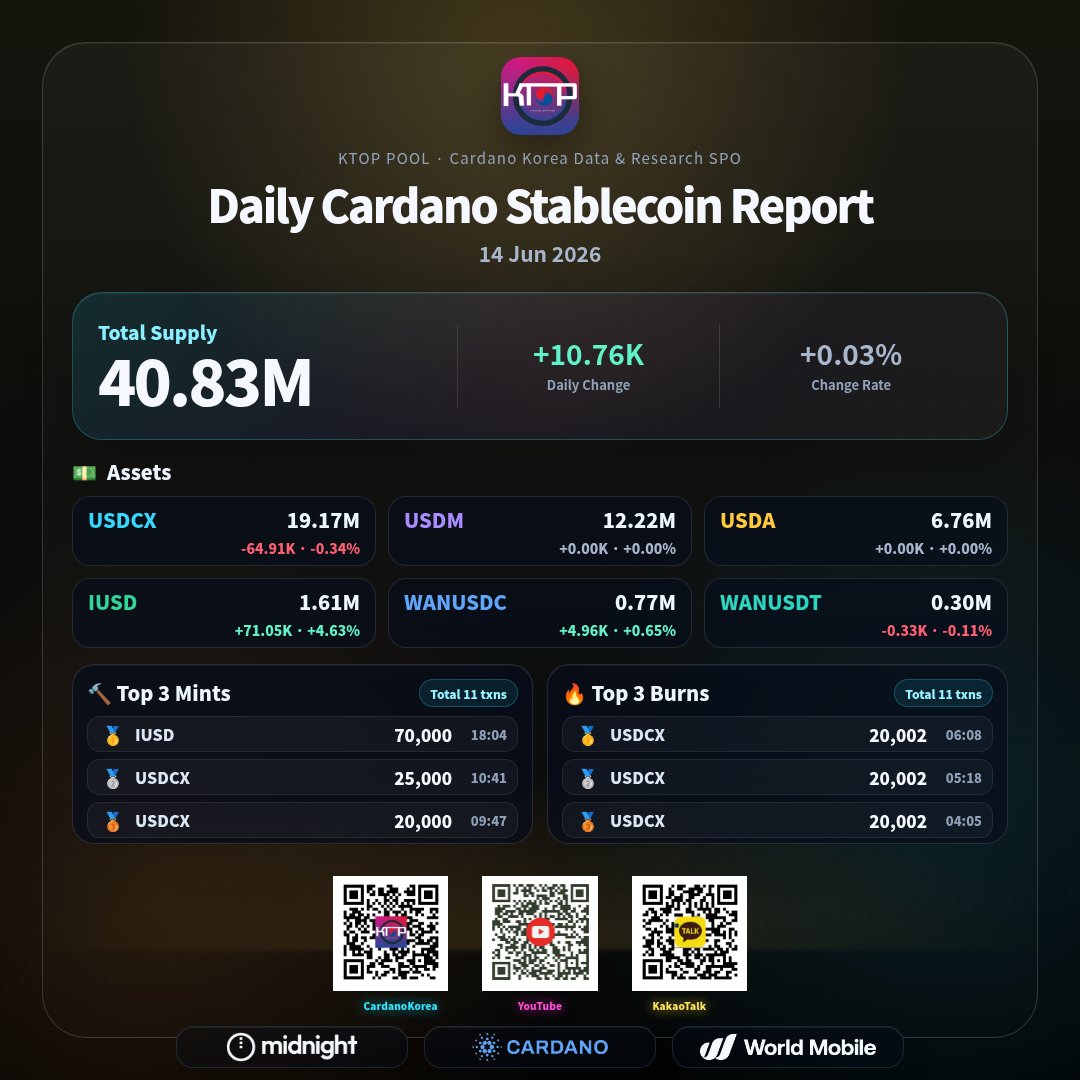
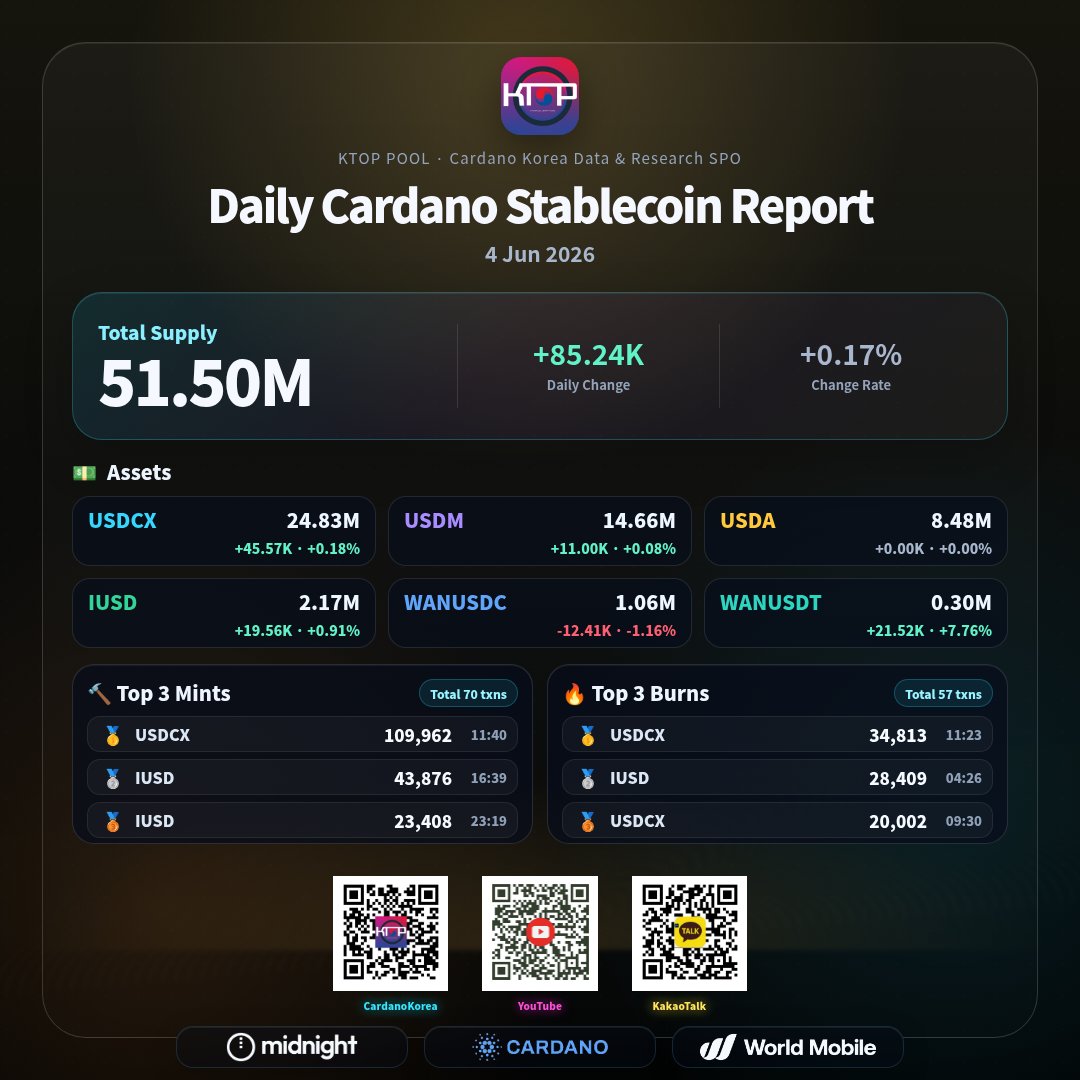
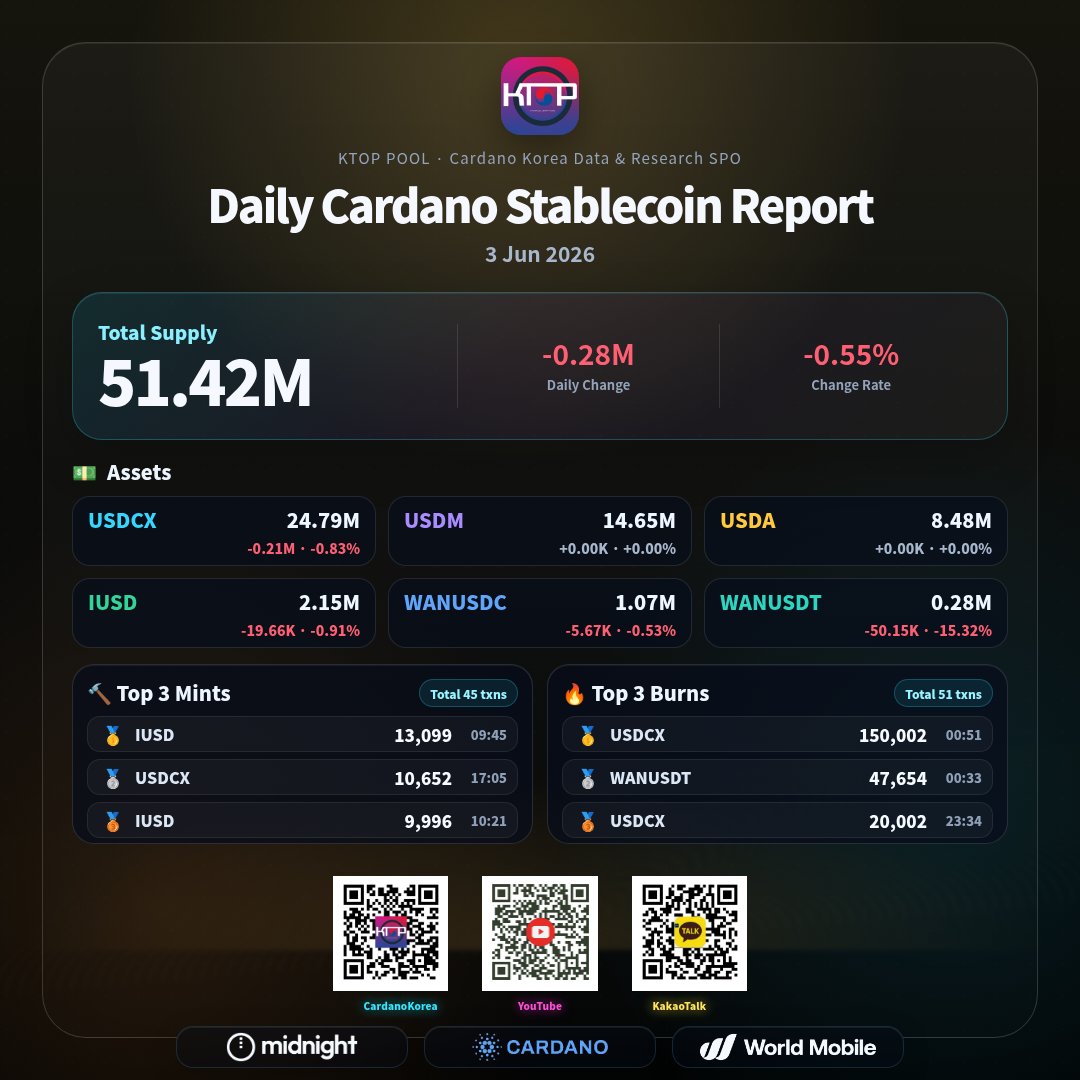
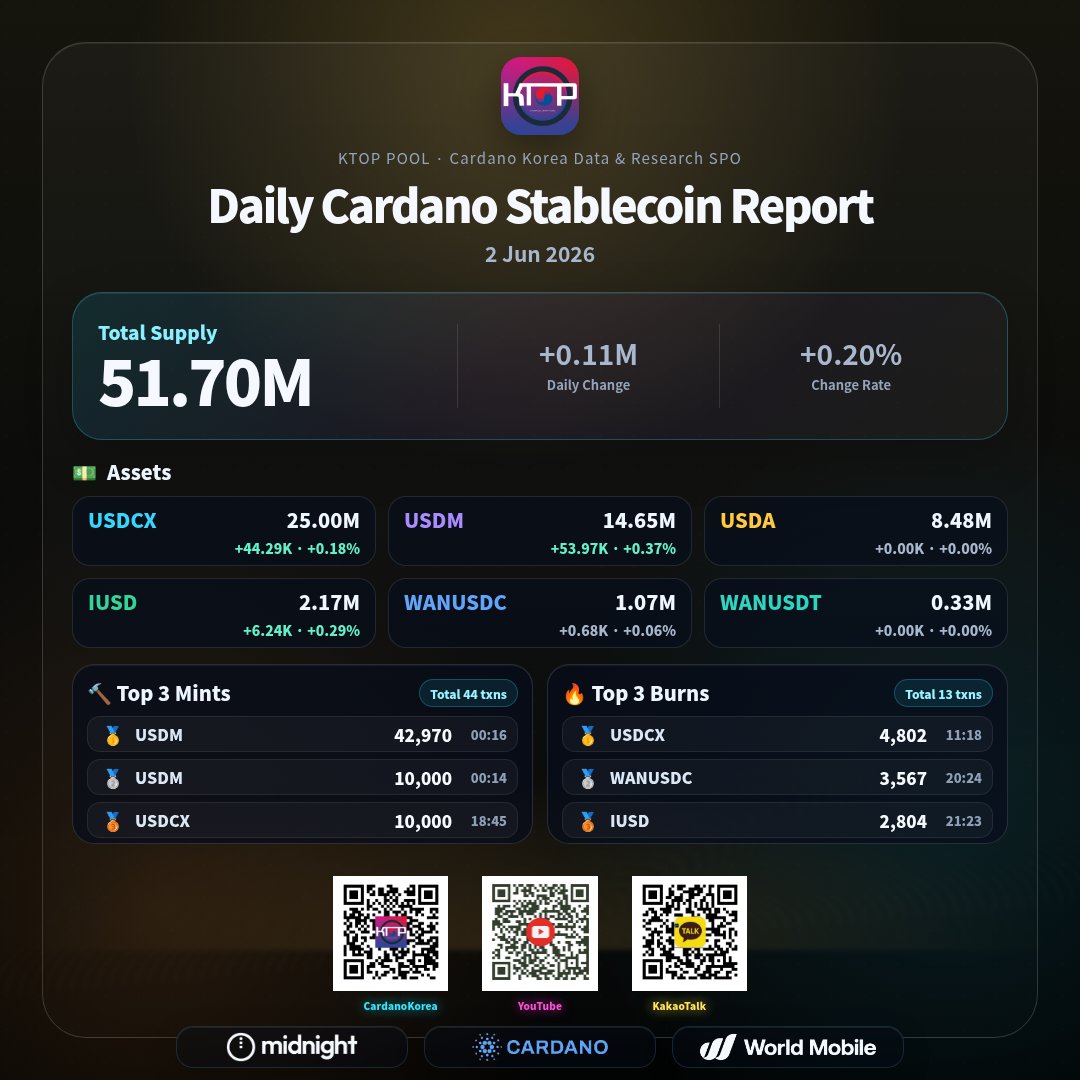
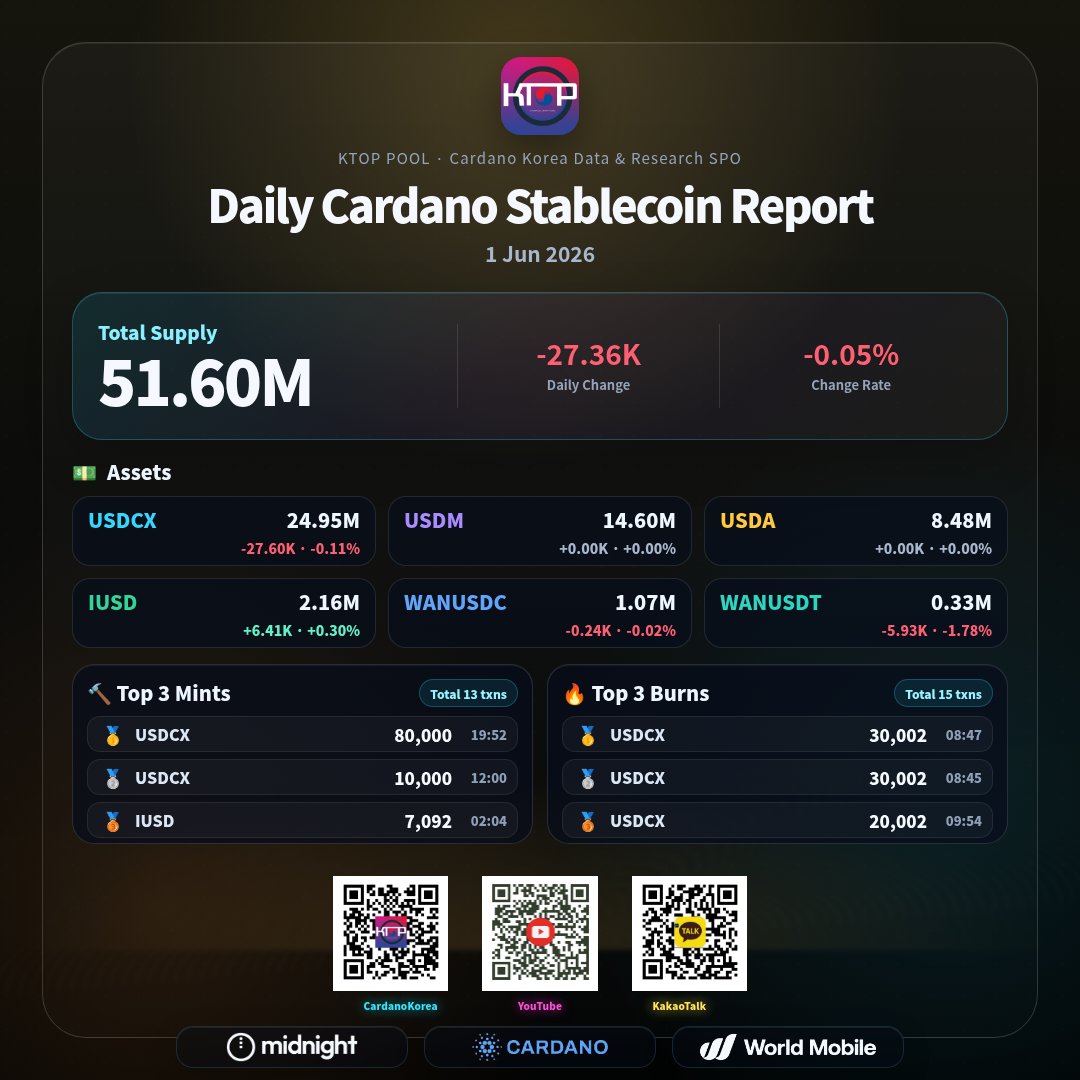

📊 Daily Cardano Stablecoin Report (14 Jun 2026)
💰 Total: 40.83M ( 10.76K, 0.03%)
💵 Assets
• USDCX 19.17M (-64.91K, -0.34%)
• USDM 12.22M ( 0.00K, 0.00%)
• USDA 6.76M ( 0.00K, 0.00%)
• IUSD 1.61M ( 71.05K, 4.63%)
• WANUSDC 0.77M ( 4.96K, 0.65%)
• WANUSDT 0.30M (-0.33K, -0.11%)
🔨 Top 3 Mints (Total 11 txns)
🥇 IUSD 70,000 (18:04)
🥈 USDCX 25,000 (10:41)
🥉 USDCX 20,000 (09:47)
🔥 Top 3 Burns (Total 11 txns)
🥇 USDCX 20,002 (06:08)
🥈 USDCX 20,002 (05:18)
🥉 USDCX 20,002 (04:05)
For more details, please visit:
🔗 cardanokorea.com/stablecoin-…
@wanchain_org @Indigo_protocol @Cardano_CF @USDMOfficial @AnzensOfficial
2
36
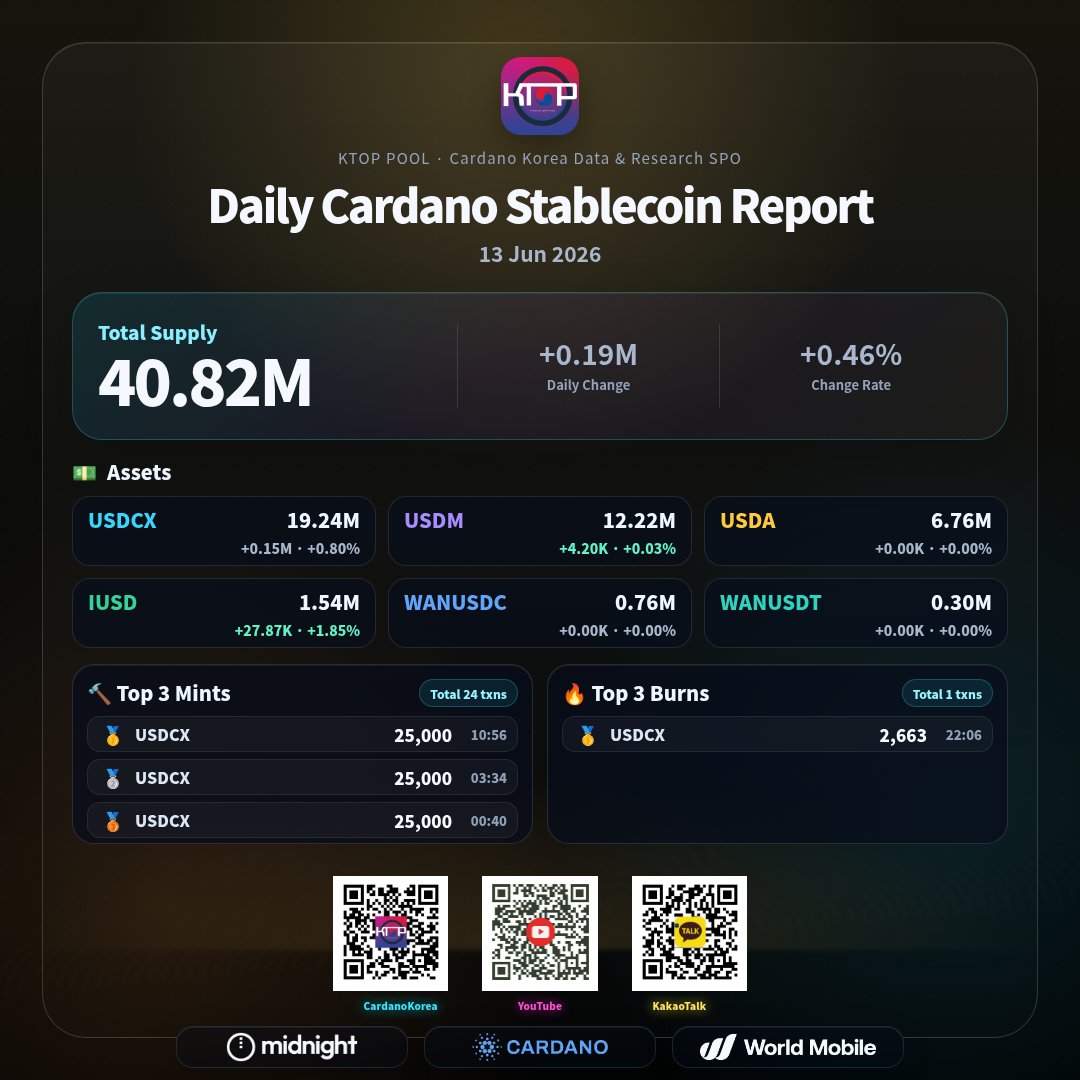
📊 Daily Cardano Stablecoin Report (13 Jun 2026)
💰 Total: 40.82M ( 0.19M, 0.46%)
💵 Assets
• USDCX 19.24M ( 0.15M, 0.80%)
• USDM 12.22M ( 4.20K, 0.03%)
• USDA 6.76M ( 0.00K, 0.00%)
• IUSD 1.54M ( 27.87K, 1.85%)
• WANUSDC 0.76M ( 0.00K, 0.00%)
• WANUSDT 0.30M ( 0.00K, 0.00%)
🔨 Top 3 Mints (Total 24 txns)
🥇 USDCX 25,000 (10:56)
🥈 USDCX 25,000 (03:34)
🥉 USDCX 25,000 (00:40)
🔥 Top 3 Burns (Total 1 txns)
🥇 USDCX 2,663 (22:06)
For more details, please visit:
🔗 cardanokorea.com/stablecoin-…
@wanchain_org @Indigo_protocol @Cardano_CF @USDMOfficial @AnzensOfficial
1
49
KTOP | SPO | WM ENO | WM & Midnight 🇰🇷Ambassador retweeted

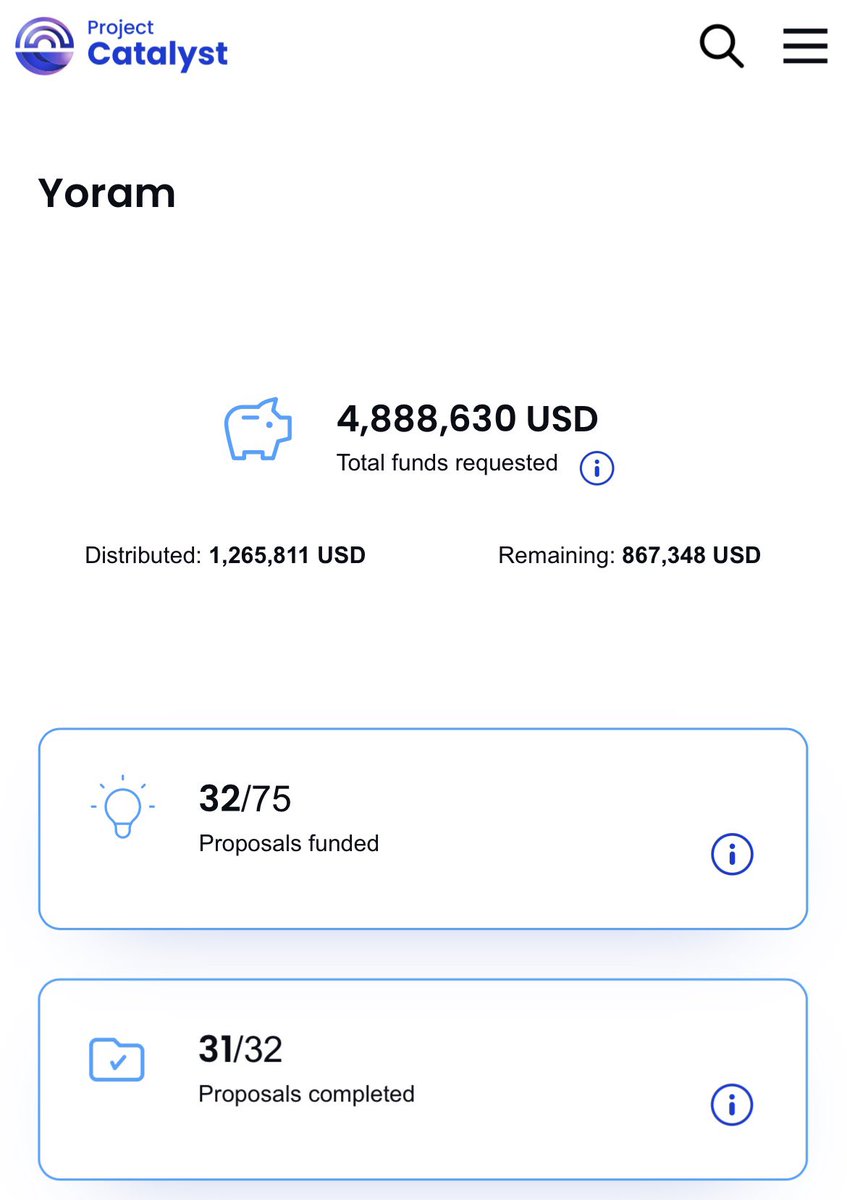
Before yall go voting on this cabal supported proposal; remember that the guy that wrote it is also a career grant writer here in Cardano and has written at least 75 other catalyst proposals over the last few years.
Get different people, #Cardano; cause these ones aren’t it
May 14

Somewhere in the world right now, it's 5AM. And a farmer is waking up. 🌅
Before the markets open. Before the offices fill. Before the rest of the world checks their phone.
They're already working.
That's why we're called 5am.Earth. 🌍
We exist for the people who start before everyone else, the 500 million smallholder farmers who feed the world, yet remain the most underserved people in the global economy.
13,000 of their farms are now on @Cardano. Verified. Permanent. Owned by them. ⛓️
This is just the beginning. 🌾
Check out the number of transactions live there: cardanoscan.io/address/01e9b…
#Cardano #5amEarth
1
3
11
3,098
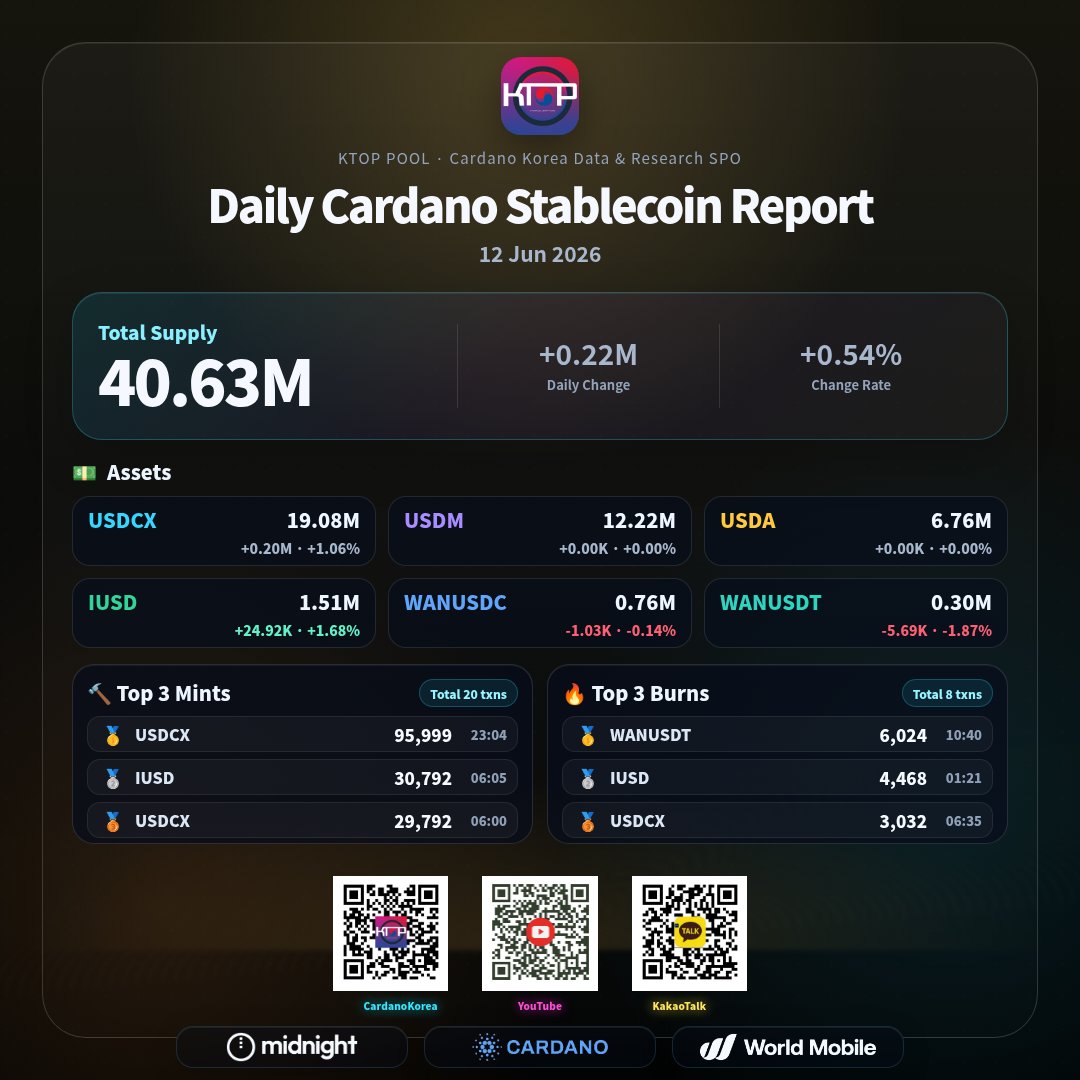
📊 Daily Cardano Stablecoin Report (12 Jun 2026)
💰 Total: 40.63M ( 0.22M, 0.54%)
💵 Assets
• USDCX 19.08M ( 0.20M, 1.06%)
• USDM 12.22M ( 0.00K, 0.00%)
• USDA 6.76M ( 0.00K, 0.00%)
• IUSD 1.51M ( 24.92K, 1.68%)
• WANUSDC 0.76M (-1.03K, -0.14%)
• WANUSDT 0.30M (-5.69K, -1.87%)
🔨 Top 3 Mints (Total 20 txns)
🥇 USDCX 95,999 (23:04)
🥈 IUSD 30,792 (06:05)
🥉 USDCX 29,792 (06:00)
🔥 Top 3 Burns (Total 8 txns)
🥇 WANUSDT 6,024 (10:40)
🥈 IUSD 4,468 (01:21)
🥉 USDCX 3,032 (06:35)
For more details, please visit:
🔗 cardanokorea.com/stablecoin-…
@wanchain_org @Indigo_protocol @Cardano_CF @USDMOfficial @AnzensOfficial
1
47
KTOP | SPO | WM ENO | WM & Midnight 🇰🇷Ambassador retweeted

WMTx holders, EarthNode Operators, AirNode Operators, Network Builders, Stakers, Affiliates, Subscribers, Partners, Resellers, Installers, Hosts, let me be clear.
You are not just appreciated.
Every single one of you is part of the master piece we are building together. Each role matters and each role moves us forward.
When it everything clicks, we all win big time.
That's what we're doing, together.
28
62
257
7,298
The Invisible Internet War and Decentralized Networks
1. The Internet Is Physical Infrastructure
■A Digital Society Built on Cables
The internet may feel invisible, but it runs on physical infrastructure: subsea cables, terrestrial networks, data centers, and power systems. Messaging, finance, cloud services, and AI all depend on stable connectivity.
■Why AI Needs Connectivity
AI systems rely on data exchange, cloud computing, and real-time information flows. If connectivity fails, the impact goes far beyond inconvenience. Healthcare, disaster response, finance, industrial automation, and defense systems can all be affected.
2. The Risk of Centralized Infrastructure
■Subsea Cables Are Becoming Concentrated
Subsea cables are the arteries of the digital age. But control over this infrastructure is increasingly concentrated among a small number of major tech companies with massive data traffic needs.
■The Cost of Concentration
When data flows depend on a few companies and routes, outages or attacks can create wider damage. Infrastructure decisions may also be driven more by profitability than public need, leaving remote or less profitable regions behind.
■Digital Sovereignty
Cable routes, equipment, landing stations, and data routing are all tied to national security. If infrastructure used like a public utility is controlled by a few private actors, countries may struggle to fully control their own connectivity during a crisis.
3. Why Decentralized Networks Matter
■Lessons From Disasters
In disaster-hit areas such as North Carolina, when ground networks failed, Starlink was used as an emergency connectivity tool. This showed why relying on one centralized network is not enough.
■A Multi-Layered Network
The future of connectivity should combine subsea cables, terrestrial networks, satellites, and stratospheric platforms. If one layer fails, another should be able to support it.
4. World Mobile and Stratospheric 5G
■A Decentralized Telecom Model
World Mobile proposes a decentralized network model where local participants can help build and operate infrastructure through AirNodes and EarthNodes. This offers one possible path away from telecom systems dominated by a small number of centralized players.
■Stratospheric 5G as an Option
Stratospheric 5G aircraft can act like flying cell towers, providing 4G/5G coverage from around 20 km above the Earth. They can cover wide areas and connect directly to standard smartphones without special hardware.
This is not a replacement for subsea cables. But it could become one way to reduce dependence on centralized infrastructure and build a more distributed, resilient network.
5. The Real Goal Is Resilience
In the AI era, connectivity is not just about speed.
It is about resilient access, decentralized infrastructure, digital sovereignty, and networks that are not locked under the control of a few private giants.
That is why stratospheric 5G and World Mobile’s decentralized network model matter.
They offer a new option for AI-era connectivity, disaster response, digital inclusion, and a more resilient future internet.
Jun 9

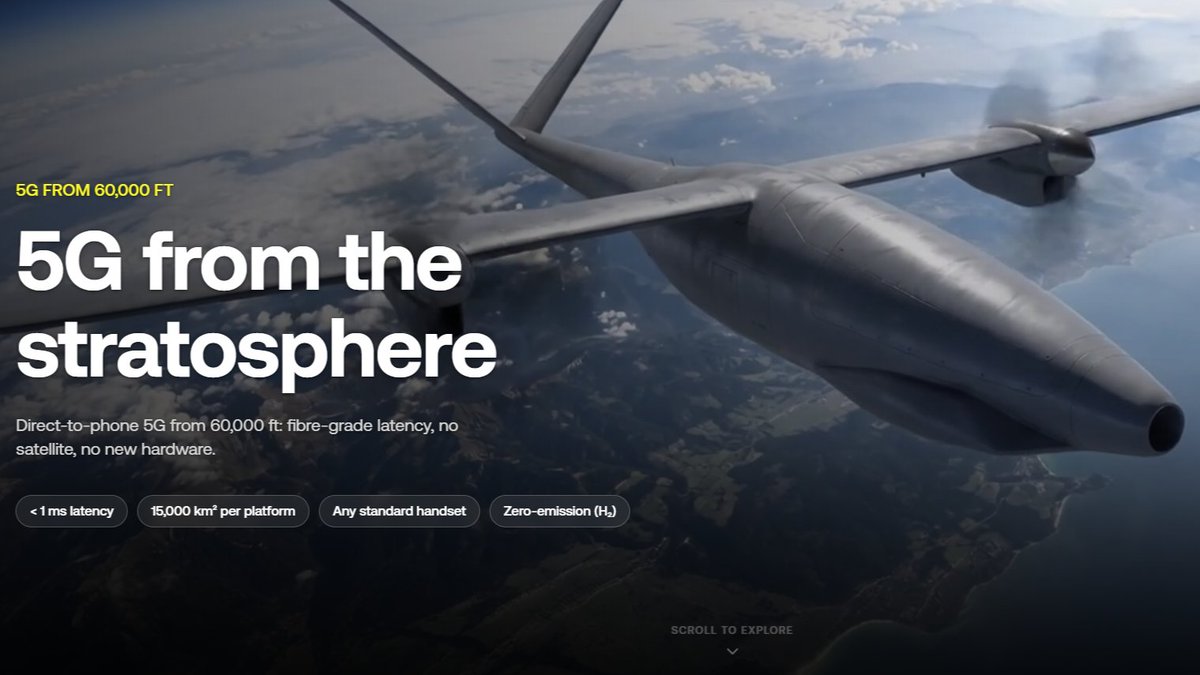
✈️ The new World Mobile Stratospheric website is live.
Explore the opportunity behind airborne connectivity: Hydrogen-powered aircraft delivering low-latency, direct-to-phone 5G coverage across up to 15,000 km² from the edge of space.
From remote communities and emergency response to maritime operations, surge capacity, and national security, World Mobile Stratospheric unlocks new possibilities for connectivity altogether.
🔗 wmstratospheric.com/
1
99
KTOP | SPO | WM ENO | WM & Midnight 🇰🇷Ambassador retweeted

Cardano doesn't need to choose between decentralisation and execution.
That might be the biggest governance challenge in front of us right now.
Jack Briggs and Ed n Stuff both touched on something important this week, from different angles.
One focused on Cardano's bigger picture.
The other focused on how we make the builder experience better.
Together, I think they point to the same question:
How does Cardano actually move forward? 👇
Jack's post was a good reminder that this week is mostly sentiment, not substance.
Markets are messy.
Risk assets are being hit.
But Cardano's core strengths haven't suddenly disappeared.
🔹 Security
🔹 Reliability
🔹 Decentralised infrastructure
🔹 Long-term thinking
🔹 A community that can look past short-term noise
There is also a lot actively moving across the ecosystem.
🔹 Midnight
🔹 RealFi
🔹 Stablecoin adoption
🔹 DeFi growth
🔹 Parameter changes
🔹 Treasury proposals
🔹 Governance votes
🔹 Builder activity
All of that continues whether the market feels good or not.
But there is still a fair criticism underneath it all.
Cardano has strong infrastructure.
What it doesn't always have is a clear path for builders to turn that infrastructure into adoption.
This is where Ed's post about a Cardano Builder Platform gets interesting.
Solana is pushing a white-glove developer platform.
Bundled APIs.
Stablecoins.
RWAs.
Payments.
Compliance.
Custody.
Faster onboarding.
Less friction.
That is something Cardano should take seriously.
Not because we need to copy Solana.
But because we should ask a better question:
What would this look like if it was done the Cardano way?
Cardano already has many of the pieces.
🔹 Blockfrost
🔹 Maestro
🔹 Koios
🔹 Mesh
🔹 Aiken
🔹 TxPipe
🔹 Wallets
🔹 DEXs
🔹 Lending protocols
🔹 Identity projects
🔹 Stablecoin infrastructure
🔹 Governance rails
🔹 DReps
🔹 SPOs
🔹 Ambassadors
🔹 Content creators
The issue is that these pieces often feel disconnected.
A new team coming to Cardano still has to work out:
🔹 Which tools to use
🔹 Who to speak to
🔹 How to get funding
🔹 How to integrate wallets
🔹 How to reach users
🔹 How to explain their project
🔹 How to navigate governance
🔹 How to get support when something breaks
That is not white-glove onboarding.
That is "good luck, mate."
And that probably isn't good enough anymore.
If Cardano wants more serious builders, founders and enterprises, then we need to reduce friction.
But we need to do it without giving up what makes Cardano different.
Not by centralising control.
Not by handing everything to one foundation.
Not by creating another insider group.
But by building community-governed structures that can actually execute.
A Cardano Builder Platform, or something like it, could be worth exploring properly.
Something that gives serious teams:
🔹 Integrated developer tools
🔹 Clear API access
🔹 Stablecoin, RWA, payments and identity support
🔹 Treasury-aligned funding pathways
🔹 Go-to-market support
🔹 Technical onboarding
🔹 Professional business development
🔹 Clear accountability back to DReps and the community
The hard part is governance design.
If treasury money is used, the structure has to avoid the usual traps.
No self-dealing.
No permanent insiders.
No vague mandates.
No blank cheques.
No "trust us bro" reporting.
A proper version would need:
🔹 Strong conflict of interest rules
🔹 Public dashboards
🔹 Clear KPIs
🔹 Milestone-based funding
🔹 Rotating roles
🔹 Transparent compensation
🔹 DRep review
🔹 The ability to stop or redirect funding if delivery is not happening
That is where Voltaire can become more than a voting system.
It can become Cardano's coordination layer.
Governance should not only be about saying yes or no to proposals.
It should help us decide:
🔹 What gets funded
🔹 Who gets trusted
🔹 How progress is measured
🔹 Where Cardano should focus
🔹 How we support builders
🔹 How we avoid wasting treasury funds
🔹 How we move faster without losing transparency
Jack is right that Cardano needs alignment.
Ed is right that Cardano needs better execution.
The answer probably sits somewhere between the two.
Cardano needs to consolidate around the areas where it can genuinely win.
🔹 RealFi
🔹 Digital identity
🔹 Stablecoins
🔹 Payments
🔹 Transparent funding
🔹 Reliable infrastructure
🔹 Enterprise-grade decentralisation
🔹 Privacy through Midnight
🔹 Better rails for builders
Once those areas are clear, we need to back them properly.
Not with scattered one-off grants that leave teams isolated.
Not with endless debate that burns everyone out.
Not with governance theatre.
But with structures that help serious builders succeed, while keeping control in the hands of the Cardano community.
That is the hard balance.
⚖️ Professional execution without giving up decentralisation.
⚖️ Fast onboarding without abandoning transparency.
⚖️ Competitive funding without creating insider capture.
⚖️ Long-term strategy without killing open participation.
This is probably where Cardano's next phase is won or lost.
The market will do what the market does.
But governance is something we can actually improve.
My read is this:
Cardano doesn't lack talent.
It doesn't lack infrastructure.
It doesn't lack ideals.
What it lacks is a better operating system for turning all of that into visible momentum.
Maybe a Cardano Builder Platform is one answer.
Maybe the exact structure needs more work.
But the direction feels right.
If we want the best builders to choose Cardano, we need to make Cardano one of the easiest ecosystems to build in.
Not easiest because it cuts corners.
Easiest because the path is clear, the support is real, the funding is accountable, and the community knows how to move when something matters.
That is the version of governance I want to see more of.
Not just voting.
Building the systems that help Cardano actually move.
What would you want included in a proper Cardano Builder Platform?
*This is not a paid promotion.
3
17
97
1,814
KTOP | SPO | WM ENO | WM & Midnight 🇰🇷Ambassador retweeted

Jun 11
What makes the Nightforce so special?
It's the people behind it and the shared mission that connects them. ✨
Across countries, time zones, and backgrounds, contributors around the world are helping grow the Midnight ecosystem together.
One team. One dream.
138
182
418
23,443
There are so many people here that I’ve been wanting to see again🥲
One team, One dream❤️
Jun 11

What makes the Nightforce so special?
It's the people behind it and the shared mission that connects them. ✨
Across countries, time zones, and backgrounds, contributors around the world are helping grow the Midnight ecosystem together.
One team. One dream.
1
40
KTOP | SPO | WM ENO | WM & Midnight 🇰🇷Ambassador retweeted

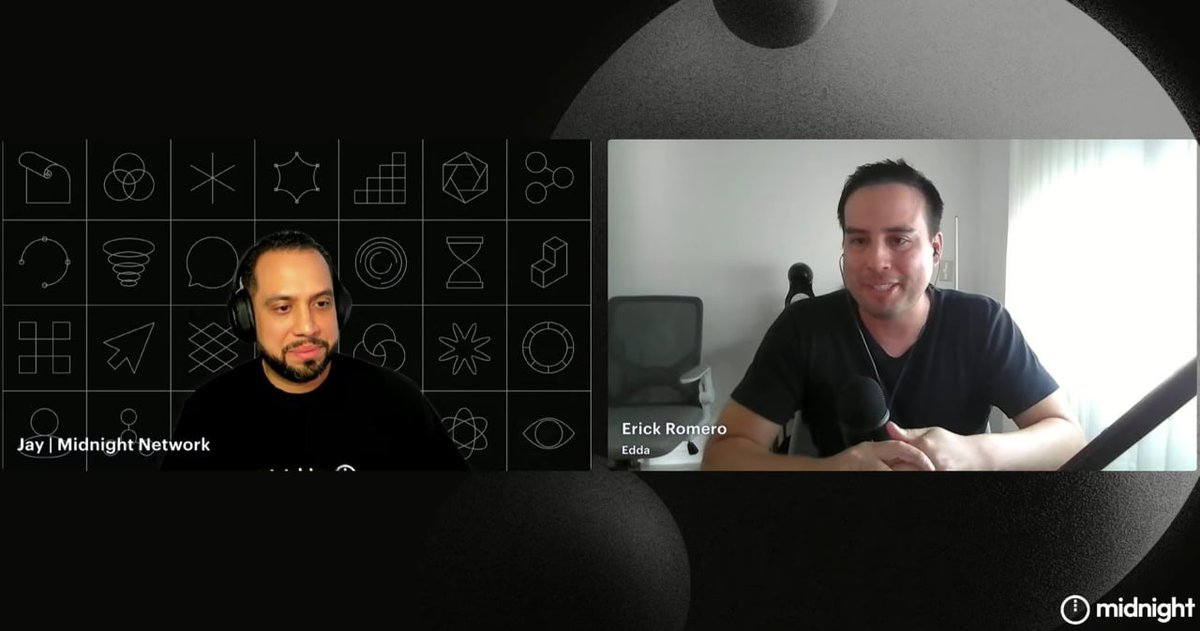
지난 밤,@Jay_Albert_ (DevRel, Midnight Foundation)가 호스트를 맡은 Fireside Dev Hang 세션이 진행되었습니다!
이번 세션에서는 데이터 가용성(Data Availability), 새로워진 zSwap 기능, 그리고 따끈한 커뮤니티 소식까지 두루 다뤘습니다. 데이터 가용성부터 zSwap settlement, 최신 스프린트 소식까지 한 번에 따라잡고 싶다면 이번 세션을 꼭 확인해 보세요.
👉 youtube.com/watch?v=dwsO4q8S…
🗓 이번 세션에서 다룬 내용
🌉 Data Availability & EffectStream — with Sebastien
데이터 가용성이 왜 중요한지, 그리고 EffectStream이 어떻게 멀티체인 애플리케이션을 가능하게 하는지 살펴봤습니다.
🤝 Offer Files와 zSwap Settlement 소개
Offer Files가 무엇인지, zSwap settlement와 어떻게 맞물려 동작하는지 직접 따라가 봤습니다.
🏆 1AM Partner Sprint 수상자 발표
지난 1AM 스프린트의 수상자를 발표했습니다.
🏃 새로운 Zealy Sprint 킥오프
다음 스프린트의 세부 내용과 참여 방법을 안내했습니다.
2
3
8
257
KTOP | SPO | WM ENO | WM & Midnight 🇰🇷Ambassador retweeted

Jun 11
Telemetry is the process of collecting real-world network intelligence directly from active devices.
Unlike surveys, estimates, or synthetic testing, telemetry captures what is actually happening on live networks in real locations.
Every measurement contributes to a larger picture of network performance, helping identify trends, validate service quality, and uncover issues that would otherwise remain hidden.
The result is data grounded in reality, not assumptions.
9
38
126
2,308
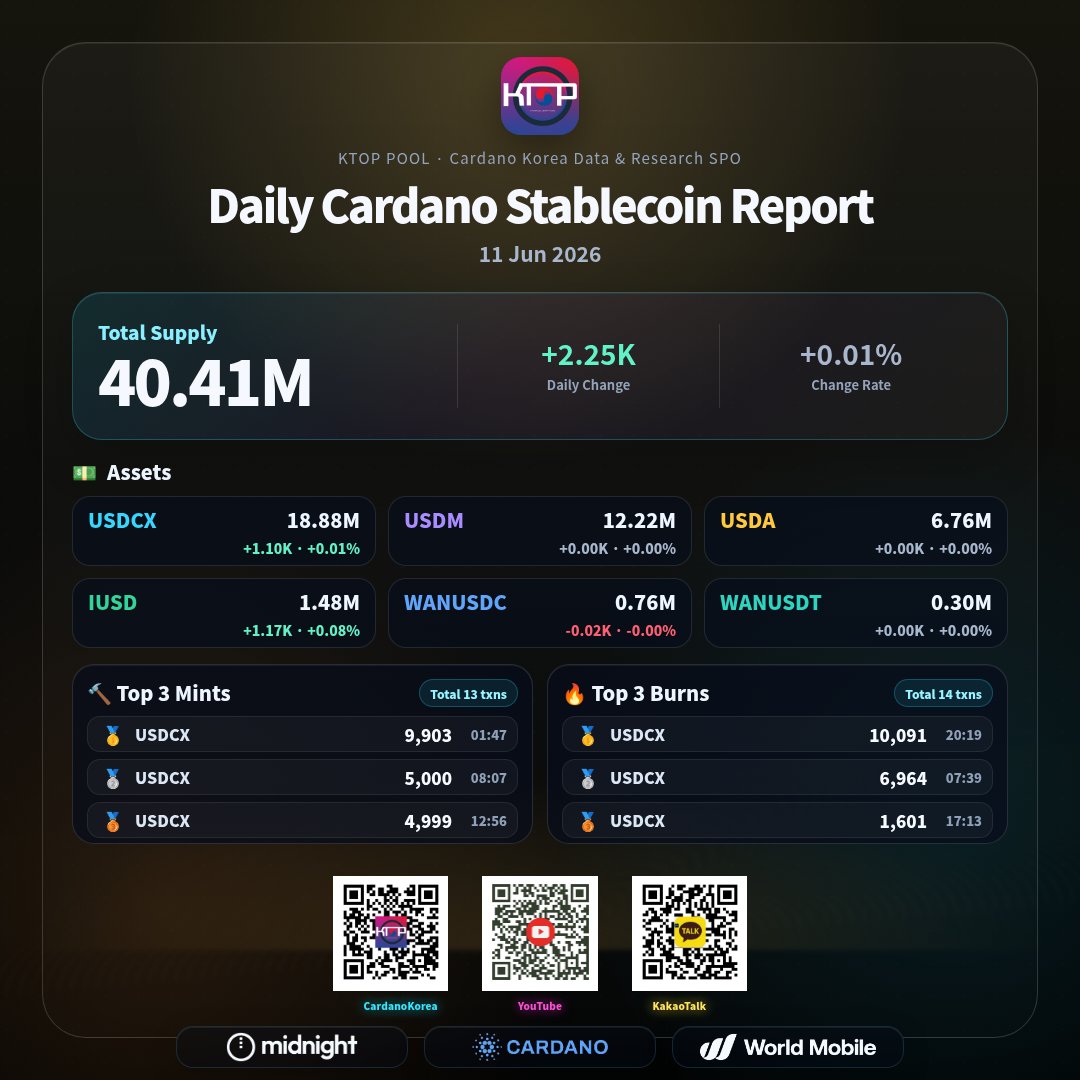
📊 Daily Cardano Stablecoin Report (11 Jun 2026)
💰 Total: 40.41M ( 2.25K, 0.01%)
💵 Assets
• USDCX 18.88M ( 1.10K, 0.01%)
• USDM 12.22M ( 0.00K, 0.00%)
• USDA 6.76M ( 0.00K, 0.00%)
• IUSD 1.48M ( 1.17K, 0.08%)
• WANUSDC 0.76M (-0.02K, -0.00%)
• WANUSDT 0.30M ( 0.00K, 0.00%)
🔨 Top 3 Mints (Total 13 txns)
🥇 USDCX 9,903 (01:47)
🥈 USDCX 5,000 (08:07)
🥉 USDCX 4,999 (12:56)
🔥 Top 3 Burns (Total 14 txns)
🥇 USDCX 10,091 (20:19)
🥈 USDCX 6,964 (07:39)
🥉 USDCX 1,601 (17:13)
For more details, please visit:
🔗 cardanokorea.com/stablecoin-…
@wanchain_org @Indigo_protocol @Cardano_CF @USDMOfficial @AnzensOfficial
1
2
51
KTOP | SPO | WM ENO | WM & Midnight 🇰🇷Ambassador retweeted

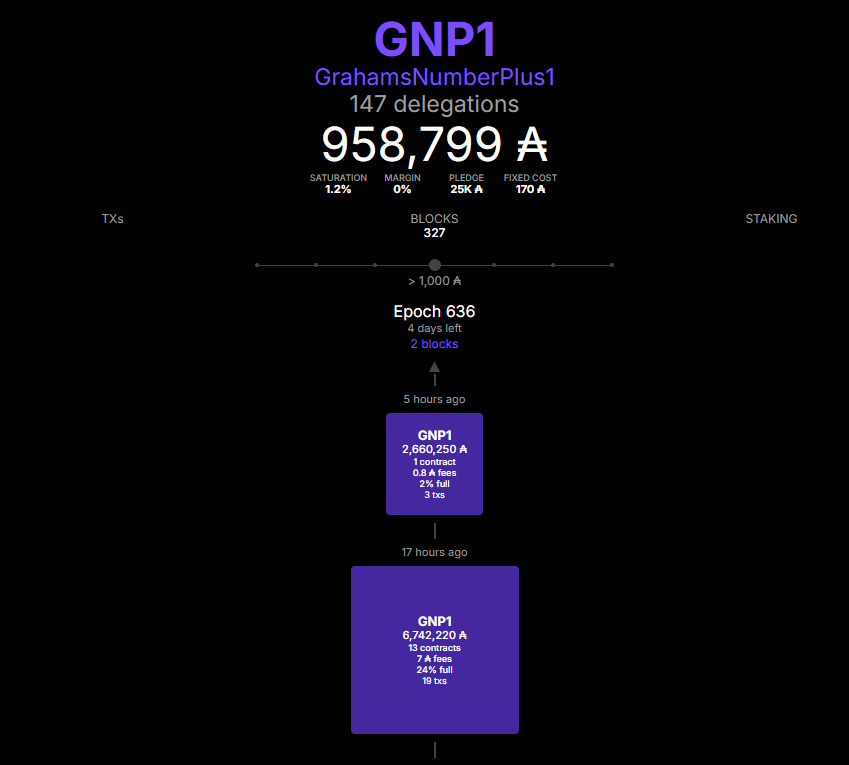
Six years of perfect stakepool operations with 100% up time for GNP1
Another perfect Epoch with 2 from 2 blocks minted for Epoch 636
Don't you think it is time that we deserved more delegation ?
Help us keep going and stake with GNP1 🙏
1
3
11
137
KTOP | SPO | WM ENO | WM & Midnight 🇰🇷Ambassador retweeted

Jun 10
📡 World Mobile is collaborating with Integrity Technologies Corp. to explore integrated telecom deployments for rural communities, tribal lands, and underserved regions across the U.S.
Fiber backhaul. AirNode infrastructure. Community-powered last-mile access.
Ground-based networks today. Stratospheric connectivity tomorrow.
This is how telecom gets rebuilt where legacy models stopped short.
🔗 Read the full announcement: clarionledger.com/press-rele…
5
67
194
7,172
KTOP | SPO | WM ENO | WM & Midnight 🇰🇷Ambassador retweeted

Jun 9
Dolos v1.2.0 is out 🚀
A lightweight Cardano data node with rich query capabilities.
This release brings steady improvements shaped by community feedback.
What's new 🧵
github.com/txpipe/dolos
3
15
61
1,082
KTOP | SPO | WM ENO | WM & Midnight 🇰🇷Ambassador retweeted

Jun 9
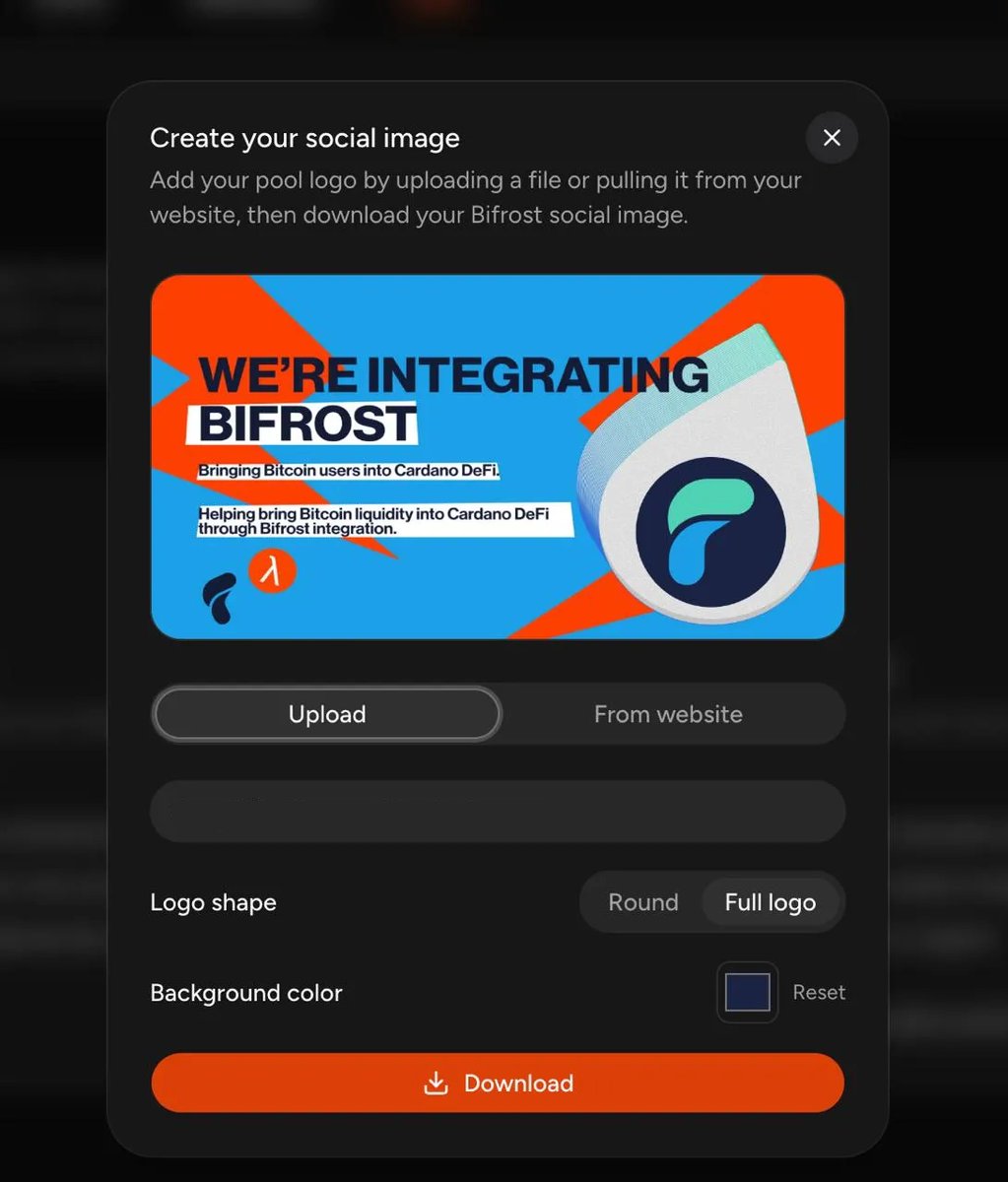
Every SPO, every dApp, and everyone planning to use the Bifrost bridge should start preparing for the Bifrost integration 👀
We’ll be sharing the application form very soon, meanwhile we’ve prepared a nice visual so you can go tell your delegators and users📣
3
28
146
4,801
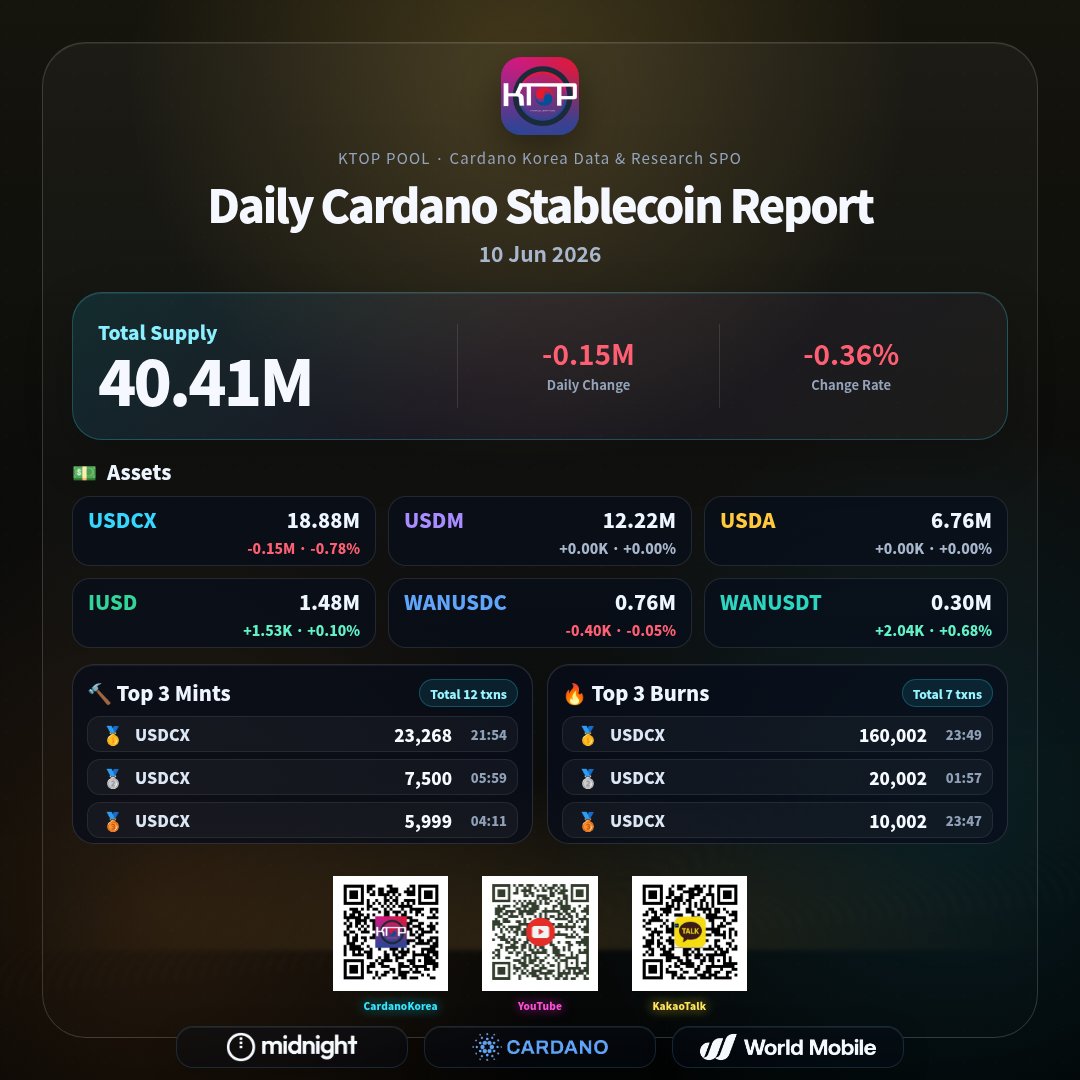
📊 Daily Cardano Stablecoin Report (10 Jun 2026)
💰 Total: 40.41M (-0.15M, -0.36%)
💵 Assets
• USDCX 18.88M (-0.15M, -0.78%)
• USDM 12.22M ( 0.00K, 0.00%)
• USDA 6.76M ( 0.00K, 0.00%)
• IUSD 1.48M ( 1.53K, 0.10%)
• WANUSDC 0.76M (-0.40K, -0.05%)
• WANUSDT 0.30M ( 2.04K, 0.68%)
🔨 Top 3 Mints (Total 12 txns)
🥇 USDCX 23,268 (21:54)
🥈 USDCX 7,500 (05:59)
🥉 USDCX 5,999 (04:11)
🔥 Top 3 Burns (Total 7 txns)
🥇 USDCX 160,002 (23:49)
🥈 USDCX 20,002 (01:57)
🥉 USDCX 10,002 (23:47)
For more details, please visit:
🔗 cardanokorea.com/stablecoin-…
@wanchain_org @Indigo_protocol @Cardano_CF @USDMOfficial @AnzensOfficial
1
3
66
KTOP | SPO | WM ENO | WM & Midnight 🇰🇷Ambassador retweeted

We're excited to partner with @COTInetwork to advance privacy standards, empower builders, and expand what's possible for privacy-preserving applications across Web3.
The privacy ecosystem grows stronger when we build together. 🤝

19
109
550
18,586
KTOP | SPO | WM ENO | WM & Midnight 🇰🇷Ambassador retweeted

Jun 9
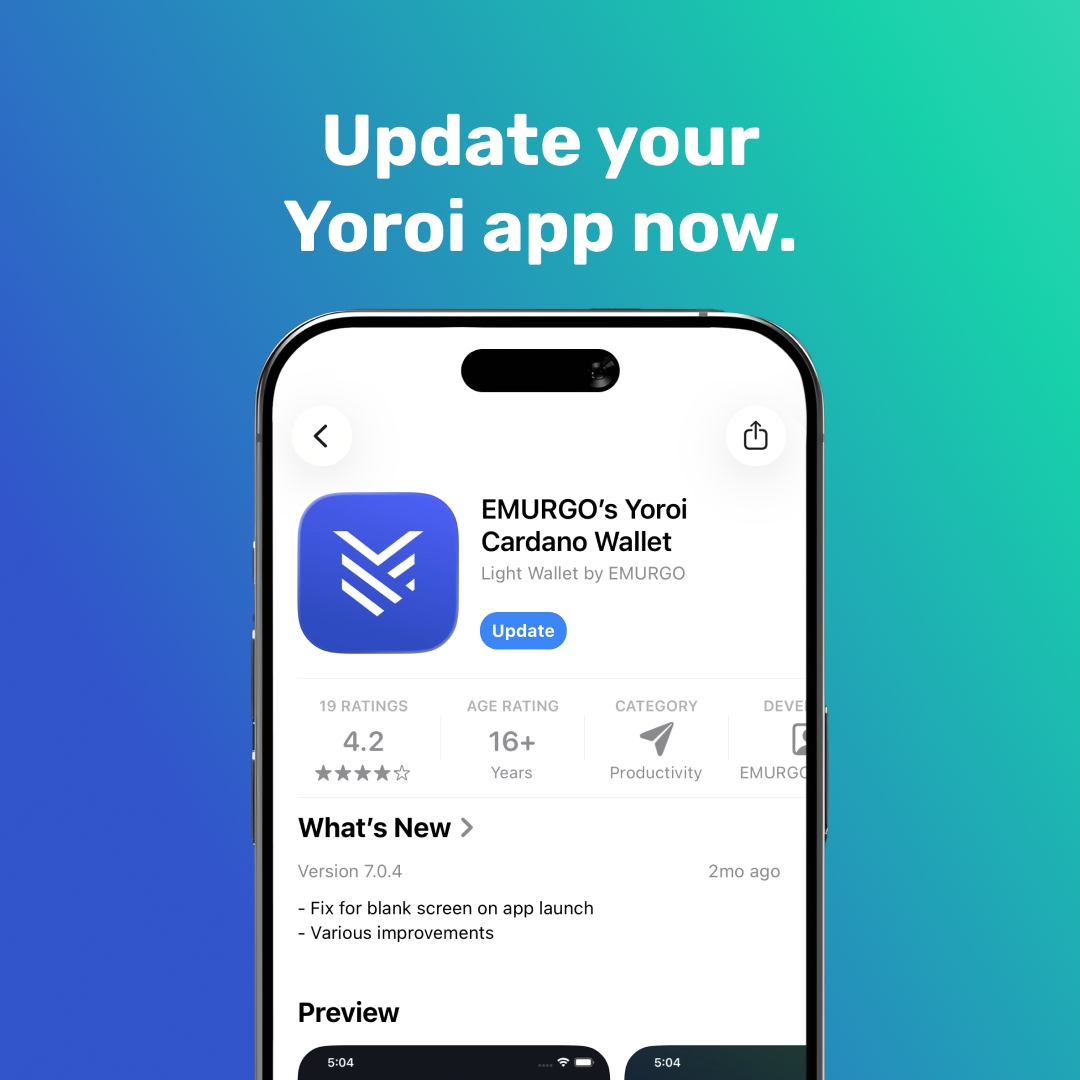
Yoroi Wallet App is now @secondfiapp. 🟦
Here’s what it means for Yoroi users:
- Your Yoroi DRep delegation stays exactly as you set it. SecondFi inherits Cardano governance from Yoroi.
- Your stake pool stays exactly as you set it. Rewards continue to the same pool (no re-delegation needed).
- Your keys, recovery phrase, and custody stay yours.
Same DNA. More ways to own your money: secondfi.io
15
63
283
21,138
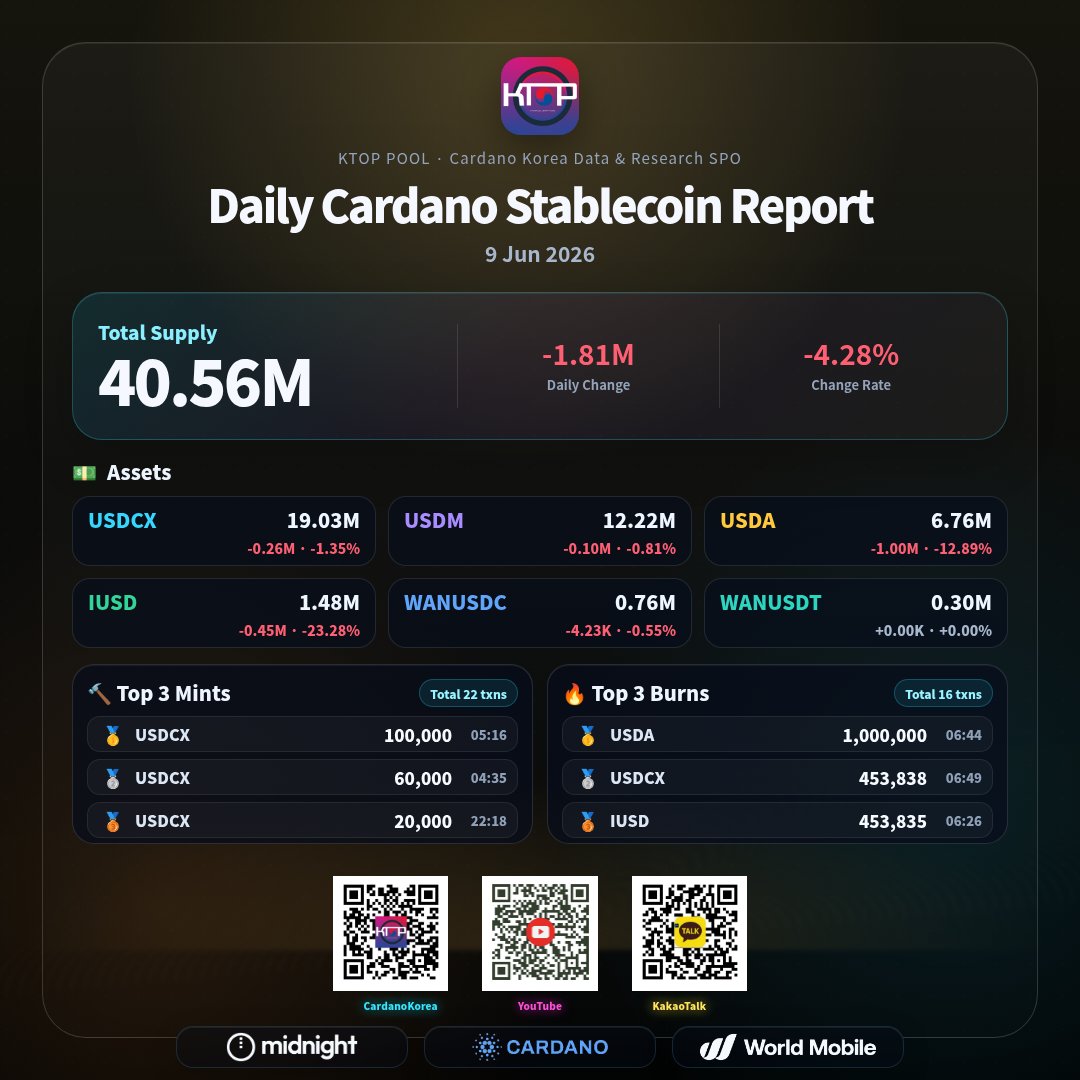
📊 Daily Cardano Stablecoin Report (9 Jun 2026)
💰 Total: 40.56M (-1.81M, -4.28%)
💵 Assets
• USDCX 19.03M (-0.26M, -1.35%)
• USDM 12.22M (-0.10M, -0.81%)
• USDA 6.76M (-1.00M, -12.89%)
• IUSD 1.48M (-0.45M, -23.28%)
• WANUSDC 0.76M (-4.23K, -0.55%)
• WANUSDT 0.30M ( 0.00K, 0.00%)
🔨 Top 3 Mints (Total 22 txns)
🥇 USDCX 100,000 (05:16)
🥈 USDCX 60,000 (04:35)
🥉 USDCX 20,000 (22:18)
🔥 Top 3 Burns (Total 16 txns)
🥇 USDA 1,000,000 (06:44)
🥈 USDCX 453,838 (06:49)
🥉 IUSD 453,835 (06:26)
For more details, please visit:
🔗 cardanokorea.com/stablecoin-…
@wanchain_org @Indigo_protocol @Cardano_CF @USDMOfficial @AnzensOfficial
2
60