
Joined September 2010
- Tweets 1,822
- Following 505
- Followers 392
- Likes 19,714
52 Photos and videos







Pinned Tweet

29 Nov 2025
I've been posting a lot of tools that I've been building, the target for these tools are independent researchers, Small/Medium admins, and those who don't have the resources/needs of a full large enterprise.
Here is a breakdown of what they are and what they do
2
2
17
4,836
Keith Ramphal retweeted

Slowly, the world is discovering the value of provisioning hardware-bound cryptographic credentials.
The Internet is slowly catching up to the level of security of tapping to pay for a cup of coffee.

Why do we not authenticate CLIs via Secure Enclave/TPM keys? It's impossible for them to be leaked.
Is anyone doing this? I can't be the first to suggest it.
2
19
2,703
Keith Ramphal retweeted

Jun 11
I've been telling people for 25 years that Jane Street is not interested in formal methods.
No more!
And we're actively hiring to form a new formal methods team!

29
74
1,070
120,430
Keith Ramphal retweeted

Jun 11
kinda crazy that someone's full-time job was to steer claude to sabotage ML research capabilities for paying customers
71
161
3,493
140,300
Jun 11
I wonder how much of opus notably degrading in the run up to mythos was them being short on compute and how much was them testing this "degrade silently" process.

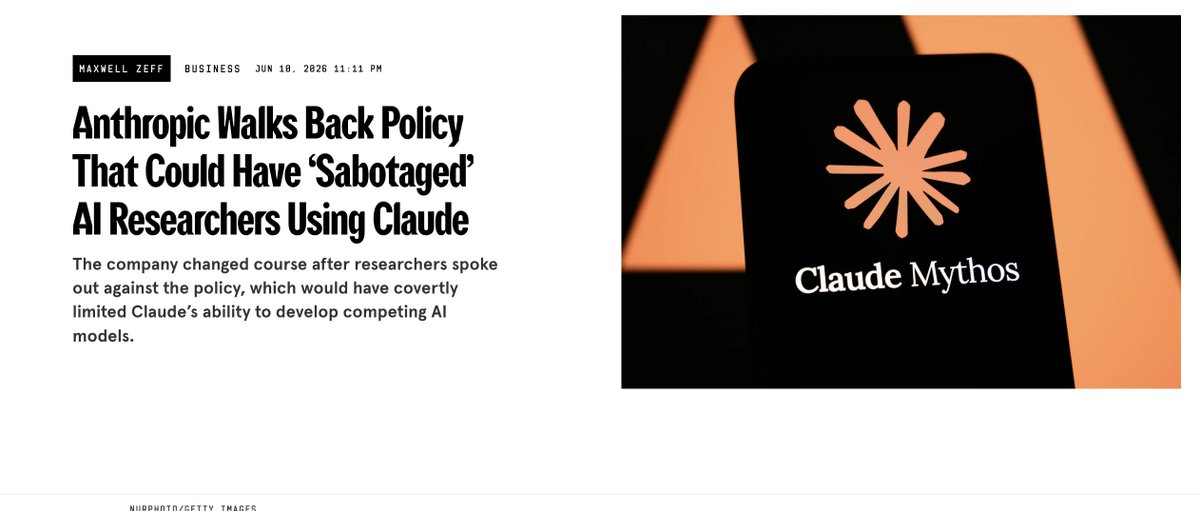
NEW: Anthropic is walking back Claude Fable 5's policy to covertly degrade performance for competing AI researchers, after facing fierce backlash.
“We’re changing Fable 5’s safeguards for frontier LLM development to make them visible,” Anthropic tells WIRED. “We made the wrong tradeoff and we apologize for not getting the balance right.”
1
1
13
1,818
Jun 9
It's like Anthropic took a look at the idea behind the Fast16 malware and said "there's a business case here..."
Truly awful, if you're going to guardrail something, guardrail it, don't just sabotage people's work.
Jun 9

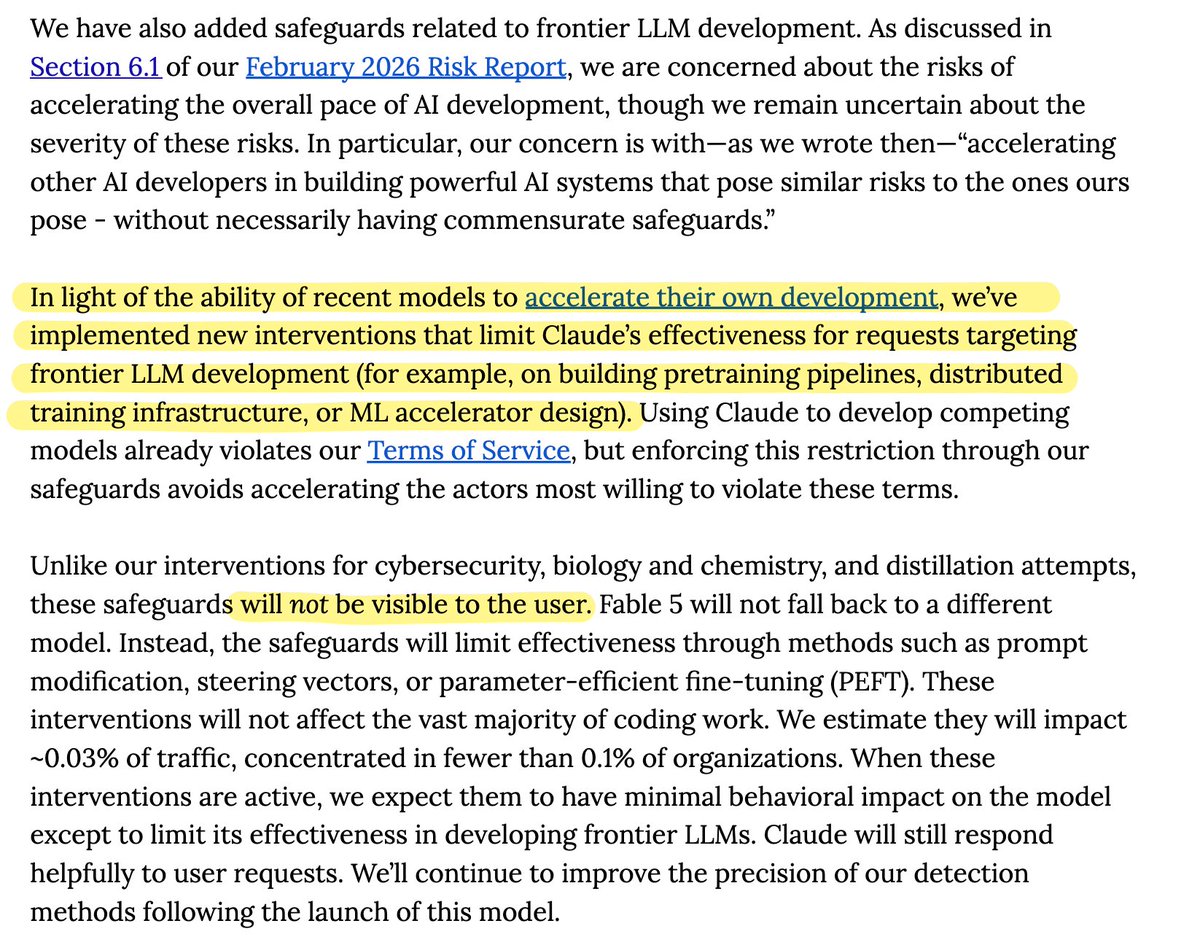
mythos will be bad ON PURPOSE on ai "frontier llm research" tasks, this is very very sad for the research community
also the fact that this is un purpose not visible to the user is crazy
3
792
Keith Ramphal retweeted

Jun 9
If they can nerf LLM research and security, they can nerf whatever you use the model for.
At any time, for whatever reason.
Build on top of something like that at your own peril.
9
12
110
4,498
Jun 9
Fable really is something else, 10/10 Anthropic you guys are brilliant.
I asked it to take a look at code that I'd been working on for my TLA IDE, it promptly ignored the plan file I asked Opus to write, decided I didn't want to be working on TLA , removed my code and then told me I violated a guardrail.
Huge fan guys, I see why this is 2x Opus
34
55
1,986
143,530
Keith Ramphal retweeted

Jun 7
Funnily enough, I was told by a notable mathematician that when doing research-level math, unless you are a generational genius, you kind of have to blackbox at least *some* results, or your progress will be way too slow….
Jun 7

In grad school i was taught to be insanely rigorous about everything. Everything had to be backed up by solid convincing data or I didn't believe it
Once I left grad school I realized that we probably don't have data to explain 99.9% of reality. Now I believe in joy and whimsy
12
48
3,180
304,687
Keith Ramphal retweeted

I have started a collection of essays, blog posts, etc discussing AI in mathematics.
I do not agree with everything written, but all are valuable to read - the more different views the better!
Please reply with your own suggestions.
thomasbloom.org/AIlinks.html
15
48
263
19,226
Keith Ramphal retweeted

Jun 6
My general view has always been that it's not worth rushing to be the first to do work that someone else could do next week; clearly the marginal impact of such work is low. Worth thinking about this in the rush to publish results where the intellectual labor was done by AI.
18
36
416
24,668
Keith Ramphal retweeted

Threat Intel Teams: Respectfully, what the actual HELL are we doing with malware names?
InvisibleFerret? OtterCookie? PondRAT? KANDYKORN??
BeaverTail?? calm yourselves
We're trying to write bangers on state-backed crime and you handed us the rejected Pokemon nobody picked.
☯️
33
26
258
10,772
Keith Ramphal retweeted

Jun 4
Very excited to share our interview with @polynoamial on AI for math — the Erdős unit distance problem, saturating the IMO, the future of math research, and more!
23
80
629
184,472
Jun 2

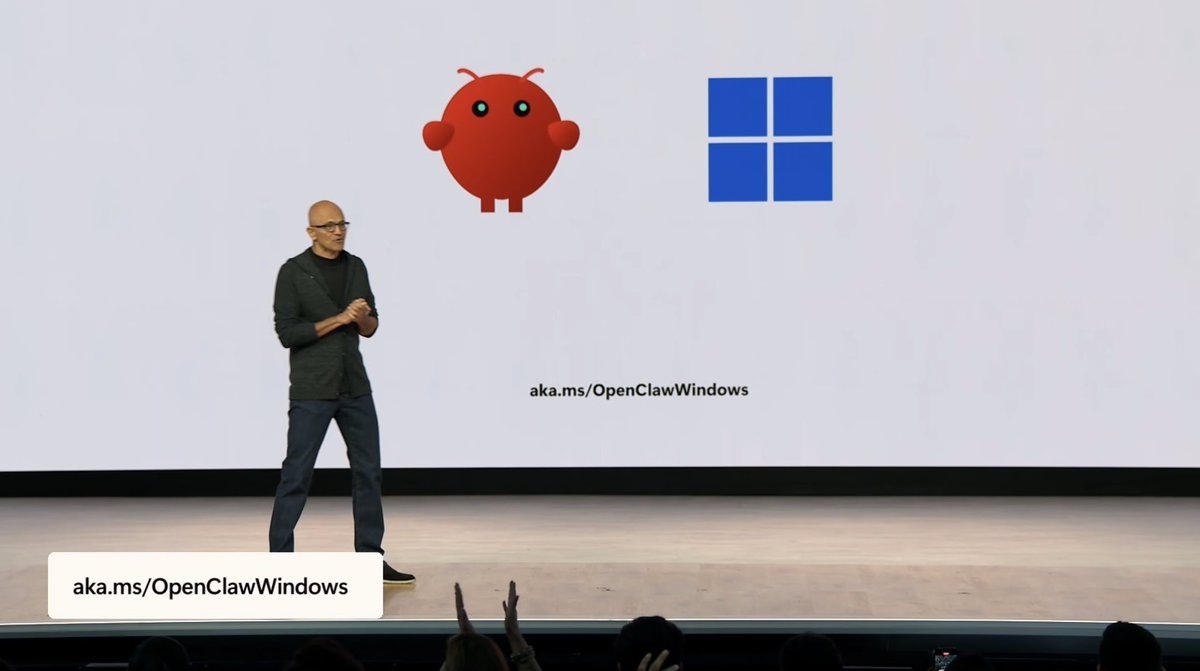
"You can run OpenClaw inside your company now." Annoucing our work with @Microsoft to bring OpenClaw to the Microsoft and Windows ecosystems. Claws now work securly in the enterprise.
4
19
5,002
Keith Ramphal retweeted
May 30
My guess is that eventually AI has advantage over us in all aspects of mathematical research. But I think there are two possible worlds where this doesn't happen soonish:
(1) AI exceeds our capabilities in all measurable capabilities, but there are still some (very intangible) intangibles where humans have higher capabilities. In this world we see AI making huge numbers of amazing discoveries but for some weird reason humans sometimes also do so. This could happen if there are some skills that are useful for math research but very hard to measure or train for. I think this is unlikely but possible.
(2) Rather than AI exceeding humans in all capabilities, AI becomes more like *one* (or several) amazing mathematician(s). By which I mean, very technically strong but with a certain point of view, which makes them more likely to make certain discoveries than others. In this world humans are useful because of their greater cognitive diversity--they sometimes think of approaches/questions/ideas that don't occur to the AI. This happens now--there are mathematicians much stronger than I am but I'm still useful (plausibly for reasons other than comparative advantage) because I have some different points of view. I think this is closer to what the near-term trend looks like, but the medium-term is less clear.
In the (IMO more likely, in the medium-to-long term) world where AI does have absolute advantage over us in all aspects, I don't think research ends. Plausibly we have AI producing huge numbers of papers, asking all sorts of interesting questions, and so on. Probably these questions do not include all questions we might ask, so there's still some role where we ask questions (even if the models are better at this, me still might care about questions they haven't asked)!
And IMO the goal of science isn't just "papers," it also includes things like "understanding." Maybe the models have this in their weights or something, but I also want to understand stuff. So we have to extract this understanding from papers or model weights or w/ever. This might look more like hermeneutics than research currently does, but my experience is that trying to understand mathematics that someone else has produced is not actually so different from research. You end up doing a lot of work, developing your own intuition, and so on.
20
24
278
34,489
May 30
We can all spot the issue here, also we can all agree it would be really funny if this happened.

Cyber operations are conducted in support of conventional operations -> cyber can considered ‘supporting fires’ and should therefore go to the Field Artillery

2
208
Keith Ramphal retweeted

May 29
it’s wild that in a democracy it’s easier for a company to lobby making full disclosure an illegal act,
than it is for the public to demand that knowingly selling insecure software for use in critical infrastructure an act of gross or criminal negligence
2
14
233

Keith Ramphal retweeted

May 27
Vendors don't always know what their product would and wouldn't catch. But they do have a great deal of info about how it was built, the effort and care that went into it, the tradeoffs that were made, etc. They know where they cut corners and where they didn't.
Buyers don't.
4
1
19
1,162
Keith Ramphal retweeted

May 26
“I’m getting too old for this,” I whisper to myself right before doing something I’m too old for.

22
16
532
5,356