The Kempner Institute for the Study of Natural and Artificial Intelligence at @Harvard University. RTs ≠ Endorsements

Joined November 2022
333 Photos and videos
What is the #KempnerInstitute? Watch a short video feature to dive deeper into our mission and meet the researchers behind it: bit.ly/49ODO2K #AI #ML #NeuroAI #neuroscience @Harvard
1
8
39
17,135
🧠🎉Congratulations to #KempnerInstitute Investigator SueYeon Chung (@s_y_chung), selected as a 2026 McKnight Scholar for her work on neural population geometry. Learn more: bit.ly/3PWkP2x @harvardphysics @hseas @McKnightFdn
9
683
Kempner Institute at Harvard University retweeted
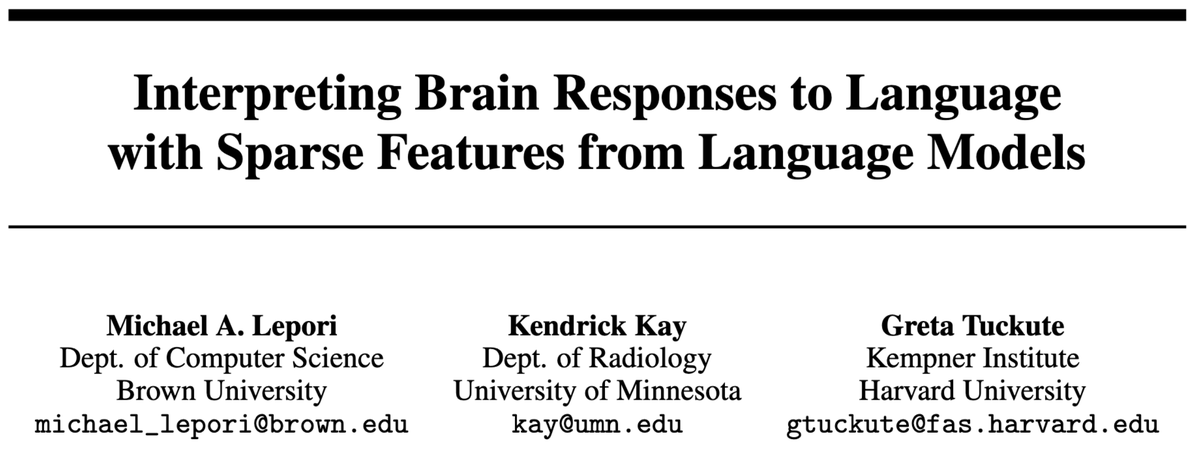
It is tricky to characterize the features represented by human language cortex. This work is a step toward doing so. Using small, interpretable feature sets, we explain language-network responses and show a shared feature basis across regions with variation across individuals.
🚨New preprint!🚨 We know that LM representations can be used to predict brain responses to language. But what *features* of these representations underlie this alignment? We use SAEs to find out!
10
64
6,057
Kempner Institute at Harvard University retweeted
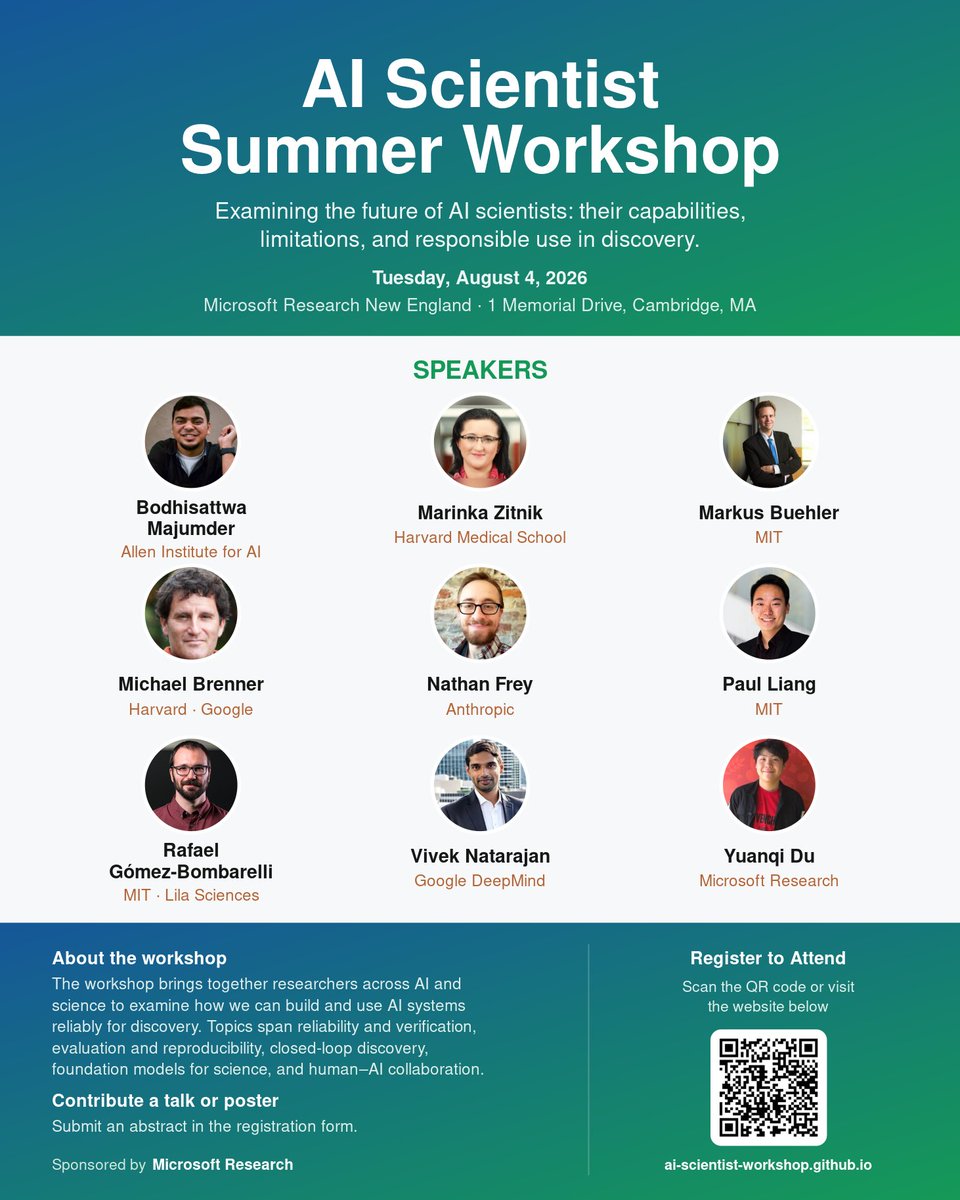
We're organizing an AI Scientist Summer Workshop in Boston on August 4! We have already received an incredible amount of interest, so please register soon to secure a spot. We have an incredible line up of speakers from Harvard, MIT, Anthropic, Google DeepMind, AI2, and Microsoft Research. Marinka Zitnik (HMS) @marinkazitnik Vivek Natarajan (Google) @vivnat Nathan Frey (Anthropic) @nc_frey Paul Liang (MIT) @pliang279 Michael Brenner (Harvard, Google) Markus Buehler (MIT) @ProfBuehlerMIT Yuanqi Du (MSR) @YuanqiD Bodhisattwa Majumder (AI2) @mbodhisattwa Rafael Gómez-Bombarelli (MIT, Lila Sciences) @RGBLabMIT We're also welcoming contributed talks and posters. Please fill in the registration form to submit a talk or poster 👇 Thank you to my fellow organizers @WengongJin @YuanqiD
8
40
227
20,388
Kempner Institute at Harvard University retweeted
1/ When diffusion generates images from text, before an image has objects, how does each noisy token know what it should become? In our new work, we found that Diffusion Transformers solve spatial-relation prompts using a circuit motif reminiscent of developmental biology: morphogen-like spatial gradients. At the start of sampling, image tokens are mostly uninformed noise — like an undifferentiated sheet in an embryo. Relation heads then write smooth spatial gradients onto the image canvas, guiding where objects should emerge. Accepted as a @CVPR 2026 Highlight🌟: animadversio.github.io/DiT-R… Beautiful collaboration with my friends and colleagues @fjxdaisy & Xu Pan! A 🧵
3
49
222
37,814
Kempner Institute at Harvard University retweeted
How can we effectively use VLMs for robotics manipulation? Excited to share SIMPACT, which uses simulation as a tool to enable VLMs to reason and plan continuous robotics actions.
Excited to share our CVPR work: SIMPACT: Simulation-Enabled Action Planning using Vision-Language Models, 11:45 PM – 1:45 PM at ExHall F 611 simpact-bot.github.io/ How can we make VLMs plan robotic manipulation actions with grounded physical reasoning?
2
9
93
12,139
📢 Today at 4:30 p.m. ET, #KempnerInstitute joins Harvard Alumni; “Kempner Institute: Unlocking Intelligence.” Learn about our work to reveal the foundations of intelligence. Featuring @blsabatini, @ShamKakade6, @KanakaRajanPhD, and @du_yilun. Watch: bit.ly/4oarIJW
3
609
Kempner Institute at Harvard University retweeted
My big takeaway from our new work: saturation is the underrated key to learning. Always think about what concepts are saturating, because that’s when you get to learn the next one.
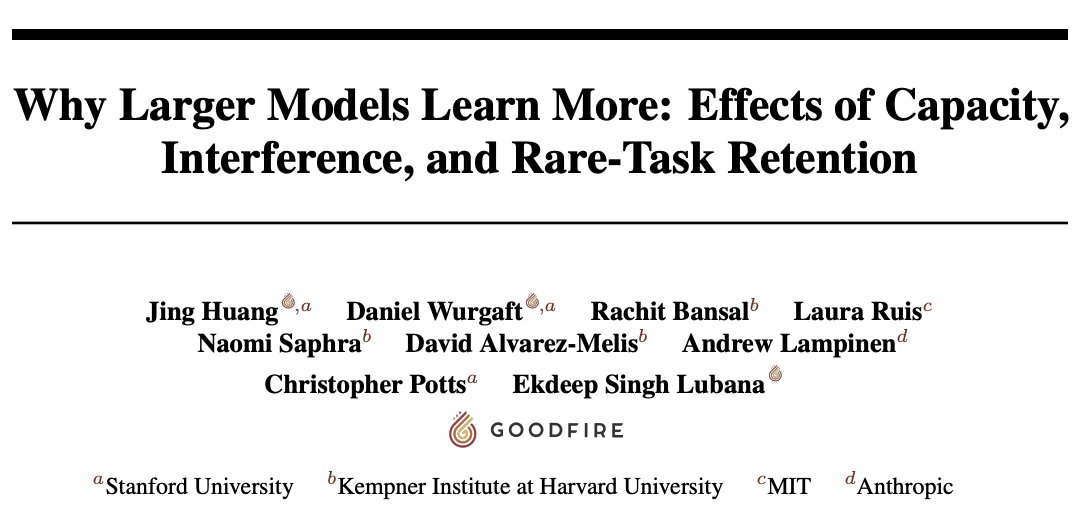
We take for granted that larger models are better than smaller ones, but why is this so? Our new paper, led by Jing Huang and @EkdeepL, traces this to a data-induced competition for resources (neurons), using formal analysis, idealized tasks, and real pretraining.
1
6
62
5,637
Kempner Institute at Harvard University retweeted
The ToolUniverse plugin for Claude Code is here: 2,000 life-science tools and 120 research skills, with a real source on every answer, installed with one prompt. ToolUniverse already powers a range of AI agents. This plugin brings its full toolset and skill library into Claude Code. What it does: → Claude Code automatically reaches for the right tools and skills to run a full life-science analysis end to end: variant interpretation, RNA-seq differential expression, drug and target lookups, rare-disease workups. Every claim comes back with a real source, instead of from memory. → When accuracy is critical, dedicated commands add discipline: • cross-validate a claim across 3 independent sources • literature-sweep, a graded review across 15 indexes (PubMed, EuropePMC, OpenAlex, and more) • compare, side-by-side tables for drugs, targets, diseases, or variants • research, a step-by-step multi-source investigation • translate-id, resolve an ID across every namespace Install in one step. Paste this into Claude Code and it sets itself up: Read raw.githubusercontent.com/mi… and install the ToolUniverse Claude Code plugin for me. Blog post 👇 aiscientist.tools/posts/tool… @marinkazitnik @ScientistTools @KempnerInst @HarvardDBMI
2
17
79
13,680
Kempner Institute at Harvard University retweeted
How can we get LLM agents with different capabilities to autonomously self-orchestrate? Excited to share Economy of Minds, where agents autonomously learn to cooperate with each other through economic transactions, where agents reward each other for jointly solving tasks.
Imagine a population of machine agents. Each might be strong on certain tasks but fundamentally limited: partial tools, partial observations, finite context, bounded compute. How can these agents self-orchestrate and self-evolve into stronger collective intelligence to solve tasks beyond any single agent's capability? Instead of designing the multi-agent system itself, we propose designing the incentives that govern it. We put agents in an economy. They compete, trade, get wealthy, go bankrupt, and mutate, forming an alive society where coordination and adaptation automatically emerge in a decentralized manner.
3
16
150
19,458
Kempner Institute at Harvard University retweeted
Task diversity is supposedly key to generalization in RL. But what does it do to continual RL, where agents face one new task distribution after another? We find that past a point, more diversity actually inhibits continual reinforcement learning 🧵
4
15
88
7,973
Kempner Institute at Harvard University retweeted
1/n Are biological neurons linear-nonlinear computers, like perceptrons, or is their output governed by non-linear interactions between inputs? If the activity of a neuron is well fit by linear models that sum inputs, does that mean that the neural computation actually is linear?
4
21
135
28,875
If you're at #ICRA2026 tomorrow, check out this presentation from the lab of #KempnerInstitute Investigator @du_yilun! #AI #robotics
Flexible Locomotion Learning with Diffusion Model Predictive Control Excited to share that our paper has been accepted to #ICRA2026 @ieee_ras_icra! A diffusion-planning framework for flexible real-world quadruped locomotion. Instead of learning a fixed RL policy or relying on hand-crafted dynamics for MPC, we train a diffusion trajectory prior that jointly predicts future states and actions. Key Ideas: Diffusion-MPC: A diffusion planner unlocks flexible locomotion through test-time reward and constraint adaptation Interactive reward-weighted finetuning enables continual behavior refinement from online environment feedback Real-world deployment on Unitree Go2 with efficient and adaptive planning The same planner can adapt at test time to height changes, posture/joint constraints, balancing under external disturbances, energy-aware locomotion, and zero-shot outdoor walking on grass and slopes. 🌐Homepage: flexible-diffusion-mpc.githu… 📖Paper: arxiv.org/abs/2510.04234 🔗Code: github.com/hrh6666/Flexible-… This work is by @RunhanH, Haldun Balim, @hankyang94 , and @du_yilun. #ICRA2026 #Robotics #LeggedRobots #RobotLearning #DiffusionModels #MPC #MachineLearning
1
4
934
Kempner Institute at Harvard University retweeted
very excited to finally share this work that has been in the making for more than a year! as @ChrisGPotts says, model scale is often taken for granted. we were curious: what do more parameters really do? some really satisfying answers in our preprint: arxiv.org/abs/2605.29548
We take for granted that larger models are better than smaller ones, but why is this so? Our new paper, led by Jing Huang and @EkdeepL, traces this to a data-induced competition for resources (neurons), using formal analysis, idealized tasks, and real pretraining.
1
2
26
4,606
🤖 If you’re attending #ICRA tomorrow, check out the talk by @HaonanChen_, a postdoc in the lab of #KempnerInstitute Investigator Yilun Du (@du_yilun), on #multimodal policy consensus for #robotics. 9am in Hall C! Learn more about the work: policyconsensus.github.io/ #AI

3
502
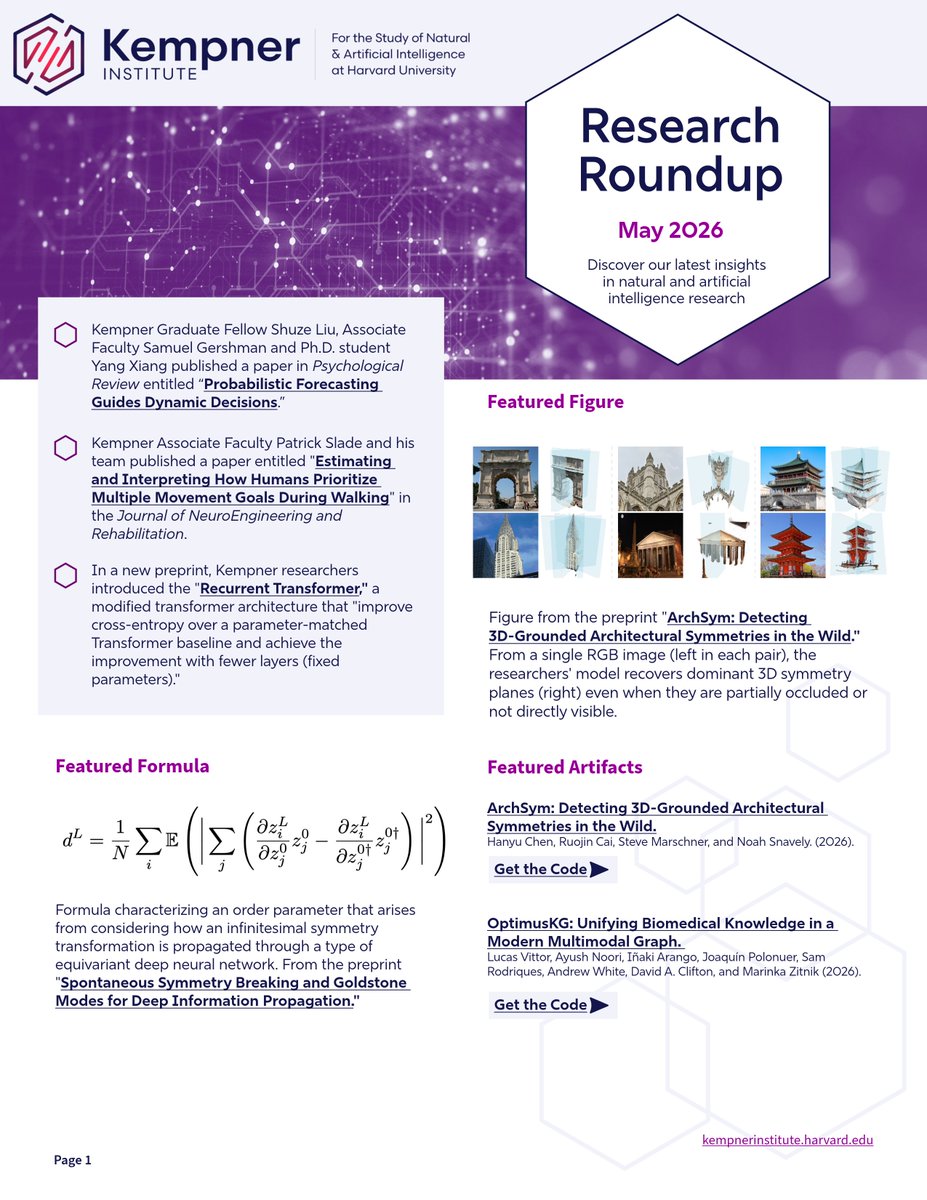
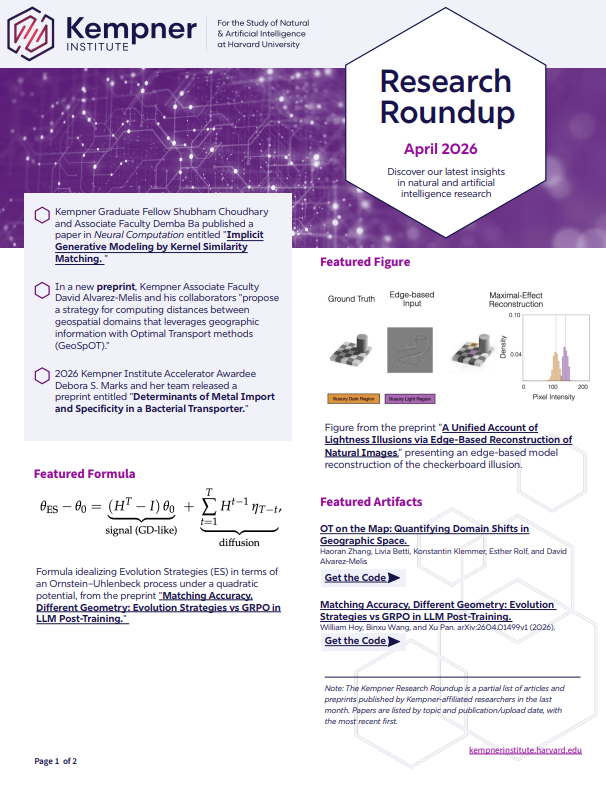
NEW: Kempner Research Roundup: May 2026! 🧠🤖 Discover the latest research in natural and artificial intelligence from the #KempnerInstitute: bit.ly/43F5ypP #AI #NeuroAI #neuroscience
1
1
13
887
The #KempnerInstitute is hiring! 👇 ⏰ Application deadlines approaching: • June 1: Kempner AI Fellows (post BS/MS) • June 8: Postdoctoral AI Researchers (post PhD) Learn more and apply: bit.ly/439R2Gp #AI #NeuroAI
6
48
3,754
📢✨Introducing AutoScientists: #AIscientists that do real science, going beyond answering questions or running workflows. From #KempnerInstitute Graduate Fellow @AdaFang_ Associate Faculty @marinkazitnik and @GaoShanghua @HarvardDBMI
AI Scientists are starting to actually do science. Not just answer questions. Not just run workflows. Introducing AutoScientists: a decentralized team of AI agents that can generate hypotheses, design experiments, write code, test ideas, analyze failures, and revise strategy as evidence accumulates. Because real research is not a to do list of tasks. It is a living search process. Leads emerge, failures matter, teams form around what works, and priorities shift when evidence changes. Much like how a lab of scientists would work on cutting edge research together. Across GPT training optimization, biomedical ML, and protein fitness prediction, this decentralized structure consistently does better research. Learn more 👇 @GaoShanghua @marinkazitnik @KempnerInst @HarvardDBMI @Harvard
4
16
3,743