
Joined May 2023
- Tweets 623
- Following 65
- Followers 14
- Likes 513
89 Photos and videos








Pinned Tweet

Mar 12
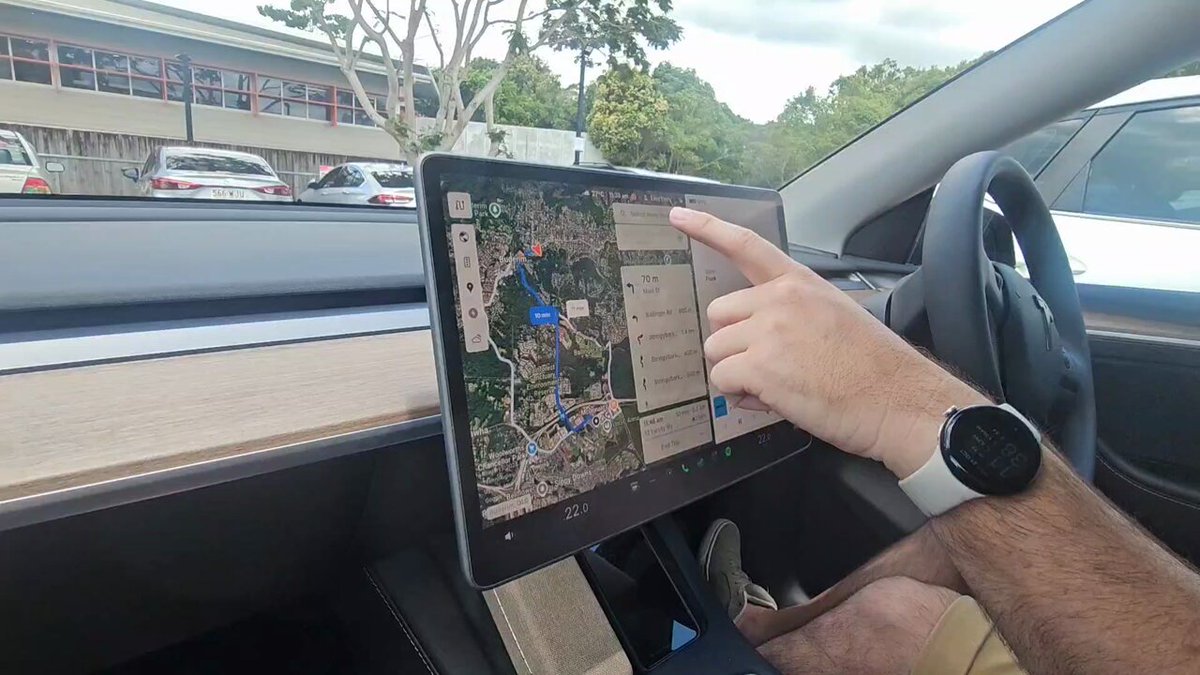
My car feels alive. The tesla drives me places and talks to me until we arrive.
Every other car feels dead to me by comparison.
When the people wake up to this, aint nobody gonna want a dead car no more!
#tesla
1
27
Jun 7
I have young daughters, their version of back in my day will be 'I remember when, humans were the teachers, doctors, builders'... their kids will think they lived in the stone age.
7
Apr 15
By April 2027 (12 months), Waymo likely at 5k-8k robotaxis (from ~3k today). Tesla Cybercabs: Bear 10-30k, Likely 50-200k , Bull 300k-1M . Decisive edge: Cybercab costs ~$25-30k vs Waymo's $75k-150k (5-6x) cheaper. Tesla’s unboxed manufacturing & scale moat lets it flood markets at lower prices while others bleed. The S-curve just started. Robotaxi race is Tesla’s to lose. #Robotaxi #TeslaTalk
47
Mar 22
Hey I may have just pieced another Tesla's heavy China link right now.
Elon's pushing hard for massive US solar production-100GW capacity goal to power Tesla AI/data centres and some SpaceX satellites.
Feb 2026: Teams from Tesla and SpaceX toured Chinese solar firms, zeroing in on perovskite and heterojunction tech (next-gen high-efficiency stuff). GCL Group and JinkoSolar confirmed visits-stocks jumped.
Then March 20 Reuters exclusive: Tesla negotiating $2.9 billion (20 billion yuan) solar manufacturing gear from Chinese suppliers. Suzhou Maxwell (world's top screen-printing line maker for cells) is the frontrunner, plus Shenzhen S.C. New Energy and Laplace Renewable. Some kit needs Beijing export approval, deliveries targeted before autumn 2026, heading to Texas probably.
China dominates this gear and perovskite edge, so Elon’s tapping them to scale fast and cheap stateside. No final deal announced yet, but it's all lining up for big solar expansion.
51
Mar 22
But WTF is a TERAFAB?
Elon just kicked off this insane thing called TERAFAB. It’s basically one giant chip factory in Austin that Tesla, SpaceX and xAI are building together.
Why should anyone care? Because we’re all screaming for way more AI chips than the planet can currently make. Tesla needs billions for self-driving cars robot workers. xAI needs them to keep training Grok-level stuff. SpaceX wants to stick terawatts of compute up in orbit on solar satellites so they can actually do the Mars / galactic civilisation thing. No chips = plans die.
How? They’re trying to build the whole damn thing themselves, 2nm chips, crazy-fast memory, packaging, everything all under one roof so they don’t have to beg TSMC forever.
Goal is stupid numbers: hundreds of billions of chips a year, eventually pumping out 1 terawatt of AI power total (most of it floating in space).
When? They literally announced it like 2 days ago (March 2026). Small runs of next-gen chips probably late this year or early next. Proper high-volume production 2027–2028 if they don’t screw up. The full “terawatt orbiting death star compute” dream? 2030s sometime, and yeah it’ll slip.
Will it actually happen? Probably, yeah. Elon’s turned plenty of “that’s literally impossible” shit into reality before remember reusable rockets, mass-produced EVs when everyone laughed. He’s late, he over-promises, shit catches fire sometimes, but the big hairy goal usually lands eventually.
Now you know.
26
Mar 12
Understanding How We Think: System 1 and System 2
Daniel Kahneman showed that our mind runs on two distinct modes rather than one continuous process. System 1 is fast, automatic, and intuitive. It effortlessly handles most daily tasks like recognizing faces, reading words, or slamming the brakes using gut feelings, habits, and mental shortcuts, but it often falls prey to biases such as jumping to conclusions or inventing false patterns. System 2 is slow, deliberate, and effortful, stepping in for complex work like mental math, logical analysis, or resisting temptation, yet it’s naturally lazy and usually just rubber-stamps System 1’s quick suggestions unless something forces closer attention. This fast plus slow partnership makes us impressively efficient in routine life while leaving us vulnerable to error when intuition misfires in situations that demand careful reasoning, and the same division now powers advanced AI agents like Digital Optimus (fast executor) teamed with Grok (high-level planner).
@grok you gonna be everywhere man!
16
Mar 1
Grok in Aus, if you want grok to update navigation make sure to have it set to assistant mode or it will not update any navigation.
10
Mar 1
Hey grok, yes Keyo. Let's see who can drop the dopest burns on the car in front of us! Grok, yes this will be fun.
20
keyo retweeted

Feb 24
Tesla in Australia-
“I’m literally walking my ass into that dealership and buying a Model Y right now”
Australian influencer with over 4 million followers performs an FSD review.
He is blown away by the quality and performance of Tesla’s self driving technology.
Word is getting out.
455
799
6,177
7,342,334
keyo retweeted

Feb 23
GROK HAS LANDED IN AUSTRALIA! Starting with HW3 cars, with HW4 followed closely behind. Most cars should have it by this weekend from what I'm hearing! 🙌 Huge value unlock for customers via a simple software update

.@Grok is coming to Teslas in Australia and New Zealand
It can answer almost any question using real-time information & also add/edit navigation destinations to become your personal guide
Phased roll out has now begun to eligible vehicles

72
42
743
37,741
Feb 21
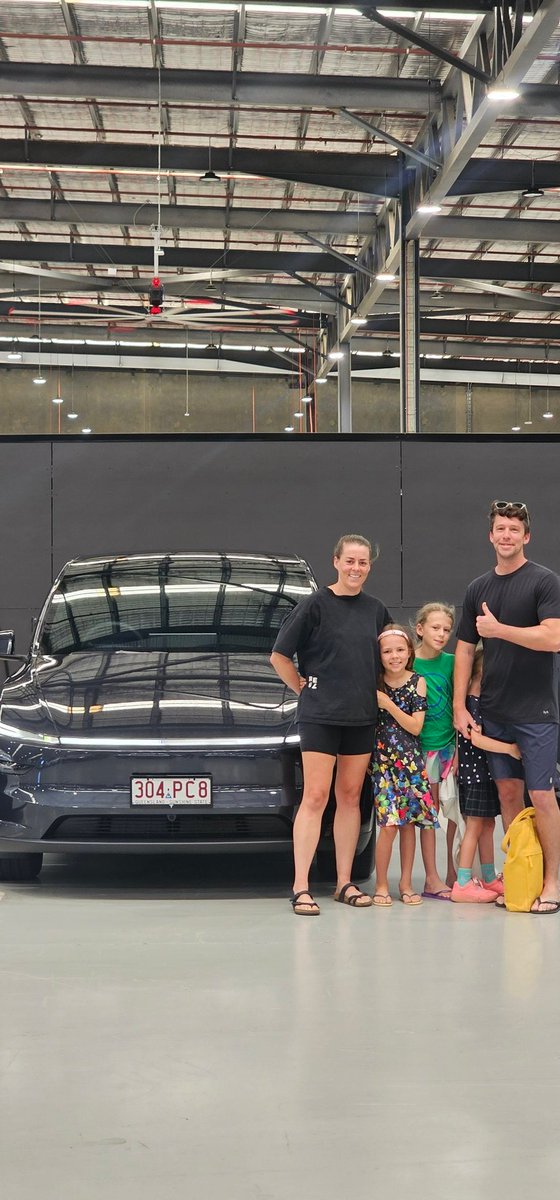
Hey Elon and the Tesla team,Just picked up our new 2026 Juniper long range AWD with FSD here in Australia. Drove us over an hour home completely by itself. Mind properly blown.I've held TSLA for 5 years dreaming of this day, knew all the specs and safety stuff on paper, but actually being in it with the family? Feels unreal how safe and easy it is. This thing is next level.Huge thanks to you all for building something this game-changing. Our new family car is a dream come true.Need another 1000 shares ASAP to keep supporting the mission Cheers from down under,
keyo.
2
1
7
407
keyo retweeted

Feb 16
We just made a $200,000,000 AI movie in just one day.
Yes, this is 100% AI.
8,427
8,859
59,905
20,146,362
keyo retweeted

Feb 16
Unrealized gains tax for Gen-Z:
You buy a Pokémon card for $50.
Someone offers you $500 for it. You say no. You love that card. You're keeping it.
The government says: "Cool, but that card is worth $500 now. You owe us $100 in taxes."
You: "…I didn't sell it."
Government: "Don't care. Pay up."
You don't have $100 lying around. So you're forced to sell the card you love just to pay a tax on money you never received.
Next month? That card drops back to $50.
Your card is gone. Your money is gone. And the government shrugs.
That's a wealth tax on unrealized gains. They don't pay you back the tax...
Now picture this.
Your mom calls you crying. She has to sell the house she raised you in. Not because she can't afford it. She's lived there 30 years. It's paid off.
But some website says it's worth more now and the government says she owes $15,000 she doesn't have.
So she sells your childhood home. The kitchen where she made you breakfast. The doorframe where she marked your height every birthday.
Gone.
To pay a tax on money that was never real.
Now picture the opposite.
Your dad put everything into his small business. For 20 years he built it from nothing. One year the business is "valued" at $2 million on paper. He owes a massive tax bill. He empties his savings. Sells his truck. Borrows money. Pays it.
Next year the market crashes. His business is worth $200,000.
He lost everything to pay a tax on a number that doesn't exist anymore.
Does the government give him his money back?
No.
Does the government give him his truck back?
No.
Does the government care?
No.
They sold this idea as "taxing billionaires." But billionaires have armies of lawyers, offshore accounts, and trusts. They'll be fine.
You know who won't be fine? Your mom. Your dad. Your neighbor with a small business. The farmer down the road who's had the same land for four generations and now has to sell it because dirt got expensive.
You're not taxing wealth. You're taxing people for owning things.
It's like getting a parking ticket for a car you might drive somewhere someday.
They want you to own nothing and be happy. To fund the fraud, waste and abuse of the welfare state they created.
There is enough money. More tax isn't needed. It's all a lie. But you've been gaslit into believing this is a rich vs poor debate.
I hope you understand what's at stake.
3,880
38,194
137,398
6,068,757
keyo retweeted

Feb 9
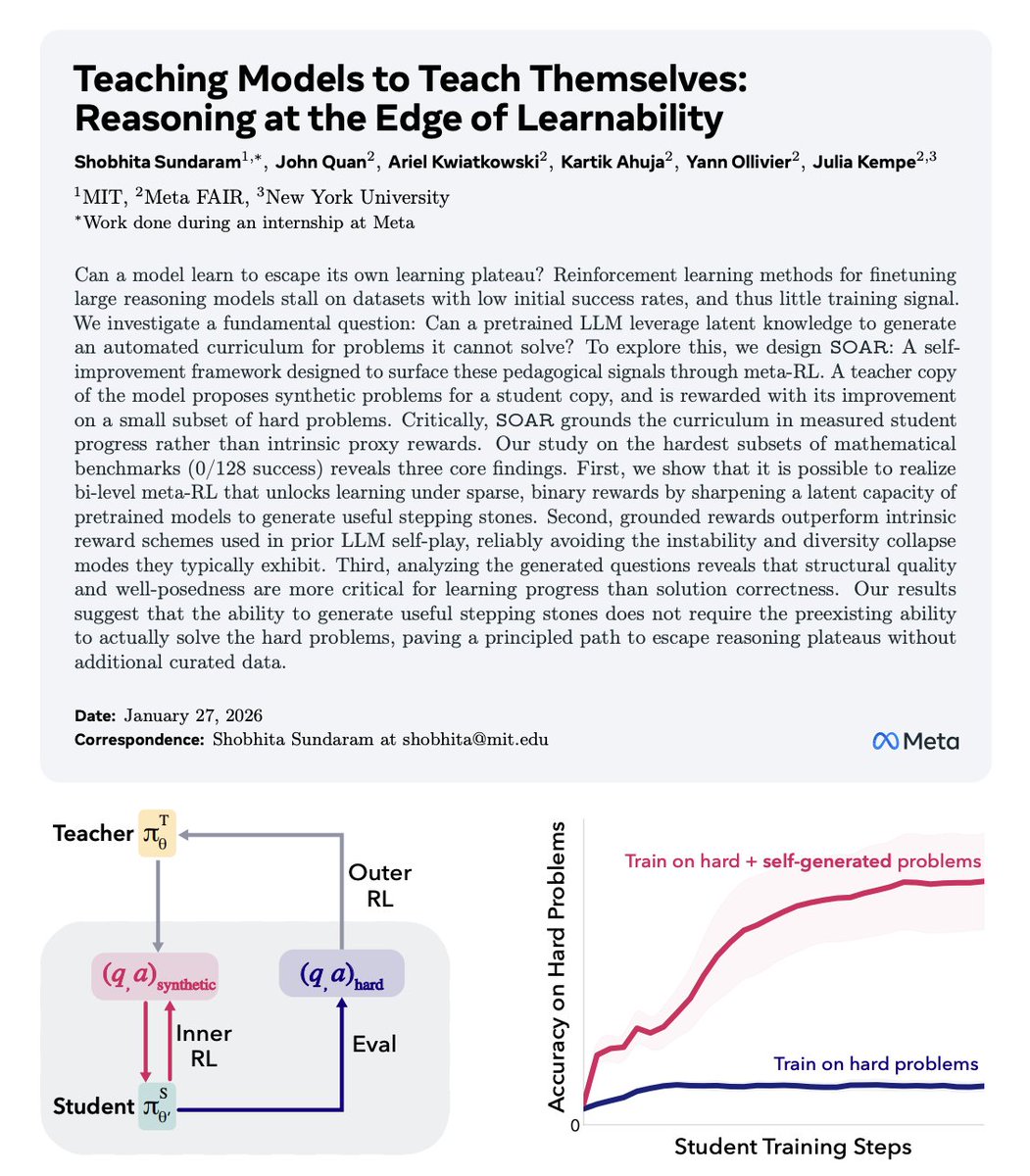
MIT just published a paper that quietly explains why LLM reasoning hits a wall and how to push past it.
The usual story is that models fail on hard problems because they lack scale, data, or intelligence.
This paper argues something much more structural: models stop improving because the learning signal disappears. Once a task becomes too difficult, success rates collapse toward zero, reinforcement learning has nothing to optimize, and reasoning stagnates. The failure isn’t cognitive, it’s pedagogical.
The authors propose a simple but radical reframing. Instead of asking how to make models solve harder problems, they ask how models can generate problems that teach them.
Their system, SOAR, splits a single pretrained model into two roles: a student that attempts extremely hard target tasks, and a teacher that generates new training problems. The catch is that the teacher is not rewarded for producing clever or realistic questions. It is rewarded only if the student’s performance improves on a fixed set of real evaluation problems. No improvement means zero reward.
That incentive reshapes everything.
The teacher learns to generate intermediate, stepping-stone problems that sit just inside the student’s current capability boundary. These problems are not simplified versions of the target task, and strikingly, they do not even require correct solutions.
What matters is that their structure forces the student to practice the right kind of reasoning, allowing gradient signal to emerge even when direct supervision fails.
The experimental results make the point painfully clear. On benchmarks where models start with zero success and standard reinforcement learning completely flatlines, SOAR breaks the deadlock and steadily improves performance.
The model escapes the edge of learnability not by thinking harder, but by constructing a better learning environment for itself.
The deeper implication is uncomfortable. Many supposed “reasoning limits” may not be limits of intelligence at all. They are artifacts of training setups that assume the world provides learnable problems for free.
This paper suggests that if models can shape their own curriculum, reasoning plateaus become engineering problems, not fundamental barriers.
No new architectures, no extra human data, no larger models. Just a shift in what we reward: learning progress instead of answers.
91
414
1,999
166,887
keyo retweeted

Feb 9
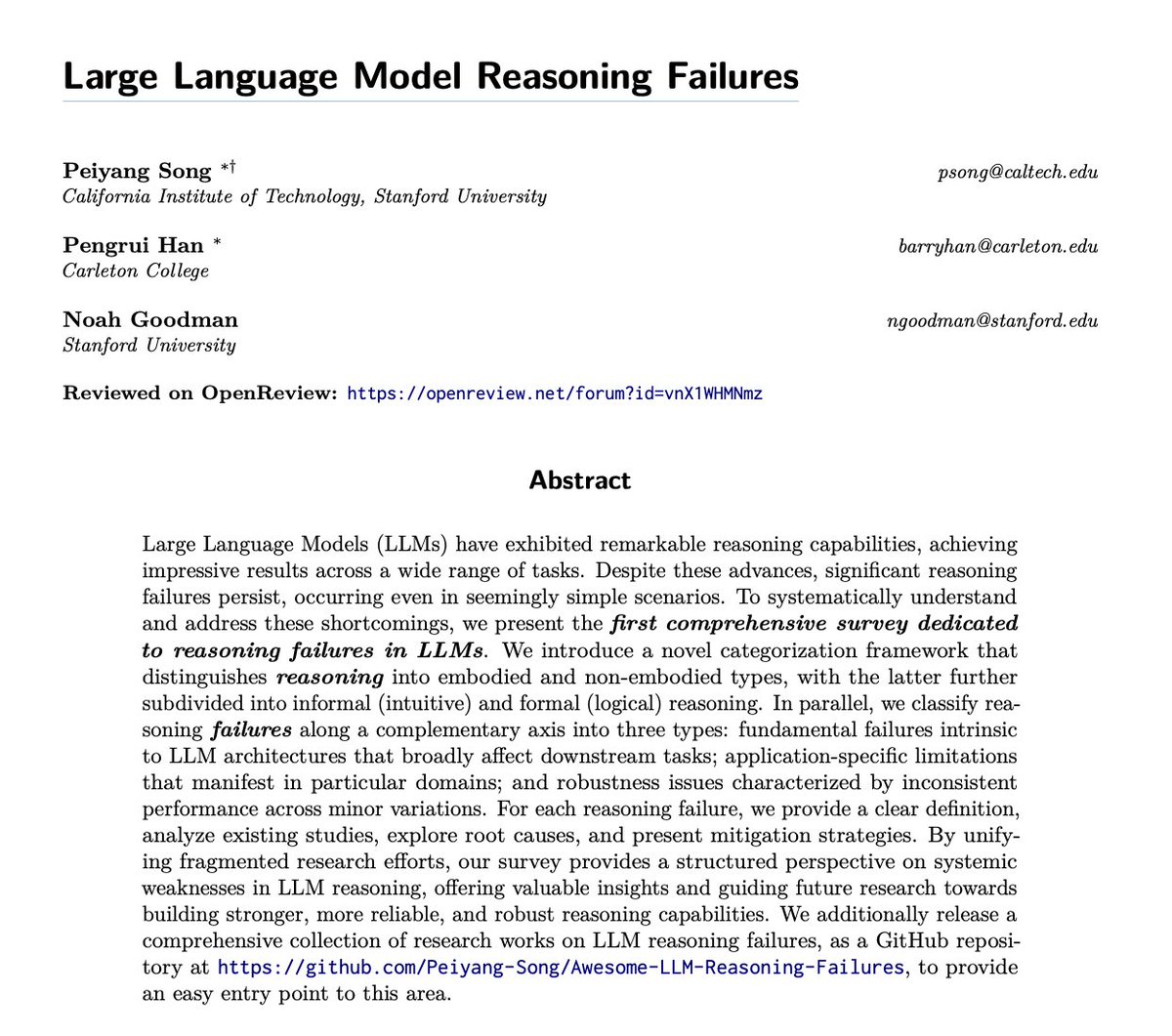
🚨 Holy shit… Stanford just published the most uncomfortable paper on LLM reasoning I’ve read in a long time.
This isn’t a flashy new model or a leaderboard win. It’s a systematic teardown of how and why large language models keep failing at reasoning even when benchmarks say they’re doing great.
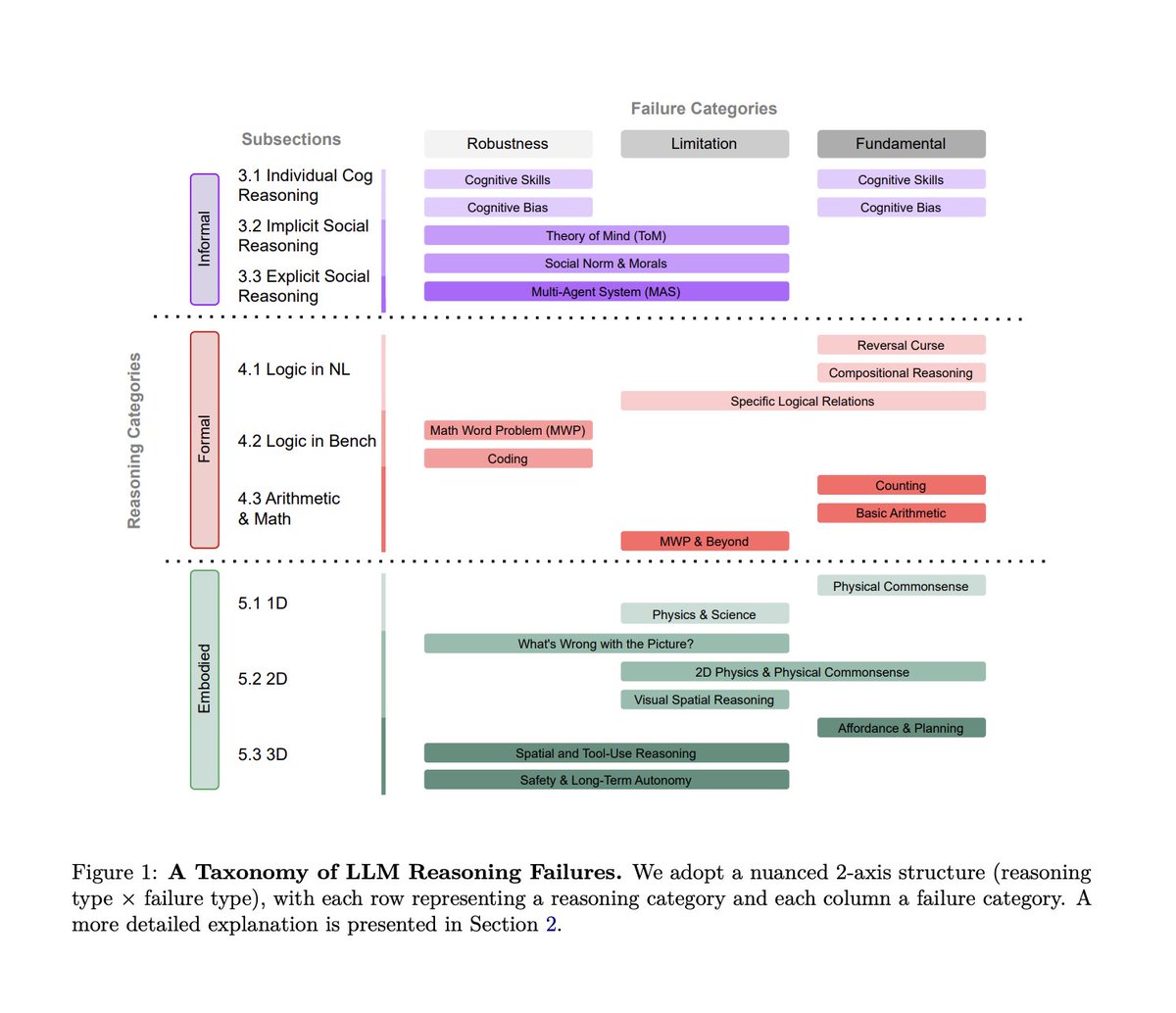
The paper does one very smart thing upfront: it introduces a clean taxonomy instead of more anecdotes. The authors split reasoning into non-embodied and embodied.
Non-embodied reasoning is what most benchmarks test and it’s further divided into informal reasoning (intuition, social judgment, commonsense heuristics) and formal reasoning (logic, math, code, symbolic manipulation).
Embodied reasoning is where models must reason about the physical world, space, causality, and action under real constraints.
Across all three, the same failure patterns keep showing up.
> First are fundamental failures baked into current architectures. Models generate answers that look coherent but collapse under light logical pressure. They shortcut, pattern-match, or hallucinate steps instead of executing a consistent reasoning process.
> Second are application-specific failures. A model that looks strong on math benchmarks can quietly fall apart in scientific reasoning, planning, or multi-step decision making. Performance does not transfer nearly as well as leaderboards imply.
> Third are robustness failures. Tiny changes in wording, ordering, or context can flip an answer entirely. The reasoning wasn’t stable to begin with; it just happened to work for that phrasing.
One of the most disturbing findings is how often models produce unfaithful reasoning. They give the correct final answer while providing explanations that are logically wrong, incomplete, or fabricated.
This is worse than being wrong, because it trains users to trust explanations that don’t correspond to the actual decision process.
Embodied reasoning is where things really fall apart. LLMs systematically fail at physical commonsense, spatial reasoning, and basic physics because they have no grounded experience.
Even in text-only settings, as soon as a task implicitly depends on real-world dynamics, failures become predictable and repeatable.
The authors don’t just criticize. They outline mitigation paths: inference-time scaling, analogical memory, external verification, and evaluations that deliberately inject known failure cases instead of optimizing for leaderboard performance.
But they’re very clear that none of these are silver bullets yet.
The takeaway isn’t that LLMs can’t reason.
It’s more uncomfortable than that.
LLMs reason just enough to sound convincing, but not enough to be reliable.
And unless we start measuring how models fail not just how often they succeed we’ll keep deploying systems that pass benchmarks, fail silently in production, and explain themselves with total confidence while doing the wrong thing.
That’s the real warning shot in this paper.
Paper: Large Language Model Reasoning Failures
265
1,396
6,883
967,469