
2,497 Photos and videos












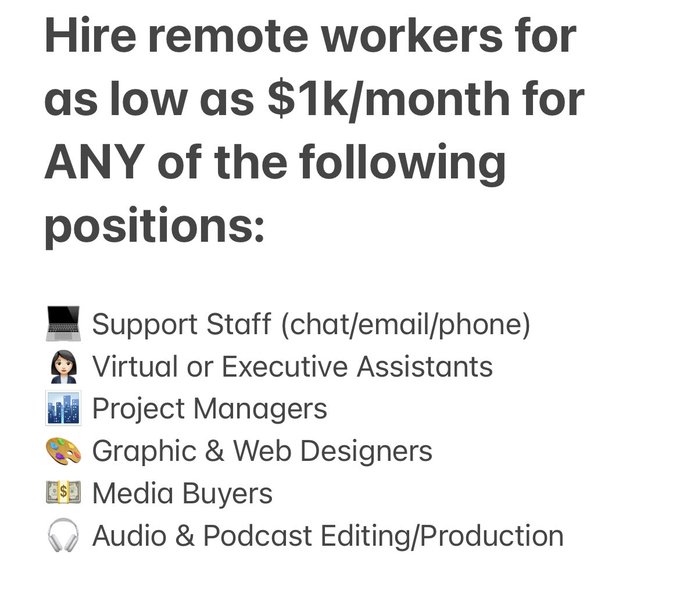
You can hire rockstar employees for as low as $1k/month with @HireUA.
We'll get you interviews with 3-5 qualified candidates within 1 week. GUARANTEED.
Hiring does NOT have to be a painful process.
Learn more:
Hire-UA.com
(More details in this thread)
15
14
139
After 3 years living in Poland I can honestly say I have very few good things to say about the place.
Most Westerners visiting would be impressed. It is safe. Clean, not really. Nice enough of course in many ways.
But living? Getting things done? Actually conducting business and making a life?
Forget it, I'd rather pull my own nails out.
13
Opening a company in Poland was the worst decision of my life. Seriously screwed up place to do business.
Do not recommend.
youtu.be/7NG93UhbRwQ?si=FaXr…
1
357
The actual reality with coaching programs, doesn't matter if it's Ecom or career coaching or fitness etc etc.
95% of people don't actually do the work.
Of the 5% who do it, I'm guessing 50% (so 2.50%) get results, 2.5% don't.
The 50% that don't get results who did the work should get a refund... and that comes down to the quality and integrity of the coaching program itself.


206
Mine is close to 4 and has been to and has been to a dozen countries and flown international business class 6 times.
It's really not that hard. Actually more fun in many ways. Keeps you busy. Just slower and don't see as much but that doesn't matter.
Jun 12

Just did 3 different countries in 8 days with my 3 year old Son
I spent the time playing tag with him in the empty hotel, showing him new places and different cuisines
Never let anyone tell you kids get in the way
None of my 10 years of solo travel comes close to this trip
1
274
Most companies make up some crap on their listicle posts and rank themselves number one.
I wrote the truth.
hire-ua.com/best-virtual-ass…
79
Over 10 developers placed over the last few years.
hire-ua.com/case-studies/cha…
50
They're literally incapable
It's not their fault... but also, they suck
Jun 10

The most frustrating thing about stupid people is that you can't explain to them why they're wrong.
Not only can they not understand you–because they're stupid–but they think *you're* stupid one...
Because they can't understand you.
This is why we can't have nice things AND we're gonna lose the ones we have.
1
103
But but but...
Free coffee.
Jun 10
Been living the last few days in a Hotel near the airport
Every day from my Window I see the cars leaving the City along the highway, 7-9am and 5-7pm stuck
4 hours of their life every day they will never get back
20 hours a week 80 hours a month 960 hours a year
Go Remote
1
157
~95% of corporate American jobs are pretty much just trying to look busy.

I'm 38.
At this point of my life/career, I have so many friends working corporate W2 jobs making $200-400K/year (mostly in NYC/NJ/PA corridor) who just don't actually work that much.
One friend makes $250K as a manager at a biotech... all he does is send pictures of his chicken coop or other DIY projects all day during the week.. no idea what value he actually provides his company.
Then there's my "jiggler" friend who you might recall... guy makes $250-300K and just plugs a "mouse jiggler" into his laptop and just goes to the gym, homeschools his kids, tans, does yard work... all day. I ask him what he does and he can't even articulate it...
Another friend makes $150K at a remote startup and just travels around the world all the time... don't ask don't tell situation on where people are at any given time... but does seemingly little actual work.. maybe 1 hour a day.
This is truly what's going on out there... BS W2 jobs all over the place. And AI is a bubble?
Really?
263
At least it's not an iPad asking you.
Jun 9

You walk into a restaurant and see this.
What’s your first thought? 🤔

151
That's the thing.
You trade a lot more stress of owning the business...for total freedom.

"agency model is SOO hard"
maybe
but also
you can just book spontaneous trips across the globe
and not have to beg another grown man for 3 days off
it still ceases to amaze me that you can just do this

2
5
1,388

There's a version of your day you never talk about. Not the meetings. Not the deals. Those are "work."
I'm talking about the other stuff.
The forty-five minutes you spent comparing car insurance quotes because the renewal came in higher than last year. The twenty minutes researching whether that restaurant has a private room for your anniversary. The eleven emails about your kid's school pickup schedule change. The passport renewal you've been meaning to start for three weeks. The dentist appointment you rescheduled twice because something always comes up.
Nobody puts this on their calendar. Nobody tracks it. Nobody calls it work.
But it is.
It's the invisible workday — the layer of micro-tasks that sits underneath everything else, constantly pulling at your attention, never quite getting done, always slightly overdue.
And the worst part is, every single one of these tasks is easy. None of them take more than ten or fifteen minutes. But they don't come in batches. They come one at a time, all day long, interrupting whatever you're actually trying to focus on.
You're in the middle of writing a proposal and you remember the car needs an oil change. You're prepping for a board meeting and your wife texts about the plumber. You're reviewing financials and a notification pops up reminding you that your domain is expiring in three days.
Context switch. Handle it. Context switch back. Try to remember where you were.
Multiply that by fifteen times a day, five days a week, fifty weeks a year. That's 3,750 context switches per year on tasks that have nothing to do with the thing you're actually good at.
The invisible workday doesn't show up on any time audit. It doesn't feel like a problem because each individual task is small. But small times constant equals massive.
The first step is tracking it. For one week, write down every time you stop what you're doing to handle something that isn't what you would consider to be your zone of genius.
The number will make you sick.
93