
Lawyer (ret.) | @leanlawstrategy@masto.ai | kennethgrady@post.news | @leanlawstrategy@bsky.social
Joined January 2012
- Tweets 16,511
- Following 455
- Followers 7,117
- Likes 2,335
1,175 Photos and videos









29 Aug 2024
The question I think you are asking: Should law school be more of a trade school or more of a traditional college school? It is hard to be both. In the categories you mention (mid- big-law), I think the real issue is that firms should let professional managers run ...
28 Aug 2024

The several job categories is true! The example I shared was for a class where the students were targeting mid-size to biglaw jobs. Perhaps not every law grad needs this - just the ones going into that segment. But even with that, too few school offer curriculum for this.
I am once again testing my filter bubble and bias. I see it as an opportunity for school, not so much a burden or gap.
4
1
23
858
29 Aug 2024
the firm and let lawyers practice law. Trying, in a law school setting, to give law students more than a sensitization to law as a business isn't really feasible. One class that gives an overview should be enough. (I recognize the legal reg issues here.)
1
19
563
20 Aug 2024
I agree, but I'd add some nuances. LLMs are becoming a dead end on the AI tree of life. They face practical problems (training data limits, and in fact shrinking amounts of training data compared to two years ago), structural problems (hallucinations, bonehead errors), and ...
20 Aug 2024

Adoption is inevitable.
Adoption won’t follow past patterns built around gaining early adopters and trying to grow from there. Product life cycles in legal, which have generally been unbearably long will quickly become distressingly short. Every legal tech tool will quickly become (at least in part) an AI tool. And there simply won’t be the time for targeted legal AI tools to get traction before bumping up against irrelevance or obsolescence. Moreover, buyers will soon find there is no “opt out” option. This may not be your experience in 2024, but i can guarantee you it will be in 2025.
In a recent video, former Google chair Eric Schmidt forecast that in the next year, the combination (at scale) of very large context windows, agents and text-to-action computing, will have an impact on the world greater than the past 2 years of LLM development and of even social media. Hyperbolic? Maybe. But not really as he was mostly applying a conservative extrapolation of capabilities now in broad use.
The LLM capabilities available today enable legal tech suppliers, firms and clients alike to create powerful tools that unlock significant value quickly, cheaply and robustly. Today’s version of the “early adopter” is the organization active in creating its own future, but unlike with prior legal technology, its choices have no bearing on what, how or when the early majority, late majority or laggards follow as AI adoption by all (and in many forms) is now inevitable.

1
13
927
20 Aug 2024
power of AI, these differences could have a real impact on results depending on use cases. The speed of change will make it hard to keep up or stay ahead for long (the cost of next gen AI may come down quickly just as the cost of memory dropped). Since there will be no ...
1
9
153
20 Aug 2024
avoiding AI, the market will be forcibly disrupted.
1
6
147
14 Aug 2024
It is a dead end.
* Building useful apps off the current model is proving much more difficult than the early cheerleaders suspected.
What now?
* Neurosymbolic logic seems to be the favored flavor for the next round of AI development.
* Lawyers and firms should be very ... 3/
1
3
142
14 Aug 2024
careful about choosing which apps to pursue with current AI. Understand well its limitations.
1
2
106
14 Aug 2024
Back when all of the hullabaloo began in the legal industry after ChatGPT, etc, came out I (and some others) raised a skeptical eyebrow. If it seems to good to be true, it probably is.
Well, now it appears the main approach underlying the current AI wave is foundering. 1/
1
1
3
284
14 Aug 2024
* Training new models requires more data than is available (and data available is shrinking for a variety of reasons).
* New models will not do away with the hallucination or bonehead error problems.
* The limits of the current approach have become more apparent. 2/
1
1
2
91
18 Jun 2024
Or another justification to push forward with modern amphibious car development ...
1
5
401
16 Apr 2024
That's the standard line many of us have said. But if you think more deeply about it, most academic programs don't teach you how to do, they teach you theory and fundamentals. Law schools, though they grant "doctorates" are really bachelor degree programs (the change ...
16 Apr 2024

Law schools should be teaching law students skills like collaboration, communication, matter and document management, transactional skills (document drafting, review, negotiation). Too often law schools focus their curriculums on the past rather than the present and the future.
3
5
985
16 Apr 2024
from LLB to JD occurred in the 60s because lawyers felt inferior to MDs).
With that in mind, shouldn't we restructure legal ed? Students need to learn theory and fundamentals, but then we need ways to teach practical skills. If we look around, that probably means a ...
1
1
2
193
16 Apr 2024
combination of academic/formal and practical/informal skill training. Coop programs, apprenticeships following degree, etc.
Academic institutions are not great at teaching "how" (doctors do residency programs). Let's rethink legal ed.
1
1
3
204
9 Apr 2024
Unpopular view: The "winners" are all the tech companies/individuals promoting AI; the losers are everyone (even the winners).
9 Apr 2024

The AI Revolution Is Here. Who Will Be the Winners and Losers in Legal Services?
ALM law.com/corpcounsel/2024/04/…
Good discussion and IMO, no one yet knows the answer.
2
3
7
1,072
7 Apr 2024
What do we mean when we say undergraduates today have it easier than in days gone by?
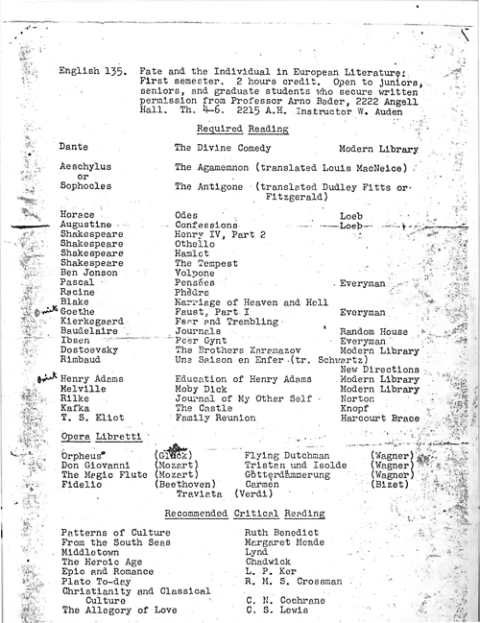
W.H. Auden, 1941, 2 credit hour course at UofMich, Fate and the Individual in European Literature - 6,000 pages of reading.
x.com/bfcarlson/status/17762…
5 Apr 2024

Are you hardcore enough to handle W.H. Auden's reading list for 1941 University of Michigan undergrads?
Over 6,000 pages of material. One semester.
Including the complete texts of:
- Brothers Karamazov
- Moby Dick
- The Divine Comedy (Inferno, Purgatorio, Paradiso)
- Faust
Once you get through those, you can enjoy the 8 books of recommended critical commentaries.
How many students today do you think could get through this?
1
1
4
613
6 Apr 2024
If so, though I probably won't live to see it, process management and lean thinking will have prevailed in law.
6 Apr 2024

Lawyers may largely become general contractors who oversee teams of skilled artificial laborers
1
3
382
4 Apr 2024
From an article written by a physician/professor at UPenn medical school: "Flexner was a non-physician commissioned in 1910 by the Council on Medical Education and the Carnegie Foundation for the Advancement of Teaching ..." Exceptionalism exists in all professions.

“Non-Lawyer” is part of the lexicon of #LawyerExceptionalism. Ever hear of a “non-accountant”, “non-architect”, “non-teacher” even a “non-doctor”? No? That’s of course because #LawLand is “special”. Whenever you hear a lawyer use “non-lawyer”, ask if they are a non-human, non-leader, non-decider.
4
2
3
586
28 Mar 2024
Hey Josh, you missed a line:
"Called our insurance carrier and told them what I had done. They said they'd be dropping us and, by the way, we should expect lawsuits against us to go up a thousand-fold."
28 Mar 2024
BigLaw Partner: "One of our clients is a former associate and is now the GC. We have an awesome relationship and get tons of work."
"They started using [a GenAI tool] over the last year."
"Our work has easily been cut in half."
"Last week I used [GenAI] tool to write a legal memo. I didn't edit it one bit. Sent it to the client, told them it was AI, and didn't charge for it."
Yeah, this GenAI thing is nothing big.
1
1
2
662
26 Mar 2024
And a sensei has you do things and gives you feedback on how you can improve.
25 Mar 2024
Difference between a consultant and an advisor?
Consultant shows you how to think about doing some things.
Advisor shows you how to do things.
1
2
267