
Joined December 2020
- Tweets 3,321
- Following 40
- Followers 457
- Likes 134
2,189 Photos and videos


Apr 21
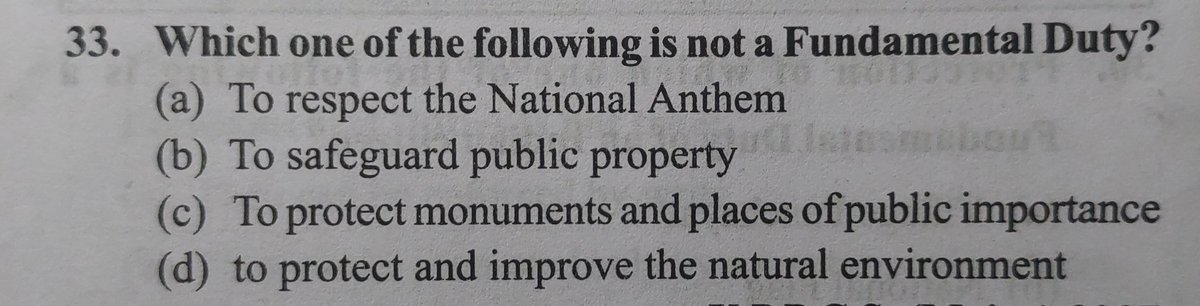
बहुत ज्यादा गरीबी है, बिहार में. कभी महसूस करना हो तो एक बार बिहार visit कीजिए.
13
Apr 12
⚡️ Fresh Flash ⚡️
Centre hikes windfall gains tax on diesel, ATF for exports
Time to understand this whole concept...........
Suppose that you own a small mango orchard. Usually, you sell your mangoes for a fair price. But suddenly, because of a massive shortage elsewhere in the world, the global price of mangoes triples overnight. You didn’t do anything extra - you didn’t plant more trees or work harder - you just got lucky because of the situation. You are now making a "lottery-like" profit.
In India, when big oil companies find themselves in this exact spot because global crude oil prices have shot up due to a war or a crisis, the Central Government steps in. They say, "Since you’re making these massive 'windfall' profits through no extra effort of your own, you should share a bit more of that luck with the country."
This "extra share" is what we call a Windfall Tax.
Who runs the show?
It is the Ministry of Finance (specifically the Department of Revenue) that decides when to bark and when to bite. They sit down every 15 days to check the global oil pulse. If global prices are still sky-high and companies are making "super-profits," the tax stays or goes up. If prices drop, they reduce the tax.
How is it collected?
It’s collected as a Special Additional Excise Duty (SAED). Think of it as a special surcharge that goes directly into the Central Government's pocket.
Why hike it when prices are already high?
It sounds backwards, right? If oil is already expensive, why tax it more? Here is the simple logic to justify it:
👉 India First Policy: When global prices are high, private oil companies are tempted to ship all their fuel abroad to earn expensive Dollars. By putting a high tax on exports (like the recent hike on diesel and jet fuel), the government makes it less profitable to sell outside. This nudges companies to keep enough fuel at Indian petrol pumps so you and I don't face a shortage.
👉 Balancing the Family Budget: When oil prices rise, the cost of everything - from your onions to your transport - tends to go up. To help the poor, the government spends more on subsidies for food and fertilizers. The Windfall Tax provides the "extra cash" the government needs to pay for these welfare schemes without going into deep debt.
👉 The Fairness Factor: The government feels it’s only fair that if a company is earning "extraordinary" money because of a global crisis, that money should help stabilize the Indian economy rather than just padding a corporate bank account.
In short, it’s the government’s way of making sure that a global oil crisis doesn't just result in richer companies but also helps keep India's domestic supply steady and its welfare bills paid.
53
Apr 12
A wise man once said, "To find lasting calm, one must first silence the 'I'."

#WATCH | US-Iran peace talks | Islamabad, Pakistan: US Vice President JD Vance says, "...The bad news is that we have not reached an agreement. I think that is bad news for Iran much more than it's bad news for the USA. So, we go back to the US having not come to an agreement...they have chosen not to accept our terms."
"...Whatever shortcomings in the negotiation, it wasn't because of the Pakistanis who did an amazing job and really tried to help us and Iranians bridge the gap and get to a deal. We have been at it now for 21 hours and we have had a number of substantive discussions with the Iranians. That's the good news. The bad news is that we have not reached an agreement. I think that is bad news for Iran much more than it's bad news for the USA. So, we go back to the US having not come to an agreement...they have chosen not to accept our terms."
(Video Source: White House)
27
Apr 11
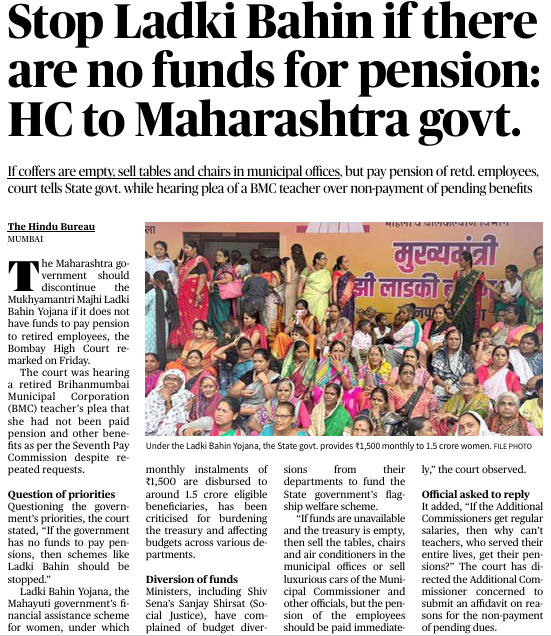
Imagine a person who has worked hard all their life, finally retires, and waits for the pension they were promised - money they earned with years of sweat. Now, imagine they go to collect it, only to be told, "Sorry, we have exhausted our funds/resources." But as they walk away, they see the same person who denied them their pension handing out cash to others under a shiny new welfare scheme.
This is the heart of the recent clash between the Bombay High Court and the Maharashtra Government.
When a retired teacher didn't get her pension because the government claimed a "lack of funds," the Court lost its patience. The judges made some stinging remarks, essentially saying: "If you can’t pay your old debts, stop your new charities." They even went as far as suggesting the government should sell its office furniture and luxury cars to pay the dues.
On the surface, it feels like a victory for the "little guy." It’s heartening to see a court hold power to account. But if we look closer, the situation is far more complicated - and perhaps a bit alarming.
Think of it like a family in deep debt. If a creditor forces them to sell their house or the tools they use for work just to pay a month's interest, does it actually solve the problem? Not really. It just makes the family homeless and unable to earn money in the future. Suggesting that the government sell its "furniture and cars" sounds powerful in a courtroom, but in reality, it would just paralyze the very machinery that keeps the state running.
Then there’s the Ladki Bahin Yojana. The Court suggested stopping it, but this scheme puts money directly into the hands of women who are often far more disadvantaged than a retired teacher. Is it right to tell one vulnerable person they can't have a lifeline because the government owes money to someone else?
This is where the "practicality gap" of the judiciary shows up. Judges are experts in law, but they aren't economists. By making sweeping, emotional statements, they often miss the messy reality of running a state. It’s easy to point a finger and demand a debt be paid, but it’s much harder to suggest a way for a government to balance its books without hurting the poorest of the poor.
We are left with a system that feels like it’s pulling in opposite directions. We want a court that fights for our rights, but we also need a government that can function and provide welfare. When the judiciary stops being practical and starts being purely critical, it risks becoming just another part of the problem rather than the solution.
20
Apr 11
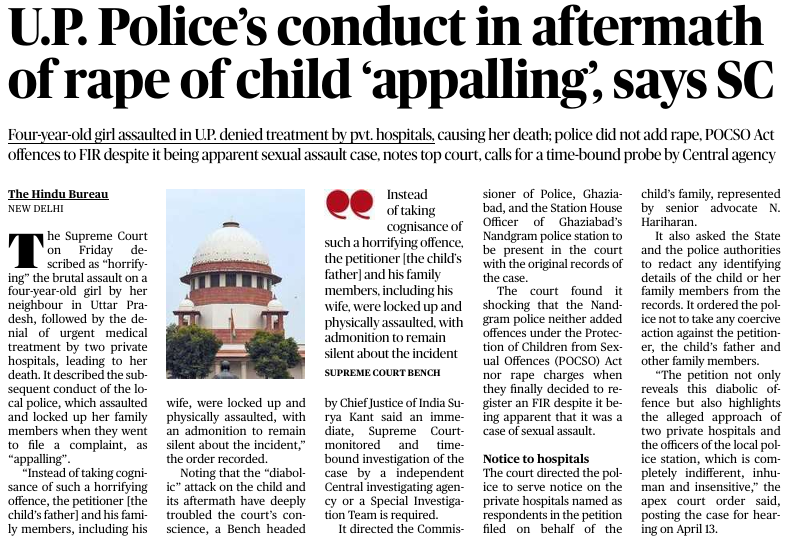
The story of a four-year-old girl in Ghaziabad is not just a news report; it is a heartbreaking mirror held up to the gaps in our society.
Imagine a father, a daily wager who works from dawn to dusk, returning home only to find his world shattered. On March 16, 2026, his little daughter was lured away by a neighbour, a man she likely saw every day, and subjected to an unthinkable crime. In that moment, a family’s life ended, even as they fought to save hers.
What followed was a nightmare no parent should ever endure. Instead of a helping hand, they met the cold, hard wall of institutional apathy.
Private hospitals, built on the promise of care, allegedly turned a bleeding, dying child away because of paperwork or policy.
When the broken parents turned to the police, the very people sworn to protect them reportedly assaulted them to keep them quiet. It is this exact brand of "appalling" insensitivity that stalls the heart of criminal justice in India, making the common man feel that the law is a luxury he cannot afford.
The criminal who did this didn't emerge from a vacuum; he is a product of a society that often looks the other way until it is too late.
But just as it seemed the system would swallow this tragedy whole, the Supreme Court stepped in with a rare and powerful alacrity. Seeing the "diabolic" nature of the crime and the "hanky-panky" in the investigation, the court didn't just observe - it acted.
By summoning the top brass of the police and demanding immediate answers, the Court proved that it remains the last resort for the masses. For a father who has nothing, the Supreme Court became the only place where his daughter’s life finally mattered more than a police report or a hospital’s bottom line. It is a stark reminder that while our systems often fail, the pursuit of justice can still find a voice at the very top.
49
Apr 10
⚡️ Fresh Flash ⚡️
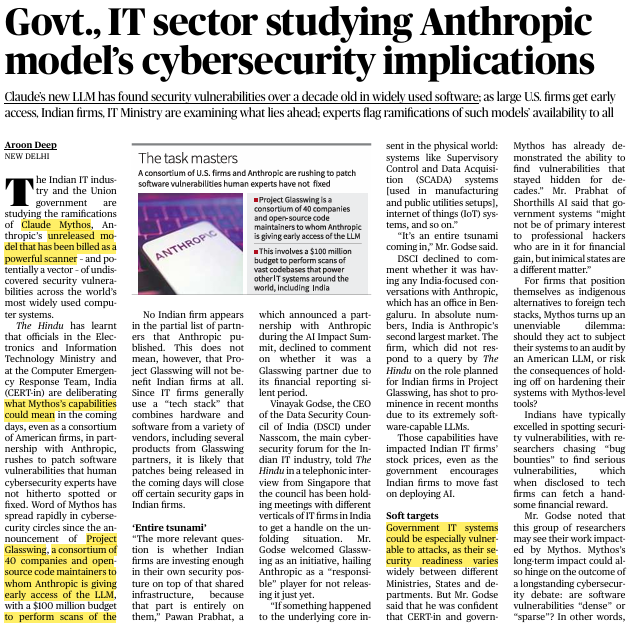
Claude Mythos and Project Glasswing represent a critical shift in the intersection of Artificial Intelligence (AI) and Cybersecurity. To understand this shift, imagine our digital world - banking apps, power grids, and smartphones - as a giant fortress built with millions of lines of code. For decades, human "architects" have tried to find and fix tiny, hidden cracks in these walls before hackers could find them.
The arrival of Claude Mythos changed everything. This AI is like a super-microscope that can see flaws invisible to the human eye. In its testing, it didn't just find a few bugs; it identified thousands of "Zero-Day" vulnerabilities - flaws that had existed for 30 years without anyone noticing. This discovery proved that AI has reached a level where it can outpace even the world’s best human experts in finding ways to break into systems.
Because this tool is so powerful, its creators realized it could be the ultimate weapon if it fell into the wrong hands. They faced a massive dilemma: keeping it a secret meant those "cracks" would stay open, but releasing it meant giving hackers a master key to the world's digital infrastructure.
To solve this, they launched Project Glasswing. Instead of a public release, they formed a high-level defensive coalition with the world’s leading technology guardians, including Google, Microsoft, and Apple. The goal is to use the AI's "X-ray vision" in a controlled environment to find and repair these vulnerabilities. It is essentially a race to "patch the holes" before a malicious version of this AI is built by someone else.
For a nation's security, this marks a new era. It shows that cybersecurity is no longer just about humans writing better code; it is now an "AI vs. AI" battle. The side that possesses the most advanced model will hold the power to either protect the world’s digital assets or dismantle them entirely.
41
Apr 10
⚡️ Fresh Flash ⚡️
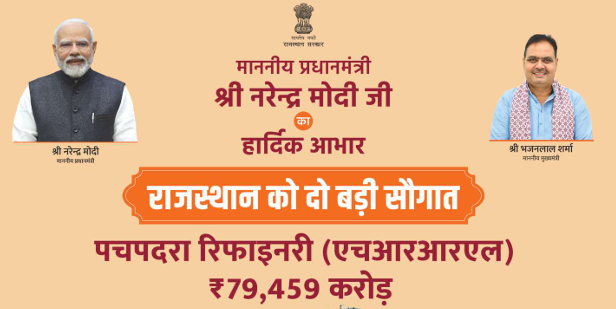
Places in News
Pachpadara Refinery
📍 Located in Barmer, Rajasthan
📍 To process local and imported crude into fuels and chemical feedstocks
📍 Operated by HPCL Rajasthan Refinery Limited (HRRL), a partnership between Hindustan Petroleum Corporation Limited (HPCL) and the Government of Rajasthan.
86
Apr 9
⚡️ Fresh Flash ⚡️
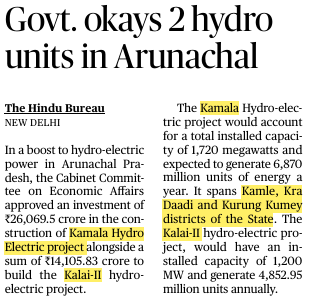
📍 Places in News
Kamala and Kalai
- hydroelectric projects
- in Arunachal Pradesh
29
Apr 6
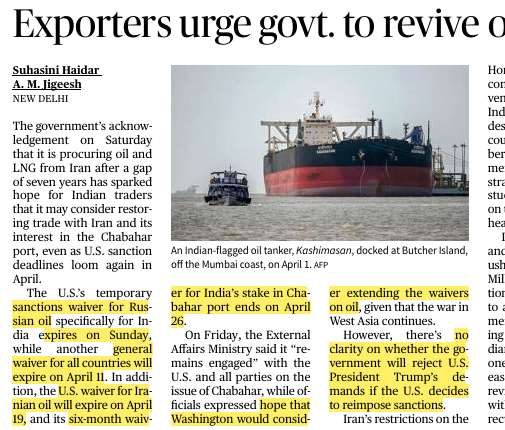
Look at the way waiver deadline dates are mentioned. Do you think India has an independent foreign policy? Or, to a great extent, even some of our core interests are dependent on the moves of the US?
12
Apr 6
⚡️ Fresh Flash ⚡️
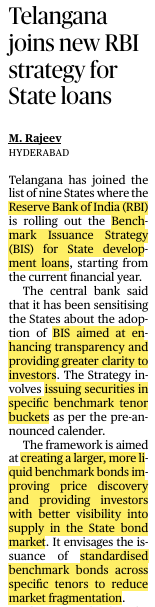
Benchmark Issuance Strategy (BIS)
👉 A new framework introduced by the Reserve Bank of India (RBI).
👉 To modernise how Indian states borrow money from the market.
Understand the Basics
👉 Traditionally, state borrowings - known as State Development Loans (SDLs) - have been fragmented across many small, different issues. This made SDLs less attractive to big investors.
👉 The new strategy (BIS) changes this by focusing on a few large, highly liquid "benchmark" bonds. It is being rolled out as a pilot in nine states.
What BIS provides?
👉 Standardised Maturity Buckets: Instead of random dates, states will issue bonds in specific "tenor buckets" - typically 5-year, 10-year, and 15-year maturities.
👉 Pre-announced Calendar: Borrowing will follow a strict, public schedule, giving investors clear visibility into when and how much supply is coming.
What will be the benefits of BIS?
👉 For Investors: It provides "price discovery," meaning they can see exactly what a fair interest rate is because these bonds are traded frequently.
👉 For States: Larger, more liquid bonds often attract a wider range of investors, which can gradually lower borrowing costs.
👉 Market Transparency: It brings state-level borrowing closer to the efficiency seen in Central Government Securities (G-Secs).
1
68
Apr 5
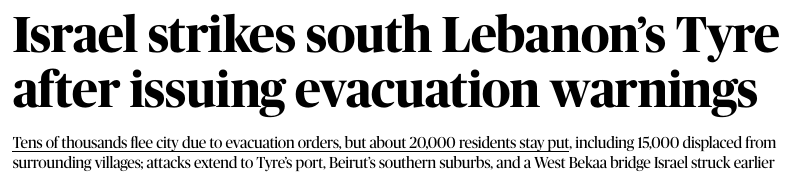
📍 Places In News
Let’s talk about a different kind of Tyre.
Most of us think of rubber and roads, but Tyre is actually a UNESCO World Heritage Site.
Located in Lebanon, the city of Tyre has been in the news due to recent strikes by Israel.
Did you know about this city before today?
35
Apr 1
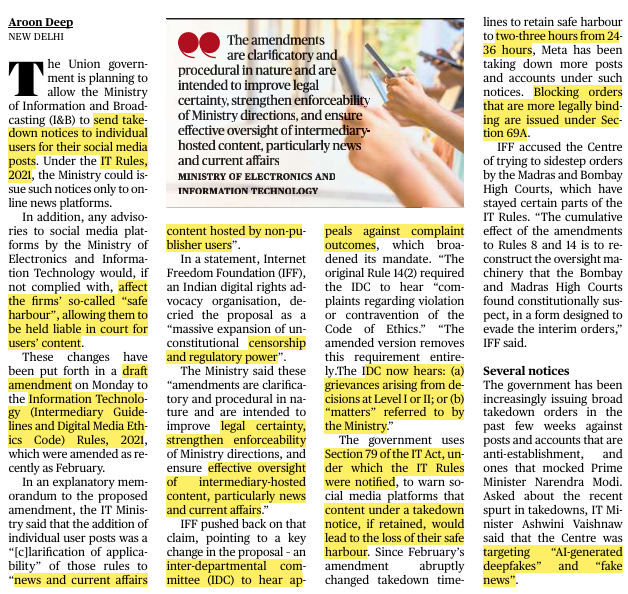
There is something called the Information Technology (Intermediary Guidelines and Digital Media Ethics Code) Rules, 2021. As the name suggests, the rules written over there help regulate behaviour over social media platforms.
The government is set to bring certain amendments to this. It may impact you as well if you copy-paste content without applying your brain.
👉 If you post a video on YouTube or a thread on X (Twitter) discussing a protest or a political scandal, the government can now treat you like a professional news channel. If your post looks like "news or current affairs," it can be ordered to be deleted, if the government feels it to be causing some nuisance.
👉 You might have heard about Inter-Departmental Committee (IDC). Actually, it is a "Jury of Government Officials". They decide if your post is "wrong" or "harmful." Since they all work for the government, critics say it’s like the prosecutor also being the judge and the jury.
👉 And what is the Safe Harbour provision? Imagine you send a malicious letter through the post office. Under "Safe Harbour," the Post Office isn't blamed for what you wrote; they just delivered it. Social media companies (Meta, X, Google) currently have this protection - they aren't responsible for your posts. The government is moving toward taking this protection away. If a platform doesn't take down your post when told, they lose their "Safe Harbour." This means the platform itself could be sued or jailed for your post.
22
Mar 31
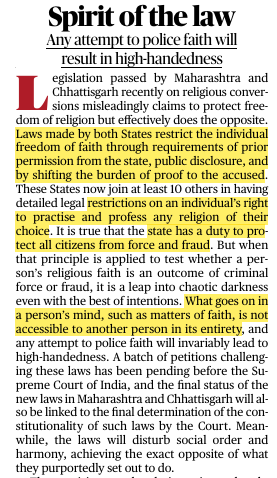
If you are among the people who blindly trust newspaper editorials, then this should be an eye-opener for you.
Always read with a pinch of salt, never take anything on face value because, after all, such editorials are written by some individuals who must be having a perception skewed towards bias.
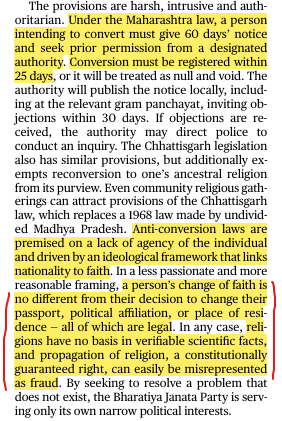
This editorial from The Hindu (31 March 2026) makes two sweeping statements:
👉 A person’s change of faith is no different from their decision to change their passport, political affiliation, or place of residence - all of which are legal.
👉 Religions have no basis in verifiable scientific facts, and propagation of religion, ........, can easily be misrepresented as fraud.
‼️ It is bullshit to equate changing religion with changing passport or place of residence. Religion is about internal belief and heritage. Changing it doesn't change your family history or your DNA.
‼️ And is it true that if something is based on verifiable scientific facts, it is immune from misrepresentation as fraud?
‼️ It is a scientific fact that "100% of people who drink water eventually die." A fraudster could use this fact to sell "water-free" supplements by implying that water is a deadly toxin. The fact is true, but the conclusion is a total fraud.
23
Mar 31
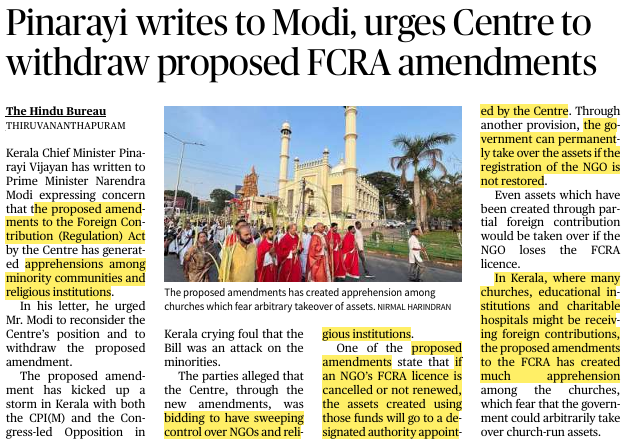
The Government vs NGOs tussle is again out for a match over FCRA.
Several NGOs in India are functioning on the bread and butter provided by their foreign fund donors. And many of those NGOs have been accused of acting against national interest.
Now, the government has proposed an amendment to Foreign Contribution (Regulation) Act [FCRA]. If implemented, this will empower the Government to take over the assets of NGOs if their registration is revoked permanently.
You can argue across the two sides:
👉 Such sweeping powers will allow the government to sniff the life out of the NGOs who do not support its policies.
👉 Such sweeping powers are required because vested interests emanating out of the country have a track record of destabilising the internal functioning of India.
👉 The way forward will continue to call for using the provision judiciously without political vendetta. Can you think of any better way forward beyond this boring one?
1
29
Mar 29
⚡️ Fresh Flash ⚡️
Terms in News
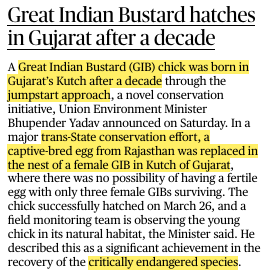
The Jumpstart Approach
It is a conservation strategy used to revive a dying wild population by introducing fertile eggs from a different location.
👉 The Problem: The last three GIBs in Gujarat are all females. With no males to mate with, they were laying infertile eggs that could never hatch.
👉 The Swap: Scientists took a fertile egg from a breeding center in Rajasthan, drove it to Gujarat. They swapped the fertile egg into a wild female’s nest while she was away foraging.
👉 The Result: When the mother returned, she tucked the new egg under her warm feathers and continued her vigil. Later, the shell cracked, and for the first time in a decade, a Great Indian Bustard was born in Kutch.
👉 The Goal: By letting the wild mother hatch and raise the chick herself, the newborn learns essential survival skills in wild - like finding food and avoiding predators - that a lab cannot teach.
1
51
Mar 28
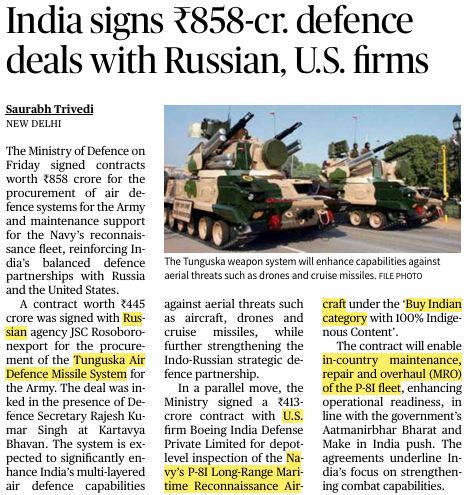
After S-400, what is unique about this new weapon system for Indian Army?
In modern warfare, an army without a sophisticated air defence is a sitting duck.
Tunguska is a hybrid powerhouse - combining rapid-fire anti-aircraft guns with surface-to-air missiles - ensuring that even if a threat slips through the outer perimeter, it is neutralized before it can strike frontline assets.
For an Army operating in diverse terrains, this layered security is not a luxury; it is a survival necessity.

1
40
Mar 28
⚡️ Fresh Flash ⚡️
Species in News
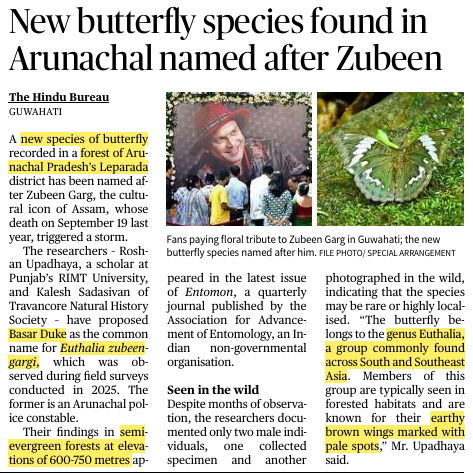
Basar Duke - A butterfly species discovered in the semi-evergreen forests of Basar in the Leparada district of Arunachal Pradesh.
2
157