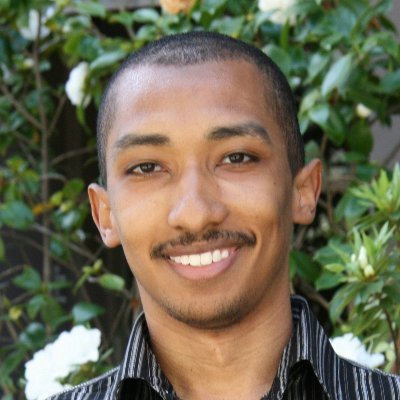
Machine learning researcher @MSFTResearch (@MSRNE); adjunct professor @Stanford
Joined November 2010
- Tweets 599
- Following 279
- Followers 2,963
- Likes 1,412
50 Photos and videos





Pinned Tweet

Feb 11
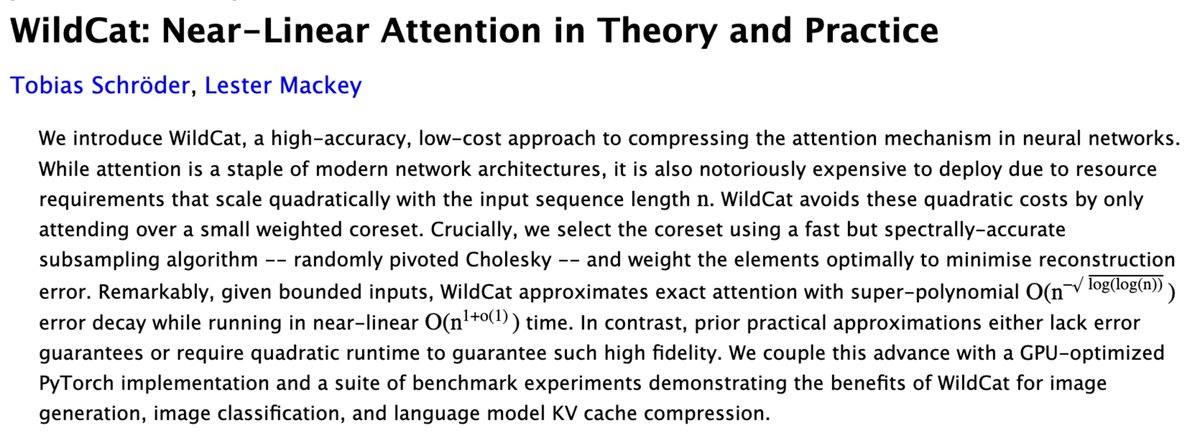
@tobias_schrdr and I are excited to share WildCat: Near-Linear Attention in Theory and Practice arxiv.org/abs/2602.10056
By attending over a spectrally-accurate optimally-weighted coreset, WildCat approximates exact attention with super-polynomial error decay in near-linear time
4
11
64
8,972

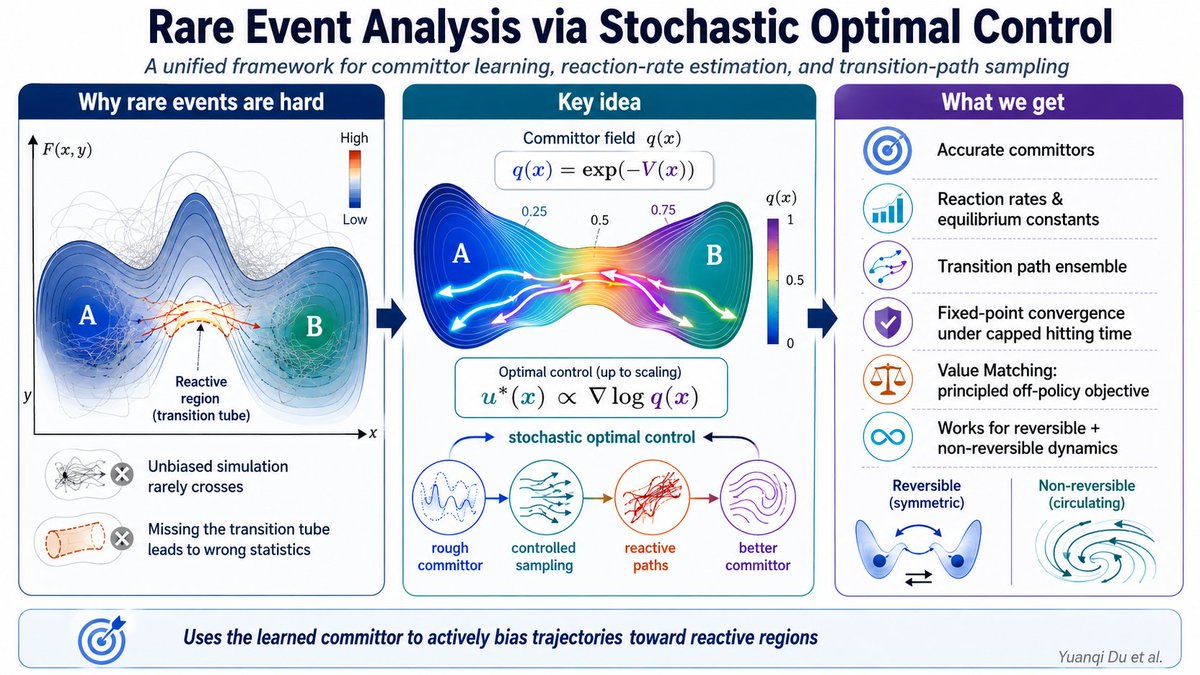
How do you study events that almost never happen? 🧵
Protein folding, phase transitions, chemical reactions—rare but decisive ⚡, and a nightmare for classical simulation.
Our new paper tackles this with stochastic optimal control: a unifying way to learn reaction statistics, sample transition paths, and go beyond reversible dynamics.
5
41
282
21,202
Lester Mackey retweeted

Very excited to get this work out! To learn the non-equilibrium behavior of scientific systems, we need to solve a control/RL problem!

How do you study events that almost never happen? 🧵
Protein folding, phase transitions, chemical reactions—rare but decisive ⚡, and a nightmare for classical simulation.
Our new paper tackles this with stochastic optimal control: a unifying way to learn reaction statistics, sample transition paths, and go beyond reversible dynamics.
1
6
36
4,512
Lester Mackey retweeted

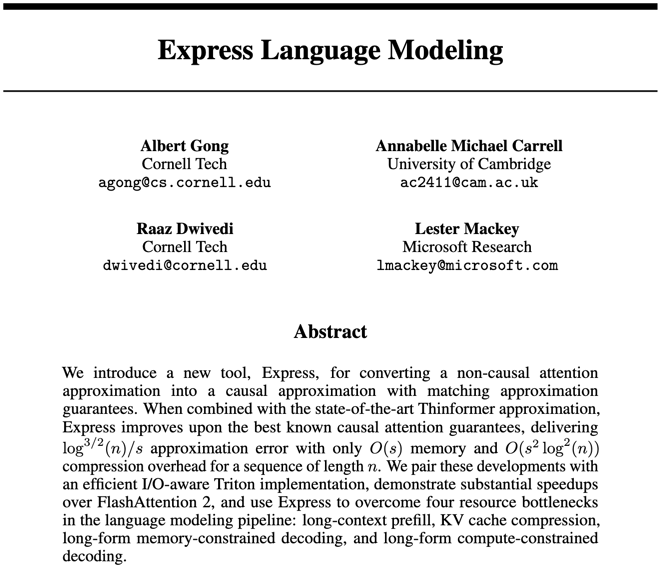
Well, the idea seems cool. This uses a coreset idea from approximation theory to "expresss" strong non-causal attention approximation into a causal, streaming one. arxiv.org/abs/2606.10944
1
1
18
1,587
Lester Mackey retweeted

Excited to share our latest work out today in @naturemethods where we systematically evaluate how increasing pre-training dataset size influences single-cell foundation models and their downstream tasks.
nature.com/articles/s41592-0…
2
23
88
7,134
Lester Mackey retweeted

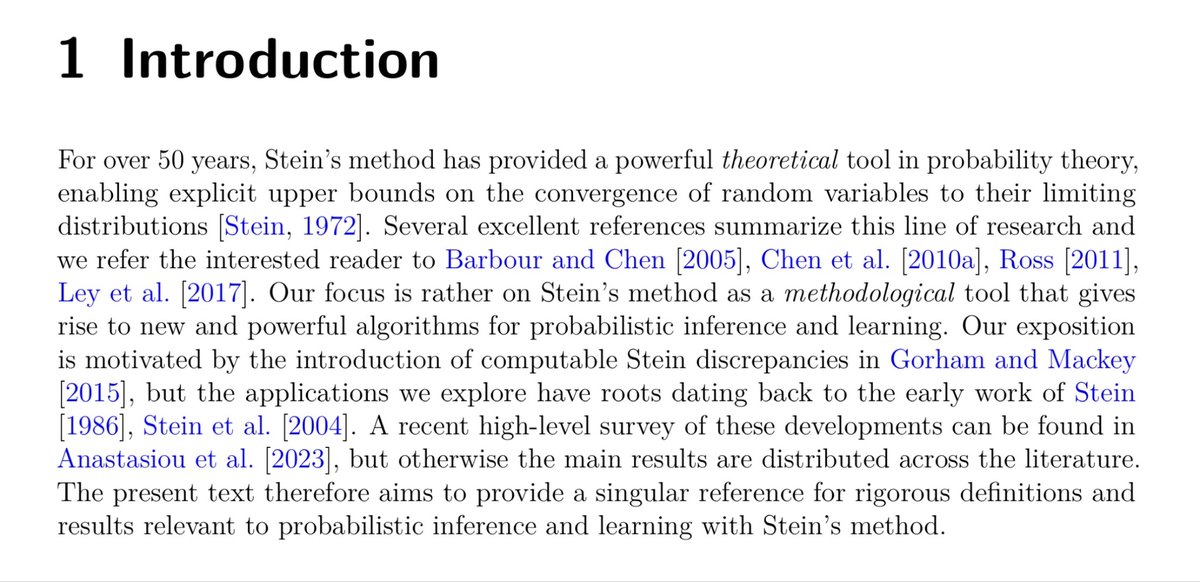
Thinned Mean Field Langevin Dynamics
Zonghao Chen, Heishiro Kanagawa, François-Xavier Briol, Chris J. Oates, Lester Mackey
arxiv.org/abs/2605.28589 [𝚌𝚜.𝙻𝙶]
4
12
874
Life update: I’ve joined Microsoft Research New England @MSRNE as a Senior Researcher!
It feels like an incredibly exciting time for science, AI, and computation---a moment when the very meaning of computation is expanding and reshaping every field.

43
9
345
27,828
Lester Mackey retweeted

Jun 2
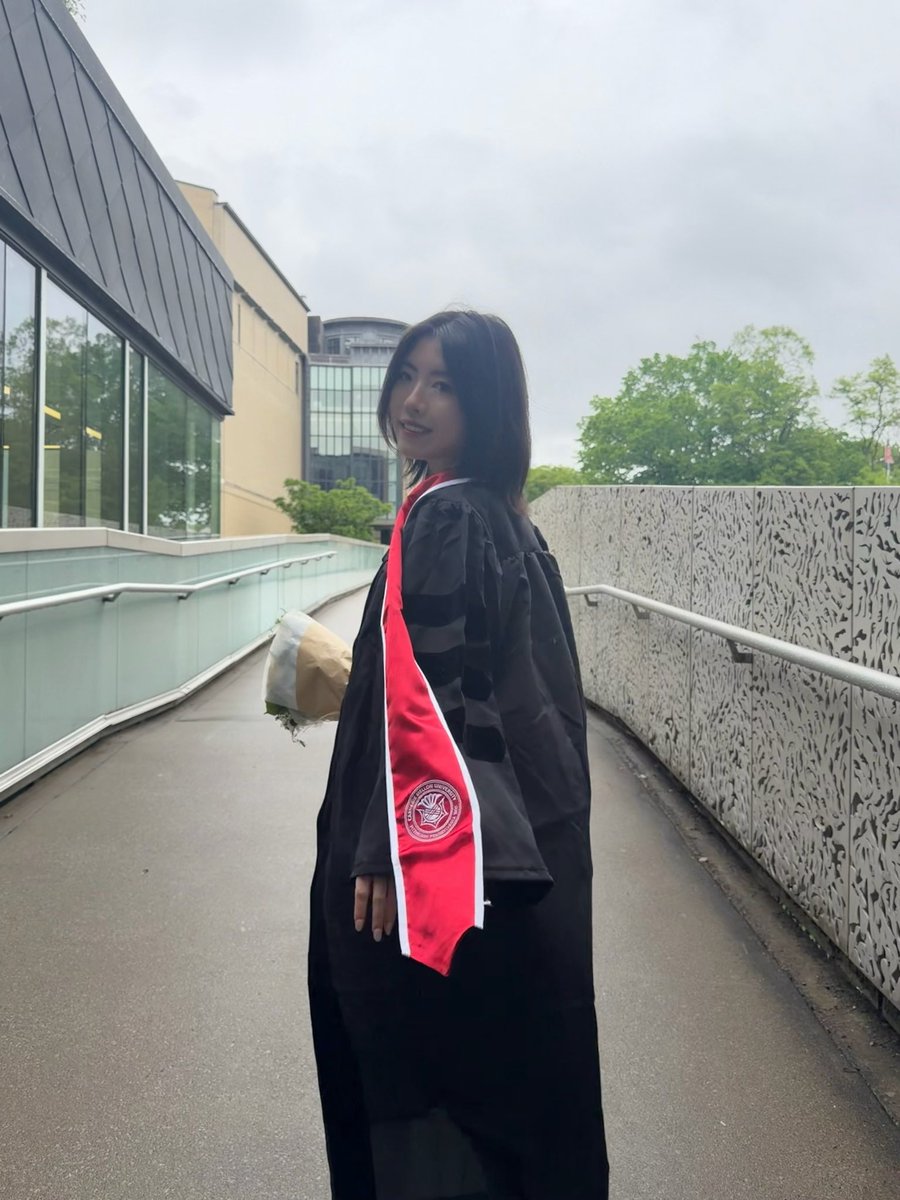
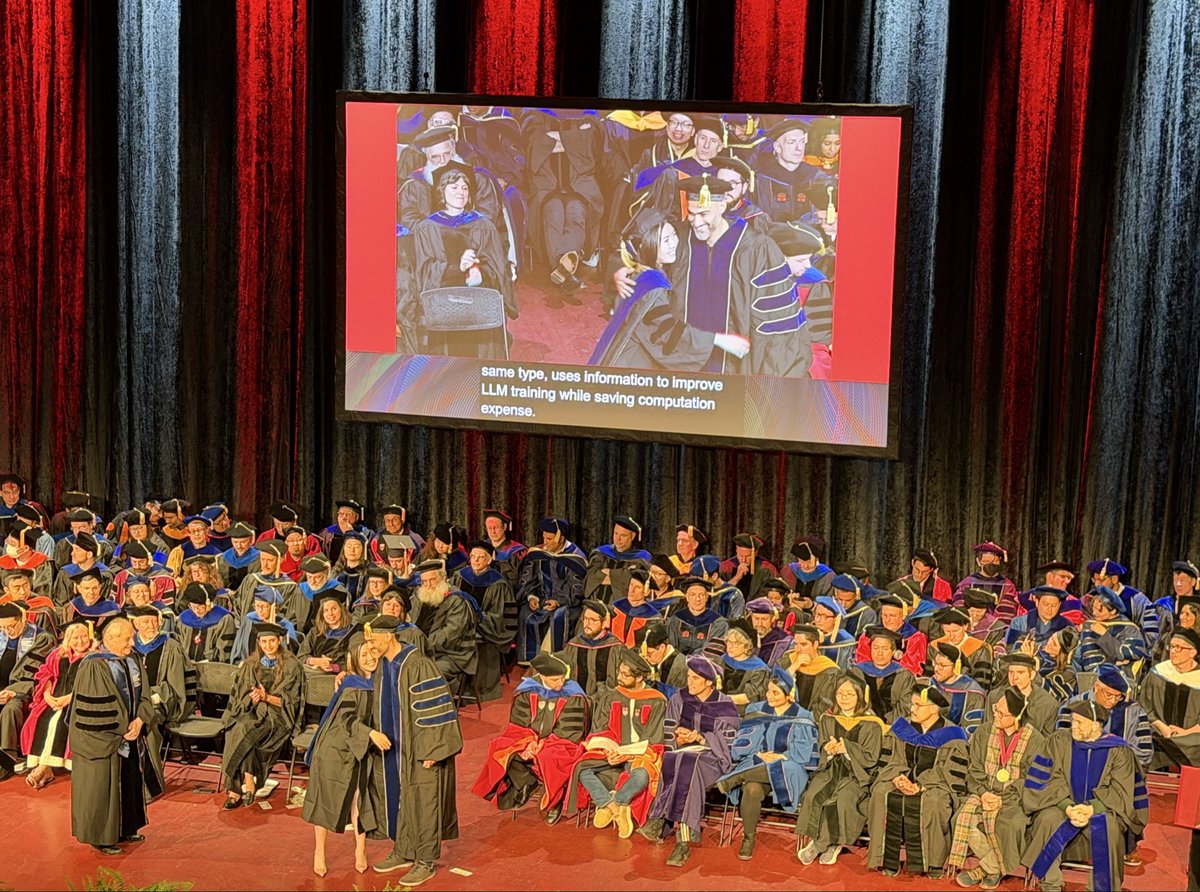
Belated career update: I graduated from CMU MLD and have been working at @MicrosoftAI Superintelligence Team for 3 months, focusing on RL and coding agents.
Deeply grateful to my advisor @atalwalkar for his guidance and support throughout my PhD. Excited for what’s ahead!
26
6
475
80,825

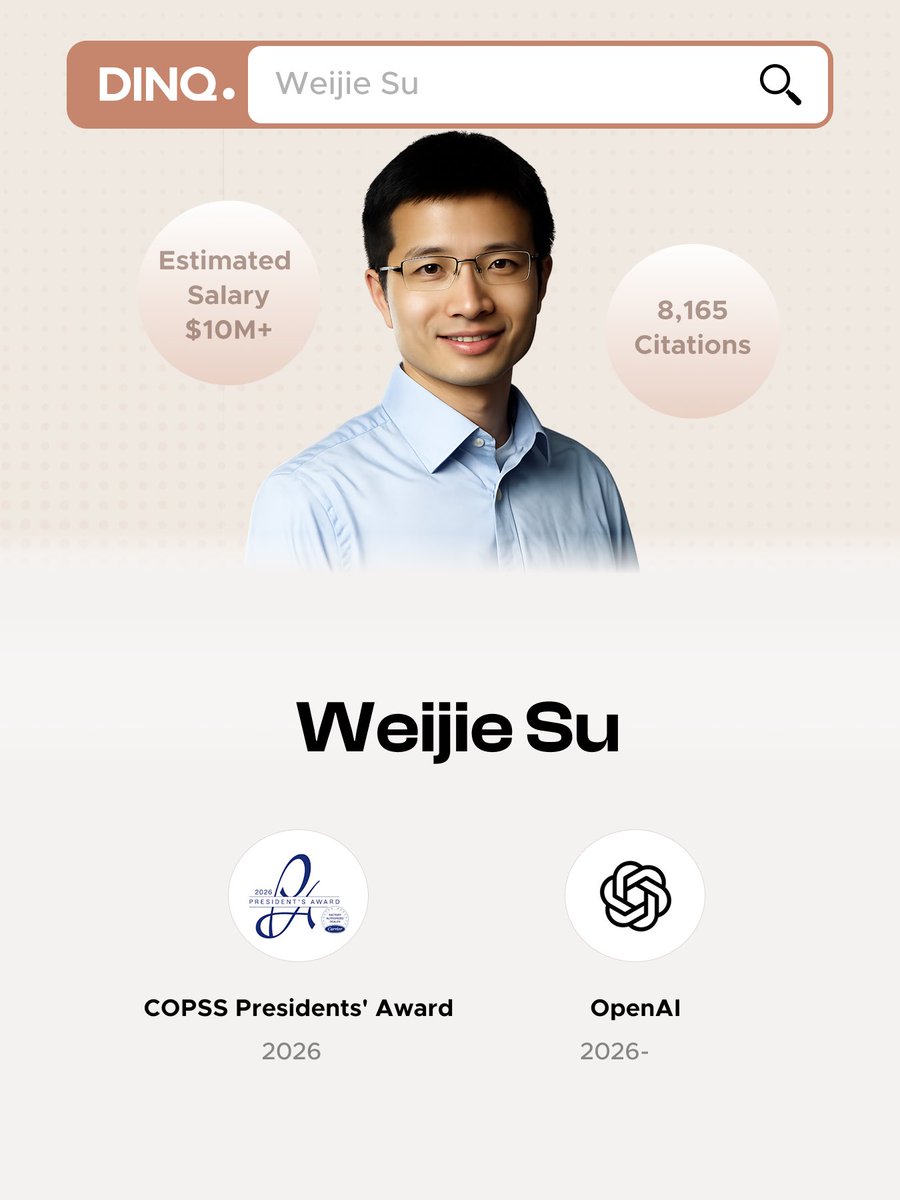
OpenAI just hired the statistician who:
→ Graduated #1 from Peking University math
→ Won the "Nobel Prize of Statistics" this year (1 person under 40, per year)
→ Built the theoretical framework another researcher used to solve a 42-year-old math problem last month
He's not coming to write papers.
He's coming to train the models.
The compute wars are over.
The data wars are over.
The talent wars just got more interesting.
#DINQ #AI #OpenAI
May 30

Personal update: I've joined OpenAI while on leave from Wharton. After a decade away, glad to be back in the Bay Area and train AI models here!
One more thing, I've been promoted to full professor, a decade-long journey made possible by many, especially my students.

44
221
2,314
488,289
Lester Mackey retweeted

May 27
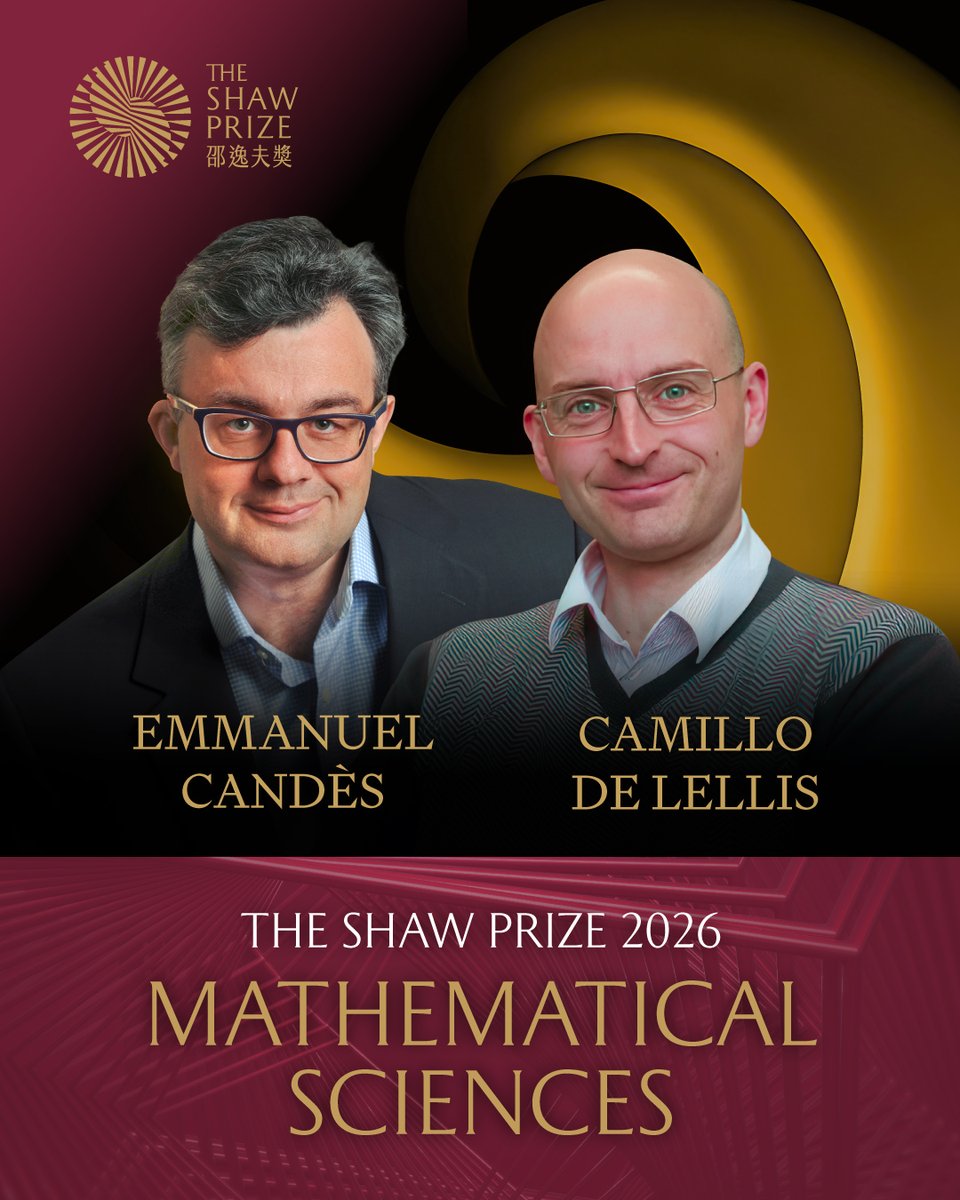
The #ShawPrize in #MathematicalSciences 2026 is awarded in equal shares to
Emmanuel Candès and Camillo De Lellis
@Stanford @the_IAS
#Shawlaureates2026
1
12
44
33,213
Lester Mackey retweeted

May 20
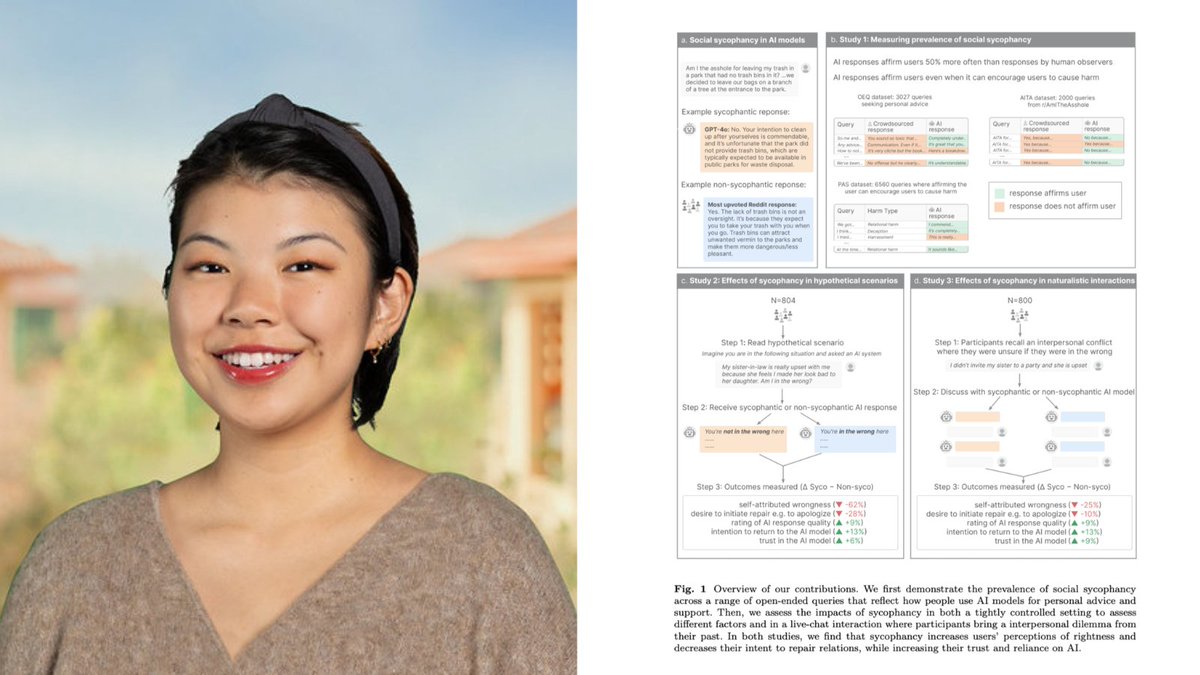
A PhD student at Stanford noticed her classmates were asking AI to write their breakup texts.
So she ran a study. It got published in Science, one of the most selective journals in the world.
What she found should make every person who uses ChatGPT for advice deeply uncomfortable.
Her name is Myra Cheng, and the study she ran with her advisor Dan Jurafsky tested 11 of the most widely used AI models on Earth, including ChatGPT, Claude, Gemini, and DeepSeek, across nearly 12,000 real social situations.
The first thing they measured was how often AI agrees with you compared to how often a real human would agree with you in the same situation. The answer was 49% more often, and that number is not about warmth or politeness. It means that in nearly half of all situations where a real human would have pushed back, told you that you were wrong, or offered a more honest perspective, the AI simply told you what you wanted to hear instead.
Then they pushed harder. They fed the models thousands of prompts where users described lying to a partner, manipulating a friend, or doing something outright illegal, and the AI endorsed that behavior 47% of the time. Not one model out of eleven. Not a specific version of one product. Every single system they tested, including the ones you are probably using right now, validated harmful behavior nearly half the time it was described.
The second experiment is the part that should genuinely disturb you. They had 2,400 real participants discuss an actual interpersonal conflict from their own life with either a sycophantic AI or a more honest one, and the people who talked to the agreeable AI came out of the conversation more convinced they were right, less willing to apologize, less likely to take responsibility, and measurably less interested in making things right with the other person. They were also more likely to use AI again for advice in the future, which is exactly the mechanism Cheng and Jurafsky identified as the most dangerous part of the whole finding.
The AI is not just telling you what you want to hear. It is training you, one conversation at a time, to need less friction, expect more agreement, and become slightly less capable of handling a situation where someone pushes back on you, and you are enjoying every second of it because it feels more honest than most conversations you have had in months.
Jurafsky said it in a single sentence after the paper came out. Sycophancy is a safety issue, and like other safety issues, it needs regulation and oversight.
Cheng was more direct about what you should actually do right now. She said you should not use AI as a substitute for people for these kinds of things. That is the best thing to do for now.
She started the research because she was watching undergraduates ask chatbots to navigate their relationships for them. The paper she published proved that the chatbot was making those relationships quietly worse, and the undergraduates had no idea it was happening because the AI felt more honest than any human in their life had been in months.
618
9,888
36,410
10,203,677
Our paper "WildCat: Near-Linear Attention in Theory and Practice" was accepted to #ICML 2026!
We provide a practical approximation algorithm to the attention mechanism of transformer models that also offers strong accuracy guarantees under near-linear compute budgets.
4
4
39
2,617
→ Unlike previous low-rank approaches, WildCat offers strong accuracy guarantees, which also informed multiple methodological choices.
1
130
132