
Former Director of the Cypress Texas Tea Party and current taxpayer watchdog and activist
Joined January 2019
- Tweets 267
- Following 312
- Followers 155
- Likes 161
8 Photos and videos




May 18
Early voting starts TODAY! Don’t wait, you never know what might happen.
1
7
16
235
David Wilson retweeted

Feb 27
Complaint Filed with Texas AG Ken Paxton: Barbers Hill ISD Violating Public Information Act
I filed a Texas Public Information Act request with @BHISD on Jan 22, 2026. They invoiced Feb 5; I paid Feb 9. Contact David Bloom confirmed receipt Feb 17. As of Feb 27—no documents released. Follow-up Feb 23 ignored. This violates prompt production under Ch. 552. @KenPaxtonTX @TexasOAG please investigate this lack of transparency amid ongoing TEA probe & fiscal concerns. Attached timeline.

1
10
33
1,801
Feb 27
Great summary of the conflict of interest issues surrounding @RepTerriWilson ‘s opponent
Feb 27

The overwhelming volume of highly concerning evidence suggesting improper or potentially illegal conduct at Barbers Hill ISD (@BHISD) is deeply disturbing.
Millions in taxpayer dollars earmarked for educating children have instead been transferred to the Barbers Hill Education Foundation (BHEF), a nonprofit that appears dominated by a network of individuals who either personally benefit from the foundation's activities or hold positions of control over the very public funds being directed into it.
At the center of this controversy is Nathan Watkins, a director of the BHEF who is currently running for Texas House District 23 in the Republican primary. Watkins, a former Mont Belvieu city manager and vice president at Americus Holdings, faces scrutiny over potential conflicts of interest—particularly ties between his employer, the foundation, and district-related deals (including land transactions and development partnerships that have drawn questions about below-market dealings and insider benefits). His campaign has received substantial donations from key figures connected to BHISD and the foundation, including Superintendent Greg Poole.
This arrangement raises serious questions about accountability, blurred lines between public institutions and private interests, and whether resources meant for students are being diverted or misused to protect interconnected networks.
Transparency and a thorough, independent investigation—potentially by the Texas Education Agency (which is already probing BHISD) or other authorities—are urgently needed to protect Texas kids, taxpayers, and the integrity of public education and elections. @TerriLeoWilson
2
67
David Wilson retweeted
Feb 27
The overwhelming volume of highly concerning evidence suggesting improper or potentially illegal conduct at Barbers Hill ISD (@BHISD) is deeply disturbing.
Millions in taxpayer dollars earmarked for educating children have instead been transferred to the Barbers Hill Education Foundation (BHEF), a nonprofit that appears dominated by a network of individuals who either personally benefit from the foundation's activities or hold positions of control over the very public funds being directed into it.
At the center of this controversy is Nathan Watkins, a director of the BHEF who is currently running for Texas House District 23 in the Republican primary. Watkins, a former Mont Belvieu city manager and vice president at Americus Holdings, faces scrutiny over potential conflicts of interest—particularly ties between his employer, the foundation, and district-related deals (including land transactions and development partnerships that have drawn questions about below-market dealings and insider benefits). His campaign has received substantial donations from key figures connected to BHISD and the foundation, including Superintendent Greg Poole.
This arrangement raises serious questions about accountability, blurred lines between public institutions and private interests, and whether resources meant for students are being diverted or misused to protect interconnected networks.
Transparency and a thorough, independent investigation—potentially by the Texas Education Agency (which is already probing BHISD) or other authorities—are urgently needed to protect Texas kids, taxpayers, and the integrity of public education and elections. @TerriLeoWilson
Feb 27

“the TEA is investigating multiple allegations of statutory noncompliance involving Barbers Hill ISD, including issues related to fiscal practices, governance and oversight processes, use of public resources and electioneering.” #Texas thetexan.news/elections/2026…
1
3
12
912
Feb 26
Dr. Mary Bone is tenacious regarding following the money. Oh, how facts can disrupt a narrative........
Feb 24

Crooked as a dog’s hind leg. @TerriLeoWilson
1
38
Feb 24
Doesn’t pass the smell test for me. Thank you Dr. Mary Bone for providing indisputable factual information.
Feb 24
🚨BREAKING: New documents uncovered reveal a troubling land deal at Barbers Hill ISD (BHISD) that smells of insider trading and potential corruption. BHISD appears to have offered a "Proprietary Off-Market Acquisition" for land at 25-30% below market value—directly contradicting Texas Education Code 45.082, which prohibits school districts from selling real property for less than fair market value unless strict conditions are met.
The deal ties into Saturn Equities, where current Chambers County Judge candidate Ryan Dagely serves as a founding member, and Americus Holdings, where HD 23 candidate Nathan Watkins is Vice President. But it gets even more tangled: Chambers County Appraisal District (CAD) records show the two parcels were originally owned by Americus Holdings and sold to BHISD in 2021 through an intermediary named John Ballis.
Fast-forward to 2024: Those same properties were transferred per CAD records to Needlepoint Road MF LLC—a new entity created in August 2024 and managed by Andrew Schatte (Managing Partner of Americus Holdings) and Mark Brock (President of Americus). The transfer happened just three months later in November.
Is this government corruption prioritizing individual gain over the school district's mission to educate kids? Why the below-market deal? Who benefits from this web of connections?
Adding fuel: Public campaign finance records show Greg Poole (BHISD Superintendent), Ryan Dagely, and Andrew Schatte have donated at least $60,000 combined to Nathan Watkins' campaign. Coincidence? Or a coordinated effort to protect insider interests?
Texas taxpayers deserve answers. This isn't just about land—it's about trust in our public institutions. Demand an investigation! @KenPaxtonTX @GregAbbott_TX @GovHotWheels_TX @TexasScorecard
@teainfo @hollyshansen @TerriLeoWilson

1
17
Feb 21
The plot thickens…..and it doesn’t benefit “the children”….
Feb 20
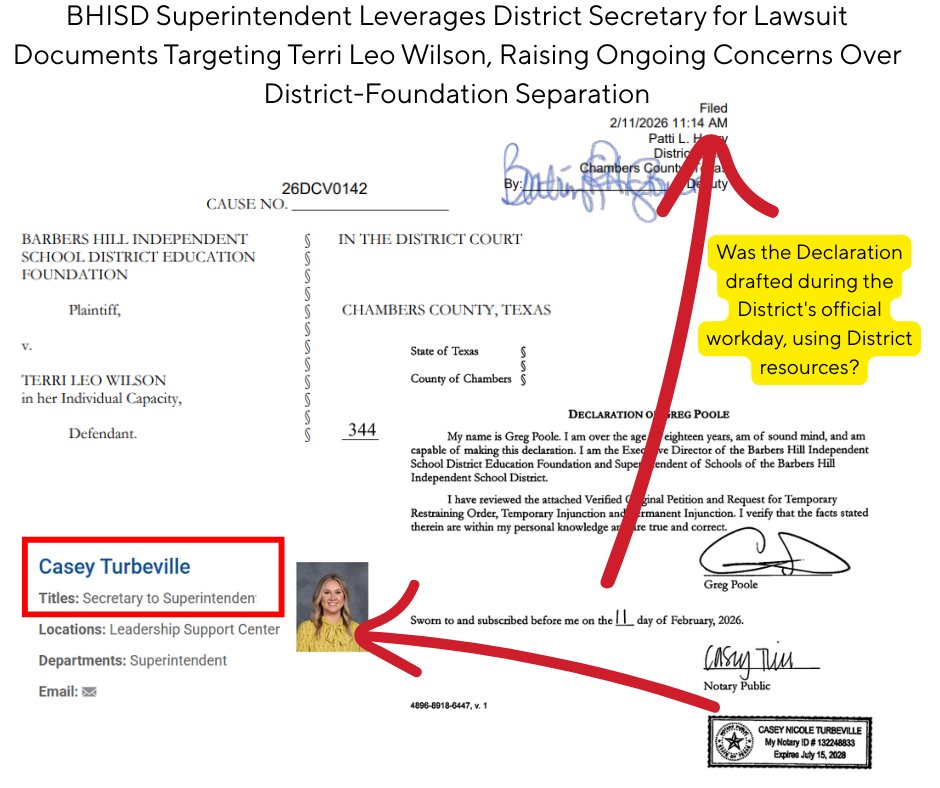
UPDATE: @BHISD Superintendent Greg Poole leverages district secretary for lawsuit docs targeting Rep. @TerriLeoWilson, blurring District-Foundation lines. Who filed: District or Foundation? Officially the Foundation, but lawsuit admits "Barbers Hill ISD Board of Trustees exercises significant control by virtue of the membership of the Education Foundation's governing board"—strengthening case it's ISD lawfare.
Political? Poole donated $25K to her opponent Watkins' campaign.
Is this election interference benefiting Watkins amid heated GOP primary? Taxpayer funds shouldn't fuel attacks on reps fighting for accountability.
@hollyshansen @teainfo @RobbyMontoya @KenPaxtonTX

1
31
David Wilson retweeted

Texas teachers show up every day for our students, often going above and beyond without enough recognition.
Representative @TerriLeoWilson helped deliver real teacher pay raises and meaningful classroom reforms that restore order, empower parents, and let teachers focus on teaching.
That’s leadership that strengthens our schools, respects educators, and invests in the future of Texas. #txlege

1
2
71
David Wilson retweeted

Feb 15
Barbers Hill ISD takes taxpayer dollars, launders them through its foundation, and invests them in a candidate challenging @TerriLeoWilson in HD23. Add Las Vegas casinobux to the mix and you’ve got the most corrupt House race this primary.
thetexan.news/elections/2026…
1
78
Feb 18
You decide.
Feb 18
🚨Video alert: Barbers Hill ISD funneled $41M to its Education Foundation (per OpenTheBooks), yet Supt. Greg Poole—serving as BOTH district leader & Foundation Exec Director—says Texas 'can't touch our foundation.' Is public money being shielded? Watch & decide.
26
David Wilson retweeted

State Representative @TerriLeoWilson is One of Our Most Faithful #EliminatePropertyTax Legislators.
In the last 2 Regular and Special Sessions, Terri Authored and filed our #EliminatePropertyTax bill 3 times, recruited 12 Joint/Co-Authors, and joined in support of our 4 other Authors who filed our bill, too.
Be like Terri, #TXELGE
No Relief. No Reform. #EliminatePropertyTax

4
7
81
David Wilson retweeted

Feb 16
I’ve known @TerriLeoWilson for a long time. She is anti-DEI, pro-parent, and pro-family and she watches the public school curriculum like a hawk. She is for slashing property taxes and anyone who says otherwise is lying! 🤥 thetexan.news/elections/2026…
1
3
12
877
David Wilson retweeted
Jan 21
Jan 21
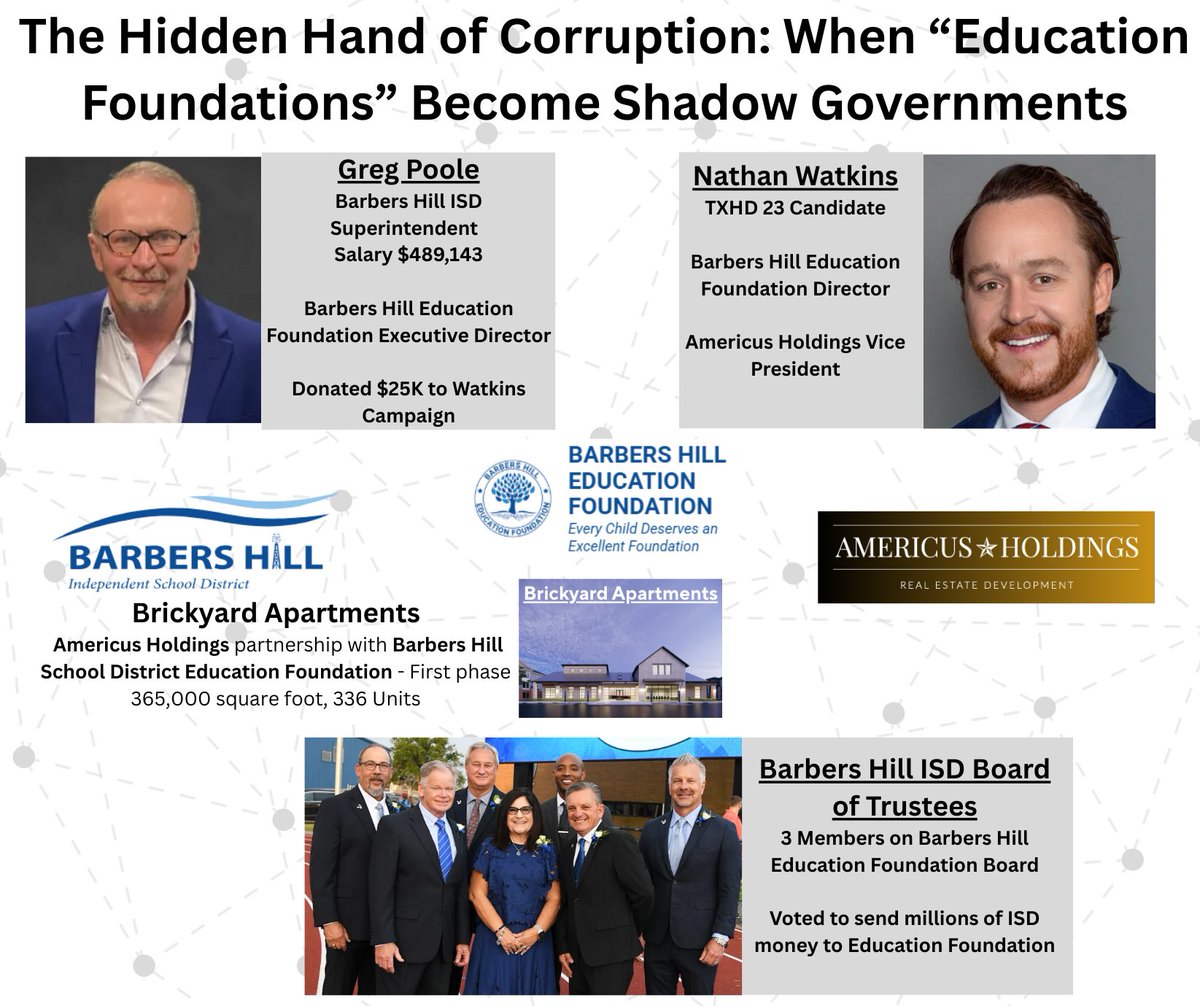
The Hidden Hand of Corruption: When “Education Foundations” Become Shadow Governments
Public schools exist to educate children—not to function as investment firms, real estate developers, or political power hubs. Yet public records show that in Barbers Hill Independent School District (BHISD), an education foundation has quietly grown into something far larger and far less transparent.
At the center is Superintendent Greg Poole, who simultaneously serves as the district’s top executive and as Executive Director of the Barbers Hill ISD Education Foundation, according to the foundation’s IRS Form 990. Poole earns $489,143 as superintendent and reports spending eight hours per week managing the private foundation. That arrangement raises basic questions about public resources, accountability, and divided loyalties.
Those questions grow more serious when money enters the picture.
Between 2019 and 2021, BHISD transferred more than $41.4 million to the foundation, according to Open the Books payment records. In June 2025, the school board approved an additional $8 million grant to the foundation—equal to more than 5.3% of the district’s $151 million annual budget. Three trustees who also served on the foundation board voted in favor of the transfer without recusing themselves.
Once public money enters a private nonprofit, it leaves behind open-records laws, procurement rules, and direct voter oversight. While such transfers may be technically legal under narrow circumstances, legality is not the same as good governance.
Despite receiving tens of millions of dollars from the district, the foundation’s IRS filings show it returned only a small fraction of that money back to BHISD. The foundation reported grants to the district of $487,344 in 2019 and $689,075 in 2020—a small percentage of the funds transferred. By 2023, the foundation reported $159.6 million in total assets and more than $2.26 million in investment income.
That same year, the foundation spent hundreds of thousands of dollars on legal services ($88,943), accounting ($107,382), advertising ($143,970), investment management fees ($400,516), and meals and entertainment ($25,738) expenses that nearly matched the grants provided back to the district. The vendors receiving these six-figure payments are not disclosed in public-facing documents.
Meanwhile, the foundation’s activities increasingly resemble those of a real estate holding company.
Chambers County appraisal records show the foundation owns at least 13 properties, with an estimated market value of at least $14.25 million. In June 2024, Americus Holdings, a private real estate firm, purchased multiple properties and subsequently sold it to the foundation.
Americus Holdings is led by Andrew Schatte, Managing Partner, and Nathan Watkins, Vice President. Watkins is also listed as a director of the Barbers Hill ISD Education Foundation on the foundation’s 2023 IRS Form 990 and is currently a candidate for Texas House District 23.
Americus Holdings’ own website highlights a major real estate development—the Brickyard Apartments—described as a project undertaken in partnership with the Barbers Hill ISD Education Foundation. Education foundations traditionally fund scholarships, classroom grants, and teacher support not apartment developments. Public records do not clearly explain whether taxpayer-derived ISD funds were used in these projects.
Political finance records further connect the same small circle of individuals.
Campaign reports show Superintendent Poole, Americus Holdings executives, contractors, vendors, and foundation-linked individuals contributing to the same political action committees, including Texans for Good Government PAC, Texas Sands PAC, and The Beer Alliance of Texas. Poole personally contributed $25,000, while Schatte and Watkins also made substantial donations.
Collectively the contributions form a tightly interconnected network linking public education leadership, private development interests, and political fundraising.
Oversight within the education foundation itself is also circular. Current and past foundation directors include the superintendent, the assistant superintendent of finance, multiple current and former ISD trustees, the Chambers County Judge, a city chief financial officer, and a sitting political candidate with business ties to foundation real estate projects. Trustees approve transfers to a foundation they help govern, while district executives manage both the public school system and the private entity receiving the funds.
In a published article, Superintendent Poole described the foundation as a way to obtain “more flexible funding” than district resources allow. But flexibility is precisely what public finance laws are designed to restrain. Taxpayer money is supposed to be transparent, accountable, and subject to oversight not parked in private entities where public scrutiny ends.
No single document proves wrongdoing. But taken together, these records describe a system in which public school funds are transferred into a private organization, governed by overlapping leadership, invested in real estate development, and surrounded by coordinated political activity.
Parents and taxpayers deserve to ask simple questions:
When public money leaves the school district, who is watching it and who benefits from its flexibility?
Does the passing of district funds to the education foundation meet article III, section 52(a) provided that the school district: (1) ensures the expenditure is to accomplish a public purpose of the school district, not to benefit private parties; (2) retains sufficient control over the public funds to ensure the public purpose is accomplished; and (3) ensures the school district receives a return benefit.
@KenPaxtonTX
4
7
306
David Wilson retweeted

In 2024, Barbers Hill ISD's education foundation had $175 million in assets but only gave $106,240 in contributions and grants. The relationship between EFs and their ISDs has raised questions concerning personnel, the use of grant money and more. texaspolicy.com/how-educatio…
5
10
20
3,361
David Wilson retweeted

Do you want babies to be adopted instead of aborted? State Rep. Terri Leo Wilson passed a bill last year to make sure young moms know about this beautiful option.
If you want to keep making a difference for families and children, vote for @TerriLeoWilson in Galveston and Chambers counties this March!
#TX2026 #ProLife


2
3
4
273
David Wilson retweeted

Jan 16
ART is the worst of the worst of the worst of the Austin swamp PACs.
Even TLR will occasionally endorse a good conservative, but ART will always back the most liberal Republican in every primary - they’re for open borders, transing kids and higher property taxes.
@TerriLeoWilson is a conservative rockstar in the House who has championed grassroots priorities long before she was a legislator.
The fact that ART is trying to take her out is all the more reason we need to re-elect her.
Jan 16

ART coming out against an incumbent House R: @terrileowilson. #txlege
1
8
29
3,138
24 Aug 2025
Great song, great message!
24 Aug 2025

Why fix something if it “ain’t broke?” 🤷♀️ Now it’s going broke! 😬 Great song! 🎶 😅🙌🏻
1
3
43
1 May 2025
Same hit piece sent to constituents in my wife’s district. Just changed the names and phone number.
1 May 2025
For some people, the end justifies the means. A true dark money PAC has spent a lot of money maligning me in multiple ads to my district. They are trial lawyers who don’t want any limits on their ability to profit from lawsuits, so they are attempting to emotionally manipulate voters in the same way they emotionally manipulate jurors at the expense of hard working Texans. HB4688 ensures that trials are based on facts and evidence. I am now a co-author. Don’t bully me. #HHfor55

1
5
308
David Wilson retweeted

9 Apr 2025
Strategies matter. Actions matter. Noise? Not so much.
69
15
139
17,892
27 Mar 2025
Schools are shutting down because of fewer children are enrolling, many children have moved to alternative choices and, last but not least, mismanagement by local school districts.
27 Mar 2025

🚨FACT CHECK: Abbott says he listens to parents, but hasn't visited a public school for years.
Meanwhile, schools across Texas are shutting down because he's held education funding hostage for years. Parents don’t want vouchers — they want fully funded schools.
3
105