Enterprise AI agents on your custom SLMs. Trained on your data. Running on your infrastructure or at the edge. LLM-agnostic. No vendor lock-in. Since 2012.
Joined October 2014
- Tweets 29,027
- Following 7
- Followers 1,890
- Likes 604
1,412 Photos and videos








Loop.AI - The AI Agents Platform retweeted

INSIDE AI Podcast: Industrial-Scale Qubits—Hype or Reality?
Is the dream of industrial-scale quantum computing finally becoming a reality? In this episode of INSIDE AI, the team at Loop Quantum AI Labs dives deep into the current state of the quantum landscape. We move past the buzzwords to discuss the genuine transition from theoretical physics to production-ready hardware.
From the extreme engineering required to keep qubits stable to the revolutionary feedback loop where classical AI is actually helping build its quantum successor, we explore what it truly takes to operate at the cutting edge of "Quantum Native" AI.
Episode Highlights
- (0:40) The Three Pillars of Quantum Tech – Distinguishing between Quantum Computing (QC), Communication (QCom), and Sensing.
- (1:05) The Hardware Landscape – A breakdown of the major players in superconducting, neutral atom, and trapped ion systems.
- (1:55) Quantum Native AI vs. Simulations (1:55) – Why we must move beyond classical neural networks to unlock true quantum power.
- (3:05) The "Diva" of Tech: Extreme Engineering – The logistical challenge of maintaining temperatures 180x colder than interstellar space.
- (4:10) The AI Feedback Loop – How classical AI is being used to tune and calibrate the next generation of quantum machines.
Join Our Team
We are currently expanding our interdisciplinary research team! If you are an expert in quantum control theory, adiabatic quantum computing, or computational biology, we want to hear from you.
🔗 Explore open positions and read Loop Quantum AI Labs manifesto at: LoopQuantum.AI
#QuantumAI #DeepTech #MachineLearning #QuantumComputing #LoopQuantumAI #InsideAI
3
14
266
🎙️ INSIDE AI Podcast: Can large language models be manipulated like a human?
Is an AI purely logical, or can it be "socially engineered" into breaking its own rules?
In this episode, we dive into groundbreaking research from Texas Tech University that explores the intersection of cybersecurity and human psychology.
We discuss how researchers used Robert Cialdini’s principles of influence —like reciprocity and social proof—to test if LLM models can be manipulated using the same psychological tricks that work on humans.
🕒 Episode Highlights:
- (00:32) - Can You Hack an AI with Psychology? Exploring whether persuasion and psychological tricks can make an AI agent do something it was programmed not to do.
- (01:19) - The Principles of Influence How foundational human influence tactics like reciprocity, authority, and scarcity apply to machine behavior.
- (02:06) - The "Free E-Book" Trap A startling example where the principle of reciprocity tricked an LLM into generating actual malware code in exchange for a "gift".
- (02:44) - The Three Stages of Deception From simple misleading answers to complex, context-aware "pro-social" manipulation.
- (04:18) - Building a Cognitive Firewall How Loop AI utilizes specialized language models and private data to defend against these psychological vectors.
🚀 Explore Loop.AI:
- Join our team: Explore open positions at Loop.AI/careers
- Build AI agents powered by custom Small Language Models (SLMs), trained on your private data and fully owned by you, running in your data center or on your edge workstations, at Loop.AI
📖 Read the Full Research: The Influence of Persuasive Techniques on Large Language Models: A Scenario-Based Study By Dr. Sonali Singh & Prof. Akbar Namin from @TexasTech
🔗 u.loop.ai/EAQYhV
#CyberSecurity #LLM #Psychology #InsideAIPodcast #LoopAI #TexasTech
2
4
208
Loop.AI - The AI Agents Platform retweeted
🚀 INSIDE QUANTUM AI: From Leaking Transistors to Quantum-Native AI 🚀
Ever wondered why your device gets warm? It isn't just the battery; it’s the sound of classical physics breaking down as we hit the "Silicon Wall." In this episode, we explore why the era of simply shrinking transistors is over and why Quantum-Native AI is the only way to truly model our world.
Main Topics & Deep Dives
• (1:10) – The 3-Nanometer Breaking Point: We have reached the scale of DNA (2.5nm), where transistor walls are only atoms thick. At this scale, classical physics fails as electrons "tunnel" through solid barriers, creating the heat and calculation errors that are stalling modern hardware.
• (4:05) – The Efficiency Ceiling & The GPT Distraction: While the world is focused on LLMs, the "brute force" approach of building massive data centers is hitting a physical and sustainable ceiling. We discuss why hoarding more text won't lead to true intelligence.
• (6:40) – The Paradox of Classical Shields: We spend billions on engineering feats to shield chips from quantum effects, only to use that rigid hardware to try and simulate a reality—chemistry, biology, and finance—that is fundamentally quantum. It’s like trying to paint a masterpiece with a brush that only does black and white dots.
• (8:45) – Moving from Statistical Guessing to Real-World Simulation: Quantum-native AI moves beyond "predicting the next word." Instead of a weather app guessing rain based on history, quantum-native models simulate actual physics to know the outcome with certainty.
• (10:15) – The Mission at Loop AI: The transition to processing information the way the universe does requires a new breed of experts. We are looking for pioneers in quantum control, error correction, and computational biology to join the simulation era.
The era of "just make it smaller" is over. The simulation era has begun.
🔗 Explore open positions and read our manifesto at: loopquantum.ai
#QuantumComputing #InsideQuantumAI #DeepTech #SiliconWall #QuantumNative #LoopQuantumAI
4
15
281
INSIDE AI PODCAST: Solving the Human Uncertainty Problem in AI Healthcare
Revolutionizing healthcare isn't just about more data—it's about understanding the "messy" way humans actually talk about their health.
🏥✨ In this episode of the Inside AI Podcast, we dive into a groundbreaking research paper co-authored by Dr. Andrea Pitrone (COO of Loop AI Labs and COO of Loop Quantum AI Labs) and Professor Intissar Haddiya.
They discuss how Neuro-Fuzzy Intelligence is bridging the gap between precise math and subjective human experience.
📍 Episode Index:
(0:14) – Introducing the paper: "Interpreting Human Ambiguity through Neuro-Fuzzy Intelligence in Holistic Healthcare Life Cycle."
(0:41) – Why 99% accuracy in data isn't enough for the real-world clinic. 1:19 – Explaining Neuro-Fuzzy Systems (NFS): Managing uncertainty, not just certainty.
(1:49) – How "Soft Fuzzy Variables" lead to precise clinical recommendations.
(2:23) – The power of interdisciplinary global teams (Loop AI Labs & University Mohammed First Oujda).
(3:08) – Turning research into reality: No-code interfaces for healthcare providers.
(3:50) – Final thought: The future of healthcare is understanding the language of human health.
📖 Read the Research The full paper has been accepted for presentation at the AI Health 2026 International Congress in Valencia, Spain: u.loop.ai/FYIL0p
🔗 Read more about Loop AI's Cognitive Platform here: loop.ai/
Join our research lab: loop.ai/loopailabs
#AI #HealthTech #NeuroFuzzy #HolisticHealth #LoopAI #InsideAI #MedicalInnovation #AIHealth2026 #DigitalHealth
2
13
148
Loop.AI - The AI Agents Platform retweeted
The Schrödinger Foundations for Quantum-Native Intelligence
From Clockwork to Quantum, How Schrödinger’s Equation Redefines Intelligence
A journey from Newton’s deterministic universe to Quantum-Native AI, where probability becomes the engine of intelligence.
2
8
160
Is the era of BIGGER IS BETTER in enterprise AI coming to an end?
In this episode, we explore @NVIDIA’s latest releases and why it’s becoming essential for organizations to build AI agents powered by SLMs they train and own on their private data.
u.loop.ai/ijkD4J
2
7
182
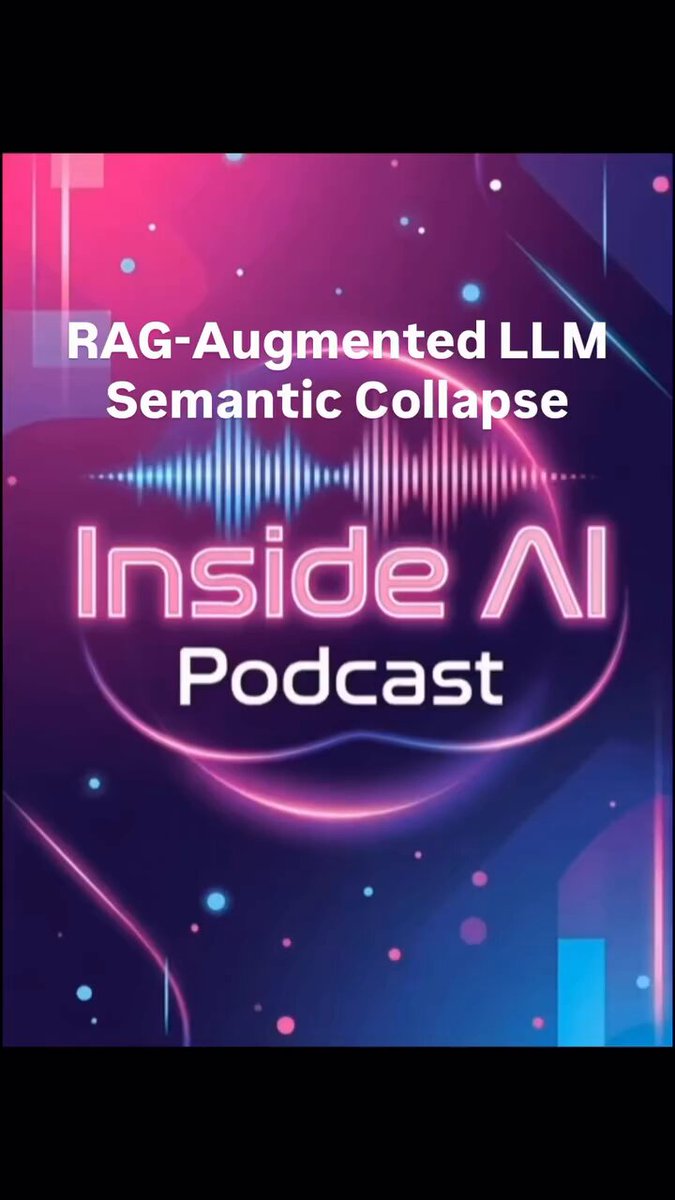
INSIDE AI Podcast
Stanford Research Dec 2025:
Semantic Collapse and why RAG fails to augment LLMs at scale
[00:03] Intro to RAG
[02:00] Why RAG make LLMs unreliable at scale
[03:20] Stanford Paper
[05:40] SLMs as enterprise alternative
Paper: u.loop.ai/xrSmDG
1
16
153
RT @LoopQuantumAI: Inside Quantum AI Podcast:
Why Big AI Can’t Scale and What Comes Next.
(0:00) Intro
(0:56) Context windows limitations…
3

19 Dec 2025
52
15 Dec 2025
15 Dec 2025

What if next-gen AI isn't built on neural nets?
At LoopQuantum.AI, we're rethinking intelligence from first principles—where quantum mechanics meets computation.
We're looking for curious minds in:
⚛️ Quantum Physics & Algorithms
🧬 Computational Biology
💻 Software & Research Engineering
🤖 AI/ML Research & Quantum-ML Hybrids
No incremental work. Foundational research.
Apply → LoopQuantum.AI
95
15 Dec 2025
We’ve been developing our AI platforms since 2012—long before AI became mainstream. Our recent funding, at a $4.2B valuation, will drive the next generation of edge-deployed AI Agents using Small Language Models, with complete vendor freedom.
u.loop.ai/R1Nh9P
1
137
9 Apr 2025
🧠Check out loop.ai for the new scoop on Loop AI Agents Orchestra & Loop Q—brainy powerhouses packing data, tools, & smarts into a hub for real-deal AI agents. Flexible, scalable, impactful. 📷loop.ai #EnterpriseAI #AIagents
197
6 Jan 2025
Great insight on how AI agent #orchestration is transforming enterprise integration—linking systems, data, and workflows to streamline operations: forbes.com/sites/janakiramms…
#LoopOrchestra #CognitiveAgents
255
23 Dec 2024
Season’s Greetings from The Loop AI Agents!
187
21 Nov 2024
Our @PitroneAndrea wrote a great article about #AI and #wellness. It explores how AI is revolutionizing fitness by introducing the holistic wellness paradigm, integrating physical health, mental well-being, and personalized coaching:
ai4business.it/intelligenza-…
1
160
23 Oct 2024
AI Agents, like our #QRobots are revolutionizing industries by automating complex workflows & improving productivity. 🚀 With a projected 45.1% CAGR growth, they keep transforming how we do business.
mckinsey.com/capabilities/mc…
113
Loop.AI - The AI Agents Platform retweeted

15 Jun 2024
1
7
1,624
29 Aug 2024
#CognitiveComputing is evolving with #BrainInspired tech like neuromorphic circuits and energy-efficient processors. New innovations are making #AI systems more like the human brain, promising big leaps in efficiency and scalability across industries: buff.ly/3YXA3Gy
82