
Joined July 2024
- Tweets 8,310
- Following 553
- Followers 1,033
- Likes 11,261
191 Photos and videos







Pinned Tweet

Jun 3
Think about how much data is created every day in Web3.
Each transaction, credential minted, and governance vote contributes to a person's reputation.
Currently, crypto wallets are treated like disconnected and basic bank accounts, and we need to shift the way we approach these digital identities.
The future of digital identities will not only be about providing better wallets;
it will also be about creating a single integrated identity that works across many different systems.
@endlessdomains has created a solution that combines all of an individual's history and reputation into one permanent identity across numerous ecosystems.
So, now you can verify and validate your on-chain presence.
This type of technology is essential for building the next generation of Web3 technologies.
The waitlist is now available, and only a limited number of people can join the founding group.
You do not want to wait any longer for this opportunity:
endlessdomains.io//waitlist?…
May 27

We raised “zero” dollars to build the infrastructure the on-chain economy has been missing since day one.
Every week "millions in rewards" go to people who can prove their reputation on-chain.
You have the history.
You just cannot show it yet.
That ends on launch day. Sign up now to be first in line.
Reply "IDENTITY" and we will hold your spot.
23
40
129
3,630
Web3semper retweeted

Jun 13
Juice?
Juice it
Sign up for a GTD:
tinyurl.com/juice-it-form

534
467
1,365
8,406
Web3semper retweeted

Jun 10
Remember this, an upcoming story begins here.
gLOObiez.
5,490
3,821
5,439
78,488
Jun 10
x.com/i/status/2063982125477…
My entry fully cooked. 🤞
Jun 4

A Whooping $500 Thread Contest ❗️
Sponsored by @UsdMem
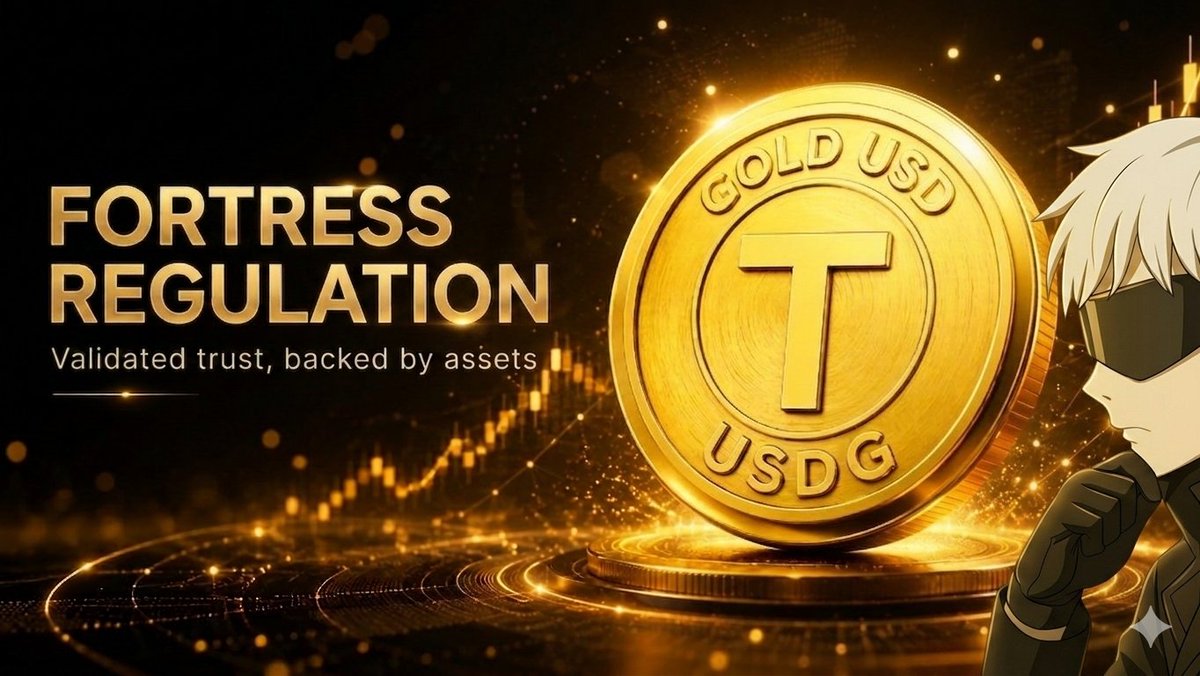
We are launching a USDG X Threads Contest to reward creators who can clearly explain and promote the USDG ecosystem.
How to enter:
- Follow @UsdMem and @Chom_sky1
- Repost this post
- Create an original X thread about USDG Fortuna and the USDG ecosystem
Note: Your thread should explain
- What USDG is and why it is unique
- USDG Fortuna and the Tap to Earn system, including benefits and impact
USDG listings on major CEXs, CMC, and CG based on official information
- Your experience using the Telegram Mini App
- The overall vision and narrative behind USDG
Use the hashtags USDG, ThreadContest, TapToEarn, and USDG
Tag @UsdMem and @Chom_sky1
- All information must come from official USDG sources only
- Quote repost the pinned announcement with your thread link
- Submit your thread link in the Telegram group under the X Threads Contest section
Prize pool distribution $500
1st – $90
2nd – $70
3rd – $60
4th – $50
5th – $45
6th – $40
7th – $35
8th – $35
9th – $40
10th – $35
Winners will be selected based on content quality, accuracy, creativity, and engagement.
The goal is to reward creators who deliver real value and help grow awareness of the USDG ecosystem.
Note: Contest lasts for 7 days

1
18
Jun 8
If you don't know by now.?
Trillions in volume move yearly, yet legacy issues take 100% of the yield while we, the users take all the risks.
Enter $USDG(The Global Dollar) which is a revolution that is resetting the narrative.
It is the next generation stable coin changing the web3 ecosystem.
Backed by Paxos and accelerated by the viral power of USDG Fortuna which is also it's telegram mini app that is driving global adoption.
I won't starve you this time, so here is everything you need to know.!
@UsdMem
9
2
93
965
Jun 10
I know I'm not the only one who remember the childhood joy of buying football card packs, tearing them open and hoping to find Messi or Ronaldo. 😅
We'd sit on the playground, trading duplicates with friends.
I'd try all day to complete my collection album before the World Cup ended.
@CUPcards_sol just brought that exact nostalgic magic to the Solana blockchain for the 2026 World Cup.
But what gets more exciting is that the cards actually carry real financial value.!
I personally had to try it out and mechanics are on some next level we want.!
Let me tell you more.!
CUP.cards isn’t a standard NFT drop. Your cards are live, on-chain protocol records.
Solana handles the fast, zero-friction value settlement meaning every payout lands instantly in your wallet with no locking or staking.
Remember some of the cards gathering dust in an old shoe box? CUP.cards solves this.
If you pull cards that don't fit your strategy, you can instantly burn them back to the game engine for a ~60% cash refund in $CUPC.
Your downside is mathematically capped at 40%.
And If you pull a powerhouse country card like Brazil, Argentina, or France, its underlying value doubles every single round they survive in the real World Cup.
If they lift the trophy, you score a massive 128x value multiplication.
You can also use your cards across 4 active game loops:
Fantasy Lineups, Match Predictions, P2P Trading, and Forging (upgrading packs).
Winning entries clear a 2x minimum payout with jackpot upside over 100x.
Plus, your cards never expire.
They carry over to the Euros and Copa América.
The main marketplace and token launch are coming soon, meaning you are incredibly early.
To test the smart contracts, they are letting users claim and open a pack completely FREE with zero gas fees.
Go pull your first country card and start stacking before kick-off:
cup.cards/kols 🎒🏆
14
4
140
1,097
Jun 8
My personal experience with the Fortuna Mini App.?
It is truly a masterclass in UX and I'm not even bluffing.!
The UI is incredibly smooth and intuitive, removing the daunting UX usually associated with crypto.
But this isn't just a Telegram game; it is an institutional beast.
USDG is already fully tracked on CoinMarketCap & CoinGecko, listed on Tier-1 CEXs like Kraken, and backed by giants like Robinhood and Anchorage Digital.
1
1
35
Jun 8
The whole narrative behind USDG is the democratization of global digital dollars.
It is a blueprint for a compliant, borderless and programmable payment framework that works anywhere on Earth.
With elite institutional backing and viral gateways like FORTUNA, USDG isn't just surviving the future of finance, it is building it !
Don't sit this one out.!!!
#USDG #TapToEarn #ThreadContest
Be part now:
t.me/usdggold
x.com/UsdMem
usdgdefi.com
1
25
May 31
NFA!!
If you’ve spent five minutes on Solana, you know how it normally goes: a token launches, the devs dump, and the chart dies.
But every now and then,
the community steps up and says,
"No. We are building this anyway."
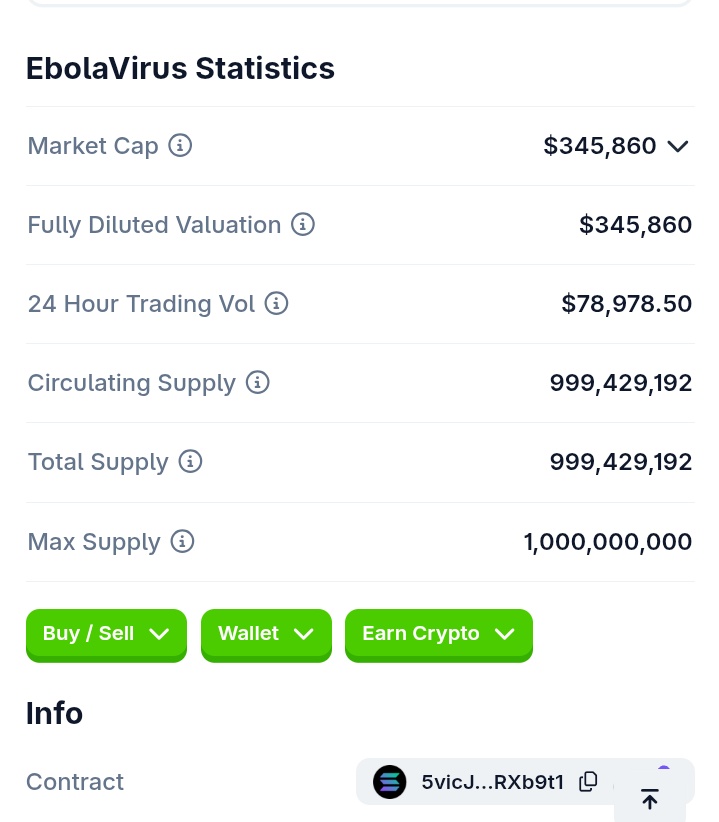
That is the story of $EBOLA @Ebola_Updates.
Following a clean Community Takeover (CTO), a team of relentless builders took over with a spotless track record.
They didn’t just save the project—they gave it a real-world purpose.
With global outbreak discussions constantly hitting the headlines, $EBOLA is turning viral momentum into an actual global awareness engine.
• Decentralized Info Hub: Keeping the public informed with live virus updates via an active X page and real-time tickers on their website.
• Direct NGO Outreach: Instead of sending funds to random charities where it disappears, the team is actively contacting boots-on-the-ground NGOs for transparent, trackable awareness campaign.
The new team is funding everything out of pocket, treating this CTO like a real tech startup:
-- Jupiter Verified for safe, seamless trading.
-- Live on CoinGecko (with CMC actively in progress.
-- Aggressive Marketing:
Fully paid for hundreds of strategic trending boosts.
-- 24/7 Management: Round-the-clock moderation to onboard new investors.
You aren’t just buying a ticker symbol—you are betting on the work ethic of the community running it.
By pairing a globally growing narrative with an ironclad team,
they are building a foundation designed to scale.
• Contract Address (CA): 5vicJEyYTDBqMsKe74vWQeDVMe5cmeA3vr1AT8RXb9t1
• Join the Movement: t.me/ogEbola
11
2
74
1,785
May 30
If you really think about how standard banks work:
they take your savings, give you a tiny bit of interest, and then turn around and charge borrowers massive fees while keeping the profits.
At 07:16, @marygooneratne breaks down how @Loopscale is completely flipping this on @solana.
Her point is so simple but huge:
"Matching lenders and borrowers directly means Lend Rate equals Borrow Rate."
Basically, instead of dumping money into a massive shared bucket where a middleman takes a cut, they built a direct matching system.
It’s like Uber connecting a rider straight to a driver.
And because of how fast the network is, it actually works smoothly:
"Solana's single programmable ledger allows us to build a general-purpose order book engine that is impossible on slower chains."
No middlemen taking a cut, no wasted money.
What the borrower pays goes straight to the person lending it.
Clipped the exact moment she explains it below—definitely worth a watch! 👇

Exploring Solana Ep. 18: @Loopscale
Pool based lending is the default in DeFi. Loopscale is doing something different. Order book model that matches lenders and borrowers directly.
I sat down with @marygooneratne, co-founder, to talk about the future of lending on @solana 👇
00:00 Intro & What is Loopscale?
00:22 From college CS class to building on Solana
03:33 Why they rebranded from Bridgesplit to Loopscale
07:16 Why orderbook lending vs the pool-based model
11:10 What Loopscale actually unlocks for borrowers and lenders
14:00 Closed beta learnings and what users actually wanted
18:36 What is Loops 2.0, and what changed
21:10 Expanding into RWAs and real-world borrowers
25:00 Solana DeFi is only 1% of what it could be
28:57 Biggest milestone for 2026
13
6
139
3,651
May 26
5 days ago, I really wanted to bridge $100 to a particular chain.
I only got $99.40 after the bridge.
I was left with dealing with slippage and incomplete money too.
Web3 commerce is not moving forward because of slippage, especially when you are forced to pay with different tokens across multiple crypto networks.
Think about what we ask people to do right now just to move some funds:
Spend 10 minutes hunting for a bridge that won't get exploited.
Realize you don't even have $2 worth of a random gas token on the destination chain.
Bridge anyway, watch slippage eat your principal mid-route, and pray the destination protocol doesn't leave you half of your money.
If crypto is ever going to scale to global commerce, neobanks, and real-world fintech, this entire model has to go.
This is exactly why the launch of LI.FI Intents is such a massive deal.
Instead of making you sign a complex string of smart contract interactions, @lifiprotocol is shifting everything to outcome-based execution.
You just declare exactly what you want on the destination chain, sign the intent, and you're done.
That easy, right?
Behind the scenes, a competitive network of professional market makers—called solvers—competes to do the heavy lifting using their own private liquidity, CEX desks, and OTC inventory.
Here is the actual impact of what they are pulling off:
1️⃣ Hardcoded, Exact Outcomes for Payments:
Let’s go back to my $100 invoice. With LI.FI Intents, solvers absorb the execution risk.
If you send 100 USDC from Arbitrum, the merchant receives exactly 100 USDT on Solana.
Zero slippage on 1:1 stablecoin swaps, and zero gas management required from the user.
It finally turns cross-chain crypto into actual, predictable payment infrastructure.
2️⃣ A Clean Path for Institutional Capital:
Regulated fintech firms and neobanks can’t touch standard, anonymous DeFi pools because of strict compliance, AML, and KYB laws.
LI.FI Intents gives them a third path: a KYB-verified solver network with built-in OFAC screening.
Institutions can pick exactly which trusted corporate solvers handle their volume.
They get on-chain speed without the regulatory headaches.
3️⃣ Instant, Modular RWA Access:
Instead of forcing apps to build custom plumbing for every single Real-World Asset issuer out there, LI.FI modularizes the whole stack.
A single integration lets protocols route through licensed market makers to access tokenized US Treasuries or gold (like Ondo and xStocks) while handling compliance checks smoothly in the background.
LI.FI is building an enterprise-grade, completely abstracted execution layer where the user only cares about the destination, and the tech handles the rest.
Serving as the baseline for the Open Intents Framework—which they co-developed with the Ethereum Foundation—proves its technical credibility.
It is already quietly powering heavy hitters like Jumper and Rabby.
But here is my actual take: a solver network is only as good as its real-world performance under heavy network congestion.
Hype posts won't scale this tech—rigorous stress-testing will.
I'm all in on where this tech is going.
I've been backing LI.FI's vision for a long time, and you should be paying attention too.
Let's see what these intents can actually do.
Try the product: jumper.exchange
🔗 Read the architecture: docs.li.fi/lifi-intents/intr…
@lifiprotocol
#LIFIIntents
May 26

Introducing LI.FI Intents.
Infrastructure for apps, wallets, and neobanks to:
• Enable stablecoin payments
• Access real-world assets
• Tap into compliant onchain liquidity
Built for enterprises bringing financial products onchain.
5
3
50
1,742
May 26
Think about the smell of rain on a hot sidewalk, or the taste of a dish you haven't eaten since you were a kid.
you don't just remember a random fact—you're instantly thrown back into an entire chapter of your life.
Or think about bumping into an old classmate you haven't seen in years.
within two seconds of laughing at an inside joke, all that history and trust comes flooding back.
you don’t have to introduce yourselves all over again.
Even a simple sticky note on the fridge tells a story.
before you even read the words, you know exactly who wrote it just by looking at the messy handwriting.
Right now, AI lives with permanent amnesia.
Every time a session ends, its mind is wiped completely clean.
It can process millions of data points, but it has zero past.
It’s stuck living like a total stranger, re-learning everything from scratch.
For CONCH Day, let’s talk about how @0xypheon is fixing this by giving AI a permanent, sovereign memory layer.
🧵

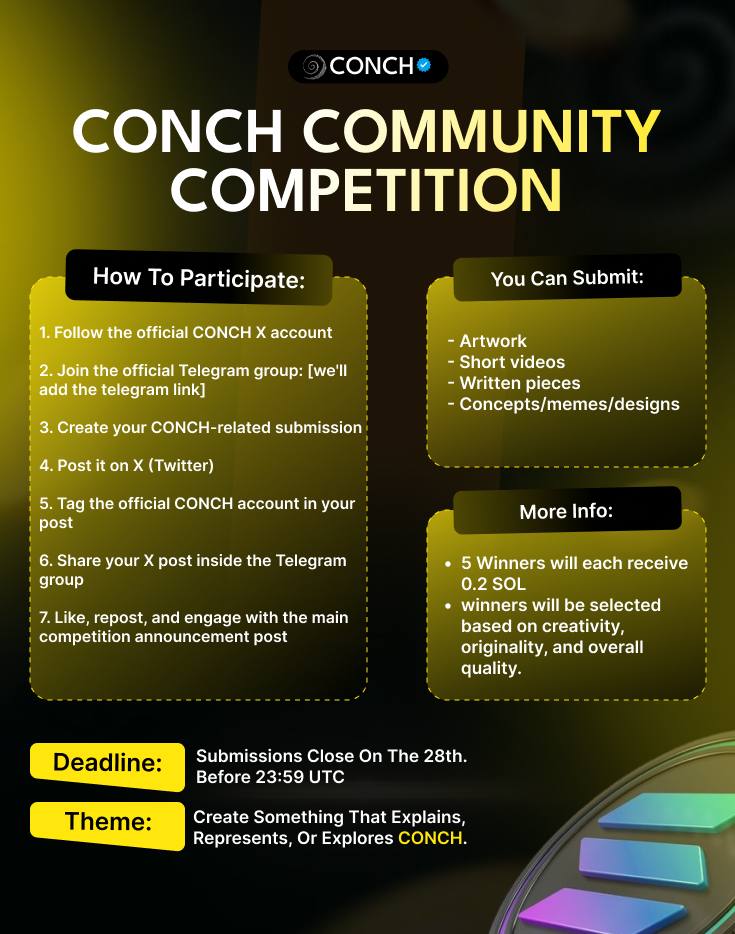
🎉 CONCH COMMUNITY COMPETITION 🎉
To celebrate CONCH Day, we’re launching a creative community challenge designed to highlight imagination, expression, and what CONCH represents through the eyes of the community.
THEME:
Create anything that explains, represents, or explores CONCH. This could be your interpretation of its meaning, its identity, its culture, or a creative concept built around it.
You can submit in any format:
➠Artwork / designs
➠Short videos / animations
➠Written pieces / storytelling
➠Memes, concepts, or creative ideas
There are no restrictions, originality is what matters most.
🏆 REWARDS
5 winners will each receive 0.2 SOL
HOW TO PARTICIPATE
➠Follow the official CONCH X account
➠Join the official Telegram group (link will be shared)
➠Create your CONCH-themed submission
➠Post your work on X, quoting this post
➠Tag the official CONCH account in your post
➠Share your post inside the Telegram group
➠Engage with the main announcement (like, repost, and comment)
📅 DEADLINE
All submissions close on the 28th
🏅 WINNER SELECTION
Winners will be chosen based on:
➠Creativity and originality
➠Clarity of idea and execution
➠Overall quality of submission
This is more than a contest, it’s a chance for the community to help define and express what CONCH stands for through creativity.
Let’s see what you build 🐚
4
3
144
2,863
May 26
The fuel for this organic growth is what CONCH calls Artifacts.
think of a memory artifact like a rare vinyl record or a hand-signed letter.
It isn't just a basic file; it carries its own undeniable proof of origin and its own unique history.
Because these digital artifacts are cryptographically verifiable and tamper-proof, the ecosystem scales exactly the way human culture does—not by corporate decree, but through shared, trusted stories.
3
3
79
1,786
May 26
as we move into a future run by autonomous systems, trust cannot be a guessing game.
we absolutely need to know what is real, where it came from, and who has permission to access it.
This is why the core pillars of CONCH are so vital:
• Private: Context and memory remain secure and completely sovereign.
• Portable: Memories aren't locked in walled gardens; they move across platforms.
• Durable: Built to last onchain, ensuring they don't simply fade away.
Centralized control is a dead end.
True digital sovereignty requires systems that can remember, verify, and persist on their own terms.
The next era isn't unfolding through corporate boardrooms—it’s unfolding through artifacts.
Let’s build the future of memory together.
#CONCHDay #Solana
1
63