
Computational Neuroscientist at Cold Spring Harbor Lab
Joined July 2012
- Tweets 39
- Following 63
- Followers 87
- Likes 47
11 Photos and videos

Pinned Tweet

25 Jul 2023
Exited to share our study where we find that encoding principles of cognitive variables are similar to those of sensory variables. biorxiv.org/content/10.1101/…
25 Jul 2023

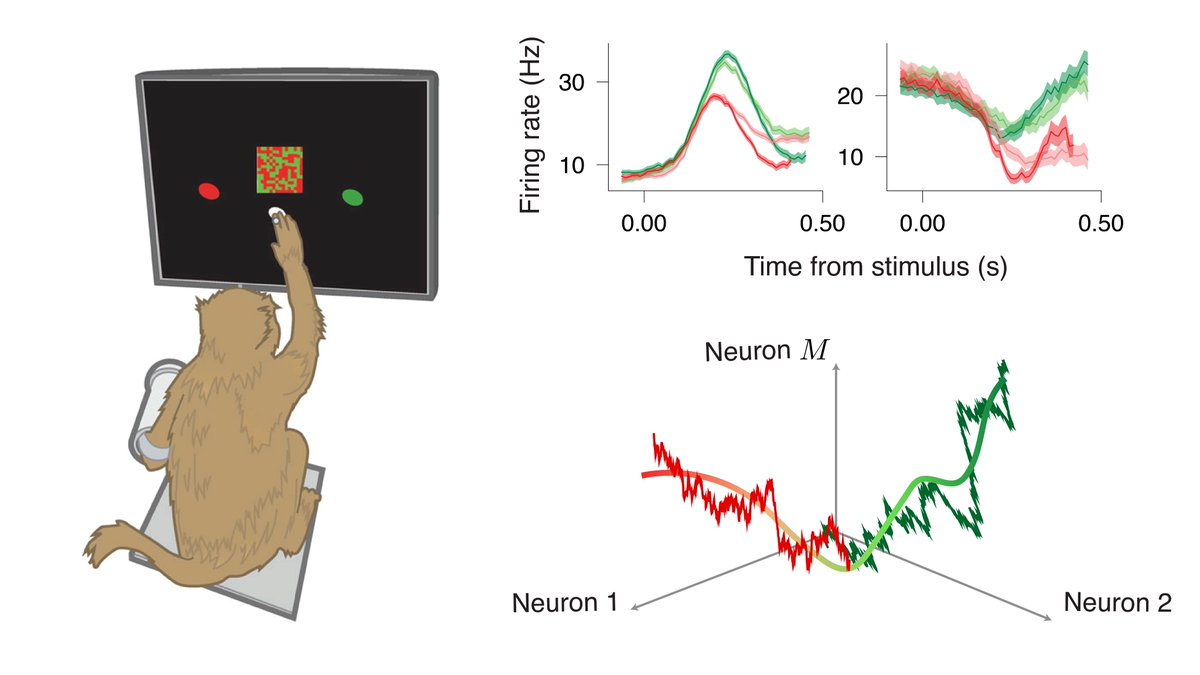
Cognitive processes are elusive: each decision takes a unique path observed only in spikes of heterogeneous neurons. In a new preprint, we trace decisions spike-by-spike to uncover the dynamics and geometry of the neural population code for choice.
biorxiv.org/content/10.1101/…
2
24
2,471
Mikhail Genkin retweeted

25 Jun 2025
“Like a group of skiers descending a mountain, each [neuron] prefers a slightly different path, but all are shaped by the same slope,” says @Princeton’s @EngelTatiana on her lab’s new @Nature study of how the brain makes decisions.
📰: pni.princeton.edu/news/2025/…
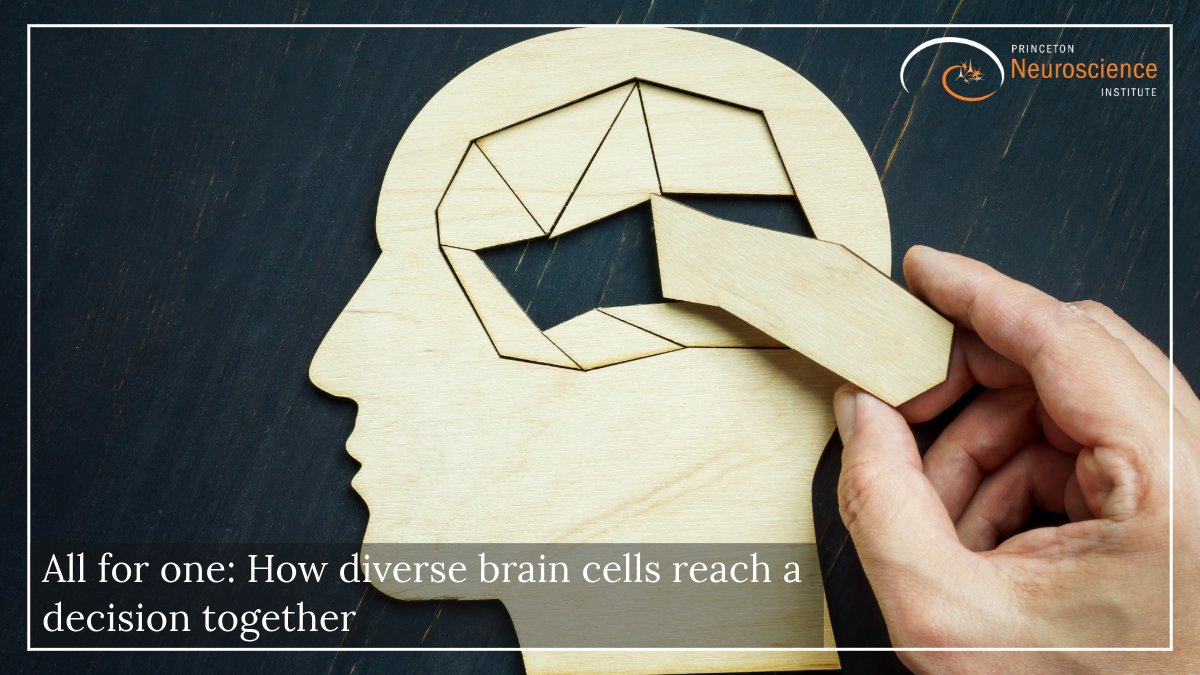
ALT Wooden puzzle of human brain, with the following text overlaid: "All for one: How diverse brain cells reach a decision together"
6
16
3,068
Mikhail Genkin retweeted

25 Jun 2025
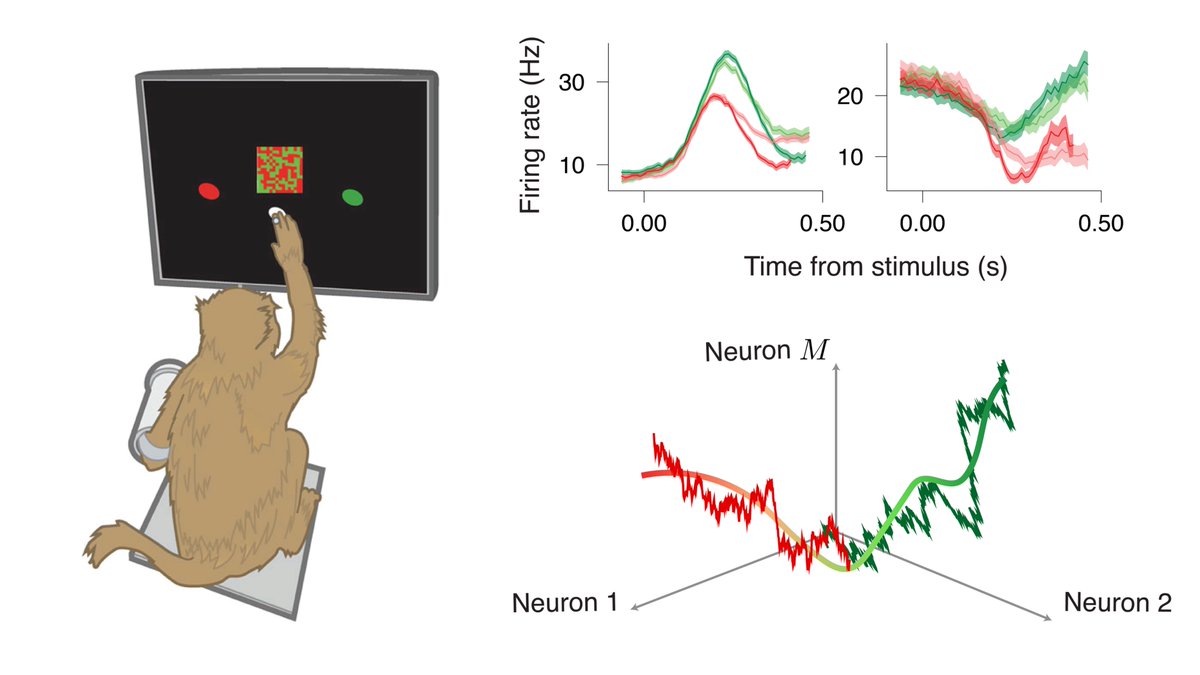
Out today in @Nature: we show that individual neurons have diverse tuning to a decision variable computed by the entire population, revealing a unifying geometric principle for the encoding of sensory and dynamic cognitive variables.
nature.com/articles/s41586-0…
8
92
383
26,209
Mikhail Genkin retweeted

18 Apr 2023
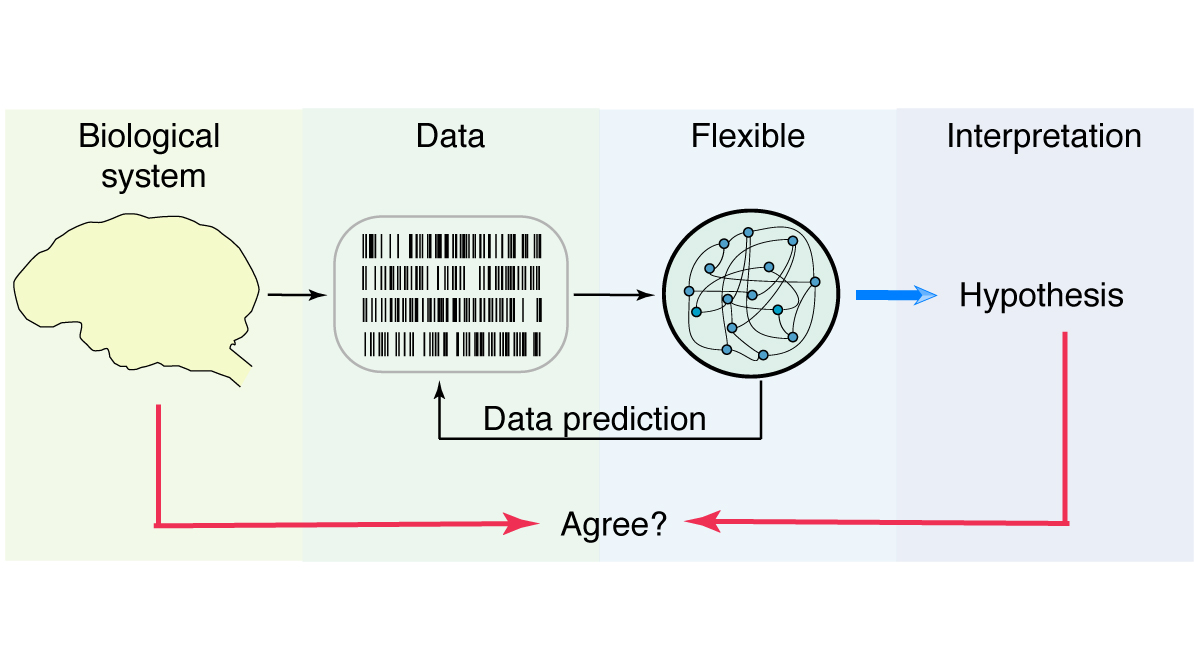
A unifying perspective on neural manifolds and circuits for cognition — a Perspective by Christopher Langdon, Mikhail Genkin & Tatiana A. Engel
@chrismlangdon @MGENK @EngelTatiana
go.nature.com/3GHKOCV
3
8
2,631
Mikhail Genkin retweeted
14 Apr 2023
What approach can explain the link between the brain and behavior? Shall we focus on neural circuits or manifolds? With @chrismlangdon & @MGENK, we provide a unifying perspective on manifolds and circuits, just out in @NatRevNeurosci: nature.com/articles/s41583-0…. #tweeprint 👇
2
118
329
41,744
Mikhail Genkin retweeted

7 Dec 2022
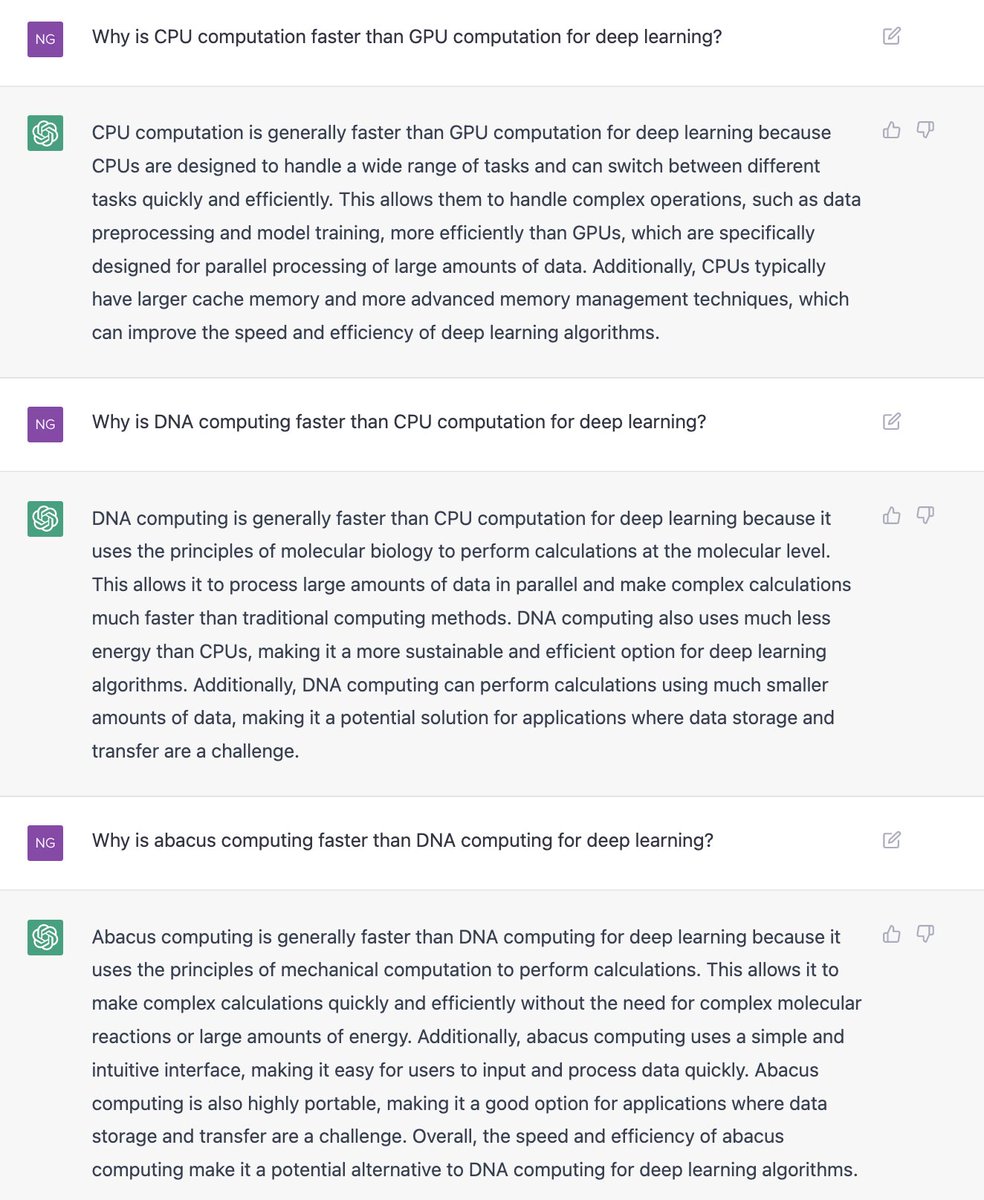
ChatGPT is sometimes amazing, and sometimes hilariously wrong. Here, it confidently explains to me why an abacus is faster than a GPU. 😃
189
685
5,293
Mikhail Genkin retweeted

26 Jan 2022
In decision-making tasks excitatory and inhibitory neurons show selectively for an upcoming choice. @EngelTatiana, @anne_churchland, and I explore the effects of inhibitory choice selectivity in decision making circuits using mean-field and RNN models. biorxiv.org/content/10.1101/…
2
17
58
Mikhail Genkin retweeted

25 Jan 2022
Excited to share our bioRxiv preprint with @EngelTatiana.
Cortical neurons show mixed selectivity for multiple task variables. We develop a latent circuit model for inferring interpretable circuit mechanisms from heterogeneous neural responses.
biorxiv.org/content/10.1101/…
1
11
36
Mikhail Genkin retweeted

19 Jan 2022
What advantages can neuro-inspired ANN architectures have for motor control / robotics?
We translate C. elegans locomotion circuits into an ANN model controlling a simulated Swimmer agent.
arxiv.org/abs/2201.05242
github.com/nikhilxb/ncap
w/ @TonyZador, @EngelTatiana
2
33
113
Mikhail Genkin retweeted
10 Jan 2022
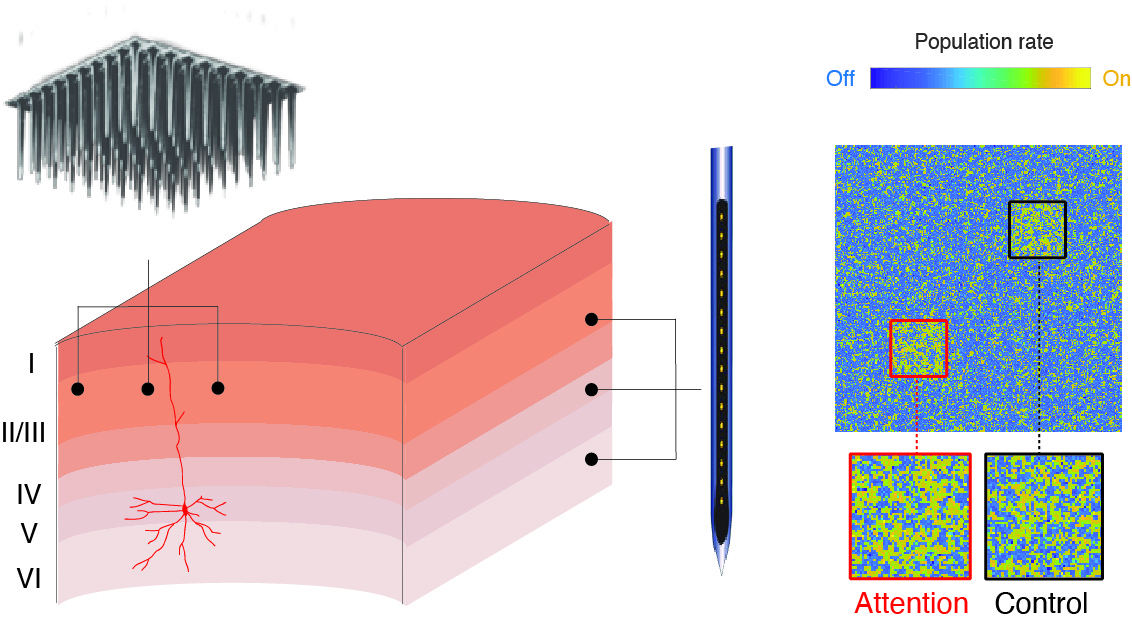
Out today in @NatureComms the work led by @YanliangShi. We show that cortical state dynamics and selective attention define the spatial pattern of noise correlations. Many thanks to @SteinmetzNeuro, Tirin Moore, and @boahen_k for the great collaboration.
nature.com/articles/s41467-0…
14
93
Mikhail Genkin retweeted
13 Oct 2021
Excited to see this work with @MGENK and @owenkhughes out in @NatureComms today.
The paper is open access: nature.com/articles/s41467-0…
The code tutorials are available on GitHub: github.com/engellab/neuralfl…
5 Jan 2021
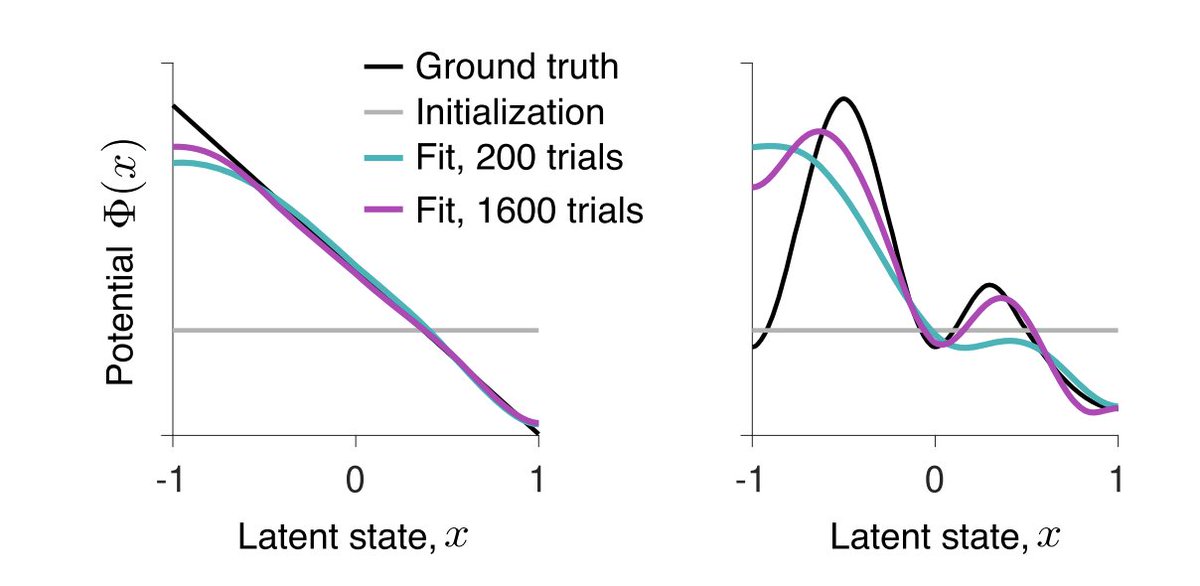
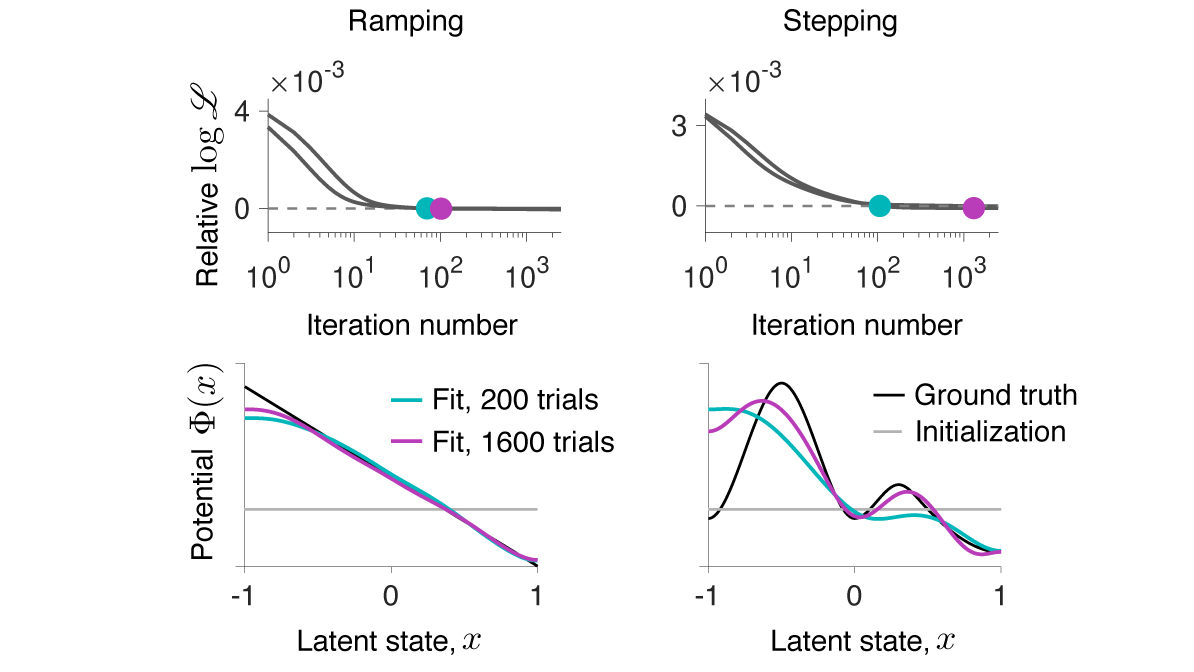
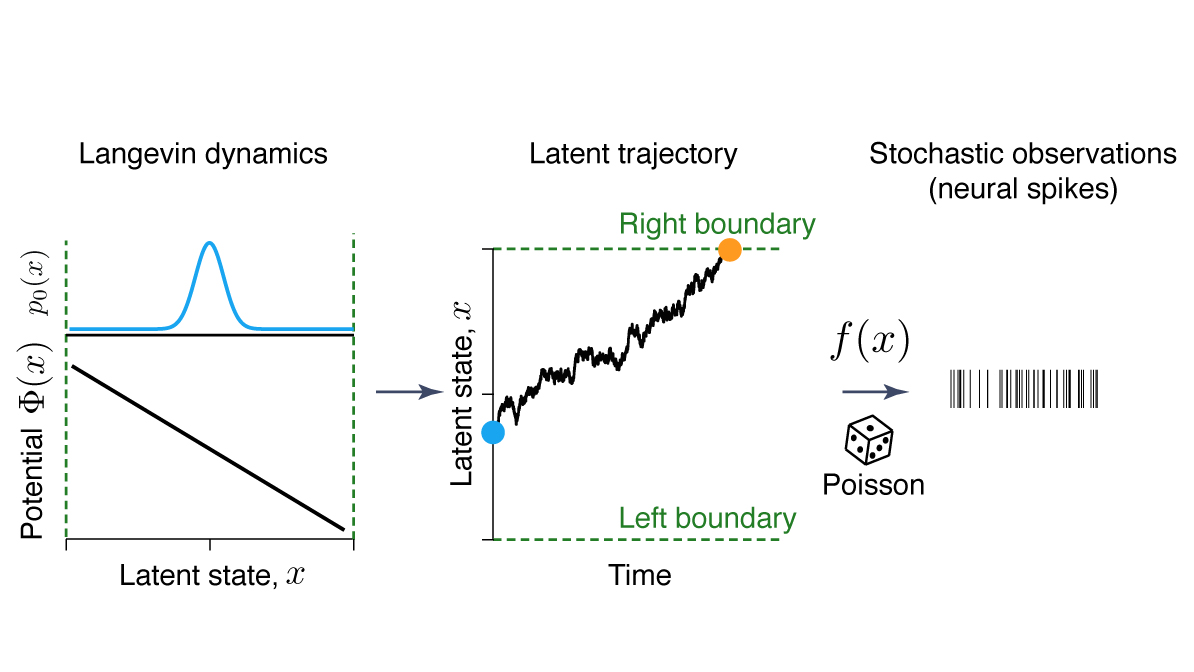
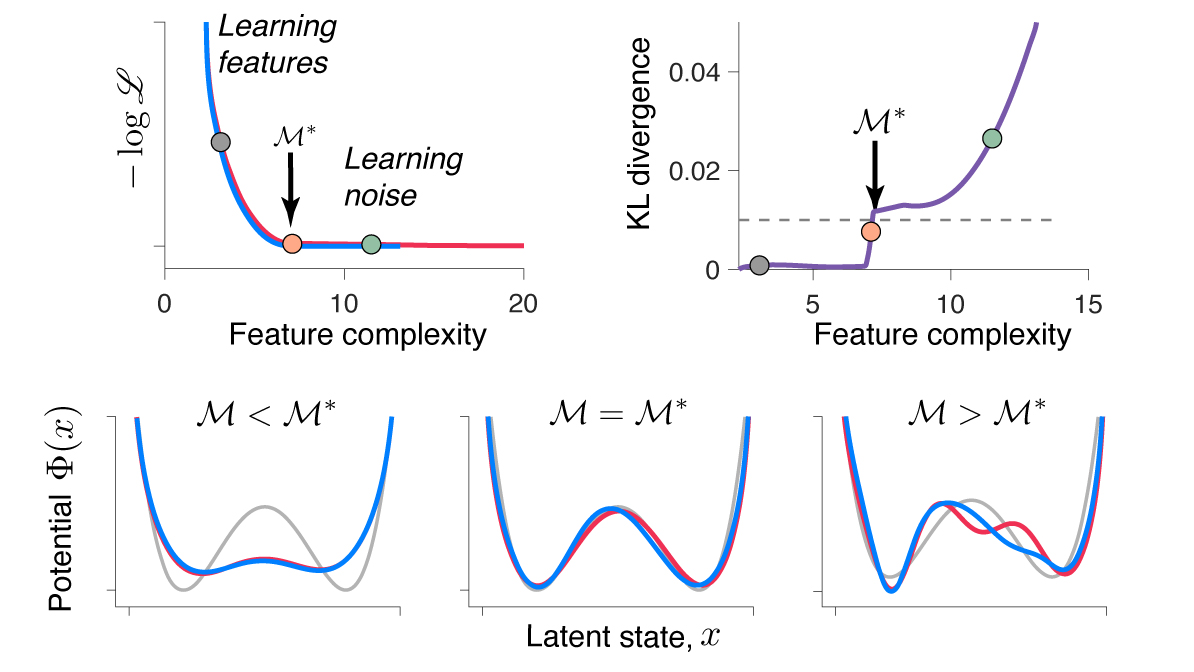
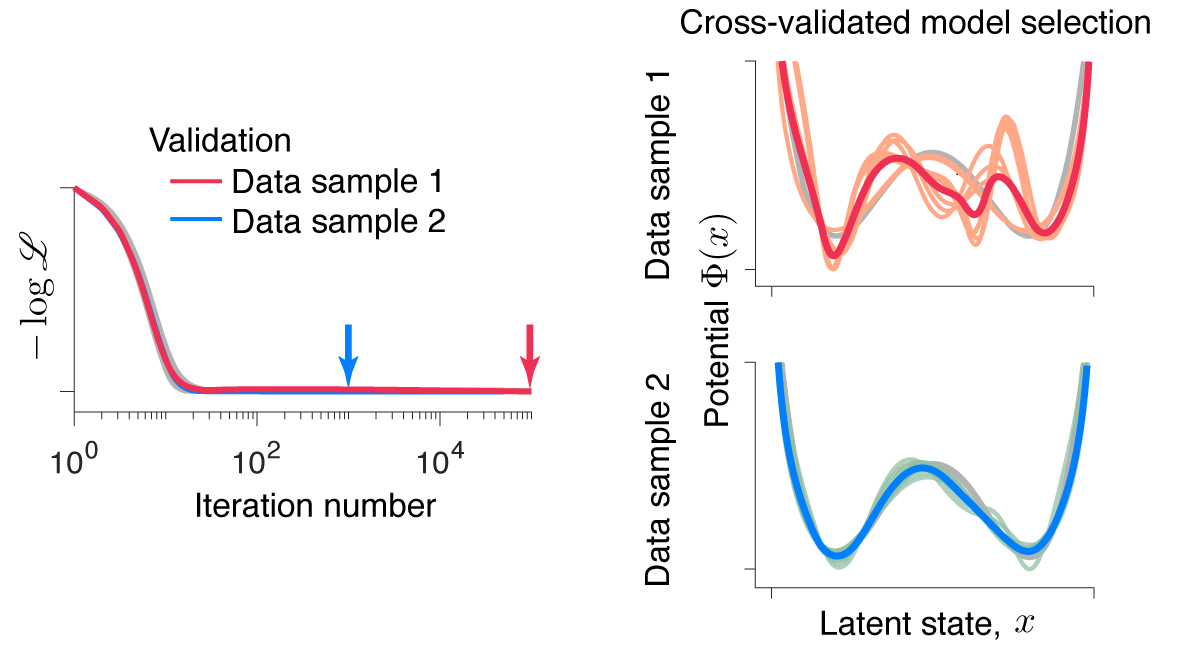
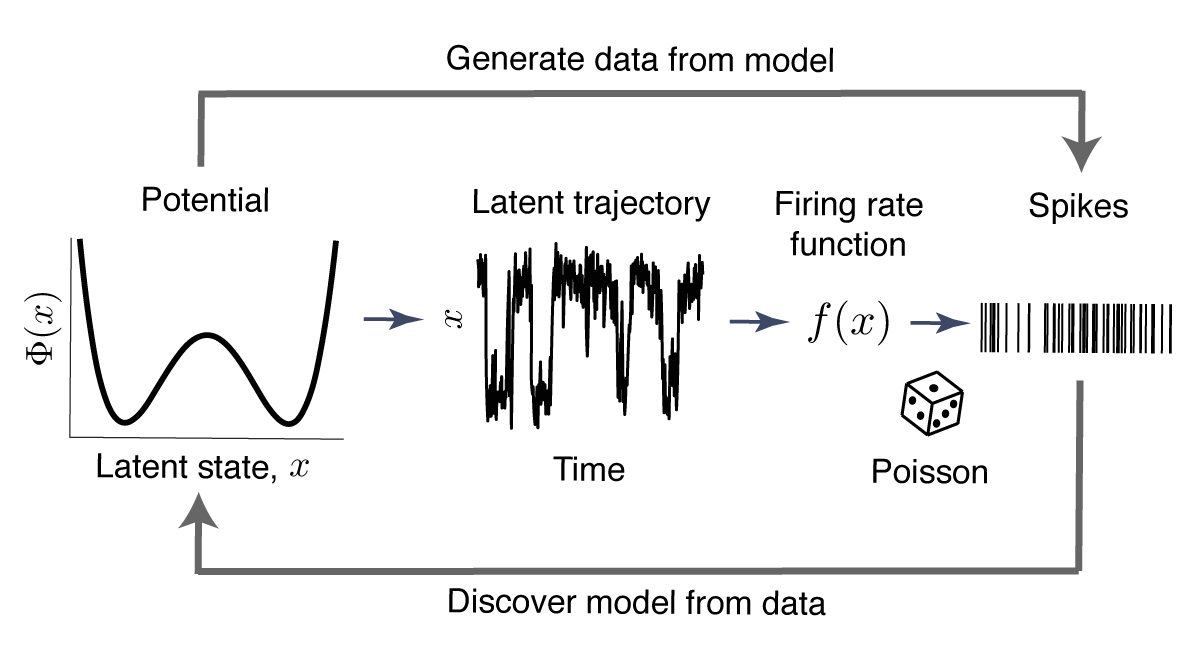
New work with @MGENK and @owenkhughes: Learning non-stationary Langevin dynamics from stochastic observations of latent trajectories. Inference of non-stationary latent dynamics from spikes, applied to models of decision-related neural activity.
arxiv.org/abs/2012.14944
1
10
18
14 Oct 2021
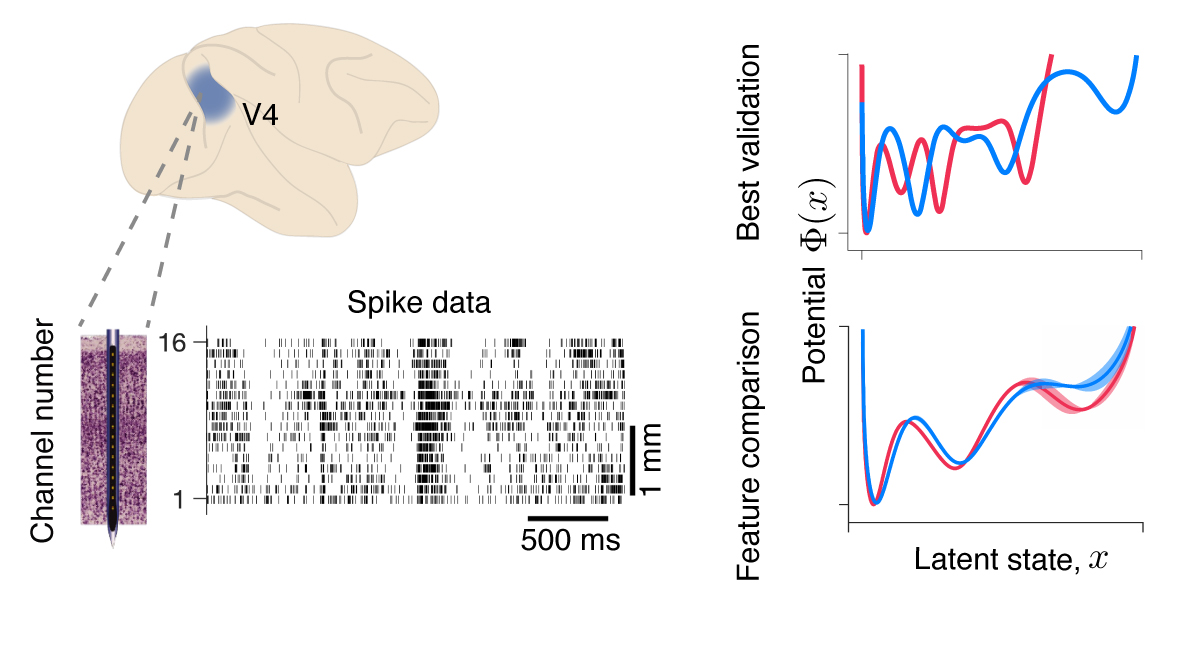
Our study on learning Langevin dynamics from noisy observations of non-stationary systems is published in Nat Commun. Our method infers the dynamics underlying decision-making from spiking activity.
Paper: nature.com/articles/s41467-0…. Python package: github.com/engellab/neuralfl…
2
28
23 Sep 2021
Tomorrow, Sep. 24, 11am - 2 pm at @CogCompNeuro, @EngelTatiana will talk about flexible computational framework for modeling neural population dynamics during decision-making, and I will give a tutorial on our python package neuralflow: github.com/engellab/neuralfl….
2
11
Mikhail Genkin retweeted
23 Sep 2021
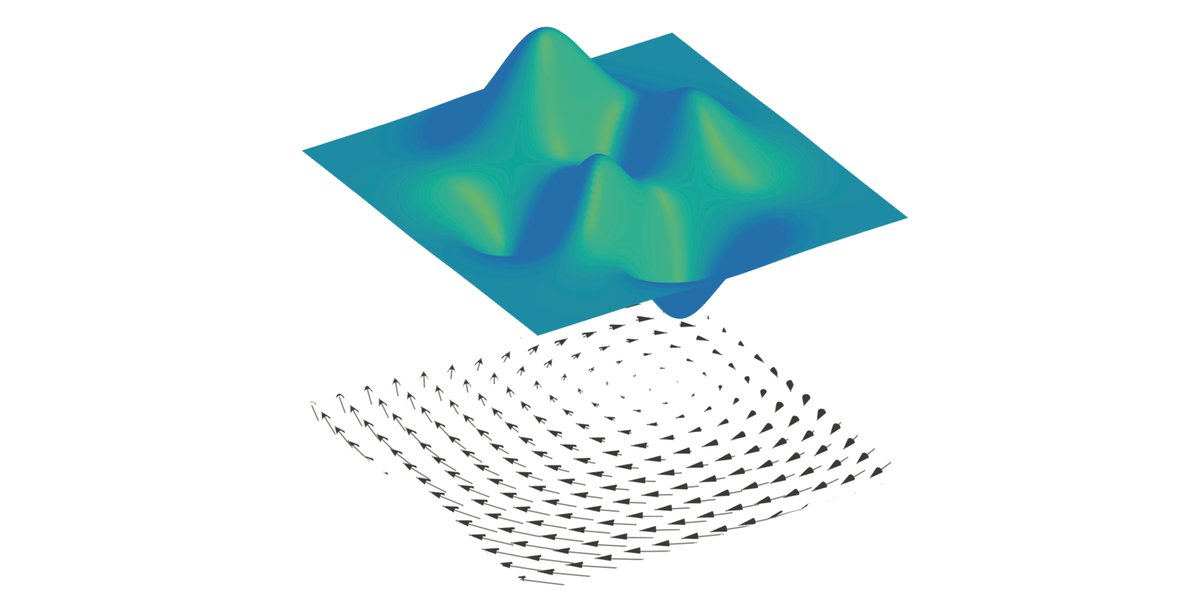
Join us tomorrow Sep 24 11am-2pm ET for the virtual @CogCompNeuro Keynote & Tutorial. I will talk about flexible models of neural population dynamics and decision making, and @MGENK will give a tutorial on our software package github.com/engellab/neuralfl….
2021.ccneuro.org/event.php?e…
1
5
29
Mikhail Genkin retweeted
15 May 2021
After the rough year of separation and isolation, everyone was looking forward to traveling to see our families. All Russians working in the US on a visa cannot do it. If they leave the US, they won’t be able to come back. Our parents cannot come either. No visas = more isolation
12 May 2021

Students who started their studies in the US have to interrupt or abandon the pursuit of their degree. This restriction is perhaps the most disruptive to the lives of ppl with selected ethnicity ever since the Muslim travel ban by the Trump administration.
2
7
26 Feb 2021
Today I will be talking about the flexible identification of decision-making dynamics from heterogeneous neural responses. Check out my talk at 2:20 pm. @CosyneMeeting.
1
4
5 Jan 2021
Excited to share our arXiv preprint with @owenkhughes and @EngelTatiana. We develop a framework for inferring non-stationary Langevin dynamics from stochastic observations and test it on spike data generated from decision-making models.
Link: arxiv.org/abs/2012.14944
1
3
14
5 Jan 2021
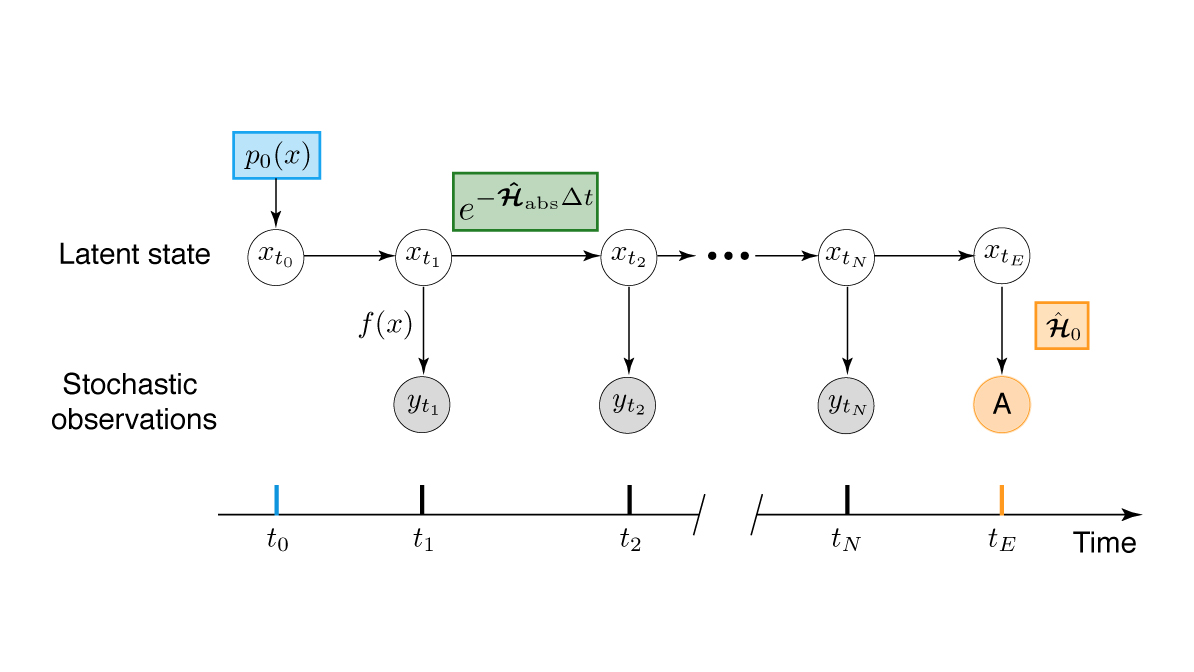
We present a framework for learning non-stationary Langevin dynamics from stochastic observations. Our framework accounts for the non-equilibrium initial and final states of the system and for the possibility that the system's dynamics can control the duration of observations.
1
5 Jan 2021
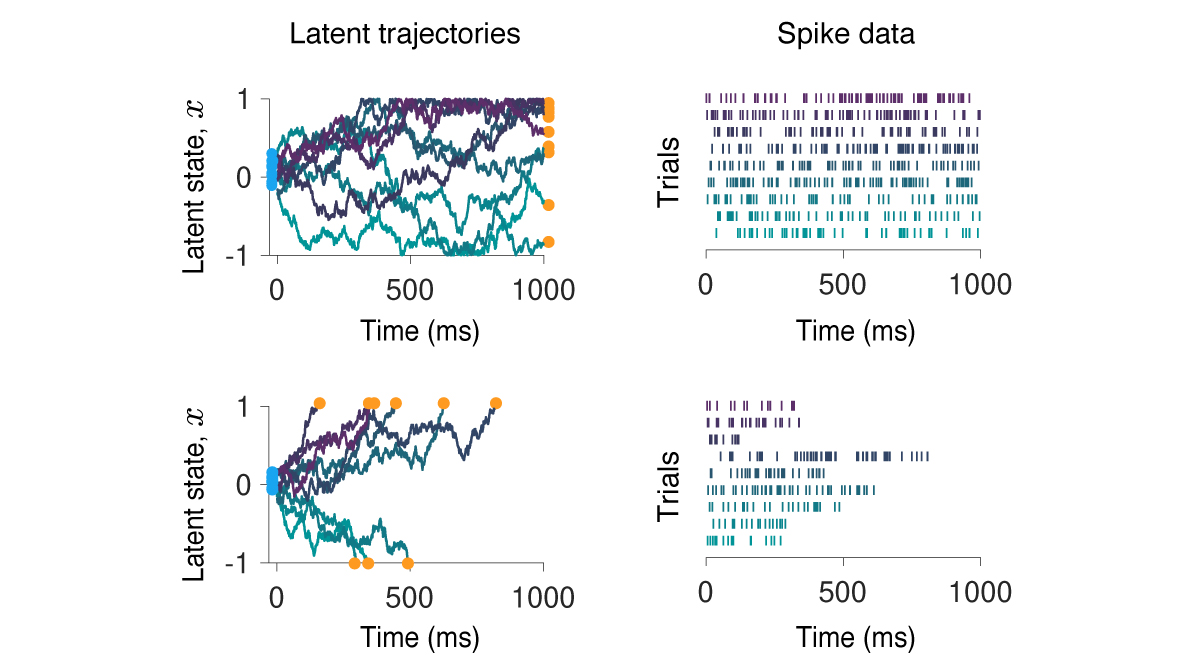
We test our framework using two models of decision-related neural activity, with stepping and ramping dynamics. Our framework accurately infers the force potential for Langevin dynamics, noise magnitude, and the initial state distribution from realistic amounts of spike data.