
Founder @ Supra | Helping 350 product leaders accelerate their careers through peer learning and community |
Joined March 2018
- Tweets 701
- Following 300
- Followers 164
- Likes 177
Photos and videos
AI automation has a process debt problem.
A lot of teams are trying to automate workflows they haven't really clarified, and that's the idea I keep coming back to after recording a podcast with Noah Levin.
Noah calls himself a "free-range AI consultant," but what I liked most is that when companies come to him for help with AI, much of the work doesn't start with AI at all.
It starts with basic business questions.
What is this process trying to do?
Where is it breaking?
Is it written down anywhere?
Does the written version match what people actually do?
Are 10 people doing it 10 different ways? And if they are, which version actually works best?
I know Elon can be polarizing, but his algorithm is genuinely useful here. The rough version:
1/ Question every requirement
2/ Delete the part or process
3/ Simplify what's left
4/ Accelerate cycle time
5/ Automate
The order matters because I think many teams using AI are jumping straight to step five.
They take a messy inherited workflow, point an agent at it, and now the same mess moves faster. Maybe the output looks cleaner. Maybe fewer people touch it. But if nobody understood the process underneath, that is not progress. It's just a more scalable mess.
Ben and I have run into this at Insider Loops too. We have an internal workflow that takes customer feedback, reads the relevant guide, and suggests where the guide should change. When it works, it feels kind of magical. But it works because we spent an annoying amount of time on the boring stuff first.
Sometimes feedback means a missing example. Sometimes the evaluation criteria are unclear. Sometimes it's just one customer's preference and should not change the guide at all.
Before the agent can help, the process needs opinions:
What kind of feedback should count as signal?
Where should it go in the guide?
What should the agent suggest vs. change?
What should a human always review?
What should never be touched automatically?
The agent is useful because the process underneath it is opinionated. I think that's the part people skip when they talk about AI automation.
The first question is usually "can we automate this?" But the better question is whether the workflow should exist this way at all.
IMO, automation is the reward for doing the boring process work first.
1
1
2
32

Jun 14
Startup equity negotiation gets better when you stop asking "how many points?" and start asking "what assumptions produced this grant?"
One common question I get from Supra members:
"I'm negotiating a Head of Product role at a seed, Series A, or Series B company. How much equity should I ask for?"
Benchmarks help. But the better conversation is about the logic behind the grant. Stage matters a lot, but the underlying questions are similar.
Fred Wilson's 2010 AVC post is my favorite reference here. The numbers are dated, but the method is useful.
Once a company has a real operating team, equity should move from art to science.
1/ Stop thinking only in percentage points
A company might offer 0.25%, 0.5%, or 1%. But the percentage alone doesn't tell you enough.
You also need:
↳ Fully diluted shares outstanding
↳ Latest 409A / strike price
↳ Last round valuation and terms
↳ Liquidation preferences
↳ Vesting schedule and exercise window
If they won't tell you the denominator, you have a number that looks precise but cannot be evaluated.
2/ Translate the grant into a target dollar value
In a more disciplined process, the company starts with a target equity value for the role instead of a share count.
Base salary x role/level multiplier = target equity value
The multiplier is where the company's philosophy shows up: how much equity the role should carry relative to cash comp and expected impact.
Target equity value / estimated value per option = number of options
"Estimated value per option" is an assumption, not a fact. Some companies use current estimated market value per share. Others subtract the strike price. Later-stage companies may use a formal option-pricing model.
Startup equity can still be worth zero. But a good process forces people to explain the assumptions.
3/ Reverse-engineer the same math
If you're a Head of Product candidate, I would not just ask, "Can I get more equity?"
I would ask:
"Can you walk me through how you got to this grant size?"
Then I would ask:
↳ What valuation are you using?
↳ What is the strike price?
↳ What percentage does this represent on a fully diluted basis today?
↳ What option pool assumptions are baked into the fully diluted share count?
↳ What does this grant imply in a base case, good case, and great case after expected dilution?
↳ How do refresh grants work once the initial grant starts vesting down?
For early-stage product leaders, benchmarks are the starting point.
The better questions are:
What is the company assuming my impact is worth?
How did they translate that into options?
What dilution assumptions are baked into the answer?
What happens if I stay, take on more scope, and keep creating value?
Curious what others are seeing for Head of Product / VP Product roles from seed through Series B.
Are companies actually explaining the math behind grants?
Or are candidates still being handed a percentage and asked to trust it?
2
40
Jun 13
Customer Advisory Boards (CABs) keep coming up in Supra conversations.
They sound simple. Put your best customers in a room and ask them what they think. In practice, most CABs become quarterly theater. Big logos, polite feedback, very little product signal.
Most companies run a CAB like a meeting that happens a few times a year. The product leaders who get the most out of CABs treat them like ongoing relationships. A few folks in Supra shared what has worked for them:
1/ Know if you're running a Product CAB or a relationship CAB.
A relationship CAB exists to make customers feel valued, deepen exec relationships, and protect renewals. Useful, but different.
A Product CAB exists to pressure-test real decisions. Decide which one before you send a single invite.
2/ Require commitment before giving someone a seat.
One product leader I know offers no swag and no fancy dinners. Just early access, direct influence on roadmap tradeoffs, and time with the PM team. In exchange, members commit to a pilot a year, share impact data, and give fast, honest feedback.
That commitment is the filter. Whether you ask for a pilot or just a commitment to show up for discovery, ask for something real.
3/ Pick the right customers, not the biggest ones.
Not your largest accounts or your loudest complainers. The forward-thinking ones who'll share sensitive data and genuinely want you to win.
4/ Bring real bets, not a roadmap review.
Don't walk in with a roadmap and ask for approval. Bring the choices your exec team is actually fighting about: pricing, new directions, the stuff with no obvious answer.
A few product leaders swear by a "buy a feature" exercise. Give each member a fake budget and make them buy from a list of possible bets. It turns vague enthusiasm into forced prioritization fast.
And don't try to cover five things in one session. Doing too much is the most common way these go sideways.
5/ Don't start one before you can feed it.
These usually start with a bang and die within 6 to 12 months. Not because the idea was wrong, but because the team runs out of reasons for good conversations, and the company can't close the loop fast enough for members to feel real impact.
If you can't feed it, don't open it.
6/ The real value lives between the meetings.
The formal session is the floor, not the ceiling. My bar for a CAB that's working is simple. I can shoot a quick text to a member and get a straight, honest answer back.
And when you get the room together, create the conditions for disagreement. Ask pointed questions and call on the quiet ones. A head-nodding session is wasted.
A key takeaway for me was: Swag, dinners, and big logos get you politeness. Real honesty shows up when there's commitment and shared risk on the table.
1
1
70
Jun 12
Searching for your next product leadership role but not sure where to look?
Every two weeks, I'll be posting a curated list of open Product Leadership Roles at leading companies to help people who are actively looking for jobs.
For context: I run Supra, a private community of high-caliber product leaders, so I have access to roles our community members are hiring for and jobs posted in our job-openings Slack channel. Here are the most interesting roles:
Prefer to get the the roles via email 📧? Subscribe to this bi-weekly job listing here: buff.ly/6EJaLZm.
𝐇𝐞𝐚𝐝 / 𝐕𝐏 𝐨𝐟 𝐏𝐫𝐨𝐝𝐮𝐜𝐭 𝐫𝐨𝐥𝐞𝐬
- Imagene AI is hiring a Head of Product - buff.ly/0STakHH
- Google is hiring a Vice President, Product Management, Chrome and Web Ecosystem - buff.ly/RgZJYkv
- Hello Patient is hiring a Head of Product - buff.ly/kO14iMk
- Fetch is hiring a Vice President of Product, Consumer Earning Verticals - buff.ly/tFfi9lF
- S&P Global is hiring a Head of Product – Private Markets Strategic Product Initiatives - buff.ly/wzixwOT
𝐃𝐢𝐫𝐞𝐜𝐭𝐨𝐫/ 𝐒𝐫 𝐃𝐢𝐫𝐞𝐜𝐭𝐨𝐫 𝐨𝐟 𝐏𝐫𝐨𝐝𝐮𝐜𝐭
- Airwallex is hiring a Product Director, Embedded Finance - buff.ly/zyUc5Wf
- The Trade Desk is hiring a Sr Director, Product Management - VenturaOS - buff.ly/69HcYFy
- Pinterest is hiring a Senior Director, Revenue Technology & Innovation - buff.ly/hrgi8FY
- Salesforce is hiring a Director of Product Management, Tableau AI - buff.ly/Y0KZmH5
- Solera Health is hiring a Director, Product Management - buff.ly/bcGhe6J
𝐆𝐫𝐨𝐮𝐩 𝐏𝐌 / 𝐏𝐫𝐨𝐝𝐮𝐜𝐭 𝐋𝐞𝐚𝐝
- Stripe is hiring a Product Lead, Connect - buff.ly/Ble3Zqx
- Google is hiring a Group Product Manager, 0-1 AI Products, Google Labs - buff.ly/G7biUa5
- Supabase is hiring a Core Product Lead - buff.ly/055ZtWq
- Dropbox is hiring a Senior Group Product Manager, Dropbox Sign - buff.ly/Sia5bON
- Inworld AI is hiring a Product Lead - USA - buff.ly/17YLrKb
𝐏𝐫𝐢𝐧𝐜𝐢𝐩𝐚𝐥 / 𝐋𝐞𝐚𝐝 𝐏𝐌
- Anthropic is hiring a Product Manager, Consumer - buff.ly/RXoTdkY
- Galileo.ai is hiring a Lead Product Manager - buff.ly/aamY9DL
- Amazon is hiring a Principal Product Manager - Technical, External Services, AWS Customer Experience - buff.ly/UEtLRUi
- Okta is hiring a Staff Product Analyst, Workday Payroll - buff.ly/4FGFVDa
- Motive is hiring a Principal Product Manager, AI Cameras & Video Safety - buff.ly/SlU6y81
- Pinterest is hiring a Staff Product Manager, Billing - buff.ly/Ux1m2Rs
𝐓𝐨 𝐬𝐞𝐞 𝐦𝐨𝐫𝐞 𝐫𝐨𝐥𝐞𝐬, 𝐜𝐡𝐞𝐜𝐤 𝐨𝐮𝐭 𝐨𝐮𝐫 𝐒𝐮𝐩𝐫𝐚 𝐣𝐨𝐛𝐬 portal 𝐰𝐢𝐭𝐡 80 𝐨𝐩𝐞𝐧 𝐫𝐨𝐥𝐞𝐬
> buff.ly/Y0oxjc7
If you know someone looking for a job or hiring, tag them in the comments or repost this post to help spread the word.
Follow me (Marc Baselga) to receive these job openings.
1
196
Marc Baselga retweeted

Jun 11
Introducing Hamster 🐹
Multiplayer AI for product teams. Hunch in, PR out.
Design, engineering, product, & business reason on the same work, and your agents deliver it.
Your team makes a hundred decisions a week. Now your AI remembers all of them.
tryhamster.com
32
17
135
519,704
Marc Baselga retweeted

Jun 11
why I like to design games that are enjoyable to play
1
2
51
Jun 11
Your DoorDash product sense answers are probably too far out.
Many candidates walk in pitching long-term roadmaps and transformation plans. The kind of answer that can work in a more classic FAANG product sense loop.
At DoorDash, it falls flat.
This came up repeatedly in our Insider Loops research. One DoorDash interviewer put it bluntly: "No one cares about a two-year vision."
They want scrappy tests you could run in weeks. Some teams there think in weeks, not quarters, and they want to see that you operate the same way.
"We could redesign the Dasher app to improve earnings transparency, starting with research, then a phased rollout over two quarters..."
vs.
"I'd run a one-week pilot in one market showing estimated earnings before Dashers accept orders. If acceptance rates go up without hurting delivery times, we expand."
One sounds like a strategy deck. The other sounds like someone who ships.
If you're prepping for DoorDash and your mock answers sound like strategy decks, try cutting the timeline in half. Then half again.
That's closer to what they want to hear.
P.S. This is one slice from the Insider Loops DoorDash guide. We captured the complete DoorDash PM interview playbook at insiderloops(dot)com.
1
49
Jun 10
Tomorrow, I'll post 50 exciting new product leadership roles for folks looking for:
• Head / VP of product
• Director of product
• Group PM
• Principal-level PM roles
Subscribe to get these new open roles via email in 24hrs: buff.ly/6EJaLZm
1
123
Jun 9
Directors of Product who want to become VPs are often preparing for the wrong job.
Most prepare the obvious ways: more scope, more visibility, more strategic-sounding work.
But the Director-to-VP jump is not a harder version of the same job. It's a different job entirely:
↳ You got promoted because you knew your product better than anyone. At VP, the job is seeing across five products well enough to make the right bets.
↳ You used to fight for your team's roadmap. Now you're the one deciding which team's roadmap gets cut.
↳ VPs make calls earlier, with more ambiguity, and with bigger downstream consequences.
↳ Your first team was your PMs. At VP, your first team is the C-suite, and much more of your week goes to headcount, org design, and executive alignment instead of product.
The things that made you a great Director can actually work against you here.
And the loneliest part is that you can't ask your VP how to take their job. You can't tell your team you're trying to level up out of the role. You're preparing for a transition nobody around you can really teach you.
We're launching a VP of Product cohort inside Supra. 8 spots. Kicking off mid-April.
For current VPs and Sr. Directors actively making the transition. Monthly structured sessions:
↳ shifting from solving problems to allocating resources
↳ building executive presence before you have the title
↳ making decisions under ambiguity instead of waiting for more data
↳ navigating the political layer of VP that stays invisible from the Director seat
Application: buff.ly/MofL4Pf
1
26
Marc Baselga retweeted
Jun 8
On a recent episode of @lennysan's podcast, @danshipper (founder of @every), said "every agent needs a human to love them".
@MarcBaselga and I explored this idea in this week's episode of our podcast with our friend Noah Levin.
Noah was formerly VP Product at Honor, spent a decade at Amazon (he was an intern on Amazon Fresh back in 2011) and today calls himself a "free-range AI consultant," working with small and mid-sized companies on AI strategy.
I really enjoyed this convo with Noah bc it helped solidify that even in a world where intelligence is productized, value can't be delivered without a person giving some TLC to the agents.
What I mean is that you can put an agent in place but that's not a guarantee that the agent will deliver the value you expect/want.
A few things Noah has been seeing over and over:
1: The agent is the easy part
Wiring up the model to a workflow takes an afternoon. Getting the workflow to actually move a business metric takes months — and a human who understands the business, not just the model.
2: The model is becoming a commodity
The smartest people in the world are building toward roughly interchangeable intelligence. Which means the durable advantage moves up the stack — to whoever knows the business well enough to stitch the right agents into it.
3: "Free-range" beats "factory-farmed."
Noah's term for the alternative. The big consultancies (and the deployment arms of OpenAI, Anthropic, etc.) are good at a specific shape of problem. The shape they don't serve — a 40-person CPG company, a private equity turnaround, a solo lawyer building her own stack — is where the interesting work is.
Noah also brings a rule from Honor to his consulting work: "don't automate a process until you know it's the right process". Most AI work today skips that step and the biggest opportunity is in the boring work right before it.
AI consulting is one of the most interesting "PM-shaped" jobs in tech right now (the main proof point is just how happy Noah looks doing what he's doing right now) and I'm glad we could unpack it together in this convo. Enjoy!
Spotify: open.spotify.com/episode/4qb…
Apple: podcasts.apple.com/us/podcas…
YouTube: youtu.be/mwAWmD0IyGc
Substack: suprainsider.substack.com/p/…
P.S. If you haven't heard Dan and Lenny talk about agents, that episode is the setup for basically everything in this post. I highly recommend it.
1
1
7
387
Jun 4
One of the best PM training grounds I've seen recently is shipping something small enough to own, and real enough to hurt a little.
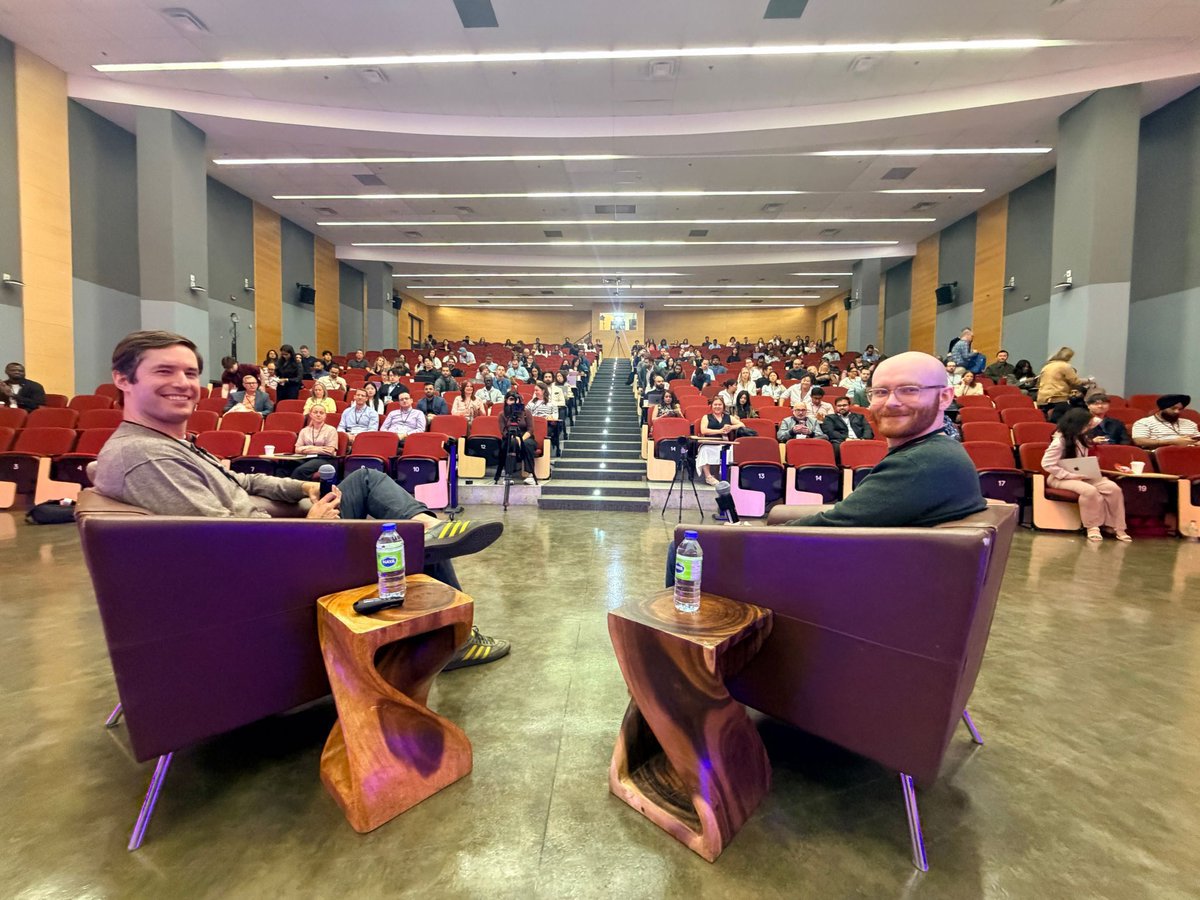
I talked about this at Toronto Product Con with Colin Matthews on stage, and it was a blast
I don't mean every PM needs to start a company at night, or become an engineer. A real side project just forces more of the product loop into your own head.
At work, even in strong PM roles, you usually own a slice of the loop.
With a side project, you can't really hide in the slice. You have to build, launch, get people to care, deal with feedback, support the thing, and then decide what to do next.
The annoying part is where the learning actually happens.
A prototype can make you feel smart. Real users make you realize how much was still fake.
They don't know what you meant, they don't onboard the way you expected, they hit permission issues in the one flow you forgot to test, your analytics are missing the event you actually need, and the support burden shows up way earlier than you thought.
That stuff is painful, but it builds a kind of product judgment that's hard to learn from only writing docs or coordinating across teams.
The three pieces I think matter most:
1/ Production judgment
Can this work when I'm not personally hand-holding the user?
Not "does the demo work?"
Can someone open it cold, understand it, use it, and recover when something goes wrong?
2/ Distribution judgment
Can I get the first 10 to 50 people to care?
Colin made this point well: building is getting cheaper, but attention is not. A useful side project starts with a believable path to users, not just a clever idea.
3/ Boundary judgment
What should I own myself, and where do design and engineering still matter deeply?
You still need great designers and engineers.
The side project just gives you enough reps to bring better questions, cleaner tradeoffs, and less hand-wavy product direction.
That's why I think real side projects are underrated for senior PMs and product leaders.
A personal app shows curiosity, which is already a good signal. A real project with users shows something different: agency, taste, technical fluency, distribution intuition, and the ability to carry something end to end.
So if you're trying to stay sharp as PM role evolves, I recommend go build something:
↳ small enough to ship
↳ real enough that other people can use it
↳ close enough to a real customer that you have to ask whether anyone would use it, value it, or pay for it
Huge shout-out to the Toronto Product Management Association for putting together such a thoughtful, high-signal conference.
This was one of my favorite product conversations in a while.
1
116
Jun 3
Stripe's product technical interview is 60 minutes with an engineer (not a PM). They'll ask you to whiteboard the architecture of a system you've personally worked on, then probe every component. Why this database? Why this API structure? What were the scaling challenges? etc.
Most PM candidates prep by studying system design courses and memorizing architecture patterns. All useful, but not where the interview is won or lost.
The candidates we spoke to who did well all did something simpler. They called their old engineering or tech lead. The person they worked with on the system they planned to discuss.
They had them walk through the entire architecture from scratch. Not a high-level chat. A real walkthrough where the engineer explained the rationale behind every decision.
Then they asked three things.
↳ "Why did we make this choice?" for each major component
↳ "What's missing from my diagram?"
↳ "What was the hardest trade-off?"
These are exactly the follow-up questions the Stripe interviewer will ask.
When you get to the actual interview, start with a blank canvas. Build it one component at a time. Client layer, APIs, backend services, data stores. Explain each connection and trade-off as you draw.
Don't show up with a pre-built 10-box diagram. The interviewer wants to follow your thinking as you build the system, not orient themselves to a finished artifact.
P.S. This is one slice from the Insider Loops Stripe guide. We captured the complete Stripe PM interview playbook at insiderloops(dot)com.
2
122
Jun 2
Someone asked Dr. Molly Maloof a very product-y question in our lastest Supra session.
Is the bigger race in consumer health aggregating all your data, or collecting new kinds of data? Labs, hormones, gut microbiome, CGMs, wearables, scans.
Her answer was neither. The missing layer is patient history.
That answer landed because Molly has a pretty unusual vantage point: she has worked as a doctor to high-performing founders and operators, advised dozens of health companies, and started her career in a hospital lab.
Molly said "the real money is in the qualitative information about a person's life." That line has been sitting with me because it changes how I think about a lot of AI products, not just health products.
She's seen the whole messy path from blood draw to lab processing to report, and how much can go wrong before a doctor sees the result. Samples get mishandled, tests vary by company, some results need to be repeated, and a scary marker can be real or it can be noise.
A lab result is dangerously easy to misread without the story around it.
Before you interpret the marker, you need to know things like:
↳ What is this person trying to optimize for?
↳ What changed recently?
↳ What have they lived through?
↳ Which lab produced this result, and how much do we trust it?
↳ Is this a one-off signal or something worth retesting?
↳ What would acting on this actually change?
The product instinct is often to ingest more.
More labs. More wearable data. More CRM data. More call transcripts. More Slack threads. More dashboards.
And I get it. The demo usually looks great because the AI touched all the sources. But the expert instinct is different. Before interpreting the data, a good expert asks what context would make the data mean something.
That's why Molly made me think differently about the "all your data in one place" pitch. The aggregation layer matters and the input layer matters, but the intake layer might be where the product starts to feel like an expert instead of a dashboard.
And this is what I found especially cool about Molly. She isn't anti-AI at all. She is probably the most AI-native doctor I've met. She uses ChatGPT, Claude, Gemini, OpenEvidence, Doximity, and other AI tools across different parts of her practice, and talks about AI making her a "super doctor."
But she still doesn't outsource judgment to the pile of data. The AI products I would trust most are the ones that collect the data, then know what still needs to be asked before interpreting it.
25
Jun 1
There's one moment in Anthropic's culture interview that catches even experienced PMs: the disagreement story drill.
When you tell a story about disagreeing with someone (especially a senior leader) and changing your mind, expect 4 to 6 follow-ups that dismantle it. I covered the broader culture round in a post last month. This one's about that drill, plus three other mechanics that catch people in the same round.
1/ The disagreement story gets 4 to 6 follow-ups
This is where they go deepest in the entire round. They'll probe with questions like:
↳ "Was this disagree-and-commit, or did you genuinely change your mind?"
↳ "If this hadn't been your CEO, would you have landed somewhere different?"
↳ "Is there someone you disagree with but still really respect?"
They're testing whether your update was evidence-driven or authority-driven. Most candidates pick a clean "I disagreed and we found a better way" story and watch it collapse around probe 4.
2/ "Why Anthropic" gets pressure-tested three levels deep
One-line answers don't survive. They push back with "OpenAI also does that" and "OpenAI is doing free models for democratizing access, so how is Anthropic different for you?" Then they loop back to your opening answer later in the same interview to test whether you've actually thought about it or were just reciting talking points.
3/ They want you to hold contradictions, not pick a side
Anthropic explicitly values what they call "hold light and shade": the ability to articulate specific risks AND specific benefits of AI at the same time, without collapsing into pure optimism or pure doomerism.
If you walk in with a clean position on safety, you're being tested on whether you can hold the tension instead of resolving it too neatly. The interviewer is watching whether you can sit inside the contradiction without flinching. Picking a clean side reads as ducking the question.
4/ The second person on the call isn't there to judge you
Sometimes a second person joins your culture interview with video off and barely speaks. Most candidates assume this is the "real" decision-maker silently scoring them.
It's calibration. Anthropic needs to certify bench interviewers across all functions, and the shadow is there to watch how the primary interviewer runs the round, not you. It doesn't go in your scorecard.
The bar feels uncomfortable on purpose. If you're going to interview there, prep this round as a live conversation rather than a polished performance.
P.S. We shipped the full Anthropic PM Interview Guide at insiderloops(dot)com last month. It includes the complete Culture interview prep, and more on their PM process.
11
May 29
One of the coolest Supra sessions we've had recently was with Dr. Molly Maloof.
Molly has spent 12 years working with Silicon Valley founders, execs, and investors on health, longevity, and performance. She also taught healthspan extension at Stanford and wrote The Spark Factor.
What I love about her approach is that she looks at high-performing people like systems under load, and health shows up in the quality of their judgment.
Most of us spend our days optimizing teams, roadmaps, strategy, and metrics. When it comes to our own bodies, we mostly wing it. That works until it doesn't.
A few ideas I keep coming back to from her session:
1/ Behavior before biomarkers
Going in, one of the questions I cared most about was what the exec in the worst shape is actually doing the week before they call her. I wanted the behavior before the biomarkers.
That ended up being the right frame, because a lot of health optimization gets pulled toward dashboards, scores, scans, supplements, and protocols. Molly kept bringing it back to what is actually happening in someone's life.
Travel. Sleep. Stress. Food. Movement. The support system around them. The boring stuff we all know matters and still ignore when work gets intense.
2/ Data only matters if it changes judgment or behavior
Molly is deeply data-driven, but she has sharp judgment about when a tool creates real signal and when it gives an ambitious person one more number to manage.
Product leaders do this constantly too. We add dashboards, metrics, tracking, weekly reviews, and sometimes confuse instrumentation with understanding.
Data is useful when it changes the decision, the behavior, or the diagnosis. Otherwise it's just another layer of noise.
3/ AI works best with real expertise behind it
Molly is probably the most AI-native doctor I've met.
She talked about using ChatGPT, Claude, Gemini, OpenEvidence, Doximity, and other AI tools across different parts of her practice.
What I liked is that the expertise was still very clearly hers. AI helps her widen the surface area of her thinking, pressure-test hypotheses, and become a more effective doctor.
Then she brings clinical judgment back to the answer. That feels like a good model for any expert using AI.
4/ Health is operating capacity
If you are running at half capacity and calling it normal, your work is going to feel harder than it needs to. Your judgment gets worse. Your patience gets thinner. Your ambition starts borrowing from your body.
I don't think enough ambitious people take that seriously until something breaks. That's what made the session feel different. It connected health directly to judgment, energy, and sustained ambition.
Thank you, Molly, for an epic session!
20
May 28
Searching for your next product leadership role but not sure where to look?
Every two weeks, I'll be posting a curated list of open Product Leadership Roles at leading companies to help people who are actively looking for jobs.
For context: I run Supra, a private community of high-caliber product leaders, so I have access to roles our community members are hiring for and jobs posted in our job-openings Slack channel. Here are the most interesting roles:
Prefer to get the the roles via email 📧? Subscribe to this bi-weekly job listing here: buff.ly/PxHxZsb .
𝐇𝐞𝐚𝐝 / 𝐕𝐏 𝐨𝐟 𝐏𝐫𝐨𝐝𝐮𝐜𝐭 𝐫𝐨𝐥𝐞𝐬
- Mastercard is hiring a Vice President, Global Platforms – Mastercard Open Finance - buff.ly/By6z9CQ
- Noonlight is hiring a Head of Product - buff.ly/vTXX1jq
- Drata is hiring a Head of Product, Assurance - buff.ly/wm95bzz
- Grubhub is hiring a Sr Vice President, Product - buff.ly/AuA0bL5
- Burq is hiring a Head of Product - buff.ly/nIwSWBU.
- Blytzpay is hiring a Chief Product Officer - buff.ly/Nt4z7Ei
- Block is hiring a Head of Product, Square Trust & Safety - buff.ly/nIP671E
- Meta is hiring a VP, Product Threads - buff.ly/LESjfCR
𝐃𝐢𝐫𝐞𝐜𝐭𝐨𝐫/ 𝐒𝐫 𝐃𝐢𝐫𝐞𝐜𝐭𝐨𝐫 𝐨𝐟 𝐏𝐫𝐨𝐝𝐮𝐜𝐭
- Resident is hiring a Director of Product - buff.ly/C2r1RsS
- Google is hiring a Senior Director, Product Management, YouTube Fan Funding - buff.ly/1ZUryvt
- Xometry is hiring a Senior Director & Product Lead - buff.ly/C1Nih8R
- Figma is hiring a Director, Product - Enterprise - buff.ly/GMvtE0M
- NVIDIA is hiring a Director, Product Management - Agent Tooling - buff.ly/UvPi4Fy
- Adobe is hiring a Director, Product Management - Agentic Product - buff.ly/jot9E3v
𝐆𝐫𝐨𝐮𝐩 𝐏𝐌 / 𝐏𝐫𝐨𝐝𝐮𝐜𝐭 𝐋𝐞𝐚𝐝
- MetaLab is hiring a AI Product Lead - buff.ly/0Z5yQ6i
- Google is hiring a Group Product Manager, Search AI Security - buff.ly/1qT3xQj
- Etsy is hiring a Group Product Manager, Trust Experience - buff.ly/Z1HPhpR
- Uber is hiring a Group Product Manager, Grocery & Retail Selection - buff.ly/jDwPvxg
- Pinterest is hiring a Group Product Manager I, Connections - buff.ly/PUIgTzu
- hims & hers is hiring a Lead Product Manager, Growth - buff.ly/El64fyO
𝐏𝐫𝐢𝐧𝐜𝐢𝐩𝐚𝐥 / 𝐋𝐞𝐚𝐝 𝐏𝐌
- Galileo.ai is hiring a Lead Product Manager, Clinical Experience - buff.ly/epfta0O
- Stacker is hiring a Lead Product Manager, GEO & Earned Media Reporting - buff.ly/FpG2zl4
- NewtonX is hiring a Staff Product Manager - buff.ly/boMl4Gq
- Klaviyo is hiring a Lead Product Manager, AI - buff.ly/6TmZsAG
- Uber is hiring a Lead Product Manager - In-App Recording (Safety) - buff.ly/ywyxCuN
- NVIDIA is hiring a Principal Technical Product Manager - Autonomous Vehicles - buff.ly/dOHHTgc
𝐓𝐨 𝐬𝐞𝐞 𝐦𝐨𝐫𝐞 𝐫𝐨𝐥𝐞𝐬, 𝐜𝐡𝐞𝐜𝐤 𝐨𝐮𝐭 𝐨𝐮𝐫 𝐒𝐮𝐩𝐫𝐚 𝐣𝐨𝐛𝐬 portal 𝐰𝐢𝐭𝐡 80 𝐨𝐩𝐞𝐧 𝐫𝐨𝐥𝐞𝐬
> buff.ly/rXpxJWx
If you know someone looking for a job or hiring, tag them in the comments or repost this post to help spread the word.
Follow me (Marc Baselga) to receive these job openings.
2
120
May 27
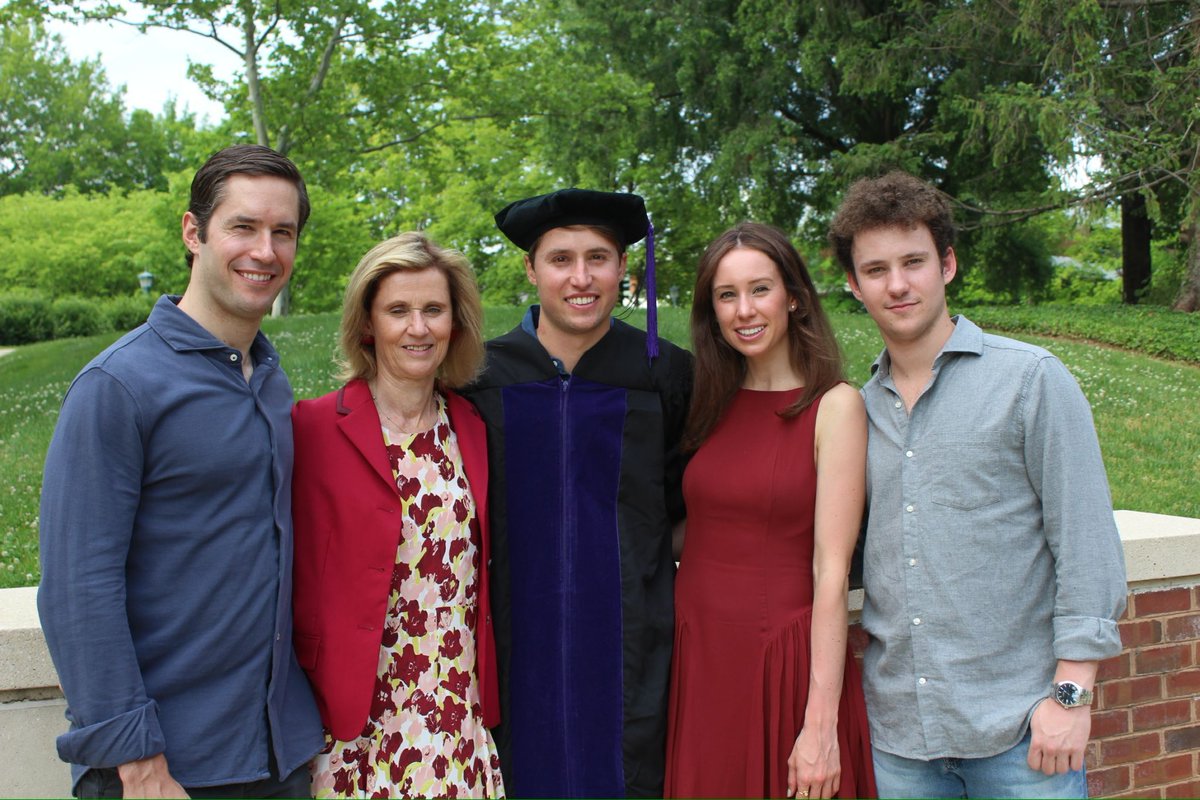
The last two weekends have been special. Two of my siblings graduated: my brother Alex from UVA Law, and my brother Pepe with a degree in Computer Science from Cornell.
I'm super proud of both of them. But after this weekend, what I keep coming back to is what the last five years have looked like for our family.
Five years ago, my dad unexpectedly passed away.
He was the fearless leader of our family. The one who set the tone, made things feel possible, and had this insane ability to push us while making us believe in ourselves.
I think a lot of families could have crumbled in that situation. Losing someone like that changes the center of gravity of a family. I'm not going to pretend it was easy. There were a lot of moments where everyone was figuring out life on their own while still trying to be there for everyone else.
But what I've watched in the years since has been pretty amazing. Everyone took the best of my dad, and what he taught us, and carried it forward in their own way.
Alex finished law school and is getting ready for the bar before starting at a great firm in New York.
Pepe just graduated from Cornell CS and is heading to Google in Mountain View to work on AI.
My sister Clara is a rock star. After Harvard Med School, she's now at MGH in a residency program she worked insanely hard to earn.
And my mom (Silvia) has been the backbone. She's been leading the foundation my dad started (Fundación FERO), transforming the team, and taking it to new heights. But beyond that, she's been the glue. She makes sure we see each other, check on each other, stay close, and celebrate each other's wins as our own.
That's maybe the part I love most about the last two weekends. I got to watch the family celebrate in a way that felt bigger than any one person's milestone. When you have a dad like ours, someone who was such a force of nature, it would have been easy to assume that was the model.
But I think one of the coolest things about our family is that each of us has found our own passion and path. Law. Computer Science and AI. Medicine. Foundation work. Community building. I think that goes back to our parents. They gave us high standards, but also the freedom and confidence to choose honestly.
Strength doesn't have to look the same for everyone. Sometimes it looks like finishing law school. Sometimes it looks like building a career in AI. Sometimes it looks like becoming a doctor. Sometimes it looks like carrying forward a foundation. Sometimes it looks like keeping a family close after an enormous loss.
So today I'm feeling a little extra proud of my family. Full family brag over.
2
57

Ben Erez and his co-founder Marc are building Insider Loops. They haven't even read Incorruptible yet. Just hearing about the argument on Lenny's podcast was enough.
Now they're writing the mission directly into their operating agreement, with both partners required to unanimously agree before it can change. They also launched a scholarship for laid-off PMs as their first proof of life.
From Ben's post: "The best time to make a company incorruptible is when there's not much to corrupt. So we're starting now."
The book is officially out today. The blueprint is already in use.
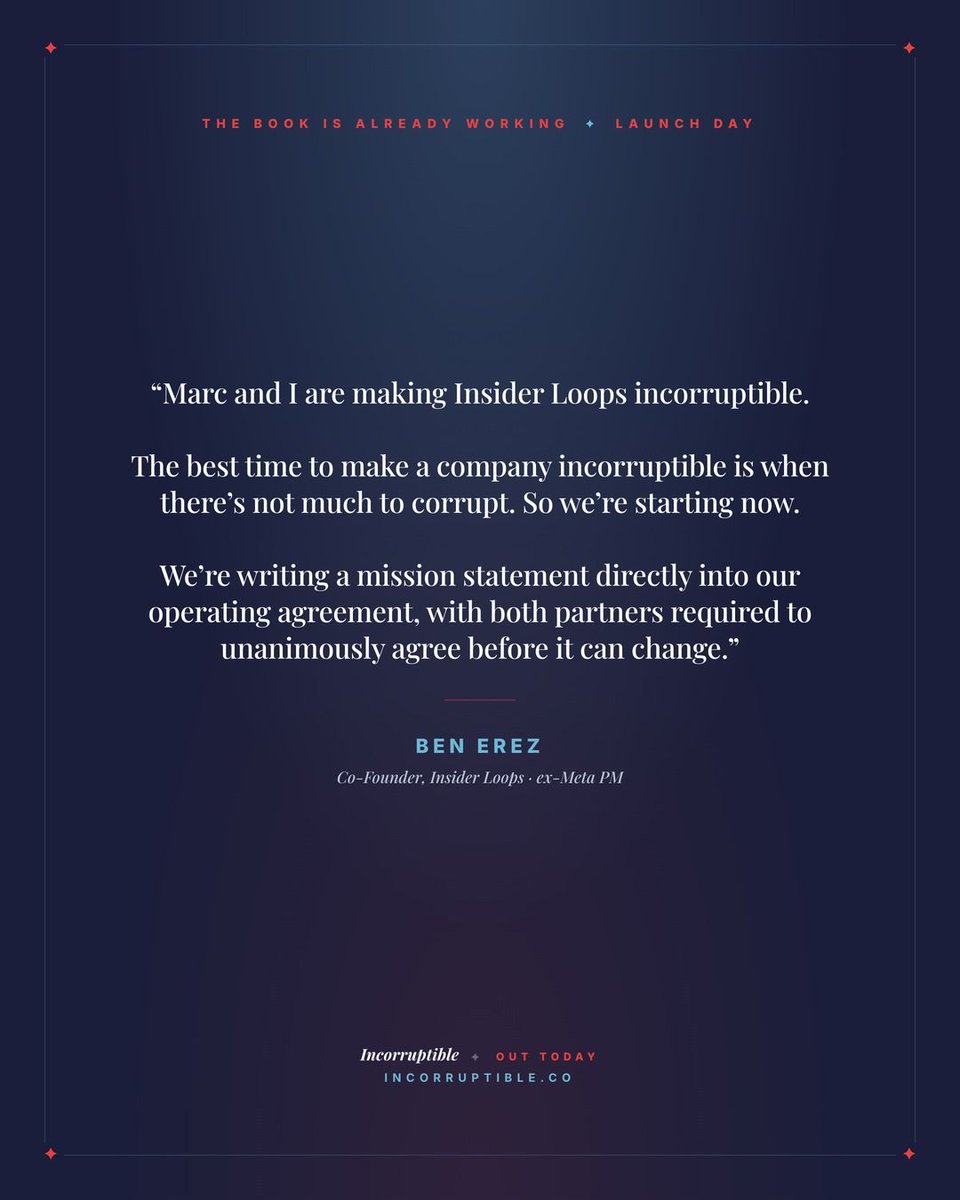
ALT Quote from Ben Erez, Co-Founder of Insider Loops: Marc and I are making Insider Loops incorruptible. The best time to make a company incorruptible is when there's not much to corrupt. So we're starting now.
2
4
17
1,541
May 26
The worst time to practice work-life integration is 5:45 to 7:15pm.
I don't have kids myself yet. But this is one of the most common struggles I hear from working parents in Supra.
Most of the day, the integration model works. It lets you work remotely, flex your schedule, and move between home and work without pretending they're separate lives.
But that block in the evening is the exception.
You're with your kid, but you're sneaking peeks at Slack. Tomorrow's deadline keeps surfacing in your head during bath time. And you're wondering whether your team thinks you've checked out.
You feel like a bad parent and a bad colleague at the same time.
In a recent Supra session, we hosted Daisy Wademan Dowling, author of WorkParent and former global head of talent development at Blackstone. She now coaches senior leaders and has spent years studying what actually works for working parents.
Her argument is that you should treat those evening hours differently. Instead of trying to overlap work and family, draw a clean line between them. Make the window explicit, like 5:45 to 7:15, and during that block, do nothing else.
1/ Set a hard boundary block
Pick a specific window. During that block, no peeks at messages. Your brain will still drift to tomorrow's deadline or whether your team thinks you've checked out, and that's fine. Just don't act on it.
Then log back in fully after the kids are down. The work still gets done. The evenings actually get attended to.
2/ Use a ritual to switch modes
One of Daisy's clients changes into "play clothes" the moment she gets home. It's a signal to her own brain (and to her kids) that she's in mom mode.
If you work from home, the equivalent is closing the laptop and taking 30 seconds before walking out of the room. The pivot needs a physical cue, or your head stays at work.
3/ Keep the block clean
Kids absorb the vibe. They feel half-presence even when they can't name it.
And the cleaner the line, the easier it is to come back to work fully focused once they're asleep.
Work-life integration works best when you choose where it applies. And for a lot of working parents, that 5:45 to 7:15 window needs a line.
11
May 25
I think people trivialize fun at work way too much.
I know that fun sounds frivolous. Like the thing you talk about after the serious people are done talking about customers, revenue, growth, all that.
Ben Erez and I recently talked about how much fun we've been having building Insider Loops.
What's interesting to me is that the fun part doesn't feel like some random side benefit. Under the right conditions, I think it's signal.
Not always. Fun in isolation from the market is just a hobby.
But when the work is hard, customers are responding, and you still wake up wanting to keep playing the game, I think that is worth paying attention to.
The way I've been thinking about it is pretty simple:
1/ Fun tells you whether the work fits your energy
I love product. I love talking to customers, designing the experience, making the thing better, and feeling like a weird customer email can turn into a better product by the end of the week.
That doesn't mean every task is fun. There is still plenty of unsexy stuff. Support emails, operational cleanup, authentication decisions that need to be good enough for the next few months, not perfect forever.
But the core work gives me energy instead of slowly making me resent the thing we're building. And that feels like a real signal.
2/ Fun tells you whether the feedback loop is alive
Insider Loops would not be fun if nobody cared.
The fun comes from putting something into the market, seeing people buy it, hearing what confused them, reading between the lines of the feedback, and then making the product better.
I trust the fun when the market keeps giving you something useful to react to. Not when you're just enjoying your own ideas.
3/ Fun shows you're working with the right people
This is probably the part I appreciate most about building with Ben.
We move fast, but the air stays clear. We can say when something feels off. We can change how we work without making it a whole political process.
There is no drama tax. That makes the work way more fun, but it also makes the business better. Decisions move faster. Feedback gets metabolized faster. Bad ideas die without anyone getting precious.
I don't think fun should be the only thing you optimize for.
But if the business is working and the work still gives you energy, I would take that feeling very seriously. Every day Ben and I get to play this game feels like a win. And for a business, that compounds.
2
24