
Truth Seeker & sushi lover
Joined July 2023
- Tweets 105,758
- Following 2,690
- Followers 848
- Likes 94,585
168 Photos and videos

SpamMusubi retweeted

18h
For those still persisting in the desperate lie that Brianna Wu is a reasonable moderate who isn't seeking to chemically castrate and dismember confused children

63
174
1,440
32,603
SpamMusubi retweeted

Jun 13
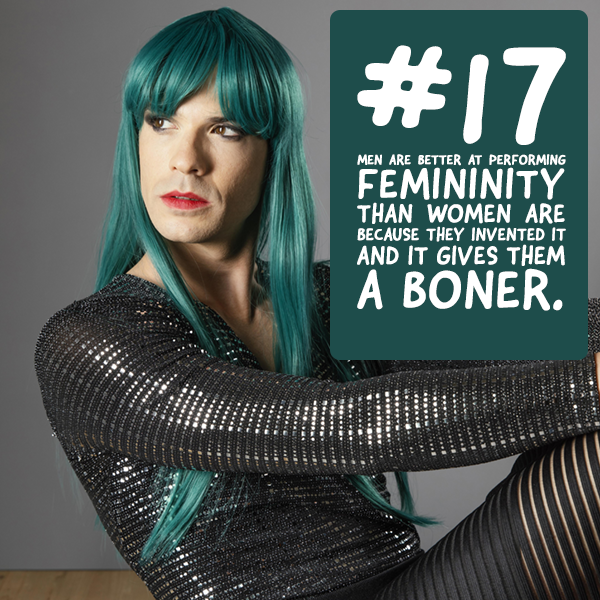
Rule of misogyny #17.
New patriarchy, same as the old patriarchy.
8
56
961
12,215
SpamMusubi retweeted

Jun 13
[1/7] 🚨 Eric Holder wrote the memo that let every bank in the 2008 controlled demolition skate prosecution — then take a federal bailout. Now he's pushing race-based congressional districts for 13% of the population in 2026. Why is he still on the field?
6
27
72
1,197
SpamMusubi retweeted

Jun 13
🇺🇸 During this year — the year of America’s 250th birthday — there seems to be a perpetual stream of "America sucks" screeching from the mainstream media.
Meaning: the left.
I'm here to say: Be proud to be American.

32
327
2,286
19,907
SpamMusubi retweeted

🚨🚨NO JUSTICE: Alameda County District Attorney's Office refuses to prosecute for assault and robbery.
Ms. Carney reasoned:
“It's clear from this incident that he (Mr. Grady) believed his wife was being harassed so he stepped in to intervene.
We don't believe that there's sufficient evidence here to prove a crime, beyond a reasonable doubt, to a jury of 12 people.”
Insane.
* these are her words verbatim, in my voice.
15 Sep 2025

Most insane and terrifying two minutes of my life.
Police reports have been made.
Both race organizers need to be permanently banned from @usacycling for physically assaulting me.
Men do not belong in women’s cycling.
@AAGDhillon
@Riley_Gaines_
@i_heart__bikes
9
35
172
9,550
SpamMusubi retweeted

Jun 13
I've never watched back my debate with Helen Webberley because I found it so enraging and upsetting. I think she's worse than a liar: to me she seems like someone who has lost all sense of respect for truth or reality. But watching this was quite fun.
Jun 12

This debate is so satisfying.
Helen Webberly is a “gender affirming doctor” that runs a clinic called gender GP where she grifts off mentally ill children, by allowing them to bypass their parents and receive hormone blockers within just a few months.
Her practise has been banned in multiple jurisdictions and she has recently moved operations to the United States 🇺🇸
She gets absolutely tied in a pretzel from the jump here.
Check out my full breakdown below 👇
90
310
2,249
65,823
SpamMusubi retweeted

Giggle has applied to have Giggle v Tickle heard in the High Court.
“We have filed for special leave in the High Court… Because the federal court is saying men can be women in law & making women only spaces effectively unisex, we are going to the High Court to challenge that.”
138
1,328
8,768
106,726
SpamMusubi retweeted

Jun 13
Thanks for joining us today for this special report.
Follow us (@ZeeeMedia and @VigilantFox) for stories that matter—stories the media doesn’t want you to see.
We’ll be back with another show on Monday. See you then.
5
22
86
15,902
SpamMusubi retweeted
Jun 13
Smart cities rely on enormous networks of IoT sensors, cameras, traffic systems, smart grids, autonomous vehicles, and AI-driven services.
These systems generate vast amounts of data that require near-instant processing.
Processing information locally at the edge rather than sending it to distant facilities enables low-latency responses. While this can be used for public safety and energy management, it could also facilitate real-time surveillance of people’s movements, transactions, and communications.
She says the triangulation pattern creates a distributed mesh network. Multiple edge data centers surrounding a city provide redundancy, geographic coverage, fault tolerance, and minimal network delays.
Smart cities generate enormous volumes of data and that centralized hyperscale facilities alone may not be sufficient, which could explain the clusters surrounding smart city locations.
Maria says she has good reason to believe that hyperscale data centers are being deliberately placed in rural areas such as the Texas Panhandle, Odessa, and Wichita Falls to draw on aquifers, power grids, and land resources.
She believes the result is a transfer of resources away from rural populations and toward AI systems and urban technology infrastructure.
Rural communities are left with higher bills, noise, and depleted water resources, while cities receive the benefits of smart infrastructure.
Maria further argues that data center triangulation around smart cities serves not only low-latency computing needs but also creates the framework for extensive digital monitoring and control.
In Maria’s view, distant hyperscale facilities handle large-scale AI training and monitoring, while edge nodes positioned around cities could eventually support real-time citizen tracking, social credit scoring, and behavior modification.
Smart city infrastructure is designed to lock residents into tightly managed urban environments featuring digital IDs, programmable digital currencies, monitoring systems, and resource rationing.
Rural areas, she argues, are being weakened in ways that make those controlled environments increasingly attractive or necessary.
Maria also contends that hyperscale data centers are part of a broader centralized AI infrastructure serving global elites and transhumanist goals. She argues that rural power and water resources are being siphoned away to “train the beast,” while smart city systems eventually become the enforcement mechanism.
Flooding rural areas with data centers increases costs, harms agriculture and tourism, and contributes to what she describes as engineered rural depopulation. This simultaneously clears land for future projects and weakens resistance from rural populations.
Placing facilities over stressed aquifers weaponizes water scarcity by increasing dependence on centralized smart grid and smart water systems.
Ultimately, Maria believes the long-term objective is to make everything outside smart cities increasingly difficult to inhabit.

6
70
133
6,181
SpamMusubi retweeted
Jun 13
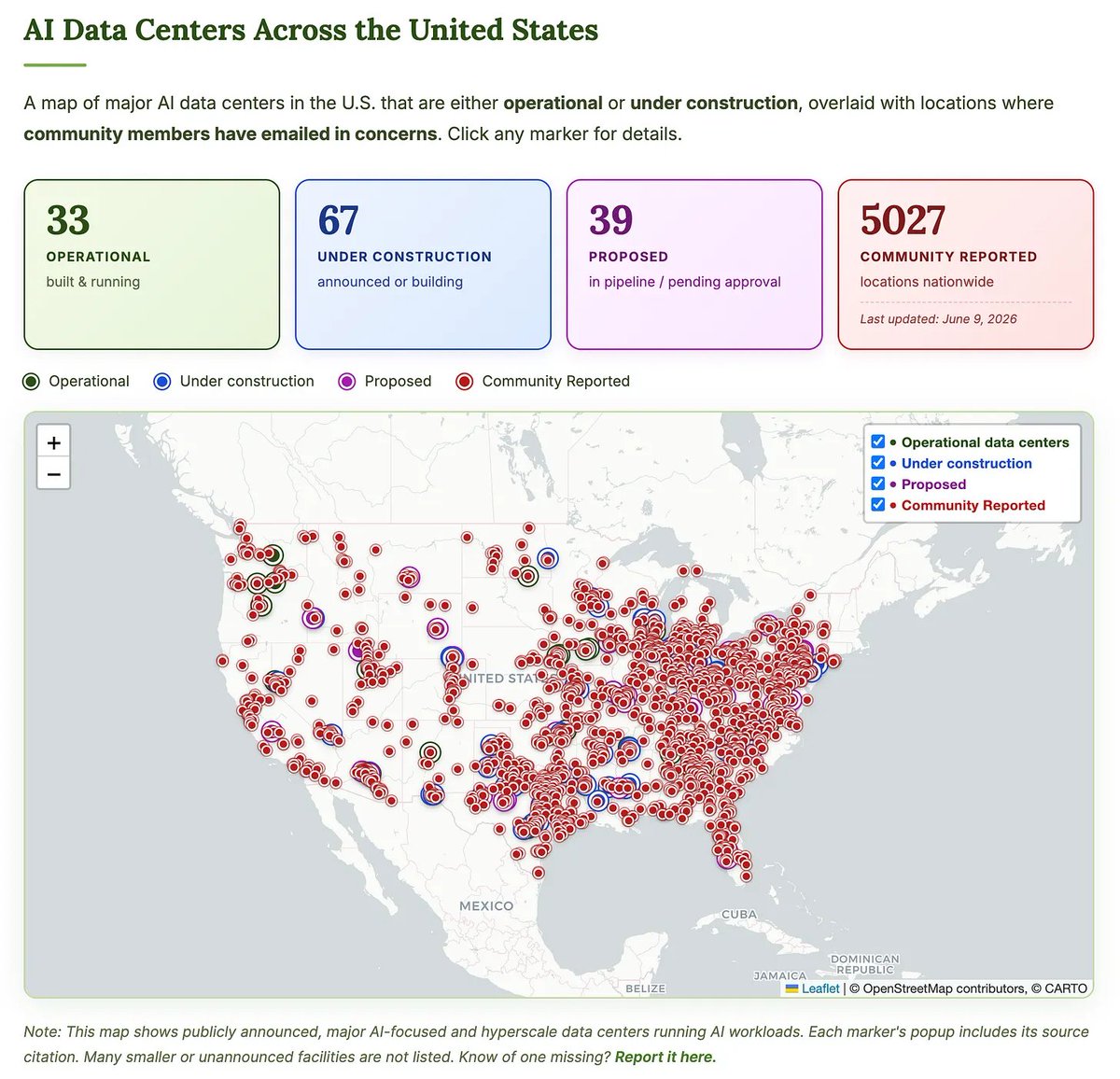
The bigger issue is that many projects are hidden behind NDAs, forcing communities to rely on reports of suspected data centers. There are now more than 5,000 community reports across the country.
Here’s the still image for anyone who wants to take a closer look.
11
153
322
10,518
SpamMusubi retweeted
Jun 13
We took Erin Brockovich's map of every data center in America. Then we laid the nation's aquifers on top of it.
We noticed they're not building data centers where the land is cheap. They're building them where the water is.
Farmers near these facilities say their livestock have stopped falling pregnant. Residents say the humming never stops.
And the projects arrive under NDAs, so most towns don't know until the ground is already broken.
The question isn’t where they’re building anymore. It’s why they’re building where they’re building. Tonight, we think we can answer that question.
We’ve been covering the data center issue in great detail on this broadcast, and for good reason. It’s a serious problem in America and worldwide, and it’s one that is uniting people from all sides of the political aisle because, guess what, whether you are a conservative or a liberal, you have human rights that enable you to have access to basic survival needs like water, which was given to us by God, not by the state or Big Tech, by the way.
Erin Brockovich joined the data center fight recently. She launched a site including a map that shows data centers either completed, under construction, planned, or community reported, likely due to all those pesky NDAs in place stopping us from knowing they’re coming to our area. But the public isn’t stupid.
So Maria thought she’d do something a little bit different. She created a series of maps using Erin Brockovich’s data center data, then superimposed aquifer maps onto those maps, then superimposed smart city locations onto those maps. What Maria found was pretty mind-blowing and, she says, lends credence to her theory that those in charge are purposely making rural areas unlivable for the purpose of pushing people into smart cities, where they will be under constant surveillance and on a short leash.
619
11,306
20,383
540,477
SpamMusubi retweeted
Jun 13
Together, we will win.
18
383
2,682
17,951
SpamMusubi retweeted
🚨🚨NO JUSTICE: Alameda County District Attorney's Office refuses to prosecute for assault and robbery.
I just heard from Sharon Carney, the Deputy DA that the DA will not be arresting the man who attacked me and stole my phone and signs at a bike race in Livermore last September.
Ms. Carney reasoned:
“It's clear from this incident that he (Mr. Grady) believed his wife was being harassed so he stepped in to intervene.
We don't believe that there's sufficient evidence here to prove a crime, beyond a reasonable doubt, to a jury of 12 people.”
Insane.
15 Sep 2025
Most insane and terrifying two minutes of my life.
Police reports have been made.
Both race organizers need to be permanently banned from @usacycling for physically assaulting me.
Men do not belong in women’s cycling.
@AAGDhillon
@Riley_Gaines_
@i_heart__bikes
58
241
1,037
34,512
SpamMusubi retweeted

Pride is a deviant s*xual k*nk fest which permits them to expose their f*tishes to children and we want no part of it!
PRIDE IS NOT FOR KIDS!

113
432
2,312
18,007

RT @ApostateAri: Performative feminism has not shown up through all of this!!! children are being trafficked in Seattle and Katie Wilson is…
43
SpamMusubi retweeted

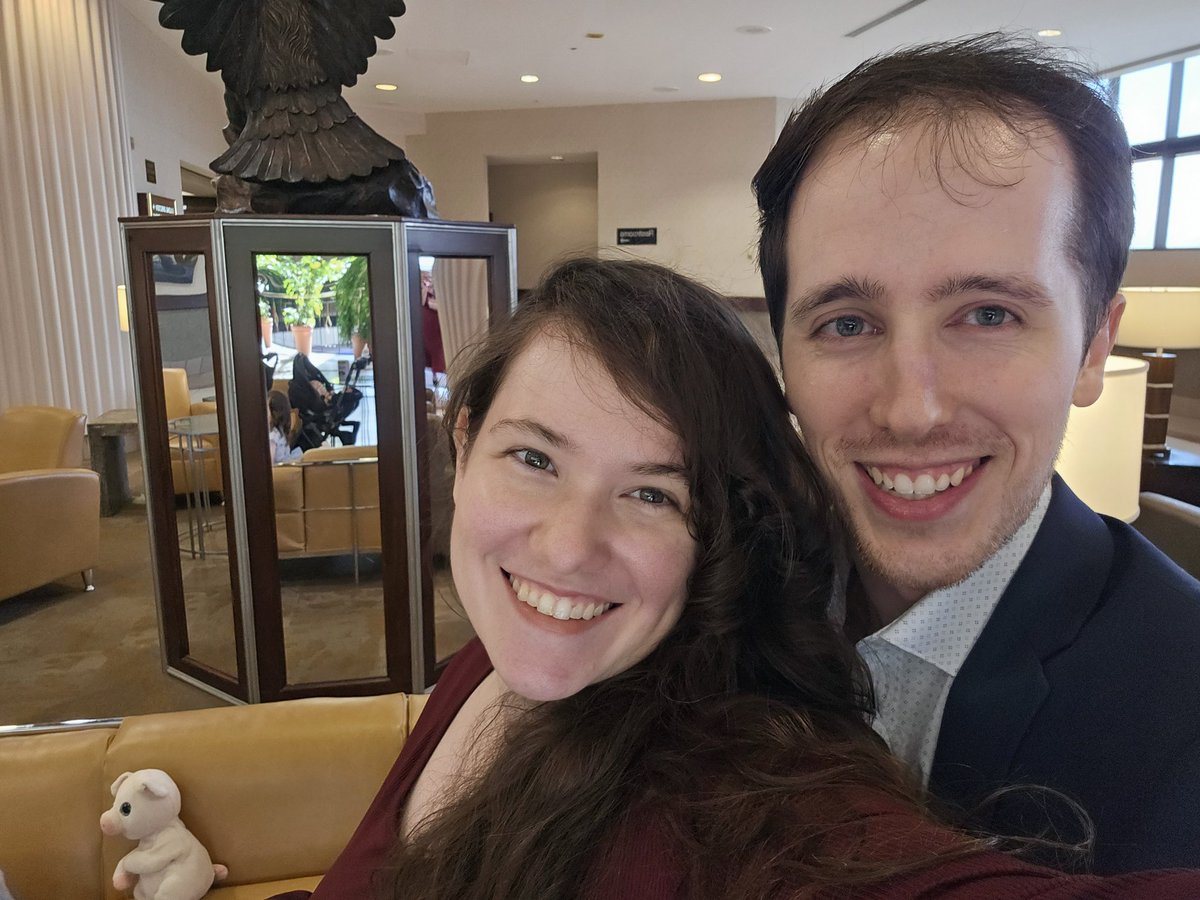
On our way back from the RNC! Made lots of connections and educated some people on DSDs and gender ideology
These are so challenging with babies, but we did it! 😅💕
7
7
104
2,205
RT @Jonnywsbell: Northern Ireland First Minister Michelle O’Neill (Sinn Féin) was asked: “Can a woman have a penis?”
Listen to the sheer d…
347
SpamMusubi retweeted

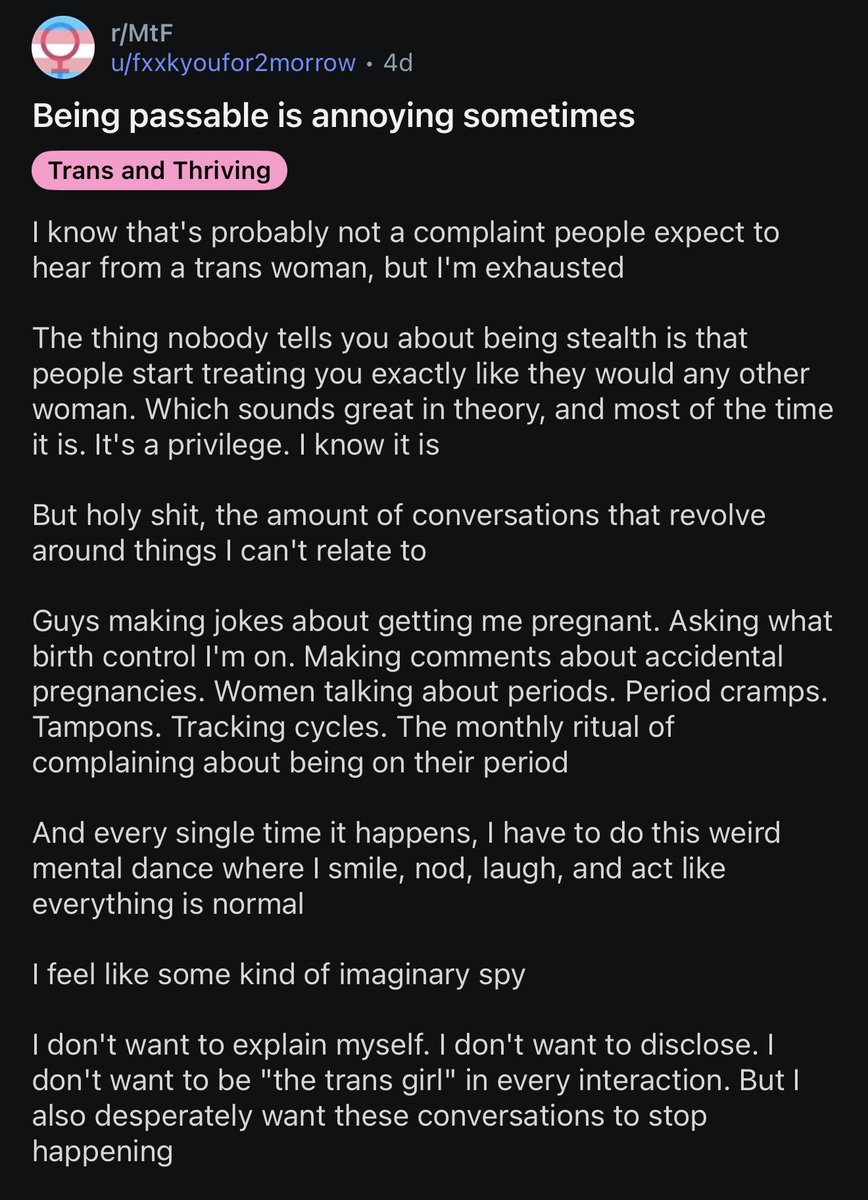
Man who says he wants to be treated like a woman is annoyed when it happens because people assume he’s female and it reminds him that no, he actually isn’t.

259
70
952
37,702
RT @ApostateAri: Prostitution is not Work
Performative feminism is a stain
Mayor Katie Wilson should step down
27
SpamMusubi retweeted

Jun 13
Leftists preach tolerance but are becoming increasingly hostile towards those who disagree with them.
You're mistaken if you think this is hypocrisy.
It is a strategy called "Repressive Tolerance."
14
201
539
7,210