
X1 Wealth. PDF Tools, #5 claude desktop extension now Open Document Alliance. useminutes.dev. pharmacy technology. prev cofounded wealth factory
Joined October 2008
- Tweets 1,141
- Following 5,263
- Followers 1,279
- Likes 10,513
51 Photos and videos



Pinned Tweet

Mar 20
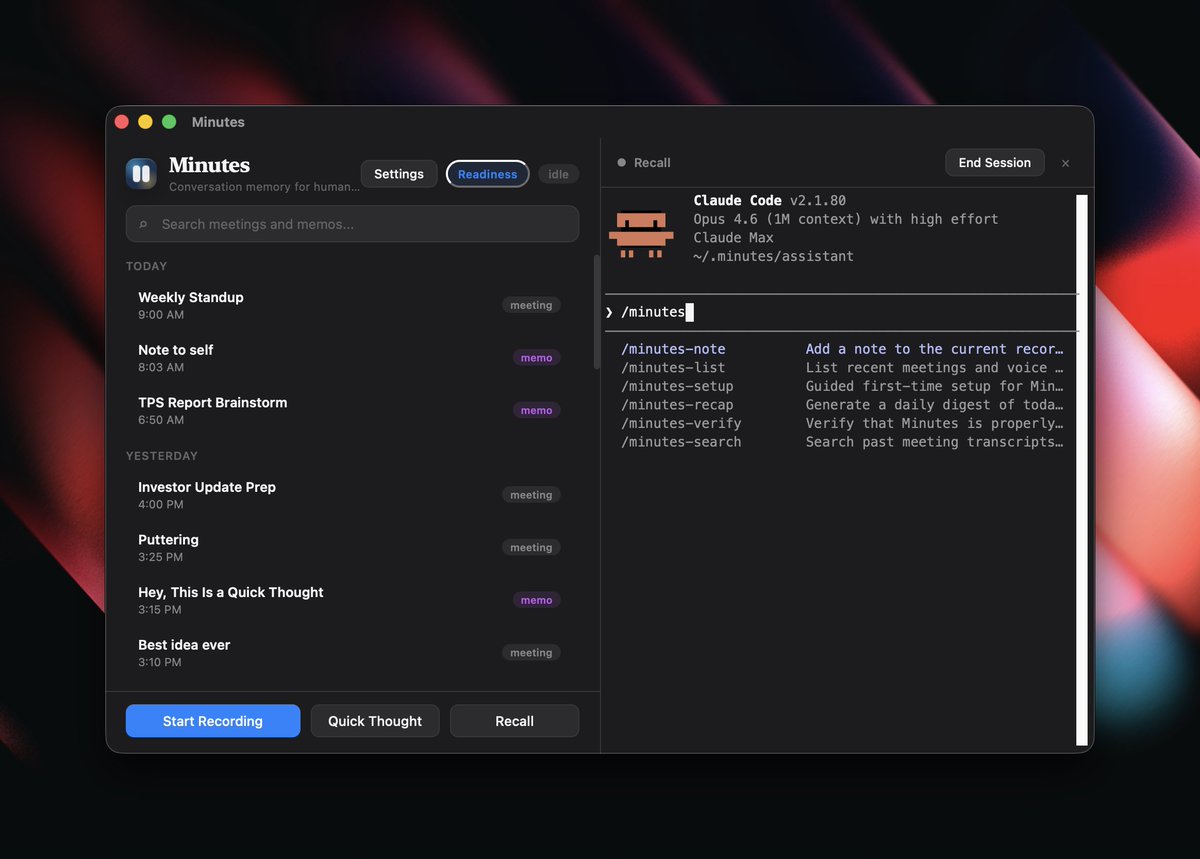
Now paying Granola $18/mo to upload my meeting audio to their servers. So I built my own thing. It's 7 MB. Everything runs locally.
Works with @tobi's QMD for super fast search, PARA method second brain setup for organized people, projects, entities, @obisidan, CLI, claude code, codex, Claude Desktop.
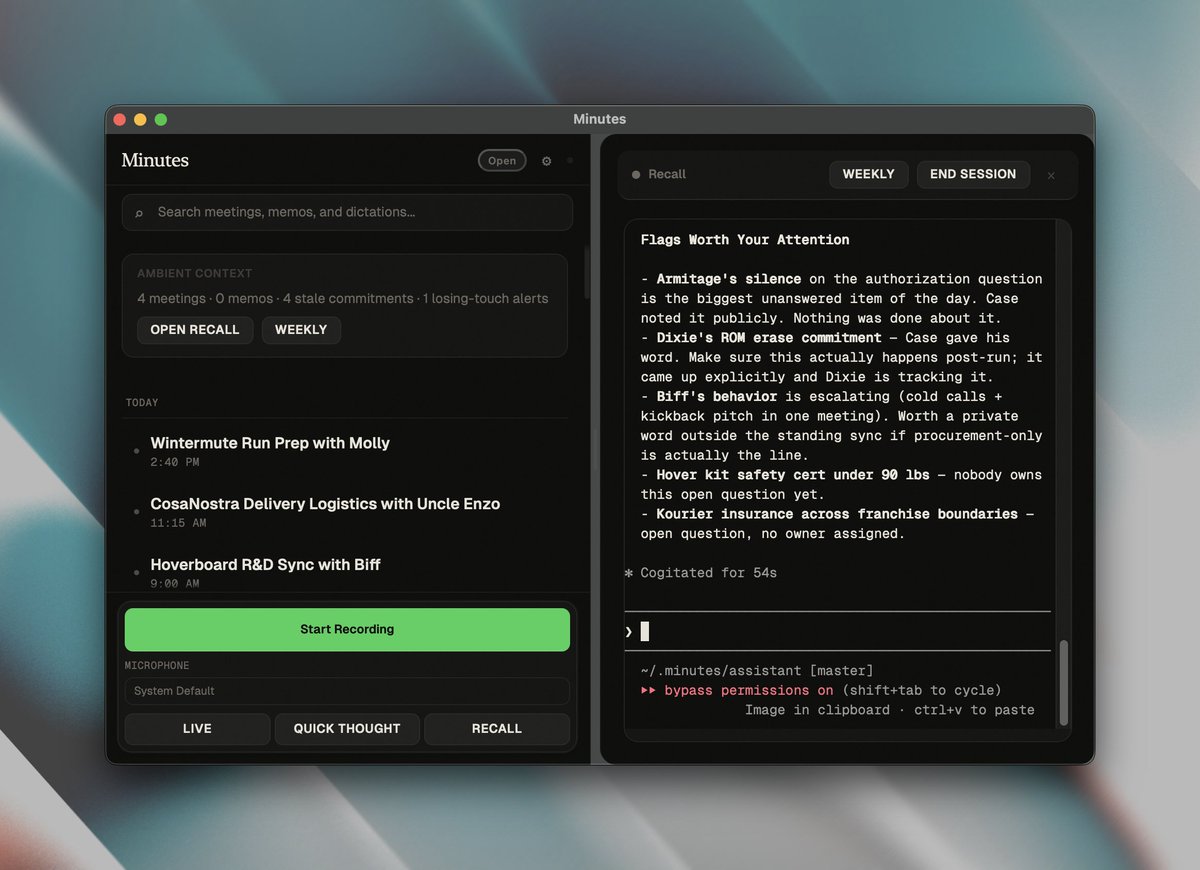
Before a call with Biff it pulls your last 12 conversations, shows you pricing came up 5 times in 2 weeks, and reminds you that you owe Biff a doc from Friday. After the call it asks if you got what you came for.
You just ask "what did Biff say about pricing last week" and it pulls from your transcripts. No API key needed, use your existing subs.
The meeting prep feature came from messing around with @garrytan's gstack skills. His /office-hours pattern forces you to be specific instead of accepting vague answers. I stole that idea and applied it to meeting prep and post-meeting debrief.
It's called Minutes. Rust, whisper.cpp, Tauri. MIT licensed. First real release on github.
31
22
497
75,037
May 15
turns out if your startup is chatgpt for personal finance, it's pretty vulnerable to chatgpt for personal finance. go deep, not wide, there's a ton of opportunity in this space if you solve for bigger problems than pretty dashboards and asking questions over your data.
May 15

A preview for Pro users: a new personal finance experience in ChatGPT.
Pro users in the U.S. can securely connect financial accounts, see where their money is going, and ask questions based on the information they choose to connect.
Your full financial picture, now in ChatGPT.
1
221
Apr 11
Built this for conversations.
minutes records meetings, calls, voice memos. Transcribes locally with whisper.cpp. Then compiles a knowledge base from them: person profiles across months of conversations, decision history, commitment tracking, cross-meeting intelligence.
26 MCP tools let any AI agent (claude code, codex, open source offline llm, etc) query the compiled layer. The raw markdown is yours.
Local-first open source, MIT. About to cross 1,000 stars.
Apr 2

LLM Knowledge Bases
Something I'm finding very useful recently: using LLMs to build personal knowledge bases for various topics of research interest. In this way, a large fraction of my recent token throughput is going less into manipulating code, and more into manipulating knowledge (stored as markdown and images). The latest LLMs are quite good at it. So:
Data ingest:
I index source documents (articles, papers, repos, datasets, images, etc.) into a raw/ directory, then I use an LLM to incrementally "compile" a wiki, which is just a collection of .md files in a directory structure. The wiki includes summaries of all the data in raw/, backlinks, and then it categorizes data into concepts, writes articles for them, and links them all. To convert web articles into .md files I like to use the Obsidian Web Clipper extension, and then I also use a hotkey to download all the related images to local so that my LLM can easily reference them.
IDE:
I use Obsidian as the IDE "frontend" where I can view the raw data, the the compiled wiki, and the derived visualizations. Important to note that the LLM writes and maintains all of the data of the wiki, I rarely touch it directly. I've played with a few Obsidian plugins to render and view data in other ways (e.g. Marp for slides).
Q&A:
Where things get interesting is that once your wiki is big enough (e.g. mine on some recent research is ~100 articles and ~400K words), you can ask your LLM agent all kinds of complex questions against the wiki, and it will go off, research the answers, etc. I thought I had to reach for fancy RAG, but the LLM has been pretty good about auto-maintaining index files and brief summaries of all the documents and it reads all the important related data fairly easily at this ~small scale.
Output:
Instead of getting answers in text/terminal, I like to have it render markdown files for me, or slide shows (Marp format), or matplotlib images, all of which I then view again in Obsidian. You can imagine many other visual output formats depending on the query. Often, I end up "filing" the outputs back into the wiki to enhance it for further queries. So my own explorations and queries always "add up" in the knowledge base.
Linting:
I've run some LLM "health checks" over the wiki to e.g. find inconsistent data, impute missing data (with web searchers), find interesting connections for new article candidates, etc., to incrementally clean up the wiki and enhance its overall data integrity. The LLMs are quite good at suggesting further questions to ask and look into.
Extra tools:
I find myself developing additional tools to process the data, e.g. I vibe coded a small and naive search engine over the wiki, which I both use directly (in a web ui), but more often I want to hand it off to an LLM via CLI as a tool for larger queries.
Further explorations:
As the repo grows, the natural desire is to also think about synthetic data generation finetuning to have your LLM "know" the data in its weights instead of just context windows.
TLDR: raw data from a given number of sources is collected, then compiled by an LLM into a .md wiki, then operated on by various CLIs by the LLM to do Q&A and to incrementally enhance the wiki, and all of it viewable in Obsidian. You rarely ever write or edit the wiki manually, it's the domain of the LLM. I think there is room here for an incredible new product instead of a hacky collection of scripts.
3
7
656

Apr 11
v0.11 just shipped:
⌨️ Command palette (⌘⇧K from anywhere on macOS)
⚡ Whisper finally uses your GPU
🎤 Native Meet calls get your name right
🎨 Dark theme overhaul
🔊 New acoustic cues (goodbye compiler beep)
9 contributors so far on this little fast moving project with some killer people and possible a couple of agents by the looks of it). And ty @cathrynlavery for the redesign!
brew install silverstein/tap/minutes
github.com/silverstein/minut…
1
9
4,405
Mar 25
since this tweet, been mulling over whether any tools connect what you say in meetings to who you say it to...
mapped out the landscape: Gong and Otter have your conversations. Affinity and Clay track your relationships. Nobody does both. That quadrant is just... empty?
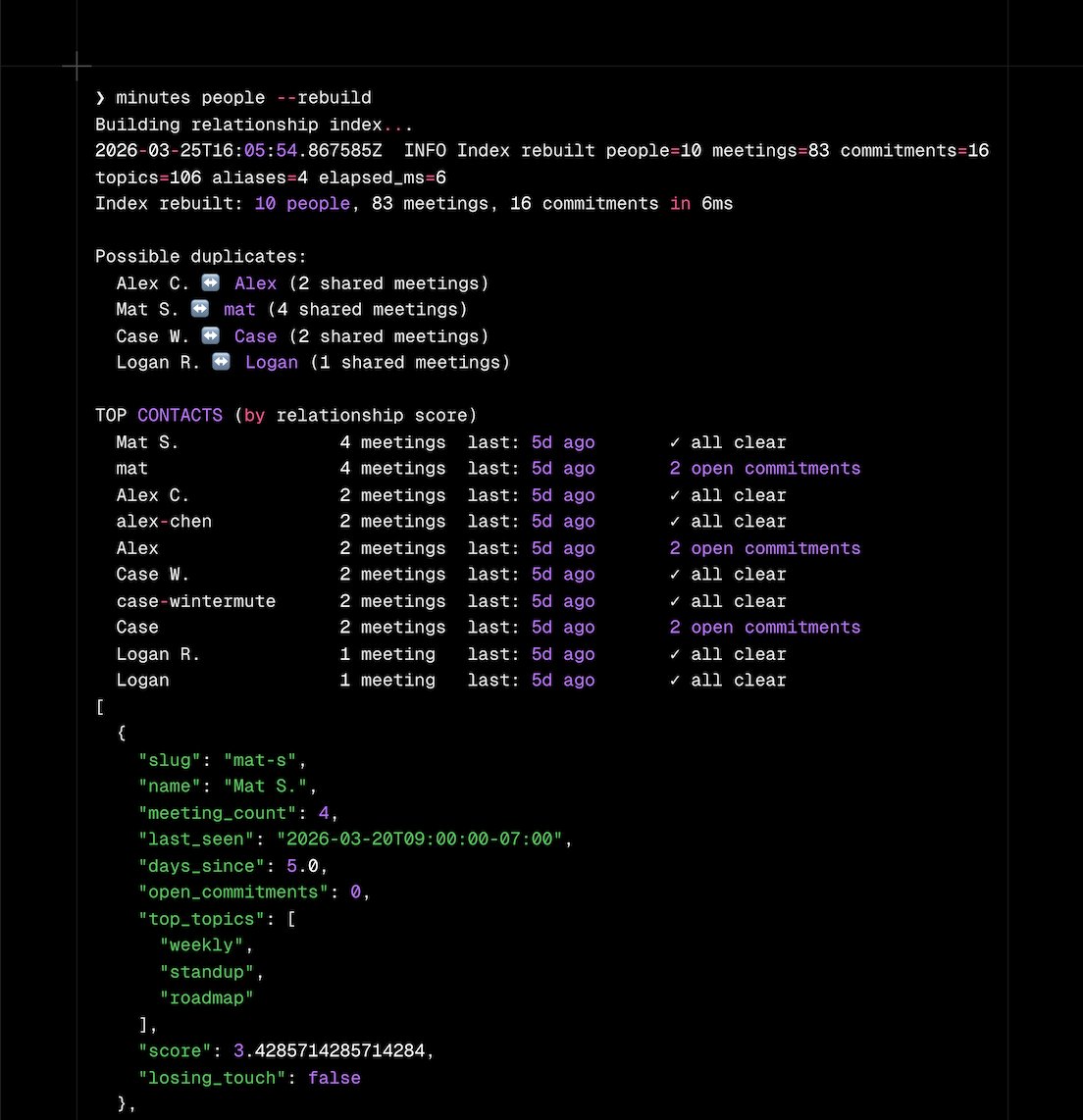
So I built a relationship intelligence graph into Minutes.
Every meeting feeds a graph of people, commitments, and topics. It knows who you talk to, what you promised, how often you meet, and when you're drifting apart.
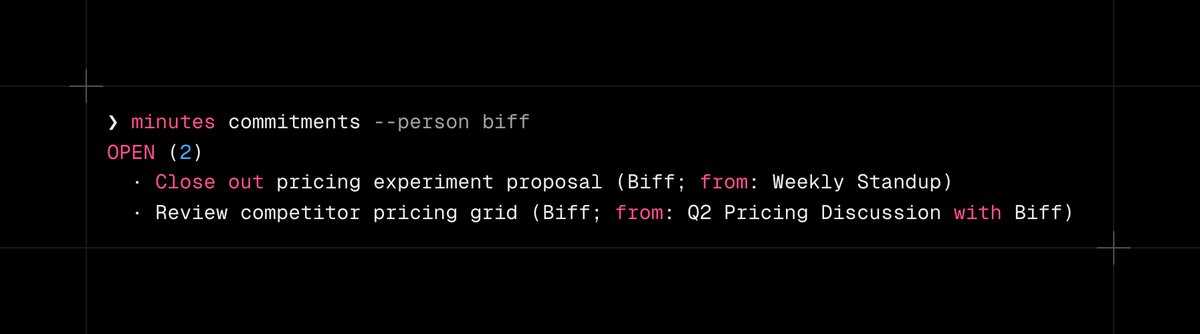
minutes commitments --person biff
→ "Review competitor pricing grid (open, from Q2 Planning)"
It also flags when I'm losing touch with someone I used to meet weekly.
v1 shipped today. Where it's going: your AI can know who you're meeting before you do, what you owe them, what changed since you last spoke. v2 is connecting the relationship intelligence graph and diarization. github link for recent changes.
Mar 20

Now paying Granola $18/mo to upload my meeting audio to their servers. So I built my own thing. It's 7 MB. Everything runs locally.
Works with @tobi's QMD for super fast search, PARA method second brain setup for organized people, projects, entities, @obisidan, CLI, claude code, codex, Claude Desktop.
Before a call with Biff it pulls your last 12 conversations, shows you pricing came up 5 times in 2 weeks, and reminds you that you owe Biff a doc from Friday. After the call it asks if you got what you came for.
You just ask "what did Biff say about pricing last week" and it pulls from your transcripts. No API key needed, use your existing subs.
The meeting prep feature came from messing around with @garrytan's gstack skills. His /office-hours pattern forces you to be specific instead of accepting vague answers. I stole that idea and applied it to meeting prep and post-meeting debrief.
It's called Minutes. Rust, whisper.cpp, Tauri. MIT licensed. First real release on github.
7
19
1,774
Mar 25
4
188
Mar 25
quality of life improvement: "i have raycast pro. based on everything you know about me and my projects, what should i be doing w/
raycast that i'm not doing? is there a raycast cli you can use to know what i'm doing in racyast? (there's not, but you'll get a killer answer)
3
5
881
Mar 25
ex: 8 bash script commands I can now invoke from raycast — "Start X1 Dev" boots my entire dev environment, "QMD Search" queries my personal knowledge base, "Cass Search" searches across all my past agent conversations (@doodlestein love this!)
and of course some for useminutes.dev cli
4
224
Mar 20
Now paying Granola $18/mo to upload my meeting audio to their servers. So I built my own thing. It's 7 MB. Everything runs locally.
Works with @tobi's QMD for super fast search, PARA method second brain setup for organized people, projects, entities, @obisidan, CLI, claude code, codex, Claude Desktop.
Before a call with Biff it pulls your last 12 conversations, shows you pricing came up 5 times in 2 weeks, and reminds you that you owe Biff a doc from Friday. After the call it asks if you got what you came for.
You just ask "what did Biff say about pricing last week" and it pulls from your transcripts. No API key needed, use your existing subs.
The meeting prep feature came from messing around with @garrytan's gstack skills. His /office-hours pattern forces you to be specific instead of accepting vague answers. I stole that idea and applied it to meeting prep and post-meeting debrief.
It's called Minutes. Rust, whisper.cpp, Tauri. MIT licensed. First real release on github.
31
22
497
75,037
Mar 24
Mar 23
hot damn, turned meetings into an API. so point your agent at the repo.
minutes is open-source infrastructure that decomposes the entire meeting workflow (scheduling awareness, recording, transcription, note-taking, structured extraction, search, people memory) into primitives that any AI agent can orchestrate.
Your agent knows your calendar. It starts the recording when your call begins. It transcribes locally with whisper.cpp. It extracts decisions, action items, and commitments as structured data. It builds profiles of the people you work with across months of conversations. It flags when last week's decision contradicts this week's.
You just talk and the agent handles everything else.
Traditional meeting apps are monoliths designed for humans to click buttons. minutes is a toolkit of 13 MCP operations designed for agents to compose however they want.
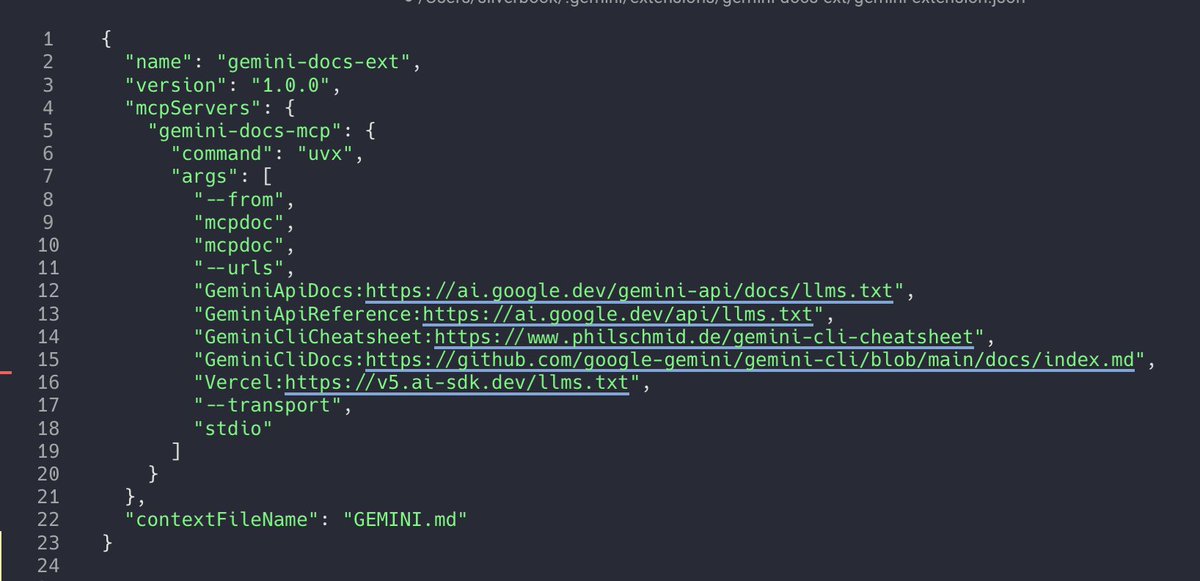
Claude, Codex, Cursor, Windsurf, Gemini CLI, or your own agent, any MCP client gets the full meeting lifecycle out of the box.
Open source. Local transcription. MIT licensed. Have fun.
530
Mar 24
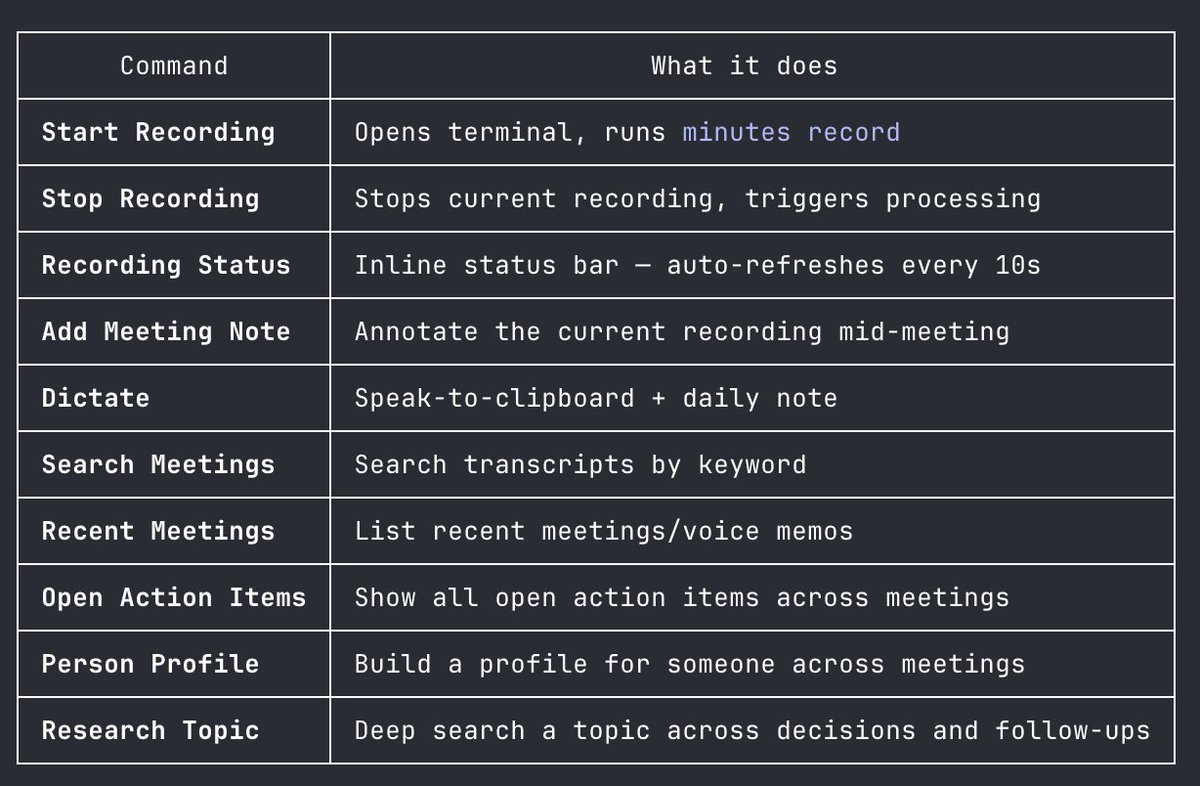
more meeting power for your agents:
dictation. hold a hotkey, speak, text hits your clipboard. local whisper, no cloud.
your phone captures thoughts for your agent/llm. record a voice memo while walking. 60 seconds later Claude/Codex/Gemini/etc knows about it.
works w/ any phone. iCloud, Dropbox, Google Drive, or just drag the file.
short memos auto-route through the fast pipeline. long recordings get full meeting treatment with speakers, decisions, action items.
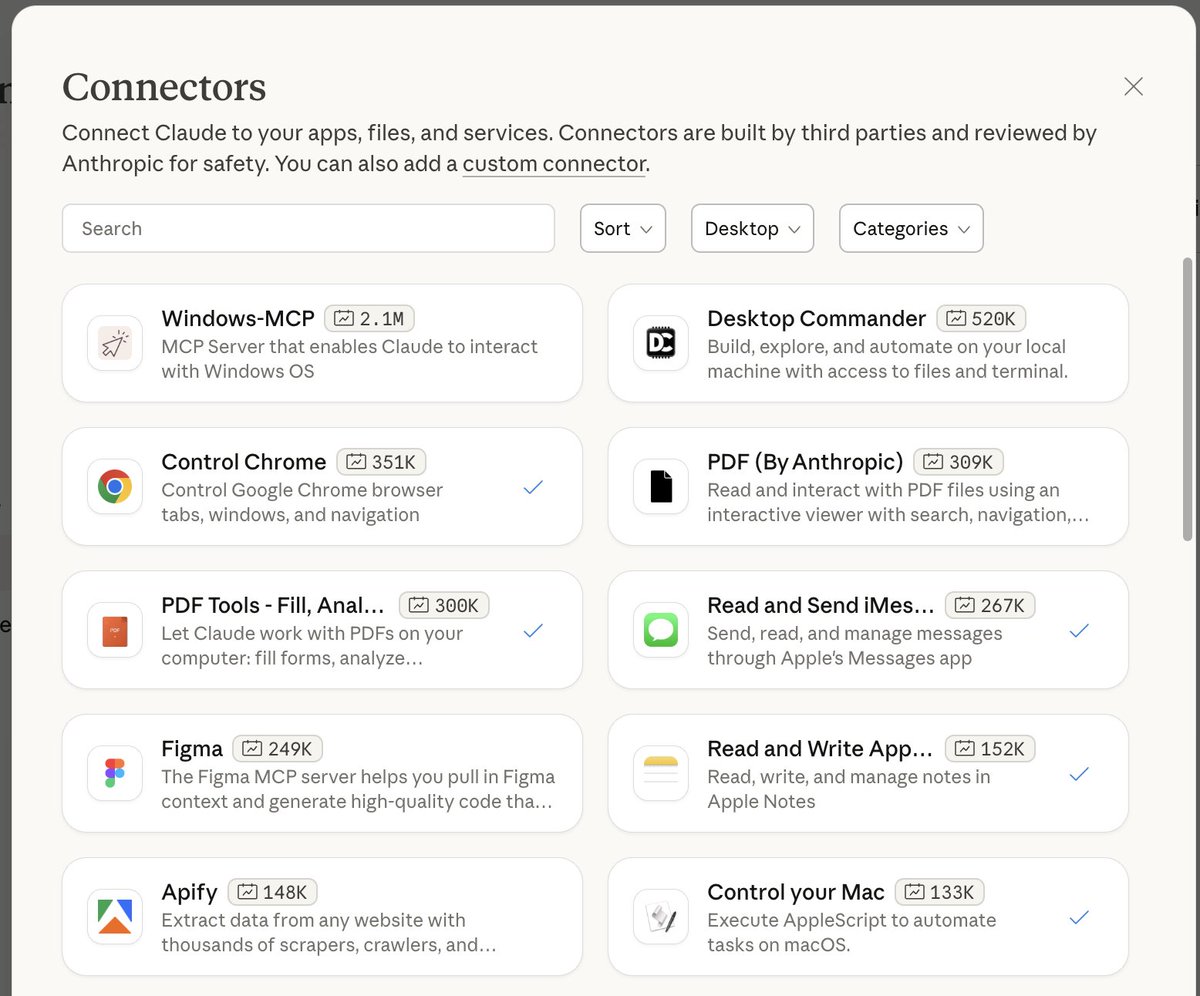
13 MCP tools, simple cli stuff, still MIT, and on the claude desktop extensions marketplace very soon (just got approved)
Mar 20
Now paying Granola $18/mo to upload my meeting audio to their servers. So I built my own thing. It's 7 MB. Everything runs locally.
Works with @tobi's QMD for super fast search, PARA method second brain setup for organized people, projects, entities, @obisidan, CLI, claude code, codex, Claude Desktop.
Before a call with Biff it pulls your last 12 conversations, shows you pricing came up 5 times in 2 weeks, and reminds you that you owe Biff a doc from Friday. After the call it asks if you got what you came for.
You just ask "what did Biff say about pricing last week" and it pulls from your transcripts. No API key needed, use your existing subs.
The meeting prep feature came from messing around with @garrytan's gstack skills. His /office-hours pattern forces you to be specific instead of accepting vague answers. I stole that idea and applied it to meeting prep and post-meeting debrief.
It's called Minutes. Rust, whisper.cpp, Tauri. MIT licensed. First real release on github.
10
9
127
19,017
Mat Silverstein retweeted

Mar 23
"I really don't want to manage an AI team."
@cathrynlavery found a solution: Paperclip, the open-source project
What she showed me:
• Paperclip leads her agents using its project management setup
• Humans on her team use it to assign tasks to agents
• Agents delegate tasks to humans or other agents
• Paperclip turns your goals into agent tasks
• It turns an SEO audit doc (for example) into agent tasks
• It organizes OpenClaw agents OR even creates its own agents
Also: fast-forward to 9min25sec to see a 3-minute Paperclip setup.
(YouTube version in first comment.)
18
28
291
54,126
Mar 23
hot damn, turned meetings into an API. so point your agent at the repo.
minutes is open-source infrastructure that decomposes the entire meeting workflow (scheduling awareness, recording, transcription, note-taking, structured extraction, search, people memory) into primitives that any AI agent can orchestrate.
Your agent knows your calendar. It starts the recording when your call begins. It transcribes locally with whisper.cpp. It extracts decisions, action items, and commitments as structured data. It builds profiles of the people you work with across months of conversations. It flags when last week's decision contradicts this week's.
You just talk and the agent handles everything else.
Traditional meeting apps are monoliths designed for humans to click buttons. minutes is a toolkit of 13 MCP operations designed for agents to compose however they want.
Claude, Codex, Cursor, Windsurf, Gemini CLI, or your own agent, any MCP client gets the full meeting lifecycle out of the box.
Open source. Local transcription. MIT licensed. Have fun.
4
2
70
8,522
Mar 23
here's what the cli version looks like. way cooler in claude or the minutes tauri app, but I have a feeling your agent won't care
2
480
Mar 23
github.com/silverstein/minut…
Get started in 30 seconds:
npx minutes-mcp (for the mcp part if you don't need the whole thing). or just point your agent at the repo and have it set up the entire thing for you
1
15
959
Mar 20
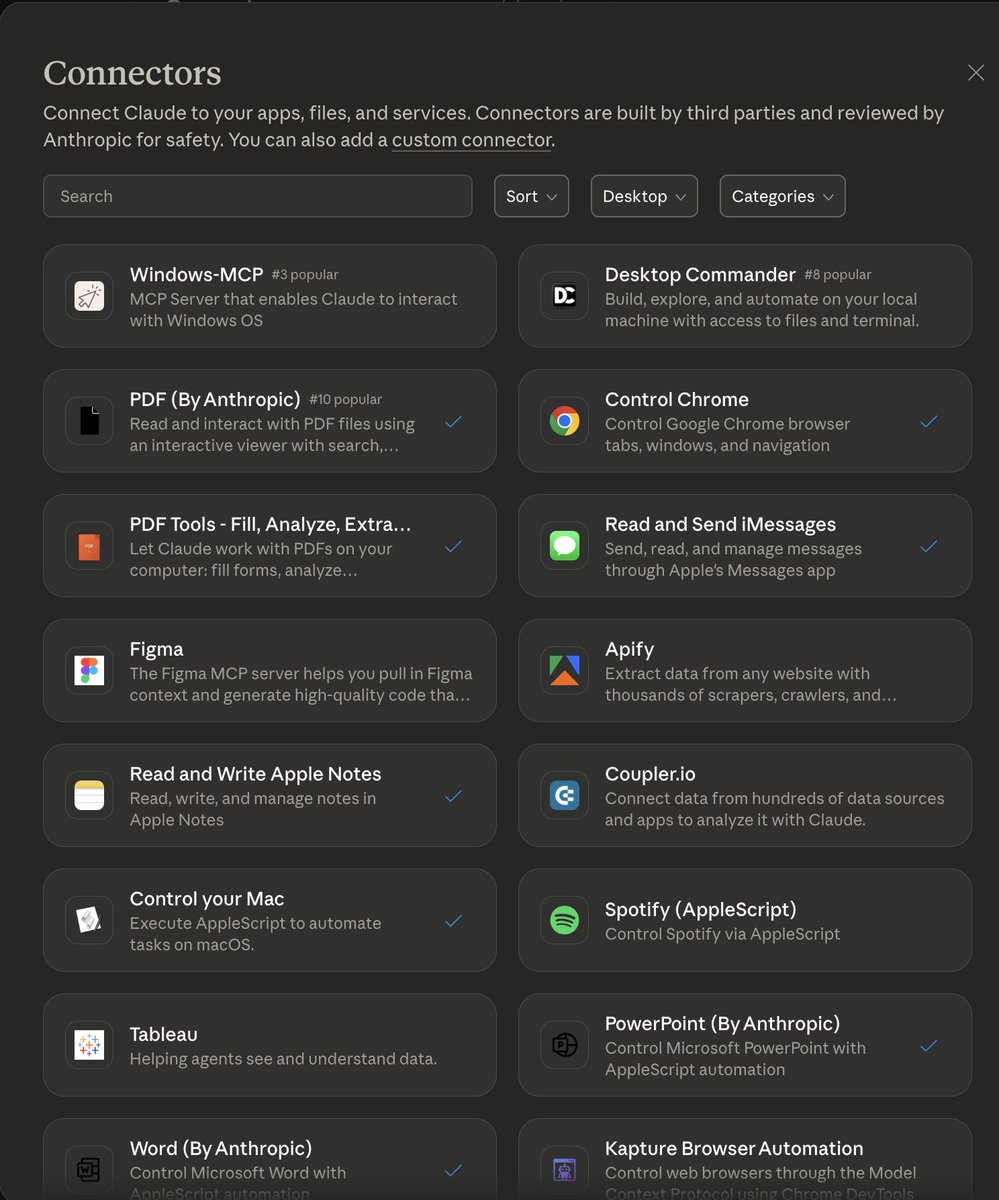
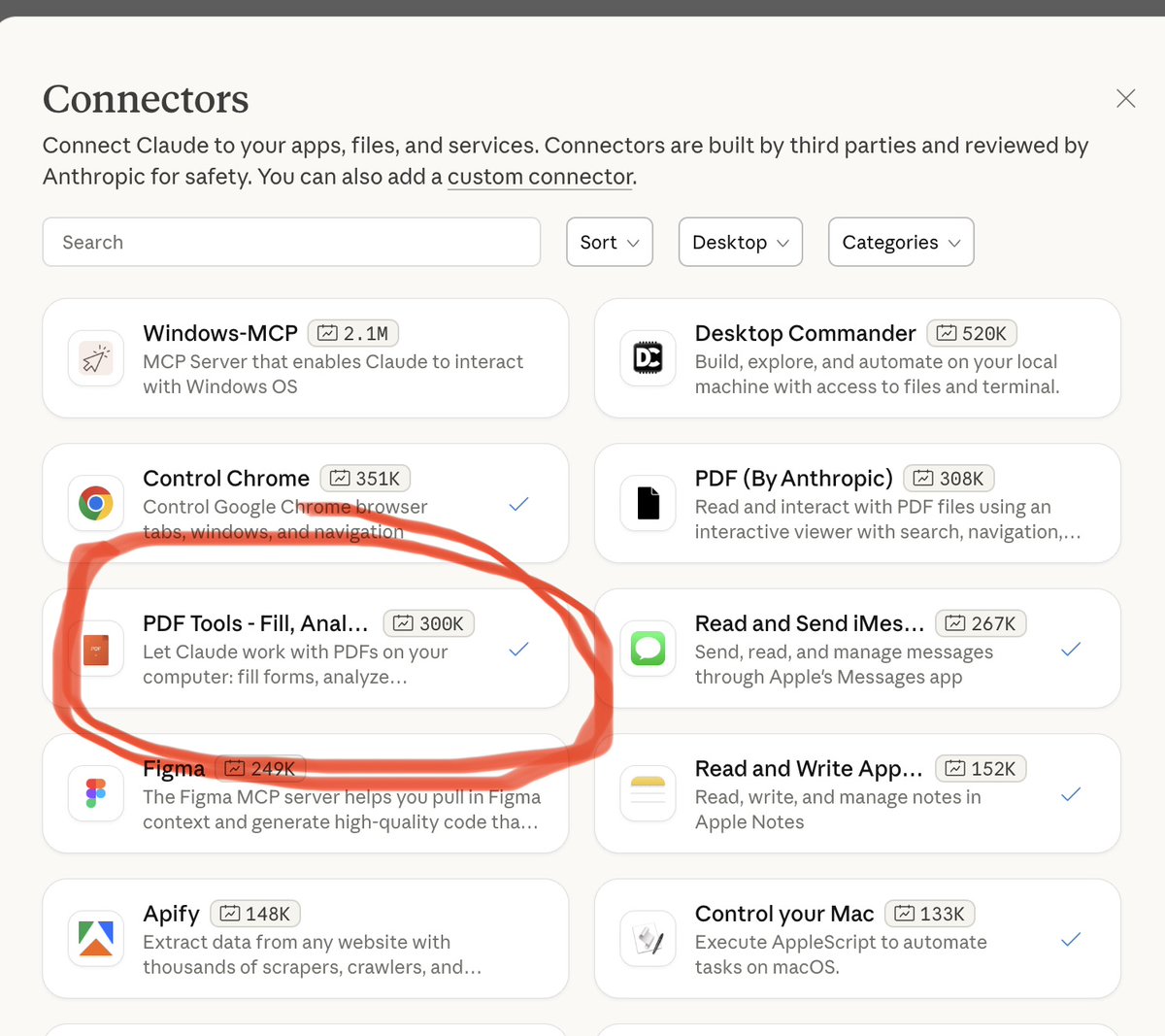
I created the #5 most installed claude desktop extension, but I really truly didn't mean for this truncation...
5
1
13
5,564
Mar 20
Seems someone on the team noticed, and fixed the issue by removing the install counts
2
499
Mar 20
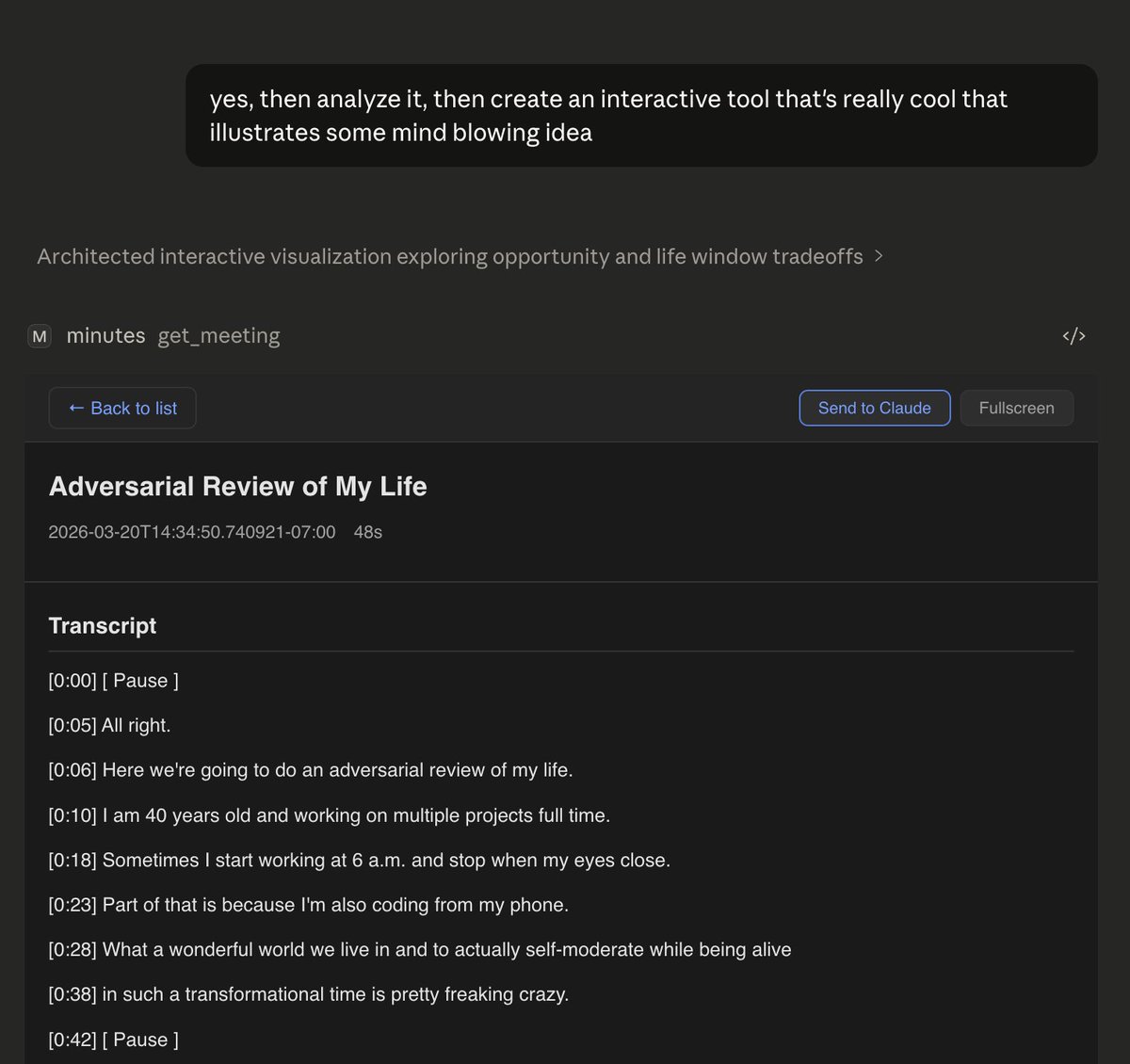
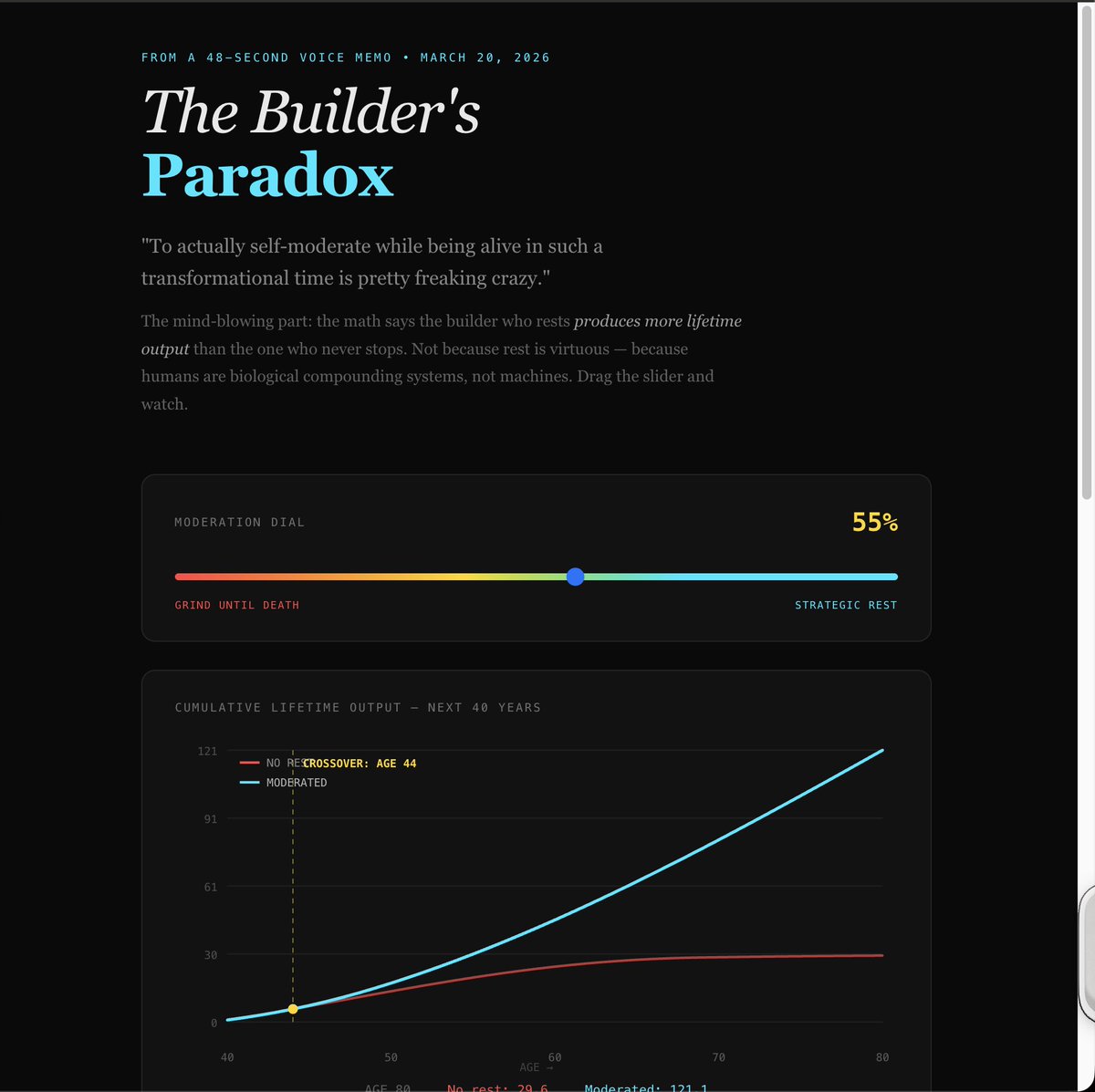
just pushed an update to the .mcpb so you can install it in claude desktop, and use Minutes as an interactive app, then had Claude create an artifact claude.ai/public/artifacts/7…
8
1,701
Mar 20
Making it more agent friendly now so your openclaws can use them.
9
1,659
Mar 20
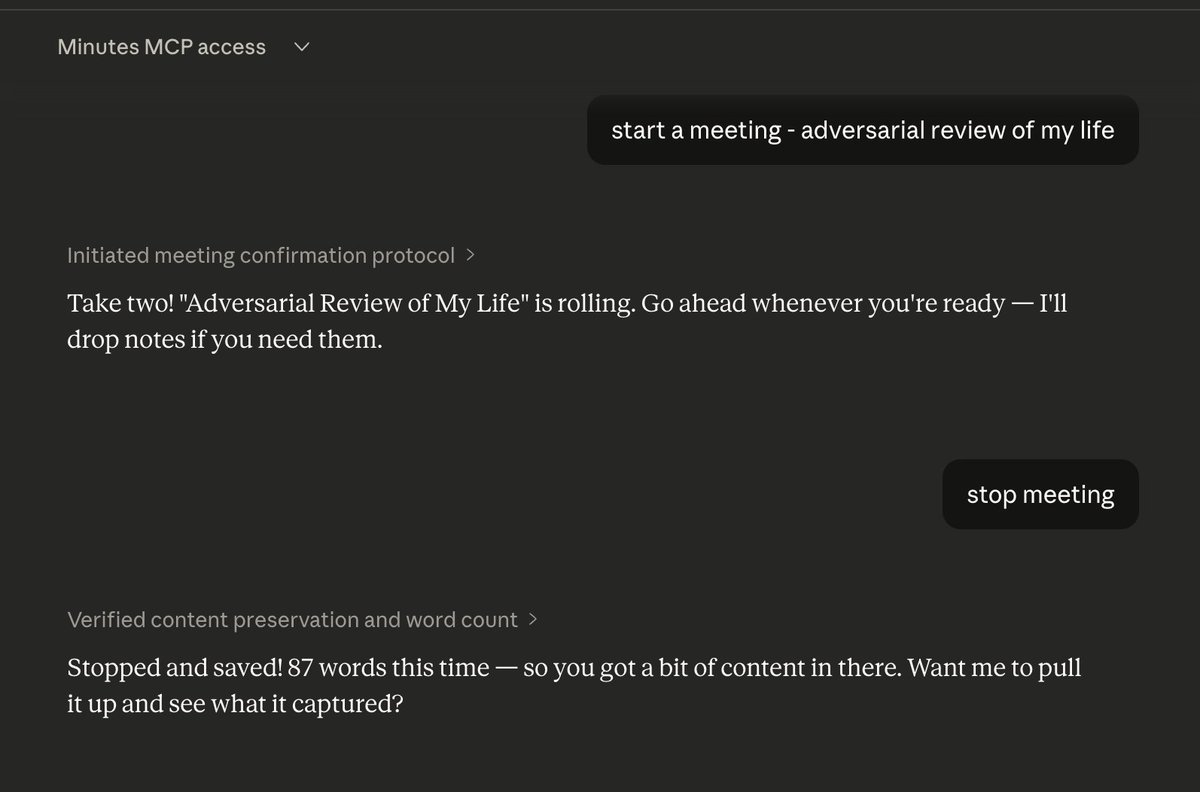
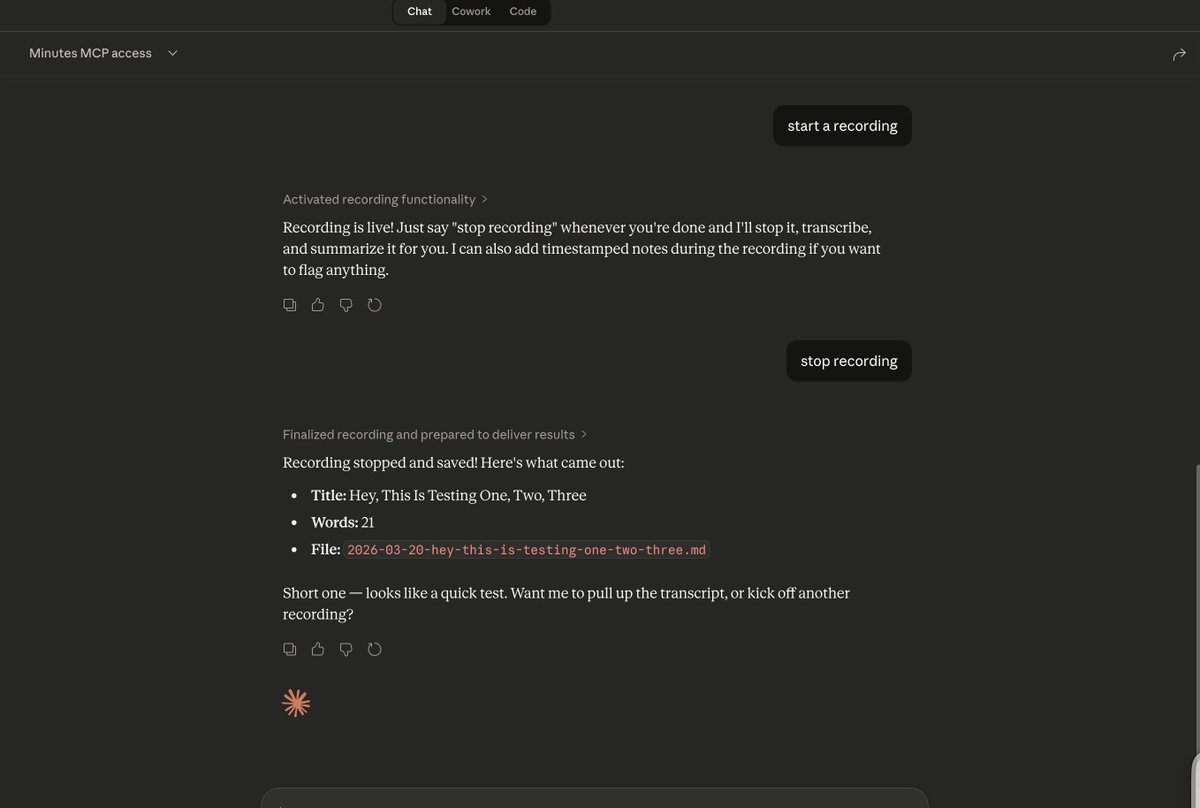
Sweet this worked! Started and stopped a meeting recording right inside of Claude Desktop.
8
3,165