
Aquí encontrarás mis soluciones a problemas matemáticos, de física y tecnología publicados en la red. Cuenta Principal: @Eneatipo7
Joined October 2025
- Tweets 214
- Following 21
- Followers 316
- Likes 218
Photos and videos
Math Physics & Tech retweeted

16 Nov 2025
Si:
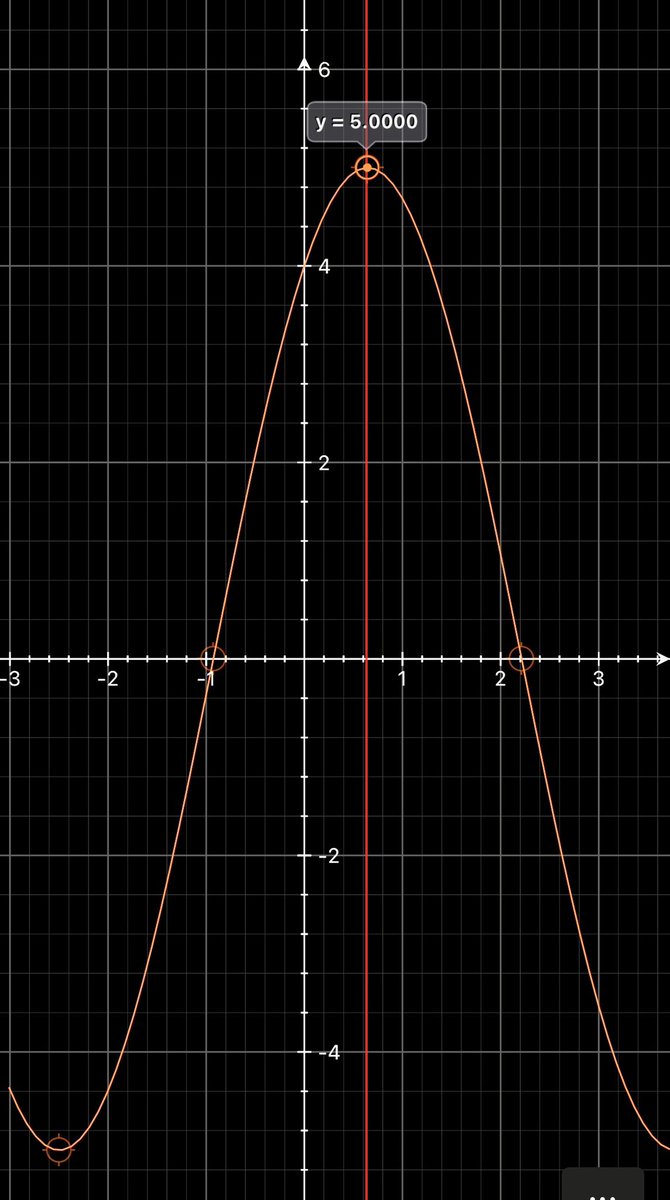
f(x) = 3 cos (x) 4 sin (x)
Con 1ª derivada: f(x) ‘ = 0
f(x) ‘ = - 3 sin (x) 4 cos (x)
Con f(x) ‘ = 0
tan (x) = 4/3
Arctg (4/3) = 0,927295
Sea 2ª derivada: f(x) ‘’ evaluada en “x”
f(x) ‘’ = - 3 cos (x) - 4 sin (x)
f(0,927295) ‘’ < 0
Luego f(x) = f(0,927295) es Máximo.
Entonces, reemplazando en f(x):
f(0,927295) = 5
Max (f(x)) = 5
2
3
10
2,162
Math Physics & Tech retweeted
14 Nov 2025
Sea: 🇨🇱🇪🇸
[( x - 1 ) / 3 ] ³ = 64
a = ( x - 1 ) / 3
Luego:
a ³ - 64 = 0
a ³ - 4 ³ = (a - 4) (a ² 4a 4 ²) = 0
Entonces:
a - 4 = 0
a ² 4a 4 ² = 0
a1 = 4
a2 = ( - 4 √(16 - 64)) / 2
a3 = ( - 4 - √(16 - 64)) / 2
Donde:
a1 = 4
a2 = - 2 2i √3
a3 = - 2 - 2i √3
Reemplazando en la ecuación inicial:
( x - 1 ) / 3 = a1 = a2 = a3
Resolviendo,
Las tres raíces de la ecuación son:
x1 = 13
x2 = - 5 6i √3
x3 = - 5 - 6i √3
——————————————
Let: 🇺🇸
[(x - 1) / 3]³ = 64
a = (x - 1) / 3
Then:
a³ - 64 = 0
a³ - 4³ = (a - 4) (a² 4a 4²) = 0
So:
a - 4 = 0
a² 4a 4² = 0
a₁ = 4
a₂ = (- 4 √(16 - 64)) / 2
a₃ = (- 4 - √(16 - 64)) / 2
Where:
a₁ = 4
a₂ = - 2 2i√3
a₃ = - 2 - 2i√3
Substituting into the initial equation:
(x - 1) / 3 = a1 = a2 = a3
Solving,
The three roots of the equation are:
x1 = 13
x2 = - 5 6i√3
x3 = - 5 - 6i√3
3
2
24
5,392
Math Physics & Tech retweeted
14 Nov 2025
( x 2 ) ² = 49
( x 2 ) ² - 7 ² = 0
( x - 5 ) ( x 9 ) = 0
x1 = 5
x2 = - 9
2
1
14
1,320
Math Physics & Tech retweeted
16 Aug 2023
45 / 3 = 15
39 / 3 = 13
X / 3 = 11
Then x = 33
1
3
673
Math Physics & Tech retweeted
16 Aug 2022
Easy
Sin ² (x) Sin ² (90 - x) = 1
Then
Sin ² (1) Sin ² (89) = 1
Sin ² (2) Sin ² (88) = 1
Sin ² (3) Sin ² (87) = 1
.
.
.
Sin ² (44) Sin ² (46) = 1
And
Sin ² (45) = 1/2
Sin ² (90) = 1
Then
44
∑ Sin²(x) Sin²(90-x) 1 1/2
1
= 44 1 1/2
Addition = 45.5
q.e.d
1
6
Math Physics & Tech retweeted
18 Dec 2023
Si diagonal = √180 = 2√45
Si diagonal = > a √2 = 2√45
a = √90 = 3 √10
Área = a ² / 2 = 45
Área = 45 cm ²
1
3
406
Math Physics & Tech retweeted
28 Dec 2023
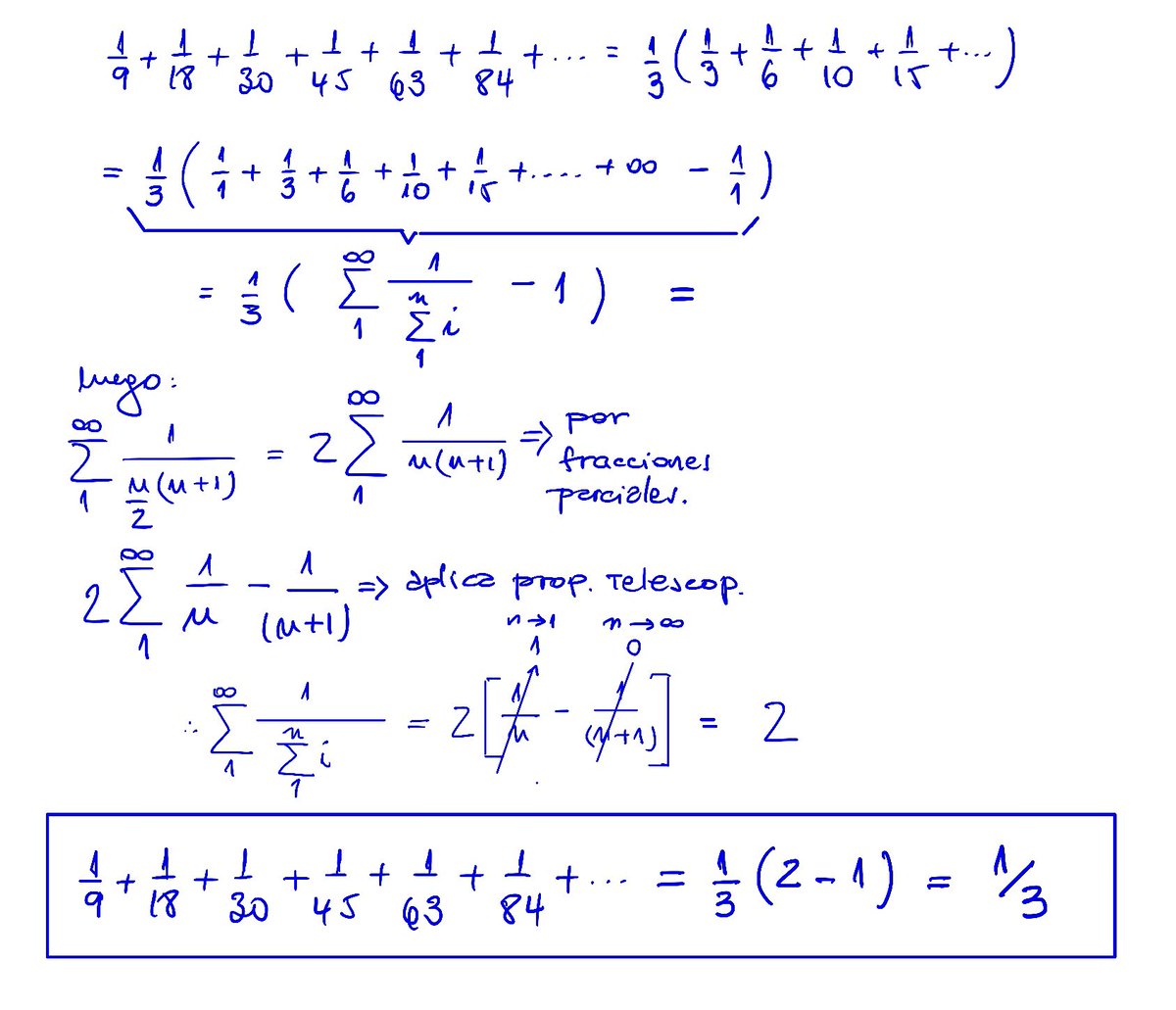
1/9 1/18 1/30 1/45 1/63 … oo
∑ = 1/3
2
1
10
525
Math Physics & Tech retweeted
25 Jan 2025
By Pythagoras:
A: √ 45
B: √ 50
C: √ 52
D: √ 40
C > B > A > D
Finally C is the largest.
1
2
339
Math Physics & Tech retweeted
1 Nov 2021
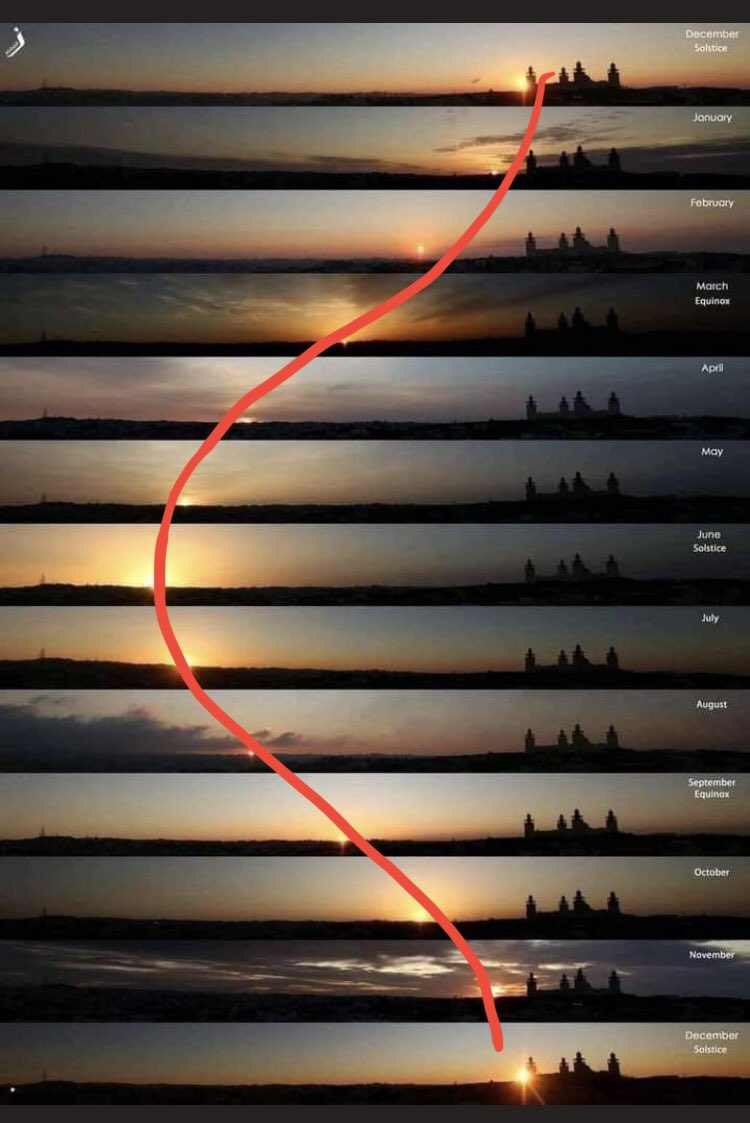
TRIGONOMETRÍA Y NATURALEZA
12 fotos del Sol en doce meses, el mismo día, el mismo lugar y a la misma hora.
La misma cámara, la misma exposición, misma ASA, mismo teleobjetivo y mismo enfoque.
Una sinusoide perfecta.

5
11
44
Math Physics & Tech retweeted
27 Jul 2024
cos x - sin x = 1 /( ) ²
cos ²x - 2sin x cos x sin ²x = 1
If:
cos ²x sin ²x = 1
Then:
sin x cos x = 0
x1 = 0º 2 π n ∀ ∈ |R
or
x2 = π/2 2 π n ∀ ∈ |R
where:
i) sin x = 0 ∧ cos x = 1
or
ii) sin x = 1 ∧ cos x = 0
Then:
(cos x)^2022 (sin x)^2022 = 1
1
1
3
267
Math Physics & Tech retweeted
31 Oct 2025
🇪🇸 Suponga que:
(x 3)(x 5)(x 7)(x 9) = 9
Dado que 3,5,7,9 son impares consecutivos, se considera el promedio de los términos libres:
(3 5 7 9) /4 = 24/4 = 6
Luego:
x = - 6 es solución factible.
Combinaciones que dan 9
( -3 )( -1 )( 1 )( 3 ) = 9
Luego:
Si x 3 = -3
x = - 6
Si x 5 = - 1
x = - 6
Si x 7 = 1
x = - 6
Si x 9 = 3
x = - 6
Por tanto, ( - 6 ) es solución consistente.
Reemplazando:
(-6 3)(-6 5)(-6 7)(-6 9) = 9
Luego x = - 6 cumple.
Por simetría, el polinomio tiene 4 raíces de las cuales dos son reales e iguales que equivalen a ( - 6)
Por tanto las otras dos raíces son reales distintas pero no enteras, por no haber enteros que multipliquen 9, diferentes a la combinación dada de 4 factores.
Luego al menos dos raíces son ( - 6 )
Las otras dos raíces, se pueden encontrar por las propiedades de los polinomios o gráficamente bajando dos grados, dado que conocemos dos raíces.
🇺🇸 Suppose that:
(x 3)(x 5)(x 7)(x 9) = 9
Since 3, 5, 7, and 9 are consecutive odd numbers, we consider the average of the constant terms:
(3 5 7 9) / 4 = 24 / 4 = 6
Therefore:
x = -6 is a feasible solution.
Combinations that give 9:
(-3)(-1)(1)(3) = 9
Therefore:
If x 3 = -3
x = -6
If x 5 = -1
x = -6
If x 7 = 1
x = -6
If x 9 = 3
x = -6
Therefore, (-6) is a consistent solution.
Substituting:
(-6 3)(-6 5)(-6 7)(-6 9) = 9. Therefore, x = -6 satisfies the condition.
By symmetry, the polynomial has 4 roots, two of which are real and equal, equivalent to -6.
Therefore, the other two roots are distinct real roots, but not integers, since there are no integers that multiply 9 other than the given combination of 4 factors. Thus, at least two roots are -6.
The other two roots can be found using the properties of polynomials or graphically by descending two degrees, given that we know two roots.
2
5
54
6,127
Math Physics & Tech retweeted
31 Oct 2025
Sea:
Volumen x = Volumen y = 1.000 L
X con altura hx
Y con altura hy
Asumiendo el mismo líquido en ambos recipientes y ambos sujetos a sólo la acción de la gravedad se tiene que:
La velocidad de salida del líquido es:
Vx = √(2ghx)
Vy = √(2ghy)
Luego el caudal Q es:
Qx = Vx Ax en litros por segundo
Qy = Vy Ay en litros por segundo
Donde A es la sección transversal de la boca de salida, que se asume igual para ambos caños.
Luego:
Ax = Ay
Como hx > hy -> Vx > Vy
Entonces: Qx > Qy
Por tanto si el caudal de x es mayor que el caudal de y por unidad de tiempo, entonces el recipiente x se vaciará más pronto debido a su mayor columna de agua.
Let:
Volume x = Volume y = 1000 L
X with height hx
Y with height hy
Assuming the same liquid in both containers and both subject only to the action of gravity, we have:
The liquid's exit velocity is:
Vx = √(2ghx)
Vy = √(2ghy)
Then the flow rate Q is:
Qx = Vx Ax in liters per second
Qy = Vy Ay in liters per second
Where A is the cross-sectional area of the outlet, which is assumed to be the same for both pipes. Therefore:
Ax = Ay
Since hx > hy -> Vx > Vy
Therefore: Qx > Qy
Thus, if the flow rate of x is greater than the flow rate of y per unit of time, then container x will empty faster due to its greater water column.
6
6
54
9,962
Math Physics & Tech retweeted
27 Oct 2025
Let the Algebraic Method be:
y = 2^x x - 5
If:
a = 2^x
ln a = x ln 2
a = e ^ (x ln 2)
2^x = e ^ (x ln 2)
By Taylor Series:
e^x = 1 x x ² / 2! x ³ / 3! ….
If we replace:
2^x = 1 (x ln 2) (x ln 2) ²/2! (x ln 2) ³/3! ….
If we expand to degree 3.
Then:
2^x x = 5
1 (x ln 2) x (ln 2) ²/2! (x ln 2) ³/3! x = 5
x³(ln 2)³/6 x²(ln 2)²/2 x (1 ln 2) - 4 = 0
0.0555 x ³ 0.24 x ² 1.69 x - 4 = 0
One of its roots is:
x = 1.75 (approximate value).
Greater accuracy can be achieved by using more degrees of the series and then using the Newton-Raphson method with the polynomial.
2
17
1,746
Math Physics & Tech retweeted
4 Jun 2024
1 ² 2 ² = 5
1 4 = 5
1 ² 2 ² 3 ² 4 ² 5 ² = 55
1 4 9 16 25 = 55
1
1
217
Math Physics & Tech retweeted
3 Jun 2024
Favorable Cases = ( 6 * 5 * 4 ) * 3 = 360
Possible Cases = 3 * 6 ³ = 648
Probability = 360 / 648 = 5/9
Probability = 0,55555 = 55,555 %
1
1
194
Math Physics & Tech retweeted
23 Jun 2024
x ² - x ³ = 80
x ² - x ³ - 80 = 0
(x 4) (x ² - 5x 20) = 0
Se cumple que:
x 4 = 0
x ² - 5x 20 = 0
Luego:
x1 = - 4
x2 = (5 i √ 55) / 2
x3 = (5 - i √ 55) / 2
1
1
216
Math Physics & Tech retweeted
19 Oct 2025
DATO FREAK.
El mayor número primo descubierto al día de hoy es:
________________________________
| |
| M = 2 ¹³⁶ ²⁷⁹ ⁸⁴¹ - 1 |
| ¹³⁶ ²⁷⁹ ⁸⁴¹ |
|_______________________________|
Es el mayor número primo conocido, tiene 41.024.320 dígitos en su escritura decimal.
Cabe destacar dos precisiones importantes:
•Este es el mayor primo conocido hasta ahora, no el mayor primo posible, ya que por el teorema de Euclides sabemos que existen infinitos números primos.
•Este número pertenece a la clase de los llamados primos de Mersenne, es decir de la forma 2^p – 1 con p primo. Estos se usan porque permiten test de primalidad más eficientes para números enormes.
Cantidad de dígitos
Tiene 41.024.320 dígitos.
Para que te hagas una idea: si lo imprimieras en una hoja A4 con letra tamaño 10, el número ocuparía más de 13.000 páginas completas, o sea unas 26 resmas de papel tamaño carta.
Tipo de número.
Cómo he señalado, es un primo de Mersenne, es decir, un número de la forma 2^p - 1, donde p también es primo.
Estos primos son muy buscados porque su estructura permite usar el test de “Lucas–Lehmer”, que verifica su primalidad de forma relativamente eficiente, incluso para exponentes enormes.
Descubrimiento:
Fue descubierto el 12 de octubre del 2024 por Luke Durant, dentro del proyecto GIMPS (Great Internet Mersenne Prime Search), un esfuerzo colaborativo mundial que usa computadoras personales para buscar nuevos primos gigantes.
¿Cómo se verificó?
El número fue confirmado por cuatro pruebas independientes, usando distintos equipos y programas.
La verificación tardó alrededor de 7 días de cálculo continuo en un procesador de última generación.
Curiosidades:
•Es el 53º primo de Mersenne conocido.
•Si lo escribieras completo, sólo su texto pesaría más de 40 MB en un archivo .txt.
•En promedio, los nuevos primos de Mersenne se descubren cada pocos años, pero cada vez cuesta mucho más esfuerzo computacional encontrarlos.
Dato Freak (freak): Mi número celular de ocho dígitos es un número primo, y la probabilidad de que un número de teléfono móvil en Chile sea primo, es sólo de un 5,66%
Y el tuyo, ¿Es primo?
2
5
15
1,128

30 Oct 2025
RT @Eneatipo7: Un 18 de Agosto de 1685 nace Brook Taylor, un matemático británico, autor del teorema que lleva su nombre y de destacadas co…
1
Math Physics & Tech retweeted
13 Jun 2024
Si
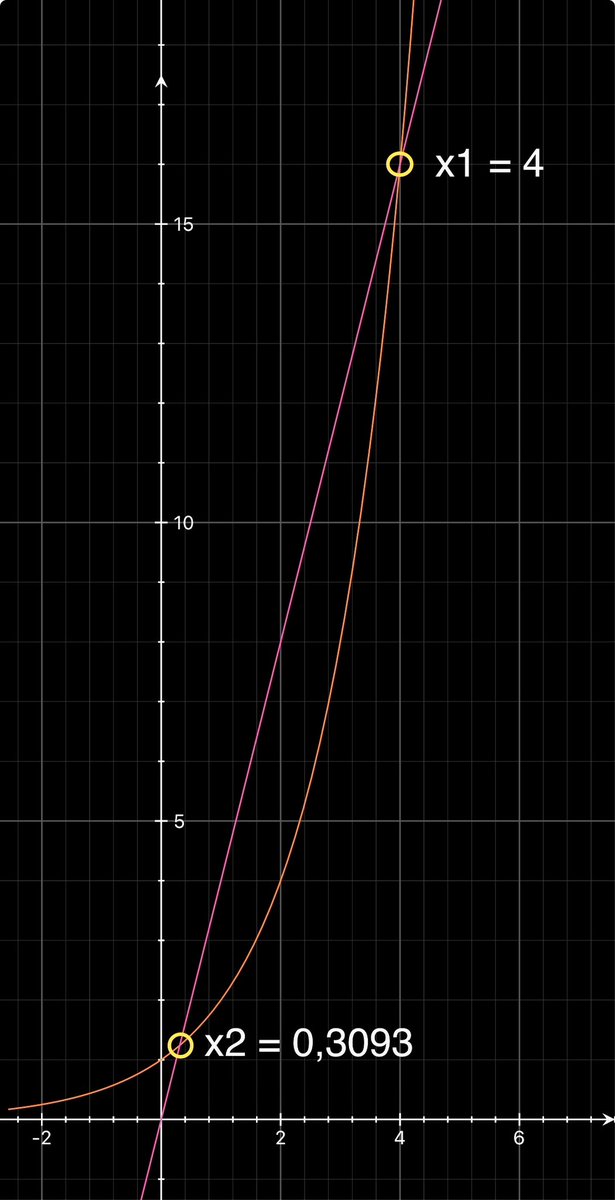
2^x = 4x
Sean
x1 = 4
X2 = ?
Con
2^x = e^(x ln2)
Por Taylor ∀ z < 1
e^z = 1 z z ²/2! …
Si z => x ln2
e^(x ln2) = 1 xln2 (xln2) ²/2 = 4x
Ec de 2º grado
A= (ln2)²/2 = 0,24022
B= (ln2)-4 = -3,30685
C= 1
Con x2 < 1
x2 = (3,30685 - 3,15821) / 0,48044
x2 = 0,3093 Aprox.
1
1
202