
Professional staking service for Polygon | Building Cloud at scale @0xPolygon
Joined August 2021
- Tweets 934
- Following 119
- Followers 117
- Likes 1,045
129 Photos and videos





Pinned Tweet

Mar 8
Proud to share, Our @0xPolygon Strategic Reserve validator now surpasses 1 MILLION $POL ✅
Cc: @sandeepnailwal @0xPolygonFdn
@0xMarcB @0xPolygonEco 🙏
Believing on #Polygon since the inception and continue to be operating as a top notch validator for the next multiple decades (30 years ) and continue to be building and believing on Polygon.
Matrix Stake has been accumulating Polygon rewards generated from our validator to our POL reserve as a long term commitment / alignment just as our #Bitcoin Reserve.
Feel free to delegate and support POL ecosystem 💜


6
6
40
2,821
Jun 8
.@0xPolygon Weekly update is here 🙌
✅ @Mastercard launches always-on stablecoin settlement on #Polygon
✅ @Bitso integrates $USDC payments on Polygon
✅ @Uniswap hits $100M protocol volume on Polygon in 24 hours
✅ @WalletConnect launches USDT payments on Polygon
✅ @symbiosis_fi crosses 2.5x Polygon volume from Feb to May
✅ Polygon launches technical preview for the Open Money Stack
✅ Polygon crosses $79.25B stablecoin volume in May
✅ Polygon hits $2.6T in lifetime stablecoin value moved
✅ Polygon mainnet block time reduced to 1.5s, down from 1.75s
Keep building team 👏
1
74
Jun 2
.@0xPolygon latest weekly update is here 💜
✅ @CashApp launches stablecoin payments on Polygon
✅ @BRL1Coin goes live on @capa_fi's payments infrastructure on Polygon, connecting real-pegged stablecoin volume to global rails
✅ @Mercuryo_io crosses $10M onramp volume on Polygon
✅ @BPConsortium launches Open Transaction Layer with Polygon Labs as founding partner
✅ @sherlockdefi launches a security engagement on Polygon with rewards
✅ @Deel expands stablecoin payroll on Polygon to full-time employees worldwide
✅ @DptPay launches on Polygon with stablecoin-powered card payments
✅ Programmable auth/capture launches at the wallet layer for Polygon's Open Money Stack
✅ Polygon crosses $2.5 trillion in lifetime stablecoin volume
✅ Polygon turns 6️⃣
1
1
3
120
Matrix Stake retweeted

May 29
6 years on mainnet. $2.5T in stablecoin value moved.
People use Polygon every day to move money. So we created a space where every item represent a real payment made on Polygon. If you look hard enough, you might find some hidden treasure.
Start here: trillions.polygon.technology…
35
52
360
27,388
May 18
.@0xPolygon Bullish weekly update is here 💜
✅ @0xMiden Testnet connects to Agglayer, making the interop solution officially chain-agnostic
✅ @EntEthAlliance releases its first Privacy Report with Polygon Labs
✅ @AsseteraGlobal and Deploi launches private credit issuance on #Polygon for EU investors
✅ @StraitsX's xSGD crosses $1.1B volume on Polygon
✅ @zerion releases its Agent CLI with support for Polygon
✅ @graphprotocol launches Agent0 Subgraphs on Polygon
✅ @0FiatDotCom kicks off a Sats Pizza Party for Polygon
✅ @mayan crosses $300M in payments on Polygon
✅ @USDT0_to confirms Polygon had the most active USDT0 senders with 6M
✅ New privacy upgrade goes live for Polygon CDK with @SuccinctLabs
1
75
May 11
.@0xPolygon Bullish weekly update is here 🙌
The #Polygon chain is faster, the capacity is bigger, the payments keep growing 👏
✅ Polygon Chain block time drops to 1.75s, making it the first reduction since genesis
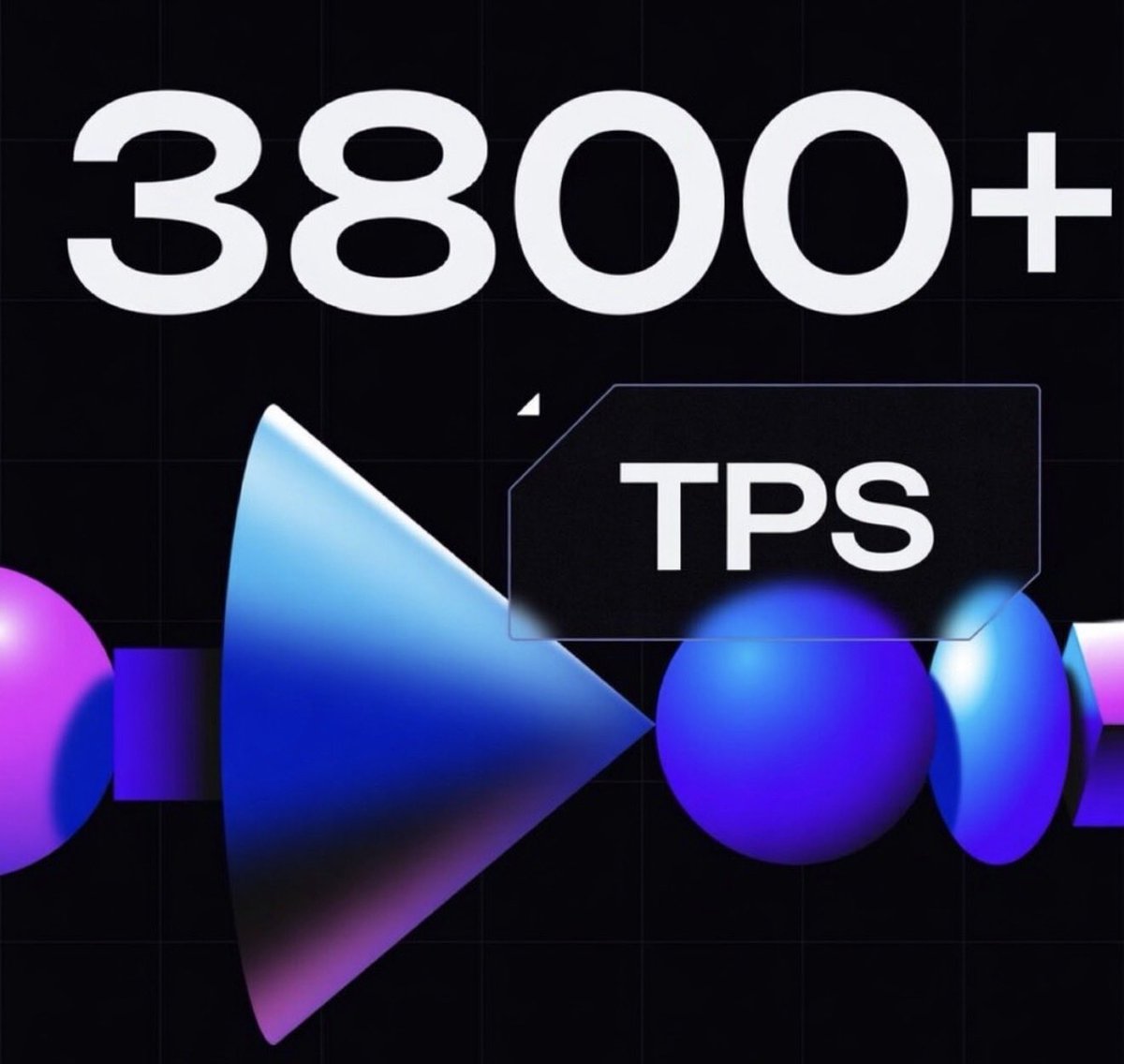
✅ Polygon Chain gets upgraded to 140M gas, bringing max TPS to 3,800
✅ @ZKPanther deploys mainnet on Polygon, bringing programmable privacy to DeFi
✅ @0FiatDotCom adds USDT on Polygon for payments across 45 countries
✅ @Hadronfc x @Ignyte_AE launch Smart Commerce Infrastructure Challenge on Polygon with a 25K USDC prize pool
✅ @MessariCrypto Polygon Q1 report is out with fresh payments data
✅ @katana perps trading competition starts, powered by Polygon CDK
✅ Private payments launch on Polygon for stablecoin transfers
1
19
252
May 9
.@0xPolygon Now: 3800 TPS is positioning itself as a key enabler for fixing this $48B problem through stablecoins and on-chain loyalty programs.
Cc: @sandeepnailwal @0xMarcB @0xAishwary
Here’s why it matters:
✅ Low-cost, instant, and scalable transactions make it practical to tokenize loyalty rewards as stablecoin-like assets or programmable points on Polygon. Traditional systems are slow, siloed, and expensive to manage on-chain versions allow instant redemption, gifting, or cross-platform use without friction.
✅ Programmable money via smart contracts could let companies automate rewards, enable seamless transfers between brands, or even let customers spend points like cash (e.g., converting airline miles into stablecoin value usable anywhere). This directly tackles the “never redeemed” issue by making rewards more liquid and valuable to users.
✅ Boost to customer retention and business outcomes: Higher redemption rates mean better loyalty program ROI. Companies could see increased engagement, repeat business, and reduced waste of the $48B annual black hole.
✅ Broader ecosystem play: Polygon already supports major stablecoins (USDC, USDT, etc.) and has been pushing real-world use cases in payments, DeFi, and tokenized assets. This narrative ties into Polygon’s strategy of bringing stablecoins and blockchain infrastructure into everyday finance and retail, potentially driving more adoption, TVL (total value locked), and usage of the POL ecosystem.
Bottomline: Polygon blockchain infrastructure stable-coins can turn a massive industry inefficiency into a humongous growth opportunity
1
20
357
May 9
.@0xPolygon Head of Business, @0xAishwary explains how stablecoins can close that gap and boost customer retention 👏
2
50
May 9
.@0xPolygon “Another upgrade for the chain. Now up to 140M gas, bringing max TPS to 3,800
$POL increased capacity again to enable even more onchain payments at scale.” 👏
3,800 TPS is a massive milestone for on-chain payments powered by #Polygon
21
341
May 8
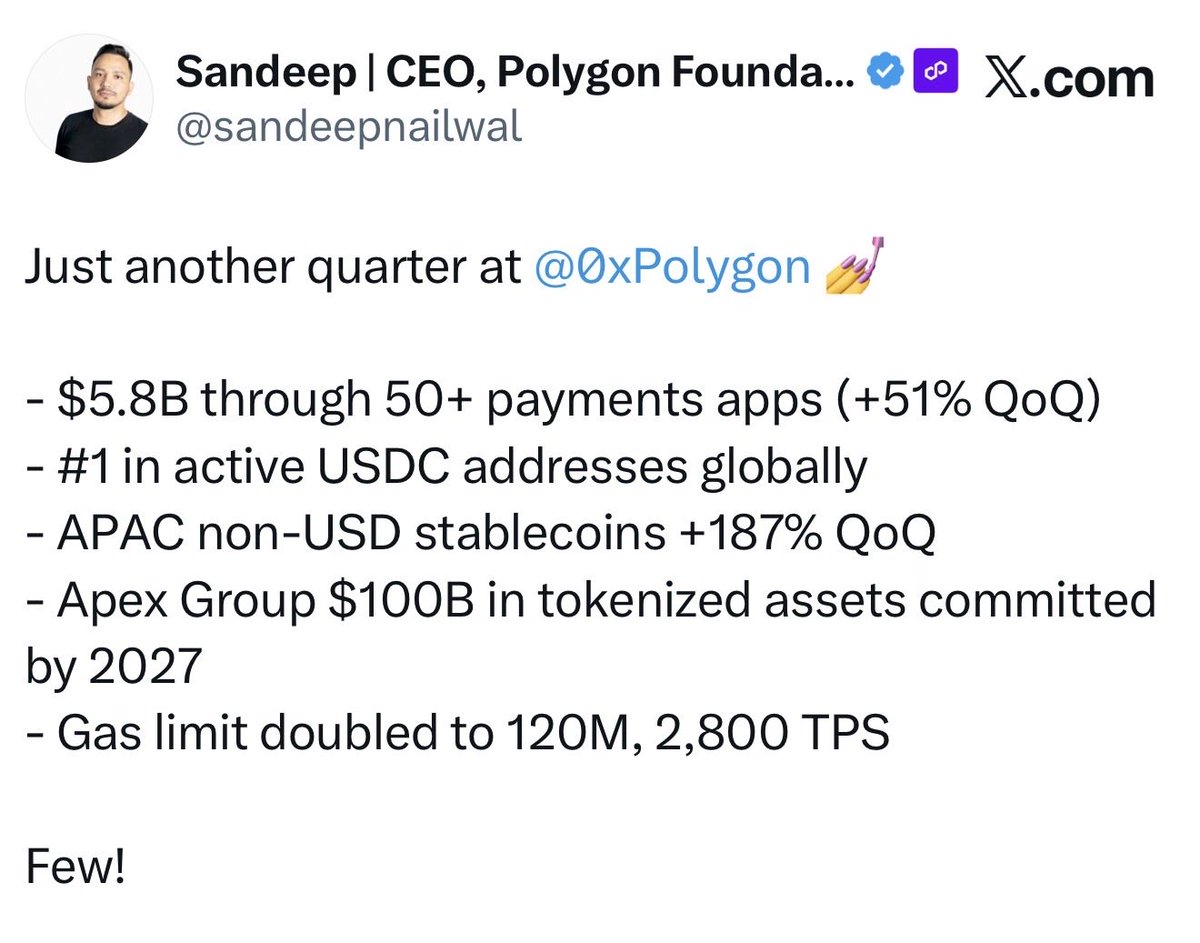
Just another quarter at @0xPolygon 📈
- $5.8B through 50 payments apps ( 51% QoQ)
- #1 in active USDC addresses globally
- APAC non-USD stablecoins 187% QoQ
- Apex Group $100B in tokenized assets committed by 2027
- Gas limit doubled to 120M, 2,800 TPS
Few understand! 💯
Cc: @sandeepnailwal
3
3
40
1,880
Matrix Stake retweeted

Just another quarter at @0xPolygon 💅
- $5.8B through 50 payments apps ( 51% QoQ)
- #1 in active USDC addresses globally
- APAC non-USD stablecoins 187% QoQ
- Apex Group $100B in tokenized assets committed by 2027
- Gas limit doubled to 120M, 2,800 TPS
Few!
May 7

State of @0xPolygon Q1 2026
Key Update: Polygon saw strong growth in payments and stablecoin activity in Q1, while Polymarket continued to anchor network usage and fee generation.
QoQ Metrics 📊
Transfer Volume ⬆️ 51.4% to $5.8B
Stablecoin Supply ⬆️ 21.3% to $3.55B
Transaction Fees ⬆️ 419.8% to $11.7M
Polymarket OI ⬆️ 32.4% to $463.1M
19
34
211
8,076
May 8
.@0xPolygon State of @0xPolygon Q1 2026 is here!
Cc: @MessariCrypto
Key Update: #Polygon saw strong growth in payments and stablecoin activity in Q1, while Polymarket continued to anchor network usage and fee generation.
QoQ Metrics 📊
🟪 Payments apps 51% QoQ ($5.8B)
🟪 Stablecoin supply 21% QoQ ($3.5B)
🟪 APAC non-USD stablecoins 187% QoQ
🟪 #1 in active USDC addresses globally
🟪 And more in the State of Polygon Q1 2026 Report
1
25
407
May 8
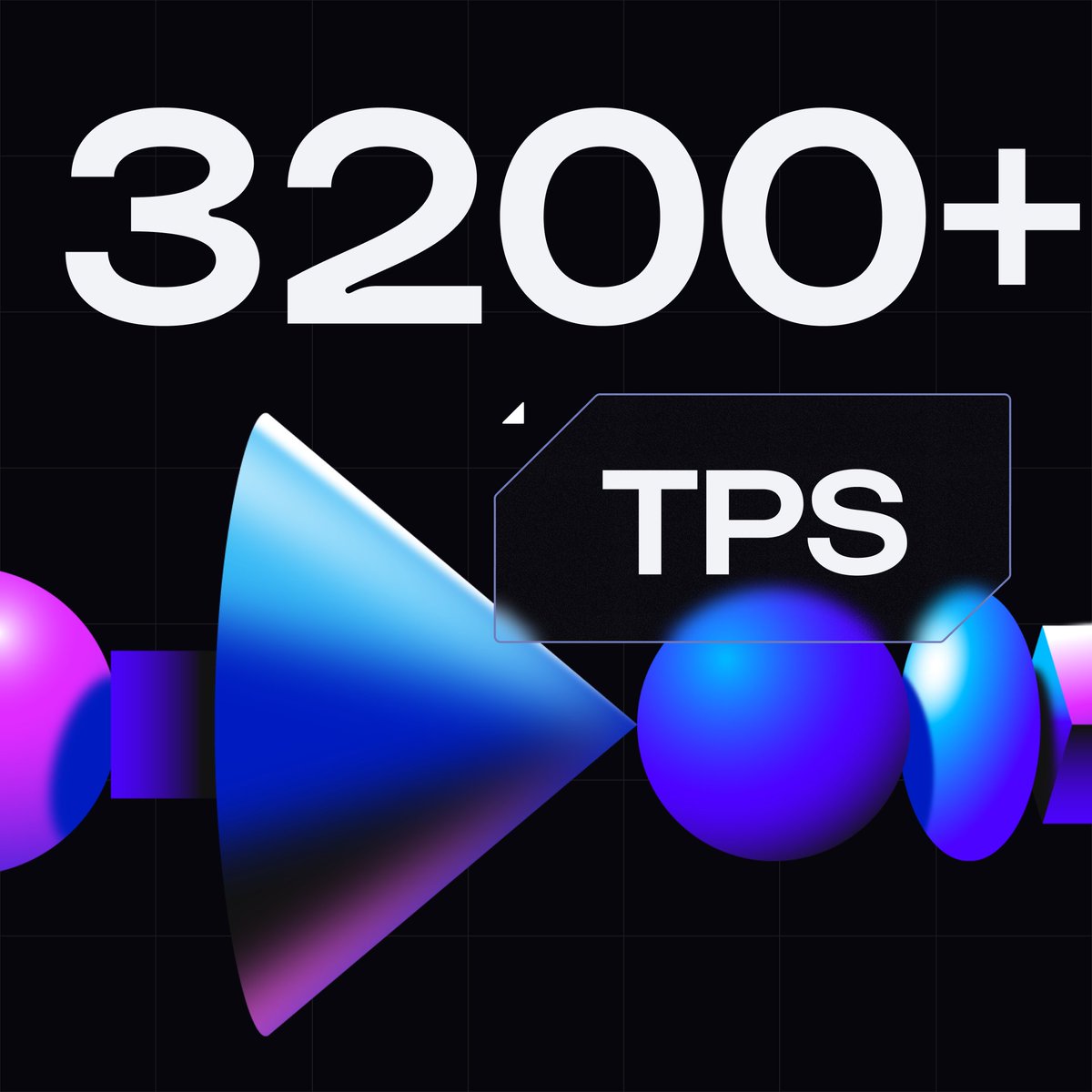
.@0xPolygon “is now pushing 3200 TPS, with 1.75-second blocks and sub 5-second finality.
This follows a 250ms reduction on block time.
14% more payments per second on the chain built for money movement”
Congratulations for the huge milestone 👏
1
2
12
132
May 8
.@0xPolygon “is now pushing 3200 TPS, with 1.75-second blocks and sub 5-second finality.
This follows a 250ms reduction on block time.
14% more payments per second on the chain built for money movement”
Congratulations for the huge milestone 👏
May 7

More payments. Every second.
Polygon is now pushing 3200 TPS, with 1.75-second blocks and sub 5-second finality. This follows a 250ms reduction on block time.
14% more payments per second on the chain built for money movement
3
20
336
May 7
.@0xPolygon “just shipped another upgrade to the chain.
Block time has decreased to 1.75s, making it the first reduction since genesis.
14% more payments per second, every second.
Every payment on #Polygon just got faster.”
Kudos to the team 👏
38
May 6
.@0xPolygon is at 2,800 TPS today with capacity for around 240M transactions a day.
#Polygon team is upgrading the network to hit payments grade throughput, the kind of scale $VISA operate at.
“When I talk about playing for the next order of magnitude that's literally what I mean.” - @sandeepnailwal 🙌
Kudos!
1
1
12
592
May 6
“Over $2.4T in stablecoin value has already settled on @0xPolygon and these is actual stablecoin volume transferred on the chain, not a forecast that stablecoin activity on the network grew 264% year over year through 2025, and in April 2026 alone the chain processed more than 577M stablecoin transactions. Right now by transaction activity we are number one chain for USD stablecoins globally with a total of $3.6B in stablecoins sitting on the network.” 👏

2
13
313
May 6
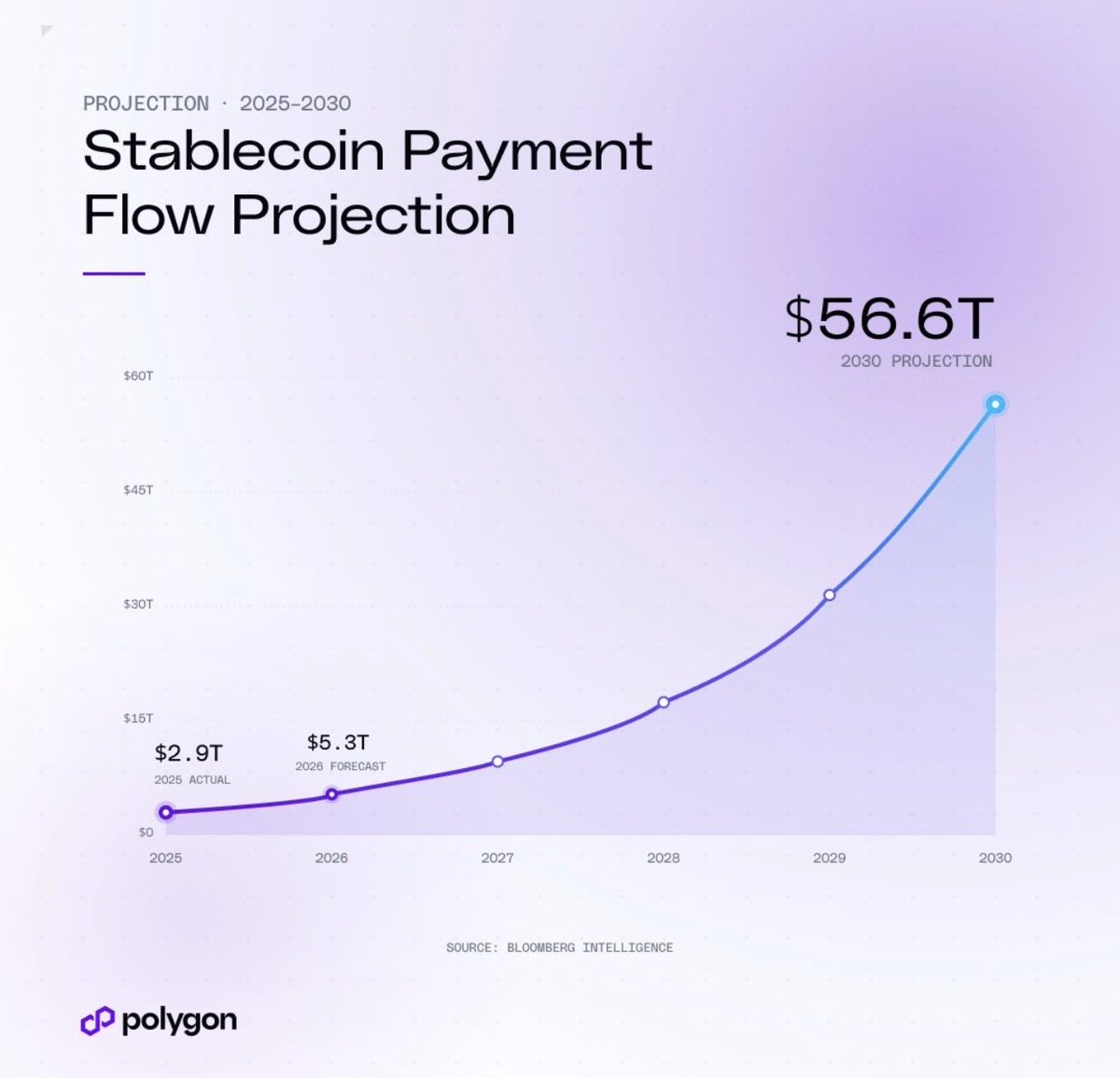
.@0xPolygon / @sandeepnailwal “Bloomberg projects stablecoin payment flows go from $2.9T in 2025 to $56.6T by 2030.
Stablecoin transactions on #Polygon grew 264% YoY through 2025, and in April 2026 alone we processed more than 577M! (source: @artemis)
In 5 years from now the numbers we are celebrating today will look like nothing. But they'll still be flowing on Polygon.” 🙌
44