
Chang Robotics is a Christ-centered engineering firm that designs, builds, and commissions Factory 5.0 automation for American manufacturing.
Joined May 2009
- Tweets 15,622
- Following 971
- Followers 9,689
- Likes 17,606
1,690 Photos and videos








Pinned Tweet

May 12
I build factories that bring manufacturing back to America. 🇺🇸
I've commissioned about 30 factories. Not PowerPoints about factories. Not tweets about factories. Actual factories, standing next to the owner when we press the button to turn them on.
Here's how we win:
13
34
349
17,945
Matthew Chang retweeted

Strong men ➡️ Good times

Here are a few of my strength / fitness posts. Note 30 reps of 135lbs bench @ 220 lbs 6’4”. Yes the pregnant wife clean and jerk is real.
SECWAR is a beast.
1
14
2,072
This has to be a @RobertMSterling burner account to go this hard after MS Teams.

Dear US government,
Since you've just blocked Fable and Mythos on critical national security grounds, here are some other tools that pose a similar threat to the American people:
- Microsoft Teams
- SAP
- Salesforce
- Jira
- Outlook
Please do what you must to save America 🇺🇸
7
977
Window, middle, aisle.
Now we see why simulation is so important to traffic, airplane loading, and yes, of course, FACTORIES AND INVENTORY.

Turns out there's a faster way to board an aircraft!
Someone should tag literally every airline and show them this.
📹: bad_science_jokes
2
2
19
2,063
Jun 13
Who else is getting in on the first round
Jun 13

5 axis VMC: $90K, Bandsaw: $6K, 3x 6DOF robots: $36K, Zeiss CMM: $35K, AMR: $30k, Form 4L & filament: $8K, deburr: $5K, parts wash: $5K, ZP gear: $60K, secret sauce stuff: $275K
Acquiring the goods for Next.Industries cell 1: ~$550K
Reindustrializing America: priceless
1
6
1,655
Jun 12
“One integrated system”
Launch
Communications
Energy
AI
This is the way
2
1
8
2,515
Jun 12
The AI designed my sky scraper - what could go wrong?
Jun 11

JEFF BEZOS JUST EMERGED FROM STEALTH WITH A $41 BILLION AI STARTUP CALLED PROMETHEUS
$12 billion raised. Valued at $41 billion. Coming out of stealth today.
The backers: Bezos personally, JPMorgan, BlackRock, Goldman Sachs, DST Global, and Arch Venture Partners.
The mission: do for engineering and manufacturing what large language models did for text.
Bezos is calling it an "artificial general engineer." Instead of training on words from the internet, Prometheus ingests data from the physical world to accelerate the manufacturing of skyscrapers, smartphones, jet engines, and everything in between.
In Bezos' own words: "Something that today was going to take 100 engineers 10 years to build, if you can change that to taking 10 engineers one year to build, you're just going to get way more things built."
This is Bezos' first CEO role since stepping down from Amazon in 2021. He's co-leading it with Vik Bajaj, former Google X executive.
(Source Semafor)

4
10
2,991
Jun 12
And code officials have not yet seen AI slop.
Some PE is going to have to sign off on AI generated designs.
3
1
4
336
Jun 12
I’m guessing there’s no real product liability.
If the building settles, cracks, or collapses - who owns the liability?
Will design firm professional liability insurers cover the AI design?
1
3
165
Matthew Chang retweeted

Jun 12
Our robotic sewing technology was invented in America. Our machines are built in America. Anatar, America’s Textile Prime.
Jun 11

542,000 industrial robots were installed in factories last year. Nearly half the new US ones went into auto plants.
Almost none of them were built here.
We picture AI as something on our screens. And yet the version reshaping the most jobs in the US is the one showing up on the factory floor.
6
16
254
14,079
Jun 12
Me and lil man tried the concrete jumping thing. 3x 1 minutes and my legs were toast!

Let’s be honest…
Even Fit people can’t Jump Barefoot on Concrete Repetitively for long durations.
Their knees would buckle.
They lack the Foundation.
Totally skipped Foundational work because that’s what everybody does.
Straight into the gym, straight into weakness.
1
11
7,298
Matthew Chang retweeted

Jun 11
Another great episode with @MatthewChang yesterday! We may need @kaiarhodes to make some new shirts though


The ReForge Podcast EP 018 x.com/i/broadcasts/1yxBeebgX…
2
2
8
1,466
Jun 11
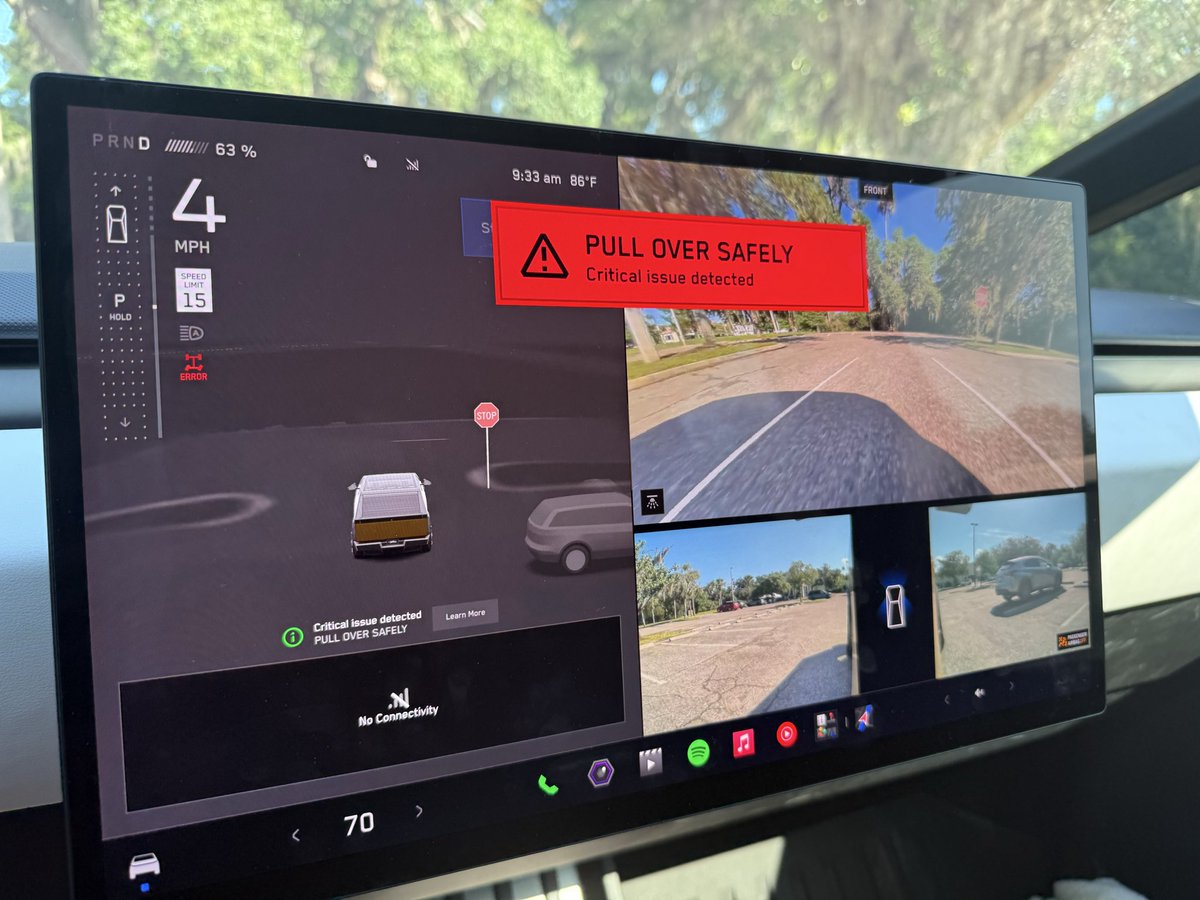
Public Service Announcement:
You CAN drive your Cybertruck thru a river.
BUT the Cybertruck may get mad at you.
7
415
Jun 11
OEE - overall equipment effectiveness
I break down how factory ai has a real chance at increasing throughput of existing plants.
Only on @thereforgepod
1
4
10
460
Matthew Chang retweeted

Jun 11
I totally agree with this. I’m 4 years into my nuclear engineering journey and although I have learned an insane amount, the guys with 10 years of experience around me are crazy smart.
1
2
4
448
Jun 11
Dads, you have no idea what they took from us.

2
794
Jun 10
Consider this the DM. See you there 🫡
Jun 10

I will be at Reindustrialize next week with my cofounder
Anyone that wants to meet while were there, send me a DM
1
15
1,270
Jun 10
It takes 15 years to make a good engineer.
Knowledge management systems needed severely in engineering. The whole industry is understaffed.
Timeline:
1) high school grads must choose engineering
2) 4-5 years college
3) 5 years as apprentice, then PE
4) 5 years working in the trade
15 years… and that’s if you’re good.
@ThaaatColin @BrianRoemmele
Jun 10

Engineering Wednesday
The other great replacement is upon us.
Companies did not adapt.
I am constantly looking and applying because I love making stuff and have no intention of ever retiring. After your CEO and CFO quit in the same week, you start to wonder if it is time to ramp things up. So my search is hitting a new tempo.
Here is what I am seeing that almost nobody is talking about.
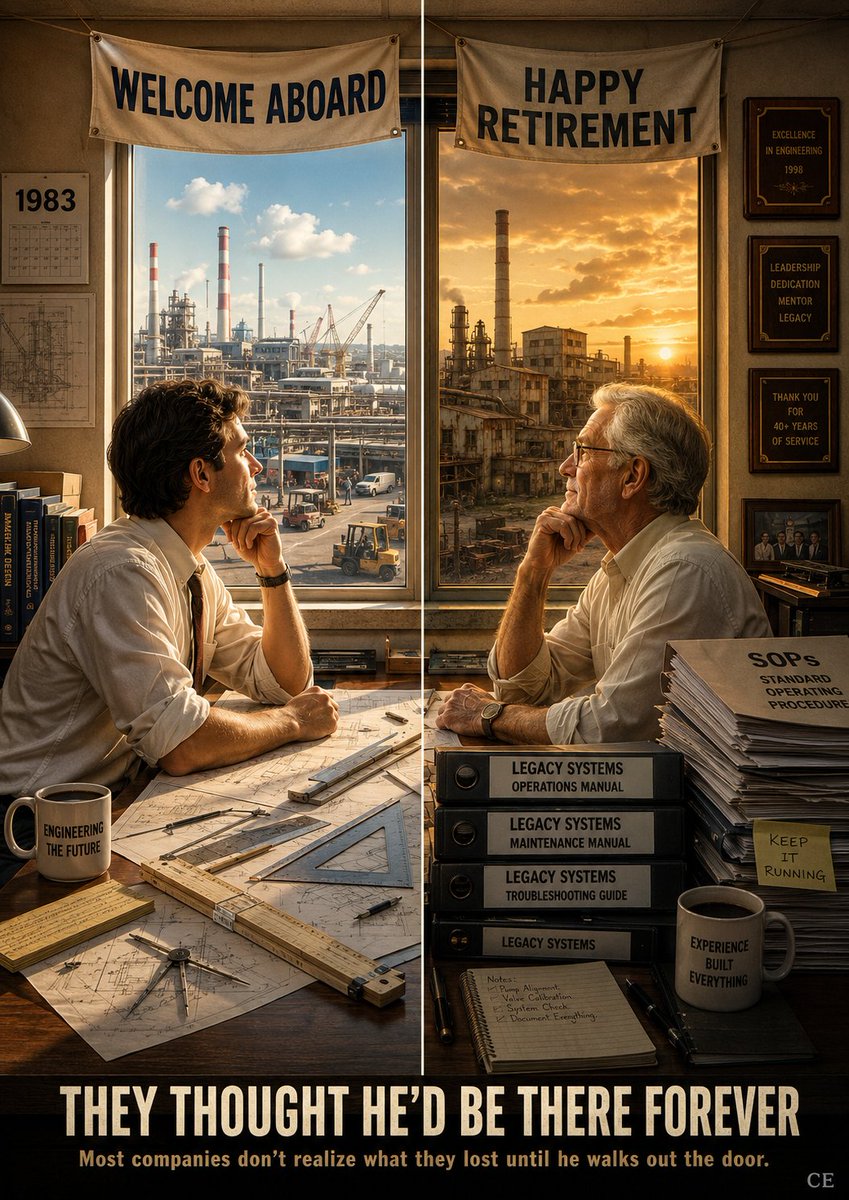
So many companies thought their 40-year keystone employee was going to live forever and work forever at the same pay they gave him when he bought his house decades ago. They assumed if that person ever left, they would just slide in another loyal soul willing to do the same for the next 40 years.
That world is gone.
The new reality is brutal. Average job tenure in tech is now around 2.5 years. Even in more stable industries it is pushing 4 years at best. HR folks and managers tell me I am wrong here. Tell us how difficult it is getting.
The fact is the culture changed.
People move. Loyalty is no longer assumed on either side.
Technical Directors are in a special class. These are not just managers. They are the ones who direct. They carry deep business knowledge, technical mastery, financial understanding, customer relationships, regulatory insight, and the undocumented history that keeps everything running.
If they get it wrong, people can actually get hurt or die in the industries I work in. Regardless, directors are critical to the success of an organization.
Replacing that depth is incredibly hard.
In the past month I have had several interviews where the story is the same. A guy who was there 30, 40, even 55 years (this morning) is finally stepping out. The company suddenly realizes they have no real succession plan, no documentation, no automation, and no one who knows all the legacy systems, customers, and industry jargon the way he did. In some cases the offboarding retiree developed a great database...that nobody knows how to use.
One shock for companies is... They are not going to get another replacement for a 40-year guy at the pay they are offering. The technical skillset is obviously at the top end for there to be a replacement.
That era is over.
The reasonable answer is honest succession planning.
I have stepped into roles where my job was to archive everything the long-term person knew, automate what could be automated, write the SOPs, policies, and procedures that were never written, and then either train the next team or run the role while documenting it all.
That transition work is valuable.
It saves lives and protects institutional knowledge.
But most companies did not plan for this. They just assumed the old model would last forever.
People who started in the 70s and 80s expected to stay at one company for decades if they did good work. In engineering, especially in engineering - you see people stay a decade or two past retirement.
At no point in their life were they raised to think they would work for an employer that hires to retire. Even if you wanted to, I would still be working in the best job I ever had with Siemens- but the spinoffs, IPO, merger and PE song and dance has made that expectation delusional for employers.
After this, like many others I found myself in the 3 year spin as I was recruited by think tanks, tech developers, and others who might have had 5 year roadmaps but appetite for only a 3 year tech execution. Face it in 3 yrs everything you started on could be obsolete.
Because of this- today the average person expects to move. We would see that 30 yr keystone player but they were unlikely to move and unlikely to want to. Everyone else landed in a job ready to pull stakes because nothing was permanent anymore.
Companies expect the same from new hires- they should be disposable. Warm body in place - nothing kills innovation faster btw.
Both sides stopped investing in the long game.
This mismatch is creating real pain right now, especially in technical leadership roles.
We need to get much better at succession, documentation, and knowledge transfer. Especially since there is no indication that most companies are focusing on retention.
The days of one person carrying the entire system in their head for 40 years are ending. AI is not the answer either. AI will, with confidence, drive the bus off the cliff because data and reality are not the same.
The companies that figure this out and treat tribal knowledge as real institutional capital will have a massive advantage.
HR - ensure your manager understands the position they are filling isn't just that keystone employee, its the person that can make succession seamless.
The ones that do not will keep getting surprised when their keystone people walk out the door.
Question for folks willing to speak up:
Have you seen companies get caught flat-footed when long-term technical people finally retired?
Drop what you observed.
7
3
22
2,982