
Evernest CEO & SFR Investor | 9x Inc 5,000 | Passionate about people & business building | Follow me for lessons learned growing a team from 3 to 500 .
Joined March 2024
- Tweets 177
- Following 161
- Followers 41
- Likes 604
6 Photos and videos
Pinned Tweet

Jan 31
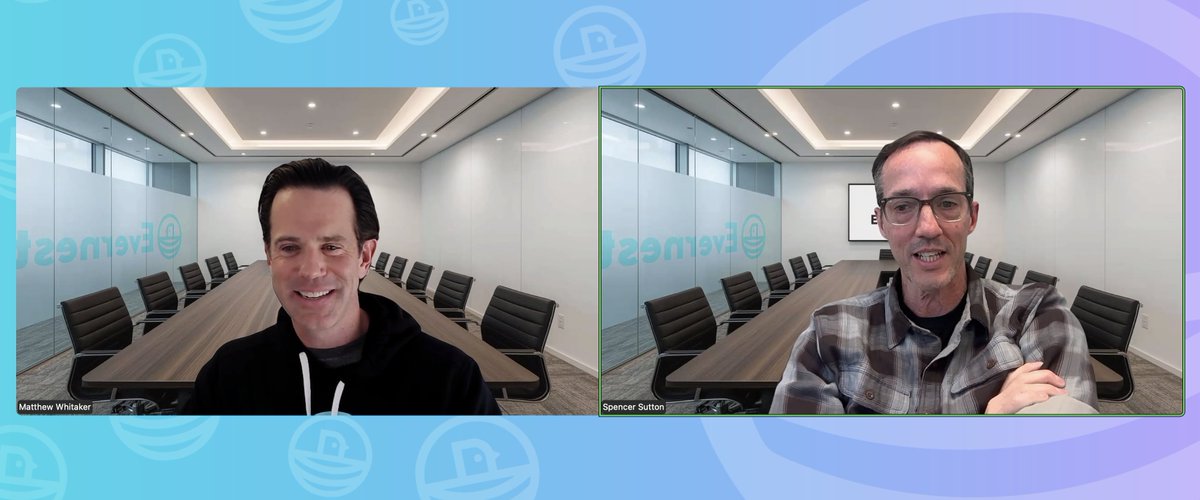
Enjoyed hanging out with @pslohmann on his podcast recently.
Inside Evernest’s 20,000-Door Playbook with Matthew Whitaker | Peter Loh... youtu.be/zOjNpHFH_cE?si=bjko… via @YouTube

2
262
Jun 14
People are absolutely losing their minds about Elon Musk becoming the first trillionaire. For many the default setting is that the money could be better spent somewhere else. That post is for another time though. I want to steel man the case for why we should celebrate this accomplishment.
Before we get started, you need to do something most Americans (even me) struggle to do. See people through a nuanced lense versus putting them completely in a “bad” or “good” bucket. Everyone is a human being with traits to be admired and flaws we can learn from. To write them off completely misses the beauty of the traits we should admire.
First, Elon is an immigrant. He came to America during his college years. He worked hard, started a number of businesses and succeeded. He’s almost gone bankrupt multiple times. America is literally the only country he could have done something like this. If for no other reason, if you’re an American you should cheer that this is happening here. The American Dream still lives.
Second, he’s created more commercial value than any other human being in history. Doing it once MAY be luck. To be CEO of a list of successful companies is mind boggling. He’s driven down the cost of launching payload to space many times over, given countless poor countries and remote areas access to internet, built battery powered self driving cars in factories filled with American workers, implanted chips into people’s brains that makes the disabled able again and run a successful media company where he allows everyone to have a voice, even if they disagree with him. No single person has created so much commercial value in the history of humanity.
And third, you don’t have to look too far into the future to see the seeds have been planted where we become a multi planetary species, poor people are lifted out of poverty through cheap access to internet, our children never have to deal with the death of a friend or family member from a traffic accident, quadriplegics walk and whole dictatorships are torn down from the power of access to information.
Last thought, if we were drafting CEOs and you (any of you) had the first pick for a CEO that would run the company to feed your family, 10/10 of you would choose Elon. Not to teach Sunday School, not to take your daughter out on a date, to lead a business.
It makes sense to me that he is the richest person in the world. What do you think?

66
Matthew Whitaker retweeted

May 18
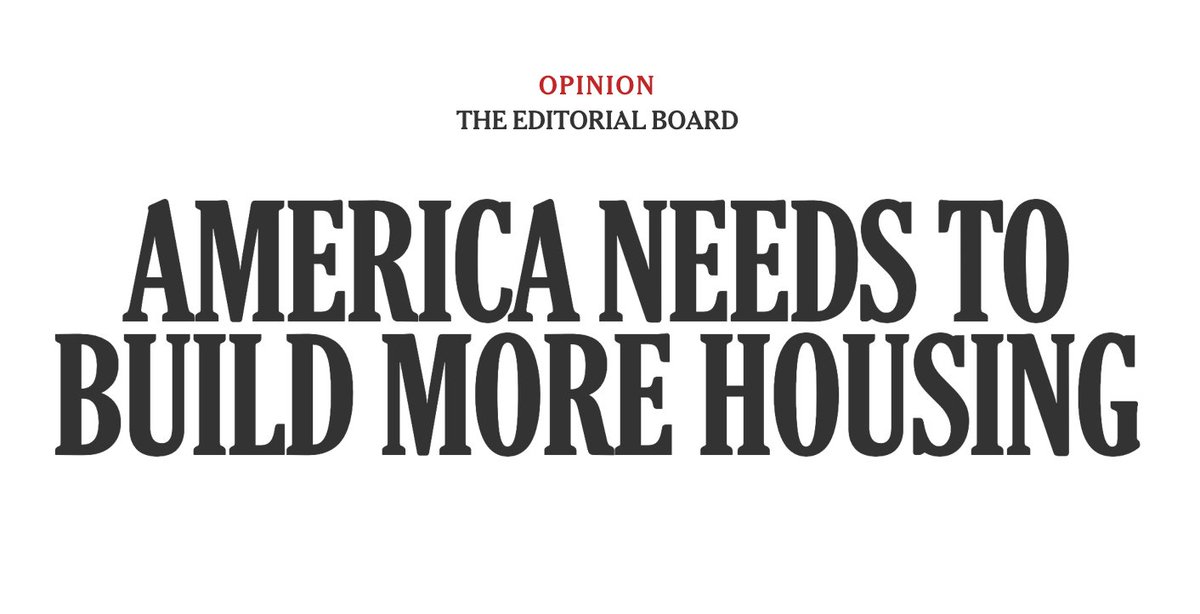
What every voter and apparently, the NY Times Editorial Board, should know about housing policy:
1. Rents reflect the balance of supply of apartments and demand for those apartments in a given area. That’s it; there’s no magic. If you want lower rents, you can hope for a recession that destroys jobs and, therefore, demand. Or you can add supply.
2. There is no amount of money that any big city government could feasibly spend that would add materially to supply. This is because, depending on the location, new apartments cost $250,000-1,000,000 to develop… building even a few hundred of those starts to stress any city budget, and many big cities need tens or hundreds of thousands.
3. On the other hand, investors (including pension funds and endowments, insurance companies, rich families, etc.) can collectively **easily** provide enough capital to build as much housing as we need **so long as they are confident they can get a reasonable return**.
To get those investors to fund the creation of the housing our society needs, we must do two things:
1. Dramatically reduce the time & complexity associated with securing governmental permission to develop housing. This means reviewing and simplifying the overlapping regulations that constrain housing production: zoning codes, building codes, parking, ADA, etc. But it also means changing the cultures within the relevant governmental agencies from “default no” to “how can we help you?”.
2. Provide certainty around on-going regulation of apartment operations.
The way investors get a return from building rentals is as follows: They hire managers to lease the apartments, collect the rents, pay operating expenses and any mortgage payments, and then send the investors the cashflow that remains.
But governments all over the country have been restricting the manner in which apartment buildings can be operated in all kinds of ways.
For example: Cities have been making it harder to screen tenants, while also making it much harder to evict tenants who don’t pay. You can see why both of those measures are politically popular. After all, who doesn’t want people to get second chances? And who wants anyone to get evicted? But, as a manager, the combination of those two regulations makes it much harder to predict, with any certainty, that the rent will get paid… and that makes it very difficult to get investors to provide capital to create more housing.
Another example: Rent control. Again, I understand why renters love rent control and why politicians want to give it to them. But, if, as has been the case in NY, LA and San Francisco, city governments hold annual rent increases below the rate of growth in the operating expenses of the buildings, the cashflow payable to the investors shrinks… making them much less likely to invest capital in building more apartments.
In conclusion: For ~every other good or service in the economy, we allow the market to function, and the result is that we have a surplus of choice at all price points (think of food or clothes or cars), which is spectacular for the consumer. If we want a surplus of choice at all price points in housing, we need to get comfortable with the idea of allowing the market to provide it.
And that means allowing investors to build rental apartments *and* allowing them to operate those apartments in a manner consistent with making a reasonable profit.
Remember: Every developer of rentals is either a landlord-in-waiting or hoping to sell to one.
74
137
969
160,694
Matthew Whitaker retweeted
May 9
Regular readers know I started a company called ReSeed with an incredible group of co-founders ~3 yrs ago to identify, train, mentor and capitalize emerging real estate operators across the country.
One of those operators, a husband-and-wife team in the Midwest, just closed their 3rd deal with us, taking them above $30MM of capital deployed and taking ReSeed above $130MM deployed across the platform.
Pretty amazing, for what was just a new idea in my partner Rhett's head not too long ago.
-
If you are an operator or passive investor and would like to learn more about ReSeed, please visit reseedpartners.com
11
4
189
14,784
Mar 27
If you build supply, then prices for housing come down. It’s a tale as old as time. Seen most recently in Austin. Elizabeth Warren is either playing games are really dumb.
Mar 27

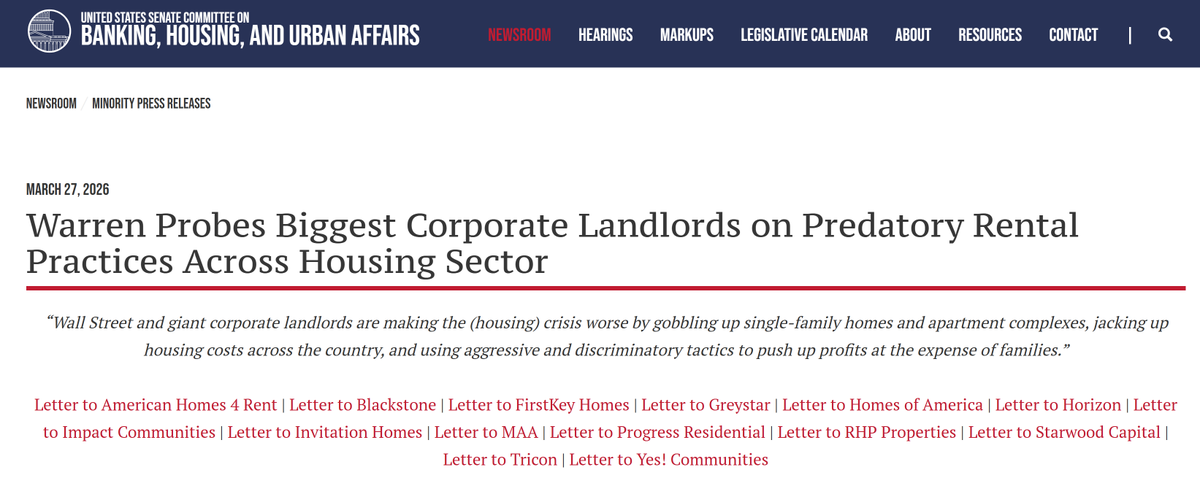
This is wild. Senator Warren is now threatening apartment developers and investors, too, with a letter chock-full of misinformation.
Such threats can scare off development capital, and they just shift to building warehouses or something else. But America's renters become collateral damage, with less supply and higher rents.
This letter fails to note:
1) The role of these groups in adding new housing supply.
2) That America's affordability crisis is concentrated among lower-income renters -- very few of whom live in the properties owned by these groups receiving letters. They generally serve renters making $75k and spending 15-25% of income on rent.
3) It also falsely says large investors own 3% of single-family homes, which isn't true. It's 3% of single-family RENTAL homes, but only 0.5% of the total number of single-family homes.
We gotta do better than this and start putting the focus on addressing the real issue: We need to build more housing of all types.
57
Matthew Whitaker retweeted

Schatz says on the Senate floor "there is a problem" with the housing bill.
"There was an original idea to go after hedge fund ownership of housing. ... There is also a section that does a very bizarre thing, which is ... anybody who owns and rents out more than 350 units ... must sell."
20
61
679
430,062
Matthew Whitaker retweeted

Mar 9
Pretty much every serious housing analyst and economist is opposing the ROAD to Housing [Inflation] Bill.
Yet the National Association of Realtors is cheering for a bill that would take housing away from people who can't afford to buy houses. 🤡

12
10
104
8,508
How to Sell (or Buy) a Property Management Company in 2026: Our 9-Step P... youtu.be/YAq_TB9p3Cc?si=T4Vl… via @YouTube
21
Headed in the right direction . . .
Feb 5

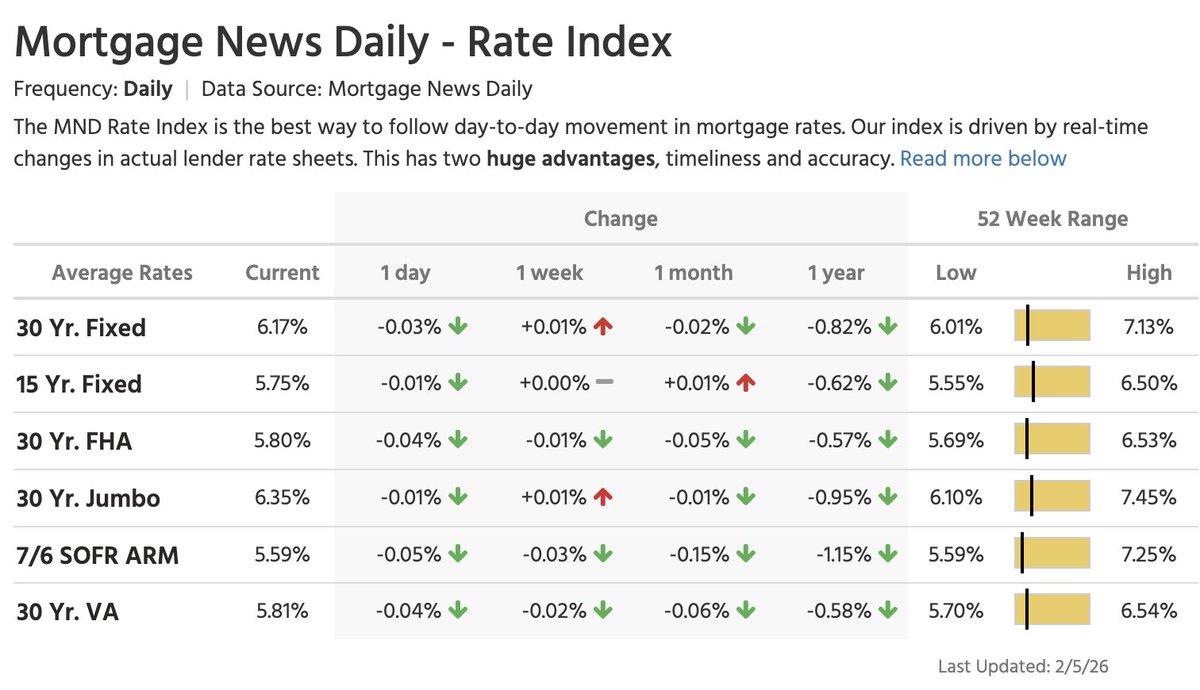
The average 30-year fixed mortgage rate today: 6.17%
Same day last year: 6.99%
----------------------
10-year Treasury yield: 4.21
Spread today: 196 bps
1
77
Matthew Whitaker retweeted

Feb 5
The average 30-year fixed mortgage rate today: 6.17%
Same day last year: 6.99%
----------------------
10-year Treasury yield: 4.21
Spread today: 196 bps
3
11
67
5,460
At Evernest we have an unlimited PTO policy for anyone who is not hourly. That's right, you can take as much sick time or vacation as you need. I used to tell people, "If you're sick, don't come in!" or "if you need a vacation, take one!"
I always hated it when someone would come up to me and ask if they can have time off. It felt like in elementary school when you had to ask to go to the bathroom (in Alabama we didn't call it a "bio-break"). I always thought it was so weird to have an adult ask me for time off for some reason.
I decided, if I have to worry about how much vacation or sick time you're taking, then that means you aren't the right person. I found that if I hired the right people, they respected the fact that they had a job to do. And I didn't need to worry about pointless things like PTO.
I know many of you have seen some data that suggests that people take less time off with unlimited PTO. I don't know if that is true here at Evernest, but it's not the reason for the policy. I also don't know how someone can count their hours in today's work environment.
Bottom line, if you treat people like adults, then they act like adults.
If you treat them like adults and they act like children, then they probably weren't good for your team anyway.
1
25
Jan 31
One of the biggest misconceptions people have about work is . . . if it is hard, it must be bad. I think it's because so many successful people talk about "never working a day in their life." The disconnect is that these successful people have learned to enjoy the hard work. It is not because their days lack any of it.
I read this article this morning and laughed out loud a half dozen times. Any of you who ever had a hard athletic coach will appreciate the article. As I got to the very end, I realized why these guys put themselves and others through the grueling workouts.
The truth is doing hard things builds confidence. When people lack confidence they do dumb things in search of meaning and self worth. Why do you rob a convenience store? Maybe for the money . . . but most likely to make your friends respect you.
People at work are no different. We find meaning in different ways. We can find meaning by being the company pessimist. We can find meaning in being the company gossip.
The most successful organizations prefer to find meaning in doing really hard work together. Pushing past the limits anyone thought possible. They embrace the grind of hard work because they know that's where the true joy in work lies - accomplishing something really hard that others thought impossible.
One thing that stood out to me in the article is the author sets two personal records in the middle of the workout (traditionally you would set records after a brief warmup while you are still fresh). He was pushed to set them by the main character "Unc".
As leaders, we have a duty to see more in our people than they see in themselves. We have to pull more out of them than they ever thought possible. We have to believe things about them that they never believed about themselves.
If we do, some will rise to the occasion. Set personal records in the midst of hard work. Take their career further than they ever thought possible. All the while, bringing the companies we lead along with them.
THAT'S what leaders do and THAT'S why they are so important.
And if your job is hard . . . good.
I hope you enjoy this article as much as I did.
espn.com/espn/story/_/id/477…
23
Jan 30
Super pumped to see Evernest team member Christine Belin highlight her Denver market wisdom in this article.
keycrew.co/journal/denvers-i…
44
Jan 30
Life on autopilot. I was going to do a whole new workout routine starting today. So busy at work that I just did my old workout routine at lunch. Just realized it.
Your brain really does want to work on autopilot.
17
Jan 30
One of my favorite Jeff Bezos quotes is, "The best customer service is if the customer doesn't need to call you, doesn't need to talk to you. It just works." I often ask groups I'm speaking to, "Do you think Amazon has great customer service?" Inevitably, almost everyone, nods their head, "Yes."
I ask them, "Have you ever called Amazon's customer service department?" A few have . . . but way more people haven't.
The reality is that Amazon has great customer service because they deliver on expectations - not because they smile when they answer the phone.
In fact, to keep you from calling, they get out ahead of communication when things aren't going to meet your expectations. I'm sure all of us have received that email notification.
The one time I did call Amazon's customer service, I told them I ordered something that said in the app it arrived, but it hadn't. Without asking another question (assuming the lady saw how much money I spend on the site) she apologized and immediately sent another one! Her goal was to solve the problem as quickly as possible and get me off the phone - she knew all I wanted was for it to "just work" - to get what I ordered.
Property management is exactly like this. All the owner, resident, vendor wants is for it just to work. The owner rarely wants to talk to us as long as things are moving through the pipes as expected. The same for the resident. They expect us to get out ahead of communication when things aren't going as planned.
One of Bezos's heroes is Sam Walton. He was notorious for handing out Walton's autobiography he finished right before he died, Made in America (also one of my all time favorite books).
What both men realized is that to be competitor focused was focusing on the wrong thing. To be customer obsessed produced much better outcomes. They were maniacal about keeping the main thing the main thing.
What's interesting about Bezos is that he is so customer obsessed that he realizes the customer doesn't want customer service. What the customer wants is to order something and have it arrive on time, every time.
When you think about property management (or your business through this lens) it leads me to be maniacal about creating an experience for our owners, residents and vendors that just works.
22
Jan 30
If you aren't willing to get massive amounts of bad news, don't start and grow a company.
15
Jan 27
Some people say, when things go wrong, you made a bad decision. They’ll say the inverse is also true, when things go right, you made a good decision.
While, these are highly correlated it's a fallacy to think they are exact.
1
38
Jan 27
Dan Sullivan has a principle he likes to teach called, "work less, make more". This has proven to be a challenge for me. As a founder of Evernest I've always prided myself on being in the trenches with the team. Early in the organization I would go from riding around Birmingham leasing houses, to chatting with an owner about a maintenance issue, to posting rents into AppFolio.
As the organization has grown, I still have that urge to get to the office and prove to everyone that I'm working as hard as they are. It's a hard mindset to break. And to be fair, that attitude drove a lot of our success to this point.
But now the organization is 500 people. I can still go out to show houses, call an owner or post rents; but none of these make a dent in the work to be done in today's Evernest.
Jeff Bezos said on a podcast once, that if he wakes up every day and makes three good decisions, that is a great day. That's over 750 good decisions in a year!
But he needs the bandwidth to make those good decisions. If he was still packing boxes or doing customer calls, he wouldn't have the energy to make those good decisions due to decision fatigue.
This is one reason it is so hard to go from a founder to leading a huge organization. Because each step requires something different from the last. You have to leave parts of you behind to become the next leader the organization needs. Leaving the parts that made you succesfull feels dangerous.
I think at some point, people stop changing. They don't want to become the next person they need to be so the organization can grow. It's too dangerous or they become content with where they've gotten to.
For me, I want to take the next step. "Work less, make more." Recognize leverage and the power of a clear mind.
It's what Evernest needs from me today.
2
62
Jan 25
Allysia Finley could have not nailed this any more. @AllysiaFinley shares facts around Wall Street being the scapegoat for lack of government policies helping provide housing.
wsj.com/opinion/scott-bessen…
1
50